Innovating, sustaining and embedding TEL (Technology Enhanced Learning)  Peter BullenEmeritus ProfessorUniversity of HertfordshireUniversity of Ulster -9th annual elearning conference; 20th January 2011
My experienceOpportunities and challengesUniversity of Hertfordshire and The Blended Learning UnitSector activity in this area -  JISC and HEA programmes. Why this topic?
Influenced byPersonal experience in industry and educationColleagues, Educationalists and others, e.g.:John Seddon – Systems thinkingW Edwards Deming – Understanding and managing organisationsTaiichiOhno – Toyota production SystemPeter Senge – Learning organisationsRalph Stacey – Managing complexityAnne Miller – Getting ideas adoptedInitial involvement with e-learning from the mid 1990sMy experience
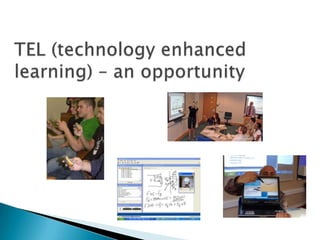
TEL (technology enhanced learning) – an opportunity
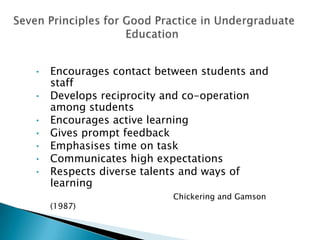
   Seven Principles for Good Practice in Undergraduate                                   EducationEncourages contact between students and staff
Develops reciprocity and co-operation among students
Encourages active learning
Gives prompt feedback
Emphasises time on task
Communicates high expectations
Respects diverse talents and ways of learning Chickering and Gamson (1987)
StudyNet (University of Hertfordshire’s MLE) Respects diverse talents and ways of learningDevelops reciprocity and collaboration Encourages contact between students and staffWeekly Assessed Tutorial Sheets (WATS)Emphasises time on taskEncourages active learningGives prompt feedbackPeer assessment of laboratory reportsCommunicates high expectationsGives prompt feedbackJust-in-time teachingIWB to encourage collaborative learningOn-line tutorial using ElluminateAn example - A first year engineering modulee-contentblendedlearning
TEL (technology enhanced learning) – challenges
SectorInstitutionDisciplineIndividualStaffStudentsOther stakeholdersand – technology!Challenges
Teachers conference 1703:“Students today can’t prepare bark to calculate their problems. They depend on their slates which are more expensive. What will they do when the slate is dropped and it breaks? They will be unable to write!”Scepticism about technology Martin Bean keynote at ALT-C 2009www.alt.ac.uk/alt2009/keynotes.html
Principal’s publication, 1815: “Students today depend on paper too much. They don’t know how to write on a slate without getting chalk dust all over themselves. They can’t clean a slate properly. What will they do when they run out of paper?”
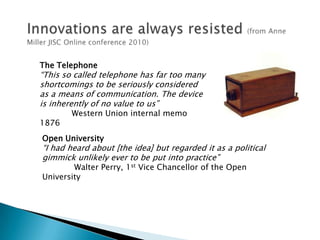
Innovations are always resisted (from Anne Miller JISC Online conference 2010)The Telephone“This so called telephone has far too many shortcomings to be seriously considered as a means of communication. The device is inherently of no value to us”	Western Union internal memo 1876Open University“I had heard about [the idea] but regarded it as a political gimmick unlikely ever to be put into practice”	Walter Perry, 1st Vice Chancellor of the Open University
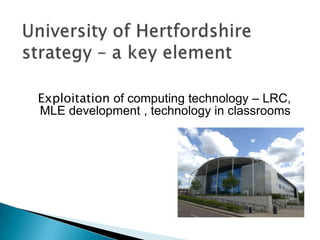
University of Hertfordshire  strategy – a key elementExploitationof computing technology – LRC, MLE development , technology in classrooms
A network of StudyNet ChampionsFaculty appointmentsMembers of the StudyNet development group and the StudyNet learning and teaching development groupInnovation in Learning and TeachingLTDF fundA D.I.Y. philosophy not D.I.F.M.
Small core groupBlended learning teachers (on average 12, overall 26 different people)Key points:All practitioners All enthusiastic about the use of technologyRepresented 17 different disciplines from all FacultiesContacts (networks) at all levelsBlended Learning Unit (a CETL 2005 -2010) - Who we are?
Blended Learning Unit – what we do.   We develop, promote and evaluate the combination of established ways of Learning and Teaching and the opportunities offered by technology in order to improve students’ learning and increase flexibility in how, when and where they study
What we do:Minimising barriersBL innovation  & developmentEvaluationDissemination (communications and engagement)
Infrastructure and availability of technologyAcademic staffActualities and perceptionsMinimising barriers
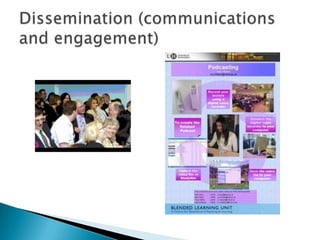
Dissemination (communications and engagement)
 DisseminationTransformation (Changing practice)Changing the emphasisBenchmarking e-learning
CABLE (Change Academy for Blended learning Enhancement)
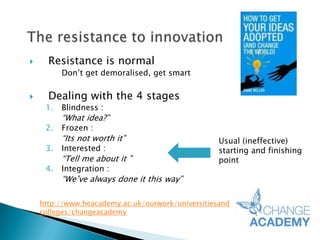
Usual (ineffective) starting and finishing pointThe resistance to innovation Resistance is normalDon’t get demoralised, get smartDealing with the 4 stagesBlindness :   “What idea?”Frozen :   “Its not worth it”Interested : “Tell me about it ”Integration :  “We’ve always done it this way”http://www.heacademy.ac.uk/ourwork/universitiesandcolleges/changeacademy
CABLE – Change Academy for Blended Learning EnhancementDevelop effective teams across disciplines
A focus on needs of the participating                        Schools
Academic-led
Student involvement

Peter bullen

  • 1.
    Innovating, sustaining andembedding TEL (Technology Enhanced Learning) Peter BullenEmeritus ProfessorUniversity of HertfordshireUniversity of Ulster -9th annual elearning conference; 20th January 2011
  • 2.
    My experienceOpportunities andchallengesUniversity of Hertfordshire and The Blended Learning UnitSector activity in this area - JISC and HEA programmes. Why this topic?
  • 3.
    Influenced byPersonal experiencein industry and educationColleagues, Educationalists and others, e.g.:John Seddon – Systems thinkingW Edwards Deming – Understanding and managing organisationsTaiichiOhno – Toyota production SystemPeter Senge – Learning organisationsRalph Stacey – Managing complexityAnne Miller – Getting ideas adoptedInitial involvement with e-learning from the mid 1990sMy experience
  • 4.
    TEL (technology enhancedlearning) – an opportunity
  • 5.
    Seven Principles for Good Practice in Undergraduate EducationEncourages contact between students and staff
  • 6.
    Develops reciprocity andco-operation among students
  • 7.
  • 8.
  • 9.
  • 10.
  • 11.
    Respects diverse talentsand ways of learning Chickering and Gamson (1987)
  • 12.
    StudyNet (University ofHertfordshire’s MLE) Respects diverse talents and ways of learningDevelops reciprocity and collaboration Encourages contact between students and staffWeekly Assessed Tutorial Sheets (WATS)Emphasises time on taskEncourages active learningGives prompt feedbackPeer assessment of laboratory reportsCommunicates high expectationsGives prompt feedbackJust-in-time teachingIWB to encourage collaborative learningOn-line tutorial using ElluminateAn example - A first year engineering modulee-contentblendedlearning
  • 13.
    TEL (technology enhancedlearning) – challenges
  • 14.
  • 15.
    Teachers conference 1703:“Studentstoday can’t prepare bark to calculate their problems. They depend on their slates which are more expensive. What will they do when the slate is dropped and it breaks? They will be unable to write!”Scepticism about technology Martin Bean keynote at ALT-C 2009www.alt.ac.uk/alt2009/keynotes.html
  • 16.
    Principal’s publication, 1815:“Students today depend on paper too much. They don’t know how to write on a slate without getting chalk dust all over themselves. They can’t clean a slate properly. What will they do when they run out of paper?”
  • 17.
    Innovations are alwaysresisted (from Anne Miller JISC Online conference 2010)The Telephone“This so called telephone has far too many shortcomings to be seriously considered as a means of communication. The device is inherently of no value to us” Western Union internal memo 1876Open University“I had heard about [the idea] but regarded it as a political gimmick unlikely ever to be put into practice” Walter Perry, 1st Vice Chancellor of the Open University
  • 18.
    University of Hertfordshire strategy – a key elementExploitationof computing technology – LRC, MLE development , technology in classrooms
  • 20.
    A network ofStudyNet ChampionsFaculty appointmentsMembers of the StudyNet development group and the StudyNet learning and teaching development groupInnovation in Learning and TeachingLTDF fundA D.I.Y. philosophy not D.I.F.M.
  • 21.
    Small core groupBlendedlearning teachers (on average 12, overall 26 different people)Key points:All practitioners All enthusiastic about the use of technologyRepresented 17 different disciplines from all FacultiesContacts (networks) at all levelsBlended Learning Unit (a CETL 2005 -2010) - Who we are?
  • 22.
    Blended Learning Unit– what we do. We develop, promote and evaluate the combination of established ways of Learning and Teaching and the opportunities offered by technology in order to improve students’ learning and increase flexibility in how, when and where they study
  • 23.
    What we do:MinimisingbarriersBL innovation & developmentEvaluationDissemination (communications and engagement)
  • 24.
    Infrastructure and availabilityof technologyAcademic staffActualities and perceptionsMinimising barriers
  • 25.
  • 26.
    DisseminationTransformation (Changingpractice)Changing the emphasisBenchmarking e-learning
  • 27.
    CABLE (Change Academyfor Blended learning Enhancement)
  • 28.
    Usual (ineffective) startingand finishing pointThe resistance to innovation Resistance is normalDon’t get demoralised, get smartDealing with the 4 stagesBlindness : “What idea?”Frozen : “Its not worth it”Interested : “Tell me about it ”Integration : “We’ve always done it this way”http://www.heacademy.ac.uk/ourwork/universitiesandcolleges/changeacademy
  • 29.
    CABLE – ChangeAcademy for Blended Learning EnhancementDevelop effective teams across disciplines
  • 30.
    A focus onneeds of the participating Schools
  • 31.
  • 32.