1
Exploratory Data Analysis
Kathirmani Sukumar
Data Scientist @ Gramener
How do I start doing analysis?
2
Exploratory Data Analysis might help
you…!!!
3
CASE STUDIES
4
DETECTING FRAUD
“
We know meter readings are
incorrect, for various reasons.
We don’t, however, have the
concrete proof we need to start
the process of meter reading
automation.
Part of our problem is the
volume of data that needs to be
analysed. The other is the
inexperience in tools or
analyses to identify such
patterns.
ENERGY UTILITY
5
AN ENERGY UTILITY DETECTED BILLING FRAUD
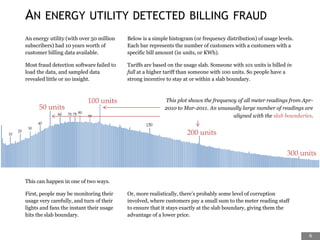
This plot shows the frequency of all meter readings from Apr-
2010 to Mar-2011. An unusually large number of readings are
aligned with the slab boundaries.
Below is a simple histogram (or frequency distribution) of usage levels.
Each bar represents the number of customers with a customers with a
specific bill amount (in units, or KWh).
Tariffs are based on the usage slab. Someone with 101 units is billed in
full at a higher tariff than someone with 100 units. So people have a
strong incentive to stay at or within a slab boundary.
An energy utility (with over 50 million
subscribers) had 10 years worth of
customer billing data available.
Most fraud detection software failed to
load the data, and sampled data
revealed little or no insight.
This can happen in one of two ways.
First, people may be monitoring their
usage very carefully, and turn of their
lights and fans the instant their usage
hits the slab boundary.
Or, more realistically, there’s probably some level of corruption
involved, where customers pay a small sum to the meter reading staff
to ensure that it stays exactly at the slab boundary, giving them the
advantage of a lower price.
6
PREDICTING MARKS
“
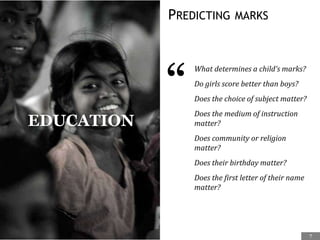
What determines a child’s marks?
Do girls score better than boys?
Does the choice of subject matter?
Does the medium of instruction
matter?
Does community or religion
matter?
Does their birthday matter?
Does the first letter of their name
matter?
EDUCATION
7
TN CLASS X: ENGLISH
0
5,000
10,000
15,000
20,000
25,000
30,000
35,000
40,000
0 5 10 15 20 25 30 35 40 45 50 55 60 65 70 75 80 85 90 95 100 8
TN CLASS X: SOCIAL SCIENCE
0
5,000
10,000
15,000
20,000
25,000
30,000
35,000
40,000
0 5 10 15 20 25 30 35 40 45 50 55 60 65 70 75 80 85 90 95 100 9
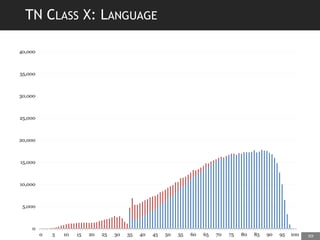
TN CLASS X: LANGUAGE
0
5,000
10,000
15,000
20,000
25,000
30,000
35,000
40,000
0 5 10 15 20 25 30 35 40 45 50 55 60 65 70 75 80 85 90 95 100 10
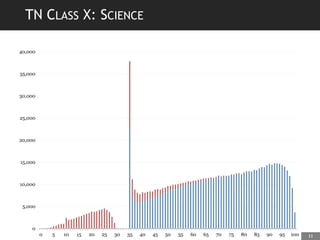
TN CLASS X: SCIENCE
0
5,000
10,000
15,000
20,000
25,000
30,000
35,000
40,000
0 5 10 15 20 25 30 35 40 45 50 55 60 65 70 75 80 85 90 95 100 11
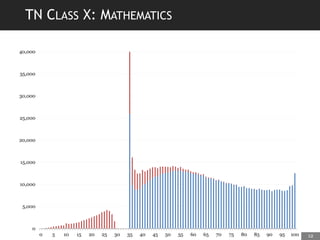
TN CLASS X: MATHEMATICS
0
5,000
10,000
15,000
20,000
25,000
30,000
35,000
40,000
0 5 10 15 20 25 30 35 40 45 50 55 60 65 70 75 80 85 90 95 100 12
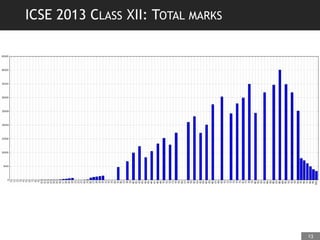
ICSE 2013 CLASS XII: TOTAL MARKS
13
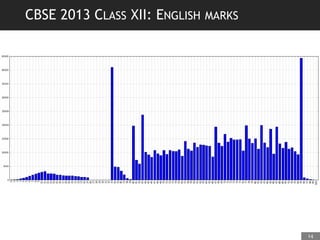
CBSE 2013 CLASS XII: ENGLISH MARKS
14
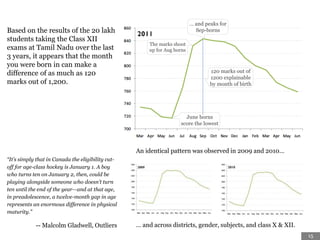
Based on the results of the 20 lakh
students taking the Class XII
exams at Tamil Nadu over the last
3 years, it appears that the month
you were born in can make a
difference of as much as 120
marks out of 1,200.
June borns
score the lowest
The marks shoot
up for Aug borns
… and peaks for
Sep-borns
120 marks out of
1200 explainable
by month of birth
An identical pattern was observed in 2009 and 2010…
… and across districts, gender, subjects, and class X & XII.
“It’s simply that in Canada the eligibility cut-
off for age-class hockey is January 1. A boy
who turns ten on January 2, then, could be
playing alongside someone who doesn’t turn
ten until the end of the year—and at that age,
in preadolescence, a twelve-month gap in age
represents an enormous difference in physical
maturity.”
-- Malcolm Gladwell, Outliers
15
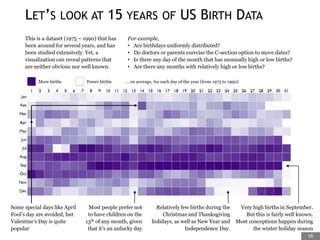
This is a dataset (1975 – 1990) that has
been around for several years, and has
been studied extensively. Yet, a
visualization can reveal patterns that
are neither obvious nor well known.
For example,
• Are birthdays uniformly distributed?
• Do doctors or parents exercise the C-section option to move dates?
• Is there any day of the month that has unusually high or low births?
• Are there any months with relatively high or low births?
Very high births in September.
But this is fairly well known.
Most conceptions happen during
the winter holiday season
Relatively few births during the
Christmas and Thanksgiving
holidays, as well as New Year and
Independence Day.
Most people prefer not
to have children on the
13th of any month, given
that it’s an unlucky day
Some special days like April
Fool’s day are avoided, but
Valentine’s Day is quite
popular
More births Fewer births … on average, for each day of the year (from 1975 to 1990)
LET’S LOOK AT 15 YEARS OF US BIRTH DATA
16
THE PATTERN IN INDIA IS QUITE DIFFERENT
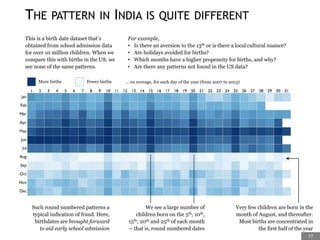
This is a birth date dataset that’s
obtained from school admission data
for over 10 million children. When we
compare this with births in the US, we
see none of the same patterns.
For example,
• Is there an aversion to the 13th or is there a local cultural nuance?
• Are holidays avoided for births?
• Which months have a higher propensity for births, and why?
• Are there any patterns not found in the US data?
Very few children are born in the
month of August, and thereafter.
Most births are concentrated in
the first half of the year
We see a large number of
children born on the 5th, 10th,
15th, 20th and 25th of each month
– that is, round numbered dates
Such round numbered patterns a
typical indication of fraud. Here,
birthdates are brought forward
to aid early school admission
More births Fewer births … on average, for each day of the year (from 2007 to 2013)
17
EDA PROCESS
UNDERSTAND DERIVE QUESTION INTERACT
 Identify
Relevant data &
sources
 Map Context
 Prepare
Metadata
 Label & Clean
data
 New Metrics
from business
 Metrics from
Patterns
(Binning,
comparison,
Ratios,
Attributes,
Transformation)
 Stakeholder
inputs who
would benefit
from the
analysis
 Based on
patterns(top
groups by a
metric,
maximise a
metric,
bivariate
relationships)
 Filter by a
group value
 Compare
against a
value or a
derived
metric
 Sort by a
dimension
LIVE DEMO
19
THANK YOU
20
Reaching out…
21
Kathirmani Sukumar
Email: kathir.mani@gramener.com
Twitter: @skathirmani
LinkedIn: https://in.linkedin.com/in/skathirmani

Exploratory data analysis

  • 1.
    1 Exploratory Data Analysis KathirmaniSukumar Data Scientist @ Gramener
  • 2.
    How do Istart doing analysis? 2
  • 3.
    Exploratory Data Analysismight help you…!!! 3
  • 4.
  • 5.
    DETECTING FRAUD “ We knowmeter readings are incorrect, for various reasons. We don’t, however, have the concrete proof we need to start the process of meter reading automation. Part of our problem is the volume of data that needs to be analysed. The other is the inexperience in tools or analyses to identify such patterns. ENERGY UTILITY 5
  • 6.
    AN ENERGY UTILITYDETECTED BILLING FRAUD This plot shows the frequency of all meter readings from Apr- 2010 to Mar-2011. An unusually large number of readings are aligned with the slab boundaries. Below is a simple histogram (or frequency distribution) of usage levels. Each bar represents the number of customers with a customers with a specific bill amount (in units, or KWh). Tariffs are based on the usage slab. Someone with 101 units is billed in full at a higher tariff than someone with 100 units. So people have a strong incentive to stay at or within a slab boundary. An energy utility (with over 50 million subscribers) had 10 years worth of customer billing data available. Most fraud detection software failed to load the data, and sampled data revealed little or no insight. This can happen in one of two ways. First, people may be monitoring their usage very carefully, and turn of their lights and fans the instant their usage hits the slab boundary. Or, more realistically, there’s probably some level of corruption involved, where customers pay a small sum to the meter reading staff to ensure that it stays exactly at the slab boundary, giving them the advantage of a lower price. 6
  • 7.
    PREDICTING MARKS “ What determinesa child’s marks? Do girls score better than boys? Does the choice of subject matter? Does the medium of instruction matter? Does community or religion matter? Does their birthday matter? Does the first letter of their name matter? EDUCATION 7
  • 8.
    TN CLASS X:ENGLISH 0 5,000 10,000 15,000 20,000 25,000 30,000 35,000 40,000 0 5 10 15 20 25 30 35 40 45 50 55 60 65 70 75 80 85 90 95 100 8
  • 9.
    TN CLASS X:SOCIAL SCIENCE 0 5,000 10,000 15,000 20,000 25,000 30,000 35,000 40,000 0 5 10 15 20 25 30 35 40 45 50 55 60 65 70 75 80 85 90 95 100 9
  • 10.
    TN CLASS X:LANGUAGE 0 5,000 10,000 15,000 20,000 25,000 30,000 35,000 40,000 0 5 10 15 20 25 30 35 40 45 50 55 60 65 70 75 80 85 90 95 100 10
  • 11.
    TN CLASS X:SCIENCE 0 5,000 10,000 15,000 20,000 25,000 30,000 35,000 40,000 0 5 10 15 20 25 30 35 40 45 50 55 60 65 70 75 80 85 90 95 100 11
  • 12.
    TN CLASS X:MATHEMATICS 0 5,000 10,000 15,000 20,000 25,000 30,000 35,000 40,000 0 5 10 15 20 25 30 35 40 45 50 55 60 65 70 75 80 85 90 95 100 12
  • 13.
    ICSE 2013 CLASSXII: TOTAL MARKS 13
  • 14.
    CBSE 2013 CLASSXII: ENGLISH MARKS 14
  • 15.
    Based on theresults of the 20 lakh students taking the Class XII exams at Tamil Nadu over the last 3 years, it appears that the month you were born in can make a difference of as much as 120 marks out of 1,200. June borns score the lowest The marks shoot up for Aug borns … and peaks for Sep-borns 120 marks out of 1200 explainable by month of birth An identical pattern was observed in 2009 and 2010… … and across districts, gender, subjects, and class X & XII. “It’s simply that in Canada the eligibility cut- off for age-class hockey is January 1. A boy who turns ten on January 2, then, could be playing alongside someone who doesn’t turn ten until the end of the year—and at that age, in preadolescence, a twelve-month gap in age represents an enormous difference in physical maturity.” -- Malcolm Gladwell, Outliers 15
  • 16.
    This is adataset (1975 – 1990) that has been around for several years, and has been studied extensively. Yet, a visualization can reveal patterns that are neither obvious nor well known. For example, • Are birthdays uniformly distributed? • Do doctors or parents exercise the C-section option to move dates? • Is there any day of the month that has unusually high or low births? • Are there any months with relatively high or low births? Very high births in September. But this is fairly well known. Most conceptions happen during the winter holiday season Relatively few births during the Christmas and Thanksgiving holidays, as well as New Year and Independence Day. Most people prefer not to have children on the 13th of any month, given that it’s an unlucky day Some special days like April Fool’s day are avoided, but Valentine’s Day is quite popular More births Fewer births … on average, for each day of the year (from 1975 to 1990) LET’S LOOK AT 15 YEARS OF US BIRTH DATA 16
  • 17.
    THE PATTERN ININDIA IS QUITE DIFFERENT This is a birth date dataset that’s obtained from school admission data for over 10 million children. When we compare this with births in the US, we see none of the same patterns. For example, • Is there an aversion to the 13th or is there a local cultural nuance? • Are holidays avoided for births? • Which months have a higher propensity for births, and why? • Are there any patterns not found in the US data? Very few children are born in the month of August, and thereafter. Most births are concentrated in the first half of the year We see a large number of children born on the 5th, 10th, 15th, 20th and 25th of each month – that is, round numbered dates Such round numbered patterns a typical indication of fraud. Here, birthdates are brought forward to aid early school admission More births Fewer births … on average, for each day of the year (from 2007 to 2013) 17
  • 18.
    EDA PROCESS UNDERSTAND DERIVEQUESTION INTERACT  Identify Relevant data & sources  Map Context  Prepare Metadata  Label & Clean data  New Metrics from business  Metrics from Patterns (Binning, comparison, Ratios, Attributes, Transformation)  Stakeholder inputs who would benefit from the analysis  Based on patterns(top groups by a metric, maximise a metric, bivariate relationships)  Filter by a group value  Compare against a value or a derived metric  Sort by a dimension
  • 19.
  • 20.
  • 21.
    Reaching out… 21 Kathirmani Sukumar Email:kathir.mani@gramener.com Twitter: @skathirmani LinkedIn: https://in.linkedin.com/in/skathirmani