B.Sc.(Ag.) Final Year
J. N. Agriculture University, Jabalpur
College of Agriculture, Tikamgarh (M.P.)
Image: NASA 2005
GOVARDHAN LODHA
AKASH SONKUSALE
SUBMITTED TO :-
Dr. M. L. Kewat
Associate Professor
PRESENTED BY :-
Slides
• Introduction
• GIS Operations
• How does GIS work?
• Types of data
• Data Representation
• Working with GIS
• An overview of GIS Image
What is GIS?
1
Geographic Information System
• Geographic – 80% of government data collected is associated
with some location in space
• Information - attributes, or the
characteristics (data), can be used to symbolize and provide
further insight into a given location
• System – a seamless operation linking the information to the
geography – which requires hardware, networks, software,
data, and operational procedures
…not just software!
…not just for making maps!
• Many More to Come…
 Environmental impact assessment
 Resource management
 Land use planning
 Tax Mapping
 Water and Sanitation Mapping
 Transportation routing
 And many more ...
GIS Operations -
How does a GIS work?
• GIS data has a spatial/geographic
reference
 This might be a reference that describes a
feature on the earth using:
• a latitude & longitude
• a national coordinate system
• an address
• a district
• a wetland identifier
• a road name
Types of data
 Two types of data are stored for each item in the
database
• 1. Attribute data:
 Says what a feature is
• Eg. statistics, text, images, sound, etc.
• 2. Spatial data:
 Says where the feature is
 This also of two types -
1. Vector data
2. Raster data:
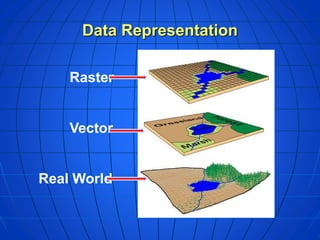
Types of Spatial data
Raster
Vector
Real World
Data Representation
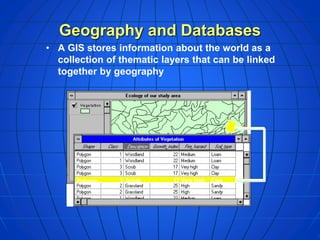
• A GIS stores information about the world as a
collection of thematic layers that can be linked
together by geography
Polygon 3 Scrub 17 Very high Clay
Geography and Databases
GIS provides Data Integration
Vectors
Topology
Networks
Terrain
Surveys
Images
CAD
Drawings
Annotation
Addresses
27 Main St.
Attributes
ABC
107’
3D Objects
Dimensions
• Roads
• Land Parcels
• Population
• Utilities
• Land Mines
• Hospitals
• Refugee Camps
• Wells
• Sanitation
Data formation in GIS
 Capturing data
 Scanning: all of map converted into raster data
 Digitising: individual features selected from map as
points, lines or polygons
 Geo-referencing
 Initial scanning digitising gives co-ordinates in inches
from bottom left corner of digitiser/scanner
 Real-world co-ordinates are found for few
registration points on the captured data
 These are used to convert the entire map onto a
real-world co-ordinate system
Generate Image of Real world -
An overview of a GIS 3D image -
Thank You !

Lodha govardhan

  • 1.
    B.Sc.(Ag.) Final Year J.N. Agriculture University, Jabalpur College of Agriculture, Tikamgarh (M.P.)
  • 2.
    Image: NASA 2005 GOVARDHANLODHA AKASH SONKUSALE SUBMITTED TO :- Dr. M. L. Kewat Associate Professor PRESENTED BY :-
  • 3.
    Slides • Introduction • GISOperations • How does GIS work? • Types of data • Data Representation • Working with GIS • An overview of GIS Image
  • 4.
  • 5.
    Geographic Information System •Geographic – 80% of government data collected is associated with some location in space • Information - attributes, or the characteristics (data), can be used to symbolize and provide further insight into a given location • System – a seamless operation linking the information to the geography – which requires hardware, networks, software, data, and operational procedures …not just software! …not just for making maps!
  • 6.
    • Many Moreto Come…  Environmental impact assessment  Resource management  Land use planning  Tax Mapping  Water and Sanitation Mapping  Transportation routing  And many more ... GIS Operations -
  • 7.
    How does aGIS work? • GIS data has a spatial/geographic reference  This might be a reference that describes a feature on the earth using: • a latitude & longitude • a national coordinate system • an address • a district • a wetland identifier • a road name
  • 8.
    Types of data Two types of data are stored for each item in the database • 1. Attribute data:  Says what a feature is • Eg. statistics, text, images, sound, etc. • 2. Spatial data:  Says where the feature is  This also of two types - 1. Vector data 2. Raster data:
  • 9.
  • 10.
  • 11.
    • A GISstores information about the world as a collection of thematic layers that can be linked together by geography Polygon 3 Scrub 17 Very high Clay Geography and Databases
  • 12.
    GIS provides DataIntegration Vectors Topology Networks Terrain Surveys Images CAD Drawings Annotation Addresses 27 Main St. Attributes ABC 107’ 3D Objects Dimensions • Roads • Land Parcels • Population • Utilities • Land Mines • Hospitals • Refugee Camps • Wells • Sanitation
  • 14.
    Data formation inGIS  Capturing data  Scanning: all of map converted into raster data  Digitising: individual features selected from map as points, lines or polygons  Geo-referencing  Initial scanning digitising gives co-ordinates in inches from bottom left corner of digitiser/scanner  Real-world co-ordinates are found for few registration points on the captured data  These are used to convert the entire map onto a real-world co-ordinate system
  • 15.
    Generate Image ofReal world -
  • 16.
    An overview ofa GIS 3D image -
  • 18.