Introduction to
Geographic Information
Systems (GIS)
:Ashwini.S
Flying Blind
Jul 24th 2003
The Economist
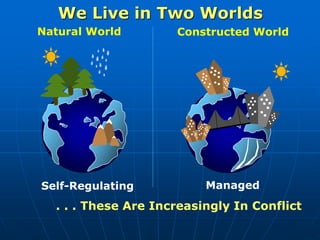
We Live in Two Worlds
Self-Regulating Managed
Natural World Constructed World
. . . These Are Increasingly In Conflict
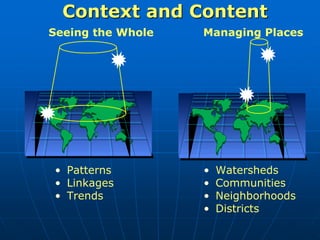
• Watersheds
• Communities
• Neighborhoods
• Districts
Context and Content
• Patterns
• Linkages
• Trends
Seeing the Whole Managing Places
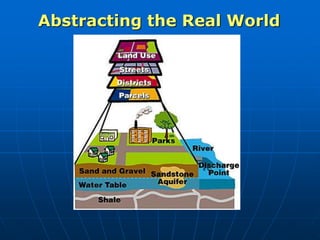
Abstracting the Real World
What is GIS?
• A Geographic Information System
(GIS) is a computer-based system
including software, hardware, people,
and geographic information
• A GIS can:
 create, edit, query, analyze, and display
map information on the computer
Geographic Information System
• Geographic – 80% of government data collected is
associated with some location in space
• Information - attributes, or the
characteristics (data), can be used to symbolize and
provide further insight into a given location
• System – a seamless operation linking the
information to the geography – which requires
hardware, networks, software, data, and operational
procedures
…not just software!
…not just for making maps!
Who uses GIS?
• International organizations
 UN HABITAT, The World Bank, UNEP, FAO, WHO,
etc.
• Private industry
 Transport, Real Estate, Insurance, etc.
• Government
 Ministries of Environment, Housing, Agriculture,
etc.
 Local Authorities, Cities, Municipalities, etc.
 Provincial Agencies for Planning, Parks,
Transportation, etc.
• Non-profit organizations/NGO’s
 World Resources Institute, ICMA, etc.
• Academic and Research Institutions
 Smithsonian Institution, CIESIN, etc.
• The possibilities are unlimited…
 Environmental impact assessment
 Resource management
 Land use planning
 Tax Mapping
 Water and Sanitation Mapping
 Transportation routing
 and more ...
What can you do with a GIS?
How does a GIS work?
• GIS data has a spatial/geographic
reference
 This might be a reference that
describes a feature on the earth using:
• a latitude & longitude
• a national coordinate system
• an address
• a district
• a wetland identifier
• a road name
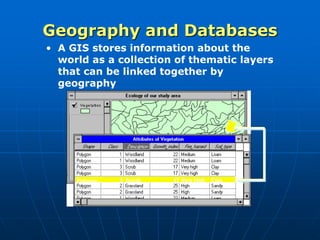
• A GIS stores information about the
world as a collection of thematic layers
that can be linked together by
geography
Polygon 3 Scrub 17 Very high Clay
Geography and Databases
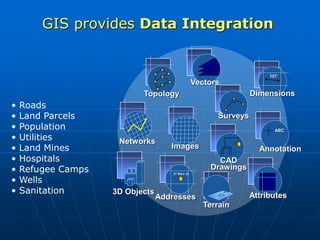
GIS provides Data Integration
Vectors
Topology
Networks
Terrain
Surveys
Images
CAD
Drawings
Annotation
Addresses
27 Main St.
Attributes
ABC
107’
3D Objects
Dimensions
• Roads
• Land Parcels
• Population
• Utilities
• Land Mines
• Hospitals
• Refugee Camps
• Wells
• Sanitation
Two fundamental types of data
• Vector
 A series of x,y coordinates
 For discrete data represented as points, lines,
polygons
• Raster
 Grid and cells
 For continuous data such as elevation, slope,
surfaces
• A Desktop GIS should be able to handle both
types of data effectively!
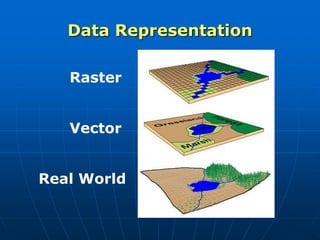
Raster
Vector
Real World
Data Representation
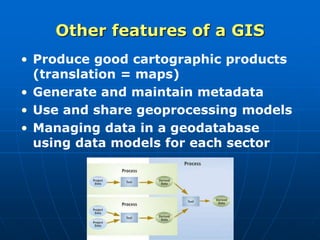
Other features of a GIS
• Produce good cartographic products
(translation = maps)
• Generate and maintain metadata
• Use and share geoprocessing models
• Managing data in a geodatabase
using data models for each sector
Hint – having GIS software does
not a cartographer make!
• Good to know something about
these issues when creating a
map and doing spatial analysis…
 Scale/Resolution
 Projection
 Basic cartographic principles
regarding design, generalization,
etc.
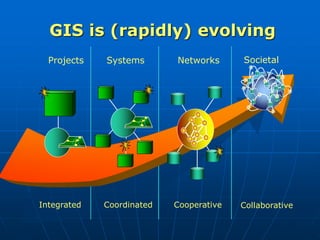
GIS is (rapidly) evolving
Projects Systems Networks
Integrated Coordinated Cooperative
Societal
Collaborative
Spatial Data Infrastructure
(SDI)
• Definition - the technology, policies,
standards, human resources, and
related activities necessary to
acquire, process, distribute, use,
maintain, and preserve spatial data
• Part of many nation’s e-Gov strategy
• www.GSDI.org
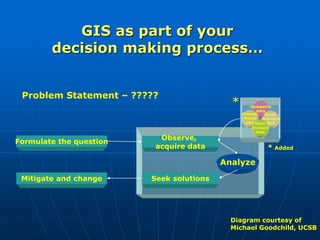
Problem Statement – ?????
*
Formulate the question
Mitigate and change Seek solutions
Observe,
acquire data
Analyze
Diagram courtesy of
Michael Goodchild, UCSB
Geospatial
data
Socio-
Economic
data
Ground-
Based
dataOther
Ancillary
data
* Added
GIS as part of your
decision making process…
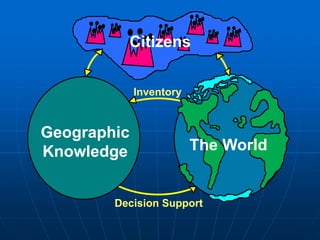
The World
Geographic
Knowledge
Citizens
Inventory
Decision Support
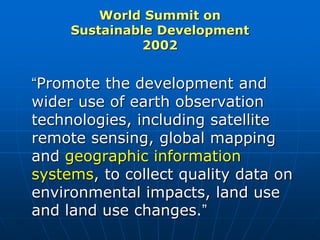
World Summit on
Sustainable Development
2002
“Promote the development and
wider use of earth observation
technologies, including satellite
remote sensing, global mapping
and geographic information
systems, to collect quality data on
environmental impacts, land use
and land use changes.”
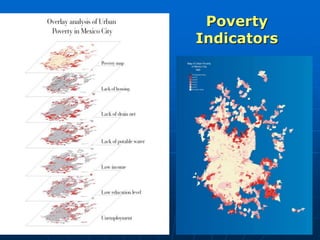
Poverty
Indicators
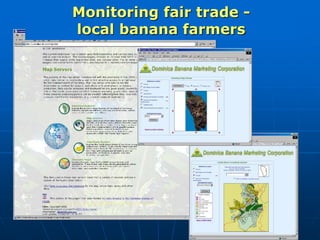
Monitoring fair trade -
local banana farmers
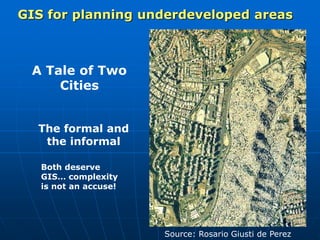
A Tale of Two
Cities
The formal and
the informal
Both deserve
GIS… complexity
is not an accuse!
GIS for planning underdeveloped areas
Source: Rosario Giusti de Perez
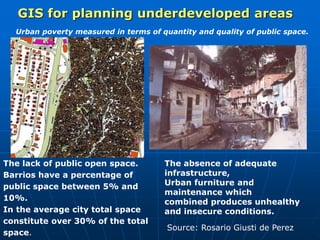
The lack of public open space.
Barrios have a percentage of
public space between 5% and
10%.
In the average city total space
constitute over 30% of the total
space.
Urban poverty measured in terms of quantity and quality of public space.
The absence of adequate
infrastructure,
Urban furniture and
maintenance which
combined produces unhealthy
and insecure conditions.
GIS for planning underdeveloped areas
Source: Rosario Giusti de Perez
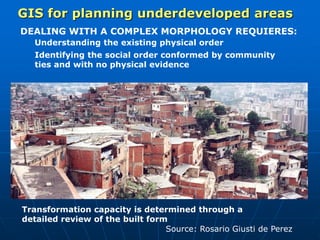
DEALING WITH A COMPLEX MORPHOLOGY REQUIERES:
Understanding the existing physical order
Identifying the social order conformed by community
ties and with no physical evidence
Transformation capacity is determined through a
detailed review of the built form
GIS for planning underdeveloped areas
Source: Rosario Giusti de Perez
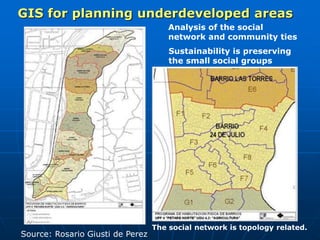
Sustainability is preserving
the small social groups
Analysis of the social
network and community ties
The social network is topology related.
GIS for planning underdeveloped areas
Source: Rosario Giusti de Perez
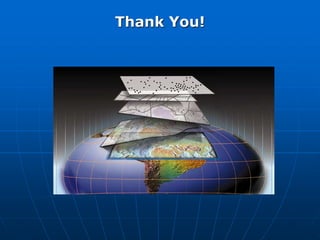
Thank You!

Intro_GIS.ppt

  • 1.
  • 2.
    Flying Blind Jul 24th2003 The Economist
  • 3.
    We Live inTwo Worlds Self-Regulating Managed Natural World Constructed World . . . These Are Increasingly In Conflict
  • 4.
    • Watersheds • Communities •Neighborhoods • Districts Context and Content • Patterns • Linkages • Trends Seeing the Whole Managing Places
  • 5.
  • 6.
    What is GIS? •A Geographic Information System (GIS) is a computer-based system including software, hardware, people, and geographic information • A GIS can:  create, edit, query, analyze, and display map information on the computer
  • 7.
    Geographic Information System •Geographic – 80% of government data collected is associated with some location in space • Information - attributes, or the characteristics (data), can be used to symbolize and provide further insight into a given location • System – a seamless operation linking the information to the geography – which requires hardware, networks, software, data, and operational procedures …not just software! …not just for making maps!
  • 8.
    Who uses GIS? •International organizations  UN HABITAT, The World Bank, UNEP, FAO, WHO, etc. • Private industry  Transport, Real Estate, Insurance, etc. • Government  Ministries of Environment, Housing, Agriculture, etc.  Local Authorities, Cities, Municipalities, etc.  Provincial Agencies for Planning, Parks, Transportation, etc. • Non-profit organizations/NGO’s  World Resources Institute, ICMA, etc. • Academic and Research Institutions  Smithsonian Institution, CIESIN, etc.
  • 9.
    • The possibilitiesare unlimited…  Environmental impact assessment  Resource management  Land use planning  Tax Mapping  Water and Sanitation Mapping  Transportation routing  and more ... What can you do with a GIS?
  • 10.
    How does aGIS work? • GIS data has a spatial/geographic reference  This might be a reference that describes a feature on the earth using: • a latitude & longitude • a national coordinate system • an address • a district • a wetland identifier • a road name
  • 11.
    • A GISstores information about the world as a collection of thematic layers that can be linked together by geography Polygon 3 Scrub 17 Very high Clay Geography and Databases
  • 12.
    GIS provides DataIntegration Vectors Topology Networks Terrain Surveys Images CAD Drawings Annotation Addresses 27 Main St. Attributes ABC 107’ 3D Objects Dimensions • Roads • Land Parcels • Population • Utilities • Land Mines • Hospitals • Refugee Camps • Wells • Sanitation
  • 13.
    Two fundamental typesof data • Vector  A series of x,y coordinates  For discrete data represented as points, lines, polygons • Raster  Grid and cells  For continuous data such as elevation, slope, surfaces • A Desktop GIS should be able to handle both types of data effectively!
  • 14.
  • 15.
    Other features ofa GIS • Produce good cartographic products (translation = maps) • Generate and maintain metadata • Use and share geoprocessing models • Managing data in a geodatabase using data models for each sector
  • 16.
    Hint – havingGIS software does not a cartographer make! • Good to know something about these issues when creating a map and doing spatial analysis…  Scale/Resolution  Projection  Basic cartographic principles regarding design, generalization, etc.
  • 17.
    GIS is (rapidly)evolving Projects Systems Networks Integrated Coordinated Cooperative Societal Collaborative
  • 18.
    Spatial Data Infrastructure (SDI) •Definition - the technology, policies, standards, human resources, and related activities necessary to acquire, process, distribute, use, maintain, and preserve spatial data • Part of many nation’s e-Gov strategy • www.GSDI.org
  • 19.
    Problem Statement –????? * Formulate the question Mitigate and change Seek solutions Observe, acquire data Analyze Diagram courtesy of Michael Goodchild, UCSB Geospatial data Socio- Economic data Ground- Based dataOther Ancillary data * Added GIS as part of your decision making process…
  • 20.
  • 21.
    World Summit on SustainableDevelopment 2002 “Promote the development and wider use of earth observation technologies, including satellite remote sensing, global mapping and geographic information systems, to collect quality data on environmental impacts, land use and land use changes.”
  • 23.
  • 24.
    Monitoring fair trade- local banana farmers
  • 25.
    A Tale ofTwo Cities The formal and the informal Both deserve GIS… complexity is not an accuse! GIS for planning underdeveloped areas Source: Rosario Giusti de Perez
  • 26.
    The lack ofpublic open space. Barrios have a percentage of public space between 5% and 10%. In the average city total space constitute over 30% of the total space. Urban poverty measured in terms of quantity and quality of public space. The absence of adequate infrastructure, Urban furniture and maintenance which combined produces unhealthy and insecure conditions. GIS for planning underdeveloped areas Source: Rosario Giusti de Perez
  • 27.
    DEALING WITH ACOMPLEX MORPHOLOGY REQUIERES: Understanding the existing physical order Identifying the social order conformed by community ties and with no physical evidence Transformation capacity is determined through a detailed review of the built form GIS for planning underdeveloped areas Source: Rosario Giusti de Perez
  • 28.
    Sustainability is preserving thesmall social groups Analysis of the social network and community ties The social network is topology related. GIS for planning underdeveloped areas Source: Rosario Giusti de Perez
  • 29.