1
Principal Components Analysis ( PCA)
• An exploratory technique used to reduce the
dimensionality of the data set to 2D or 3D
• Can be used to:
– Reduce number of dimensions in data
– Find patterns in high-dimensional data
– Visualize data of high dimensionality
• Example applications:
– Face recognition
– Image compression
– Gene expression analysis
2
Principal Components Analysis Ideas (
PCA)
• Does the data set ‘span’ the whole of d
dimensional space?
• For a matrix of m samples x n genes, create a new
covariance matrix of size n x n.
• Transform some large number of variables into a
smaller number of uncorrelated variables called
principal components (PCs).
• developed to capture as much of the variation in
data as possible
3
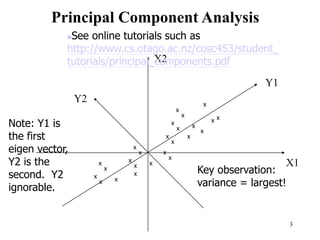
X1
X2
Principal Component Analysis
See online tutorials such as
http://www.cs.otago.ac.nz/cosc453/student_
tutorials/principal_components.pdf
Note: Y1 is
the first
eigen vector,
Y2 is the
second. Y2
ignorable.
Y1
Y2
x
x
x x
x
x
x
x
x
x
x
x
x x
x
x
x
x
x x
x
x
x
x
x
Key observation:
variance = largest!
4
Principal Component Analysis: one
attribute first
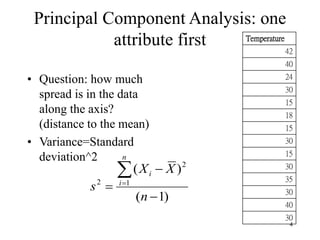
• Question: how much
spread is in the data
along the axis?
(distance to the mean)
• Variance=Standard
deviation^2
Temperature
42
40
24
30
15
18
15
30
15
30
35
30
40
30
)
1
(
)
(
1
2
2





n
X
X
s
n
i
i
5
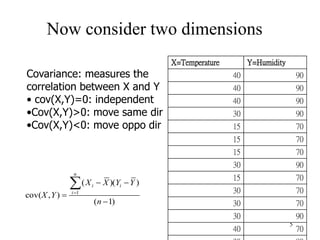
Now consider two dimensions
X=Temperature Y=Humidity
40 90
40 90
40 90
30 90
15 70
15 70
15 70
30 90
15 70
30 70
30 70
30 90
40 70
)
1
(
)
)(
(
)
,
cov( 1






n
Y
Y
X
X
Y
X
n
i
i
i
Covariance: measures the
correlation between X and Y
• cov(X,Y)=0: independent
•Cov(X,Y)>0: move same dir
•Cov(X,Y)<0: move oppo dir
6
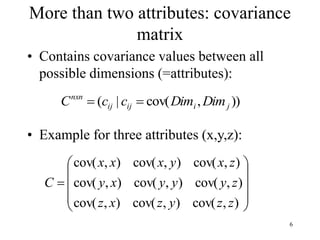
More than two attributes: covariance
matrix
• Contains covariance values between all
possible dimensions (=attributes):
• Example for three attributes (x,y,z):
))
,
cov(
|
( j
i
ij
ij
nxn
Dim
Dim
c
c
C 












)
,
cov(
)
,
cov(
)
,
cov(
)
,
cov(
)
,
cov(
)
,
cov(
)
,
cov(
)
,
cov(
)
,
cov(
z
z
y
z
x
z
z
y
y
y
x
y
z
x
y
x
x
x
C
7
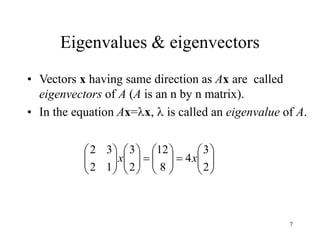
Eigenvalues & eigenvectors
• Vectors x having same direction as Ax are called
eigenvectors of A (A is an n by n matrix).
• In the equation Ax=x,  is called an eigenvalue of A.


































2
3
4
8
12
2
3
1
2
3
2
x
x
8
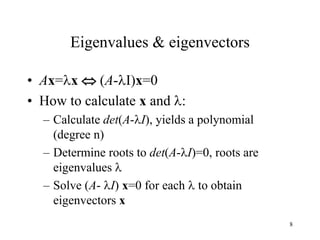
Eigenvalues & eigenvectors
• Ax=x  (A-I)x=0
• How to calculate x and :
– Calculate det(A-I), yields a polynomial
(degree n)
– Determine roots to det(A-I)=0, roots are
eigenvalues 
– Solve (A- I) x=0 for each  to obtain
eigenvectors x
9
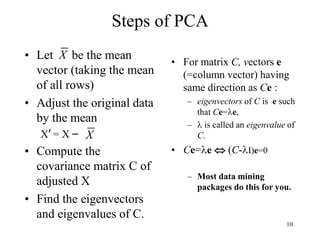
Principal components
• 1. principal component (PC1)
– The eigenvalue with the largest absolute value will
indicate that the data have the largest variance
along its eigenvector, the direction along which
there is greatest variation
• 2. principal component (PC2)
– the direction with maximum variation left in data,
orthogonal to the 1. PC
• In general, only few directions manage to
capture most of the variability in the data.
10
Steps of PCA
• Let be the mean
vector (taking the mean
of all rows)
• Adjust the original data
by the mean
X’ = X –
• Compute the
covariance matrix C of
adjusted X
• Find the eigenvectors
and eigenvalues of C.
X
• For matrix C, vectors e
(=column vector) having
same direction as Ce :
– eigenvectors of C is e such
that Ce=e,
–  is called an eigenvalue of
C.
• Ce=e  (C-I)e=0
– Most data mining
packages do this for you.
X
11
Eigenvalues
• Calculate eigenvalues  and eigenvectors x for
covariance matrix:
– Eigenvalues j are used for calculation of [% of total
variance] (Vj) for each component j:

 




n
x
x
n
x
x
j
j n
V
1
1
100 


12
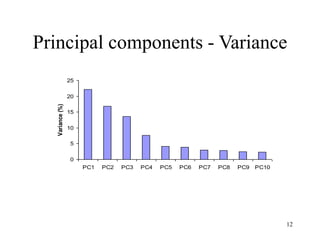
Principal components - Variance
0
5
10
15
20
25
PC1 PC2 PC3 PC4 PC5 PC6 PC7 PC8 PC9 PC10
Variance
(%)
13
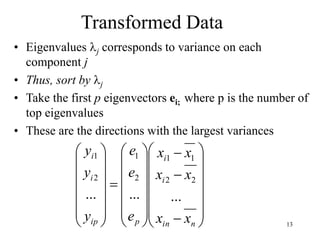
Transformed Data
• Eigenvalues j corresponds to variance on each
component j
• Thus, sort by j
• Take the first p eigenvectors ei; where p is the number of
top eigenvalues
• These are the directions with the largest variances














































n
in
i
i
p
ip
i
i
x
x
x
x
x
x
e
e
e
y
y
y
...
...
...
2
2
1
1
2
1
2
1
14
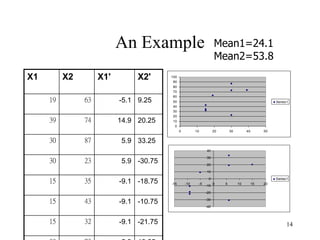
An Example
X1 X2 X1' X2'
19 63 -5.1 9.25
39 74 14.9 20.25
30 87 5.9 33.25
30 23 5.9 -30.75
15 35 -9.1 -18.75
15 43 -9.1 -10.75
15 32 -9.1 -21.75
0
10
20
30
40
50
60
70
80
90
100
0 10 20 30 40 50
Series1
Mean1=24.1
Mean2=53.8
-40
-30
-20
-10
0
10
20
30
40
-15 -10 -5 0 5 10 15 20
Series1
15
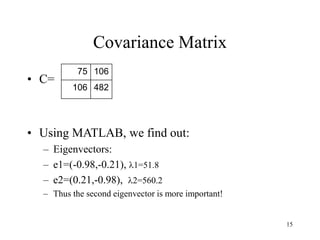
Covariance Matrix
• C=
• Using MATLAB, we find out:
– Eigenvectors:
– e1=(-0.98,-0.21), 1=51.8
– e2=(0.21,-0.98), 2=560.2
– Thus the second eigenvector is more important!
75 106
106 482
16
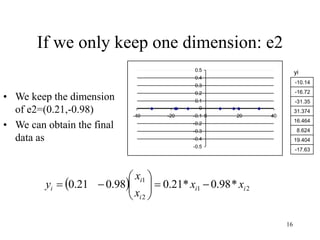
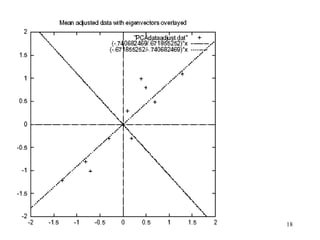
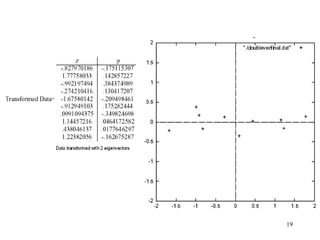
If we only keep one dimension: e2
• We keep the dimension
of e2=(0.21,-0.98)
• We can obtain the final
data as
  2
1
2
1
*
98
.
0
*
21
.
0
98
.
0
21
.
0 i
i
i
i
i x
x
x
x
y 











-0.5
-0.4
-0.3
-0.2
-0.1
0
0.1
0.2
0.3
0.4
0.5
-40 -20 0 20 40
yi
-10.14
-16.72
-31.35
31.374
16.464
8.624
19.404
-17.63
17
18
19
20
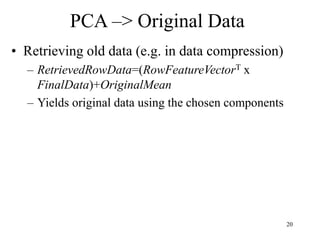
PCA –> Original Data
• Retrieving old data (e.g. in data compression)
– RetrievedRowData=(RowFeatureVectorT x
FinalData)+OriginalMean
– Yields original data using the chosen components
21
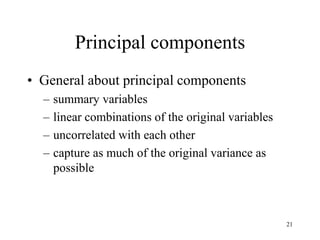
Principal components
• General about principal components
– summary variables
– linear combinations of the original variables
– uncorrelated with each other
– capture as much of the original variance as
possible
22
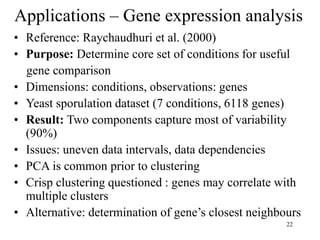
Applications – Gene expression analysis
• Reference: Raychaudhuri et al. (2000)
• Purpose: Determine core set of conditions for useful
gene comparison
• Dimensions: conditions, observations: genes
• Yeast sporulation dataset (7 conditions, 6118 genes)
• Result: Two components capture most of variability
(90%)
• Issues: uneven data intervals, data dependencies
• PCA is common prior to clustering
• Crisp clustering questioned : genes may correlate with
multiple clusters
• Alternative: determination of gene’s closest neighbours
23
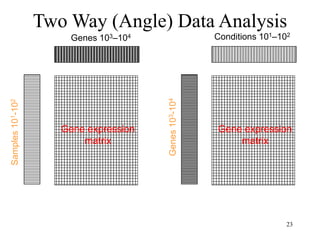
Two Way (Angle) Data Analysis
Genes 103–104
Samples
10
1
-10
2
Gene expression
matrix
Sample space analysis Gene space analysis
Conditions 101–102
Genes
10
3
-10
4
Gene expression
matrix
24
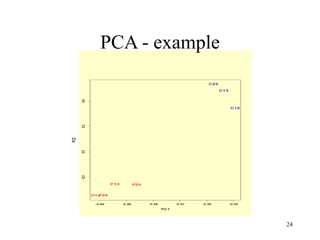
PCA - example
25
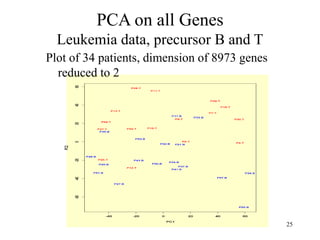
PCA on all Genes
Leukemia data, precursor B and T
Plot of 34 patients, dimension of 8973 genes
reduced to 2
26
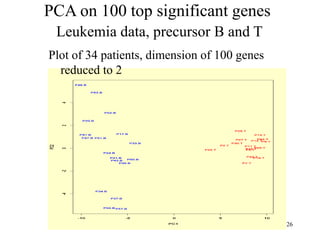
PCA on 100 top significant genes
Leukemia data, precursor B and T
Plot of 34 patients, dimension of 100 genes
reduced to 2
27
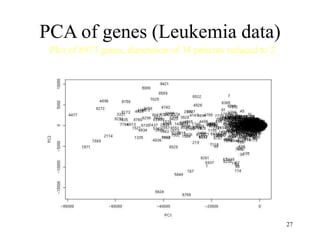
PCA of genes (Leukemia data)
Plot of 8973 genes, dimension of 34 patients reduced to 2

pca.ppt

  • 1.
    1 Principal Components Analysis( PCA) • An exploratory technique used to reduce the dimensionality of the data set to 2D or 3D • Can be used to: – Reduce number of dimensions in data – Find patterns in high-dimensional data – Visualize data of high dimensionality • Example applications: – Face recognition – Image compression – Gene expression analysis
  • 2.
    2 Principal Components AnalysisIdeas ( PCA) • Does the data set ‘span’ the whole of d dimensional space? • For a matrix of m samples x n genes, create a new covariance matrix of size n x n. • Transform some large number of variables into a smaller number of uncorrelated variables called principal components (PCs). • developed to capture as much of the variation in data as possible
  • 3.
    3 X1 X2 Principal Component Analysis Seeonline tutorials such as http://www.cs.otago.ac.nz/cosc453/student_ tutorials/principal_components.pdf Note: Y1 is the first eigen vector, Y2 is the second. Y2 ignorable. Y1 Y2 x x x x x x x x x x x x x x x x x x x x x x x x x Key observation: variance = largest!
  • 4.
    4 Principal Component Analysis:one attribute first • Question: how much spread is in the data along the axis? (distance to the mean) • Variance=Standard deviation^2 Temperature 42 40 24 30 15 18 15 30 15 30 35 30 40 30 ) 1 ( ) ( 1 2 2      n X X s n i i
  • 5.
    5 Now consider twodimensions X=Temperature Y=Humidity 40 90 40 90 40 90 30 90 15 70 15 70 15 70 30 90 15 70 30 70 30 70 30 90 40 70 ) 1 ( ) )( ( ) , cov( 1       n Y Y X X Y X n i i i Covariance: measures the correlation between X and Y • cov(X,Y)=0: independent •Cov(X,Y)>0: move same dir •Cov(X,Y)<0: move oppo dir
  • 6.
    6 More than twoattributes: covariance matrix • Contains covariance values between all possible dimensions (=attributes): • Example for three attributes (x,y,z): )) , cov( | ( j i ij ij nxn Dim Dim c c C              ) , cov( ) , cov( ) , cov( ) , cov( ) , cov( ) , cov( ) , cov( ) , cov( ) , cov( z z y z x z z y y y x y z x y x x x C
  • 7.
    7 Eigenvalues & eigenvectors •Vectors x having same direction as Ax are called eigenvectors of A (A is an n by n matrix). • In the equation Ax=x,  is called an eigenvalue of A.                                   2 3 4 8 12 2 3 1 2 3 2 x x
  • 8.
    8 Eigenvalues & eigenvectors •Ax=x  (A-I)x=0 • How to calculate x and : – Calculate det(A-I), yields a polynomial (degree n) – Determine roots to det(A-I)=0, roots are eigenvalues  – Solve (A- I) x=0 for each  to obtain eigenvectors x
  • 9.
    9 Principal components • 1.principal component (PC1) – The eigenvalue with the largest absolute value will indicate that the data have the largest variance along its eigenvector, the direction along which there is greatest variation • 2. principal component (PC2) – the direction with maximum variation left in data, orthogonal to the 1. PC • In general, only few directions manage to capture most of the variability in the data.
  • 10.
    10 Steps of PCA •Let be the mean vector (taking the mean of all rows) • Adjust the original data by the mean X’ = X – • Compute the covariance matrix C of adjusted X • Find the eigenvectors and eigenvalues of C. X • For matrix C, vectors e (=column vector) having same direction as Ce : – eigenvectors of C is e such that Ce=e, –  is called an eigenvalue of C. • Ce=e  (C-I)e=0 – Most data mining packages do this for you. X
  • 11.
    11 Eigenvalues • Calculate eigenvalues and eigenvectors x for covariance matrix: – Eigenvalues j are used for calculation of [% of total variance] (Vj) for each component j:        n x x n x x j j n V 1 1 100   
  • 12.
    12 Principal components -Variance 0 5 10 15 20 25 PC1 PC2 PC3 PC4 PC5 PC6 PC7 PC8 PC9 PC10 Variance (%)
  • 13.
    13 Transformed Data • Eigenvaluesj corresponds to variance on each component j • Thus, sort by j • Take the first p eigenvectors ei; where p is the number of top eigenvalues • These are the directions with the largest variances                                               n in i i p ip i i x x x x x x e e e y y y ... ... ... 2 2 1 1 2 1 2 1
  • 14.
    14 An Example X1 X2X1' X2' 19 63 -5.1 9.25 39 74 14.9 20.25 30 87 5.9 33.25 30 23 5.9 -30.75 15 35 -9.1 -18.75 15 43 -9.1 -10.75 15 32 -9.1 -21.75 0 10 20 30 40 50 60 70 80 90 100 0 10 20 30 40 50 Series1 Mean1=24.1 Mean2=53.8 -40 -30 -20 -10 0 10 20 30 40 -15 -10 -5 0 5 10 15 20 Series1
  • 15.
    15 Covariance Matrix • C= •Using MATLAB, we find out: – Eigenvectors: – e1=(-0.98,-0.21), 1=51.8 – e2=(0.21,-0.98), 2=560.2 – Thus the second eigenvector is more important! 75 106 106 482
  • 16.
    16 If we onlykeep one dimension: e2 • We keep the dimension of e2=(0.21,-0.98) • We can obtain the final data as   2 1 2 1 * 98 . 0 * 21 . 0 98 . 0 21 . 0 i i i i i x x x x y             -0.5 -0.4 -0.3 -0.2 -0.1 0 0.1 0.2 0.3 0.4 0.5 -40 -20 0 20 40 yi -10.14 -16.72 -31.35 31.374 16.464 8.624 19.404 -17.63
  • 17.
  • 18.
  • 19.
  • 20.
    20 PCA –> OriginalData • Retrieving old data (e.g. in data compression) – RetrievedRowData=(RowFeatureVectorT x FinalData)+OriginalMean – Yields original data using the chosen components
  • 21.
    21 Principal components • Generalabout principal components – summary variables – linear combinations of the original variables – uncorrelated with each other – capture as much of the original variance as possible
  • 22.
    22 Applications – Geneexpression analysis • Reference: Raychaudhuri et al. (2000) • Purpose: Determine core set of conditions for useful gene comparison • Dimensions: conditions, observations: genes • Yeast sporulation dataset (7 conditions, 6118 genes) • Result: Two components capture most of variability (90%) • Issues: uneven data intervals, data dependencies • PCA is common prior to clustering • Crisp clustering questioned : genes may correlate with multiple clusters • Alternative: determination of gene’s closest neighbours
  • 23.
    23 Two Way (Angle)Data Analysis Genes 103–104 Samples 10 1 -10 2 Gene expression matrix Sample space analysis Gene space analysis Conditions 101–102 Genes 10 3 -10 4 Gene expression matrix
  • 24.
  • 25.
    25 PCA on allGenes Leukemia data, precursor B and T Plot of 34 patients, dimension of 8973 genes reduced to 2
  • 26.
    26 PCA on 100top significant genes Leukemia data, precursor B and T Plot of 34 patients, dimension of 100 genes reduced to 2
  • 27.
    27 PCA of genes(Leukemia data) Plot of 8973 genes, dimension of 34 patients reduced to 2