Chapter 5
David de la Cruz Bailén
Jorge Moreno Fuentes
LOADING JOBS
 Loading means the assignment of Jobs to work or
processing centers.
 Operations Managers assign jobs to work centers so
that cost and completion times are kept to a minimum
 Loading work centers
Oriented to Capacity
Related to assigning specific jobs.
 Work centers are areas in a business in which productive resources are
organized and work is completed.
 It may be a single machine, a group of machines, or an area where a particular
type of work is done.
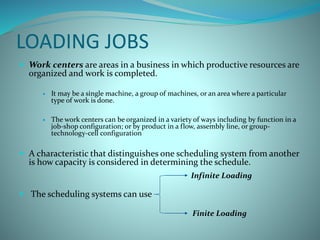
 The work centers can be organized in a variety of ways including by function in a
job-shop configuration; or by product in a flow, assembly line, or group-
technology-cell configuration
 A characteristic that distinguishes one scheduling system from another
is how capacity is considered in determining the schedule.
 The scheduling systems can use
LOADING JOBS
Infinite Loading
Finite Loading
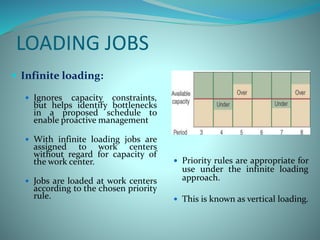
 Infinite loading:
 Ignores capacity constraints,
but helps identify bottlenecks
in a proposed schedule to
enable proactive management
 With infinite loading jobs are
assigned to work centers
without regard for capacity of
the work center.
 Jobs are loaded at work centers
according to the chosen priority
rule.
LOADING JOBS
 Priority rules are appropriate for
use under the infinite loading
approach.
 This is known as vertical loading.
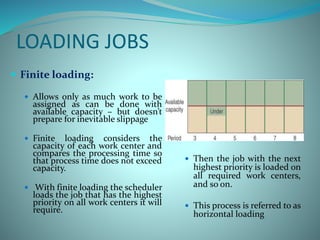
 Finite loading:
 Allows only as much work to be
assigned as can be done with
available capacity – but doesn’t
prepare for inevitable slippage
 Finite loading considers the
capacity of each work center and
compares the processing time so
that process time does not exceed
capacity.
 With finite loading the scheduler
loads the job that has the highest
priority on all work centers it will
require.
LOADING JOBS
 Then the job with the next
highest priority is loaded on
all required work centers,
and so on.
 This process is referred to as
horizontal loading
Characteristics of High-Volume
Operations
 High-volume aka flow operations, like automobiles, bread,
gasoline can be repetitive or continuous
 High-volume standard items; discrete or continuous with
smaller profit margins
 Designed for high efficiency and high utilization
 High volume flow operations with fixed routings
 Bottlenecks are easily identified
 Commonly use line-balancing to design the process around the
required tasks
 Low-volume, job shop operations, are designed for
flexibility.
 Use more general purpose equipment
 Customized products with higher margins
 Each product or service may have its own routing (scheduling is
much more difficult)
 Bottlenecks move around depending upon the products being
produced at any given time
Characteristics of Low-Volume
Operations
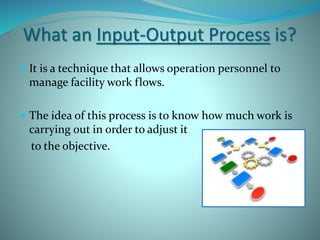
What an Input-Output Process is?
 It is a technique that allows operation personnel to
manage facility work flows.
 The idea of this process is to know how much work is
carrying out in order to adjust it
to the objective.
The advantages of Input-Output
Control
 Identifies overloading and underloading conditions
 Prompts managerial action to resolve scheduling
problems
 Can be maintained using ConWIP cards that control
the scheduling of batches.
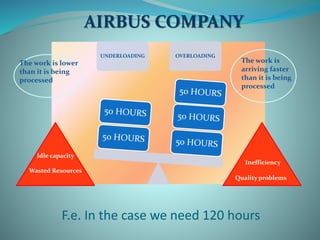
F.e. In the case we need 120 hours
IDENTIFY THE BEST CONDITION
UNDERLOADING OVERLOADING
The work is
arriving faster
than it is being
processed
Inefficiency
Quality problems
The work is lower
than it is being
processed
Idle capacity
Wasted Resources
AIRBUS COMPANY
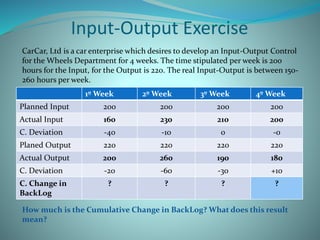
Input-Output Exercise
1º Week 2º Week 3º Week 4º Week
Planned Input 200 200 200 200
Actual Input 160 230 210 200
C. Deviation -40 -10 0 -0
Planed Output 220 220 220 220
Actual Output 200 260 190 180
C. Deviation -20 -60 -30 +10
C. Change in
BackLog
? ? ? ?
CarCar, Ltd is a car enterprise which desires to develop an Input-Output Control
for the Wheels Department for 4 weeks. The time stipulated per week is 200
hours for the Input, for the Output is 220. The real Input-Output is between 150-
260 hours per week.
How much is the Cumulative Change in BackLog? What does this result
mean?
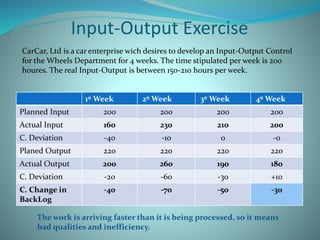
Input-Output Exercise
1º Week 2º Week 3º Week 4º Week
Planned Input 200 200 200 200
Actual Input 160 230 210 200
C. Deviation -40 -10 0 -0
Planed Output 220 220 220 220
Actual Output 200 260 190 180
C. Deviation -20 -60 -30 +10
C. Change in
BackLog
-40 -70 -50 -30
CarCar, Ltd is a car enterprise wich desires to develop an Input-Output Control
for the Wheels Department for 4 weeks. The time stipulated per week is 200
houres. The real Input-Output is between 150-210 hours per week.
The work is arriving faster than it is being processed, so it means
bad qualities and inefficiency.
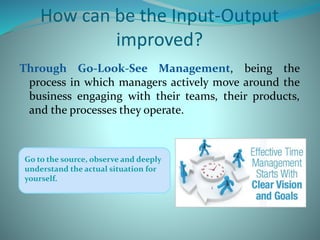
How can be the Input-Output
improved?
Through Go-Look-See Management, being the
process in which managers actively move around the
business engaging with their teams, their products,
and the processes they operate.
Go to the source, observe and deeply
understand the actual situation for
yourself.
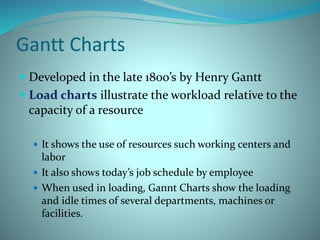
Gantt Charts
 Developed in the late 1800’s by Henry Gantt
 Load charts illustrate the workload relative to the
capacity of a resource
 It shows the use of resources such working centers and
labor
 It also shows today’s job schedule by employee
 When used in loading, Gannt Charts show the loading
and idle times of several departments, machines or
facilities.
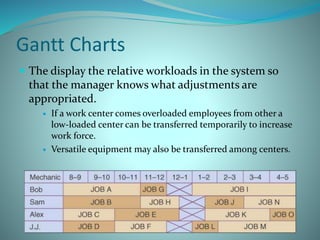
 The display the relative workloads in the system so
that the manager knows what adjustments are
appropriated.
 If a work center comes overloaded employees from other a
low-loaded center can be transferred temporarily to increase
work force.
 Versatile equipment may also be transferred among centers.
Gantt Charts
Gantt Charts
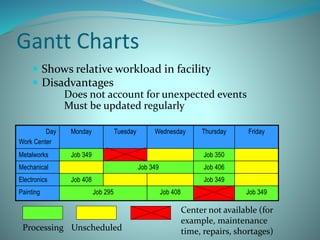
 Shows relative workload in facility
 Disadvantages
Does not account for unexpected events
Must be updated regularly
Day
Work Center
Monday Tuesday Wednesday Thursday Friday
Metalworks Job 349 Job 350
Mechanical Job 349 Job 406
Electronics Job 408 Job 349
Painting Job 295 Job 408 Job 349
Processing Unscheduled
Center not available (for
example, maintenance
time, repairs, shortages)
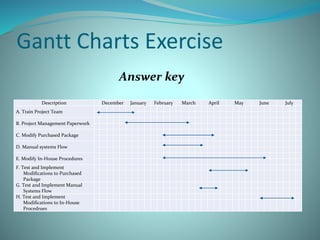
Description December January February March April May June July
A. Train Project Team
B. Project Management Paperwork
C. Modify Purchased Package
D. Manual systems Flow
E. Modify In-House Procedures
F. Test and Implement
Modifications to Purchased
Package
G. Test and Implement Manual
Systems Flow
H. Test and Implement
Modifications to In-House
Procedrues
Gantt Charts Exercise
Answer key
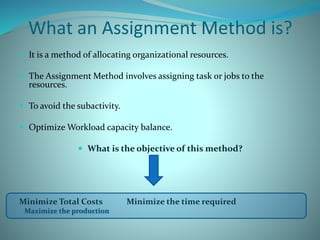
What an Assignment Method is?
 It is a method of allocating organizational resources.
 The Assignment Method involves assigning task or jobs to the
resources.
 To avoid the subactivity.
 Optimize Workload capacity balance.
 What is the objective of this method?
Minimize Total Costs Minimize the time required
Maximize the production
The characteristics of the
Assignment Method
 Just one job or work is assigned to one project or
machine.
 It is used for production allocation.
 It is called as well The Hungarian method is
a combinatorial optimization algorithm that solves the
assignment problem in polynomial time and which
anticipated later primal-dual methods.
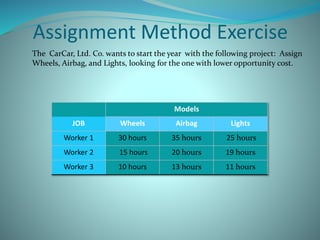
Models
JOB Wheels Airbag Lights
Worker 1 30 hours 35 hours 25 hours
Worker 2 15 hours 20 hours 19 hours
Worker 3 10 hours 13 hours 11 hours
Assignment Method Exercise
The CarCar, Ltd. Co. wants to start the year with the following project: Assign
Wheels, Airbag, and Lights, looking for the one with lower opportunity cost.
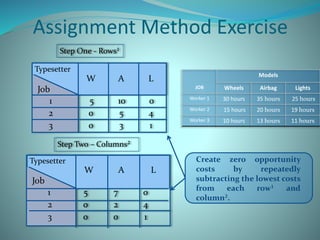
W A L
Job
1 5 10 0
2 0 5 4
3 0 3 1
Typesetter
Step One - Rows¹
W A L
Job
1 5 7 0
2 0 2 4
3 0 0 1
Typesetter
Step Two – Columns²
Assignment Method Exercise
Create zero opportunity
costs by repeatedly
subtracting the lowest costs
from each row¹ and
column².
Models
JOB Wheels Airbag Lights
Worker 1 30 hours 35 hours 25 hours
Worker 2 15 hours 20 hours 19 hours
Worker 3 10 hours 13 hours 11 hours
W A L
Job
1 5 7 0
2 0 3 4
3 0 0 1
Typesetter
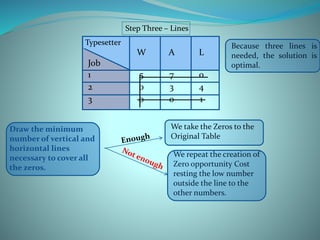
Step Three – Lines
Because three lines is
needed, the solution is
optimal.
Draw the minimum
number of vertical and
horizontal lines
necessary to cover all
the zeros.
We take the Zeros to the
Original Table
We repeat the creation of
Zero opportunity Cost
resting the low number
outside the line to the
other numbers.
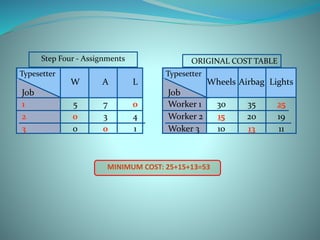
W A L
Job
1 5 7 0
2 0 3 4
3 0 0 1
Typesetter
Step Four - Assignments ORIGINAL COST TABLE
Wheels Airbag Lights
Job
Worker 1 30 35 25
Worker 2 15 20 19
Woker 3 10 13 11
Typesetter
MINIMUM COST: 25+15+13=53
David de la Cruz Bailén
Jorge Moreno Fuentes

Loading jobs and methods definitivo

  • 1.
    Chapter 5 David dela Cruz Bailén Jorge Moreno Fuentes
  • 2.
    LOADING JOBS  Loadingmeans the assignment of Jobs to work or processing centers.  Operations Managers assign jobs to work centers so that cost and completion times are kept to a minimum  Loading work centers Oriented to Capacity Related to assigning specific jobs.
  • 3.
     Work centersare areas in a business in which productive resources are organized and work is completed.  It may be a single machine, a group of machines, or an area where a particular type of work is done.  The work centers can be organized in a variety of ways including by function in a job-shop configuration; or by product in a flow, assembly line, or group- technology-cell configuration  A characteristic that distinguishes one scheduling system from another is how capacity is considered in determining the schedule.  The scheduling systems can use LOADING JOBS Infinite Loading Finite Loading
  • 4.
     Infinite loading: Ignores capacity constraints, but helps identify bottlenecks in a proposed schedule to enable proactive management  With infinite loading jobs are assigned to work centers without regard for capacity of the work center.  Jobs are loaded at work centers according to the chosen priority rule. LOADING JOBS  Priority rules are appropriate for use under the infinite loading approach.  This is known as vertical loading.
  • 5.
     Finite loading: Allows only as much work to be assigned as can be done with available capacity – but doesn’t prepare for inevitable slippage  Finite loading considers the capacity of each work center and compares the processing time so that process time does not exceed capacity.  With finite loading the scheduler loads the job that has the highest priority on all work centers it will require. LOADING JOBS  Then the job with the next highest priority is loaded on all required work centers, and so on.  This process is referred to as horizontal loading
  • 6.
    Characteristics of High-Volume Operations High-volume aka flow operations, like automobiles, bread, gasoline can be repetitive or continuous  High-volume standard items; discrete or continuous with smaller profit margins  Designed for high efficiency and high utilization  High volume flow operations with fixed routings  Bottlenecks are easily identified  Commonly use line-balancing to design the process around the required tasks
  • 7.
     Low-volume, jobshop operations, are designed for flexibility.  Use more general purpose equipment  Customized products with higher margins  Each product or service may have its own routing (scheduling is much more difficult)  Bottlenecks move around depending upon the products being produced at any given time Characteristics of Low-Volume Operations
  • 8.
    What an Input-OutputProcess is?  It is a technique that allows operation personnel to manage facility work flows.  The idea of this process is to know how much work is carrying out in order to adjust it to the objective.
  • 9.
    The advantages ofInput-Output Control  Identifies overloading and underloading conditions  Prompts managerial action to resolve scheduling problems  Can be maintained using ConWIP cards that control the scheduling of batches.
  • 10.
    F.e. In thecase we need 120 hours IDENTIFY THE BEST CONDITION UNDERLOADING OVERLOADING The work is arriving faster than it is being processed Inefficiency Quality problems The work is lower than it is being processed Idle capacity Wasted Resources AIRBUS COMPANY
  • 11.
    Input-Output Exercise 1º Week2º Week 3º Week 4º Week Planned Input 200 200 200 200 Actual Input 160 230 210 200 C. Deviation -40 -10 0 -0 Planed Output 220 220 220 220 Actual Output 200 260 190 180 C. Deviation -20 -60 -30 +10 C. Change in BackLog ? ? ? ? CarCar, Ltd is a car enterprise which desires to develop an Input-Output Control for the Wheels Department for 4 weeks. The time stipulated per week is 200 hours for the Input, for the Output is 220. The real Input-Output is between 150- 260 hours per week. How much is the Cumulative Change in BackLog? What does this result mean?
  • 12.
    Input-Output Exercise 1º Week2º Week 3º Week 4º Week Planned Input 200 200 200 200 Actual Input 160 230 210 200 C. Deviation -40 -10 0 -0 Planed Output 220 220 220 220 Actual Output 200 260 190 180 C. Deviation -20 -60 -30 +10 C. Change in BackLog -40 -70 -50 -30 CarCar, Ltd is a car enterprise wich desires to develop an Input-Output Control for the Wheels Department for 4 weeks. The time stipulated per week is 200 houres. The real Input-Output is between 150-210 hours per week. The work is arriving faster than it is being processed, so it means bad qualities and inefficiency.
  • 13.
    How can bethe Input-Output improved? Through Go-Look-See Management, being the process in which managers actively move around the business engaging with their teams, their products, and the processes they operate. Go to the source, observe and deeply understand the actual situation for yourself.
  • 14.
    Gantt Charts  Developedin the late 1800’s by Henry Gantt  Load charts illustrate the workload relative to the capacity of a resource  It shows the use of resources such working centers and labor  It also shows today’s job schedule by employee  When used in loading, Gannt Charts show the loading and idle times of several departments, machines or facilities.
  • 15.
     The displaythe relative workloads in the system so that the manager knows what adjustments are appropriated.  If a work center comes overloaded employees from other a low-loaded center can be transferred temporarily to increase work force.  Versatile equipment may also be transferred among centers. Gantt Charts
  • 16.
    Gantt Charts  Showsrelative workload in facility  Disadvantages Does not account for unexpected events Must be updated regularly Day Work Center Monday Tuesday Wednesday Thursday Friday Metalworks Job 349 Job 350 Mechanical Job 349 Job 406 Electronics Job 408 Job 349 Painting Job 295 Job 408 Job 349 Processing Unscheduled Center not available (for example, maintenance time, repairs, shortages)
  • 17.
    Description December JanuaryFebruary March April May June July A. Train Project Team B. Project Management Paperwork C. Modify Purchased Package D. Manual systems Flow E. Modify In-House Procedures F. Test and Implement Modifications to Purchased Package G. Test and Implement Manual Systems Flow H. Test and Implement Modifications to In-House Procedrues Gantt Charts Exercise Answer key
  • 18.
    What an AssignmentMethod is?  It is a method of allocating organizational resources.  The Assignment Method involves assigning task or jobs to the resources.  To avoid the subactivity.  Optimize Workload capacity balance.  What is the objective of this method? Minimize Total Costs Minimize the time required Maximize the production
  • 19.
    The characteristics ofthe Assignment Method  Just one job or work is assigned to one project or machine.  It is used for production allocation.  It is called as well The Hungarian method is a combinatorial optimization algorithm that solves the assignment problem in polynomial time and which anticipated later primal-dual methods.
  • 20.
    Models JOB Wheels AirbagLights Worker 1 30 hours 35 hours 25 hours Worker 2 15 hours 20 hours 19 hours Worker 3 10 hours 13 hours 11 hours Assignment Method Exercise The CarCar, Ltd. Co. wants to start the year with the following project: Assign Wheels, Airbag, and Lights, looking for the one with lower opportunity cost.
  • 21.
    W A L Job 15 10 0 2 0 5 4 3 0 3 1 Typesetter Step One - Rows¹ W A L Job 1 5 7 0 2 0 2 4 3 0 0 1 Typesetter Step Two – Columns² Assignment Method Exercise Create zero opportunity costs by repeatedly subtracting the lowest costs from each row¹ and column². Models JOB Wheels Airbag Lights Worker 1 30 hours 35 hours 25 hours Worker 2 15 hours 20 hours 19 hours Worker 3 10 hours 13 hours 11 hours
  • 22.
    W A L Job 15 7 0 2 0 3 4 3 0 0 1 Typesetter Step Three – Lines Because three lines is needed, the solution is optimal. Draw the minimum number of vertical and horizontal lines necessary to cover all the zeros. We take the Zeros to the Original Table We repeat the creation of Zero opportunity Cost resting the low number outside the line to the other numbers.
  • 23.
    W A L Job 15 7 0 2 0 3 4 3 0 0 1 Typesetter Step Four - Assignments ORIGINAL COST TABLE Wheels Airbag Lights Job Worker 1 30 35 25 Worker 2 15 20 19 Woker 3 10 13 11 Typesetter MINIMUM COST: 25+15+13=53
  • 24.
    David de laCruz Bailén Jorge Moreno Fuentes