Advanced methods of teaching Strategies of teaching and interaction teachingDrill work , Review , Assignment ,Inductive and deductive strategy
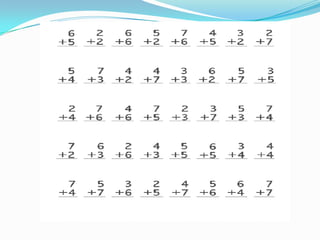
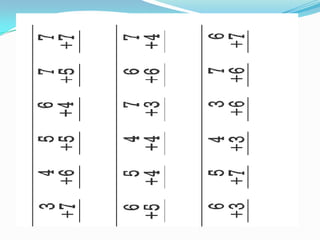
Drill work Drill is a way to revise a lesson that has already been taughtDrill work should be based on the principle of learning by doing and on the law of exercisesDrill is the one of the most commonly used fixed devices. it gives a sense of achievement and confidence and so it proves a positive stimulus for further learning.
It has been found quite useful particularly in case of average and below average studentsDrill provides an opportunity to the student to work  independently.PrecautionsDrill work should properly planned.It should be meaningfulIt should follow understanding, only then drill work is useful .
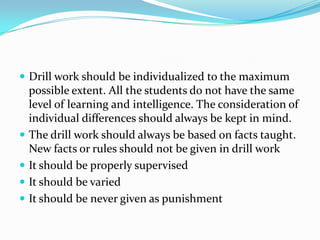
Drill work should be individualized to the maximum possible extent. All the students do not have the same level of learning and intelligence. The consideration of individual differences should always be kept in mind.The drill work should always be based on facts taught. New facts or rules should not be given in drill workIt should be properly supervisedIt should be variedIt should be never given as punishment
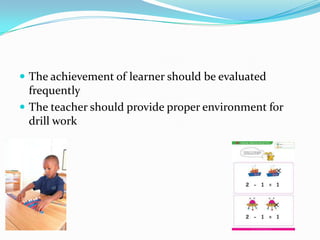
The achievement of learner should be evaluated frequentlyThe teacher should provide proper environment for drill work
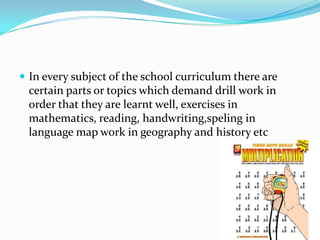
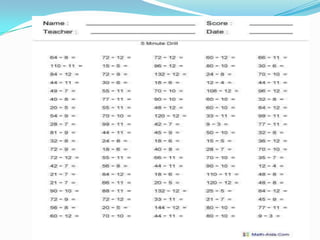
In every subject of the school curriculum there are certain parts or topics which demand drill work in order that they are learnt well, exercises in mathematics, reading, handwriting,speling in language map work in geography and history etc
ReviewReview means to view again .It is a mental process of going over the learnt materialsThe previous experiences are recalled for better understanding and commandIt involves new relationship and recognition of old materials
 Purpose of reviewTo have better understanding To fix the knowledgeTo discover relationshipsTo develop new interest in old materialsTo link the new with the old
Types of reviewThe daily lesson reviewTopical reviewUnit plan reviewCo-operative reviewReview by application
Daily lesson reviewTeacher can review what has been already covered on the subject at the beginning of the period. This can be done by summarizing the previous lesson and assignment on it relating it to the lesson in hand. This can be done even by asking ‘recapitulatory’ type of questionsTopical and unit plan reviewA topic selected and various discussions on it are renewed. It is akin to the unit plan review in which an entire unit or sometimes several units are found necessary and advisable by some teachers. For example various lessons on the mughul period in the history of India have been given, a couple of classes could be devoted to the review of the whole unit or a topic like social reforms in the mughul period could be selected for review
 Co-operative review     It involves both teacher and students, it can be in the form of discussion in which the whole class participates, and it is a sort of mass participation of the entire class in an inter-change of ideas under the guidance of teacher. This type of review is more suited to the students at the college level. Review by application    In this type of review students are given opportunities of applying the knowledge gained in new situations or putting into practice all that they have learned in classroomReview by making diagrams, sketches, charts, models etc     Good review involves a new way of handling materials, and as such can stimulate children’s interest in activity, changing the form of review, the use of the pictorial method in reviewing materials, e.g., preparation of charts, graphs and statistical tables, and the introduction of games and contests are the some of the ways of making a review interesting.
Suggestion for making effective reviewIt should lead to new learningIt should lead to discovery of inter relationship It should lead to continuity, coherence and unity of subject matterIt should be directed to the weak points or doubts of the studentsReview for main points rather than for detailsEmploy review methods which involve visualizationReview both as short and at long intervals
Assignment methodIt is a sort of self study which supplements classroom teachingIn this technique, the teacher assigns work provides guidelines and sets time limit for the completion of assignment.This method is generally advocated for teaching different subjects to pupils in the higher classes. The syllabus is split up into significant units or topics, each unit or topic, in its own, is subdivided into learning assignments for pupils
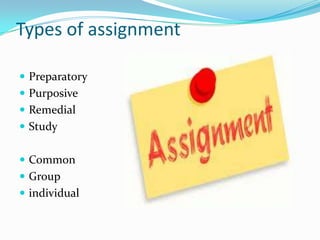
Types of assignmentPreparatoryPurposiveRemedialStudyCommonGroupindividual
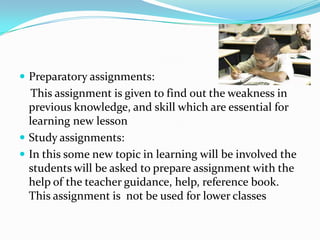
Preparatory assignments:    This assignment is given to find out the weakness in previous knowledge, and skill which are essential for learning new lessonStudy assignments:In this some new topic in learning will be involved the students will be asked to prepare assignment with the help of the teacher guidance, help, reference book. This assignment is  not be used for lower classes
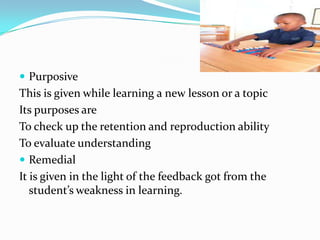
PurposiveThis is given while learning a new lesson or a topicIts purposes areTo check up the retention and reproduction abilityTo evaluate understandingRemedial It is given in the light of the feedback got from the student’s weakness in learning.
Various steps in the assignment:PlanningProviding guidelinesSupervising the work assignedEvaluating the assignment work
Criteria of good assignmentIt should be definite , clear and interestingIt should sufficiently challenge to stimulate pupil’s interest in itIt should be significantly related to the topic of which it forms a part. It should lead pupil’s to meaningful complete learning experiencesIt should appeal to the pupil’s curiosity or his desire to achieve a well established interest.It should be flexible enough to meet the different range of interests and abilities represented in the group.
Inductive and deductive methods
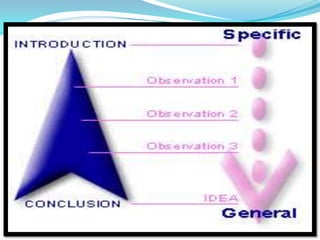
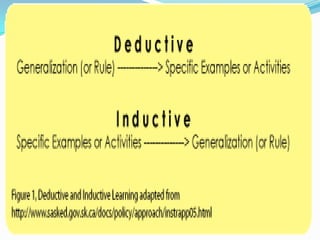
In inductive method  the pupils are led from particular instances to general conclusionConcrete examples are given and with help students are helped to arrive at certain conclusions or principles.This method is more useful in lesson where rules, definitions,generalisations,laws and casual connections  between facts are to be established
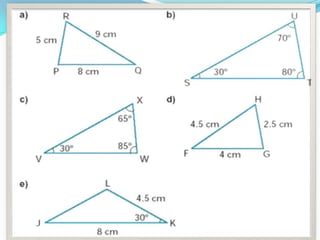
Example To teach the sum of the angles of a triangles is 180 , ask the students to draw triangles with different sets of measurements and measure the angles in each triangle, the students find that in all cases the sum of angles of triangle is 180 thus an abstract idea is established with the help of concrete situations by the students.
In language lesson, the teacher while teaching preposition may give examples like  ram is in the roomThe cat is under the table the book is on the tableThis may lead the students to find out the definition of proposition
MeritsIt stimulates the intellectual power of the students and sharpens all the faculties of the mindIt is a scientific method. It places the students on the track of discovery and develops self confidence in the studentsIt gives clear understandingActive participationIndependent of rote memoryRetention of knowledge is highIt is a psychological method as it moves from concrete to abstract
It is suitable for beginners DemeritsIt consumes more time Validity of generalization depends upon the number of particular cases taken up of study.After the derivation of the formula or a rule, the next immediate work to be taken is not explained
Deductive Deductive teaching method progresses from general concept to the specific use or application.Here the learner proceeds from general to particular, abstract to concrete and formula to examples.The rules and generalizations and principles are provided to the students and then they are asked to verify them with the help of particular example.
Example We say the formula simple interest is     Pnr/100 and then apply this rule for the calculation of S.I in every problem where S.I is to be calculatedWe have an axiom that “two distinct lines in a plane are either parallel or intersecting” (general).  Based on this axiom, the corresponding theorem is: “Two distinct lines in a plane cannot have more than one point in common.” (Specific). Thus this is an example of deductive method.
Merits this is short and time savingIt is useful for all topicsIt is suitable for all types of students, even below average students can follow this methodIt increases speed and efficiency
Demerits It is very difficult for the beginner to understand an abstract formula if it is not preceded by a number of instancesIt lays emphasis on rote memoryStudents are passive learners
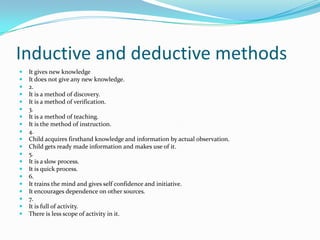
Inductive and deductive methodsIt gives new knowledgeIt does not give any new knowledge.2.It is a method of discovery.It is a method of verification.3.It is a method of teaching.It is the method of instruction.4.Child acquires firsthand knowledge and information by actual observation.Child gets ready made information and makes use of it.5.It is a slow process.It is quick process.6.It trains the mind and gives self confidence and initiative.It encourages dependence on other sources.7.It is full of activity.There is less scope of activity in it.

Advanced methods of teaching

  • 1.
    Advanced methods ofteaching Strategies of teaching and interaction teachingDrill work , Review , Assignment ,Inductive and deductive strategy
  • 2.
    Drill work Drillis a way to revise a lesson that has already been taughtDrill work should be based on the principle of learning by doing and on the law of exercisesDrill is the one of the most commonly used fixed devices. it gives a sense of achievement and confidence and so it proves a positive stimulus for further learning.
  • 3.
    It has beenfound quite useful particularly in case of average and below average studentsDrill provides an opportunity to the student to work independently.PrecautionsDrill work should properly planned.It should be meaningfulIt should follow understanding, only then drill work is useful .
  • 4.
    Drill work shouldbe individualized to the maximum possible extent. All the students do not have the same level of learning and intelligence. The consideration of individual differences should always be kept in mind.The drill work should always be based on facts taught. New facts or rules should not be given in drill workIt should be properly supervisedIt should be variedIt should be never given as punishment
  • 5.
    The achievement oflearner should be evaluated frequentlyThe teacher should provide proper environment for drill work
  • 6.
    In every subjectof the school curriculum there are certain parts or topics which demand drill work in order that they are learnt well, exercises in mathematics, reading, handwriting,speling in language map work in geography and history etc
  • 12.
    ReviewReview means toview again .It is a mental process of going over the learnt materialsThe previous experiences are recalled for better understanding and commandIt involves new relationship and recognition of old materials
  • 13.
    Purpose ofreviewTo have better understanding To fix the knowledgeTo discover relationshipsTo develop new interest in old materialsTo link the new with the old
  • 14.
    Types of reviewThedaily lesson reviewTopical reviewUnit plan reviewCo-operative reviewReview by application
  • 15.
    Daily lesson reviewTeachercan review what has been already covered on the subject at the beginning of the period. This can be done by summarizing the previous lesson and assignment on it relating it to the lesson in hand. This can be done even by asking ‘recapitulatory’ type of questionsTopical and unit plan reviewA topic selected and various discussions on it are renewed. It is akin to the unit plan review in which an entire unit or sometimes several units are found necessary and advisable by some teachers. For example various lessons on the mughul period in the history of India have been given, a couple of classes could be devoted to the review of the whole unit or a topic like social reforms in the mughul period could be selected for review
  • 16.
    Co-operative review It involves both teacher and students, it can be in the form of discussion in which the whole class participates, and it is a sort of mass participation of the entire class in an inter-change of ideas under the guidance of teacher. This type of review is more suited to the students at the college level. Review by application In this type of review students are given opportunities of applying the knowledge gained in new situations or putting into practice all that they have learned in classroomReview by making diagrams, sketches, charts, models etc Good review involves a new way of handling materials, and as such can stimulate children’s interest in activity, changing the form of review, the use of the pictorial method in reviewing materials, e.g., preparation of charts, graphs and statistical tables, and the introduction of games and contests are the some of the ways of making a review interesting.
  • 17.
    Suggestion for makingeffective reviewIt should lead to new learningIt should lead to discovery of inter relationship It should lead to continuity, coherence and unity of subject matterIt should be directed to the weak points or doubts of the studentsReview for main points rather than for detailsEmploy review methods which involve visualizationReview both as short and at long intervals
  • 18.
    Assignment methodIt isa sort of self study which supplements classroom teachingIn this technique, the teacher assigns work provides guidelines and sets time limit for the completion of assignment.This method is generally advocated for teaching different subjects to pupils in the higher classes. The syllabus is split up into significant units or topics, each unit or topic, in its own, is subdivided into learning assignments for pupils
  • 19.
  • 20.
    Preparatory assignments: This assignment is given to find out the weakness in previous knowledge, and skill which are essential for learning new lessonStudy assignments:In this some new topic in learning will be involved the students will be asked to prepare assignment with the help of the teacher guidance, help, reference book. This assignment is not be used for lower classes
  • 21.
    PurposiveThis is givenwhile learning a new lesson or a topicIts purposes areTo check up the retention and reproduction abilityTo evaluate understandingRemedial It is given in the light of the feedback got from the student’s weakness in learning.
  • 22.
    Various steps inthe assignment:PlanningProviding guidelinesSupervising the work assignedEvaluating the assignment work
  • 23.
    Criteria of goodassignmentIt should be definite , clear and interestingIt should sufficiently challenge to stimulate pupil’s interest in itIt should be significantly related to the topic of which it forms a part. It should lead pupil’s to meaningful complete learning experiencesIt should appeal to the pupil’s curiosity or his desire to achieve a well established interest.It should be flexible enough to meet the different range of interests and abilities represented in the group.
  • 24.
  • 25.
    In inductive method the pupils are led from particular instances to general conclusionConcrete examples are given and with help students are helped to arrive at certain conclusions or principles.This method is more useful in lesson where rules, definitions,generalisations,laws and casual connections between facts are to be established
  • 27.
    Example To teachthe sum of the angles of a triangles is 180 , ask the students to draw triangles with different sets of measurements and measure the angles in each triangle, the students find that in all cases the sum of angles of triangle is 180 thus an abstract idea is established with the help of concrete situations by the students.
  • 29.
    In language lesson,the teacher while teaching preposition may give examples like ram is in the roomThe cat is under the table the book is on the tableThis may lead the students to find out the definition of proposition
  • 30.
    MeritsIt stimulates theintellectual power of the students and sharpens all the faculties of the mindIt is a scientific method. It places the students on the track of discovery and develops self confidence in the studentsIt gives clear understandingActive participationIndependent of rote memoryRetention of knowledge is highIt is a psychological method as it moves from concrete to abstract
  • 31.
    It is suitablefor beginners DemeritsIt consumes more time Validity of generalization depends upon the number of particular cases taken up of study.After the derivation of the formula or a rule, the next immediate work to be taken is not explained
  • 32.
    Deductive Deductive teachingmethod progresses from general concept to the specific use or application.Here the learner proceeds from general to particular, abstract to concrete and formula to examples.The rules and generalizations and principles are provided to the students and then they are asked to verify them with the help of particular example.
  • 33.
    Example We saythe formula simple interest is Pnr/100 and then apply this rule for the calculation of S.I in every problem where S.I is to be calculatedWe have an axiom that “two distinct lines in a plane are either parallel or intersecting” (general).  Based on this axiom, the corresponding theorem is: “Two distinct lines in a plane cannot have more than one point in common.” (Specific). Thus this is an example of deductive method.
  • 34.
    Merits this isshort and time savingIt is useful for all topicsIt is suitable for all types of students, even below average students can follow this methodIt increases speed and efficiency
  • 35.
    Demerits It isvery difficult for the beginner to understand an abstract formula if it is not preceded by a number of instancesIt lays emphasis on rote memoryStudents are passive learners
  • 37.
    Inductive and deductivemethodsIt gives new knowledgeIt does not give any new knowledge.2.It is a method of discovery.It is a method of verification.3.It is a method of teaching.It is the method of instruction.4.Child acquires firsthand knowledge and information by actual observation.Child gets ready made information and makes use of it.5.It is a slow process.It is quick process.6.It trains the mind and gives self confidence and initiative.It encourages dependence on other sources.7.It is full of activity.There is less scope of activity in it.