COMPARISON OF GEOMETRY-BASED DOPPLER AMBIGUITY RESOLVER IN SQUINT SAR   & Wenchao Li University of Electronic Science and Technology of China AN INDIRECT DOPPLER RATE ESTIMATION SCHEME OF SAR IN LOW-CONTRAST SCENE
Introduction Synthetic Aperture Radar (SAR) An important remote sensing tool.  Monostatic SAR  Bistatic SAR Stripmap SAR Scan SAR Spotlight SAR Side-looking SAR Squint-looking SAR ……
Introduction Squint SAR Geometry model Squint angle
Introduction Squint SAR Range History : The linear term is  range walk  The quadratic term is  range curvature
Introduction Doppler centroid (  ) Doppler rate (  ) After range walk correction, the azimuth data can be modeled as a linear frequency modulated (LFM) signal, Signal model
Introduction In principle, it is possible to compute Doppler parameter from prior information provided by GPS/INS, but measurement uncertainties on the information will limit the accuracy.
Introduction An incorrect Doppler centroid   a loss of SNR; an increase in the azimuth ambiguity level;  a shift in the location of the target; … ...  Incorrect Doppler rate Correct Doppler rate An incorrect Doppler rate would blur the image.
Introduction Therefore, Doppler parameter Estimation from echo data is an essential procedure for high quality SAR processing
Doppler centroid estimation (Resolve Doppler centroid ambiguity)
Doppler centroid estimation As azimuth data are sampled by pulse repetition frequency (PRF), there is always Doppler centroid ambiguity, and the bigger the squint angle is, the more serious the doppler ambiguity will be.  Doppler centroid is usually expressed in two parts: the baseband Doppler centroid and Doppler ambiguity number .
Doppler centroid estimation Multiple PRF Wavelength diversity algorithm (WDA)  Multilook algorithms (MLCC,MLBF) Geometry-based algorithms
Geometry-based algorithms The relationship between Doppler centroid and range walk slope,  Since this method is based on the geometric characteristics of the range compressed data, it is named as a geometry-based Doppler ambiguity resolver. Then Doppler centroid can be computed via estimating the range walk slope.
Conventional Radon transform scheme Radon transform: A well-known tool for detecting slope.  It integrates intensity along every possible direction in the image and maps this information into a feature space. It involves two-dimensional search. Geometry-based algorithms
Iterative scheme The slope is seen as a searching variable, and entropy is used to measure the robustness of signal. It utilizes the prior information of platform, and replaces the Radon transform with a simple integration of image intensity over azimuth.  Geometry-based algorithms
Improved Radon transform scheme This scheme utilizes prior information of platform, convert the data into binary data, and conduct two-step Radon transform, which would make it is sparse and reduce the need to search the whole feature space .  Geometry-based algorithms
Comparisons It is obviously that they can give the accurate Doppler ambiguity number. While the speed of the iterative scheme and the improved Radon transform scheme is much faster than conventional Radon transform.
Doppler rate estimation (Autofocus)
Parametric Method  Metric-based Autofocus (Entropy/Contrast) Map Drift (MD) Shift and correlate (SAC) Doppler rate estimation Nonparametric Method  Prominent Point Processing (PPP) Phase Gradient Autofocus (PGA) Time-Frequency Analysis High contrast scene.
Low contrast scene Low SNR Without prominent point What can we do ? Doppler rate estimation
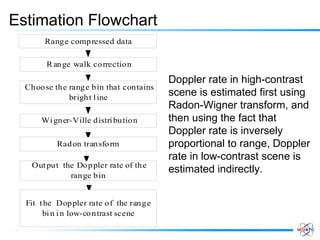
Estimation Scheme According to the fact that Doppler rate is inversely proportional to range,   It indicates that the Doppler rate in low- contrast scene can be estimated indirectly.
Estimation Flowchart Doppler rate in high-contrast scene is estimated first using Radon-Wigner transform, and then using the fact that Doppler rate is inversely proportional to range, Doppler rate in low-contrast scene is estimated indirectly.
Results High Contrast Scene   With Prominent Point Time frequency analysis   Radon transform Low Contrast Scene   Without  Prominent Point Time frequency analysis   Radon transform
Conclusions The geometry-based scheme can be used to resolve  Doppler ambiguity of SAR with large migration.  The speed of  improved Radon transform scheme and  the iterative scheme is about  ten times faster than  conventional Radon transform scheme. An indirect estimation scheme of Doppler rate for low  contrast scene is developed. The indirect scheme is effective, and it can reduce  computation time greatly.
Thank you for your listening!

Liwenchao.ppt

  • 1.
    COMPARISON OF GEOMETRY-BASEDDOPPLER AMBIGUITY RESOLVER IN SQUINT SAR & Wenchao Li University of Electronic Science and Technology of China AN INDIRECT DOPPLER RATE ESTIMATION SCHEME OF SAR IN LOW-CONTRAST SCENE
  • 2.
    Introduction Synthetic ApertureRadar (SAR) An important remote sensing tool. Monostatic SAR Bistatic SAR Stripmap SAR Scan SAR Spotlight SAR Side-looking SAR Squint-looking SAR ……
  • 3.
    Introduction Squint SARGeometry model Squint angle
  • 4.
    Introduction Squint SARRange History : The linear term is range walk The quadratic term is range curvature
  • 5.
    Introduction Doppler centroid( ) Doppler rate ( ) After range walk correction, the azimuth data can be modeled as a linear frequency modulated (LFM) signal, Signal model
  • 6.
    Introduction In principle,it is possible to compute Doppler parameter from prior information provided by GPS/INS, but measurement uncertainties on the information will limit the accuracy.
  • 7.
    Introduction An incorrectDoppler centroid a loss of SNR; an increase in the azimuth ambiguity level; a shift in the location of the target; … ... Incorrect Doppler rate Correct Doppler rate An incorrect Doppler rate would blur the image.
  • 8.
    Introduction Therefore, Dopplerparameter Estimation from echo data is an essential procedure for high quality SAR processing
  • 9.
    Doppler centroid estimation(Resolve Doppler centroid ambiguity)
  • 10.
    Doppler centroid estimationAs azimuth data are sampled by pulse repetition frequency (PRF), there is always Doppler centroid ambiguity, and the bigger the squint angle is, the more serious the doppler ambiguity will be. Doppler centroid is usually expressed in two parts: the baseband Doppler centroid and Doppler ambiguity number .
  • 11.
    Doppler centroid estimationMultiple PRF Wavelength diversity algorithm (WDA) Multilook algorithms (MLCC,MLBF) Geometry-based algorithms
  • 12.
    Geometry-based algorithms Therelationship between Doppler centroid and range walk slope, Since this method is based on the geometric characteristics of the range compressed data, it is named as a geometry-based Doppler ambiguity resolver. Then Doppler centroid can be computed via estimating the range walk slope.
  • 13.
    Conventional Radon transformscheme Radon transform: A well-known tool for detecting slope. It integrates intensity along every possible direction in the image and maps this information into a feature space. It involves two-dimensional search. Geometry-based algorithms
  • 14.
    Iterative scheme Theslope is seen as a searching variable, and entropy is used to measure the robustness of signal. It utilizes the prior information of platform, and replaces the Radon transform with a simple integration of image intensity over azimuth. Geometry-based algorithms
  • 15.
    Improved Radon transformscheme This scheme utilizes prior information of platform, convert the data into binary data, and conduct two-step Radon transform, which would make it is sparse and reduce the need to search the whole feature space . Geometry-based algorithms
  • 16.
    Comparisons It isobviously that they can give the accurate Doppler ambiguity number. While the speed of the iterative scheme and the improved Radon transform scheme is much faster than conventional Radon transform.
  • 17.
  • 18.
    Parametric Method Metric-based Autofocus (Entropy/Contrast) Map Drift (MD) Shift and correlate (SAC) Doppler rate estimation Nonparametric Method Prominent Point Processing (PPP) Phase Gradient Autofocus (PGA) Time-Frequency Analysis High contrast scene.
  • 19.
    Low contrast sceneLow SNR Without prominent point What can we do ? Doppler rate estimation
  • 20.
    Estimation Scheme Accordingto the fact that Doppler rate is inversely proportional to range, It indicates that the Doppler rate in low- contrast scene can be estimated indirectly.
  • 21.
    Estimation Flowchart Dopplerrate in high-contrast scene is estimated first using Radon-Wigner transform, and then using the fact that Doppler rate is inversely proportional to range, Doppler rate in low-contrast scene is estimated indirectly.
  • 22.
    Results High ContrastScene With Prominent Point Time frequency analysis Radon transform Low Contrast Scene Without Prominent Point Time frequency analysis Radon transform
  • 23.
    Conclusions The geometry-basedscheme can be used to resolve Doppler ambiguity of SAR with large migration. The speed of improved Radon transform scheme and the iterative scheme is about ten times faster than conventional Radon transform scheme. An indirect estimation scheme of Doppler rate for low contrast scene is developed. The indirect scheme is effective, and it can reduce computation time greatly.
  • 24.
    Thank you foryour listening!