OPTIMAL SENSOR
POSITIONING FOR ISAR
      IMAGING
         Marco Martorella

          IGARSS 2010
      HONOLULU, HAWAII, JULY 2010
Motivation
•In ISAR, long data recordings are often needed in order to form
an image with desired characteristics (useful for target
classification)

•Such image characteristics depend of both the target motions
and the sensor position

•Since the target is often non-cooperative, only the sensor
position can be used as a degree of freedom to drive the outcome
towards the desired result

Need of a simple tool that provides the means for
predicting the optimal sensor position: this will
minimise the time on target and maximise the
probability of obtaining a desired image
Outline
•Background
 •ISAR imaging
 •Image Projection Plane (IPP)
•Sensor position as a degree of freedom
•Signal model
•IPP constraints
 •Front, Side, Top and Composite target views

•Cross-range resolution constraint
•Numerical results
•Conslusions
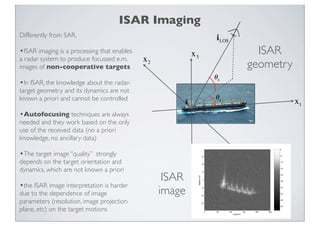
ISAR Imaging
Differently from SAR,                                          i LOS
•ISAR imaging is a processing that enables                x3             ISAR
a radar system to produce focussed e.m.      x2
images of non-cooperative targets                                      geometry
                                                               θe
•In ISAR, the knowledge about the radar-
target geometry and its dynamics are not
known a priori and cannot be controlled                        θa
                                                                                  x1
•Autofocusing techniques are always
needed and they work based on the only
use of the received data (no a priori
knowledge, no ancillary data)

•The target image “quality” strongly
depends on the target orientation and
dynamics, which are not known a priori
                                                   ISAR
•the ISAR image interpretation is harder
due to the dependence of image                    image
parameters (resolution, image projection
plane, etc) on the target motions
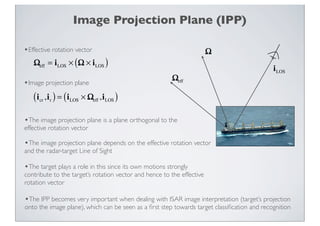
Image Projection Plane (IPP)

•Effective rotation vector                                              Ω
   Ωeff = i LOS × ( Ω × i LOS )
                                                                                             i LOS
                                                        Ωeff
•Image projection plane
   ( icr , ir ) = ( iLOS × Ωeff , iLOS )
•The image projection plane is a plane orthogonal to the
effective rotation vector

•The image projection plane depends on the effective rotation vector
and the radar-target Line of Sight

•The target plays a role in this since its own motions strongly
contribute to the target’s rotation vector and hence to the effective
rotation vector

•The IPP becomes very important when dealing with ISAR image interpretation (target’s projection
onto the image plane), which can be seen as a first step towards target classification and recognition
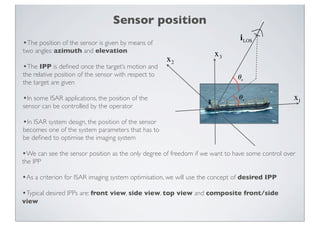
Sensor position
                                                                              i LOS
•The position of the sensor is given by means of
two angles: azimuth and elevation
                                                                     x3
                                                      x2
•The IPP is defined once the target’s motion and
the relative position of the sensor with respect to                          θe
the target are given

•In some ISAR applications, the position of the                               θa                 x1
sensor can be controlled by the operator

•In ISAR system design, the position of the sensor
becomes one of the system parameters that has to
be defined to optimise the imaging system

•We can see the sensor position as the only degree of freedom if we want to have some control over
the IPP

•As a criterion for ISAR imaging system optimisation, we will use the concept of desired IPP
•Typical desired IPPs are: front view, side view, top view and composite front/side
view
Signal model (1)
                                                                                     Tob=1.5 s
                              =
                                               Ideal Scatterers


             RADAR


•The cross-range image formation can be seen as a Doppler analysis
•Scatterers in different position along the cross-range direction produce different Doppler and
therefore are mapped in different cross-range positions in the image

•The Doppler induced by a scatterer positioned at x can be calculated analytically
                                          2
                                  fd (t) = [Ωef f (t) × x]
                                          λ
Signal model (2)
•The Doppler frequency can also be calculated by using a matrix notation
                                 2                  2 T      
                         fd (t) = [Ωef f (t) × x] =   Ω (t) Lx
                                 λ                  λ
                                                                                      Scatterer’s position
                Effective rotation vector         Rotation vector
                                                                    Sensor position
                                                                     related matrix
•where L is a 3x3 matrix with elements equal to
                                     L11 = L22 = L33 = 0
                                      L12 = −L21 = sin θe
                                   L31 = −L13 = cos θe sin θa
                                   L23 = −L32 = cos θa cos θe

•The Doppler frequency can therefore be rewritten as the sum of three contributions
                            fd (t) = L1 (t) x1 + L2 (t) x2 + L3 (t) x3

where Li ( t ) i = 1, 2, 3 are the Doppler Generating Factors (DGF)
                                  L1 (t) = Ω2 (t) L21 + Ω3 (t) L31
                                  L2 (t) = Ω1 (t) L12 + Ω3 (t) L32
                                  L3 (t) = Ω1 (t) L13 + Ω2 (t) L23
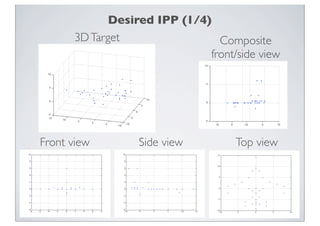
Desired IPP (1/4)
      3D Target                Composite
                             front/side view


Front view       Side view         Top view
Desired IPP (2/4)


•A desired IPP can be obtained by acting on the sensor position
•For front, side and top views, this can be done by constraining
  •one DGF
  •one of the two angles that define the sensor position
•For a composite front/side view, this can be done by constraining
  •two DGFs
  •none of the angles that define the sensor position
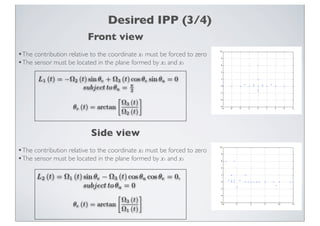
Desired IPP (3/4)
                         Front view
•The contribution relative to the coordinate x must be forced to zero
                                             1

•The sensor must be located in the plane formed by x and x
                                                     2      3


       L1 (t) = −Ω2 (t) sin θe + Ω3 (t) cos θe sin θa = 0
                      subject to θa = π 2
                                          
                                    Ω3 (t)
                  θe (t) = arctan
                                    Ω2 (t)


                          Side view
•The contribution relative to the coordinate x must be forced to zero
                                             2

•The sensor must be located in the plane formed by x and x
                                                     1      3


      L2 (t) = Ω1 (t) sin θe − Ω3 (t) cos θa cos θe = 0,
                      subject to θa = 0
                                            
                                    Ω3 (t)
                    θe (t) = arctan
                                    Ω1 (t)
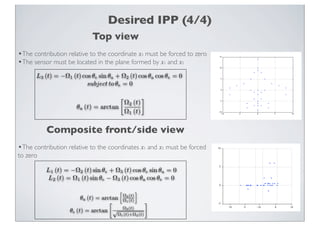
Desired IPP (4/4)
                            Top view
•The contribution relative to the coordinate x must be forced to zero
                                                           3

•The sensor must be located in the plane formed by x and x              1      2


      L3 (t) = −Ω1 (t) cos θe sin θa + Ω2 (t) cos θa cos θe = 0
                         subject to θe = 0

                                                          
                                     Ω2 (t)
                     θa (t) = arctan
                                     Ω1 (t)

          Composite front/side view
•The contribution relative to the coordinates x                1   and x2 must be forced
to zero

          L1 (t) = −Ω2 (t) sin θe + Ω3 (t) cos θe sin θa = 0
          L2 (t) = Ω1 (t) sin θe − Ω3 (t) cos θa cos θe = 0

                                                      
                                              Ω2 (t)
                        θa (t) = arctan       Ω1 (t)
                                                              
                                              Ω3 (t)
                   θe (t) = arctan √
                                      Ω1 (t)+Ω2 (t)
Cross-range Resolution Constraint
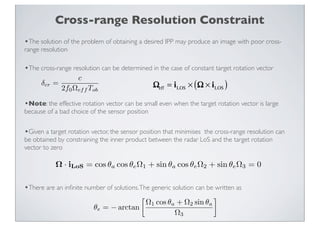
•The solution of the problem of obtaining a desired IPP may produce an image with poor cross-
range resolution

•The cross-range resolution can be determined in the case of constant target rotation vector
                    c
      δcr =
              2f0 Ωef f Tob                       Ωeff = i LOS × ( Ω × i LOS )

•Note: the effective rotation vector can be small even when the target rotation vector is large
because of a bad choice of the sensor position


•Given a target rotation vector, the sensor position that minimises
                                                                 the cross-range resolution can
be obtained by constraining the inner product between the radar LoS and the target rotation
vector to zero

           Ω · iLoS = cos θa cos θe Ω1 + sin θa cos θe Ω2 + sin θe Ω3 = 0

•There are an infinite number of solutions. The generic solution can be written as
                                                                       
                                                Ω1 cos θa + Ω2 sin θa
                          θe = − arctan
                                                         Ω3
Cross-range Resolution Constraint
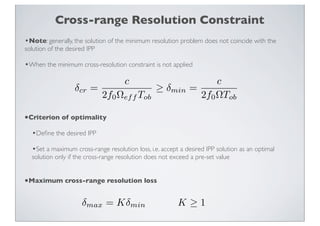
•Note: generally, the solution of the minimum resolution problem does not coincide with the
solution of the desired IPP

•When the minimum cross-resolution constraint is not applied

                                     c                             c
                   δcr =                        ≥ δmin       =
                              2f0 Ωef f Tob                    2f0 ΩTob

•Criterion of optimality
  •Define the desired IPP
  •Set a maximum cross-range resolution loss, i.e. accept a desired IPP solution as an optimal
  solution only if the cross-range resolution does not exceed a pre-set value


•Maximum cross-range resolution loss

                      δmax = Kδmin                       K≥1
Mapping target motion distribution onto
     optimal sensor position distribution
Non-cooperative target motions

   •are not known a priori and in a general case cannot be predicted with sufficient accuracy
   •depend on several parameters: both internal (e.g. target’s maneuvers) and external (e.g. sea
   conditions for a ship)

Statistical distribution of target motions

  •derived from models
  •derived from measurements

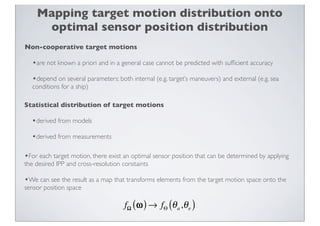
•For each target motion, there exist an optimal sensor position that can be determined by applying
the desired IPP and cross-resolution constaints

•We can see the result as a map that transforms elements from the target motion space onto the
sensor position space

                                      fΩ ( ω ) → fΘ (θ a ,θ e )
Numerical results (1/3)
                                                                                         DATA SET

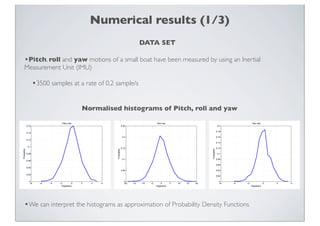
     •Pitch, roll and yaw motions of a small boat have been measured by using an Inertial
     Measurement Unit (IMU)

                         •3500 samples at a rate of 0.2 sample/s

                                                  Normalised histograms of Pitch, roll and yaw

                                     Pitch rate                                                   Roll rate                                                       Yaw rate
              0.16                                                          0.25                                                                0.2

                                                                                                                                               0.18
              0.14
                                                                             0.2                                                               0.16
              0.12
                                                                                                                                               0.14
               0.1
                                                                            0.15                                                               0.12
Probability


                                                              Probability


                                                                                                                                 Probability
              0.08                                                                                                                              0.1

                                                                             0.1                                                               0.08
              0.06
                                                                                                                                               0.06
              0.04
                                                                            0.05                                                               0.04
              0.02
                                                                                                                                               0.02

                0                                                             0                                                                  0
                     8      6   4   2         0   2   4   6                    20   15   10   5       0       5   10   15   20                        6   4   2               0   2   4
                                     Degrees/s                                                    Degrees/s                                                       Degrees/s


     •We can interpret the histograms as approximation of Probability Density Functions
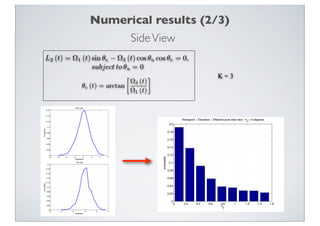
Numerical results (2/3)
                                                                               Side View
       L2 (t) = Ω1 (t) sin θe − Ω3 (t) cos θa cos θe = 0,
                       subject to θa = 0
                                                                                                                                           K=3
                                                                  Ω3 (t)
                                                  θe (t) = arctan
                                                                  Ω1 (t)

                                          Pitch rate
              0.16


              0.14

                                                                                                               Histogram    Elevation     Effective pure side view    a
                                                                                                                                                                          = 0 degrees
              0.12
                                                                                                     0.2
               0.1
Probability


              0.08                                                                                  0.18

              0.06
                                                                                                    0.16
              0.04
                                                                                                    0.14
              0.02


                0                                                                                   0.12


                                                                                      probability
                     8   6       4       2         0       2       4   6
                                          Degrees/s
                                          Yaw rate                                                   0.1
               0.2

              0.18
                                                                                                    0.08
              0.16

              0.14                                                                                  0.06
              0.12
Probability


               0.1
                                                                                                    0.04
              0.08
                                                                                                    0.02
              0.06

              0.04                                                                                    0
              0.02
                                                                                                           0    0.2        0.4      0.6         0.8        1         1.2        1.4     1.6
                                                                                                                                                  e
                0
                     6       4       2                 0       2       4
                                         Degrees/s
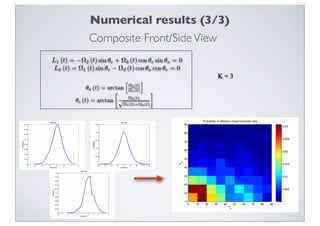
Numerical results (3/3)
                                                                                               Composite Front/Side View
                                    L1 (t) = −Ω2 (t) sin θe + Ω3 (t) cos θe sin θa = 0
                                    L2 (t) = Ω1 (t) sin θe − Ω3 (t) cos θa cos θe = 0
                                                                                                                                                                                                          K=3
                                                                                                                                                           
                                                                                                                                                   Ω2 (t)
                                                                               θa (t) = arctan                                                     Ω1 (t)
                                                                                                                                                                     
                                                                                                                                                   Ω3 (t)
                                                                          θe (t) = arctan √
                                                                                                                                          Ω1 (t)+Ω2 (t)


                                  Pitch rate                                                                                           Roll rate
                                                                                                                                                                                            Probability of effective mixed front/side view
              0.16                                                                                           0.25                                                             90
                                                                                                                                                                                                                                                       0.03
              0.14
                                                                                                              0.2
              0.12
                                                                                                                                                                              80

               0.1
                                                                                                             0.15
                                                                                                                                                                                                                                                       0.025
                                                                                                                                                                              70
Probability


                                                                                               Probability


              0.08

                                                                                                              0.1
              0.06
                                                                                                                                                                              60                                                                       0.02
              0.04
                                                                                                             0.05
              0.02                                                                                                                                                            50


                                                                                                                                                                          e
                0
                     8   6   4   2         0                  2       4    6
                                                                                                               0
                                                                                                                20   15       10   5       0       5   10   15   20
                                                                                                                                                                                                                                                       0.015
                                  Degrees/s                                                                                            Degrees/s                              40
                                                                               Yaw rate
                                                    0.2

                                                   0.18                                                                                                                       30                                                                       0.01
                                                   0.16

                                                   0.14                                                                                                                       20
                                                   0.12                                                                                                                                                                                                0.005
                                     Probability


                                                    0.1                                                                                                                       10
                                                   0.08

                                                   0.06
                                                                                                                                                                               0
                                                   0.04                                                                                                                            0   10     20     30      40       50     60      70      80   90
                                                   0.02                                                                                                                                                           a

                                                     0
                                                          6       4        2               0                    2         4
                                                                               Degrees/s
Conclusions
•Definition of optimality criteria for ISAR sensor positioning
•Mathematical derivation of a tool for predicting the optimal
sensor position

•Useful for placement of static sensors given the surveillance
scenario

•Useful for route planning of moving sensors
•Useful for predicting the probability of obtaining a desired IPP
given a scenario of interest and the position of the sensor

•Can be extended to bistatic and multistatic scenarios (please
check the proceedings of next EURAD conference)

FR4.L09 - OPTIMAL SENSOR POSITIONING FOR ISAR IMAGING

  • 1.
    OPTIMAL SENSOR POSITIONING FORISAR IMAGING Marco Martorella IGARSS 2010 HONOLULU, HAWAII, JULY 2010
  • 2.
    Motivation •In ISAR, longdata recordings are often needed in order to form an image with desired characteristics (useful for target classification) •Such image characteristics depend of both the target motions and the sensor position •Since the target is often non-cooperative, only the sensor position can be used as a degree of freedom to drive the outcome towards the desired result Need of a simple tool that provides the means for predicting the optimal sensor position: this will minimise the time on target and maximise the probability of obtaining a desired image
  • 3.
    Outline •Background •ISAR imaging •Image Projection Plane (IPP) •Sensor position as a degree of freedom •Signal model •IPP constraints •Front, Side, Top and Composite target views •Cross-range resolution constraint •Numerical results •Conslusions
  • 4.
    ISAR Imaging Differently fromSAR, i LOS •ISAR imaging is a processing that enables x3 ISAR a radar system to produce focussed e.m. x2 images of non-cooperative targets geometry θe •In ISAR, the knowledge about the radar- target geometry and its dynamics are not known a priori and cannot be controlled θa x1 •Autofocusing techniques are always needed and they work based on the only use of the received data (no a priori knowledge, no ancillary data) •The target image “quality” strongly depends on the target orientation and dynamics, which are not known a priori ISAR •the ISAR image interpretation is harder due to the dependence of image image parameters (resolution, image projection plane, etc) on the target motions
  • 5.
    Image Projection Plane(IPP) •Effective rotation vector Ω Ωeff = i LOS × ( Ω × i LOS ) i LOS Ωeff •Image projection plane ( icr , ir ) = ( iLOS × Ωeff , iLOS ) •The image projection plane is a plane orthogonal to the effective rotation vector •The image projection plane depends on the effective rotation vector and the radar-target Line of Sight •The target plays a role in this since its own motions strongly contribute to the target’s rotation vector and hence to the effective rotation vector •The IPP becomes very important when dealing with ISAR image interpretation (target’s projection onto the image plane), which can be seen as a first step towards target classification and recognition
  • 6.
    Sensor position i LOS •The position of the sensor is given by means of two angles: azimuth and elevation x3 x2 •The IPP is defined once the target’s motion and the relative position of the sensor with respect to θe the target are given •In some ISAR applications, the position of the θa x1 sensor can be controlled by the operator •In ISAR system design, the position of the sensor becomes one of the system parameters that has to be defined to optimise the imaging system •We can see the sensor position as the only degree of freedom if we want to have some control over the IPP •As a criterion for ISAR imaging system optimisation, we will use the concept of desired IPP •Typical desired IPPs are: front view, side view, top view and composite front/side view
  • 7.
    Signal model (1) Tob=1.5 s = Ideal Scatterers RADAR •The cross-range image formation can be seen as a Doppler analysis •Scatterers in different position along the cross-range direction produce different Doppler and therefore are mapped in different cross-range positions in the image •The Doppler induced by a scatterer positioned at x can be calculated analytically 2 fd (t) = [Ωef f (t) × x] λ
  • 8.
    Signal model (2) •TheDoppler frequency can also be calculated by using a matrix notation 2 2 T fd (t) = [Ωef f (t) × x] = Ω (t) Lx λ λ Scatterer’s position Effective rotation vector Rotation vector Sensor position related matrix •where L is a 3x3 matrix with elements equal to L11 = L22 = L33 = 0 L12 = −L21 = sin θe L31 = −L13 = cos θe sin θa L23 = −L32 = cos θa cos θe •The Doppler frequency can therefore be rewritten as the sum of three contributions fd (t) = L1 (t) x1 + L2 (t) x2 + L3 (t) x3 where Li ( t ) i = 1, 2, 3 are the Doppler Generating Factors (DGF) L1 (t) = Ω2 (t) L21 + Ω3 (t) L31 L2 (t) = Ω1 (t) L12 + Ω3 (t) L32 L3 (t) = Ω1 (t) L13 + Ω2 (t) L23
  • 9.
    Desired IPP (1/4) 3D Target Composite front/side view Front view Side view Top view
  • 10.
    Desired IPP (2/4) •Adesired IPP can be obtained by acting on the sensor position •For front, side and top views, this can be done by constraining •one DGF •one of the two angles that define the sensor position •For a composite front/side view, this can be done by constraining •two DGFs •none of the angles that define the sensor position
  • 11.
    Desired IPP (3/4) Front view •The contribution relative to the coordinate x must be forced to zero 1 •The sensor must be located in the plane formed by x and x 2 3 L1 (t) = −Ω2 (t) sin θe + Ω3 (t) cos θe sin θa = 0 subject to θa = π 2 Ω3 (t) θe (t) = arctan Ω2 (t) Side view •The contribution relative to the coordinate x must be forced to zero 2 •The sensor must be located in the plane formed by x and x 1 3 L2 (t) = Ω1 (t) sin θe − Ω3 (t) cos θa cos θe = 0, subject to θa = 0 Ω3 (t) θe (t) = arctan Ω1 (t)
  • 12.
    Desired IPP (4/4) Top view •The contribution relative to the coordinate x must be forced to zero 3 •The sensor must be located in the plane formed by x and x 1 2 L3 (t) = −Ω1 (t) cos θe sin θa + Ω2 (t) cos θa cos θe = 0 subject to θe = 0 Ω2 (t) θa (t) = arctan Ω1 (t) Composite front/side view •The contribution relative to the coordinates x 1 and x2 must be forced to zero L1 (t) = −Ω2 (t) sin θe + Ω3 (t) cos θe sin θa = 0 L2 (t) = Ω1 (t) sin θe − Ω3 (t) cos θa cos θe = 0 Ω2 (t) θa (t) = arctan Ω1 (t) Ω3 (t) θe (t) = arctan √ Ω1 (t)+Ω2 (t)
  • 13.
    Cross-range Resolution Constraint •Thesolution of the problem of obtaining a desired IPP may produce an image with poor cross- range resolution •The cross-range resolution can be determined in the case of constant target rotation vector c δcr = 2f0 Ωef f Tob Ωeff = i LOS × ( Ω × i LOS ) •Note: the effective rotation vector can be small even when the target rotation vector is large because of a bad choice of the sensor position •Given a target rotation vector, the sensor position that minimises the cross-range resolution can be obtained by constraining the inner product between the radar LoS and the target rotation vector to zero Ω · iLoS = cos θa cos θe Ω1 + sin θa cos θe Ω2 + sin θe Ω3 = 0 •There are an infinite number of solutions. The generic solution can be written as Ω1 cos θa + Ω2 sin θa θe = − arctan Ω3
  • 14.
    Cross-range Resolution Constraint •Note:generally, the solution of the minimum resolution problem does not coincide with the solution of the desired IPP •When the minimum cross-resolution constraint is not applied c c δcr = ≥ δmin = 2f0 Ωef f Tob 2f0 ΩTob •Criterion of optimality •Define the desired IPP •Set a maximum cross-range resolution loss, i.e. accept a desired IPP solution as an optimal solution only if the cross-range resolution does not exceed a pre-set value •Maximum cross-range resolution loss δmax = Kδmin K≥1
  • 15.
    Mapping target motiondistribution onto optimal sensor position distribution Non-cooperative target motions •are not known a priori and in a general case cannot be predicted with sufficient accuracy •depend on several parameters: both internal (e.g. target’s maneuvers) and external (e.g. sea conditions for a ship) Statistical distribution of target motions •derived from models •derived from measurements •For each target motion, there exist an optimal sensor position that can be determined by applying the desired IPP and cross-resolution constaints •We can see the result as a map that transforms elements from the target motion space onto the sensor position space fΩ ( ω ) → fΘ (θ a ,θ e )
  • 16.
    Numerical results (1/3) DATA SET •Pitch, roll and yaw motions of a small boat have been measured by using an Inertial Measurement Unit (IMU) •3500 samples at a rate of 0.2 sample/s Normalised histograms of Pitch, roll and yaw Pitch rate Roll rate Yaw rate 0.16 0.25 0.2 0.18 0.14 0.2 0.16 0.12 0.14 0.1 0.15 0.12 Probability Probability Probability 0.08 0.1 0.1 0.08 0.06 0.06 0.04 0.05 0.04 0.02 0.02 0 0 0 8 6 4 2 0 2 4 6 20 15 10 5 0 5 10 15 20 6 4 2 0 2 4 Degrees/s Degrees/s Degrees/s •We can interpret the histograms as approximation of Probability Density Functions
  • 17.
    Numerical results (2/3) Side View L2 (t) = Ω1 (t) sin θe − Ω3 (t) cos θa cos θe = 0, subject to θa = 0 K=3 Ω3 (t) θe (t) = arctan Ω1 (t) Pitch rate 0.16 0.14 Histogram Elevation Effective pure side view a = 0 degrees 0.12 0.2 0.1 Probability 0.08 0.18 0.06 0.16 0.04 0.14 0.02 0 0.12 probability 8 6 4 2 0 2 4 6 Degrees/s Yaw rate 0.1 0.2 0.18 0.08 0.16 0.14 0.06 0.12 Probability 0.1 0.04 0.08 0.02 0.06 0.04 0 0.02 0 0.2 0.4 0.6 0.8 1 1.2 1.4 1.6 e 0 6 4 2 0 2 4 Degrees/s
  • 18.
    Numerical results (3/3) Composite Front/Side View L1 (t) = −Ω2 (t) sin θe + Ω3 (t) cos θe sin θa = 0 L2 (t) = Ω1 (t) sin θe − Ω3 (t) cos θa cos θe = 0 K=3 Ω2 (t) θa (t) = arctan Ω1 (t) Ω3 (t) θe (t) = arctan √ Ω1 (t)+Ω2 (t) Pitch rate Roll rate Probability of effective mixed front/side view 0.16 0.25 90 0.03 0.14 0.2 0.12 80 0.1 0.15 0.025 70 Probability Probability 0.08 0.1 0.06 60 0.02 0.04 0.05 0.02 50 e 0 8 6 4 2 0 2 4 6 0 20 15 10 5 0 5 10 15 20 0.015 Degrees/s Degrees/s 40 Yaw rate 0.2 0.18 30 0.01 0.16 0.14 20 0.12 0.005 Probability 0.1 10 0.08 0.06 0 0.04 0 10 20 30 40 50 60 70 80 90 0.02 a 0 6 4 2 0 2 4 Degrees/s
  • 19.
    Conclusions •Definition of optimalitycriteria for ISAR sensor positioning •Mathematical derivation of a tool for predicting the optimal sensor position •Useful for placement of static sensors given the surveillance scenario •Useful for route planning of moving sensors •Useful for predicting the probability of obtaining a desired IPP given a scenario of interest and the position of the sensor •Can be extended to bistatic and multistatic scenarios (please check the proceedings of next EURAD conference)