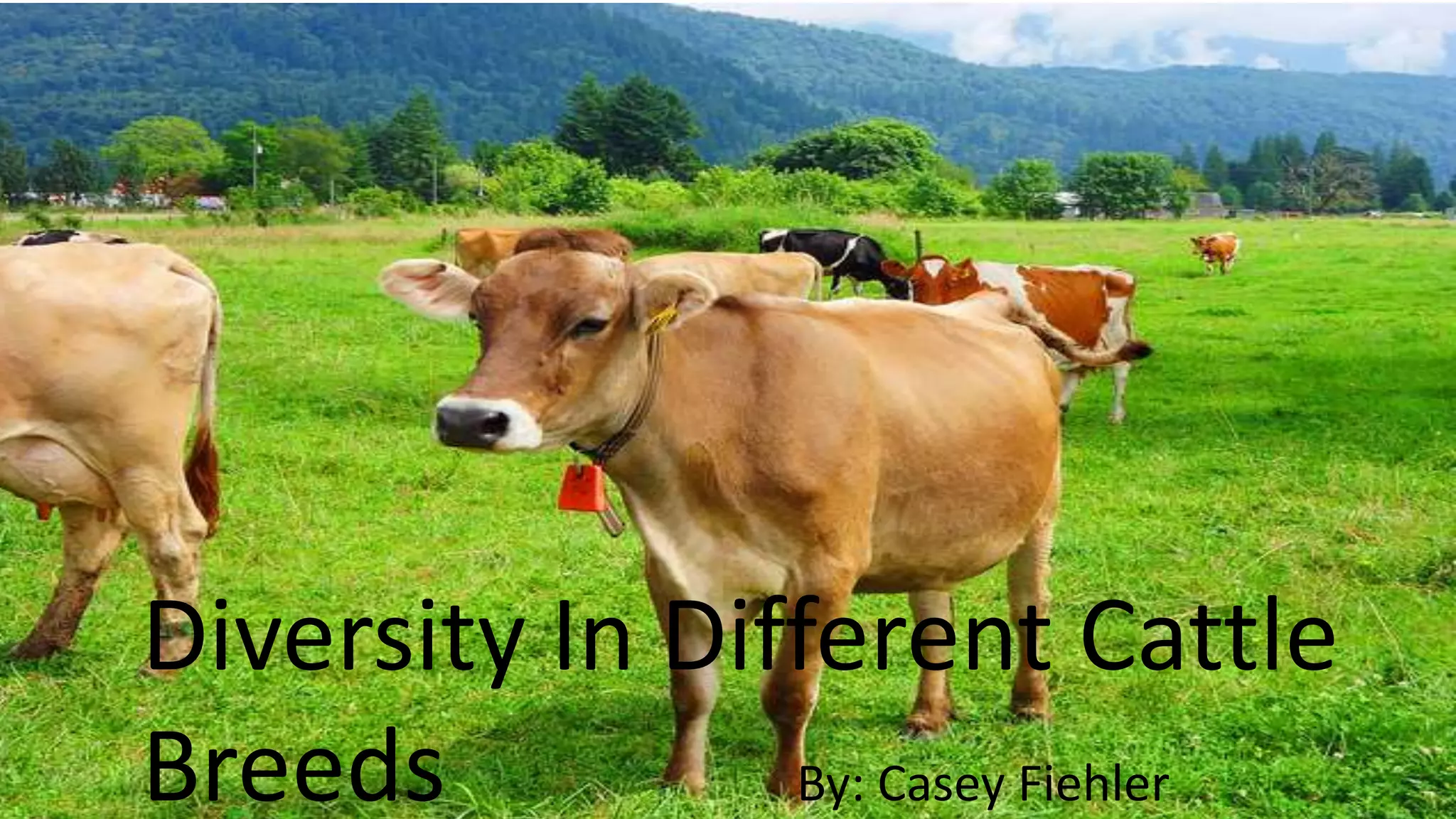
Diversity In Different Cattle
Breeds
By: Casey Fiehler
North American Dairy Cattle
Breeds
Ayrshir
11 different breeds of dairy breeds

Brown Swiss
Canadienne
Dutch Belted
Guernsey
Holstein
Jersey
Kerry
Milking Short horn
Dexter
Red Poll
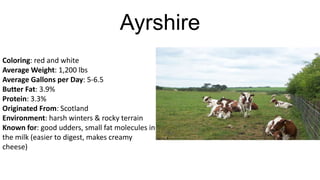
Ayrshire
Coloring: red and white
Average Weight: 1,200 lbs
Average Gallons per Day: 5-6.5
Butter Fat: 3.9%
Protein: 3.3%
Originated From: Scotland
Environment: harsh winters & rocky terrain
Known for: good udders, small fat molecules in
the milk (easier to digest, makes creamy
cheese)
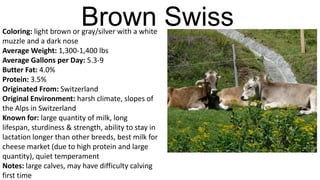
Brown Swiss

Coloring: light brown or gray/silver with a white
muzzle and a dark nose
Average Weight: 1,300-1,400 lbs
Average Gallons per Day: 5.3-9
Butter Fat: 4.0%
Protein: 3.5%
Originated From: Switzerland
Original Environment: harsh climate, slopes of
the Alps in Switzerland
Known for: large quantity of milk, long
lifespan, sturdiness & strength, ability to stay in
lactation longer than other breeds, best milk for
cheese market (due to high protein and large
quantity), quiet temperament
Notes: large calves, may have difficulty calving
first time
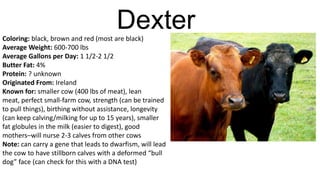
Dexter
Coloring: black, brown and red (most are black)
Average Weight: 600-700 lbs
Average Gallons per Day: 1 1/2-2 1/2
Butter Fat: 4%
Protein: ? unknown
Originated From: Ireland
Known for: smaller cow (400 lbs of meat), lean
meat, perfect small-farm cow, strength (can be trained
to pull things), birthing without assistance, longevity
(can keep calving/milking for up to 15 years), smaller
fat globules in the milk (easier to digest), good
mothers–will nurse 2-3 calves from other cows
Note: can carry a gene that leads to dwarfism, will lead
the cow to have stillborn calves with a deformed “bull
dog” face (can check for this with a DNA test)
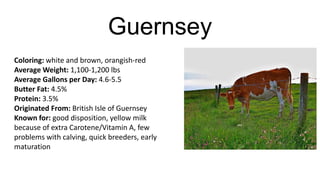
Guernsey
Coloring: white and brown, orangish-red
Average Weight: 1,100-1,200 lbs
Average Gallons per Day: 4.6-5.5
Butter Fat: 4.5%
Protein: 3.5%
Originated From: British Isle of Guernsey
Known for: good disposition, yellow milk
because of extra Carotene/Vitamin A, few
problems with calving, quick breeders, early
maturation
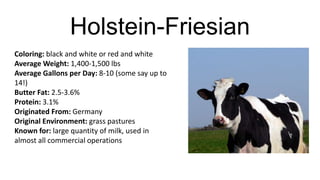
Holstein-Friesian
Coloring: black and white or red and white
Average Weight: 1,400-1,500 lbs
Average Gallons per Day: 8-10 (some say up to
14!)
Butter Fat: 2.5-3.6%
Protein: 3.1%
Originated From: Germany
Original Environment: grass pastures
Known for: large quantity of milk, used in
almost all commercial operations
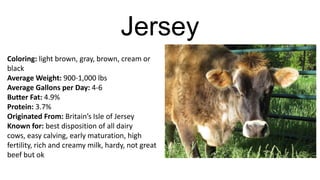
Jersey
Coloring: light brown, gray, brown, cream or
black
Average Weight: 900-1,000 lbs
Average Gallons per Day: 4-6
Butter Fat: 4.9%
Protein: 3.7%
Originated From: Britain’s Isle of Jersey
Known for: best disposition of all dairy
cows, easy calving, early maturation, high
fertility, rich and creamy milk, hardy, not great
beef but ok
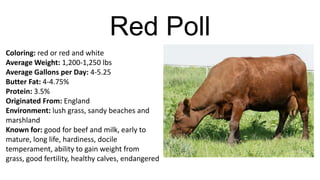
Red Poll
Coloring: red or red and white
Average Weight: 1,200-1,250 lbs
Average Gallons per Day: 4-5.25
Butter Fat: 4-4.75%
Protein: 3.5%
Originated From: England
Environment: lush grass, sandy beaches and
marshland
Known for: good for beef and milk, early to
mature, long life, hardiness, docile
temperament, ability to gain weight from
grass, good fertility, healthy calves, endangered
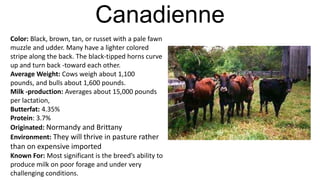
Canadienne
Color: Black, brown, tan, or russet with a pale fawn
muzzle and udder. Many have a lighter colored
stripe along the back. The black-tipped horns curve
up and turn back -toward each other.
Average Weight: Cows weigh about 1,100
pounds, and bulls about 1,600 pounds.
Milk -production: Averages about 15,000 pounds
per lactation,
Butterfat: 4.35%
Protein: 3.7%
Originated: Normandy and Brittany
Environment: They will thrive in pasture rather

than on expensive imported
Known For: Most significant is the breed’s ability to
produce milk on poor forage and under very
challenging conditions.
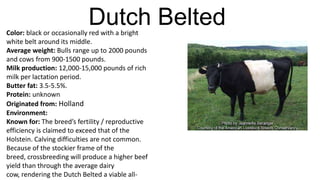
Dutch Belted

Color: black or occasionally red with a bright
white belt around its middle.
Average weight: Bulls range up to 2000 pounds
and cows from 900-1500 pounds.
Milk production: 12,000-15,000 pounds of rich
milk per lactation period.
Butter fat: 3.5-5.5%.
Protein: unknown
Originated from: Holland
Environment:
Known for: The breed’s fertility / reproductive
efficiency is claimed to exceed that of the
Holstein. Calving difficulties are not common.
Because of the stockier frame of the
breed, crossbreeding will produce a higher beef
yield than through the average dairy
cow, rendering the Dutch Belted a viable all-
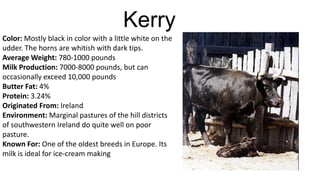
Kerry
Color: Mostly black in color with a little white on the
udder. The horns are whitish with dark tips.
Average Weight: 780-1000 pounds
Milk Production: 7000-8000 pounds, but can
occasionally exceed 10,000 pounds
Butter Fat: 4%
Protein: 3.24%
Originated From: Ireland
Environment: Marginal pastures of the hill districts
of southwestern Ireland do quite well on poor
pasture.
Known For: One of the oldest breeds in Europe. Its
milk is ideal for ice-cream making
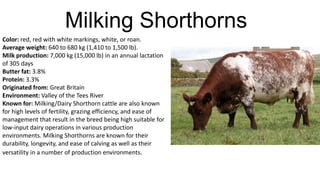
Milking Shorthorns
Color: red, red with white markings, white, or roan.
Average weight: 640 to 680 kg (1,410 to 1,500 lb).
Milk production: 7,000 kg (15,000 lb) in an annual lactation
of 305 days
Butter fat: 3.8%
Protein: 3.3%
Originated from: Great Britain
Environment: Valley of the Tees River
Known for: Milking/Dairy Shorthorn cattle are also known
for high levels of fertility, grazing efficiency, and ease of
management that result in the breed being high suitable for
low-input dairy operations in various production
environments. Milking Shorthorns are known for their
durability, longevity, and ease of calving as well as their
versatility in a number of production environments.
Beef Cattle Breeds
Black Angus
Red Angus
Herefordshire
Piedmontese
Waguyu
Charolais cow
Brangus
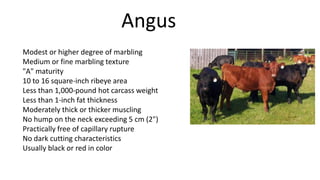
Angus
Modest or higher degree of marbling
Medium or fine marbling texture
"A" maturity
10 to 16 square-inch ribeye area
Less than 1,000-pound hot carcass weight
Less than 1-inch fat thickness
Moderately thick or thicker muscling
No hump on the neck exceeding 5 cm (2")
Practically free of capillary rupture
No dark cutting characteristics
Usually black or red in color
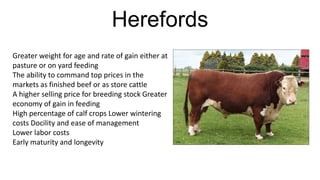
Herefords
Greater weight for age and rate of gain either at
pasture or on yard feeding
The ability to command top prices in the
markets as finished beef or as store cattle
A higher selling price for breeding stock Greater
economy of gain in feeding
High percentage of calf crops Lower wintering
costs Docility and ease of management
Lower labor costs
Early maturity and longevity
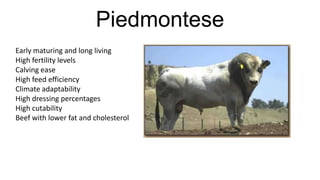
Piedmontese
Early maturing and long living
High fertility levels
Calving ease
High feed efficiency
Climate adaptability
High dressing percentages
High cutability
Beef with lower fat and cholesterol
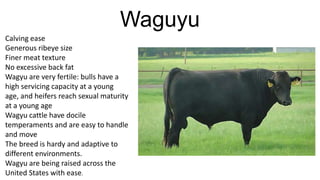
Waguyu
Calving ease
Generous ribeye size
Finer meat texture
No excessive back fat
Wagyu are very fertile: bulls have a
high servicing capacity at a young
age, and heifers reach sexual maturity
at a young age
Wagyu cattle have docile
temperaments and are easy to handle
and move
The breed is hardy and adaptive to
different environments.
Wagyu are being raised across the
United States with ease.
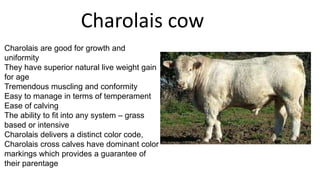
Charolais cow
Charolais are good for growth and
uniformity
They have superior natural live weight gain
for age
Tremendous muscling and conformity
Easy to manage in terms of temperament
Ease of calving
The ability to fit into any system – grass
based or intensive
Charolais delivers a distinct color code,
Charolais cross calves have dominant color
markings which provides a guarantee of
their parentage
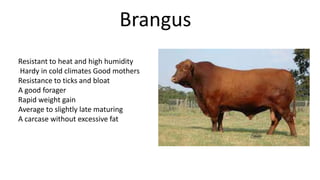
Brangus
Resistant to heat and high humidity
Hardy in cold climates Good mothers
Resistance to ticks and bloat
A good forager
Rapid weight gain
Average to slightly late maturing
A carcase without excessive fat
Fistulated
Fistulated cow: is a cow with an intentional hole in it for scientific research. In 1822, a
Canadian suffered a wound that refused to heal, but the man otherwise was in fine health.
His doctor discovered that the digestive process could be observed directly through the hole.
The discovery spread, and for over 150 years, fistulation has been used to observe digestive
processes in living animals, with the first recorded scientific use on animals dating to 1833.
In modern days, scientists install a plastic device called a 'cannula' into the side or stomach of
an animal which allows them access to the various organs. In the case of the Davis fistulated
cows, they observe how fast the cow digests various foods and what chemical/biological
processes the food undergoes.
To learn more about fistulation there is a video link below.
http://www.youtube.com/watch?v=-ban6fHArBU

Cf cattle bio_div

  • 1.
    Diversity In DifferentCattle Breeds By: Casey Fiehler
  • 2.
    North American DairyCattle Breeds Ayrshir 11 different breeds of dairy breeds Brown Swiss Canadienne Dutch Belted Guernsey Holstein Jersey Kerry Milking Short horn Dexter Red Poll
  • 3.
    Ayrshire Coloring: red andwhite Average Weight: 1,200 lbs Average Gallons per Day: 5-6.5 Butter Fat: 3.9% Protein: 3.3% Originated From: Scotland Environment: harsh winters & rocky terrain Known for: good udders, small fat molecules in the milk (easier to digest, makes creamy cheese)
  • 4.
    Brown Swiss Coloring: lightbrown or gray/silver with a white muzzle and a dark nose Average Weight: 1,300-1,400 lbs Average Gallons per Day: 5.3-9 Butter Fat: 4.0% Protein: 3.5% Originated From: Switzerland Original Environment: harsh climate, slopes of the Alps in Switzerland Known for: large quantity of milk, long lifespan, sturdiness & strength, ability to stay in lactation longer than other breeds, best milk for cheese market (due to high protein and large quantity), quiet temperament Notes: large calves, may have difficulty calving first time
  • 5.
    Dexter Coloring: black, brownand red (most are black) Average Weight: 600-700 lbs Average Gallons per Day: 1 1/2-2 1/2 Butter Fat: 4% Protein: ? unknown Originated From: Ireland Known for: smaller cow (400 lbs of meat), lean meat, perfect small-farm cow, strength (can be trained to pull things), birthing without assistance, longevity (can keep calving/milking for up to 15 years), smaller fat globules in the milk (easier to digest), good mothers–will nurse 2-3 calves from other cows Note: can carry a gene that leads to dwarfism, will lead the cow to have stillborn calves with a deformed “bull dog” face (can check for this with a DNA test)
  • 6.
    Guernsey Coloring: white andbrown, orangish-red Average Weight: 1,100-1,200 lbs Average Gallons per Day: 4.6-5.5 Butter Fat: 4.5% Protein: 3.5% Originated From: British Isle of Guernsey Known for: good disposition, yellow milk because of extra Carotene/Vitamin A, few problems with calving, quick breeders, early maturation
  • 7.
    Holstein-Friesian Coloring: black andwhite or red and white Average Weight: 1,400-1,500 lbs Average Gallons per Day: 8-10 (some say up to 14!) Butter Fat: 2.5-3.6% Protein: 3.1% Originated From: Germany Original Environment: grass pastures Known for: large quantity of milk, used in almost all commercial operations
  • 8.
    Jersey Coloring: light brown,gray, brown, cream or black Average Weight: 900-1,000 lbs Average Gallons per Day: 4-6 Butter Fat: 4.9% Protein: 3.7% Originated From: Britain’s Isle of Jersey Known for: best disposition of all dairy cows, easy calving, early maturation, high fertility, rich and creamy milk, hardy, not great beef but ok
  • 9.
    Red Poll Coloring: redor red and white Average Weight: 1,200-1,250 lbs Average Gallons per Day: 4-5.25 Butter Fat: 4-4.75% Protein: 3.5% Originated From: England Environment: lush grass, sandy beaches and marshland Known for: good for beef and milk, early to mature, long life, hardiness, docile temperament, ability to gain weight from grass, good fertility, healthy calves, endangered
  • 10.
    Canadienne Color: Black, brown,tan, or russet with a pale fawn muzzle and udder. Many have a lighter colored stripe along the back. The black-tipped horns curve up and turn back -toward each other. Average Weight: Cows weigh about 1,100 pounds, and bulls about 1,600 pounds. Milk -production: Averages about 15,000 pounds per lactation, Butterfat: 4.35% Protein: 3.7% Originated: Normandy and Brittany Environment: They will thrive in pasture rather than on expensive imported Known For: Most significant is the breed’s ability to produce milk on poor forage and under very challenging conditions.
  • 11.
    Dutch Belted Color: blackor occasionally red with a bright white belt around its middle. Average weight: Bulls range up to 2000 pounds and cows from 900-1500 pounds. Milk production: 12,000-15,000 pounds of rich milk per lactation period. Butter fat: 3.5-5.5%. Protein: unknown Originated from: Holland Environment: Known for: The breed’s fertility / reproductive efficiency is claimed to exceed that of the Holstein. Calving difficulties are not common. Because of the stockier frame of the breed, crossbreeding will produce a higher beef yield than through the average dairy cow, rendering the Dutch Belted a viable all-
  • 12.
    Kerry Color: Mostly blackin color with a little white on the udder. The horns are whitish with dark tips. Average Weight: 780-1000 pounds Milk Production: 7000-8000 pounds, but can occasionally exceed 10,000 pounds Butter Fat: 4% Protein: 3.24% Originated From: Ireland Environment: Marginal pastures of the hill districts of southwestern Ireland do quite well on poor pasture. Known For: One of the oldest breeds in Europe. Its milk is ideal for ice-cream making
  • 13.
    Milking Shorthorns Color: red,red with white markings, white, or roan. Average weight: 640 to 680 kg (1,410 to 1,500 lb). Milk production: 7,000 kg (15,000 lb) in an annual lactation of 305 days Butter fat: 3.8% Protein: 3.3% Originated from: Great Britain Environment: Valley of the Tees River Known for: Milking/Dairy Shorthorn cattle are also known for high levels of fertility, grazing efficiency, and ease of management that result in the breed being high suitable for low-input dairy operations in various production environments. Milking Shorthorns are known for their durability, longevity, and ease of calving as well as their versatility in a number of production environments.
  • 14.
    Beef Cattle Breeds BlackAngus Red Angus Herefordshire Piedmontese Waguyu Charolais cow Brangus
  • 15.
    Angus Modest or higherdegree of marbling Medium or fine marbling texture "A" maturity 10 to 16 square-inch ribeye area Less than 1,000-pound hot carcass weight Less than 1-inch fat thickness Moderately thick or thicker muscling No hump on the neck exceeding 5 cm (2") Practically free of capillary rupture No dark cutting characteristics Usually black or red in color
  • 16.
    Herefords Greater weight forage and rate of gain either at pasture or on yard feeding The ability to command top prices in the markets as finished beef or as store cattle A higher selling price for breeding stock Greater economy of gain in feeding High percentage of calf crops Lower wintering costs Docility and ease of management Lower labor costs Early maturity and longevity
  • 17.
    Piedmontese Early maturing andlong living High fertility levels Calving ease High feed efficiency Climate adaptability High dressing percentages High cutability Beef with lower fat and cholesterol
  • 18.
    Waguyu Calving ease Generous ribeyesize Finer meat texture No excessive back fat Wagyu are very fertile: bulls have a high servicing capacity at a young age, and heifers reach sexual maturity at a young age Wagyu cattle have docile temperaments and are easy to handle and move The breed is hardy and adaptive to different environments. Wagyu are being raised across the United States with ease.
  • 19.
    Charolais cow Charolais aregood for growth and uniformity They have superior natural live weight gain for age Tremendous muscling and conformity Easy to manage in terms of temperament Ease of calving The ability to fit into any system – grass based or intensive Charolais delivers a distinct color code, Charolais cross calves have dominant color markings which provides a guarantee of their parentage
  • 20.
    Brangus Resistant to heatand high humidity Hardy in cold climates Good mothers Resistance to ticks and bloat A good forager Rapid weight gain Average to slightly late maturing A carcase without excessive fat
  • 21.
    Fistulated Fistulated cow: isa cow with an intentional hole in it for scientific research. In 1822, a Canadian suffered a wound that refused to heal, but the man otherwise was in fine health. His doctor discovered that the digestive process could be observed directly through the hole. The discovery spread, and for over 150 years, fistulation has been used to observe digestive processes in living animals, with the first recorded scientific use on animals dating to 1833. In modern days, scientists install a plastic device called a 'cannula' into the side or stomach of an animal which allows them access to the various organs. In the case of the Davis fistulated cows, they observe how fast the cow digests various foods and what chemical/biological processes the food undergoes. To learn more about fistulation there is a video link below. http://www.youtube.com/watch?v=-ban6fHArBU