

SLAUGTERING of ANIMALS
and PROCESSING of
THEIR PRODUCTS
 Lecture (50%)
First Long exam 25%
Mid-term Long Exam 25%
Third/Final Long Exam 25%
Quizzes (Surprise) 15%
Assignments/Attendance 10%
GRADING SYSTEM
A
G
R
C
6
 Laboratory (50%)
 Hands-on activities 50%
 Project/Portfolio 25%
Quizzes (Surprise) 15%
Assignments/Attendance 10%
GRADING SYSTEM
A
G
R
C
6
 IMPORTANCE of ANIMAL
PRODUCTS
 good source of meat, milk and
eggs (source of income, family
consumption)
protein-55% and calories-16%
(FAO, 1992)
INTRODUCTION
A
G
R
C
6
 ABATTOIR - registered/approved
premises authorized by BFAD/BAI
where slaughtering of animals takes
place (human consumption)
 BRAND – mark/stamp/tag/label
which represents the approval of the
LI/DMI
CARCASS – body of any
slaughtered animal after bleeding
and dressing
TERMINOLOGIES
A
G
R
C
6
 COLD SLAUGHTER - slaughtering
of double dead animals
 DRESSING – removal of animal
parts not intended for human
consumption
FARBRICATION – process of
cutting carcass into standard
wholesale and retail cuts
TERMINOLOGIES
A
G
R
C
6
CONDEMNED- carcass marked as
unsound, unhealthy and unfit for
human consumption but fit as feed
stuff (PASSED)
REACTOR– animal shows evidence
of disease after specific test
application
PSE – pale, soft and exudative
meat (swine)
TERMINOLOGIES
A
G
R
C
6
FRESH MEAT – from animals NOT
undergone any substantial physical,
microbial and chemical change
DFD – dark, firm and dry meat
(BEEF)
HOT MEAT – from food animal and
poultry clandestinely slaughtered and
sold to public
FOOD ANIMAL – all domestic
livestock killed for human
consumption
TERMINOLOGIES
A
G
R
C
6
FLEECE and WOOL– and hairs
obtained from goats and sheep,
respectively
OFFAL– by-products, organs, glands
and tissues other than carcass (may
or may not be edible)
RESIDUES– foreign substances (i.e.
metabolites, therapeutic/prophylactic
agents) remaining in the carcass
which are hazardous to human
health
TERMINOLOGIES
A
G
R
C
6
TRIPE– rumen, reticulum and
omasum of compound stomach
animals
GIBLETS– heart, liver and gizzard
RIGOR MORTIS– muscle stiffening
after death of the animal due to
muscle contraction (stress and
improper handling of animals during
slaughtering)
TERMINOLOGIES
A
G
R
C
6
FASTING – withholding feed from
the animal prior to slaughtering
(water in ad libitum basis)
STUNNING – process of making the
animals unconscious prior to bleeding
FLAYING/SKINNING– act of hide
removal (goat, cattle, carabao)
SINGEING – application of flame to
carcass to burn the scraped and
unshaved hairs (goat, cattle,
carabao)
TERMINOLOGIES
A
G
R
C
6
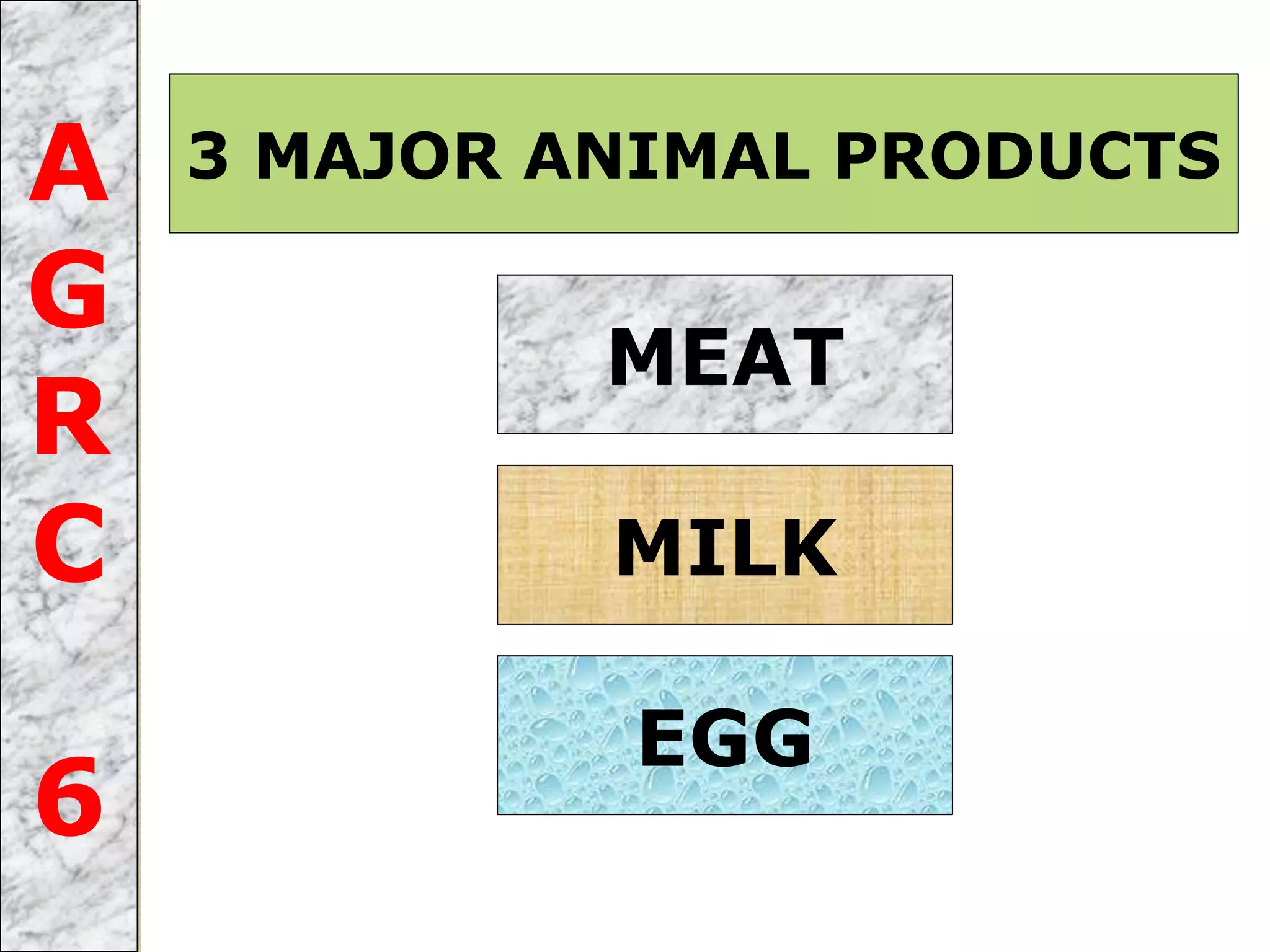
3 MAJOR ANIMAL PRODUCTSA
G
R
C
6
MEAT
MILK
EGG
animal tissues which are
suitable for use as food
abundant source of iron, zinc
and B vitamins
excellent source of protein
MEAT
M
E
A
T
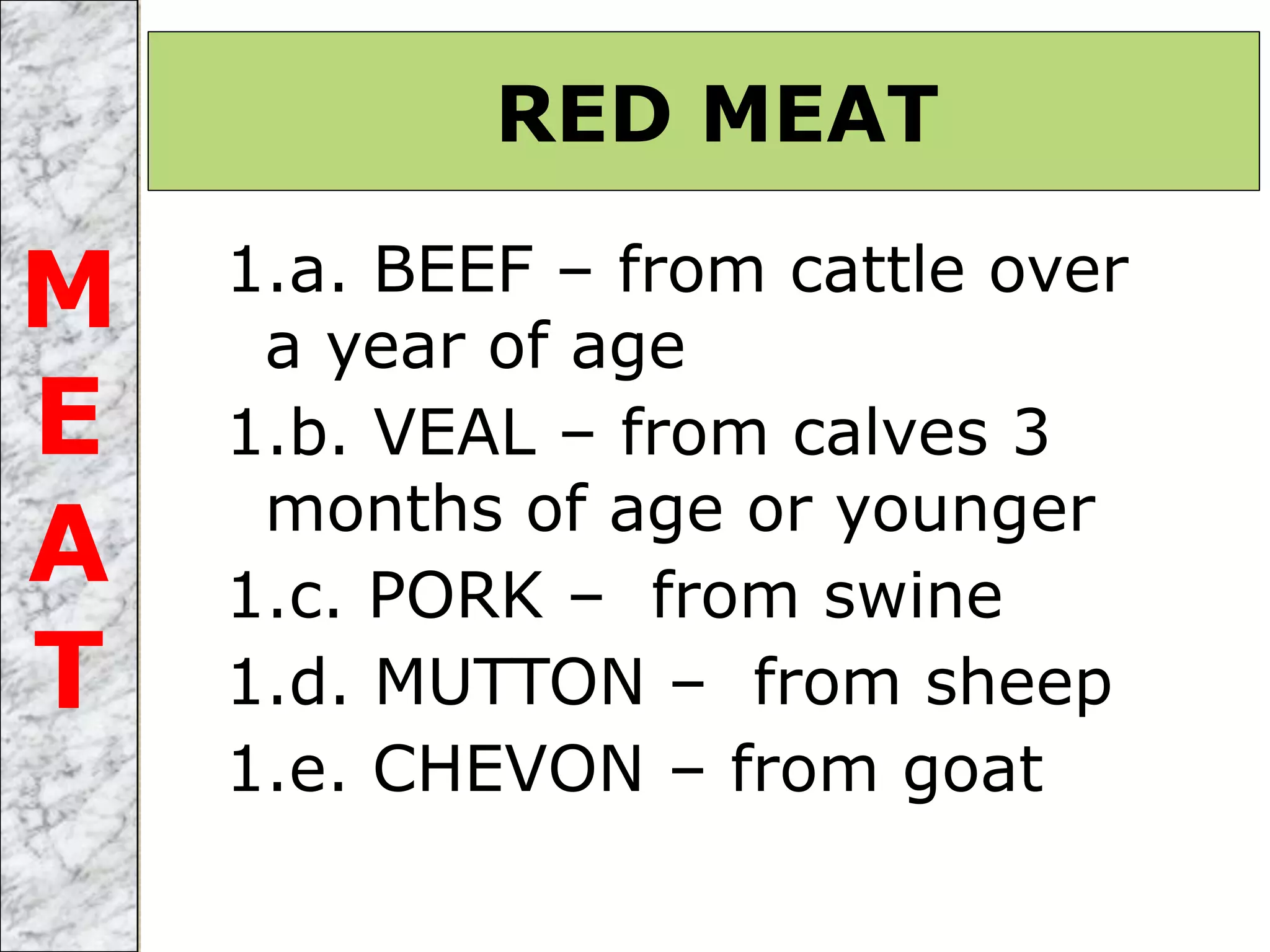
1. Red meat – comes from
cattle, swine, sheep, goats
and to a lesser extent, horses
and other animals (i.e.
buffaloes, deer)
MEAT CATEGORIES
M
E
A
T
1.a. BEEF – from cattle over
a year of age
1.b. VEAL – from calves 3
months of age or younger
1.c. PORK – from swine
1.d. MUTTON – from sheep
1.e. CHEVON – from goat
RED MEAT
M
E
A
T
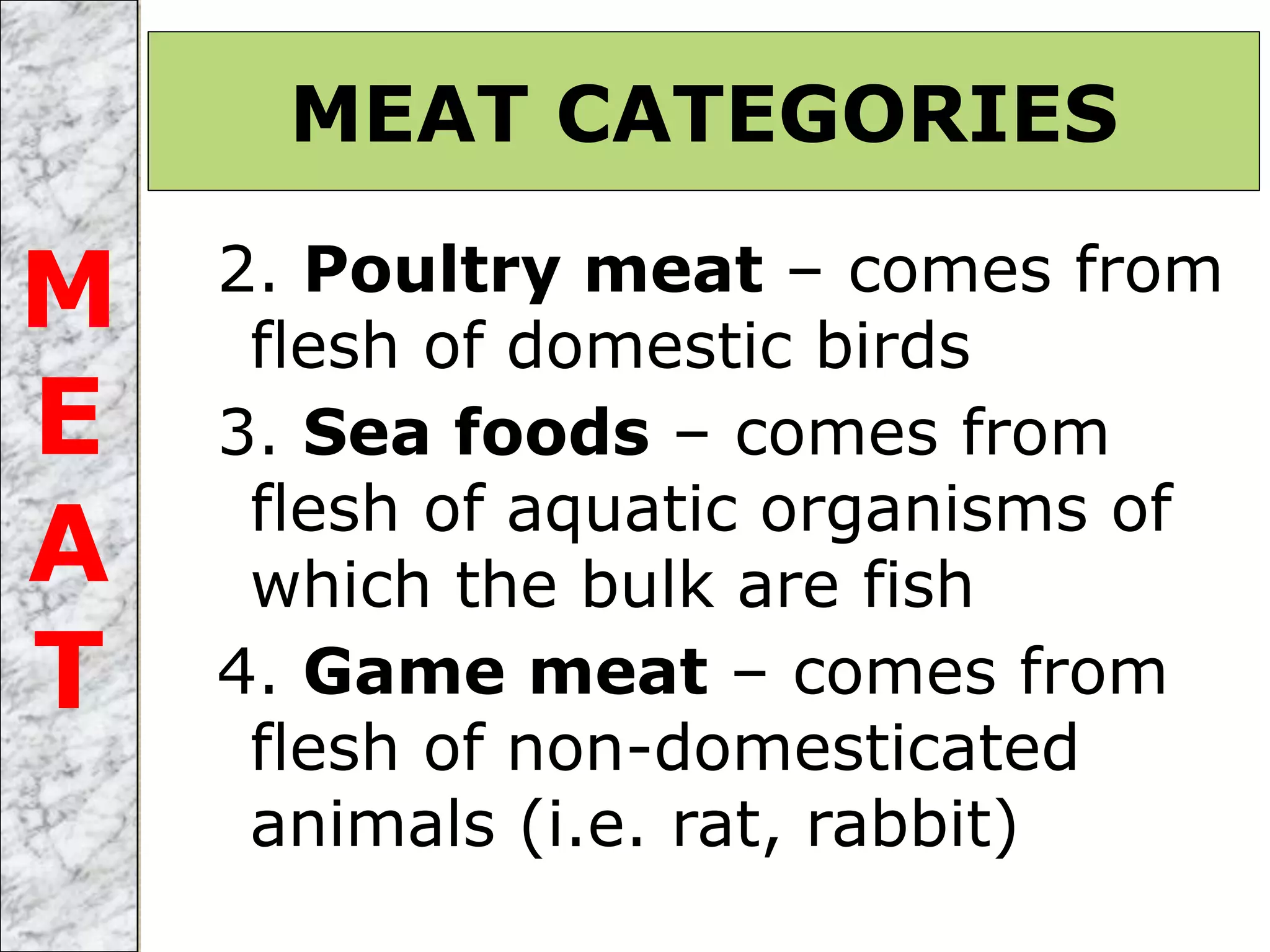
2. Poultry meat – comes from
flesh of domestic birds
3. Sea foods – comes from
flesh of aquatic organisms of
which the bulk are fish
4. Game meat – comes from
flesh of non-domesticated
animals (i.e. rat, rabbit)
MEAT CATEGORIES
M
E
A
T
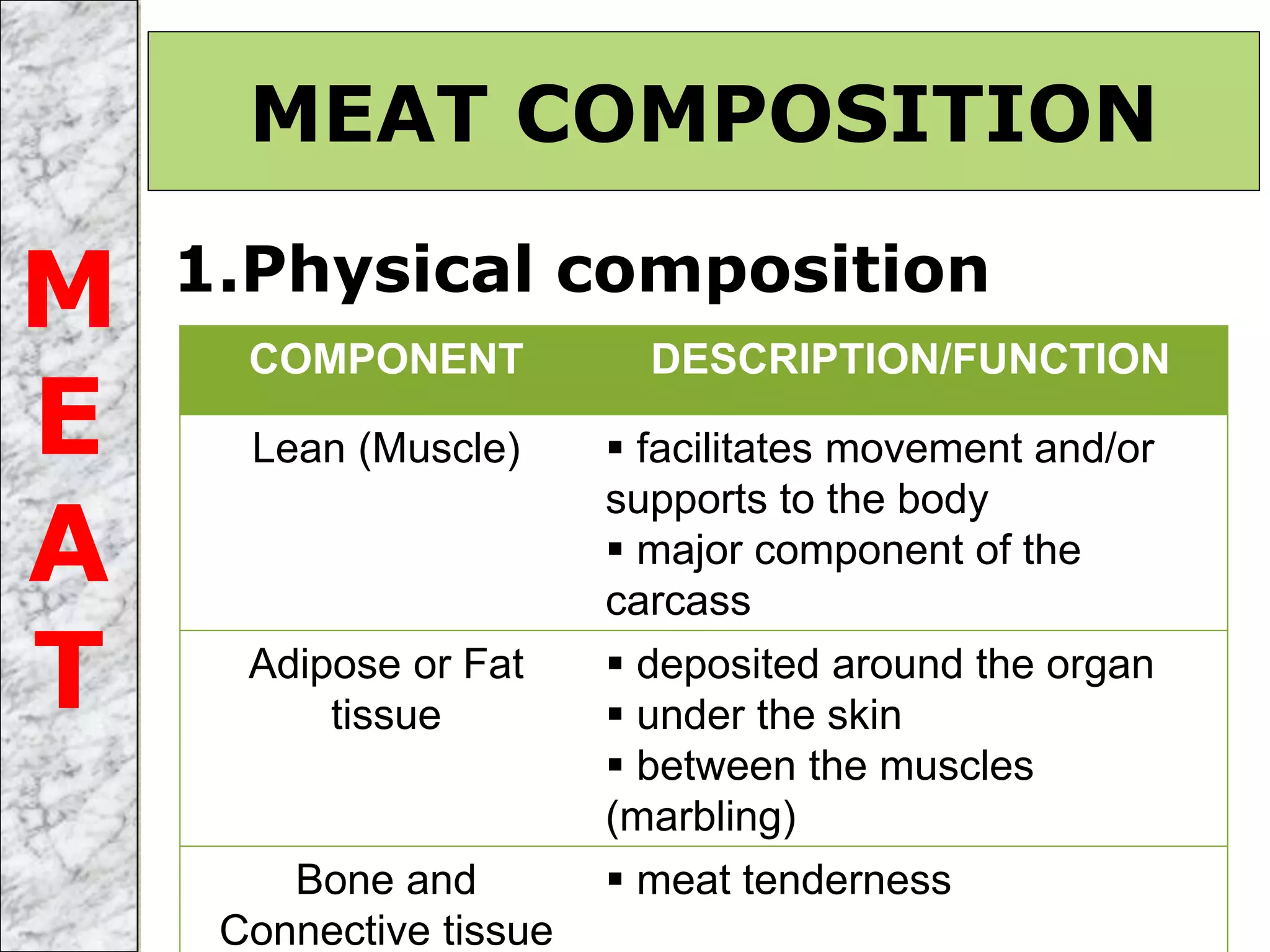
1.Physical composition
MEAT COMPOSITION
COMPONENT DESCRIPTION/FUNCTION
Lean (Muscle)  facilitates movement and/or
supports to the body
 major component of the
carcass
Adipose or Fat
tissue
 deposited around the organ
 under the skin
 between the muscles
(marbling)
Bone and
Connective tissue
 meat tenderness
M
E
A
T
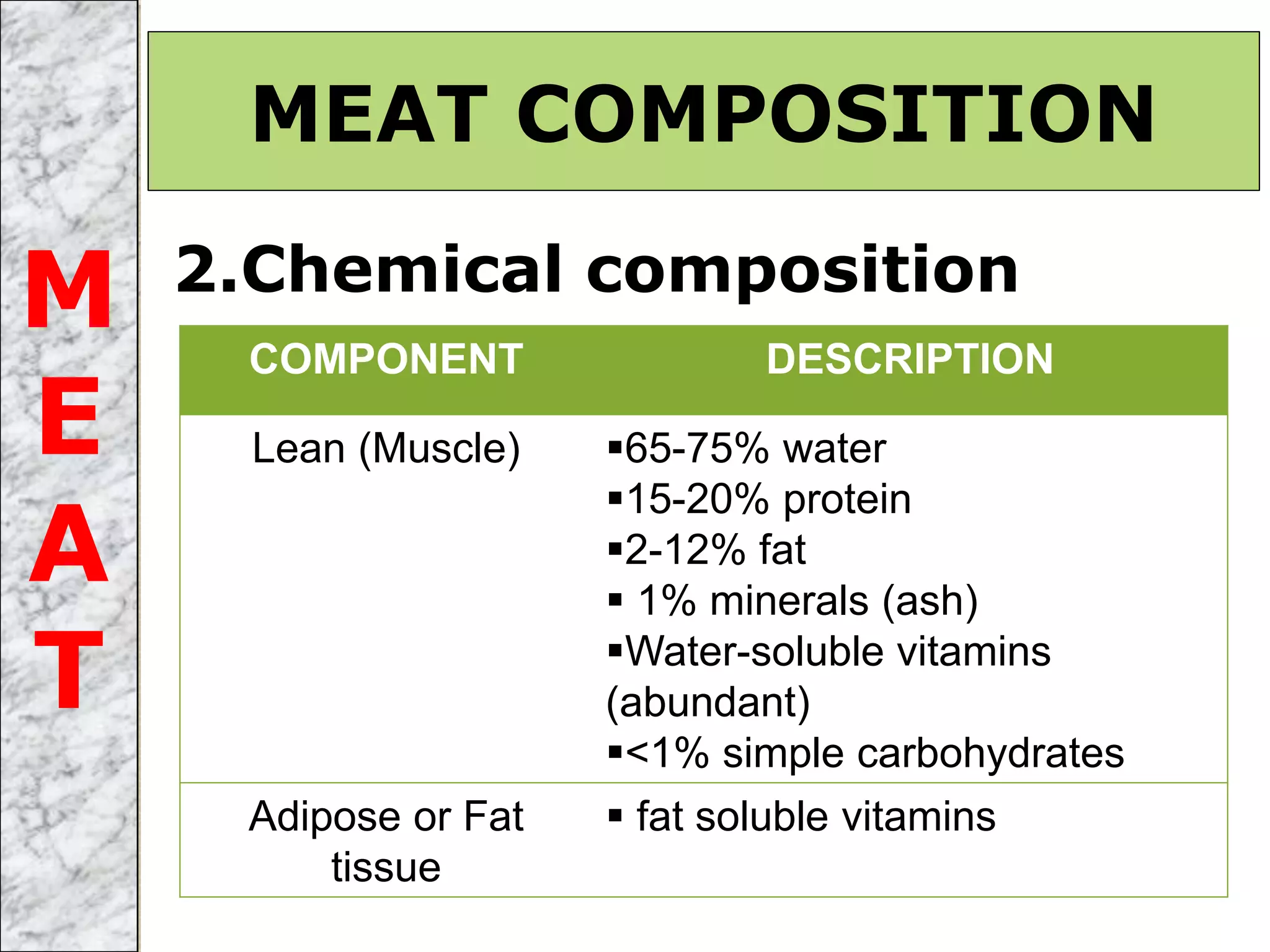
2.Chemical composition
MEAT COMPOSITION
COMPONENT DESCRIPTION
Lean (Muscle) 65-75% water
15-20% protein
2-12% fat
 1% minerals (ash)
Water-soluble vitamins
(abundant)
<1% simple carbohydrates
Adipose or Fat
tissue
 fat soluble vitamins
M
E
A
T
Nitrogenous extracts (NE)
relatively unimportant
nutritionally
provides aroma and flavor
stimulate the flow of gastric
juices (gastric phase)
 Glucose and Glycogen
concentrated in liver
(gluconeogenesis and glycolysis)
MEAT COMPOSITION
M
E
A
T
 produced by mammals
 serves as food for their offspring
 highly nutritious food
 better than any single food item
“a nearly perfect food”
 slightly sweet and pleasant taste
Low fat – tends to be flat
 high fat – creamy/fuller flavor
MILK
M
I
L
K
 first milk produced by female
mammal after the young is born
 higher in protein
 higher in minerals
 higher in milk fat than the normal
milk bur with lesser amount of
lactose
Goat’s milk – best alternative for
colostrum and person with lactose
intolerance.
COLOSTRUM
M
I
L
K
MILK FAT COLOR
M
I
L
K
 cattle/cow
yellow
carotene –precursor of vitamin A
 found in the fat
 Jersey/Guernsey– rich yellow
color
 Holstein– pale yellow (carotene -
splitted)
MILK FAT COLOR
M
I
L
K
 goats and buffaloes
 white
Carotene content – converted into
colorless vitamin A
MILK NUTRITIVE VALUE
M
I
L
K
 contains high nutrient density
 proteins, fats, carbohydrates,
minerals and vitamins
 protein – casein and whey
 milk fat
 carbohydrates – lactose, calcium,
phosphorus and zinc
 fat-soluble vitamins
 water-soluble vitamins
MILK COMPOSITION
M
I
L
K
 varies depending upon the
animals’
 species (goats, cattle, carabao)
 breed (i.e. goats – saanen; cattle
– hostein)
 individuality (lactating, pregnant)
 season (breeding season, weather)
 lactation (start, peak, plateau, dry)
 level of nutrition
 management
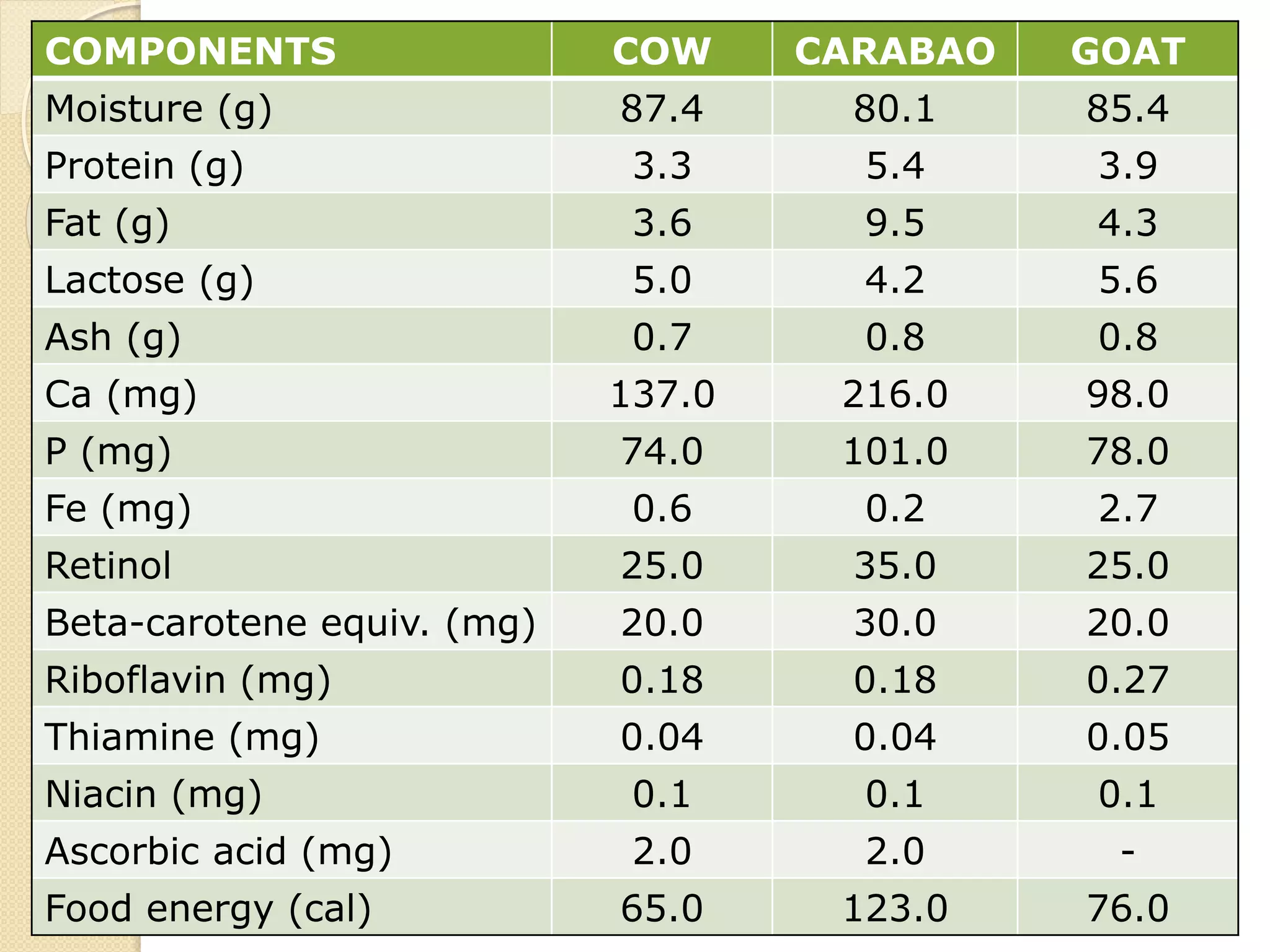
COMPONENTS COW CARABAO GOAT
Moisture (g) 87.4 80.1 85.4
Protein (g) 3.3 5.4 3.9
Fat (g) 3.6 9.5 4.3
Lactose (g) 5.0 4.2 5.6
Ash (g) 0.7 0.8 0.8
Ca (mg) 137.0 216.0 98.0
P (mg) 74.0 101.0 78.0
Fe (mg) 0.6 0.2 2.7
Retinol 25.0 35.0 25.0
Beta-carotene equiv. (mg) 20.0 30.0 20.0
Riboflavin (mg) 0.18 0.18 0.27
Thiamine (mg) 0.04 0.04 0.05
Niacin (mg) 0.1 0.1 0.1
Ascorbic acid (mg) 2.0 2.0 -
Food energy (cal) 65.0 123.0 76.0
Mineralized shell – surround
the content of the egg
2 membranes
one attached to the shell
itself
other tightly encloses the
content of the egg
EGG COMPOSITION
E
G
G
Air cell – formed between the
membranes in the blunt end of
an egg shortly after it is laid
 cuticle – block the pores
which helps to preserve
freshness and prevent microbial
contamination of the egg
contents
EGG COMPOSITION
E
G
G
Egg white/albumen
-surrounds the yolk and
-keeps the yolk in the center of the
egg
 yolk
-yellowish-colored;
-located in the center of the egg;
-its contents surrounded by a thin
and transparent membrane called
the vitelline membrane.
EGG COMPOSITION
E
G
G
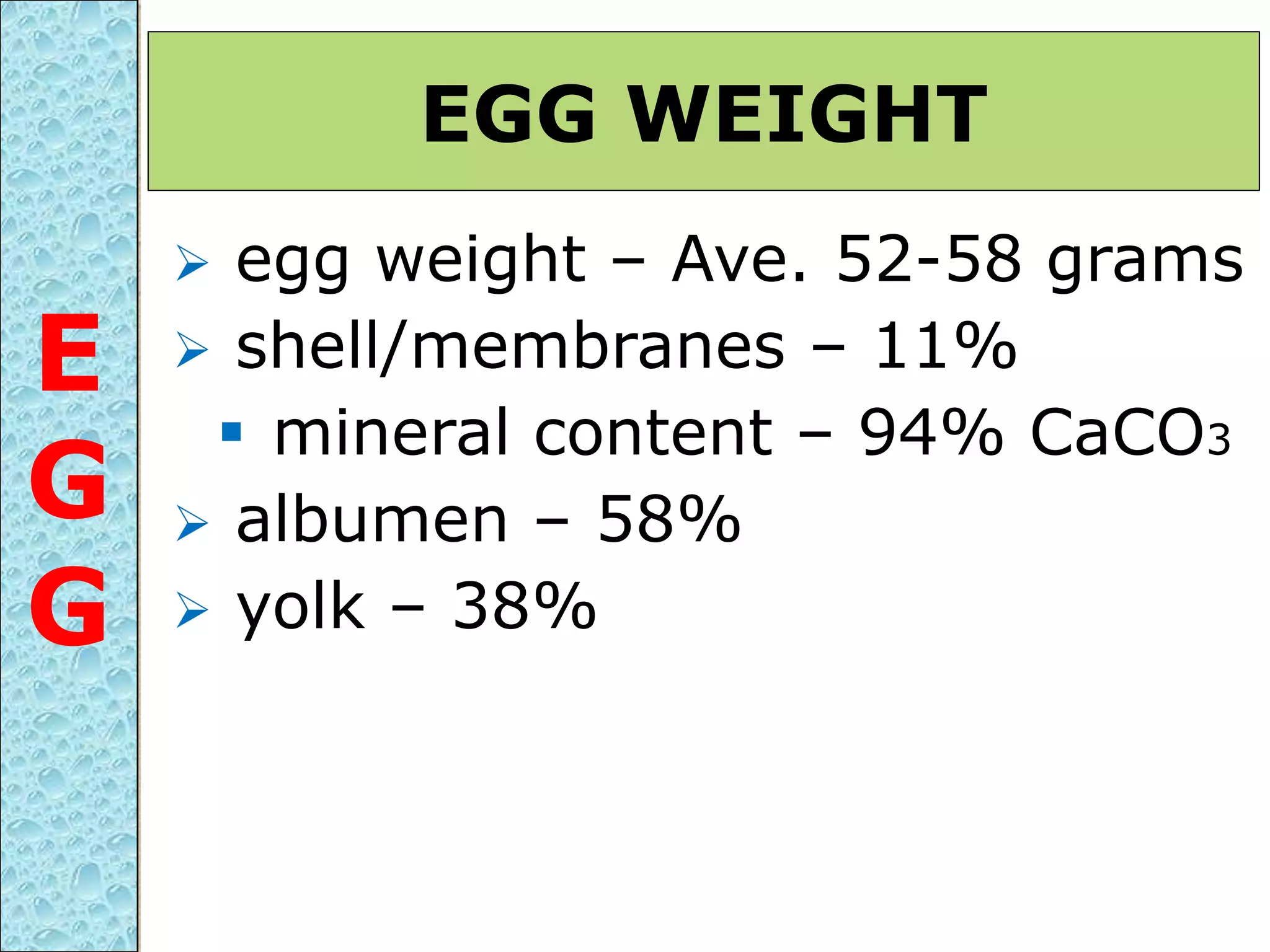
 egg weight – Ave. 52-58 grams
 shell/membranes – 11%
 mineral content – 94% CaCO3
 albumen – 58%
 yolk – 38%
EGG WEIGHT
E
G
G
Yolk
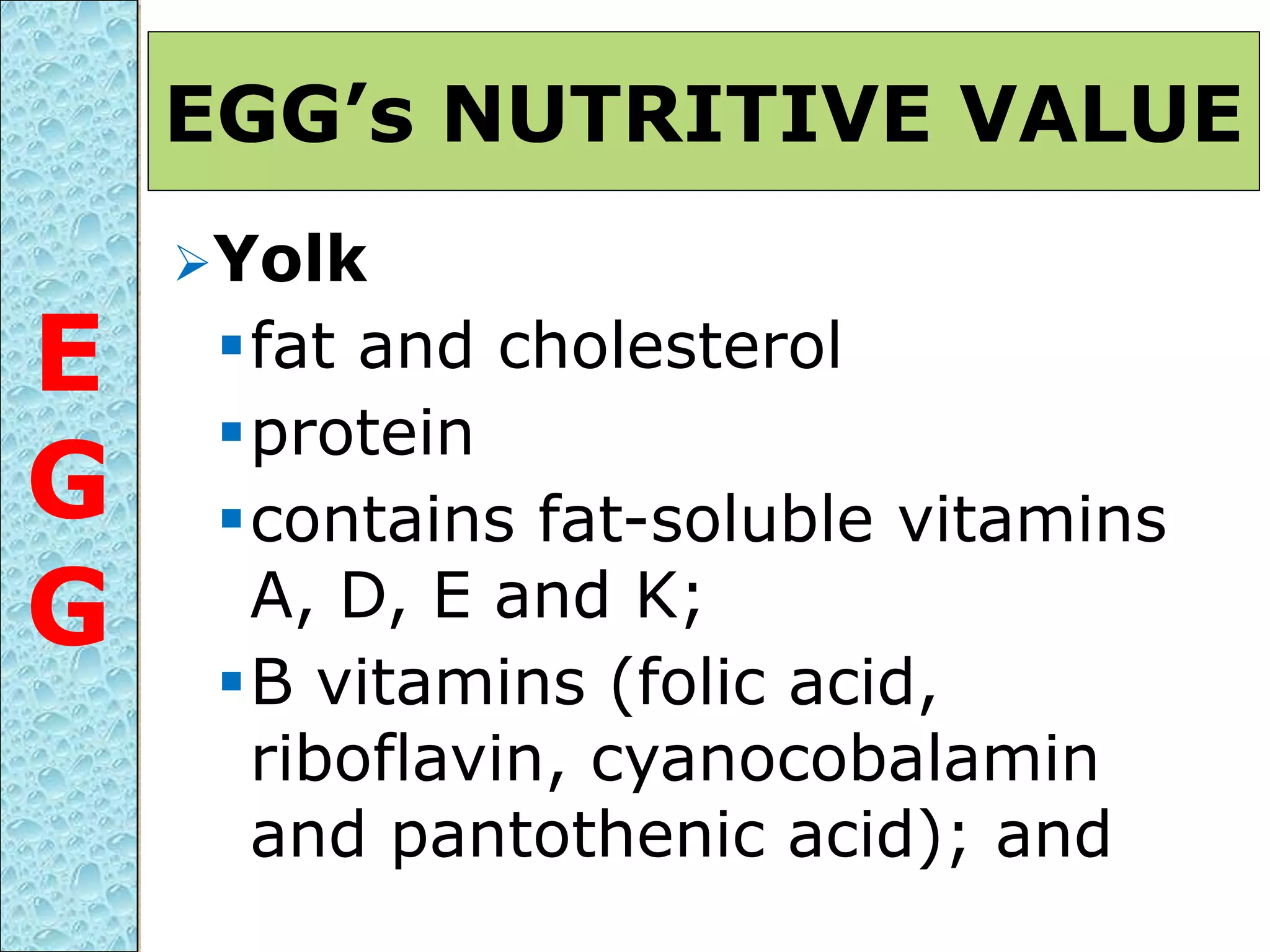
fat and cholesterol
protein
contains fat-soluble vitamins
A, D, E and K;
B vitamins (folic acid,
riboflavin, cyanocobalamin
and pantothenic acid); and
EGG’s NUTRITIVE VALUE
E
G
G
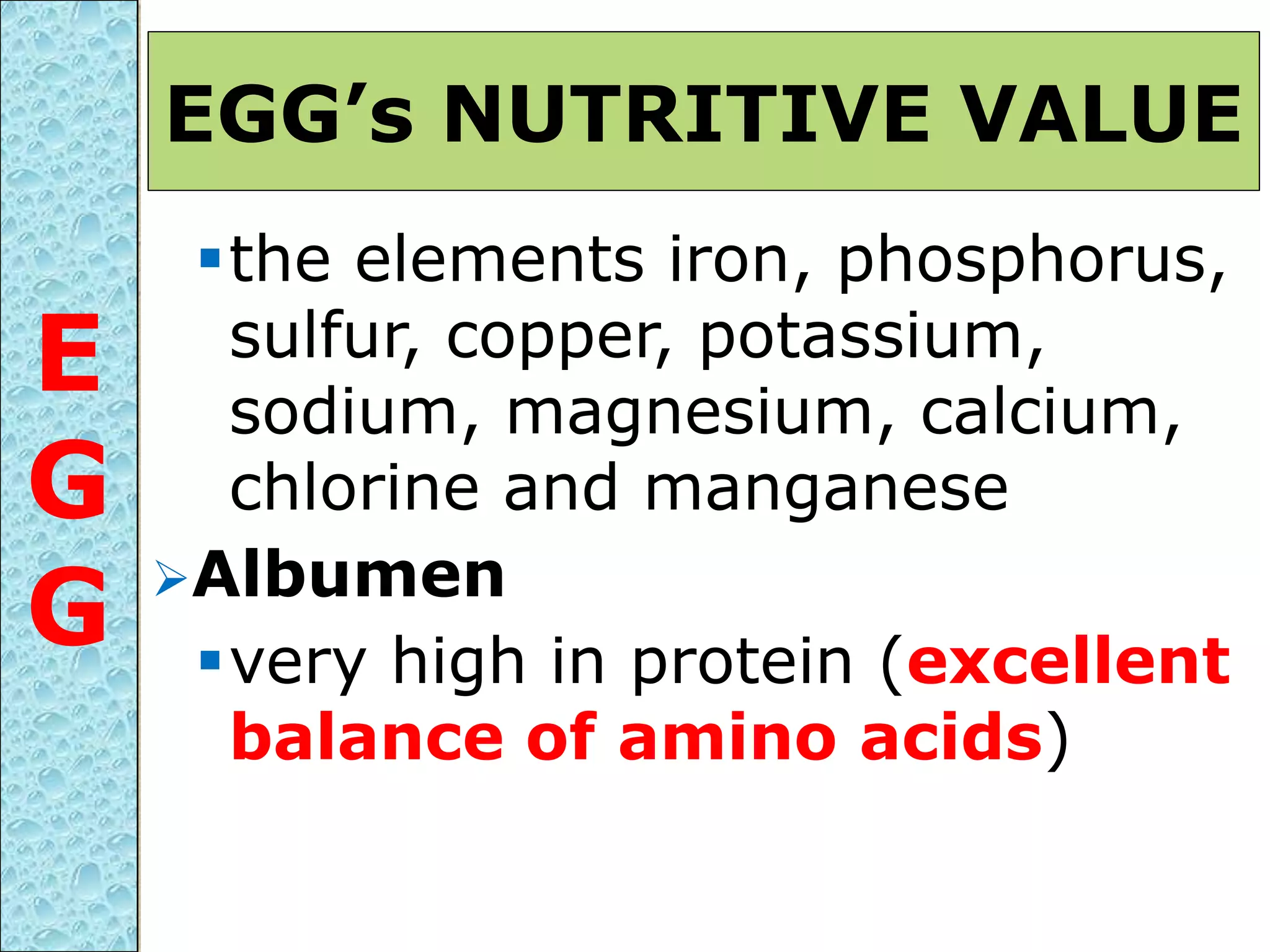
the elements iron, phosphorus,
sulfur, copper, potassium,
sodium, magnesium, calcium,
chlorine and manganese
Albumen
very high in protein (excellent
balance of amino acids)
EGG’s NUTRITIVE VALUE
E
G
G
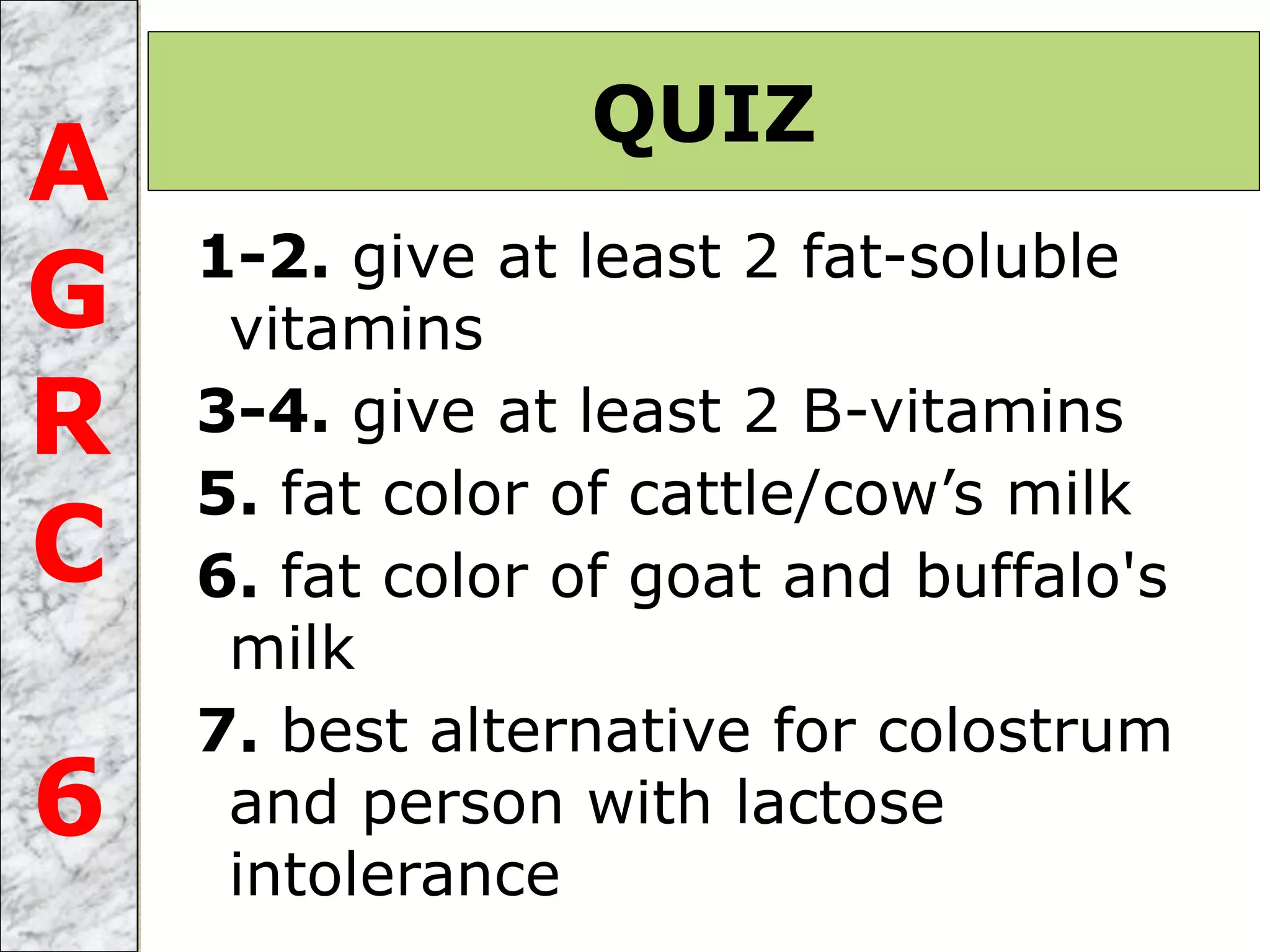
1-2. give at least 2 fat-soluble
vitamins
3-4. give at least 2 B-vitamins
5. fat color of cattle/cow’s milk
6. fat color of goat and buffalo's
milk
7. best alternative for colostrum
and person with lactose
intolerance
QUIZ
A
G
R
C
6
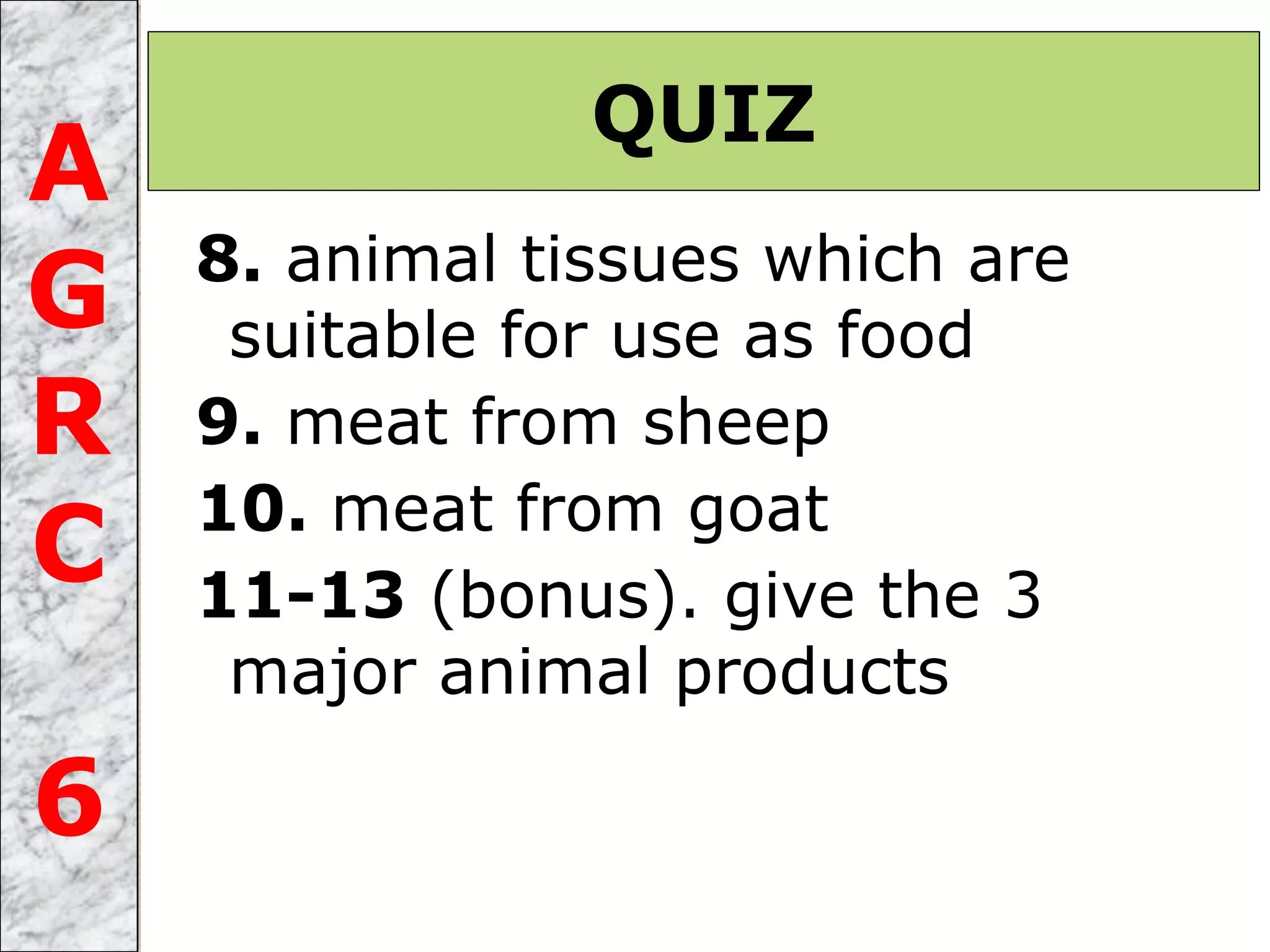
8. animal tissues which are
suitable for use as food
9. meat from sheep
10. meat from goat
11-13 (bonus). give the 3
major animal products
QUIZ
A
G
R
C
6
a. Ante-mortem inspection
- before slaughtering
- humane
- disease inspection
(condemned)
b. Post-mortem inspection
- after slaughtering
- meat fabrication
- grading
SLAUGHTERING
A
G
R
C
6
1. Cleanliness of the meat produced
2. Hygiene of production
3. Efficiency of meat inspection
4. Adequacy of meat preservation
5. Need for skilled butchers and
proper tools and equipments for
slaughtering
BASIC REQUIREMENTS IN
SLAUGHTERINGA
G
R
C
6
ANTE-MORTEM
INSPECTION
A
G
R
C
6
1.selection of animals for slaughter
a. Age of the animals
swine–6 to 12 months
cattle/carabao–<3 but not >3 yrs
goats–1 yr
NOTE: Generally, meat from old animals
is juicer than meat from young ones.
Young animals have watery meat on
first chewing but have a final
impression of dryness
ANTE-MORTEM
INSPECTIONA
G
R
C
6
b. Sex of the animals
barrows/gilts – best sources of
meat for curing
boars – young boars (<200 days)
can still be used but older boars
have pronounced “boar taint”
sows – meat is tough and during
the advance stage of pregnancy,
the meat have fishy odor
ANTE-MORTEM
INSPECTIONA
G
R
C
6
c. Size
hogs – 80-100 kg
cattle/carabao – 300 to 450 kg
d. Degree of fatness
-most flavor compounds are found
in the fatty tissue
-while, chewing, fat stimulates the
flow or saliva thus giving the
impression of juiciness
ANTE-MORTEM
INSPECTIONA
G
R
C
6
d. Health of the animal
-animals for slaughter must be
substantially healthy
- unhealthy animal must be first
treated and brought to normal
condition prior to slaughter
ANTE-MORTEM
INSPECTIONA
G
R
C
6
2. Management of Animals prior to
slaughter
a. Fasting
-it is the withdrawal of solid feed
and only water is provided ad
libitum
-hogs are fasted for 12 to 24
hours and ruminants for 24 to 48
hours
ANTE-MORTEM
INSPECTIONA
G
R
C
6
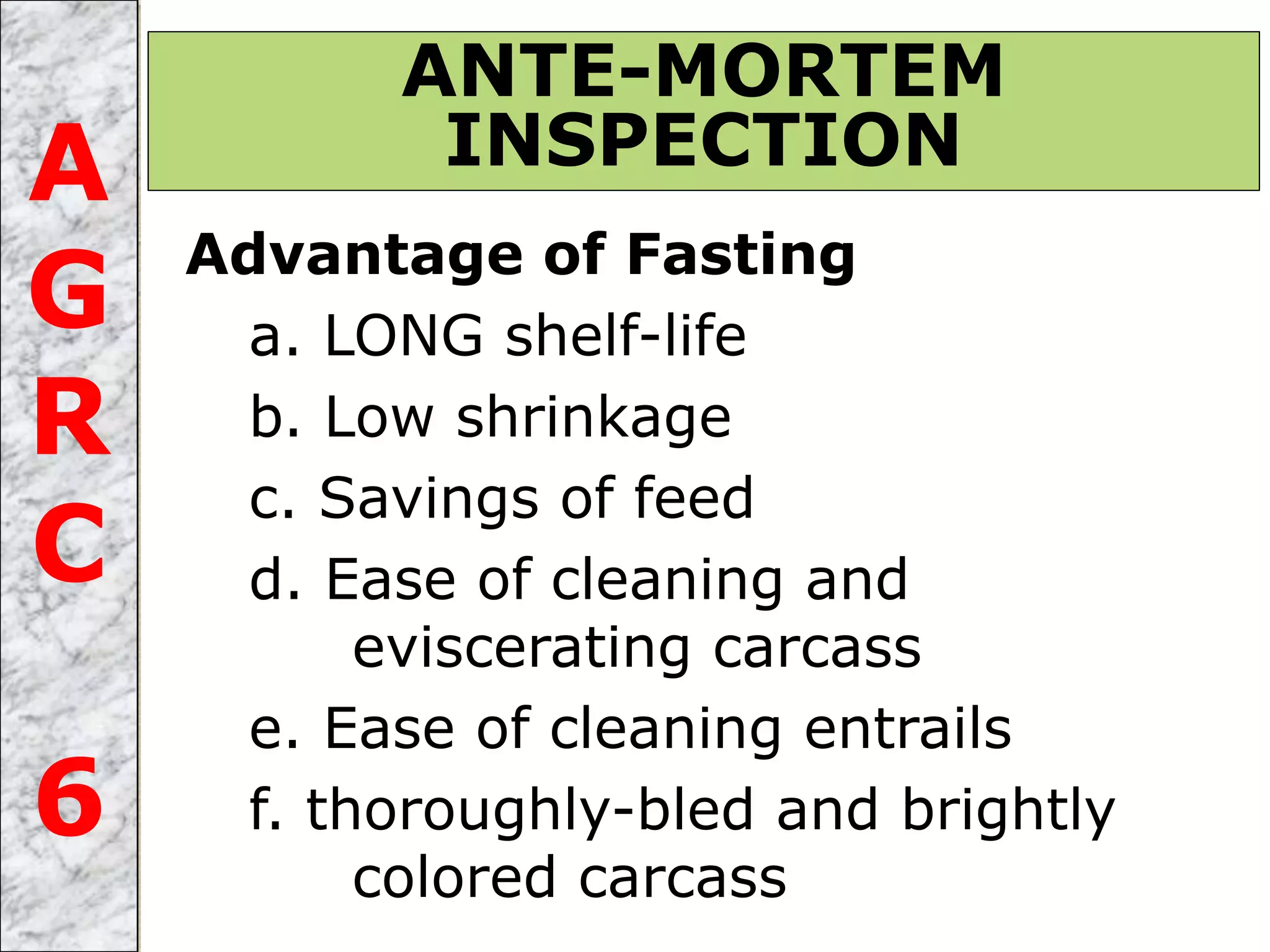
Advantage of Fasting
a. LONG shelf-life
b. Low shrinkage
c. Savings of feed
d. Ease of cleaning and
eviscerating carcass
e. Ease of cleaning entrails
f. thoroughly-bled and brightly
colored carcass
ANTE-MORTEM
INSPECTIONA
G
R
C
6
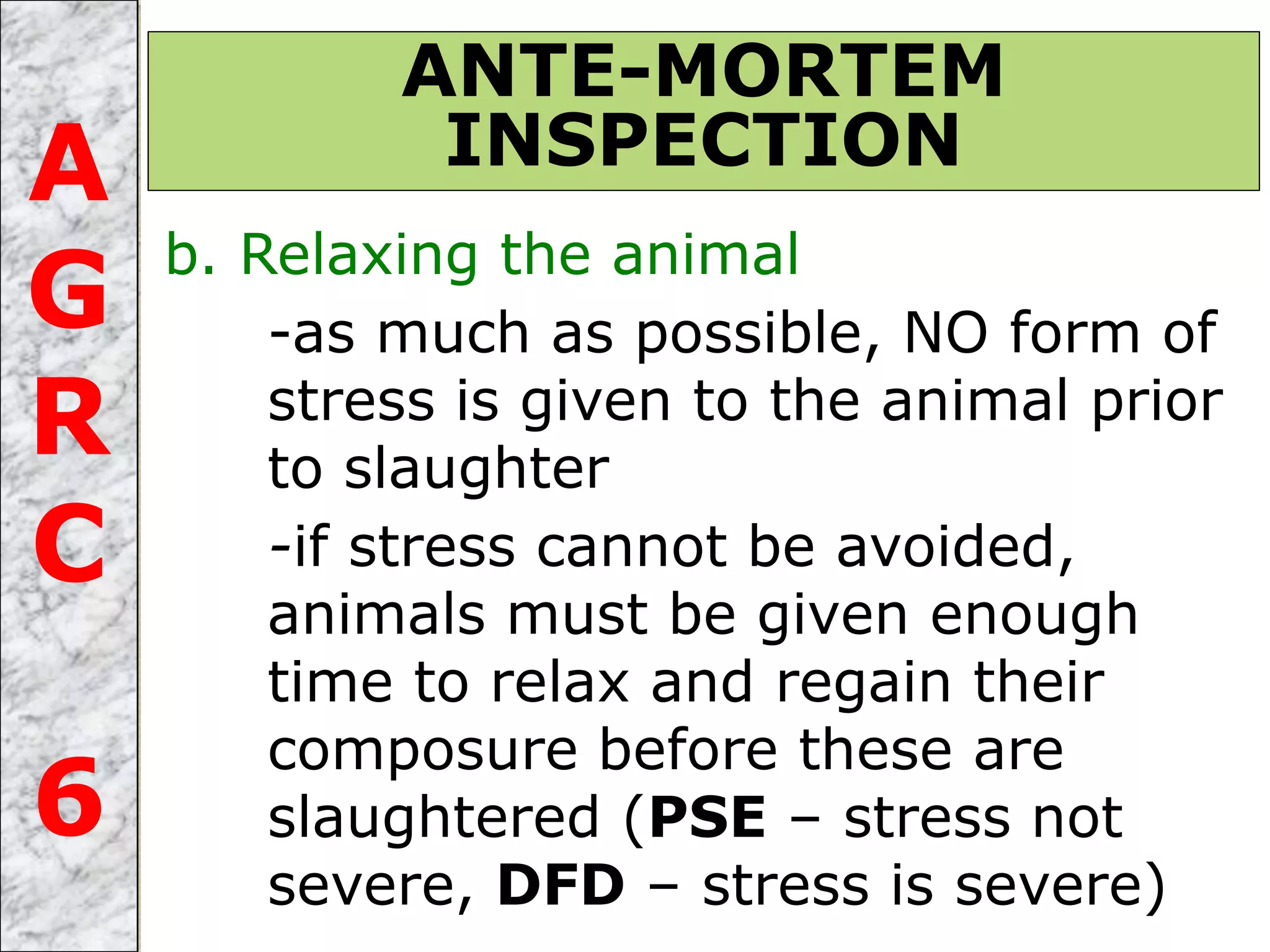
b. Relaxing the animal
-as much as possible, NO form of
stress is given to the animal prior
to slaughter
-if stress cannot be avoided,
animals must be given enough
time to relax and regain their
composure before these are
slaughtered (PSE – stress not
severe, DFD – stress is severe)
ANTE-MORTEM
INSPECTIONA
G
R
C
6
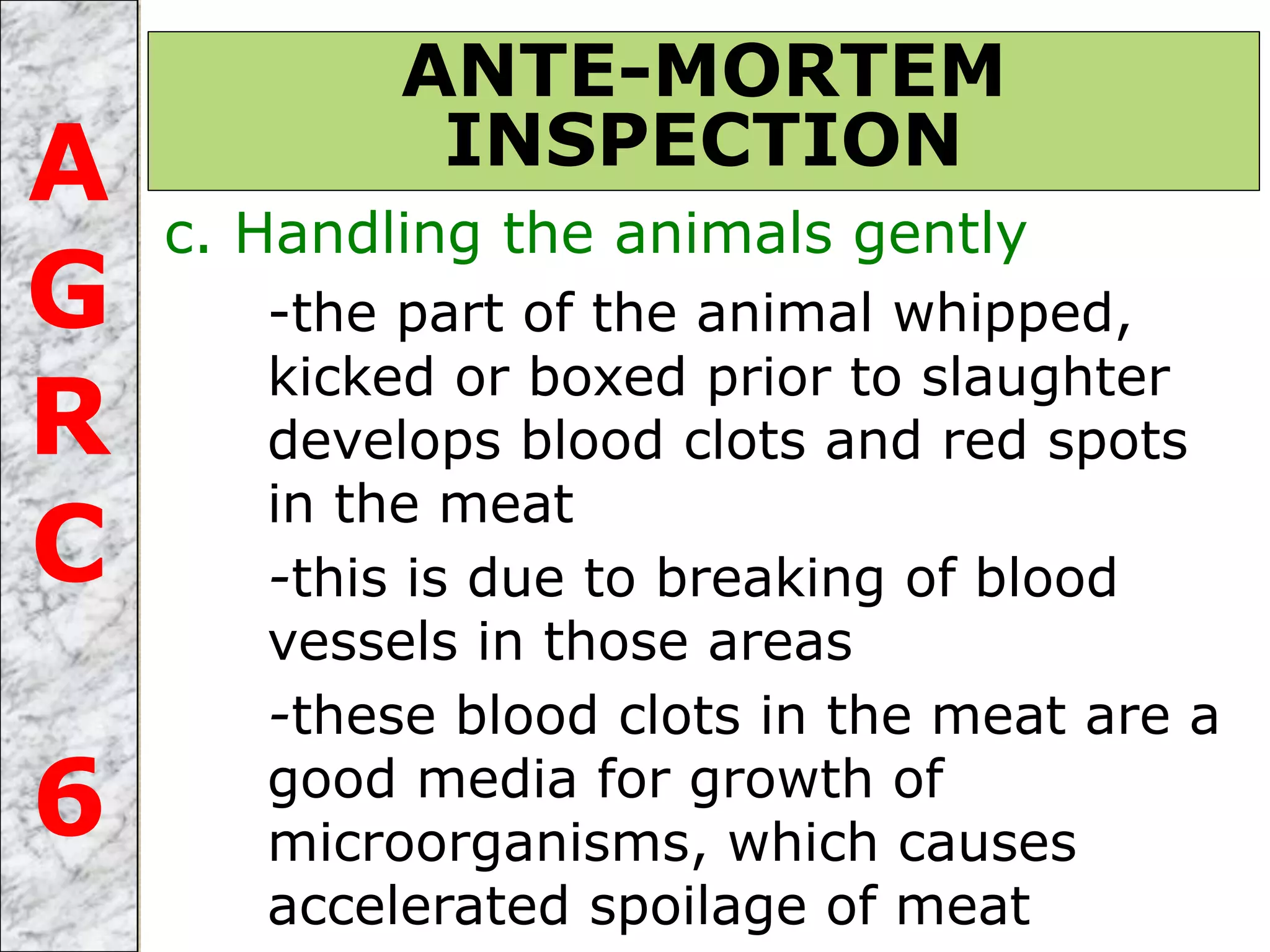
c. Handling the animals gently
-the part of the animal whipped,
kicked or boxed prior to slaughter
develops blood clots and red spots
in the meat
-this is due to breaking of blood
vessels in those areas
-these blood clots in the meat are a
good media for growth of
microorganisms, which causes
accelerated spoilage of meat
ANTE-MORTEM
INSPECTIONA
G
R
C
6
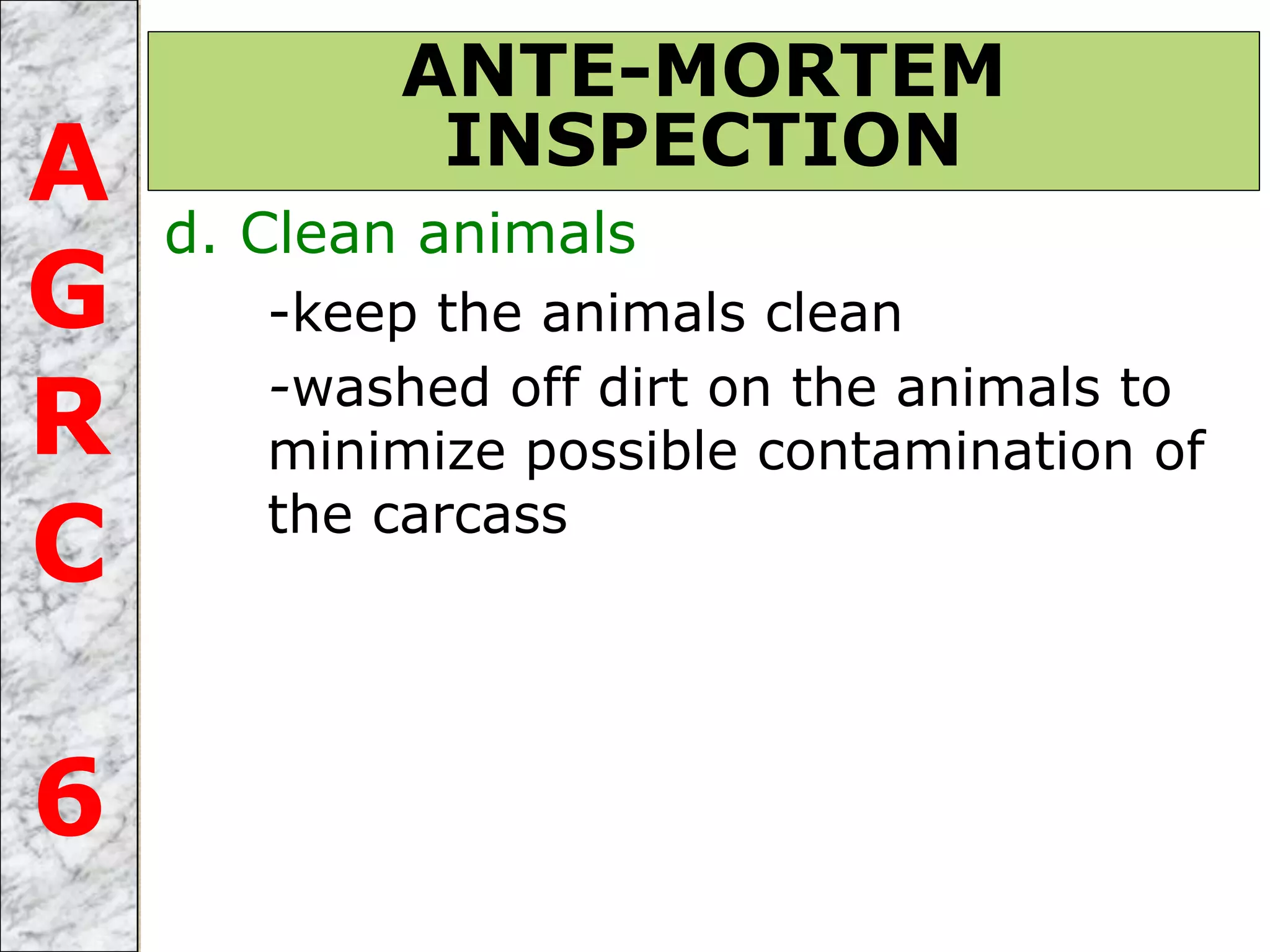
d. Clean animals
-keep the animals clean
-washed off dirt on the animals to
minimize possible contamination of
the carcass
ANTE-MORTEM
INSPECTIONA
G
R
C
6
POST-MORTEM
INSPECTION
A
G
R
C
6
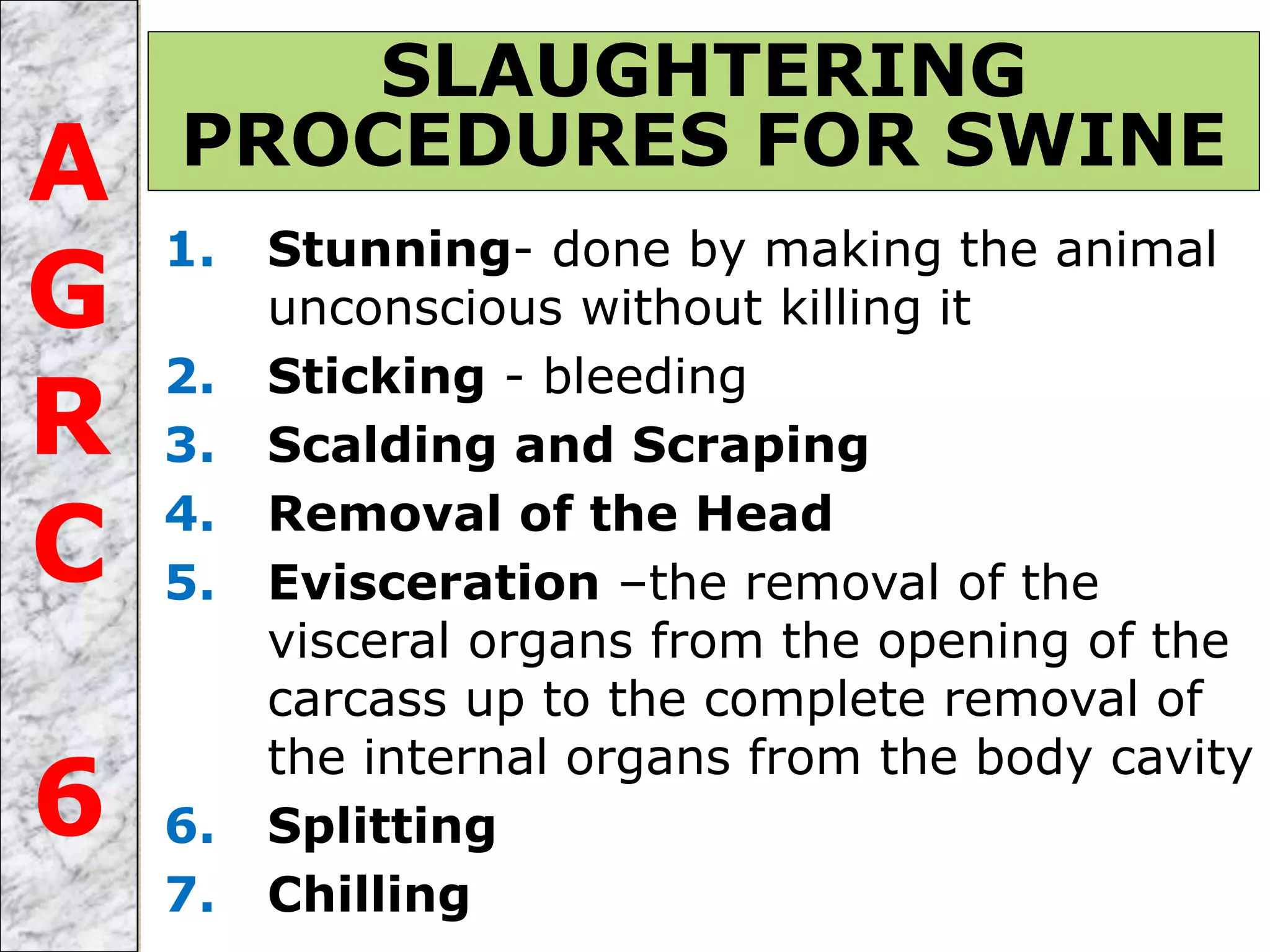
1. Stunning- done by making the animal
unconscious without killing it
2. Sticking - bleeding
3. Scalding and Scraping
4. Removal of the Head
5. Evisceration –the removal of the
visceral organs from the opening of the
carcass up to the complete removal of
the internal organs from the body cavity
6. Splitting
7. Chilling
SLAUGHTERING
PROCEDURES FOR SWINEA
G
R
C
6
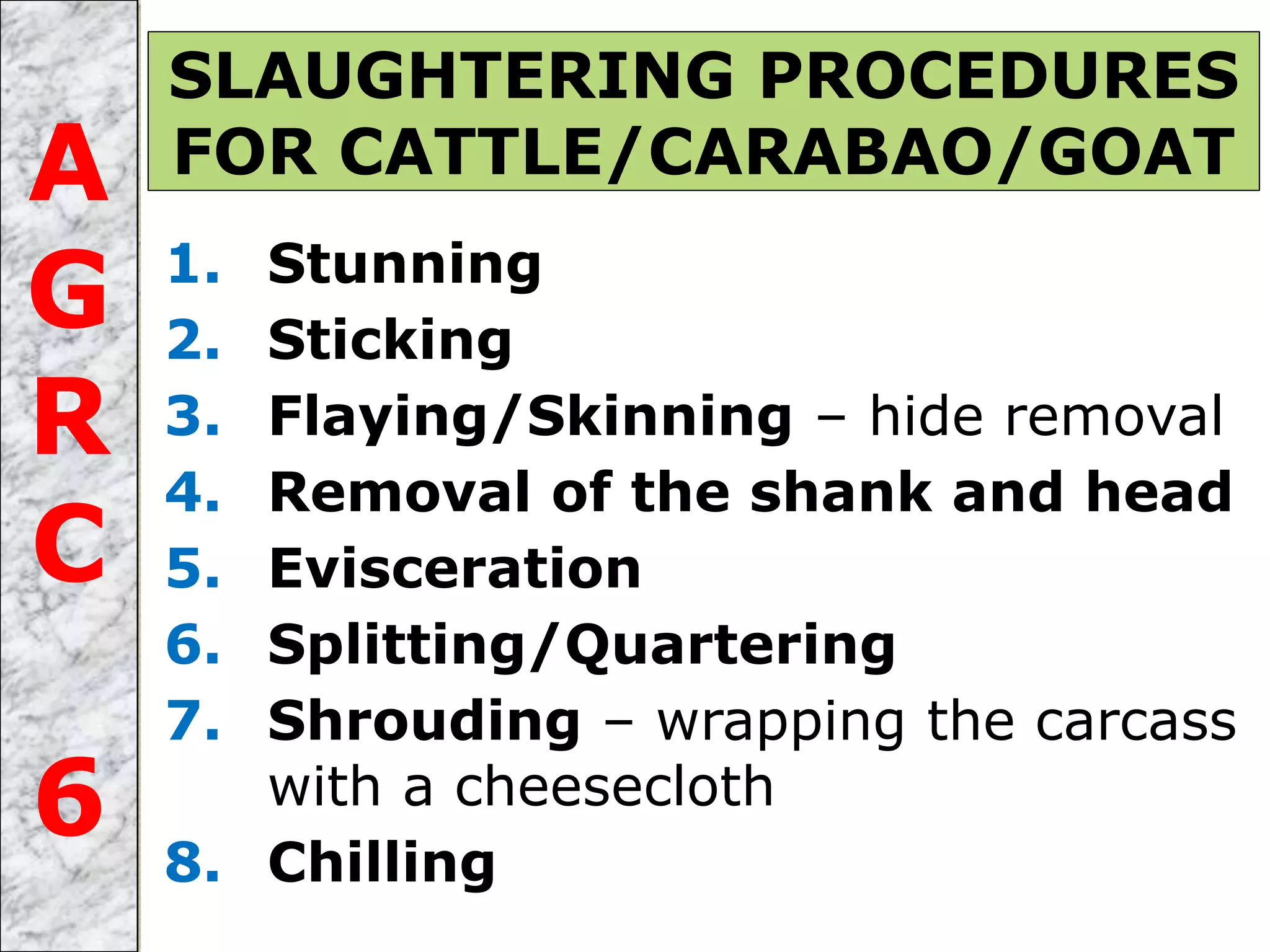
1. Stunning
2. Sticking
3. Flaying/Skinning – hide removal
4. Removal of the shank and head
5. Evisceration
6. Splitting/Quartering
7. Shrouding – wrapping the carcass
with a cheesecloth
8. Chilling
SLAUGHTERING PROCEDURES
FOR CATTLE/CARABAO/GOATA
G
R
C
6
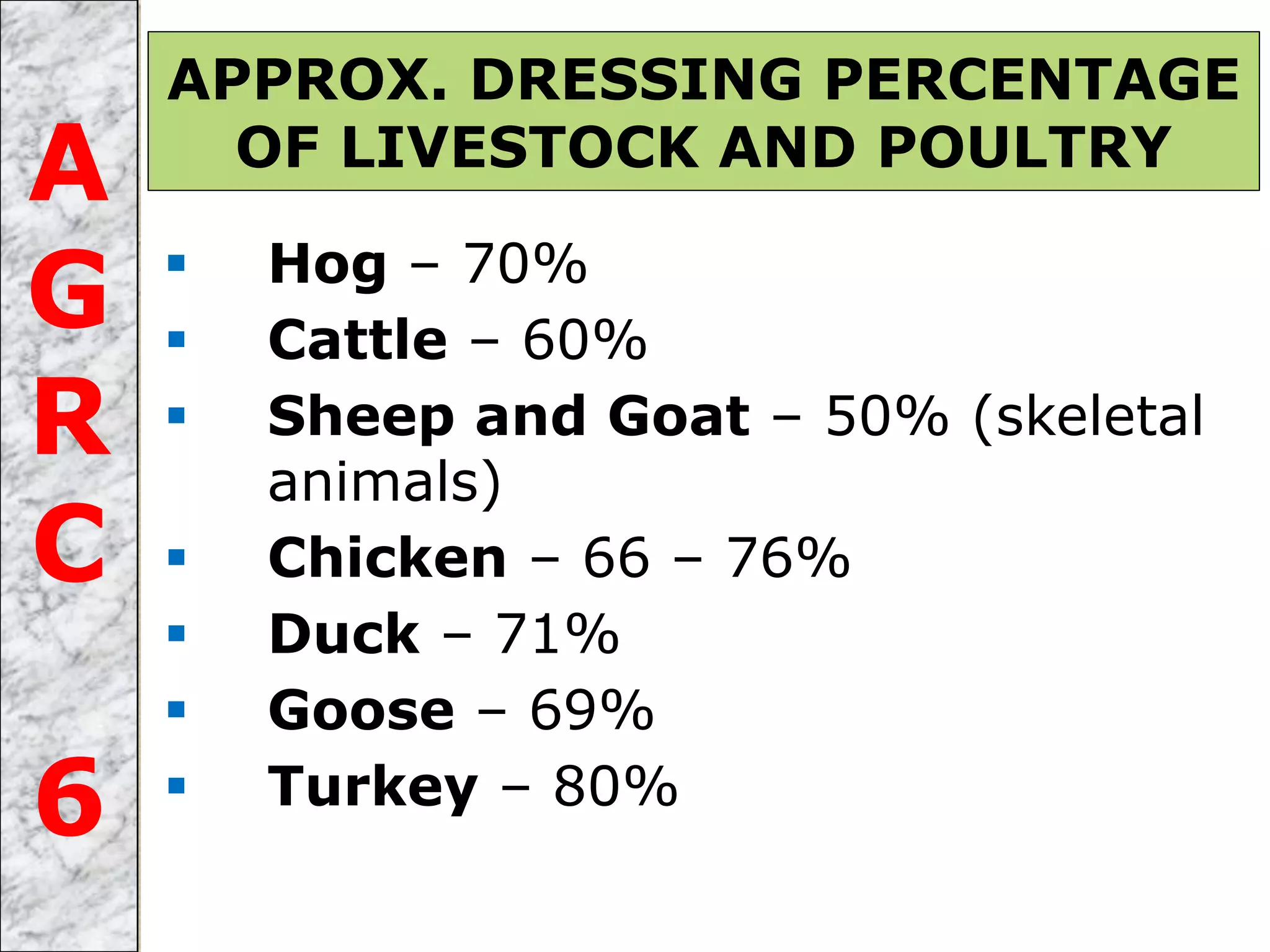
 Hog – 70%
 Cattle – 60%
 Sheep and Goat – 50% (skeletal
animals)
 Chicken – 66 – 76%
 Duck – 71%
 Goose – 69%
 Turkey – 80%
APPROX. DRESSING PERCENTAGE
OF LIVESTOCK AND POULTRY
A
G
R
C
6
1-8 enumerate the procedures for
ruminant animals (in order)
9 dressing percentage of goose
10 refers to the wrapping of ruminant
carcass with a cheesecloth
11 withdrawal of feed but water is
made available in ad-libitum basis
12 recommended age of swine for
slaughtering
13-14 best sources of meat for curing
15 main reason/advantage of fasting
QUIZ
A
G
R
C
6

Slaughtering of Animal and Processing of their Products

  • 1.
    SLAUGTERING of ANIMALS andPROCESSING of THEIR PRODUCTS
  • 2.
     Lecture (50%) FirstLong exam 25% Mid-term Long Exam 25% Third/Final Long Exam 25% Quizzes (Surprise) 15% Assignments/Attendance 10% GRADING SYSTEM A G R C 6
  • 3.
     Laboratory (50%) Hands-on activities 50%  Project/Portfolio 25% Quizzes (Surprise) 15% Assignments/Attendance 10% GRADING SYSTEM A G R C 6
  • 4.
     IMPORTANCE ofANIMAL PRODUCTS  good source of meat, milk and eggs (source of income, family consumption) protein-55% and calories-16% (FAO, 1992) INTRODUCTION A G R C 6
  • 5.
     ABATTOIR -registered/approved premises authorized by BFAD/BAI where slaughtering of animals takes place (human consumption)  BRAND – mark/stamp/tag/label which represents the approval of the LI/DMI CARCASS – body of any slaughtered animal after bleeding and dressing TERMINOLOGIES A G R C 6
  • 6.
     COLD SLAUGHTER- slaughtering of double dead animals  DRESSING – removal of animal parts not intended for human consumption FARBRICATION – process of cutting carcass into standard wholesale and retail cuts TERMINOLOGIES A G R C 6
  • 7.
    CONDEMNED- carcass markedas unsound, unhealthy and unfit for human consumption but fit as feed stuff (PASSED) REACTOR– animal shows evidence of disease after specific test application PSE – pale, soft and exudative meat (swine) TERMINOLOGIES A G R C 6
  • 8.
    FRESH MEAT –from animals NOT undergone any substantial physical, microbial and chemical change DFD – dark, firm and dry meat (BEEF) HOT MEAT – from food animal and poultry clandestinely slaughtered and sold to public FOOD ANIMAL – all domestic livestock killed for human consumption TERMINOLOGIES A G R C 6
  • 9.
    FLEECE and WOOL–and hairs obtained from goats and sheep, respectively OFFAL– by-products, organs, glands and tissues other than carcass (may or may not be edible) RESIDUES– foreign substances (i.e. metabolites, therapeutic/prophylactic agents) remaining in the carcass which are hazardous to human health TERMINOLOGIES A G R C 6
  • 10.
    TRIPE– rumen, reticulumand omasum of compound stomach animals GIBLETS– heart, liver and gizzard RIGOR MORTIS– muscle stiffening after death of the animal due to muscle contraction (stress and improper handling of animals during slaughtering) TERMINOLOGIES A G R C 6
  • 11.
    FASTING – withholdingfeed from the animal prior to slaughtering (water in ad libitum basis) STUNNING – process of making the animals unconscious prior to bleeding FLAYING/SKINNING– act of hide removal (goat, cattle, carabao) SINGEING – application of flame to carcass to burn the scraped and unshaved hairs (goat, cattle, carabao) TERMINOLOGIES A G R C 6
  • 12.
    3 MAJOR ANIMALPRODUCTSA G R C 6 MEAT MILK EGG
  • 13.
    animal tissues whichare suitable for use as food abundant source of iron, zinc and B vitamins excellent source of protein MEAT M E A T
  • 14.
    1. Red meat– comes from cattle, swine, sheep, goats and to a lesser extent, horses and other animals (i.e. buffaloes, deer) MEAT CATEGORIES M E A T
  • 15.
    1.a. BEEF –from cattle over a year of age 1.b. VEAL – from calves 3 months of age or younger 1.c. PORK – from swine 1.d. MUTTON – from sheep 1.e. CHEVON – from goat RED MEAT M E A T
  • 16.
    2. Poultry meat– comes from flesh of domestic birds 3. Sea foods – comes from flesh of aquatic organisms of which the bulk are fish 4. Game meat – comes from flesh of non-domesticated animals (i.e. rat, rabbit) MEAT CATEGORIES M E A T
  • 17.
    1.Physical composition MEAT COMPOSITION COMPONENTDESCRIPTION/FUNCTION Lean (Muscle)  facilitates movement and/or supports to the body  major component of the carcass Adipose or Fat tissue  deposited around the organ  under the skin  between the muscles (marbling) Bone and Connective tissue  meat tenderness M E A T
  • 18.
    2.Chemical composition MEAT COMPOSITION COMPONENTDESCRIPTION Lean (Muscle) 65-75% water 15-20% protein 2-12% fat  1% minerals (ash) Water-soluble vitamins (abundant) <1% simple carbohydrates Adipose or Fat tissue  fat soluble vitamins M E A T
  • 19.
    Nitrogenous extracts (NE) relativelyunimportant nutritionally provides aroma and flavor stimulate the flow of gastric juices (gastric phase)  Glucose and Glycogen concentrated in liver (gluconeogenesis and glycolysis) MEAT COMPOSITION M E A T
  • 20.
     produced bymammals  serves as food for their offspring  highly nutritious food  better than any single food item “a nearly perfect food”  slightly sweet and pleasant taste Low fat – tends to be flat  high fat – creamy/fuller flavor MILK M I L K
  • 21.
     first milkproduced by female mammal after the young is born  higher in protein  higher in minerals  higher in milk fat than the normal milk bur with lesser amount of lactose Goat’s milk – best alternative for colostrum and person with lactose intolerance. COLOSTRUM M I L K
  • 22.
    MILK FAT COLOR M I L K cattle/cow yellow carotene –precursor of vitamin A  found in the fat  Jersey/Guernsey– rich yellow color  Holstein– pale yellow (carotene - splitted)
  • 23.
    MILK FAT COLOR M I L K goats and buffaloes  white Carotene content – converted into colorless vitamin A
  • 24.
    MILK NUTRITIVE VALUE M I L K contains high nutrient density  proteins, fats, carbohydrates, minerals and vitamins  protein – casein and whey  milk fat  carbohydrates – lactose, calcium, phosphorus and zinc  fat-soluble vitamins  water-soluble vitamins
  • 25.
    MILK COMPOSITION M I L K  variesdepending upon the animals’  species (goats, cattle, carabao)  breed (i.e. goats – saanen; cattle – hostein)  individuality (lactating, pregnant)  season (breeding season, weather)  lactation (start, peak, plateau, dry)  level of nutrition  management
  • 26.
    COMPONENTS COW CARABAOGOAT Moisture (g) 87.4 80.1 85.4 Protein (g) 3.3 5.4 3.9 Fat (g) 3.6 9.5 4.3 Lactose (g) 5.0 4.2 5.6 Ash (g) 0.7 0.8 0.8 Ca (mg) 137.0 216.0 98.0 P (mg) 74.0 101.0 78.0 Fe (mg) 0.6 0.2 2.7 Retinol 25.0 35.0 25.0 Beta-carotene equiv. (mg) 20.0 30.0 20.0 Riboflavin (mg) 0.18 0.18 0.27 Thiamine (mg) 0.04 0.04 0.05 Niacin (mg) 0.1 0.1 0.1 Ascorbic acid (mg) 2.0 2.0 - Food energy (cal) 65.0 123.0 76.0
  • 27.
    Mineralized shell –surround the content of the egg 2 membranes one attached to the shell itself other tightly encloses the content of the egg EGG COMPOSITION E G G
  • 28.
    Air cell –formed between the membranes in the blunt end of an egg shortly after it is laid  cuticle – block the pores which helps to preserve freshness and prevent microbial contamination of the egg contents EGG COMPOSITION E G G
  • 29.
    Egg white/albumen -surrounds theyolk and -keeps the yolk in the center of the egg  yolk -yellowish-colored; -located in the center of the egg; -its contents surrounded by a thin and transparent membrane called the vitelline membrane. EGG COMPOSITION E G G
  • 30.
     egg weight– Ave. 52-58 grams  shell/membranes – 11%  mineral content – 94% CaCO3  albumen – 58%  yolk – 38% EGG WEIGHT E G G
  • 31.
    Yolk fat and cholesterol protein containsfat-soluble vitamins A, D, E and K; B vitamins (folic acid, riboflavin, cyanocobalamin and pantothenic acid); and EGG’s NUTRITIVE VALUE E G G
  • 32.
    the elements iron,phosphorus, sulfur, copper, potassium, sodium, magnesium, calcium, chlorine and manganese Albumen very high in protein (excellent balance of amino acids) EGG’s NUTRITIVE VALUE E G G
  • 33.
    1-2. give atleast 2 fat-soluble vitamins 3-4. give at least 2 B-vitamins 5. fat color of cattle/cow’s milk 6. fat color of goat and buffalo's milk 7. best alternative for colostrum and person with lactose intolerance QUIZ A G R C 6
  • 34.
    8. animal tissueswhich are suitable for use as food 9. meat from sheep 10. meat from goat 11-13 (bonus). give the 3 major animal products QUIZ A G R C 6
  • 35.
    a. Ante-mortem inspection -before slaughtering - humane - disease inspection (condemned) b. Post-mortem inspection - after slaughtering - meat fabrication - grading SLAUGHTERING A G R C 6
  • 36.
    1. Cleanliness ofthe meat produced 2. Hygiene of production 3. Efficiency of meat inspection 4. Adequacy of meat preservation 5. Need for skilled butchers and proper tools and equipments for slaughtering BASIC REQUIREMENTS IN SLAUGHTERINGA G R C 6
  • 37.
  • 38.
    1.selection of animalsfor slaughter a. Age of the animals swine–6 to 12 months cattle/carabao–<3 but not >3 yrs goats–1 yr NOTE: Generally, meat from old animals is juicer than meat from young ones. Young animals have watery meat on first chewing but have a final impression of dryness ANTE-MORTEM INSPECTIONA G R C 6
  • 39.
    b. Sex ofthe animals barrows/gilts – best sources of meat for curing boars – young boars (<200 days) can still be used but older boars have pronounced “boar taint” sows – meat is tough and during the advance stage of pregnancy, the meat have fishy odor ANTE-MORTEM INSPECTIONA G R C 6
  • 40.
    c. Size hogs –80-100 kg cattle/carabao – 300 to 450 kg d. Degree of fatness -most flavor compounds are found in the fatty tissue -while, chewing, fat stimulates the flow or saliva thus giving the impression of juiciness ANTE-MORTEM INSPECTIONA G R C 6
  • 41.
    d. Health ofthe animal -animals for slaughter must be substantially healthy - unhealthy animal must be first treated and brought to normal condition prior to slaughter ANTE-MORTEM INSPECTIONA G R C 6
  • 42.
    2. Management ofAnimals prior to slaughter a. Fasting -it is the withdrawal of solid feed and only water is provided ad libitum -hogs are fasted for 12 to 24 hours and ruminants for 24 to 48 hours ANTE-MORTEM INSPECTIONA G R C 6
  • 43.
    Advantage of Fasting a.LONG shelf-life b. Low shrinkage c. Savings of feed d. Ease of cleaning and eviscerating carcass e. Ease of cleaning entrails f. thoroughly-bled and brightly colored carcass ANTE-MORTEM INSPECTIONA G R C 6
  • 44.
    b. Relaxing theanimal -as much as possible, NO form of stress is given to the animal prior to slaughter -if stress cannot be avoided, animals must be given enough time to relax and regain their composure before these are slaughtered (PSE – stress not severe, DFD – stress is severe) ANTE-MORTEM INSPECTIONA G R C 6
  • 45.
    c. Handling theanimals gently -the part of the animal whipped, kicked or boxed prior to slaughter develops blood clots and red spots in the meat -this is due to breaking of blood vessels in those areas -these blood clots in the meat are a good media for growth of microorganisms, which causes accelerated spoilage of meat ANTE-MORTEM INSPECTIONA G R C 6
  • 46.
    d. Clean animals -keepthe animals clean -washed off dirt on the animals to minimize possible contamination of the carcass ANTE-MORTEM INSPECTIONA G R C 6
  • 47.
  • 48.
    1. Stunning- doneby making the animal unconscious without killing it 2. Sticking - bleeding 3. Scalding and Scraping 4. Removal of the Head 5. Evisceration –the removal of the visceral organs from the opening of the carcass up to the complete removal of the internal organs from the body cavity 6. Splitting 7. Chilling SLAUGHTERING PROCEDURES FOR SWINEA G R C 6
  • 49.
    1. Stunning 2. Sticking 3.Flaying/Skinning – hide removal 4. Removal of the shank and head 5. Evisceration 6. Splitting/Quartering 7. Shrouding – wrapping the carcass with a cheesecloth 8. Chilling SLAUGHTERING PROCEDURES FOR CATTLE/CARABAO/GOATA G R C 6
  • 50.
     Hog –70%  Cattle – 60%  Sheep and Goat – 50% (skeletal animals)  Chicken – 66 – 76%  Duck – 71%  Goose – 69%  Turkey – 80% APPROX. DRESSING PERCENTAGE OF LIVESTOCK AND POULTRY A G R C 6
  • 51.
    1-8 enumerate theprocedures for ruminant animals (in order) 9 dressing percentage of goose 10 refers to the wrapping of ruminant carcass with a cheesecloth 11 withdrawal of feed but water is made available in ad-libitum basis 12 recommended age of swine for slaughtering 13-14 best sources of meat for curing 15 main reason/advantage of fasting QUIZ A G R C 6