Support material / Material de apoyo
Learning activity 2 / Actividad de aprendizaje 2
A. Daily routines / Rutinas diarias
1. Function / Función
To talk about routines in the present, we use the simple present. / Para hablar
de rutinas utilizamos el presente simple.
Examples / Ejemplos:
 I brush my teeth every morning.
 Robert watches the news in the evening.
 They go jogging after class.
 We study Portuguese on Saturdays.
2. Structure / Estructura
Subject Verb Complement
I study English on Tuesdays and Thursdays
He supervises * his employees everyday
* Remember that when the subject is he/she/it, you have to add -s, -es, or -
ies to the verb.
3. Third person conjugation / Conjugación en tercera persona
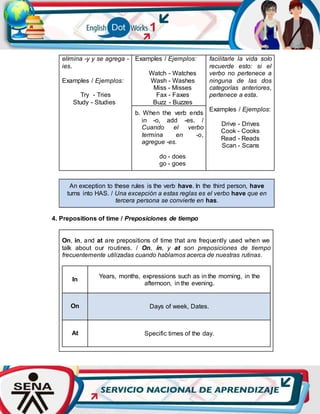
-IES -ES -S
When the verb ends in
y after a consonant,
drop the y and add -ies.
/ Cuando el verbo
termina en -y después
de una consonante, se
a. When the verb ends
in -ch, -sh, -s, -x, or -
z, add -es. / Cuando
el verbo termina en -
ch, -sh, -s, -x, o -z,
agregue -es.
To make your life
simple, just remember
this: if it does not
belong to the first two
categories, it belongs
to this one. / Para
Presentation / Presentación
elimina -y y se agrega -
ies.
Examples / Ejemplos:
Try - Tries
Study - Studies
Examples / Ejemplos:
Watch - Watches
Wash - Washes
Miss - Misses
Fax - Faxes
Buzz - Buzzes
facilitarle la vida solo
recuerde esto: si el
verbo no pertenece a
ninguna de las dos
categorías anteriores,
pertenece a esta.
Examples / Ejemplos:
Drive - Drives
Cook - Cooks
Read - Reads
Scan - Scans
b. When the verb ends
in -o, add -es. /
Cuando el verbo
termina en -o,
agregue -es.
do - does
go - goes
An exception to these rules is the verb have. In the third person, have
turns into HAS. / Una excepción a estas reglas es el verbo have que en
tercera persona se convierte en has.
4. Prepositions of time / Preposiciones de tiempo
On, in, and at are prepositions of time that are frequently used when we
talk about our routines. / On, in, y at son preposiciones de tiempo
frecuentemente utilizadas cuando hablamos acerca de nuestras rutinas.
In
Years, months, expressions such as in the morning, in the
afternoon, in the evening.
On Days of week, Dates.
At Specific times of the day.
B. Adverbs of frequency / Adverbios de frecuencia
1. Function / Función
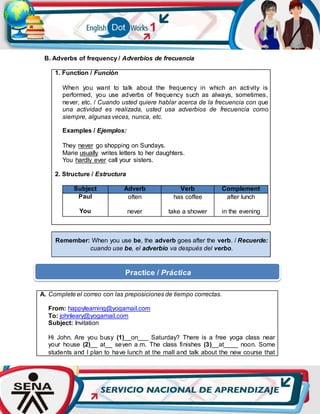
When you want to talk about the frequency in which an activity is
performed, you use adverbs of frequency such as always, sometimes,
never, etc. / Cuando usted quiere hablar acerca de la frecuencia con que
una actividad es realizada, usted usa adverbios de frecuencia como
siempre, algunas veces, nunca, etc.
Examples / Ejemplos:
They never go shopping on Sundays.
Marie usually writes letters to her daughters.
You hardly ever call your sisters.
2. Structure / Estructura
Subject Adverb Verb Complement
Paul
You
often
never
has coffee
take a shower
after lunch
in the evening
Remember: When you use be, the adverb goes after the verb. / Recuerde:
cuando use be, el adverbio va después del verbo.
A. Complete el correo con las preposiciones de tiempo correctas.
From: happylearning@yogamail.com
To: johnleary@yogamail.com
Subject: Invitation
Hi John. Are you busy (1)__on___ Saturday? There is a free yoga class near
your house (2)__ at__ seven a.m. The class finishes (3)__at____ noon. Some
students and I plan to have lunch at the mall and talk about the new course that
Practice / Práctica
starts (4)___in______ May. They say they like to have classes
(5)__on___weekends because (6)__on_______ weekdays they have to work a
lot.
Let me know if you can go.
Best regards,
James Dean.
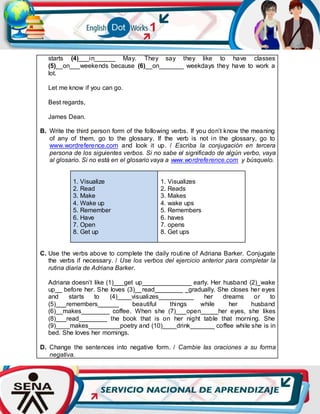
B. Write the third person form of the following verbs. If you don’t know the meaning
of any of them, go to the glossary. If the verb is not in the glossary, go to
www.wordreference.com and look it up. / Escriba la conjugación en tercera
persona de los siguientes verbos. Si no sabe el significado de algún verbo, vaya
al glosario. Si no está en el glosario vaya a www.wordreference.com y búsquelo.
1. Visualize
2. Read
3. Make
4. Wake up
5. Remember
6. Have
7. Open
8. Get up
1. Visualizes
2. Reads
3. Makes
4. wake ups
5. Remembers
6. haves
7. opens
8. Get ups
C. Use the verbs above to complete the daily routine of Adriana Barker. Conjugate
the verbs if necessary. / Use los verbos del ejercicio anterior para completar la
rutina diaria de Adriana Barker.
Adriana doesn’t like (1)___get up______________ early. Her husband (2)_wake
up__ before her. She loves (3)__read________ _gradually. She closes her eyes
and starts to (4)____visualizes__________ her dreams or to
(5)___remembers______ beautiful things while her husband
(6)__makes________ coffee. When she (7)___open_____her eyes, she likes
(8)___read________ the book that is on her night table that morning. She
(9)____makes_________poetry and (10)____drink_______ coffee while she is in
bed. She loves her mornings.
D. Change the sentences into negative form. / Cambie las oraciones a su forma
negativa.
1. Dogs like to play in water.
Dogs does not to play in the water
.
2. My mother watches TV in the afternoon.
My mother does not watches tv in the afternoon
3. Some soccer players make a lot of money.
some soccer does not players make a lot of money.
4. Alan Moore writes excellent stories.
Alan moore does not writes excellents stories
5. Susan and Patricia have coffee every morning.
Susan and patricia do not have coffee every morning
E. Make a sentence by adding the adverb in the parentheses to the sentence
provided. / Haga una oración agregando el adverbio que está en el paréntesis en
la oración que le es proporcionada.
1. Laura is hungry. (always)
Laura always is hungry
2. They go to bed after they brush their teeth. (usually)
They usually go to bed after they brush their teeth.
3. I am angry. (seldom)
I am seldom angry
4. My dad drinks coffee. (rarely)
My dad rarely frinks coffe
.
5. My son walks to school. (never)
My son never walks to school
6. We’re on time. (often)
We´re often on time
F. Look at the pictures and write sentences with the adverbs of frequency. When
you finish, check the answers at the end of this document. / Mire las imágenes y
haga oraciones utilizando los adverbios de frecuencia.
1
Always
1. Camilo and Susana
always play in the
school
2. Bibian always read in
house
2
Fuente: SENA Fuente: SENA
3
Rarely
3. My cousin rarely swims
in the pool
4. Didier rarely plays his
guitar in class
4
Fuente: SENA Fuente: SENA
5 Sometimes 6
Fuente: SENA
5. My father sometimes
read newspaper
6. I am sometimes listen
to music
Fuente: SENA
G. Put the words in order to form a sentence. Conjugate the verb if necessary. /
Organice las partes para formar una oración.
1. Often / lunch / have / David / at the office.
David often has lunch in the office
2. Go to work / rarely / my parents / by bus.
My parents rarely go to work by bus
3. In the evening / you / do homework / often.
You often do homework in the evening
3. Usually / Laura / be / good student / a
Laura be usually good a student
5. Go to the movies / on Saturdays / never / your friends.
Your friends never go to the movies on saturdays
A. Choose a person you admire or a person you consider to be a role model.
Google information about his/her personal routine. Use the information to write a
Production / Producción
composition about his/her personal routine. Write at least 10 sentences. / Escoja
una persona a quién usted admire. Una persona que usted considera un
ejemplo a seguir. Busque en Google información acerca de su rutina diaria. Use
la información para escribir una composición de por lo menos 10 oraciones
acerca de su rutina.
 Sofia Vergara usually gets up at eigth o´ clock
 Sofia Vergara always drinks coffe
 Sofia always does exercise routine
 Sofia usually bathesher hair after exercising
 Sofia always uses jeans
 Sofia never enjoys the exercise
 Sofia always eats desserts on Saturdays
 Sofia never breaks her routine
B. Using the frequency adverbs, write a composition about the routine of a member
of your family. / Utilizando los adverbios de frecuencia escriba una composición
acerca de la rutina usual de algún miembro de su familia.
My mother always gets up 5:00 am, regulary makes breakfast, bathes and
gest organized to go works at 7:00 am.
My mother never exercise, rarely lunches and always drinks coffe.
Note: To check the answers go to Program materials: Support materials /
Suggest answer sheet. / Nota: para consultar las respuestas diríjase al
botón Program materials: Support materials / Suggest answer sheet.
Document control / Control del documento
Name Position Dependence Date
Author Nicole Bruskewitz
Asesora pedagógica
English Dot Works
Dirección de
Formación
Profesional
Dirección General
August
2014
Adaptation
Paola Andrea
Bobadilla
Gutiérrez
Copy editor – Línea
de producción
Centro
Agroindustrial
Regional Quindío
August
2014

Material 2 ingles.

  • 1.
    Support material /Material de apoyo Learning activity 2 / Actividad de aprendizaje 2 A. Daily routines / Rutinas diarias 1. Function / Función To talk about routines in the present, we use the simple present. / Para hablar de rutinas utilizamos el presente simple. Examples / Ejemplos:  I brush my teeth every morning.  Robert watches the news in the evening.  They go jogging after class.  We study Portuguese on Saturdays. 2. Structure / Estructura Subject Verb Complement I study English on Tuesdays and Thursdays He supervises * his employees everyday * Remember that when the subject is he/she/it, you have to add -s, -es, or - ies to the verb. 3. Third person conjugation / Conjugación en tercera persona -IES -ES -S When the verb ends in y after a consonant, drop the y and add -ies. / Cuando el verbo termina en -y después de una consonante, se a. When the verb ends in -ch, -sh, -s, -x, or - z, add -es. / Cuando el verbo termina en - ch, -sh, -s, -x, o -z, agregue -es. To make your life simple, just remember this: if it does not belong to the first two categories, it belongs to this one. / Para Presentation / Presentación
  • 2.
    elimina -y yse agrega - ies. Examples / Ejemplos: Try - Tries Study - Studies Examples / Ejemplos: Watch - Watches Wash - Washes Miss - Misses Fax - Faxes Buzz - Buzzes facilitarle la vida solo recuerde esto: si el verbo no pertenece a ninguna de las dos categorías anteriores, pertenece a esta. Examples / Ejemplos: Drive - Drives Cook - Cooks Read - Reads Scan - Scans b. When the verb ends in -o, add -es. / Cuando el verbo termina en -o, agregue -es. do - does go - goes An exception to these rules is the verb have. In the third person, have turns into HAS. / Una excepción a estas reglas es el verbo have que en tercera persona se convierte en has. 4. Prepositions of time / Preposiciones de tiempo On, in, and at are prepositions of time that are frequently used when we talk about our routines. / On, in, y at son preposiciones de tiempo frecuentemente utilizadas cuando hablamos acerca de nuestras rutinas. In Years, months, expressions such as in the morning, in the afternoon, in the evening. On Days of week, Dates. At Specific times of the day.
  • 3.
    B. Adverbs offrequency / Adverbios de frecuencia 1. Function / Función When you want to talk about the frequency in which an activity is performed, you use adverbs of frequency such as always, sometimes, never, etc. / Cuando usted quiere hablar acerca de la frecuencia con que una actividad es realizada, usted usa adverbios de frecuencia como siempre, algunas veces, nunca, etc. Examples / Ejemplos: They never go shopping on Sundays. Marie usually writes letters to her daughters. You hardly ever call your sisters. 2. Structure / Estructura Subject Adverb Verb Complement Paul You often never has coffee take a shower after lunch in the evening Remember: When you use be, the adverb goes after the verb. / Recuerde: cuando use be, el adverbio va después del verbo. A. Complete el correo con las preposiciones de tiempo correctas. From: happylearning@yogamail.com To: johnleary@yogamail.com Subject: Invitation Hi John. Are you busy (1)__on___ Saturday? There is a free yoga class near your house (2)__ at__ seven a.m. The class finishes (3)__at____ noon. Some students and I plan to have lunch at the mall and talk about the new course that Practice / Práctica
  • 4.
    starts (4)___in______ May.They say they like to have classes (5)__on___weekends because (6)__on_______ weekdays they have to work a lot. Let me know if you can go. Best regards, James Dean. B. Write the third person form of the following verbs. If you don’t know the meaning of any of them, go to the glossary. If the verb is not in the glossary, go to www.wordreference.com and look it up. / Escriba la conjugación en tercera persona de los siguientes verbos. Si no sabe el significado de algún verbo, vaya al glosario. Si no está en el glosario vaya a www.wordreference.com y búsquelo. 1. Visualize 2. Read 3. Make 4. Wake up 5. Remember 6. Have 7. Open 8. Get up 1. Visualizes 2. Reads 3. Makes 4. wake ups 5. Remembers 6. haves 7. opens 8. Get ups C. Use the verbs above to complete the daily routine of Adriana Barker. Conjugate the verbs if necessary. / Use los verbos del ejercicio anterior para completar la rutina diaria de Adriana Barker. Adriana doesn’t like (1)___get up______________ early. Her husband (2)_wake up__ before her. She loves (3)__read________ _gradually. She closes her eyes and starts to (4)____visualizes__________ her dreams or to (5)___remembers______ beautiful things while her husband (6)__makes________ coffee. When she (7)___open_____her eyes, she likes (8)___read________ the book that is on her night table that morning. She (9)____makes_________poetry and (10)____drink_______ coffee while she is in bed. She loves her mornings. D. Change the sentences into negative form. / Cambie las oraciones a su forma negativa.
  • 5.
    1. Dogs liketo play in water. Dogs does not to play in the water . 2. My mother watches TV in the afternoon. My mother does not watches tv in the afternoon 3. Some soccer players make a lot of money. some soccer does not players make a lot of money. 4. Alan Moore writes excellent stories. Alan moore does not writes excellents stories 5. Susan and Patricia have coffee every morning. Susan and patricia do not have coffee every morning E. Make a sentence by adding the adverb in the parentheses to the sentence provided. / Haga una oración agregando el adverbio que está en el paréntesis en la oración que le es proporcionada. 1. Laura is hungry. (always) Laura always is hungry 2. They go to bed after they brush their teeth. (usually) They usually go to bed after they brush their teeth. 3. I am angry. (seldom) I am seldom angry 4. My dad drinks coffee. (rarely) My dad rarely frinks coffe
  • 6.
    . 5. My sonwalks to school. (never) My son never walks to school 6. We’re on time. (often) We´re often on time F. Look at the pictures and write sentences with the adverbs of frequency. When you finish, check the answers at the end of this document. / Mire las imágenes y haga oraciones utilizando los adverbios de frecuencia. 1 Always 1. Camilo and Susana always play in the school 2. Bibian always read in house 2 Fuente: SENA Fuente: SENA 3 Rarely 3. My cousin rarely swims in the pool 4. Didier rarely plays his guitar in class 4 Fuente: SENA Fuente: SENA 5 Sometimes 6
  • 7.
    Fuente: SENA 5. Myfather sometimes read newspaper 6. I am sometimes listen to music Fuente: SENA G. Put the words in order to form a sentence. Conjugate the verb if necessary. / Organice las partes para formar una oración. 1. Often / lunch / have / David / at the office. David often has lunch in the office 2. Go to work / rarely / my parents / by bus. My parents rarely go to work by bus 3. In the evening / you / do homework / often. You often do homework in the evening 3. Usually / Laura / be / good student / a Laura be usually good a student 5. Go to the movies / on Saturdays / never / your friends. Your friends never go to the movies on saturdays A. Choose a person you admire or a person you consider to be a role model. Google information about his/her personal routine. Use the information to write a Production / Producción
  • 8.
    composition about his/herpersonal routine. Write at least 10 sentences. / Escoja una persona a quién usted admire. Una persona que usted considera un ejemplo a seguir. Busque en Google información acerca de su rutina diaria. Use la información para escribir una composición de por lo menos 10 oraciones acerca de su rutina.  Sofia Vergara usually gets up at eigth o´ clock  Sofia Vergara always drinks coffe  Sofia always does exercise routine  Sofia usually bathesher hair after exercising  Sofia always uses jeans  Sofia never enjoys the exercise  Sofia always eats desserts on Saturdays  Sofia never breaks her routine B. Using the frequency adverbs, write a composition about the routine of a member of your family. / Utilizando los adverbios de frecuencia escriba una composición acerca de la rutina usual de algún miembro de su familia. My mother always gets up 5:00 am, regulary makes breakfast, bathes and gest organized to go works at 7:00 am. My mother never exercise, rarely lunches and always drinks coffe. Note: To check the answers go to Program materials: Support materials / Suggest answer sheet. / Nota: para consultar las respuestas diríjase al botón Program materials: Support materials / Suggest answer sheet.
  • 9.
    Document control /Control del documento Name Position Dependence Date Author Nicole Bruskewitz Asesora pedagógica English Dot Works Dirección de Formación Profesional Dirección General August 2014 Adaptation Paola Andrea Bobadilla Gutiérrez Copy editor – Línea de producción Centro Agroindustrial Regional Quindío August 2014