GRAMMAR BOOK
 Por Roxana Brown
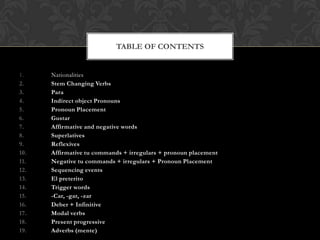
TABLE OF CONTENTS


1.    Nationalities
2.    Stem Changing Verbs
3.    Para
4.    Indirect object Pronouns
5.    Pronoun Placement
6.    Gustar
7.    Affirmative and negative words
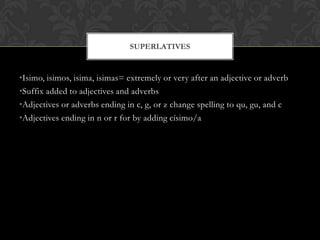
8.    Superlatives
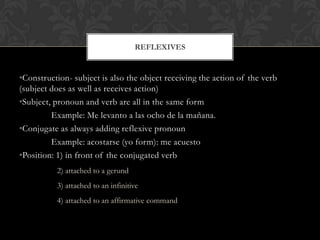
9.    Reflexives
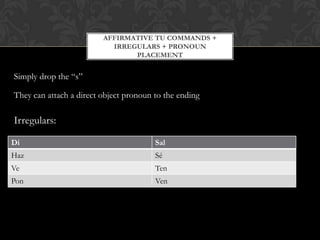
10.   Affirmative tu commands + irregulars + pronoun placement
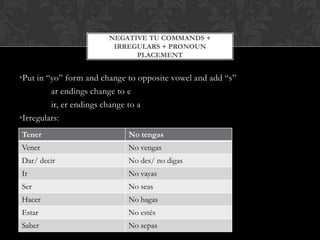
11.   Negative tu commands + irregulars + Pronoun Placement
12.   Sequencing events
13.   El preterito
14.   Trigger words
15.   -Car, -gar, -zar
16.   Deber + Infinitive
17.   Modal verbs
18.   Present progressive
19.   Adverbs (mente)
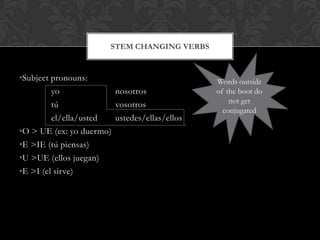
STEM CHANGING VERBS


•Subject pronouns:                            Words outside
         yo             nosotros              of the boot do
         tú             vosotros                  not get
                                                conjugated
         el/ella/usted  ustedes/ellas/ellos
•O > UE (ex: yo duermo)
•E >IE (tú piensas)
•U >UE (ellos juegan)
•E >I (el sirve)
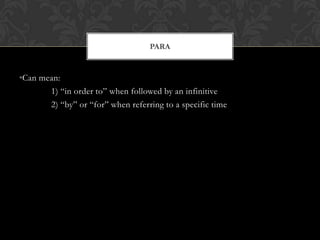
PARA


•Can mean:
       1) “in order to” when followed by an infinitive
       2) “by” or “for” when referring to a specific time
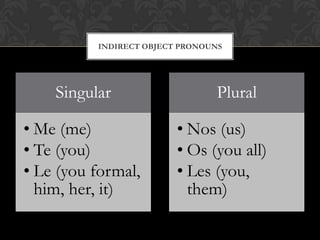
INDIRECT OBJECT PRONOUNS


    Singular                    Plural

• Me (me)                • Nos (us)
• Te (you)               • Os (you all)
• Le (you formal,        • Les (you,
  him, her, it)            them)
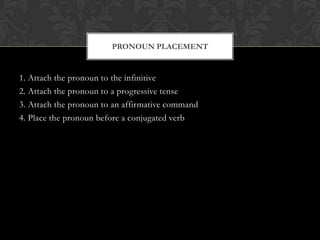
PRONOUN PLACEMENT


1. Attach the pronoun to the infinitive
2. Attach the pronoun to a progressive tense
3. Attach the pronoun to an affirmative command
4. Place the pronoun before a conjugated verb
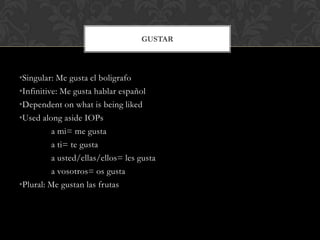
GUSTAR


•Singular: Me gusta el boligrafo
•Infinitive: Me gusta hablar español
•Dependent on what is being liked
•Used along aside IOPs
          a mi= me gusta
          a ti= te gusta
          a usted/ellas/ellos= les gusta
          a vosotros= os gusta
•Plural: Me gustan las frutas
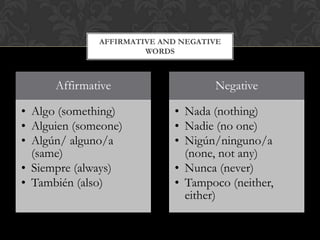
AFFIRMATIVE AND NEGATIVE
                       WORDS


      Affirmative                   Negative

• Algo (something)          • Nada (nothing)
• Alguien (someone)         • Nadie (no one)
• Algún/ alguno/a           • Nigún/ninguno/a
  (same)                      (none, not any)
• Siempre (always)          • Nunca (never)
• También (also)            • Tampoco (neither,
                              either)
SUPERLATIVES


•Isimo, isimos, isima, isimas= extremely or very after an adjective or adverb
•Suffix added to adjectives and adverbs
•Adjectives or adverbs ending in c, g, or z change spelling to qu, gu, and c
•Adjectives ending in n or r for by adding císimo/a
REFLEXIVES


•Construction- subject is also the object receiving the action of the verb
(subject does as well as receives action)
•Subject, pronoun and verb are all in the same form
         Example: Me levanto a las ocho de la mañana.
•Conjugate as always adding reflexive pronoun
         Example: acostarse (yo form): me acuesto
•Position: 1) in front of the conjugated verb
          2) attached to a gerund
          3) attached to an infinitive
          4) attached to an affirmative command
AFFIRMATIVE TU COMMANDS +
                           IRREGULARS + PRONOUN
                                PLACEMENT


Simply drop the “s”

They can attach a direct object pronoun to the ending

Irregulars:

Di                                      Sal
Haz                                     Sé
Ve                                      Ten
Pon                                     Ven
NEGATIVE TU COMMANDS +
                        IRREGULARS + PRONOUN
                             PLACEMENT


•Put in “yo” form and change to opposite vowel and add “s”
         ar endings change to e
         ir, er endings change to a
•Irregulars:
Tener                        No tengas
Vener                        No vengas
Dar/ decir                   No des/ no digas
Ir                           No vayas
Ser                          No seas
Hacer                        No hagas
Estar                        No estés
Saber                        No sepas
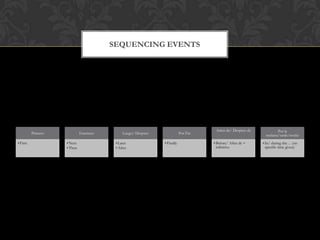
SEQUENCING EVENTS


                                                                                     Antes de/ Despues de           Por la
          Primero            Entonces        Luego/ Despues               Por Fin
                                                                                                              mañana/tarde/noche
• First             • Next               • Later              • Finally             • Before/ After de +    • In/ during the… (no
                    • Then               • After                                      infinitive              specific time given)
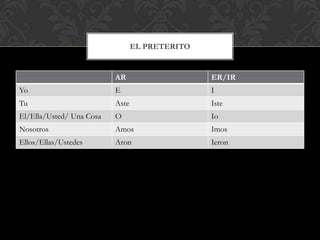
EL PRETERITO


                          AR                    ER/IR
Yo                        E                     I
Tu                        Aste                  Iste
El/Ella/Usted/ Una Cosa   O                     Io
Nosotros                  Amos                  Imos
Ellos/Ellas/Ustedes       Aron                  Ieron
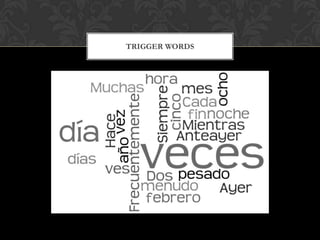
TRIGGER WORDS
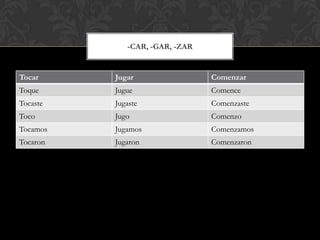
-CAR, -GAR, -ZAR


Tocar     Jugar                 Comenzar
Toque     Jugue                 Comence
Tocaste   Jugaste               Comenzaste
Toco      Jugo                  Comenzo
Tocamos   Jugamos               Comenzamos
Tocaron   Jugaron               Comenzaron
DEBER + INFINITIVE


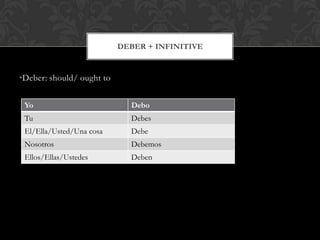
•Deber: should/ ought to


 Yo                          Debo
 Tu                          Debes
 El/Ella/Usted/Una cosa      Debe
 Nosotros                    Debemos
 Ellos/Ellas/Ustedes         Deben
MODAL VERBS


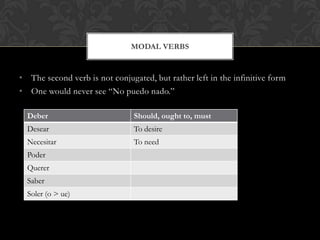
• The second verb is not conjugated, but rather left in the infinitive form
• One would never see “No puedo nado.”

  Deber                         Should, ought to, must
  Desear                        To desire
  Necesitar                     To need
  Poder
  Querer
  Saber
  Soler (o > ue)
PRESENT PROGRESSIVE


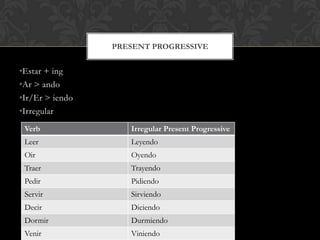
•Estar + ing
•Ar > ando
•Ir/Er > iendo
•Irregular
 Verb               Irregular Present Progressive
 Leer               Leyendo
 Oir                Oyendo
 Traer              Trayendo
 Pedir              Pidiendo
 Servir             Sirviendo
 Decir              Diciendo
 Dormir             Durmiendo
 Venir              Viniendo
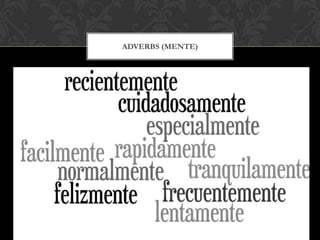
ADVERBS (MENTE)

Spanish grammar book

  • 1.
    GRAMMAR BOOK PorRoxana Brown
  • 2.
    TABLE OF CONTENTS 1. Nationalities 2. Stem Changing Verbs 3. Para 4. Indirect object Pronouns 5. Pronoun Placement 6. Gustar 7. Affirmative and negative words 8. Superlatives 9. Reflexives 10. Affirmative tu commands + irregulars + pronoun placement 11. Negative tu commands + irregulars + Pronoun Placement 12. Sequencing events 13. El preterito 14. Trigger words 15. -Car, -gar, -zar 16. Deber + Infinitive 17. Modal verbs 18. Present progressive 19. Adverbs (mente)
  • 4.
    STEM CHANGING VERBS •Subjectpronouns: Words outside yo nosotros of the boot do tú vosotros not get conjugated el/ella/usted ustedes/ellas/ellos •O > UE (ex: yo duermo) •E >IE (tú piensas) •U >UE (ellos juegan) •E >I (el sirve)
  • 5.
    PARA •Can mean: 1) “in order to” when followed by an infinitive 2) “by” or “for” when referring to a specific time
  • 6.
    INDIRECT OBJECT PRONOUNS Singular Plural • Me (me) • Nos (us) • Te (you) • Os (you all) • Le (you formal, • Les (you, him, her, it) them)
  • 7.
    PRONOUN PLACEMENT 1. Attachthe pronoun to the infinitive 2. Attach the pronoun to a progressive tense 3. Attach the pronoun to an affirmative command 4. Place the pronoun before a conjugated verb
  • 8.
    GUSTAR •Singular: Me gustael boligrafo •Infinitive: Me gusta hablar español •Dependent on what is being liked •Used along aside IOPs a mi= me gusta a ti= te gusta a usted/ellas/ellos= les gusta a vosotros= os gusta •Plural: Me gustan las frutas
  • 9.
    AFFIRMATIVE AND NEGATIVE WORDS Affirmative Negative • Algo (something) • Nada (nothing) • Alguien (someone) • Nadie (no one) • Algún/ alguno/a • Nigún/ninguno/a (same) (none, not any) • Siempre (always) • Nunca (never) • También (also) • Tampoco (neither, either)
  • 10.
    SUPERLATIVES •Isimo, isimos, isima,isimas= extremely or very after an adjective or adverb •Suffix added to adjectives and adverbs •Adjectives or adverbs ending in c, g, or z change spelling to qu, gu, and c •Adjectives ending in n or r for by adding císimo/a
  • 11.
    REFLEXIVES •Construction- subject isalso the object receiving the action of the verb (subject does as well as receives action) •Subject, pronoun and verb are all in the same form Example: Me levanto a las ocho de la mañana. •Conjugate as always adding reflexive pronoun Example: acostarse (yo form): me acuesto •Position: 1) in front of the conjugated verb 2) attached to a gerund 3) attached to an infinitive 4) attached to an affirmative command
  • 12.
    AFFIRMATIVE TU COMMANDS+ IRREGULARS + PRONOUN PLACEMENT Simply drop the “s” They can attach a direct object pronoun to the ending Irregulars: Di Sal Haz Sé Ve Ten Pon Ven
  • 13.
    NEGATIVE TU COMMANDS+ IRREGULARS + PRONOUN PLACEMENT •Put in “yo” form and change to opposite vowel and add “s” ar endings change to e ir, er endings change to a •Irregulars: Tener No tengas Vener No vengas Dar/ decir No des/ no digas Ir No vayas Ser No seas Hacer No hagas Estar No estés Saber No sepas
  • 14.
    SEQUENCING EVENTS Antes de/ Despues de Por la Primero Entonces Luego/ Despues Por Fin mañana/tarde/noche • First • Next • Later • Finally • Before/ After de + • In/ during the… (no • Then • After infinitive specific time given)
  • 15.
    EL PRETERITO AR ER/IR Yo E I Tu Aste Iste El/Ella/Usted/ Una Cosa O Io Nosotros Amos Imos Ellos/Ellas/Ustedes Aron Ieron
  • 16.
  • 17.
    -CAR, -GAR, -ZAR Tocar Jugar Comenzar Toque Jugue Comence Tocaste Jugaste Comenzaste Toco Jugo Comenzo Tocamos Jugamos Comenzamos Tocaron Jugaron Comenzaron
  • 18.
    DEBER + INFINITIVE •Deber:should/ ought to Yo Debo Tu Debes El/Ella/Usted/Una cosa Debe Nosotros Debemos Ellos/Ellas/Ustedes Deben
  • 19.
    MODAL VERBS • Thesecond verb is not conjugated, but rather left in the infinitive form • One would never see “No puedo nado.” Deber Should, ought to, must Desear To desire Necesitar To need Poder Querer Saber Soler (o > ue)
  • 20.
    PRESENT PROGRESSIVE •Estar +ing •Ar > ando •Ir/Er > iendo •Irregular Verb Irregular Present Progressive Leer Leyendo Oir Oyendo Traer Trayendo Pedir Pidiendo Servir Sirviendo Decir Diciendo Dormir Durmiendo Venir Viniendo
  • 21.