LOGO
Lithium-Air Battery
LOGO
Battery 500 Project
An initiative started by IBM in 2009 to produce a
battery capable of powering a car for 500 miles.
In IBM’s lithium-air battery, oxygen is reacted
with lithium to create lithium peroxide and
electrical energy. When the battery is recharged,
the process is reversed and oxygen is released.
Conventional batteries are completely self-
contained, and the oxygen used in an lithium-air
battery obviously comes from the atmosphere,
and so the battery itself can be much lighter.
LOGO
The main thing is that lithium-air energy
density is a lot higher than conventional
lithium-ion batteries: The max energy
density of lithium-air batteries is theorized
to be around 12 kWh/kg, some 15 times
greater than li-ion — and more
importantly, comparable to gasoline.
LOGO
LOGO
LOGO
LOGO
How it works:
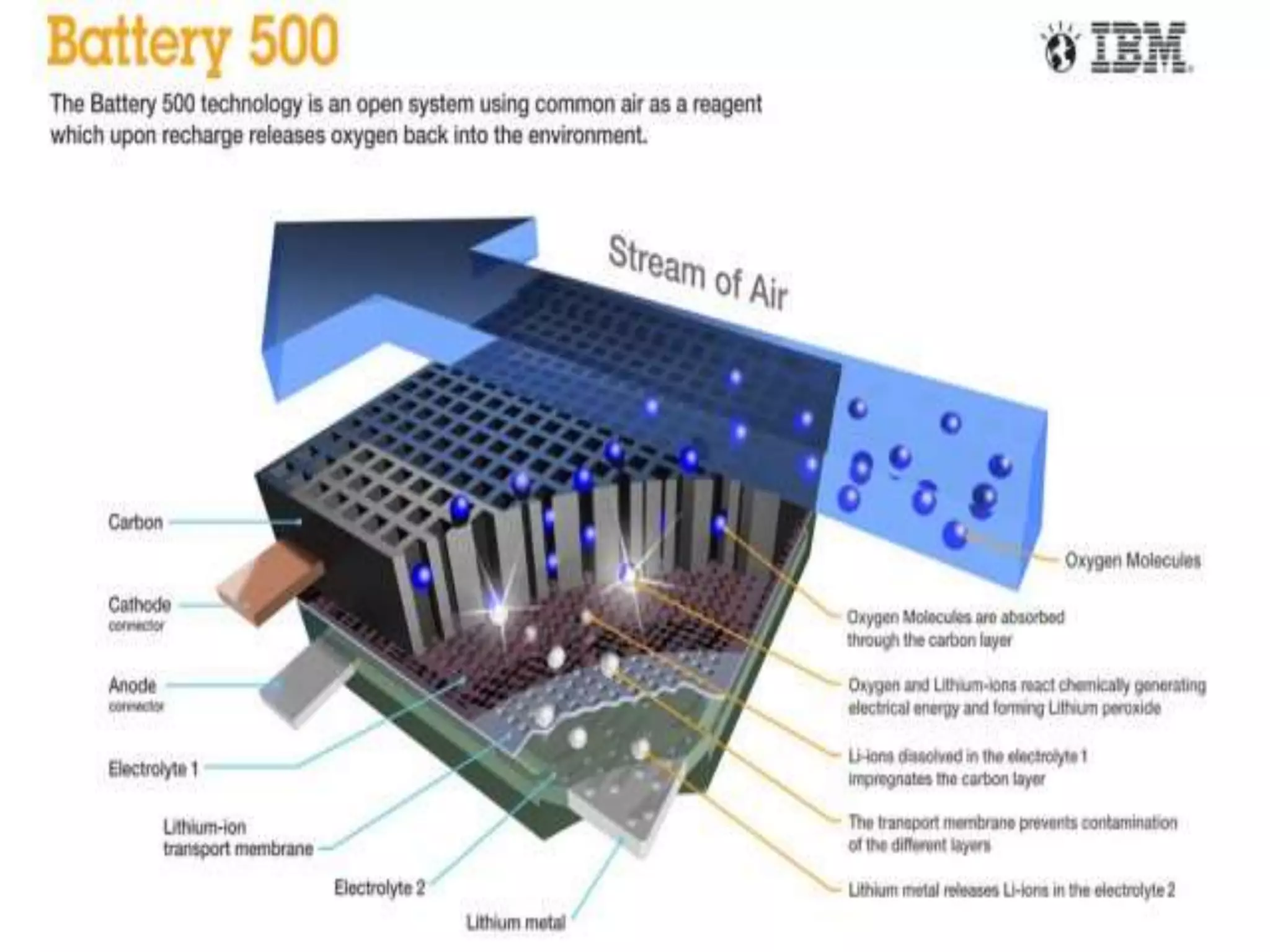
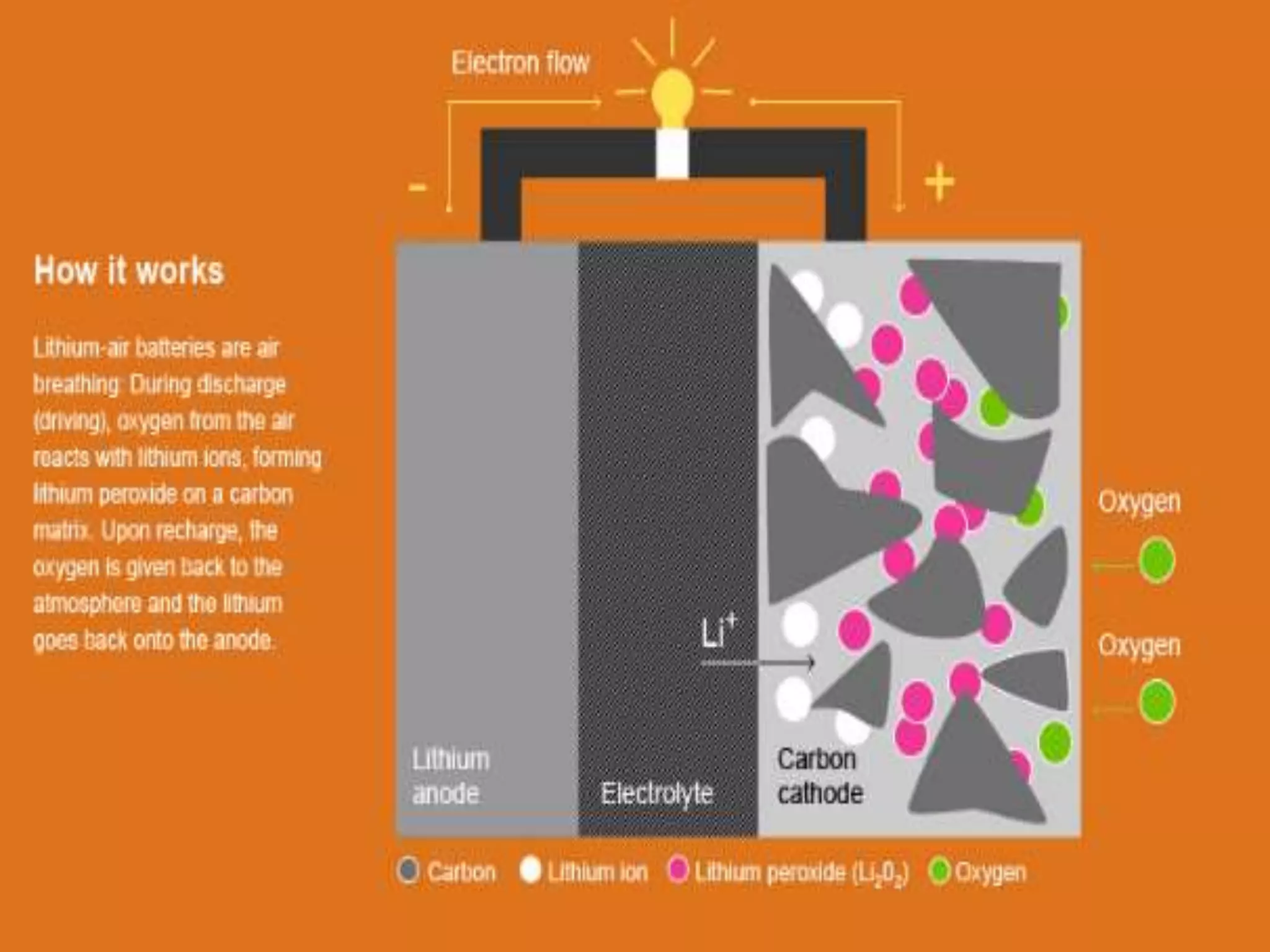
 During discharge (driving), oxygen from the air reacts
with lithium ions, forming lithium peroxide on a carbon
matrix. Upon recharge, the oxygen is given back to the
atmosphere and the lithium goes back onto the anode.
The battery is forming lithium peroxide Li2O2. Other
phases like Li2O also exist which store even more Li
atoms (i.e. energy) per molecule.
 The large volume required for an li-air battery is because
of the large surface area required to take in oxygen.
The point of the IBM approach is that they have reduced
the volume required by increasing the surface area using
nano materials in a three-dimensional lattice.
LOGO
Lithium-air batteries aren’t a new idea: They’ve
been mooted since the 1970s, but the necessary
technology was well beyond the capabilities of
then-contemporary material science. Today, with
graphene and carbon nanotubes and fancy
membranes coming out of our ears, it seems
IBM — with assistance from partners Asahi
Kasei and Central Glass — now has the
materials required to build a lithium-air battery.
There is a video embedded below that details
the electrochemical process of an li-air battery.
LOGO
The reason we are not using these magical,
breathing batteries right now is because they are
also chemically unstable, and as of right now,
frequent recharges completely destroy the
battery life. The researchers discovered that the
oxygen is also reacting with in-turn depletes the
electrolytic solvent, a conducting solution that
moves Li-ions between the electrodes and
regulates the chemical reaction.
LOGO
Now researchers collaborating between
IBM's Almaden laboratories and Zurich
research labs in Switzerland think they
have found an alternative electrolytes that
won’t react to the air. If everything turns
out as promising as it seems, the
scientists predict they will have a working
prototype by 2013 and a commercial
battery by 2020.
LOGO
Reference
 Anthony, Sebastian. "IBM creates breathing, high-density, light-
weight lithium-air battery." Extreme Tech. RSS, 20 April 2012. Web.
21 April 2012. <http://www.extremetech.com/computing/126745-
ibm-creates-breathing-high-density-light-weight-lithium-air-battery>.
 Garling, Caleb. "IBM Demos Uber Battery That ‘Breathes’." Wired
Enterprise. Permalink, 2o April 2012. Web. 1 May 2012.
<http://www.wired.com/wiredenterprise/2012/04/ibm-
supercomputers-battery/>.
LOGO

Lithium air battery

  • 1.
  • 2.
    LOGO Battery 500 Project Aninitiative started by IBM in 2009 to produce a battery capable of powering a car for 500 miles. In IBM’s lithium-air battery, oxygen is reacted with lithium to create lithium peroxide and electrical energy. When the battery is recharged, the process is reversed and oxygen is released. Conventional batteries are completely self- contained, and the oxygen used in an lithium-air battery obviously comes from the atmosphere, and so the battery itself can be much lighter.
  • 3.
    LOGO The main thingis that lithium-air energy density is a lot higher than conventional lithium-ion batteries: The max energy density of lithium-air batteries is theorized to be around 12 kWh/kg, some 15 times greater than li-ion — and more importantly, comparable to gasoline.
  • 4.
  • 5.
  • 6.
  • 7.
    LOGO How it works: During discharge (driving), oxygen from the air reacts with lithium ions, forming lithium peroxide on a carbon matrix. Upon recharge, the oxygen is given back to the atmosphere and the lithium goes back onto the anode. The battery is forming lithium peroxide Li2O2. Other phases like Li2O also exist which store even more Li atoms (i.e. energy) per molecule.  The large volume required for an li-air battery is because of the large surface area required to take in oxygen. The point of the IBM approach is that they have reduced the volume required by increasing the surface area using nano materials in a three-dimensional lattice.
  • 8.
    LOGO Lithium-air batteries aren’ta new idea: They’ve been mooted since the 1970s, but the necessary technology was well beyond the capabilities of then-contemporary material science. Today, with graphene and carbon nanotubes and fancy membranes coming out of our ears, it seems IBM — with assistance from partners Asahi Kasei and Central Glass — now has the materials required to build a lithium-air battery. There is a video embedded below that details the electrochemical process of an li-air battery.
  • 9.
    LOGO The reason weare not using these magical, breathing batteries right now is because they are also chemically unstable, and as of right now, frequent recharges completely destroy the battery life. The researchers discovered that the oxygen is also reacting with in-turn depletes the electrolytic solvent, a conducting solution that moves Li-ions between the electrodes and regulates the chemical reaction.
  • 10.
    LOGO Now researchers collaboratingbetween IBM's Almaden laboratories and Zurich research labs in Switzerland think they have found an alternative electrolytes that won’t react to the air. If everything turns out as promising as it seems, the scientists predict they will have a working prototype by 2013 and a commercial battery by 2020.
  • 11.
    LOGO Reference  Anthony, Sebastian."IBM creates breathing, high-density, light- weight lithium-air battery." Extreme Tech. RSS, 20 April 2012. Web. 21 April 2012. <http://www.extremetech.com/computing/126745- ibm-creates-breathing-high-density-light-weight-lithium-air-battery>.  Garling, Caleb. "IBM Demos Uber Battery That ‘Breathes’." Wired Enterprise. Permalink, 2o April 2012. Web. 1 May 2012. <http://www.wired.com/wiredenterprise/2012/04/ibm- supercomputers-battery/>.
  • 12.