Judith Jeevarajan, Ph.D 
Power Systems Branch 
NASA-Johnson Space Center 
April, 2014 
Power Goals for Human Space Exploration
Outline 
•Battery Basics 
•Battery Chemistries commonly used for Human Space Exploration 
•Current and Future Missions 
•Technology Programs to Achieve Power Goals 
•Challenges 
•Summary 
2
3 
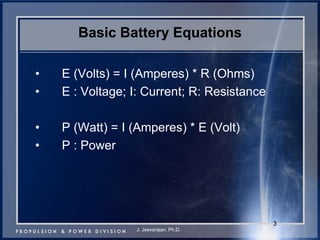
Basic Battery Equations 
•E (Volts) = I (Amperes) * R (Ohms) 
•E : Voltage; I: Current; R: Resistance 
•P (Watt) = I (Amperes) * E (Volt) 
•P : Power 
J. Jeevarajan, Ph.D.
4 
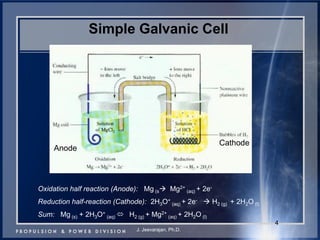
Simple Galvanic Cell 
Anode 
Cathode 
Oxidation half reaction (Anode): Mg (s  Mg2+ (aq) + 2e- 
Reduction half-reaction (Cathode): 2H3O+ (aq) + 2e-  H2 (g) + 2H2O (l) 

Sum: Mg (s) + 2H3O+ (aq)  H2 (g) + Mg2+ (aq) + 2H2O (l) 
J. Jeevarajan, Ph.D.
5 
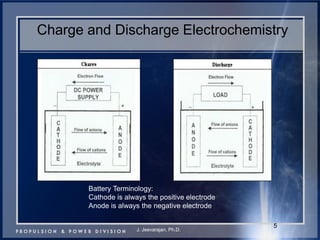
Charge and Discharge Electrochemistry 
Battery Terminology: 
Cathode is always the positive electrode 
Anode is always the negative electrode 
J. Jeevarajan, Ph.D.
6 
Electrochemical Equations 
•Ecell = Eox + Ered 
•Wmax = -n*F*Ecell = ΔG 
•-n*F*Eocell = ΔGo298 
•For a reaction to occur spontaneously, ΔG should be negative (implies that E should be always positive). 
•Nernst Equation: 
•Ecell = Eocell – (RT/nF)*ln(Q) 
•For the following reaction, 
•aA(g) + bB (g)  cC (g) + dD (g) 
•Q = reaction quotient = [PC]x[PD]y / [PA]m[PB]n 
J. Jeevarajan, Ph.D.
7 
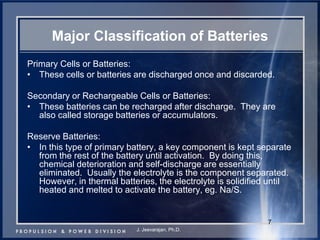
Major Classification of Batteries 
Primary Cells or Batteries: 
•These cells or batteries are discharged once and discarded. 
Secondary or Rechargeable Cells or Batteries: 
•These batteries can be recharged after discharge. They are also called storage batteries or accumulators. 
Reserve Batteries: 
•In this type of primary battery, a key component is kept separate from the rest of the battery until activation. By doing this, chemical deterioration and self-discharge are essentially eliminated. Usually the electrolyte is the component separated. However, in thermal batteries, the electrolyte is solidified until heated and melted to activate the battery, eg. Na/S. 
J. Jeevarajan, Ph.D.
8 
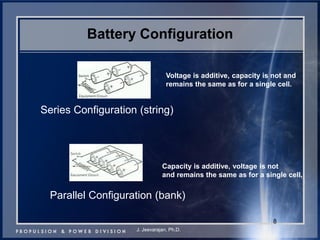
Battery Configuration 
Series Configuration (string) 
Parallel Configuration (bank) 
Voltage is additive, capacity is not and 
remains the same as for a single cell. 
Capacity is additive, voltage is not 
and remains the same as for a single cell. 
J. Jeevarajan, Ph.D.
9 
Factors to Consider in Choosing a Battery 
•Performance (voltage and capacity) including any pulse requirements 
•Volumetric and Gravimetric Energy Density 
•Safety 
•Toxicity 
•Thermal capability 
•Cycle / service life 
•Calendar life 
•Unique environments 
•Cost 
J. Jeevarajan, Ph.D.
Energy and Toxicity 
•Two main factors that categorize safety 
•Energy provided in Wh/kg or Wh/L – categorization and waivers provided under each chemistry 
•Toxicity – based on electrolyte (vapors, decomposition products, etc.) 
General Tox information based on NASA ratings: 
•KOH: alkaline, NiCd, NiMH, AgZn – caustic and corrosive- will burn skin and eyes. Typically Tox 2. 
•H2SO4: Lead acid- acidic and corrosive, will create acid fumes that can damage throat and lungs. Typically Tox 2 unless the amount is significantly large. 
•SOCl2: LiSOCl2, LiSO2Cl2, LiSO2 and LiBCX- burn skin, eyes, damage throat and lungs to a higher degree than above and can be lethal. Tox 4; could be lower if electrolyte quantity is negligible. 
•Li-ion, Li(CF)x and LiMnO2: Corrosive electrolyte that affects skin and eyes on contact (permanent eye injury to crew); electrolyte is flammable and can cause fire in the presence of an ignition source. Tox 2 based on nature of salt in electrolyte. 
10 
J. Jeevarajan, Ph.D.
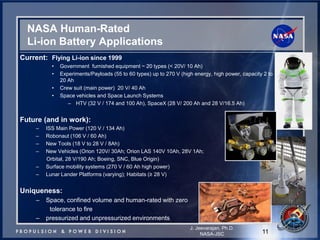
NASA Human-Rated Li-ion Battery Applications 
Current: Flying Li-ion since 1999 
•Government furnished equipment ~ 20 types (< 20V/ 10 Ah) 
•Experiments/Payloads (55 to 60 types) up to 270 V (high energy, high power, capacity 2 to 20 Ah 
•Crew suit (main power) 20 V/ 40 Ah 
•Space vehicles and Space Launch Systems 
–HTV (32 V / 174 and 100 Ah), SpaceX (28 V/ 200 Ah and 28 V/16.5 Ah) 
Future (and in work): 
–ISS Main Power (120 V / 134 Ah) 
–Robonaut (106 V / 60 Ah) 
–New Tools (18 V to 28 V / 8Ah) 
–New Vehicles (Orion 120V/ 30Ah; Orion LAS 140V 10Ah, 28V 1Ah; 
Orbital, 28 V/190 Ah; Boeing, SNC, Blue Origin) 
–Surface mobility systems (270 V / 60 Ah high power) 
–Lunar Lander Platforms (varying); Habitats (≥ 28 V) 
Uniqueness: 
–Space, confined volume and human-rated with zero 
tolerance to fire 
–pressurized and unpressurized environments 
11 
J. Jeevarajan, Ph.D. 
NASA-JSC
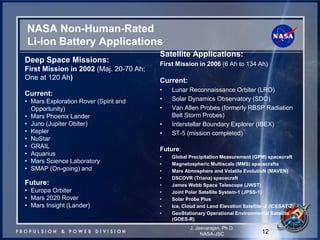
NASA Non-Human-Rated Li-ion Battery Applications 
12 
J. Jeevarajan, Ph.D. 
NASA-JSC 
Deep Space Missions: First Mission in 2002 (Maj. 20-70 Ah; One at 120 Ah) Current: 
•Mars Exploration Rover (Spirit and Opportunity) 
•Mars Phoenix Lander 
•Juno (Jupiter Obiter) 
•Kepler 
•NuStar 
•GRAIL 
•Aquarius 
•Mars Science Laboratory 
•SMAP (On-going) and Future: 
•Europa Orbiter 
•Mars 2020 Rover 
•Mars Insight (Lander) 
Satellite Applications: 
First Mission in 2006 (6 Ah to 134 Ah) 
Current: 
•Lunar Reconnaissance Orbiter (LRO) 
•Solar Dynamics Observatory (SDO) 
•Van Allen Probes (formerly RBSP Radiation Belt Storm Probes) 
•Interstellar Boundary Explorer (IBEX) 
•ST-5 (mission completed) 
Future: 
•Global Precipitation Measurement (GPM) spacecraft 
•Magnetospheric Multiscale (MMS) spacecrafts 
•Mars Atmosphere and Volatile EvolutioN (MAVEN) 
•DSCOVR (Triana) spacecraft 
•James Webb Space Telescope (JWST) 
•Joint Polar Satellite System-1 (JPSS-1) 
•Solar Probe Plus 
•Ice, Cloud and Land Elevation Satellite -2 (ICESAT-2) 
•GeoStationary Operational Environmental Satellite (GOES-R)
13 
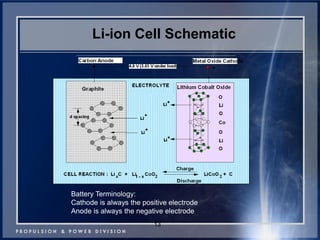
Li-ion Cell Schematic 
Battery Terminology: 
Cathode is always the positive electrode 
Anode is always the negative electrode
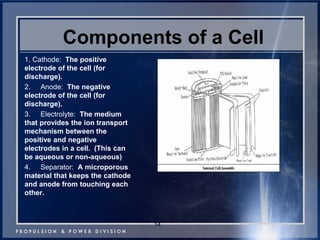
Components of a Cell 
1. Cathode: The positive electrode of the cell (for discharge). 
2. Anode: The negative electrode of the cell (for discharge). 
3. Electrolyte: The medium that provides the ion transport mechanism between the positive and negative electrodes in a cell. (This can be aqueous or non-aqueous) 
4. Separator: A microporous material that keeps the cathode and anode from touching each other. 
14
15 
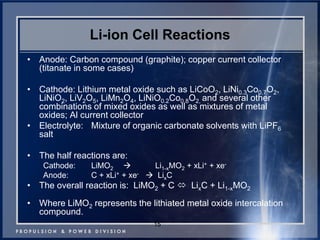
Li-ion Cell Reactions 
•Anode: Carbon compound (graphite); copper current collector (titanate in some cases) 
•Cathode: Lithium metal oxide such as LiCoO2, LiNi0.3Co0.7O2, LiNiO2, LiV2O5, LiMn2O4, LiNiO0.2Co0.8O2, and several other combinations of mixed oxides as well as mixtures of metal oxides; Al current collector 
•Electrolyte: Mixture of organic carbonate solvents with LiPF6 salt 
•The half reactions are: 
Cathode: LiMO2  Li1-xMO2 + xLi+ + xe- 
Anode: C + xLi+ + xe-  LixC 
•The overall reaction is: LiMO2 + C  LixC + Li1-xMO2 
•Where LiMO2 represents the lithiated metal oxide intercalation compound.
Judith Jeevarajan/NASA-JSC 
J. Jeevarajan, Ph.D. / 16 
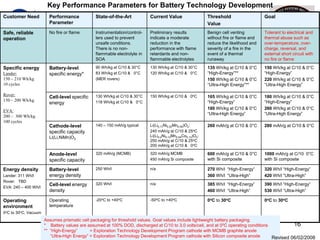
Key Performance Parameters for Battery Technology Development 
Customer Need 
Performance Parameter 
State-of-the-Art 
Current Value 
Threshold 
Value 
Goal 
Safe, reliable operation 
No fire or flame 
Instrumentation/control- lers used to prevent unsafe conditions. There is no non- flammable electrolyte in SOA 
Preliminary results indicate a moderate reduction in the performance with flame retardants and non- flammable electrolytes 
Benign cell venting without fire or flame and reduce the likelihood and severity of a fire in the event of a thermal runaway 
Tolerant to electrical and thermal abuse such as over-temperature, over- charge, reversal, and external short circuit with no fire or flame 
Specific energy 
Lander: 
150 – 210 Wh/kg 
10 cycles 
Rover: 
150 – 200 Wh/kg 
EVA: 
200 – 300 Wh/kg 
100 cycles 
Battery-level specific energy* 
90 Wh/kg at C/10 & 30°C 
83 Wh/kg at C/10 & 0°C 
(MER rovers) 
130 Wh/kg at C/10 & 30°C 
120 Wh/kg at C/10 & 0°C 
135 Wh/kg at C/10 & 0°C “High-Energy”** 
150 Wh/kg at C/10 & 0°C “Ultra-High Energy”** 
150 Wh/kg at C/10 & 0°C “High-Energy” 
220 Wh/kg at C/10 & 0°C “Ultra-High Energy” 
Cell-level specific energy 
130 Wh/kg at C/10 & 30°C 
118 Wh/kg at C/10 & 0°C 
150 Wh/kg at C/10 & 0oC 
165 Wh/kg at C/10 & 0°C “High-Energy” 
180 Wh/kg at C/10 & 0°C “Ultra-High Energy” 
180 Wh/kg at C/10 & 0°C “High-Energy” 
260 Wh/kg at C/10 & 0°C “Ultra-High Energy” 
Cathode-level specific capacity 
Li(Li,NiMn)O2 
140 – 150 mAh/g typical 
Li(Li0.17Ni0.25Mn0.58)O2: 
240 mAh/g at C/10 & 25oC 
Li(Li0.2Ni0.13Mn0.54Co0.13)O2: 250 mAh/g at C/10 & 25oC 
200 mAh/g at C/10 & 0oC 
260 mAh/g at C/10 & 0°C 
280 mAh/g at C/10 & 0°C 
Anode-level 
specific capacity 
320 mAh/g (MCMB) 
320 mAh/g MCMB 
450 mAh/g Si composite 
600 mAh/g at C/10 & 0°C 
with Si composite 
1000 mAh/g at C/10 0°C 
with Si composite 
Energy density 
Lander: 311 Wh/l 
Rover: TBD 
EVA: 240 – 400 Wh/l 
Battery-level energy density 
250 Wh/l 
n/a 
270 Wh/l “High-Energy” 
360 Wh/l “Ultra-High” 
320 Wh/l “High-Energy” 
420 Wh/l “Ultra-High” 
Cell-level energy density 
320 Wh/l 
n/a 
385 Wh/l “High-Energy” 
460 Wh/l “Ultra-High” 
390 Wh/l “High-Energy” 
530 Wh/l “Ultra-High” 
Operating environment 
0oC to 30oC, Vacuum 
Operating temperature 
-20oC to +40oC 
-50oC to +40oC 
0oC to 30oC 
0oC to 30oC 
Assumes prismatic cell packaging for threshold values. Goal values include lightweight battery packaging. 
* Battery values are assumed at 100% DOD, discharged at C/10 to 3.0 volts/cell, and at 00C operating conditions 
** ”High-Energy” = Exploration Technology Development Program cathode with MCMB graphite anode 
“Ultra-High Energy” = Exploration Technology Development Program cathode with Silicon composite anode 
Revised 06/02/2008
J. Jeevarajan, Ph.D. / NASA-JSC 
17 
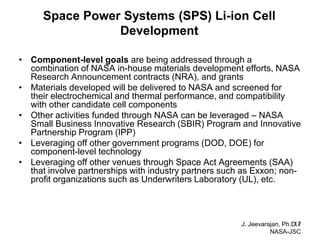
Space Power Systems (SPS) Li-ion Cell Development 
•Component-level goals are being addressed through a combination of NASA in-house materials development efforts, NASA Research Announcement contracts (NRA), and grants 
•Materials developed will be delivered to NASA and screened for their electrochemical and thermal performance, and compatibility with other candidate cell components 
•Other activities funded through NASA can be leveraged – NASA Small Business Innovative Research (SBIR) Program and Innovative Partnership Program (IPP) 
•Leveraging off other government programs (DOD, DOE) for component-level technology 
•Leveraging off other venues through Space Act Agreements (SAA) that involve partnerships with industry partners such as Exxon; non- profit organizations such as Underwriters Laboratory (UL), etc.
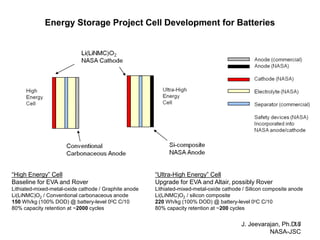
Energy Storage Project Cell Development for Batteries 
J. Jeevarajan, Ph.D. / NASA-JSC 
18 
“High Energy” Cell 
Baseline for EVA and Rover 
Lithiated-mixed-metal-oxide cathode / Graphite anode 
Li(LiNMC)O2 / Conventional carbonaceous anode 
150 Wh/kg (100% DOD) @ battery-level 00C C/10 
80% capacity retention at ~2000 cycles 
“Ultra-High Energy” Cell Upgrade for EVA and Altair, possibly Rover Lithiated-mixed-metal-oxide cathode / Silicon composite anode Li(LiNMC)O2 / silicon composite 220 Wh/kg (100% DOD) @ battery-level 00C C/10 80% capacity retention at ~200 cycles
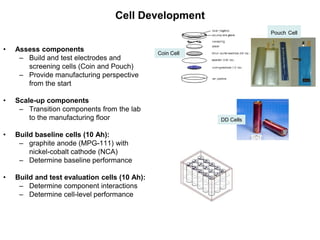
•Assess components 
–Build and test electrodes and screening cells (Coin and Pouch) 
–Provide manufacturing perspective from the start 
•Scale-up components 
–Transition components from the lab to the manufacturing floor 
•Build baseline cells (10 Ah): 
–graphite anode (MPG-111) with nickel-cobalt cathode (NCA) 
–Determine baseline performance 
•Build and test evaluation cells (10 Ah): 
–Determine component interactions 
–Determine cell-level performance 
Cell Development 
DD Cells 
Coin Cell 
Pouch Cell
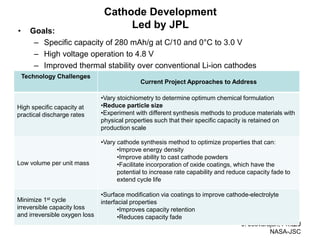
Cathode Development Led by JPL 
•Goals: 
–Specific capacity of 280 mAh/g at C/10 and 0°C to 3.0 V 
–High voltage operation to 4.8 V 
–Improved thermal stability over conventional Li-ion cathodes 
J. Jeevarajan, Ph.D. / NASA-JSC 
20 
Technology Challenges 
Current Project Approaches to Address 
High specific capacity at practical discharge rates 
•Vary stoichiometry to determine optimum chemical formulation 
•Reduce particle size 
•Experiment with different synthesis methods to produce materials with physical properties such that their specific capacity is retained on production scale 
Low volume per unit mass 
•Vary cathode synthesis method to optimize properties that can: 
•Improve energy density 
•Improve ability to cast cathode powders 
•Facilitate incorporation of oxide coatings, which have the potential to increase rate capability and reduce capacity fade to extend cycle life 
Minimize 1st cycle irreversible capacity loss and irreversible oxygen loss 
•Surface modification via coatings to improve cathode-electrolyte interfacial properties 
•Improves capacity retention 
•Reduces capacity fade
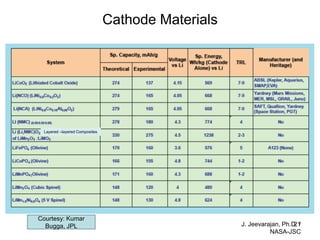
Cathode Materials 
J. Jeevarajan, Ph.D. / NASA-JSC 
21 
Layered –layered Composites 
Courtesy: Kumar Bugga, JPL
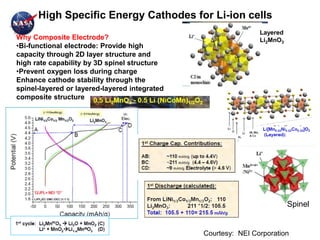
High Specific Energy Cathodes for Li-ion cells 
Layered Li2MnO3 
Spinel 
Why Composite Electrode? 
•Bi-functional electrode: Provide high capacity through 2D layer structure and high rate capability by 3D spinel structure 
•Prevent oxygen loss during charge Enhance cathode stability through the spinel-layered or layered-layered integrated composite structure 
Courtesy: NEI Corporation
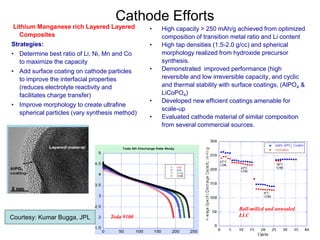
Cathode Efforts 
•High capacity > 250 mAh/g achieved from optimized composition of transition metal ratio and Li content 
•High tap densities (1.5-2.0 g/cc) and spherical morphology realized from hydroxide precursor synthesis. 
•Demonstrated improved performance (high reversible and low irreversible capacity, and cyclic and thermal stability with surface coatings, (AlPO4 & LiCoPO4) 
•Developed new efficient coatings amenable for scale-up 
•Evaluated cathode material of similar composition from several commercial sources. 
Lithium Manganese rich Layered Layered Composites 
Strategies: 
•Determine best ratio of Li, Ni, Mn and Co to maximize the capacity 
•Add surface coating on cathode particles to improve the interfacial properties (reduces electrolyte reactivity and facilitates charge transfer) 
•Improve morphology to create ultrafine spherical particles (vary synthesis method) 
Toda 9100 
Ball-milled and annealed LLC 
Courtesy: Kumar Bugga, JPL
J. Jeevarajan, Ph.D. / NASA-JSC 
24 
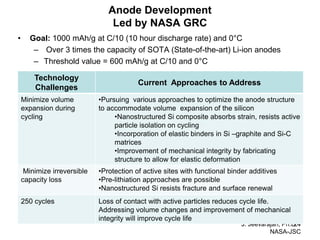
Anode Development Led by NASA GRC 
•Goal: 1000 mAh/g at C/10 (10 hour discharge rate) and 0°C 
– Over 3 times the capacity of SOTA (State-of-the-art) Li-ion anodes 
–Threshold value = 600 mAh/g at C/10 and 0°C 
Technology Challenges 
Current Approaches to Address 
Minimize volume expansion during cycling 
•Pursuing various approaches to optimize the anode structure to accommodate volume expansion of the silicon 
•Nanostructured Si composite absorbs strain, resists active particle isolation on cycling 
•Incorporation of elastic binders in Si –graphite and Si-C matrices 
•Improvement of mechanical integrity by fabricating structure to allow for elastic deformation 
Minimize irreversible capacity loss 
•Protection of active sites with functional binder additives 
•Pre-lithiation approaches are possible 
•Nanostructured Si resists fracture and surface renewal 
250 cycles 
Loss of contact with active particles reduces cycle life. Addressing volume changes and improvement of mechanical integrity will improve cycle life
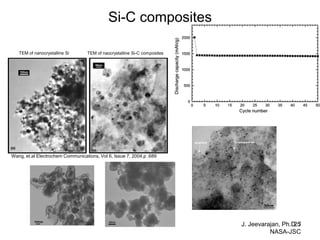
Si-C composites 
J. Jeevarajan, Ph.D. / 
NASA-JSC 
25 
Wang, et.al Electrochem Communications, Vol 6, Issue 7, 2004,p .689 
TEM of nanocrystalline Si TEM of naocrystalline Si-C composites
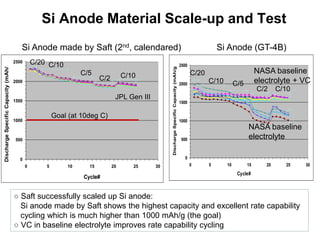
Si Anode Material Scale-up and Test 
0 
500 
1000 
1500 
2000 
2500 
0 5 10 15 20 25 30 
Cycle# 
Discharge Specific Capacity (mAh/g) 
Si Anode made by Saft (2nd, calendared) Si Anode (GT-4B) 
NASA baseline 
electrolyte + VC 
NASA baseline 
electrolyte 
C/10 
C/10 
C/2 
C/5 
C/20 
0 
500 
1000 
1500 
2000 
2500 
0 5 10 15 20 25 30 
Cycle# 
Discharge Specific Capacity (mAh/g) 
C/10 
C/10 
C/2 
C/5 
C/20 
JPL Gen III 
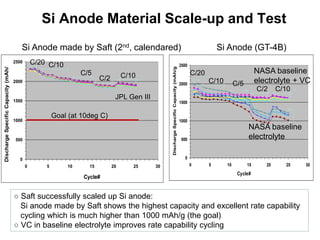
○ Saft successfully scaled up Si anode: 
Si anode made by Saft shows the highest capacity and excellent rate capability 
cycling which is much higher than 1000 mAh/g (the goal) 
○ VC in baseline electrolyte improves rate capability cycling 
Goal (at 10deg C)
Si Anode Material Scale-up and Test 
0 
500 
1000 
1500 
2000 
2500 
0 5 10 15 20 25 30 
Cycle# 
Discharge Specific Capacity (mAh/g) 
Si Anode made by Saft (2nd, calendared) Si Anode (GT-4B) 
NASA baseline 
electrolyte + VC 
NASA baseline 
electrolyte 
C/10 
C/10 
C/2 
C/5 
C/20 
0 
500 
1000 
1500 
2000 
2500 
0 5 10 15 20 25 30 
Cycle# 
Discharge Specific Capacity (mAh/g) 
C/10 
C/10 
C/2 
C/5 
C/20 
JPL Gen III 
○ Saft successfully scaled up Si anode: 
Si anode made by Saft shows the highest capacity and excellent rate capability 
cycling which is much higher than 1000 mAh/g (the goal) 
○ VC in baseline electrolyte improves rate capability cycling 
Goal (at 10deg C)
Current State for Safety of Li-ion Batteries 
Although the chemistry is one that can provide very high energy density at this time, it is not the safest 
•NASA human-rated safety requirement is two-fault tolerance to catastrophic failures – leakage of electrolyte (toxicity hazard), fire, thermal runaway 
Hazards are encountered in Li-ion cells/ batteries typically during 
•Overcharge/overvoltage 
•External shorts 
•Repeated overdischarge with subsequent charge 
•High thermal environments 
•Internal Shorts 
J. Jeevarajan, Ph.D. / NASA-JSC 
28
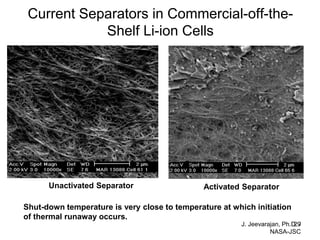
Current Separators in Commercial-off-the- Shelf Li-ion Cells 
J. Jeevarajan, Ph.D. / NASA-JSC 
29 
Unactivated Separator 
Activated Separator 
Shut-down temperature is very close to temperature at which initiation of thermal runaway occurs.
Electrolytes 
J. Jeevarajan, Ph.D. / NASA-JSC 
30 
Electrolyte Selection Criteria 
 High conductivity over a wide range of temperatures 
o 1 mS cm-1 from –60 to 40oC 
 Wide liquid range (low melting point) 
o -60 to 75oC 
 Good electrochemical stability 
o Stability over wide voltage window (0 to 4.5V) 
o Minimal oxidative degradation of solvents/salts 
 Good chemical stability 
 Good compatibility with chosen electrode couple 
o Good SEI characteristics on electrode 
o Facile lithium intercalation/de-intercalation kinetics 
 Good thermal stability 
 Good low temperature performance throughout life of cell 
o Good resilience to high temperature exposure 
o Minimal impedance build-up with cycling and/or storage 
 In addition, the electrolyte solutions should ideally 
have low flammability and be non-toxic !! 
Smart, et.al., 219th Meeting of the Electrochemical Society, 2011
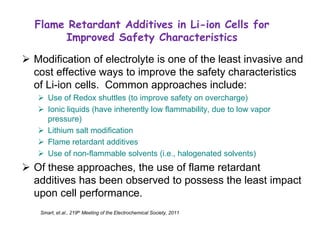
Flame Retardant Additives in Li-ion Cells for Improved Safety Characteristics 
Modification of electrolyte is one of the least invasive and cost effective ways to improve the safety characteristics of Li-ion cells. Common approaches include: 
Use of Redox shuttles (to improve safety on overcharge) 
Ionic liquids (have inherently low flammability, due to low vapor pressure) 
Lithium salt modification 
Flame retardant additives 
Use of non-flammable solvents (i.e., halogenated solvents) 
Of these approaches, the use of flame retardant additives has been observed to possess the least impact upon cell performance. 
Smart, et.al., 219th Meeting of the Electrochemical Society, 2011
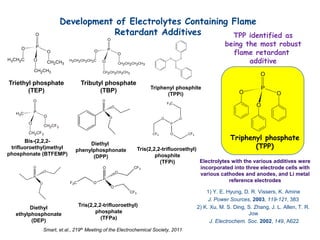
Development of Electrolytes Containing Flame 
Retardant Additives 
Electrolytes with the various additives were 
incorporated into three electrode cells with 
various cathodes and anodes, and Li metal 
reference electrodes 
1) Y. E. Hyung, D. R. Vissers, K. Amine 
J. Power Sources, 2003, 119-121, 383 
2) K. Xu, M. S. Ding, S. Zhang, J. L. Allen, T. R. 
Jow 
J. Electrochem. Soc. 2002, 149, A622 
O 
P 
O 
O 
O 
H3C P 
O 
O 
O 
CH2CF3 
CH2CF3 
Tributyl phosphate 
(TBP) 
Bis-(2,2,2- 
trifluoroethyl)methyl 
phosphonate (BTFEMP) 
Triphenyl phosphate 
(TPP) 
O P 
O 
O 
O 
H3CH2CH2CH2C 
CH2CH2CH2CH3 
CH2CH2CH2CH3 
O P 
O 
O 
O 
H3CH2C 
CH2CH3 
CH2CH3 
Triethyl phosphate 
(TEP) 
O 
P 
O 
O 
Diethyl 
ethylphosphonate 
(DEP) 
O 
P 
O 
O 
Diethyl 
phenylphosphonate 
(DPP) 
P 
O 
O O 
Triphenyl phosphite 
(TPPi) 
O 
P 
O 
O 
O 
CF3 
CF3 
F2C 
Tris(2,2,2-trifluoroethyl) 
phosphate 
(TFPa) 
P 
O 
O O 
F3C 
CF3 CF3 
Tris(2,2,2-trifluoroethyl) 
phosphite 
(TFPi) 
TPP identified as 
being the most robust 
flame retardant 
additive 
Smart, et.al., 219th Meeting of the Electrochemical Society, 2011
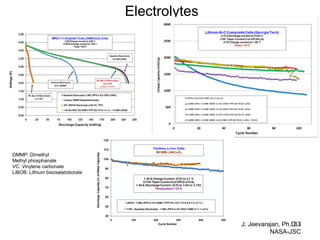
Electrolytes 
J. Jeevarajan, Ph.D. / NASA-JSC 
33 
DMMP: Dimethyl Methyl phosphanate VC: Vinylene carbonate LiBOB: Lithium bisoxalatoborate
J. Jeevarajan, Ph.D. / NASA-JSC 
34 
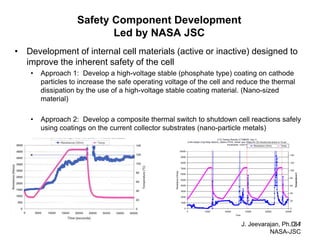
Safety Component Development Led by NASA JSC 
•Development of internal cell materials (active or inactive) designed to improve the inherent safety of the cell 
•Approach 1: Develop a high-voltage stable (phosphate type) coating on cathode particles to increase the safe operating voltage of the cell and reduce the thermal dissipation by the use of a high-voltage stable coating material. (Nano-sized material) 
•Approach 2: Develop a composite thermal switch to shutdown cell reactions safely using coatings on the current collector substrates (nano-particle metals)
PSI 
J. Jeevarajan, Ph.D. / NASA-JSC 
35 
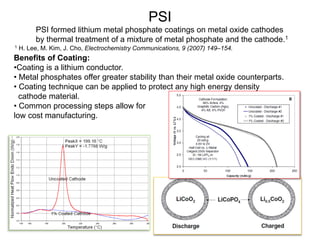
PSI formed lithium metal phosphate coatings on metal oxide cathodes 
by thermal treatment of a mixture of metal phosphate and the cathode.1 
1 H. Lee, M. Kim, J. Cho, Electrochemistry Communications, 9 (2007) 149–154. 
Benefits of Coating: 
•Coating is a lithium conductor. • Metal phosphates offer greater stability than their metal oxide counterparts. • Coating technique can be applied to protect any high energy density cathode material. • Common processing steps allow for low cost manufacturing.
Summary of Current Technology Work 
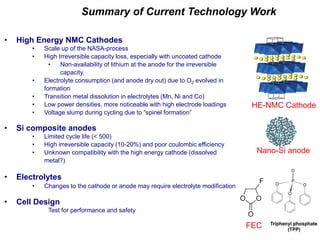
•High Energy NMC Cathodes 
•Scale up of the NASA-process 
•High Irreversible capacity loss, especially with uncoated cathode 
•Non-availability of lithium at the anode for the irreversible capacity. 
•Electrolyte consumption (and anode dry out) due to O2 evolved in formation 
•Transition metal dissolution in electrolytes (Mn, Ni and Co) 
•Low power densities, more noticeable with high electrode loadings 
•Voltage slump during cycling due to “spinel formation” 
•Si composite anodes 
•Limited cycle life (< 500) 
•High irreversible capacity (10-20%) and poor coulombic efficiency 
•Unknown compatibility with the high energy cathode (dissolved metal?) 
•Electrolytes 
•Changes to the cathode or anode may require electrolyte modification 
•Cell Design 
Test for performance and safety 
Nano-Si anode 
FEC 
HE-NMC Cathode
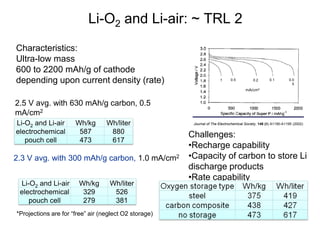
Li-O2 and Li-air: ~ TRL 2 
Characteristics: Ultra-low mass 600 to 2200 mAh/g of cathode depending upon current density (rate) 
2.5 V avg. with 630 mAh/g carbon, 0.5 mA/cm2 
Li-O2 and Li-air 
Wh/kg 
Wh/liter 
electrochemical 
587 
880 
pouch cell 
473 
617 
Challenges: 
•Recharge capability 
•Capacity of carbon to store Li discharge products 
•Rate capability 
Journal of The Electrochemical Society, 149 (9) A1190-A1195 (2002) 
1 
0.5 
0.2 
0.1 
0.05 
mA/cm² 
Li-O2 and Li-air 
Wh/kg 
Wh/liter 
electrochemical 
329 
526 
pouch cell 
279 
381 
2.3 V avg. with 300 mAh/g carbon, 1.0 mA/cm2 
*Projections are for “free” air (neglect O2 storage)
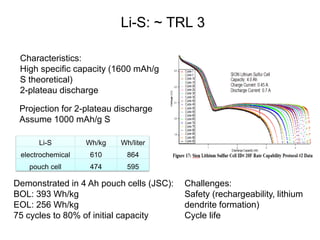
Li-S: ~ TRL 3 
Characteristics: High specific capacity (1600 mAh/g S theoretical) 2-plateau discharge 
Projection for 2-plateau discharge Assume 1000 mAh/g S 
Demonstrated in 4 Ah pouch cells (JSC): 
BOL: 393 Wh/kg 
EOL: 256 Wh/kg 
75 cycles to 80% of initial capacity 
Li-S 
Wh/kg 
Wh/liter 
electrochemical 
610 
864 
pouch cell 
474 
595 
Challenges: Safety (rechargeability, lithium dendrite formation) Cycle life
Challenges 
39 
J. Jeevarajan, Ph.D. 
NASA-JSC 
•High Energy Density – equating to lighter mass and in many cases volume 
•Very safe in a human-rated environment (includes ground handling and installation at launch facilities) – no fire, no thermal runaway 
•Various pressure environments (pressurized, vacuum) 
•Launch and landing loads (vibration, impact), etc. 
•Sea water immersion (landing environment) 
•Extreme temperatures 
•Long-term missions with less maintenance
Acknowledgment 
•Karunya University for inviting me to speak 
•My Battery Group colleagues at NASA-Johnson Space Center, NASA-Glenn Research Center and NASA-JPL 
•NASA Programs that fund the battery work 
40
Back-up Slides 
41
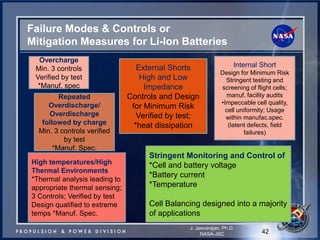
Failure Modes & Controls or Mitigation Measures for Li-Ion Batteries 
42 
J. Jeevarajan, Ph.D. 
NASA-JSC 
High temperatures/High Thermal Environments *Thermal analysis leading to appropriate thermal sensing; 3 Controls; Verified by test Design qualified to extreme temps *Manuf. Spec. 
Repeated Overdischarge/ Overdischarge followed by charge 
Min. 3 controls verified by test 
*Manuf. Spec. 
Overcharge Min. 3 controls Verified by test *Manuf. spec 
External Shorts 
High and Low Impedance 
Controls and Design for Minimum Risk 
Verified by test; 
*heat dissipation 
Internal Short Design for Minimum Risk Stringent testing and screening of flight cells; manuf. facility audits 
•Impeccable cell quality, cell uniformity; Usage within manufac.spec. (latent defects, field failures) 
Stringent Monitoring and Control of 
*Cell and battery voltage 
*Battery current 
*Temperature 
Cell Balancing designed into a majority of applications
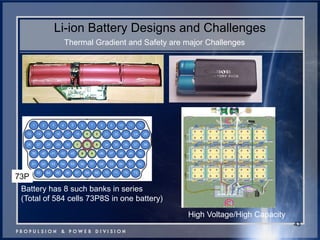
Li-ion Battery Designs and Challenges 
43 
Battery has 8 such banks in series 
(Total of 584 cells 73P8S in one battery) 
73P 
High Voltage/High Capacity 
Thermal Gradient and Safety are major Challenges
Concerns with Scaling & Testing: Cell to Module to Battery Level 
44 
J. Jeevarajan, Ph.D. 
NASA-JSC 
•Li-ion battery designs should have high fidelity thermal analysis to show that the battery design is safe under worst case environments (temperatures and pressures) and under all nominal and off-nominal conditions. 
–Results of thermal analysis should provide guidance on safe designs with very good heat dissipation paths. 
–Good thermal design increases safety as well as extends the life of the battery 
•Li-ion battery management electronics should be robust 
–strike a balance in monitoring and control; 
–extensive testing of control electronics should be carried out on ground 
–For human-rated safety critical applications insight into telemetry should be appropriate for trouble-shooting off-nominal events.
Examples of Limitations Seen with Commercial Cell Designs 
45
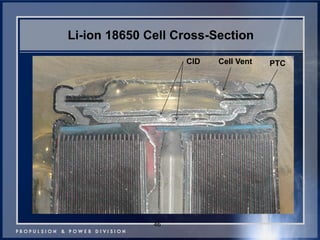
Li-ion 18650 Cell Cross-Section 
46 
CID 
PTC 
Cell Vent
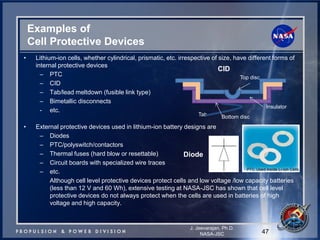
Examples of Cell Protective Devices 
47 
J. Jeevarajan, Ph.D. 
NASA-JSC 
•Lithium-ion cells, whether cylindrical, prismatic, etc. irrespective of size, have different forms of internal protective devices 
–PTC 
–CID 
–Tab/lead meltdown (fusible link type) 
–Bimetallic disconnects 
-etc. 
•External protective devices used in lithium-ion battery designs are 
–Diodes 
–PTC/polyswitch/contactors 
–Thermal fuses (hard blow or resettable) 
–Circuit boards with specialized wire traces 
–etc. 
Although cell level protective devices protect cells and low voltage /low capacity batteries (less than 12 V and 60 Wh), extensive testing at NASA-JSC has shown that cell level protective devices do not always protect when the cells are used in batteries of high voltage and high capacity. 
Diode 
Tab 
CID 
Top disc 
Insulator 
Bottom disc
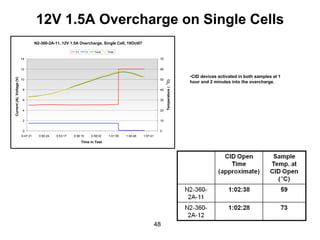
12V 1.5A Overcharge on Single Cells 
48 
N2-360-2A-11, 12V 1.5A Overcharge, Single Cell, 19Oct07 
0 
2 
4 
6 
8 
10 
12 
14 
0:47:31 
0:50:24 
0:53:17 
0:56:10 
0:59:02 
1:01:55 
1:04:48 
1:07:41 
Time in Test 
Current (A), Voltage (V) 
0 
10 
20 
30 
40 
50 
60 
70 
Temperature ( 
o 
C) 
V1 
I1 
Tend 
Tmid 
•CID devices activated in both samples at 1 hour and 2 minutes into the overcharge.
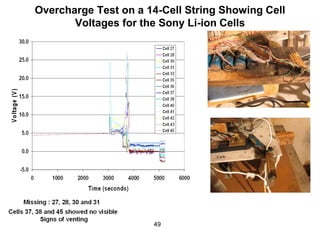
Overcharge Test on a 14-Cell String Showing Cell Voltages for the Sony Li-ion Cells 
49
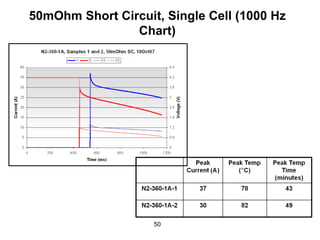
50mOhm Short Circuit, Single Cell (1000 Hz Chart) 
50
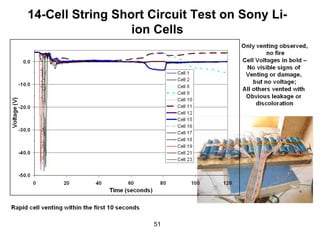
14-Cell String Short Circuit Test on Sony Li- ion Cells 
51
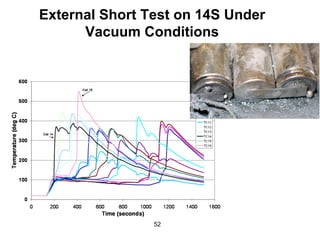
External Short Test on 14S Under Vacuum Conditions 
52
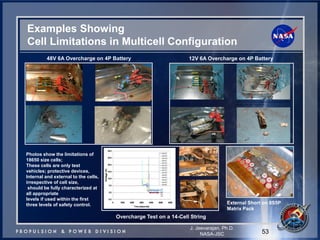
Examples Showing Cell Limitations in Multicell Configuration 
53 
J. Jeevarajan, Ph.D. 
NASA-JSC 
48V 6A Overcharge on 4P Battery 
Photos show the limitations of 18650 size cells; 
These cells are only test vehicles; protective devices, 
Internal and external to the cells, irrespective of cell size, 
should be fully characterized at all appropriate 
levels if used within the first three levels of safety control. 
12V 6A Overcharge on 4P Battery 
External Short on 8S5P 
Matrix Pack 
Overcharge Test on a 14-Cell String
Summary of COTS li-ion cell limitations 
• Test in the relevant configuration, environment, understand and characterize limitations 
Test, design, retest, redesign,…..pattern required for confirmation of safety 
54
J. Jeevarajan, Ph.D. / NASA-JSC 
55

Power goals for human space exploration

  • 1.
    Judith Jeevarajan, Ph.D Power Systems Branch NASA-Johnson Space Center April, 2014 Power Goals for Human Space Exploration
  • 2.
    Outline •Battery Basics •Battery Chemistries commonly used for Human Space Exploration •Current and Future Missions •Technology Programs to Achieve Power Goals •Challenges •Summary 2
  • 3.
    3 Basic BatteryEquations •E (Volts) = I (Amperes) * R (Ohms) •E : Voltage; I: Current; R: Resistance •P (Watt) = I (Amperes) * E (Volt) •P : Power J. Jeevarajan, Ph.D.
  • 4.
    4 Simple GalvanicCell Anode Cathode Oxidation half reaction (Anode): Mg (s  Mg2+ (aq) + 2e- Reduction half-reaction (Cathode): 2H3O+ (aq) + 2e-  H2 (g) + 2H2O (l) Sum: Mg (s) + 2H3O+ (aq)  H2 (g) + Mg2+ (aq) + 2H2O (l) J. Jeevarajan, Ph.D.
  • 5.
    5 Charge andDischarge Electrochemistry Battery Terminology: Cathode is always the positive electrode Anode is always the negative electrode J. Jeevarajan, Ph.D.
  • 6.
    6 Electrochemical Equations •Ecell = Eox + Ered •Wmax = -n*F*Ecell = ΔG •-n*F*Eocell = ΔGo298 •For a reaction to occur spontaneously, ΔG should be negative (implies that E should be always positive). •Nernst Equation: •Ecell = Eocell – (RT/nF)*ln(Q) •For the following reaction, •aA(g) + bB (g)  cC (g) + dD (g) •Q = reaction quotient = [PC]x[PD]y / [PA]m[PB]n J. Jeevarajan, Ph.D.
  • 7.
    7 Major Classificationof Batteries Primary Cells or Batteries: •These cells or batteries are discharged once and discarded. Secondary or Rechargeable Cells or Batteries: •These batteries can be recharged after discharge. They are also called storage batteries or accumulators. Reserve Batteries: •In this type of primary battery, a key component is kept separate from the rest of the battery until activation. By doing this, chemical deterioration and self-discharge are essentially eliminated. Usually the electrolyte is the component separated. However, in thermal batteries, the electrolyte is solidified until heated and melted to activate the battery, eg. Na/S. J. Jeevarajan, Ph.D.
  • 8.
    8 Battery Configuration Series Configuration (string) Parallel Configuration (bank) Voltage is additive, capacity is not and remains the same as for a single cell. Capacity is additive, voltage is not and remains the same as for a single cell. J. Jeevarajan, Ph.D.
  • 9.
    9 Factors toConsider in Choosing a Battery •Performance (voltage and capacity) including any pulse requirements •Volumetric and Gravimetric Energy Density •Safety •Toxicity •Thermal capability •Cycle / service life •Calendar life •Unique environments •Cost J. Jeevarajan, Ph.D.
  • 10.
    Energy and Toxicity •Two main factors that categorize safety •Energy provided in Wh/kg or Wh/L – categorization and waivers provided under each chemistry •Toxicity – based on electrolyte (vapors, decomposition products, etc.) General Tox information based on NASA ratings: •KOH: alkaline, NiCd, NiMH, AgZn – caustic and corrosive- will burn skin and eyes. Typically Tox 2. •H2SO4: Lead acid- acidic and corrosive, will create acid fumes that can damage throat and lungs. Typically Tox 2 unless the amount is significantly large. •SOCl2: LiSOCl2, LiSO2Cl2, LiSO2 and LiBCX- burn skin, eyes, damage throat and lungs to a higher degree than above and can be lethal. Tox 4; could be lower if electrolyte quantity is negligible. •Li-ion, Li(CF)x and LiMnO2: Corrosive electrolyte that affects skin and eyes on contact (permanent eye injury to crew); electrolyte is flammable and can cause fire in the presence of an ignition source. Tox 2 based on nature of salt in electrolyte. 10 J. Jeevarajan, Ph.D.
  • 11.
    NASA Human-Rated Li-ionBattery Applications Current: Flying Li-ion since 1999 •Government furnished equipment ~ 20 types (< 20V/ 10 Ah) •Experiments/Payloads (55 to 60 types) up to 270 V (high energy, high power, capacity 2 to 20 Ah •Crew suit (main power) 20 V/ 40 Ah •Space vehicles and Space Launch Systems –HTV (32 V / 174 and 100 Ah), SpaceX (28 V/ 200 Ah and 28 V/16.5 Ah) Future (and in work): –ISS Main Power (120 V / 134 Ah) –Robonaut (106 V / 60 Ah) –New Tools (18 V to 28 V / 8Ah) –New Vehicles (Orion 120V/ 30Ah; Orion LAS 140V 10Ah, 28V 1Ah; Orbital, 28 V/190 Ah; Boeing, SNC, Blue Origin) –Surface mobility systems (270 V / 60 Ah high power) –Lunar Lander Platforms (varying); Habitats (≥ 28 V) Uniqueness: –Space, confined volume and human-rated with zero tolerance to fire –pressurized and unpressurized environments 11 J. Jeevarajan, Ph.D. NASA-JSC
  • 12.
    NASA Non-Human-Rated Li-ionBattery Applications 12 J. Jeevarajan, Ph.D. NASA-JSC Deep Space Missions: First Mission in 2002 (Maj. 20-70 Ah; One at 120 Ah) Current: •Mars Exploration Rover (Spirit and Opportunity) •Mars Phoenix Lander •Juno (Jupiter Obiter) •Kepler •NuStar •GRAIL •Aquarius •Mars Science Laboratory •SMAP (On-going) and Future: •Europa Orbiter •Mars 2020 Rover •Mars Insight (Lander) Satellite Applications: First Mission in 2006 (6 Ah to 134 Ah) Current: •Lunar Reconnaissance Orbiter (LRO) •Solar Dynamics Observatory (SDO) •Van Allen Probes (formerly RBSP Radiation Belt Storm Probes) •Interstellar Boundary Explorer (IBEX) •ST-5 (mission completed) Future: •Global Precipitation Measurement (GPM) spacecraft •Magnetospheric Multiscale (MMS) spacecrafts •Mars Atmosphere and Volatile EvolutioN (MAVEN) •DSCOVR (Triana) spacecraft •James Webb Space Telescope (JWST) •Joint Polar Satellite System-1 (JPSS-1) •Solar Probe Plus •Ice, Cloud and Land Elevation Satellite -2 (ICESAT-2) •GeoStationary Operational Environmental Satellite (GOES-R)
  • 13.
    13 Li-ion CellSchematic Battery Terminology: Cathode is always the positive electrode Anode is always the negative electrode
  • 14.
    Components of aCell 1. Cathode: The positive electrode of the cell (for discharge). 2. Anode: The negative electrode of the cell (for discharge). 3. Electrolyte: The medium that provides the ion transport mechanism between the positive and negative electrodes in a cell. (This can be aqueous or non-aqueous) 4. Separator: A microporous material that keeps the cathode and anode from touching each other. 14
  • 15.
    15 Li-ion CellReactions •Anode: Carbon compound (graphite); copper current collector (titanate in some cases) •Cathode: Lithium metal oxide such as LiCoO2, LiNi0.3Co0.7O2, LiNiO2, LiV2O5, LiMn2O4, LiNiO0.2Co0.8O2, and several other combinations of mixed oxides as well as mixtures of metal oxides; Al current collector •Electrolyte: Mixture of organic carbonate solvents with LiPF6 salt •The half reactions are: Cathode: LiMO2  Li1-xMO2 + xLi+ + xe- Anode: C + xLi+ + xe-  LixC •The overall reaction is: LiMO2 + C  LixC + Li1-xMO2 •Where LiMO2 represents the lithiated metal oxide intercalation compound.
  • 16.
    Judith Jeevarajan/NASA-JSC J.Jeevarajan, Ph.D. / 16 Key Performance Parameters for Battery Technology Development Customer Need Performance Parameter State-of-the-Art Current Value Threshold Value Goal Safe, reliable operation No fire or flame Instrumentation/control- lers used to prevent unsafe conditions. There is no non- flammable electrolyte in SOA Preliminary results indicate a moderate reduction in the performance with flame retardants and non- flammable electrolytes Benign cell venting without fire or flame and reduce the likelihood and severity of a fire in the event of a thermal runaway Tolerant to electrical and thermal abuse such as over-temperature, over- charge, reversal, and external short circuit with no fire or flame Specific energy Lander: 150 – 210 Wh/kg 10 cycles Rover: 150 – 200 Wh/kg EVA: 200 – 300 Wh/kg 100 cycles Battery-level specific energy* 90 Wh/kg at C/10 & 30°C 83 Wh/kg at C/10 & 0°C (MER rovers) 130 Wh/kg at C/10 & 30°C 120 Wh/kg at C/10 & 0°C 135 Wh/kg at C/10 & 0°C “High-Energy”** 150 Wh/kg at C/10 & 0°C “Ultra-High Energy”** 150 Wh/kg at C/10 & 0°C “High-Energy” 220 Wh/kg at C/10 & 0°C “Ultra-High Energy” Cell-level specific energy 130 Wh/kg at C/10 & 30°C 118 Wh/kg at C/10 & 0°C 150 Wh/kg at C/10 & 0oC 165 Wh/kg at C/10 & 0°C “High-Energy” 180 Wh/kg at C/10 & 0°C “Ultra-High Energy” 180 Wh/kg at C/10 & 0°C “High-Energy” 260 Wh/kg at C/10 & 0°C “Ultra-High Energy” Cathode-level specific capacity Li(Li,NiMn)O2 140 – 150 mAh/g typical Li(Li0.17Ni0.25Mn0.58)O2: 240 mAh/g at C/10 & 25oC Li(Li0.2Ni0.13Mn0.54Co0.13)O2: 250 mAh/g at C/10 & 25oC 200 mAh/g at C/10 & 0oC 260 mAh/g at C/10 & 0°C 280 mAh/g at C/10 & 0°C Anode-level specific capacity 320 mAh/g (MCMB) 320 mAh/g MCMB 450 mAh/g Si composite 600 mAh/g at C/10 & 0°C with Si composite 1000 mAh/g at C/10 0°C with Si composite Energy density Lander: 311 Wh/l Rover: TBD EVA: 240 – 400 Wh/l Battery-level energy density 250 Wh/l n/a 270 Wh/l “High-Energy” 360 Wh/l “Ultra-High” 320 Wh/l “High-Energy” 420 Wh/l “Ultra-High” Cell-level energy density 320 Wh/l n/a 385 Wh/l “High-Energy” 460 Wh/l “Ultra-High” 390 Wh/l “High-Energy” 530 Wh/l “Ultra-High” Operating environment 0oC to 30oC, Vacuum Operating temperature -20oC to +40oC -50oC to +40oC 0oC to 30oC 0oC to 30oC Assumes prismatic cell packaging for threshold values. Goal values include lightweight battery packaging. * Battery values are assumed at 100% DOD, discharged at C/10 to 3.0 volts/cell, and at 00C operating conditions ** ”High-Energy” = Exploration Technology Development Program cathode with MCMB graphite anode “Ultra-High Energy” = Exploration Technology Development Program cathode with Silicon composite anode Revised 06/02/2008
  • 17.
    J. Jeevarajan, Ph.D./ NASA-JSC 17 Space Power Systems (SPS) Li-ion Cell Development •Component-level goals are being addressed through a combination of NASA in-house materials development efforts, NASA Research Announcement contracts (NRA), and grants •Materials developed will be delivered to NASA and screened for their electrochemical and thermal performance, and compatibility with other candidate cell components •Other activities funded through NASA can be leveraged – NASA Small Business Innovative Research (SBIR) Program and Innovative Partnership Program (IPP) •Leveraging off other government programs (DOD, DOE) for component-level technology •Leveraging off other venues through Space Act Agreements (SAA) that involve partnerships with industry partners such as Exxon; non- profit organizations such as Underwriters Laboratory (UL), etc.
  • 18.
    Energy Storage ProjectCell Development for Batteries J. Jeevarajan, Ph.D. / NASA-JSC 18 “High Energy” Cell Baseline for EVA and Rover Lithiated-mixed-metal-oxide cathode / Graphite anode Li(LiNMC)O2 / Conventional carbonaceous anode 150 Wh/kg (100% DOD) @ battery-level 00C C/10 80% capacity retention at ~2000 cycles “Ultra-High Energy” Cell Upgrade for EVA and Altair, possibly Rover Lithiated-mixed-metal-oxide cathode / Silicon composite anode Li(LiNMC)O2 / silicon composite 220 Wh/kg (100% DOD) @ battery-level 00C C/10 80% capacity retention at ~200 cycles
  • 19.
    •Assess components –Buildand test electrodes and screening cells (Coin and Pouch) –Provide manufacturing perspective from the start •Scale-up components –Transition components from the lab to the manufacturing floor •Build baseline cells (10 Ah): –graphite anode (MPG-111) with nickel-cobalt cathode (NCA) –Determine baseline performance •Build and test evaluation cells (10 Ah): –Determine component interactions –Determine cell-level performance Cell Development DD Cells Coin Cell Pouch Cell
  • 20.
    Cathode Development Ledby JPL •Goals: –Specific capacity of 280 mAh/g at C/10 and 0°C to 3.0 V –High voltage operation to 4.8 V –Improved thermal stability over conventional Li-ion cathodes J. Jeevarajan, Ph.D. / NASA-JSC 20 Technology Challenges Current Project Approaches to Address High specific capacity at practical discharge rates •Vary stoichiometry to determine optimum chemical formulation •Reduce particle size •Experiment with different synthesis methods to produce materials with physical properties such that their specific capacity is retained on production scale Low volume per unit mass •Vary cathode synthesis method to optimize properties that can: •Improve energy density •Improve ability to cast cathode powders •Facilitate incorporation of oxide coatings, which have the potential to increase rate capability and reduce capacity fade to extend cycle life Minimize 1st cycle irreversible capacity loss and irreversible oxygen loss •Surface modification via coatings to improve cathode-electrolyte interfacial properties •Improves capacity retention •Reduces capacity fade
  • 21.
    Cathode Materials J.Jeevarajan, Ph.D. / NASA-JSC 21 Layered –layered Composites Courtesy: Kumar Bugga, JPL
  • 22.
    High Specific EnergyCathodes for Li-ion cells Layered Li2MnO3 Spinel Why Composite Electrode? •Bi-functional electrode: Provide high capacity through 2D layer structure and high rate capability by 3D spinel structure •Prevent oxygen loss during charge Enhance cathode stability through the spinel-layered or layered-layered integrated composite structure Courtesy: NEI Corporation
  • 23.
    Cathode Efforts •Highcapacity > 250 mAh/g achieved from optimized composition of transition metal ratio and Li content •High tap densities (1.5-2.0 g/cc) and spherical morphology realized from hydroxide precursor synthesis. •Demonstrated improved performance (high reversible and low irreversible capacity, and cyclic and thermal stability with surface coatings, (AlPO4 & LiCoPO4) •Developed new efficient coatings amenable for scale-up •Evaluated cathode material of similar composition from several commercial sources. Lithium Manganese rich Layered Layered Composites Strategies: •Determine best ratio of Li, Ni, Mn and Co to maximize the capacity •Add surface coating on cathode particles to improve the interfacial properties (reduces electrolyte reactivity and facilitates charge transfer) •Improve morphology to create ultrafine spherical particles (vary synthesis method) Toda 9100 Ball-milled and annealed LLC Courtesy: Kumar Bugga, JPL
  • 24.
    J. Jeevarajan, Ph.D./ NASA-JSC 24 Anode Development Led by NASA GRC •Goal: 1000 mAh/g at C/10 (10 hour discharge rate) and 0°C – Over 3 times the capacity of SOTA (State-of-the-art) Li-ion anodes –Threshold value = 600 mAh/g at C/10 and 0°C Technology Challenges Current Approaches to Address Minimize volume expansion during cycling •Pursuing various approaches to optimize the anode structure to accommodate volume expansion of the silicon •Nanostructured Si composite absorbs strain, resists active particle isolation on cycling •Incorporation of elastic binders in Si –graphite and Si-C matrices •Improvement of mechanical integrity by fabricating structure to allow for elastic deformation Minimize irreversible capacity loss •Protection of active sites with functional binder additives •Pre-lithiation approaches are possible •Nanostructured Si resists fracture and surface renewal 250 cycles Loss of contact with active particles reduces cycle life. Addressing volume changes and improvement of mechanical integrity will improve cycle life
  • 25.
    Si-C composites J.Jeevarajan, Ph.D. / NASA-JSC 25 Wang, et.al Electrochem Communications, Vol 6, Issue 7, 2004,p .689 TEM of nanocrystalline Si TEM of naocrystalline Si-C composites
  • 26.
    Si Anode MaterialScale-up and Test 0 500 1000 1500 2000 2500 0 5 10 15 20 25 30 Cycle# Discharge Specific Capacity (mAh/g) Si Anode made by Saft (2nd, calendared) Si Anode (GT-4B) NASA baseline electrolyte + VC NASA baseline electrolyte C/10 C/10 C/2 C/5 C/20 0 500 1000 1500 2000 2500 0 5 10 15 20 25 30 Cycle# Discharge Specific Capacity (mAh/g) C/10 C/10 C/2 C/5 C/20 JPL Gen III ○ Saft successfully scaled up Si anode: Si anode made by Saft shows the highest capacity and excellent rate capability cycling which is much higher than 1000 mAh/g (the goal) ○ VC in baseline electrolyte improves rate capability cycling Goal (at 10deg C)
  • 27.
    Si Anode MaterialScale-up and Test 0 500 1000 1500 2000 2500 0 5 10 15 20 25 30 Cycle# Discharge Specific Capacity (mAh/g) Si Anode made by Saft (2nd, calendared) Si Anode (GT-4B) NASA baseline electrolyte + VC NASA baseline electrolyte C/10 C/10 C/2 C/5 C/20 0 500 1000 1500 2000 2500 0 5 10 15 20 25 30 Cycle# Discharge Specific Capacity (mAh/g) C/10 C/10 C/2 C/5 C/20 JPL Gen III ○ Saft successfully scaled up Si anode: Si anode made by Saft shows the highest capacity and excellent rate capability cycling which is much higher than 1000 mAh/g (the goal) ○ VC in baseline electrolyte improves rate capability cycling Goal (at 10deg C)
  • 28.
    Current State forSafety of Li-ion Batteries Although the chemistry is one that can provide very high energy density at this time, it is not the safest •NASA human-rated safety requirement is two-fault tolerance to catastrophic failures – leakage of electrolyte (toxicity hazard), fire, thermal runaway Hazards are encountered in Li-ion cells/ batteries typically during •Overcharge/overvoltage •External shorts •Repeated overdischarge with subsequent charge •High thermal environments •Internal Shorts J. Jeevarajan, Ph.D. / NASA-JSC 28
  • 29.
    Current Separators inCommercial-off-the- Shelf Li-ion Cells J. Jeevarajan, Ph.D. / NASA-JSC 29 Unactivated Separator Activated Separator Shut-down temperature is very close to temperature at which initiation of thermal runaway occurs.
  • 30.
    Electrolytes J. Jeevarajan,Ph.D. / NASA-JSC 30 Electrolyte Selection Criteria  High conductivity over a wide range of temperatures o 1 mS cm-1 from –60 to 40oC  Wide liquid range (low melting point) o -60 to 75oC  Good electrochemical stability o Stability over wide voltage window (0 to 4.5V) o Minimal oxidative degradation of solvents/salts  Good chemical stability  Good compatibility with chosen electrode couple o Good SEI characteristics on electrode o Facile lithium intercalation/de-intercalation kinetics  Good thermal stability  Good low temperature performance throughout life of cell o Good resilience to high temperature exposure o Minimal impedance build-up with cycling and/or storage  In addition, the electrolyte solutions should ideally have low flammability and be non-toxic !! Smart, et.al., 219th Meeting of the Electrochemical Society, 2011
  • 31.
    Flame Retardant Additivesin Li-ion Cells for Improved Safety Characteristics Modification of electrolyte is one of the least invasive and cost effective ways to improve the safety characteristics of Li-ion cells. Common approaches include: Use of Redox shuttles (to improve safety on overcharge) Ionic liquids (have inherently low flammability, due to low vapor pressure) Lithium salt modification Flame retardant additives Use of non-flammable solvents (i.e., halogenated solvents) Of these approaches, the use of flame retardant additives has been observed to possess the least impact upon cell performance. Smart, et.al., 219th Meeting of the Electrochemical Society, 2011
  • 32.
    Development of ElectrolytesContaining Flame Retardant Additives Electrolytes with the various additives were incorporated into three electrode cells with various cathodes and anodes, and Li metal reference electrodes 1) Y. E. Hyung, D. R. Vissers, K. Amine J. Power Sources, 2003, 119-121, 383 2) K. Xu, M. S. Ding, S. Zhang, J. L. Allen, T. R. Jow J. Electrochem. Soc. 2002, 149, A622 O P O O O H3C P O O O CH2CF3 CH2CF3 Tributyl phosphate (TBP) Bis-(2,2,2- trifluoroethyl)methyl phosphonate (BTFEMP) Triphenyl phosphate (TPP) O P O O O H3CH2CH2CH2C CH2CH2CH2CH3 CH2CH2CH2CH3 O P O O O H3CH2C CH2CH3 CH2CH3 Triethyl phosphate (TEP) O P O O Diethyl ethylphosphonate (DEP) O P O O Diethyl phenylphosphonate (DPP) P O O O Triphenyl phosphite (TPPi) O P O O O CF3 CF3 F2C Tris(2,2,2-trifluoroethyl) phosphate (TFPa) P O O O F3C CF3 CF3 Tris(2,2,2-trifluoroethyl) phosphite (TFPi) TPP identified as being the most robust flame retardant additive Smart, et.al., 219th Meeting of the Electrochemical Society, 2011
  • 33.
    Electrolytes J. Jeevarajan,Ph.D. / NASA-JSC 33 DMMP: Dimethyl Methyl phosphanate VC: Vinylene carbonate LiBOB: Lithium bisoxalatoborate
  • 34.
    J. Jeevarajan, Ph.D./ NASA-JSC 34 Safety Component Development Led by NASA JSC •Development of internal cell materials (active or inactive) designed to improve the inherent safety of the cell •Approach 1: Develop a high-voltage stable (phosphate type) coating on cathode particles to increase the safe operating voltage of the cell and reduce the thermal dissipation by the use of a high-voltage stable coating material. (Nano-sized material) •Approach 2: Develop a composite thermal switch to shutdown cell reactions safely using coatings on the current collector substrates (nano-particle metals)
  • 35.
    PSI J. Jeevarajan,Ph.D. / NASA-JSC 35 PSI formed lithium metal phosphate coatings on metal oxide cathodes by thermal treatment of a mixture of metal phosphate and the cathode.1 1 H. Lee, M. Kim, J. Cho, Electrochemistry Communications, 9 (2007) 149–154. Benefits of Coating: •Coating is a lithium conductor. • Metal phosphates offer greater stability than their metal oxide counterparts. • Coating technique can be applied to protect any high energy density cathode material. • Common processing steps allow for low cost manufacturing.
  • 36.
    Summary of CurrentTechnology Work •High Energy NMC Cathodes •Scale up of the NASA-process •High Irreversible capacity loss, especially with uncoated cathode •Non-availability of lithium at the anode for the irreversible capacity. •Electrolyte consumption (and anode dry out) due to O2 evolved in formation •Transition metal dissolution in electrolytes (Mn, Ni and Co) •Low power densities, more noticeable with high electrode loadings •Voltage slump during cycling due to “spinel formation” •Si composite anodes •Limited cycle life (< 500) •High irreversible capacity (10-20%) and poor coulombic efficiency •Unknown compatibility with the high energy cathode (dissolved metal?) •Electrolytes •Changes to the cathode or anode may require electrolyte modification •Cell Design Test for performance and safety Nano-Si anode FEC HE-NMC Cathode
  • 37.
    Li-O2 and Li-air:~ TRL 2 Characteristics: Ultra-low mass 600 to 2200 mAh/g of cathode depending upon current density (rate) 2.5 V avg. with 630 mAh/g carbon, 0.5 mA/cm2 Li-O2 and Li-air Wh/kg Wh/liter electrochemical 587 880 pouch cell 473 617 Challenges: •Recharge capability •Capacity of carbon to store Li discharge products •Rate capability Journal of The Electrochemical Society, 149 (9) A1190-A1195 (2002) 1 0.5 0.2 0.1 0.05 mA/cm² Li-O2 and Li-air Wh/kg Wh/liter electrochemical 329 526 pouch cell 279 381 2.3 V avg. with 300 mAh/g carbon, 1.0 mA/cm2 *Projections are for “free” air (neglect O2 storage)
  • 38.
    Li-S: ~ TRL3 Characteristics: High specific capacity (1600 mAh/g S theoretical) 2-plateau discharge Projection for 2-plateau discharge Assume 1000 mAh/g S Demonstrated in 4 Ah pouch cells (JSC): BOL: 393 Wh/kg EOL: 256 Wh/kg 75 cycles to 80% of initial capacity Li-S Wh/kg Wh/liter electrochemical 610 864 pouch cell 474 595 Challenges: Safety (rechargeability, lithium dendrite formation) Cycle life
  • 39.
    Challenges 39 J.Jeevarajan, Ph.D. NASA-JSC •High Energy Density – equating to lighter mass and in many cases volume •Very safe in a human-rated environment (includes ground handling and installation at launch facilities) – no fire, no thermal runaway •Various pressure environments (pressurized, vacuum) •Launch and landing loads (vibration, impact), etc. •Sea water immersion (landing environment) •Extreme temperatures •Long-term missions with less maintenance
  • 40.
    Acknowledgment •Karunya Universityfor inviting me to speak •My Battery Group colleagues at NASA-Johnson Space Center, NASA-Glenn Research Center and NASA-JPL •NASA Programs that fund the battery work 40
  • 41.
  • 42.
    Failure Modes &Controls or Mitigation Measures for Li-Ion Batteries 42 J. Jeevarajan, Ph.D. NASA-JSC High temperatures/High Thermal Environments *Thermal analysis leading to appropriate thermal sensing; 3 Controls; Verified by test Design qualified to extreme temps *Manuf. Spec. Repeated Overdischarge/ Overdischarge followed by charge Min. 3 controls verified by test *Manuf. Spec. Overcharge Min. 3 controls Verified by test *Manuf. spec External Shorts High and Low Impedance Controls and Design for Minimum Risk Verified by test; *heat dissipation Internal Short Design for Minimum Risk Stringent testing and screening of flight cells; manuf. facility audits •Impeccable cell quality, cell uniformity; Usage within manufac.spec. (latent defects, field failures) Stringent Monitoring and Control of *Cell and battery voltage *Battery current *Temperature Cell Balancing designed into a majority of applications
  • 43.
    Li-ion Battery Designsand Challenges 43 Battery has 8 such banks in series (Total of 584 cells 73P8S in one battery) 73P High Voltage/High Capacity Thermal Gradient and Safety are major Challenges
  • 44.
    Concerns with Scaling& Testing: Cell to Module to Battery Level 44 J. Jeevarajan, Ph.D. NASA-JSC •Li-ion battery designs should have high fidelity thermal analysis to show that the battery design is safe under worst case environments (temperatures and pressures) and under all nominal and off-nominal conditions. –Results of thermal analysis should provide guidance on safe designs with very good heat dissipation paths. –Good thermal design increases safety as well as extends the life of the battery •Li-ion battery management electronics should be robust –strike a balance in monitoring and control; –extensive testing of control electronics should be carried out on ground –For human-rated safety critical applications insight into telemetry should be appropriate for trouble-shooting off-nominal events.
  • 45.
    Examples of LimitationsSeen with Commercial Cell Designs 45
  • 46.
    Li-ion 18650 CellCross-Section 46 CID PTC Cell Vent
  • 47.
    Examples of CellProtective Devices 47 J. Jeevarajan, Ph.D. NASA-JSC •Lithium-ion cells, whether cylindrical, prismatic, etc. irrespective of size, have different forms of internal protective devices –PTC –CID –Tab/lead meltdown (fusible link type) –Bimetallic disconnects -etc. •External protective devices used in lithium-ion battery designs are –Diodes –PTC/polyswitch/contactors –Thermal fuses (hard blow or resettable) –Circuit boards with specialized wire traces –etc. Although cell level protective devices protect cells and low voltage /low capacity batteries (less than 12 V and 60 Wh), extensive testing at NASA-JSC has shown that cell level protective devices do not always protect when the cells are used in batteries of high voltage and high capacity. Diode Tab CID Top disc Insulator Bottom disc
  • 48.
    12V 1.5A Overchargeon Single Cells 48 N2-360-2A-11, 12V 1.5A Overcharge, Single Cell, 19Oct07 0 2 4 6 8 10 12 14 0:47:31 0:50:24 0:53:17 0:56:10 0:59:02 1:01:55 1:04:48 1:07:41 Time in Test Current (A), Voltage (V) 0 10 20 30 40 50 60 70 Temperature ( o C) V1 I1 Tend Tmid •CID devices activated in both samples at 1 hour and 2 minutes into the overcharge.
  • 49.
    Overcharge Test ona 14-Cell String Showing Cell Voltages for the Sony Li-ion Cells 49
  • 50.
    50mOhm Short Circuit,Single Cell (1000 Hz Chart) 50
  • 51.
    14-Cell String ShortCircuit Test on Sony Li- ion Cells 51
  • 52.
    External Short Teston 14S Under Vacuum Conditions 52
  • 53.
    Examples Showing CellLimitations in Multicell Configuration 53 J. Jeevarajan, Ph.D. NASA-JSC 48V 6A Overcharge on 4P Battery Photos show the limitations of 18650 size cells; These cells are only test vehicles; protective devices, Internal and external to the cells, irrespective of cell size, should be fully characterized at all appropriate levels if used within the first three levels of safety control. 12V 6A Overcharge on 4P Battery External Short on 8S5P Matrix Pack Overcharge Test on a 14-Cell String
  • 54.
    Summary of COTSli-ion cell limitations • Test in the relevant configuration, environment, understand and characterize limitations Test, design, retest, redesign,…..pattern required for confirmation of safety 54
  • 55.
    J. Jeevarajan, Ph.D./ NASA-JSC 55