Vertex Perspectives | E-mobility
5-part series on E-mobility
For more info, drop us an email at
communications@vertexholdings.com
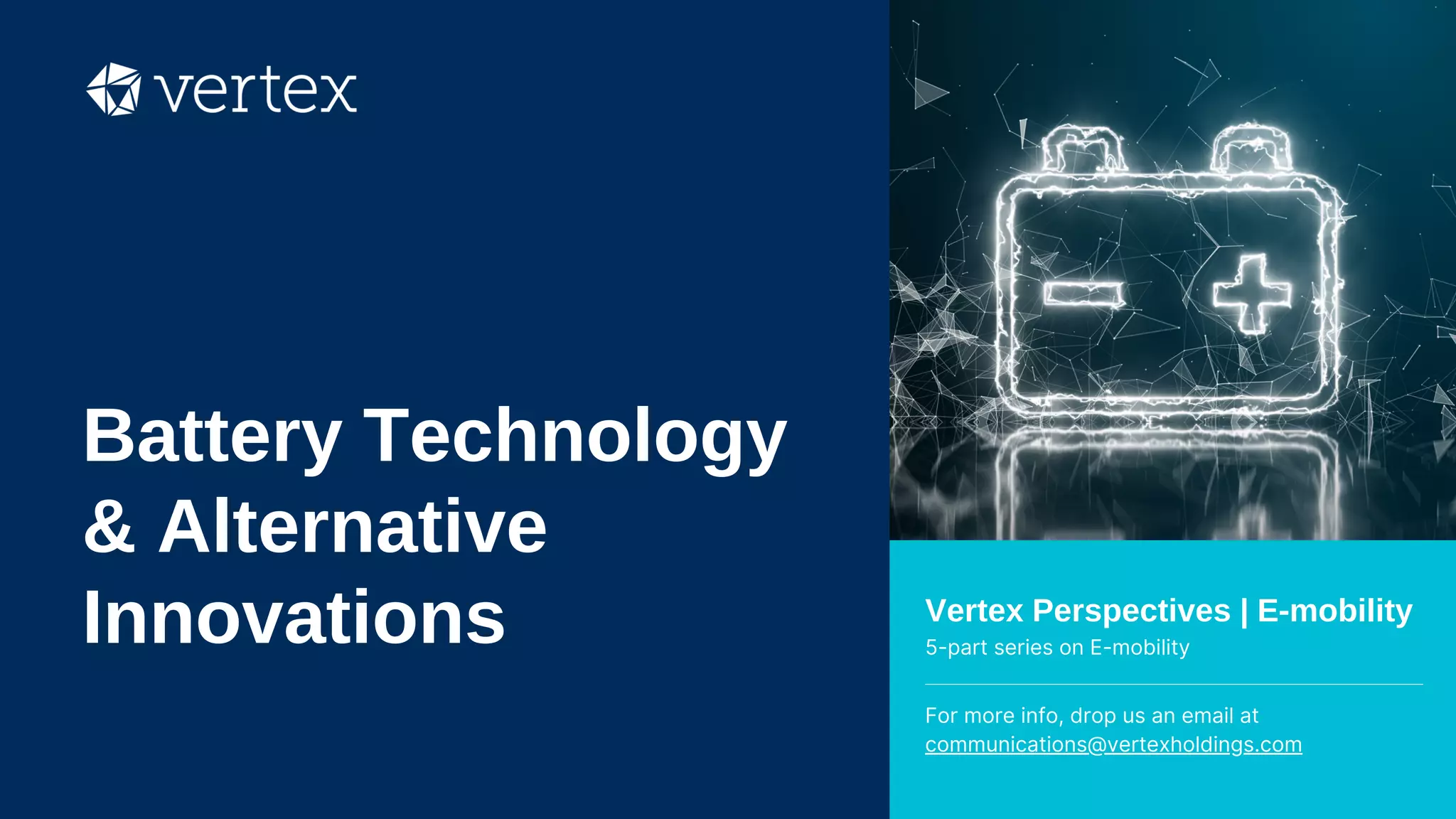
Battery Technology
& Alternative
Innovations
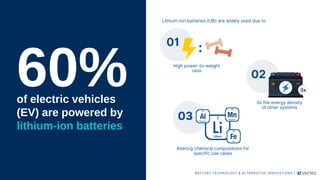
02
3x
Lithium-ion batteries (LIB) are widely used due to
BATTERY TECHNOLOGY & ALTERNATIVE INNOVATIONS |
of electric vehicles
(EV) are powered by
lithium-ion batteries
60%
01
High power-to-weight
ratio
3x the energy density
of other systems
Altering chemical compositions for
specific use cases
03
:
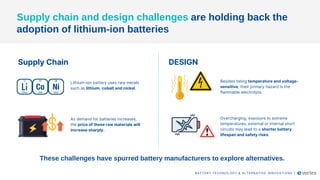
As demand for batteries increases,
the price of these raw materials will
increase sharply.
Supply chain and design challenges are holding back the
adoption of lithium-ion batteries
These challenges have spurred battery manufacturers to explore alternatives.
Supply Chain
Lithium-ion battery uses rare metals
such as lithium, cobalt and nickel.
Besides being temperature and voltage-
sensitive, their primary hazard is the
flammable electrolyte.
Overcharging, exposure to extreme
temperatures, external or internal short
circuits may lead to a shorter battery
lifespan and safety risks.​
​
DESIGN
BATTERY TECHNOLOGY & ALTERNATIVE INNOVATIONS |
Advantage of specific battery technology in comparison to lithium-ion batteries
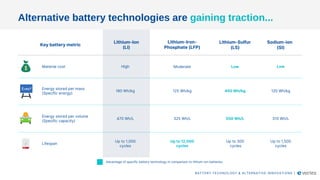
Alternative battery technologies are gaining traction...
Low
Sodium-ion
(SI)
120 Wh/kg
310 Wh/L
Key battery metric
Material cost
Energy stored per mass
(Specific energy)
Energy stored per volume
(Specific capacity)
Lifespan
High
Lithium-Ion
(LI)
180 Wh/kg
470 Wh/L
Up to 1,000
cycles
Moderate
Lithium-Iron-
Phosphate (LFP)
125 Wh/kg
325 Wh/L
Up to 12,000
cycles
Low
Lithium-Sulfur
(LS)
450 Wh/kg
550 Wh/L
Up to 300
cycles
Up to 1,500
cycles
BATTERY TECHNOLOGY & ALTERNATIVE INNOVATIONS |
Exploring
Lithium-Ion
alternatives:
Lithium-Iron
Phosphate (LFP)
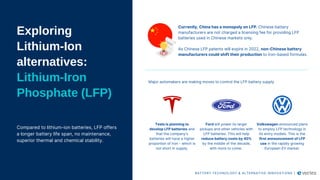
Compared to lithium-ion batteries, LFP offers
a longer battery life span, no maintenance,
superior thermal and chemical stability.
Currently, China has a monopoly on LFP. Chinese battery
manufacturers are not charged a licensing fee for providing LFP
batteries used in Chinese markets only.
As Chinese LFP patents will expire in 2022, non-Chinese battery
manufacturers could shift their production to iron-based formulas.
Major automakers are making moves to control the LFP battery supply
Tesla is planning to
develop LFP batteries and
that the company’s
batteries will have a higher
proportion of iron - which is
not short in supply.​
Ford will power its larger
pickups and other vehicles with
LFP batteries. This will help
reduce battery costs by 40%
by the middle of the decade,
with more to come.
Volkswagen announced plans
to employ LFP technology in
its entry models. This is the
first announcement of LFP
use in the rapidly growing
European EV market.
BATTERY TECHNOLOGY & ALTERNATIVE INNOVATIONS |
Exploring
Lithium-Ion
alternatives:
Lithium-sulfur
battery (LSB)
LSBs are one of the next-generation batteries
due to its high energy density, low cost,
material availability and improved safety.
Sulphur, being abundant and non-toxic, makes
LSBs a cheaper and sustainable alternative.
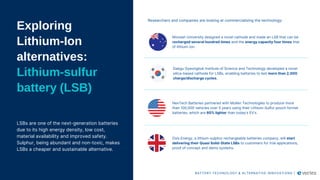
Monash University designed a novel cathode and made an LSB that can be
recharged several hundred times and the energy capacity four times that
of lithium-ion.
Daegu Gyeongbuk Institute of Science and Technology developed a novel
silica-based cathode for LSBs, enabling batteries to last more than 2,000
charge/discharge cycles.
NexTech Batteries partnered with Mullen Technologies to produce more
than 100,000 vehicles over 5 years using their Lithium-Sulfur pouch format
batteries, which are 60% lighter than today’s EV’s.
Oxis Energy, a lithium-sulphur rechargeable batteries company, will start
delivering their Quasi Solid-State LSBs to customers for trial applications,
proof of concept and demo systems.
Researchers and companies are looking at commercialising the technology:
BATTERY TECHNOLOGY & ALTERNATIVE INNOVATIONS |
Exploring
Lithium-Ion
alternatives:
Sodium-Ion
battery (SIB)
SIBs and lithium-ion batteries (LIBs) were both
developed in 1980s. Compared to LIBs, SIBs
have an inferior battery performance resulting
in slow development. In recent years, interest
arise due to its lower cost, material availability
and potential safety benefits.​
​
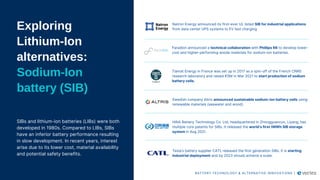
Natron Energy announced its first-ever UL listed SIB for industrial applications
from data center UPS systems to EV fast charging.
Faradion announced a technical collaboration with Phillips 66 to develop lower-
cost and higher-performing anode materials for sodium-ion batteries.
Tiamat Energy in France was set up in 2017 as a spin-off of the French CNRS
research laboratory and raised €5M in Mar 2021 to start production of sodium
battery cells.
Swedish company Altris announced sustainable sodium-ion battery cells using
renewable materials (seawater and wood).
HiNA Battery Technology Co. Ltd, headquartered in Zhongguancun, Liyang, has
multiple core patents for SIBs. It released the world’s first 1MWh SIB storage
system in Aug 2021.
Tesla’s battery supplier CATL released the first generation SIBs. It is starting
industrial deployment and by 2023 should achieve a scale.
BATTERY TECHNOLOGY & ALTERNATIVE INNOVATIONS |
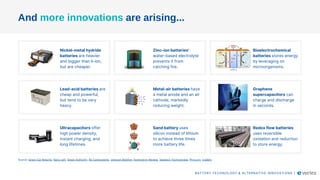
And more innovations are arising...
Nickel-metal hydride
batteries are heavier
and bigger than li-ion,
but are cheaper.
Redox flow batteries
uses reversible
oxidation and reduction
to store energy.
Graphene
supercapacitors can
charge and discharge
in seconds.
Bioelectrochemical
batteries stores energy
by leveraging on
microorganisms.
Zinc-ion batteries'
water-based electrolyte
prevents it from
catching fire.
Metal-air batteries have
a metal anode and an air
cathode, markedly
reducing weight.
Sand battery uses
silicon instead of lithium
to achieve three times
more battery life.
Lead-acid batteries are
cheap and powerful,
but tend to be very
heavy.
Ultracapacitors offer
high power density,
instant charging, and
long lifetimes.
BATTERY TECHNOLOGY & ALTERNATIVE INNOVATIONS |
Source: Green Car Reports, Nano Lett, Green Authority, RS Components, Johnson Matthey Technology Review, Skeleton Technologies, Phys.org, Codibly
Energy density
Fast charging
Safety
Energy density
Fast charging
Safety
Li-ion Battery
Anode Cathode
Liquid Electrolyte
Solid-state Battery
Solid-state
batteries - the
next generation
technology?
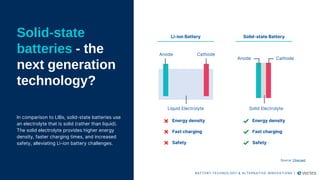
In comparison to LIBs, solid-state batteries use
an electrolyte that is solid (rather than liquid).
The solid electrolyte provides higher energy
density, faster charging times, and increased
safety, alleviating Li-ion battery challenges.
Source: Charged
Anode Cathode
Solid Electrolyte
BATTERY TECHNOLOGY & ALTERNATIVE INNOVATIONS |
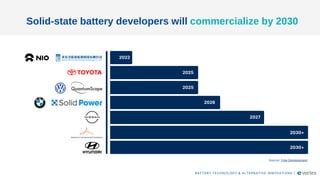
Solid-state battery developers will commercialize by 2030
2022
Source: Yole Development
2025
2025
2026
2027
2030+
2030+
BATTERY TECHNOLOGY & ALTERNATIVE INNOVATIONS |
Battery
innovation is
not accelerating
fast enough
Research institutions and companies are
collaborating to use data and AI to speed up
battery R&D and improve data management.
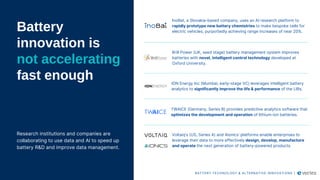
InoBat, a Slovakia-based company, uses an AI research platform to
rapidly prototype new battery chemistries to make bespoke cells for
electric vehicles, purportedly achieving range increases of near 20%.
Brill Power (UK, seed stage) battery management system improves
batteries with novel, intelligent control technology developed at
Oxford University.
TWAICE (Germany, Series B) provides predictive analytics software that
optimizes the development and operation of lithium-ion batteries.
ION Energy Inc (Mumbai, early-stage VC) leverages intelligent battery
analytics to significantly improve the life & performance of the LIBs.
BATTERY TECHNOLOGY & ALTERNATIVE INNOVATIONS |
Voltaiq’s (US, Series A) and Aionics’ platforms enable enterprises to
leverage their data to more effectively design, develop, manufacture
and operate the next generation of battery-powered products.
Battery and automakers are lowering battery costs with a
holistic approach to battery design
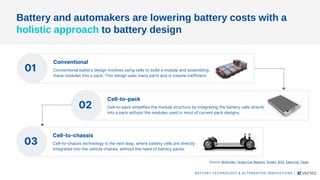
01 Conventional battery design involves using cells to build a module and assembling
these modules into a pack. This design uses many parts and is volume inefficient.
Conventional
02 Cell-to-pack simplifies the module structure by integrating the battery cells directly
into a pack without the modules used in most of current pack designs.
Cell-to-pack
03 Cell-to-chassis technology is the next leap, where battery cells are directly
integrated into the vehicle chassis, without the need of battery packs.
Cell-to-chassis
BATTERY TECHNOLOGY & ALTERNATIVE INNOVATIONS |
Source: McKinsey, Green Car Reports, Driven, BYD, Electrive, Tesla
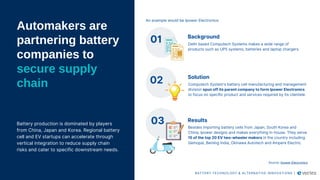
Battery production is dominated by players
from China, Japan and Korea. Regional battery
cell and EV startups can accelerate through
vertical integration to reduce supply chain
risks and cater to specific downstream needs.
Automakers are
partnering battery
companies to
secure supply
chain
Source: Ipower Electronics
Results
Delhi based Computech Systems makes a wide range of
products such as UPS systems, batteries and laptop chargers.
Background
Computech System's battery cell manufacturing and management
division spun off its parent company to form Ipower Electronics
to focus on specific product and services required by its clientele.
Solution
Besides importing battery cells from Japan, South Korea and
China, Ipower designs and makes everything in-house. They serve
15 of the top 20 EV two-wheeler makers in the country including
Gemopai, Benling India, Okinawa Autotech and Ampere Electric.
01
02
An example would be Ipower Electronics:
03
BATTERY TECHNOLOGY & ALTERNATIVE INNOVATIONS |
03
01
02
Anode Cathode
Solid Electrolyte
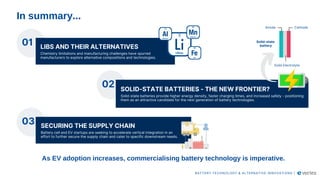
SECURING THE SUPPLY CHAIN
Battery cell and EV startups are seeking to accelerate vertical integration in an
effort to further secure the supply chain and cater to specific downstream needs.
As EV adoption increases, commercialising battery technology is imperative.
LIBS AND THEIR ALTERNATIVES
Chemistry limitations and manufacturing challenges have spurred
manufacturers to explore alternative compositions and technologies.
In summary...
SOLID-STATE BATTERIES - THE NEW FRONTIER?
Solid-state batteries provide higher energy density, faster charging times, and increased safety - positioning
them as an attractive candidate for the next generation of battery technologies.
Solid-state
battery
BATTERY TECHNOLOGY & ALTERNATIVE INNOVATIONS |
In Part III of our five-part series, we introduce the EV Batteries recycling landscape and second life
applications to better manage waste from retired batteries. Find out how batteries can be retired
sustainably and managed better with next-generation power electronics technologies.
C O M I N G U P N E X T . . .
Have a question? Drop us an email at communications@vertexholdings.com
Follow us on Social Media Stay tuned by subscribing
to our newsletter:
https://bit.ly/3GGxEDC
What happens to
retired batteries?
Battery Recycling & Power Electronics

E-mobility | Part 2 - Battery Technology & Alternative Innovations (English)

  • 1.
    Vertex Perspectives |E-mobility 5-part series on E-mobility For more info, drop us an email at communications@vertexholdings.com Battery Technology & Alternative Innovations
  • 2.
    02 3x Lithium-ion batteries (LIB)are widely used due to BATTERY TECHNOLOGY & ALTERNATIVE INNOVATIONS | of electric vehicles (EV) are powered by lithium-ion batteries 60% 01 High power-to-weight ratio 3x the energy density of other systems Altering chemical compositions for specific use cases 03 :
  • 3.
    As demand forbatteries increases, the price of these raw materials will increase sharply. Supply chain and design challenges are holding back the adoption of lithium-ion batteries These challenges have spurred battery manufacturers to explore alternatives. Supply Chain Lithium-ion battery uses rare metals such as lithium, cobalt and nickel. Besides being temperature and voltage- sensitive, their primary hazard is the flammable electrolyte. Overcharging, exposure to extreme temperatures, external or internal short circuits may lead to a shorter battery lifespan and safety risks.​ ​ DESIGN BATTERY TECHNOLOGY & ALTERNATIVE INNOVATIONS |
  • 4.
    Advantage of specificbattery technology in comparison to lithium-ion batteries Alternative battery technologies are gaining traction... Low Sodium-ion (SI) 120 Wh/kg 310 Wh/L Key battery metric Material cost Energy stored per mass (Specific energy) Energy stored per volume (Specific capacity) Lifespan High Lithium-Ion (LI) 180 Wh/kg 470 Wh/L Up to 1,000 cycles Moderate Lithium-Iron- Phosphate (LFP) 125 Wh/kg 325 Wh/L Up to 12,000 cycles Low Lithium-Sulfur (LS) 450 Wh/kg 550 Wh/L Up to 300 cycles Up to 1,500 cycles BATTERY TECHNOLOGY & ALTERNATIVE INNOVATIONS |
  • 5.
    Exploring Lithium-Ion alternatives: Lithium-Iron Phosphate (LFP) Compared tolithium-ion batteries, LFP offers a longer battery life span, no maintenance, superior thermal and chemical stability. Currently, China has a monopoly on LFP. Chinese battery manufacturers are not charged a licensing fee for providing LFP batteries used in Chinese markets only. As Chinese LFP patents will expire in 2022, non-Chinese battery manufacturers could shift their production to iron-based formulas. Major automakers are making moves to control the LFP battery supply Tesla is planning to develop LFP batteries and that the company’s batteries will have a higher proportion of iron - which is not short in supply.​ Ford will power its larger pickups and other vehicles with LFP batteries. This will help reduce battery costs by 40% by the middle of the decade, with more to come. Volkswagen announced plans to employ LFP technology in its entry models. This is the first announcement of LFP use in the rapidly growing European EV market. BATTERY TECHNOLOGY & ALTERNATIVE INNOVATIONS |
  • 6.
    Exploring Lithium-Ion alternatives: Lithium-sulfur battery (LSB) LSBs areone of the next-generation batteries due to its high energy density, low cost, material availability and improved safety. Sulphur, being abundant and non-toxic, makes LSBs a cheaper and sustainable alternative. Monash University designed a novel cathode and made an LSB that can be recharged several hundred times and the energy capacity four times that of lithium-ion. Daegu Gyeongbuk Institute of Science and Technology developed a novel silica-based cathode for LSBs, enabling batteries to last more than 2,000 charge/discharge cycles. NexTech Batteries partnered with Mullen Technologies to produce more than 100,000 vehicles over 5 years using their Lithium-Sulfur pouch format batteries, which are 60% lighter than today’s EV’s. Oxis Energy, a lithium-sulphur rechargeable batteries company, will start delivering their Quasi Solid-State LSBs to customers for trial applications, proof of concept and demo systems. Researchers and companies are looking at commercialising the technology: BATTERY TECHNOLOGY & ALTERNATIVE INNOVATIONS |
  • 7.
    Exploring Lithium-Ion alternatives: Sodium-Ion battery (SIB) SIBs andlithium-ion batteries (LIBs) were both developed in 1980s. Compared to LIBs, SIBs have an inferior battery performance resulting in slow development. In recent years, interest arise due to its lower cost, material availability and potential safety benefits.​ ​ Natron Energy announced its first-ever UL listed SIB for industrial applications from data center UPS systems to EV fast charging. Faradion announced a technical collaboration with Phillips 66 to develop lower- cost and higher-performing anode materials for sodium-ion batteries. Tiamat Energy in France was set up in 2017 as a spin-off of the French CNRS research laboratory and raised €5M in Mar 2021 to start production of sodium battery cells. Swedish company Altris announced sustainable sodium-ion battery cells using renewable materials (seawater and wood). HiNA Battery Technology Co. Ltd, headquartered in Zhongguancun, Liyang, has multiple core patents for SIBs. It released the world’s first 1MWh SIB storage system in Aug 2021. Tesla’s battery supplier CATL released the first generation SIBs. It is starting industrial deployment and by 2023 should achieve a scale. BATTERY TECHNOLOGY & ALTERNATIVE INNOVATIONS |
  • 8.
    And more innovationsare arising... Nickel-metal hydride batteries are heavier and bigger than li-ion, but are cheaper. Redox flow batteries uses reversible oxidation and reduction to store energy. Graphene supercapacitors can charge and discharge in seconds. Bioelectrochemical batteries stores energy by leveraging on microorganisms. Zinc-ion batteries' water-based electrolyte prevents it from catching fire. Metal-air batteries have a metal anode and an air cathode, markedly reducing weight. Sand battery uses silicon instead of lithium to achieve three times more battery life. Lead-acid batteries are cheap and powerful, but tend to be very heavy. Ultracapacitors offer high power density, instant charging, and long lifetimes. BATTERY TECHNOLOGY & ALTERNATIVE INNOVATIONS | Source: Green Car Reports, Nano Lett, Green Authority, RS Components, Johnson Matthey Technology Review, Skeleton Technologies, Phys.org, Codibly
  • 9.
    Energy density Fast charging Safety Energydensity Fast charging Safety Li-ion Battery Anode Cathode Liquid Electrolyte Solid-state Battery Solid-state batteries - the next generation technology? In comparison to LIBs, solid-state batteries use an electrolyte that is solid (rather than liquid). The solid electrolyte provides higher energy density, faster charging times, and increased safety, alleviating Li-ion battery challenges. Source: Charged Anode Cathode Solid Electrolyte BATTERY TECHNOLOGY & ALTERNATIVE INNOVATIONS |
  • 10.
    Solid-state battery developerswill commercialize by 2030 2022 Source: Yole Development 2025 2025 2026 2027 2030+ 2030+ BATTERY TECHNOLOGY & ALTERNATIVE INNOVATIONS |
  • 11.
    Battery innovation is not accelerating fastenough Research institutions and companies are collaborating to use data and AI to speed up battery R&D and improve data management. InoBat, a Slovakia-based company, uses an AI research platform to rapidly prototype new battery chemistries to make bespoke cells for electric vehicles, purportedly achieving range increases of near 20%. Brill Power (UK, seed stage) battery management system improves batteries with novel, intelligent control technology developed at Oxford University. TWAICE (Germany, Series B) provides predictive analytics software that optimizes the development and operation of lithium-ion batteries. ION Energy Inc (Mumbai, early-stage VC) leverages intelligent battery analytics to significantly improve the life & performance of the LIBs. BATTERY TECHNOLOGY & ALTERNATIVE INNOVATIONS | Voltaiq’s (US, Series A) and Aionics’ platforms enable enterprises to leverage their data to more effectively design, develop, manufacture and operate the next generation of battery-powered products.
  • 12.
    Battery and automakersare lowering battery costs with a holistic approach to battery design 01 Conventional battery design involves using cells to build a module and assembling these modules into a pack. This design uses many parts and is volume inefficient. Conventional 02 Cell-to-pack simplifies the module structure by integrating the battery cells directly into a pack without the modules used in most of current pack designs. Cell-to-pack 03 Cell-to-chassis technology is the next leap, where battery cells are directly integrated into the vehicle chassis, without the need of battery packs. Cell-to-chassis BATTERY TECHNOLOGY & ALTERNATIVE INNOVATIONS | Source: McKinsey, Green Car Reports, Driven, BYD, Electrive, Tesla
  • 13.
    Battery production isdominated by players from China, Japan and Korea. Regional battery cell and EV startups can accelerate through vertical integration to reduce supply chain risks and cater to specific downstream needs. Automakers are partnering battery companies to secure supply chain Source: Ipower Electronics Results Delhi based Computech Systems makes a wide range of products such as UPS systems, batteries and laptop chargers. Background Computech System's battery cell manufacturing and management division spun off its parent company to form Ipower Electronics to focus on specific product and services required by its clientele. Solution Besides importing battery cells from Japan, South Korea and China, Ipower designs and makes everything in-house. They serve 15 of the top 20 EV two-wheeler makers in the country including Gemopai, Benling India, Okinawa Autotech and Ampere Electric. 01 02 An example would be Ipower Electronics: 03 BATTERY TECHNOLOGY & ALTERNATIVE INNOVATIONS |
  • 14.
    03 01 02 Anode Cathode Solid Electrolyte SECURINGTHE SUPPLY CHAIN Battery cell and EV startups are seeking to accelerate vertical integration in an effort to further secure the supply chain and cater to specific downstream needs. As EV adoption increases, commercialising battery technology is imperative. LIBS AND THEIR ALTERNATIVES Chemistry limitations and manufacturing challenges have spurred manufacturers to explore alternative compositions and technologies. In summary... SOLID-STATE BATTERIES - THE NEW FRONTIER? Solid-state batteries provide higher energy density, faster charging times, and increased safety - positioning them as an attractive candidate for the next generation of battery technologies. Solid-state battery BATTERY TECHNOLOGY & ALTERNATIVE INNOVATIONS |
  • 15.
    In Part IIIof our five-part series, we introduce the EV Batteries recycling landscape and second life applications to better manage waste from retired batteries. Find out how batteries can be retired sustainably and managed better with next-generation power electronics technologies. C O M I N G U P N E X T . . . Have a question? Drop us an email at communications@vertexholdings.com Follow us on Social Media Stay tuned by subscribing to our newsletter: https://bit.ly/3GGxEDC What happens to retired batteries? Battery Recycling & Power Electronics