Enabling EVTOLs with Breakthrough Batteries
Dr. Sujeet Kumar,
Co-founder & CEO Ionblox
Ionblox, 3390 Gateway Boulevard, Fremont, California 94538
Company Overview
2
• Ionblox launched in Silicon Valley in 2017 has developed groundbreaking Lithium-ion
cells that can simultaneously deliver Fast Charging, High Energy, High Power and Long
Cycle Life
• Our high-performance Lithium-ion cells are enabled by a proprietary Pre-lithiated
Silicon-based anode that can be paired with a Nickel rich NCM cathode to achieve up
to 400 Wh/Kg lithium-ion cells. Cell performance validated by industry leaders
globally
üEV cell performance validated by US National Labs
üeVTOL cell performance validated by Lilium a leading eVTOL player & investor
• We have just closed a $32M Series B round from Temasek, Lilium, Applied Ventures
and Catalus, which will support the further commercialization of our cell technology
• 41 issued US patents & several pending applications. IP protection includes
foundational patents for pre-lithiation for all types of silicon-based anodes.
3
Silicon Provides Best Path to Address Market
Confidential Information
• Incumbent graphite-based
LIBs have hit their effective
performance limit.
• Silicon, which has >10X the
capacity of graphite, offers the
best path forward to enable
mass adoption of EVs.
4,212 mAh/g
372 mAh/g
Silicon Graphite
Replacing graphite-
based anodes with
silicon-based ones will
provide a step change in
performance.
Capacity
4
The Problem with Silicon
Confidential Information
• While Silicon holds great promise, it
expands and contracts by 3X during
cycling, causing:
o Silicon particle cracking and pulverization
o Battery swelling
o Electrode delamination and disintegration
o Poor performance and low cycle life
• Moreover, silicon anodes shed lithium
ions when first cycled and suffer
irreversible capacity loss (~20%).
Silicon’s problem
Silicon anodes swell and
shrink by 3X as batteries
charge and discharge.
The changes in size
eventually cause the
anode to disintegrate.
5
Confidential Information
Addressed every element of the LIB technology stack to solve the
silicon problem and developed the best cell on the market:
Silicon Monoxide
(SiOx) Anode
• 100% active material
provides step change in
performance.
• Swells less (1X vs 3X for pure
silicon).
Pre-Lithiation
• Offsets irreversible capacity
loss.
• Stabilizes cell and increases
cycle life and calendar life.
• High-speed lithium
deposition tool supplied by
strategic partner, Applied
Materials.
Electrode
Architecture
• Porous electrode
accommodates swelling.
• High-strength binder ‘glues’
silicon to the current
collector.
• Carbon nanotube network
increases mechanical
integrity and conductivity.
Cell Design &
Integration
• Electrolyte forms strong
solid electrolyte interphase
(SEI) layer improving cycle
life and calendar life.
• Formation protocol
minimizes swelling.
• Design leading to 500
Wh/kg
Ionblox’s silicon anode is
the only cell technology
that can simultaneously
meet all cell performance
metrics critical for the
mass adoption of Electric
Vehicles and Electric
Aerial Vehicles.
> 300 Mile range.
Solves range anxiety
Parity with ICE refueling time
Enables battery to last lifetime
of the vehicle
Affordable EVs and AVs with
scaled production
Vertical take-off & landing
Technology that Enables Mass Adoption of EVs & EAVs
High Energy
350 -400 Wh/kg
Fast Charge
10 min to 80 %
Cycle Life
> 1000
Low Cost
<100 $/kWh
High Power
>2500 W/Kg
6
Gen 1
7
Resetting the Bar for Energy and Power
Confidential Information
Ionblox versus the current state-of-the-art:
High-Energy High-Power Cell for EVTOL
8
§ EVTOL require high-energy for cruising & high
power during lift off & landing
§ Graphite-anode-based battery have useable
energy around 200 Wh/kg and no fast charge
capability
§ Ionblox technology enables long-range eVTOL
• High Power: 3000 Watts/Kg
• Total Specific Energy (C/3): 330 Wh/kg
• Energy Density (C/3 ): 890 Wh/l (without terrace)
• Long cycle life (1C/1C) > 900 at 100 % DOD
• Fast Charge 10 min to 80%
9
Enabling the Most Challenging Use Cases
Confidential Information
Lilium evaluated over 100
options, and Ionblox’s LIB
was the only one that could
meet the requirements:
• High Power: 2,500 W/kg for take-off.
• High Energy: for maximum range.
• High Power: 2,500 W/kg for landing,
when the cell has a low state of
charge.
• Uses standard LIB manufacturing equipment and processes.
• Strategic partnership with Applied Materials for high speed pre-lithiation.
Commercially Scalable Manufacturing
Confidential Information 10
Dry
Mixing
Slurry
Mixing
Coating Calendar
Pre-
Lithiation
Tool
Winding
or
Stacking
Electrolyte
Injection
Cell
Formation
Standard Equipment & Process Steps Standard Equipment & Process Steps
Current Pouch Cell Production & Formats
11
15-40 Ah
8-12 Ah
15-40 Ah
90-120 Ah
• Thoroughly tested by leading automotive and eVTOL manufacturers and U.S. National Labs as part of
USABC (Stellantis, GM, Ford, & DOE)
• Pilot line capacity 5 MWh expanding to 20 MWh in 2024. Plan to build Gigafactory in USA
Slot-die Coater
Calendaring & Punching Cell Assembly
Ionblox Cell Prototyping Facility
Under Development
Pouch Cell Design - 32 Ah Cell
12
32 Ah Pouch Cell
Cell Components
Cathode NCM811
Anode Pre-lithiated SiOx
Electrolyte LiPF6 in Organic Solvents+
Additives
Separator Ceramic coated Trilayer
Discharge Rate Test - 32 Ah cells
13
• Specific Energy 345 Wh/Kg at C/10
• Continuous Discharge Rate tested from C/10 to 12 C rate
Power and Resistance – 32 Ah cells
14
0
2
4
6
8
10
12
14
0
10
20
30
40
50
60
70
80
90
100
Resistance
(mΩ)
SOC (%)
Res_p1 (C/20) Res_p2 (1C) Res_p3 (4C) Res_p4 (8C) Res_p5 (12C)
0
1
2
3
4
5
6
7
8
9
0
20
40
60
80
100
Power
(kW/kg)
SOC (%)
Power_p1 (C/20) Power_p2 (1C) Power_p3 (4C)
Power_p4 (8C) Power_p5 (12C)
HPPC: Resistance HPPC: Power
• 32 Ah capacity & 335 Wh/Kg (at C/3 rate) showing Low Resistance and High Power
• High usable energy under high power requirements
• HPPC tested from C/20 to 12C rate – 30sec pulses at 30°C from 4.2V to 2.5V
60
198
128
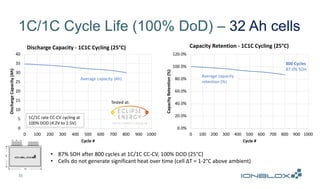
1C/1C Cycle Life (100% DoD) – 32 Ah cells
15
• 87% SOH after 800 cycles at 1C/1C CC-CV, 100% DOD (25°C)
• Cells do not generate significant heat over time (cell ∆T = 1-2°C above ambient)
0
5
10
15
20
25
30
35
40
0 100 200 300 400 500 600 700 800 900 1000
Discharge
Capacity
(Ah)
Cycle #
Discharge Capacity - 1C1C Cycling (25°C)
Average capacity (Ah)
0.0%
20.0%
40.0%
60.0%
80.0%
100.0%
120.0%
0 100 200 300 400 500 600 700 800 900 1000
Capacity
Retention
(%)
Cycle #
Capacity Retention - 1C1C Cycling (25°C)
800 Cycles
87.0% SOH
1C/1C rate CC-CV cycling at
100% DOD (4.2V to 2.5V)
Average capacity
retention (%)
60
198
128
Tested at:
Resistance Growth vs Cycling (80% DOD)
16
15
145
64
• Resistance growth is <5% after 700 cycles
• 12 Ah capacity pouch cell cycling at 1C Ch/2C Disch rate, 25˚C, with 80% DOD cycling (20% to 100% SOC)
• HPPC testing at every 100 cycles with 30 sec, 1C pulse
Capacity check every 100 cycles
HPPC resistance check every 100 cycles
1C/2C CC-CV cycling
at 80% DOD
70%
75%
80%
85%
90%
95%
100%
105%
0 100 200 300 400 500
Capacity
Retention
Cycle #
34 Ah cell #1
34 Ah cell #2
Extreme Fast Charging (XFC) Performance
17
5-minute Extreme Fast Charge Cycling:
• 34 Ah Capacity pouch cells
• Limited voltage window (~60% of capacity)
• 7C rate CCCV Charge / 1C Discharge @ 25˚C
• >400 continuous XFC cycles have been obtained with
excellent retention ~100%
• XFC cycling test still ongoing
60
198
128
Excellent continuous 5-min
Extreme Fast Charge cycling
enables new applications
18
• Gen 1 silicon dominant, pre-lithiated
anode is a platform technology that
will continue to evolve.
• Gen 2 will pair our platform with a
next generation cathode and other
components to achieve 400+ Wh/kg.
• Gen 3 will target 500+ Wh/kg.
Extending Our Lead
Confidential Information
Nextgen cathode
Cathode current collector
Separator/Solid state electrolyte
Pre-lithiated Silicon anode
Anode current collector
Traditional
Graphite
Silicon Graphite
Solid State
~2028
IONBLOX Gen 2
IONBLOX Gen 1
Energy
Density
(Wh/kg) Power Density (W/kg)
2000
300
IONBLOX Gen 3
4000
600
450
1000 3000
150
19
Energy Density Roadmap
Confidential Information
100
150
200
250
300
350
400
450
500
550
600
2022 2023 2024 2025 2026 2027 2028
Gen 2
Dry Electrode
Pre-Li SiOx Anode
NCM811 cathode
Specific
Energy
Wh/Kg
Gen 3
Candidate 1:
Pre-Li Si Anode
Li rich-Mn rich Cathode
Candidate 2:
Pre-Li Si Anode
Sulfur Cathode
• Gen 2 cells can achieve 400 Wh/kg (1,000 Wh/L) using a dry electrode process for a NCM811 cathode.
• Gen 3 cell pairs pre-lithiated silicon anode with a Li-rich Mn-rich cathode or sulfur cathode.
Gen 1
Pre-Li SiOx Anode
NCM811 cathode
350 Wh/kg
500 Wh/kg
400 Wh/kg
Sample A
Sample A
Strong IP Portfolio and Foundational Patent
Confidential Information
20
• Awarded over 41 patents.
• Own foundational patents for pre-
lithiation for all types of silicon-based
anodes.
o Covers specific range of lithiation required for
highest performance.
o Provides the only path for silicon cells to achieve
industry-leading performance.
• Prosecuting new patents pairing our
silicon anode with next generation
chemistries for specific energy >450
Wh/kg.
Cell Designs
Electrolytes
Pre-lithiation
CORE:
Silicon Anode
Formulations
Concluding Remarks
21
• Ionblox has solved the cycling and swelling-related problems associated with
Silicon anodes. Strong IP coverage for pre-lithiation Silicon anode.
• Ionblox has demonstrated multiple performance attributes; all in one cell:
• High Specific Energy: 330-345 Wh/Kg
• High Specific Power: > 3000 W/kg over wide range of SOC
• Fast-charging: 10min from 0 % to 80% SOC
• Long cycle life: >1000 cycles at 1C/1C or DST
• Major EV and eVTOL OEMs to commercialize the cell technology. Lilium has
announced the use of our technology for eVTOL
• Scaling up pouch cell production with strategic partners and at its own facility
Enabling EVTOLs with Breakthrough Batteries
Dr. Sujeet Kumar,
Co-founder & CEO Ionblox
Ionblox, 3390 Gateway Boulevard, Fremont, California 94538

ENABLING EVTOL WITH BREAKTHROUGH BATTERIES

  • 1.
    Enabling EVTOLs withBreakthrough Batteries Dr. Sujeet Kumar, Co-founder & CEO Ionblox Ionblox, 3390 Gateway Boulevard, Fremont, California 94538
  • 2.
    Company Overview 2 • Ionbloxlaunched in Silicon Valley in 2017 has developed groundbreaking Lithium-ion cells that can simultaneously deliver Fast Charging, High Energy, High Power and Long Cycle Life • Our high-performance Lithium-ion cells are enabled by a proprietary Pre-lithiated Silicon-based anode that can be paired with a Nickel rich NCM cathode to achieve up to 400 Wh/Kg lithium-ion cells. Cell performance validated by industry leaders globally üEV cell performance validated by US National Labs üeVTOL cell performance validated by Lilium a leading eVTOL player & investor • We have just closed a $32M Series B round from Temasek, Lilium, Applied Ventures and Catalus, which will support the further commercialization of our cell technology • 41 issued US patents & several pending applications. IP protection includes foundational patents for pre-lithiation for all types of silicon-based anodes.
  • 3.
    3 Silicon Provides BestPath to Address Market Confidential Information • Incumbent graphite-based LIBs have hit their effective performance limit. • Silicon, which has >10X the capacity of graphite, offers the best path forward to enable mass adoption of EVs. 4,212 mAh/g 372 mAh/g Silicon Graphite Replacing graphite- based anodes with silicon-based ones will provide a step change in performance. Capacity
  • 4.
    4 The Problem withSilicon Confidential Information • While Silicon holds great promise, it expands and contracts by 3X during cycling, causing: o Silicon particle cracking and pulverization o Battery swelling o Electrode delamination and disintegration o Poor performance and low cycle life • Moreover, silicon anodes shed lithium ions when first cycled and suffer irreversible capacity loss (~20%). Silicon’s problem Silicon anodes swell and shrink by 3X as batteries charge and discharge. The changes in size eventually cause the anode to disintegrate.
  • 5.
    5 Confidential Information Addressed everyelement of the LIB technology stack to solve the silicon problem and developed the best cell on the market: Silicon Monoxide (SiOx) Anode • 100% active material provides step change in performance. • Swells less (1X vs 3X for pure silicon). Pre-Lithiation • Offsets irreversible capacity loss. • Stabilizes cell and increases cycle life and calendar life. • High-speed lithium deposition tool supplied by strategic partner, Applied Materials. Electrode Architecture • Porous electrode accommodates swelling. • High-strength binder ‘glues’ silicon to the current collector. • Carbon nanotube network increases mechanical integrity and conductivity. Cell Design & Integration • Electrolyte forms strong solid electrolyte interphase (SEI) layer improving cycle life and calendar life. • Formation protocol minimizes swelling. • Design leading to 500 Wh/kg
  • 6.
    Ionblox’s silicon anodeis the only cell technology that can simultaneously meet all cell performance metrics critical for the mass adoption of Electric Vehicles and Electric Aerial Vehicles. > 300 Mile range. Solves range anxiety Parity with ICE refueling time Enables battery to last lifetime of the vehicle Affordable EVs and AVs with scaled production Vertical take-off & landing Technology that Enables Mass Adoption of EVs & EAVs High Energy 350 -400 Wh/kg Fast Charge 10 min to 80 % Cycle Life > 1000 Low Cost <100 $/kWh High Power >2500 W/Kg 6 Gen 1
  • 7.
    7 Resetting the Barfor Energy and Power Confidential Information Ionblox versus the current state-of-the-art:
  • 8.
    High-Energy High-Power Cellfor EVTOL 8 § EVTOL require high-energy for cruising & high power during lift off & landing § Graphite-anode-based battery have useable energy around 200 Wh/kg and no fast charge capability § Ionblox technology enables long-range eVTOL • High Power: 3000 Watts/Kg • Total Specific Energy (C/3): 330 Wh/kg • Energy Density (C/3 ): 890 Wh/l (without terrace) • Long cycle life (1C/1C) > 900 at 100 % DOD • Fast Charge 10 min to 80%
  • 9.
    9 Enabling the MostChallenging Use Cases Confidential Information Lilium evaluated over 100 options, and Ionblox’s LIB was the only one that could meet the requirements: • High Power: 2,500 W/kg for take-off. • High Energy: for maximum range. • High Power: 2,500 W/kg for landing, when the cell has a low state of charge.
  • 10.
    • Uses standardLIB manufacturing equipment and processes. • Strategic partnership with Applied Materials for high speed pre-lithiation. Commercially Scalable Manufacturing Confidential Information 10 Dry Mixing Slurry Mixing Coating Calendar Pre- Lithiation Tool Winding or Stacking Electrolyte Injection Cell Formation Standard Equipment & Process Steps Standard Equipment & Process Steps
  • 11.
    Current Pouch CellProduction & Formats 11 15-40 Ah 8-12 Ah 15-40 Ah 90-120 Ah • Thoroughly tested by leading automotive and eVTOL manufacturers and U.S. National Labs as part of USABC (Stellantis, GM, Ford, & DOE) • Pilot line capacity 5 MWh expanding to 20 MWh in 2024. Plan to build Gigafactory in USA Slot-die Coater Calendaring & Punching Cell Assembly Ionblox Cell Prototyping Facility Under Development
  • 12.
    Pouch Cell Design- 32 Ah Cell 12 32 Ah Pouch Cell Cell Components Cathode NCM811 Anode Pre-lithiated SiOx Electrolyte LiPF6 in Organic Solvents+ Additives Separator Ceramic coated Trilayer
  • 13.
    Discharge Rate Test- 32 Ah cells 13 • Specific Energy 345 Wh/Kg at C/10 • Continuous Discharge Rate tested from C/10 to 12 C rate
  • 14.
    Power and Resistance– 32 Ah cells 14 0 2 4 6 8 10 12 14 0 10 20 30 40 50 60 70 80 90 100 Resistance (mΩ) SOC (%) Res_p1 (C/20) Res_p2 (1C) Res_p3 (4C) Res_p4 (8C) Res_p5 (12C) 0 1 2 3 4 5 6 7 8 9 0 20 40 60 80 100 Power (kW/kg) SOC (%) Power_p1 (C/20) Power_p2 (1C) Power_p3 (4C) Power_p4 (8C) Power_p5 (12C) HPPC: Resistance HPPC: Power • 32 Ah capacity & 335 Wh/Kg (at C/3 rate) showing Low Resistance and High Power • High usable energy under high power requirements • HPPC tested from C/20 to 12C rate – 30sec pulses at 30°C from 4.2V to 2.5V 60 198 128
  • 15.
    1C/1C Cycle Life(100% DoD) – 32 Ah cells 15 • 87% SOH after 800 cycles at 1C/1C CC-CV, 100% DOD (25°C) • Cells do not generate significant heat over time (cell ∆T = 1-2°C above ambient) 0 5 10 15 20 25 30 35 40 0 100 200 300 400 500 600 700 800 900 1000 Discharge Capacity (Ah) Cycle # Discharge Capacity - 1C1C Cycling (25°C) Average capacity (Ah) 0.0% 20.0% 40.0% 60.0% 80.0% 100.0% 120.0% 0 100 200 300 400 500 600 700 800 900 1000 Capacity Retention (%) Cycle # Capacity Retention - 1C1C Cycling (25°C) 800 Cycles 87.0% SOH 1C/1C rate CC-CV cycling at 100% DOD (4.2V to 2.5V) Average capacity retention (%) 60 198 128 Tested at:
  • 16.
    Resistance Growth vsCycling (80% DOD) 16 15 145 64 • Resistance growth is <5% after 700 cycles • 12 Ah capacity pouch cell cycling at 1C Ch/2C Disch rate, 25˚C, with 80% DOD cycling (20% to 100% SOC) • HPPC testing at every 100 cycles with 30 sec, 1C pulse Capacity check every 100 cycles HPPC resistance check every 100 cycles 1C/2C CC-CV cycling at 80% DOD
  • 17.
    70% 75% 80% 85% 90% 95% 100% 105% 0 100 200300 400 500 Capacity Retention Cycle # 34 Ah cell #1 34 Ah cell #2 Extreme Fast Charging (XFC) Performance 17 5-minute Extreme Fast Charge Cycling: • 34 Ah Capacity pouch cells • Limited voltage window (~60% of capacity) • 7C rate CCCV Charge / 1C Discharge @ 25˚C • >400 continuous XFC cycles have been obtained with excellent retention ~100% • XFC cycling test still ongoing 60 198 128 Excellent continuous 5-min Extreme Fast Charge cycling enables new applications
  • 18.
    18 • Gen 1silicon dominant, pre-lithiated anode is a platform technology that will continue to evolve. • Gen 2 will pair our platform with a next generation cathode and other components to achieve 400+ Wh/kg. • Gen 3 will target 500+ Wh/kg. Extending Our Lead Confidential Information Nextgen cathode Cathode current collector Separator/Solid state electrolyte Pre-lithiated Silicon anode Anode current collector Traditional Graphite Silicon Graphite Solid State ~2028 IONBLOX Gen 2 IONBLOX Gen 1 Energy Density (Wh/kg) Power Density (W/kg) 2000 300 IONBLOX Gen 3 4000 600 450 1000 3000 150
  • 19.
    19 Energy Density Roadmap ConfidentialInformation 100 150 200 250 300 350 400 450 500 550 600 2022 2023 2024 2025 2026 2027 2028 Gen 2 Dry Electrode Pre-Li SiOx Anode NCM811 cathode Specific Energy Wh/Kg Gen 3 Candidate 1: Pre-Li Si Anode Li rich-Mn rich Cathode Candidate 2: Pre-Li Si Anode Sulfur Cathode • Gen 2 cells can achieve 400 Wh/kg (1,000 Wh/L) using a dry electrode process for a NCM811 cathode. • Gen 3 cell pairs pre-lithiated silicon anode with a Li-rich Mn-rich cathode or sulfur cathode. Gen 1 Pre-Li SiOx Anode NCM811 cathode 350 Wh/kg 500 Wh/kg 400 Wh/kg Sample A Sample A
  • 20.
    Strong IP Portfolioand Foundational Patent Confidential Information 20 • Awarded over 41 patents. • Own foundational patents for pre- lithiation for all types of silicon-based anodes. o Covers specific range of lithiation required for highest performance. o Provides the only path for silicon cells to achieve industry-leading performance. • Prosecuting new patents pairing our silicon anode with next generation chemistries for specific energy >450 Wh/kg. Cell Designs Electrolytes Pre-lithiation CORE: Silicon Anode Formulations
  • 21.
    Concluding Remarks 21 • Ionbloxhas solved the cycling and swelling-related problems associated with Silicon anodes. Strong IP coverage for pre-lithiation Silicon anode. • Ionblox has demonstrated multiple performance attributes; all in one cell: • High Specific Energy: 330-345 Wh/Kg • High Specific Power: > 3000 W/kg over wide range of SOC • Fast-charging: 10min from 0 % to 80% SOC • Long cycle life: >1000 cycles at 1C/1C or DST • Major EV and eVTOL OEMs to commercialize the cell technology. Lilium has announced the use of our technology for eVTOL • Scaling up pouch cell production with strategic partners and at its own facility
  • 22.
    Enabling EVTOLs withBreakthrough Batteries Dr. Sujeet Kumar, Co-founder & CEO Ionblox Ionblox, 3390 Gateway Boulevard, Fremont, California 94538