SODIUM ION BATTERIES
 INTRODUCTION
 Energy storage has become a growing global concern over the past
decade as a result of Increased energy demand, combined with drastic
increases in the price of refined fossil fuels and the environmental
consequences of their use.
 Sodium’s high abundance and low cost.
 Rechargeable electrochemical cells based on sodium.
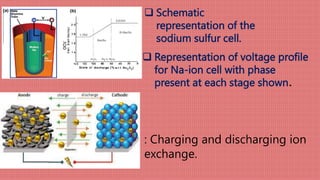
 Schematic
representation of the
sodium sulfur cell.
 Representation of voltage profile
for Na-ion cell with phase
present at each stage shown.
: Charging and discharging ion
exchange.
Sodium-ion batteries have received much academic
and commercial interest in the 2010s and 2020s as a
possible complementary technology to lithium-ion
batteries.
The commercial production of sodium-ion batteries less costly than lithium-ion
batteries.
The largest advantage of sodium-ion batteries is the high natural
abundance of sodium.
Need of this amazing battery
 Typical graphitic carbons
employed in Li-ion cells
cannot be used.
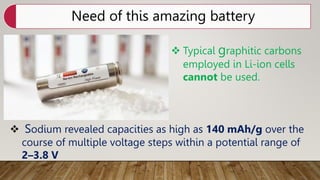
 Sodium revealed capacities as high as 140 mAh/g over the
course of multiple voltage steps within a potential range of
2–3.8 V
ADVANTAGES
 Better safety characteristics, and
similar Power delivery characteristics.
 Weight and energy density are not high
requirements
 The sodium salt raw material reserves are abundant and the price is
low.
 Power density is between 2 and
5 kW/kg, allowing for a 5 min
charging time.
 Lifetime is 5000+cycles to 80% of capacity.
 The ultra-thin protective layer that forms on the anode.
Naturally fire-extinguishing solution.
MARKET ANALYSIS OF PRODUCT
 SuperBattery’s total capital investment:
$4,72,000
Energizer’s total capital investment:
$9,17,000 Million
Conclusion:
SuperBattery’s market is 0.09% the size of Energizer market
Investment
:
An Update on Market Trends
Cost Comparison
For Super Battery to be cost competitive, a battery must
be sold for Rs.10/battery.
The cost per battery for production is Rs. 8.6 only.
Rs.1.4 profit per battery is about 16% .
 As compare to others in the market, Super
battery is must less costly and very easy to use.
0
100
200
300
400
500
600
700
2012 2013 2014 2015 2016 2017 2018 2019 2020 2021 2022 2023 2024 2025
POWER
NEED
PER
HOUR
(GW/H
)
YEAR
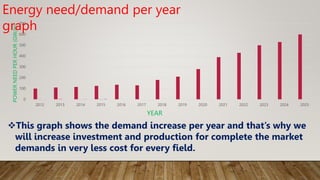
Energy need/demand per year
graph
This graph shows the demand increase per year and that’s why we
will increase investment and production for complete the market
demands in very less cost for every field.
Sodium-ion
battery
Lithium-ion
battery
Lead-acid battery
Cost per Kilowatt Hour of
Capacity
$40–77 $137 (average in 2020). $100–300
Volumetric Energy Density
250–375 W·h/L, based on
prototypes.
200–683 W·h/L 80–90 W·h/L
Gravimetric Energy Density
(specific energy)
75–165 W·h/kg, based on
prototypes and product
announcements
120–260 W·h/kg 35–40 Wh/kg
Cycles at 80% depth of
discharge[a] Hundreds to thousands. 3,500 900
Safety
Low risk for aqueous
batteries, high risk for Na in
carbon batteries.
High risk Moderate risk
Materials Earth-abundant Scarce Toxic
Cycling Stability
High (negligible self-
discharge)
High (negligible self-
discharge)
Moderate (high self-
discharge)
Direct Current Round-Trip
Efficiency
up to 92% 85–90% 70–90%
COMPARISION WITH OTHERS BATTERY
Market prices of the
battery
1. Super battery ( button cell) = 20 Rs/piece.
2. Super battery for small energy =10 Rs/piece.
3. Super inverter battery for commercial uses =
9800 Rs/piece.
4. Super battery for industrial uses in factory =
12,000 Rs/piece.
5. Super battery for soler energy = 7800
RS/piece.
 SPECIAL OFFER : BUY 2 AND GET 40% INSTANT DISCOUNT AT
THIS PRODUCT FOR FIRST 5000 BUYERS WITH NO EXTRA
SHIPPING CHARGE.
 Avilable on all electronics shop, online portal www.superbatteryenergy.com,
flipkart, amazon, super battery show rooms.

Sodium batteryppt.pptx

  • 2.
    SODIUM ION BATTERIES INTRODUCTION  Energy storage has become a growing global concern over the past decade as a result of Increased energy demand, combined with drastic increases in the price of refined fossil fuels and the environmental consequences of their use.  Sodium’s high abundance and low cost.  Rechargeable electrochemical cells based on sodium.
  • 3.
     Schematic representation ofthe sodium sulfur cell.  Representation of voltage profile for Na-ion cell with phase present at each stage shown. : Charging and discharging ion exchange.
  • 4.
    Sodium-ion batteries havereceived much academic and commercial interest in the 2010s and 2020s as a possible complementary technology to lithium-ion batteries. The commercial production of sodium-ion batteries less costly than lithium-ion batteries. The largest advantage of sodium-ion batteries is the high natural abundance of sodium.
  • 5.
    Need of thisamazing battery  Typical graphitic carbons employed in Li-ion cells cannot be used.  Sodium revealed capacities as high as 140 mAh/g over the course of multiple voltage steps within a potential range of 2–3.8 V
  • 6.
    ADVANTAGES  Better safetycharacteristics, and similar Power delivery characteristics.  Weight and energy density are not high requirements  The sodium salt raw material reserves are abundant and the price is low.
  • 7.
     Power densityis between 2 and 5 kW/kg, allowing for a 5 min charging time.  Lifetime is 5000+cycles to 80% of capacity.  The ultra-thin protective layer that forms on the anode. Naturally fire-extinguishing solution.
  • 8.
    MARKET ANALYSIS OFPRODUCT  SuperBattery’s total capital investment: $4,72,000 Energizer’s total capital investment: $9,17,000 Million Conclusion: SuperBattery’s market is 0.09% the size of Energizer market Investment :
  • 9.
    An Update onMarket Trends Cost Comparison For Super Battery to be cost competitive, a battery must be sold for Rs.10/battery. The cost per battery for production is Rs. 8.6 only. Rs.1.4 profit per battery is about 16% .  As compare to others in the market, Super battery is must less costly and very easy to use.
  • 10.
    0 100 200 300 400 500 600 700 2012 2013 20142015 2016 2017 2018 2019 2020 2021 2022 2023 2024 2025 POWER NEED PER HOUR (GW/H ) YEAR Energy need/demand per year graph This graph shows the demand increase per year and that’s why we will increase investment and production for complete the market demands in very less cost for every field.
  • 11.
    Sodium-ion battery Lithium-ion battery Lead-acid battery Cost perKilowatt Hour of Capacity $40–77 $137 (average in 2020). $100–300 Volumetric Energy Density 250–375 W·h/L, based on prototypes. 200–683 W·h/L 80–90 W·h/L Gravimetric Energy Density (specific energy) 75–165 W·h/kg, based on prototypes and product announcements 120–260 W·h/kg 35–40 Wh/kg Cycles at 80% depth of discharge[a] Hundreds to thousands. 3,500 900 Safety Low risk for aqueous batteries, high risk for Na in carbon batteries. High risk Moderate risk Materials Earth-abundant Scarce Toxic Cycling Stability High (negligible self- discharge) High (negligible self- discharge) Moderate (high self- discharge) Direct Current Round-Trip Efficiency up to 92% 85–90% 70–90% COMPARISION WITH OTHERS BATTERY
  • 12.
    Market prices ofthe battery 1. Super battery ( button cell) = 20 Rs/piece. 2. Super battery for small energy =10 Rs/piece. 3. Super inverter battery for commercial uses = 9800 Rs/piece. 4. Super battery for industrial uses in factory = 12,000 Rs/piece. 5. Super battery for soler energy = 7800 RS/piece.  SPECIAL OFFER : BUY 2 AND GET 40% INSTANT DISCOUNT AT THIS PRODUCT FOR FIRST 5000 BUYERS WITH NO EXTRA SHIPPING CHARGE.  Avilable on all electronics shop, online portal www.superbatteryenergy.com, flipkart, amazon, super battery show rooms.