
Chem-e-car
Aluminium air battery
Amar Chand
Ashutosh Kushwaha
Akul Jain
Kunal
-IIT Roorkee
Why Al-Air Battery?
 Nowadays vehicles are creating about 60%
pollution on this earth.
 If the pollution has to be controlled than
vehicles should be run by other methods that
causes very less or negligible pollution.
 There are various other methods. One of
them is to create a new type of chemical
reaction which helps the vehicle to move. Our
project "chemecar" is based on it.
 Our chemecar is based on a method which
has a basic mechanism of converting
chemical energy to electrical energy which is
then converted to mechanical energy.
Mechanism
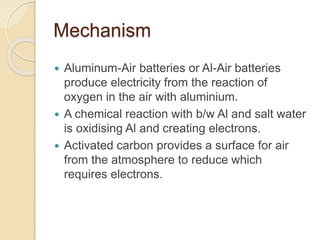
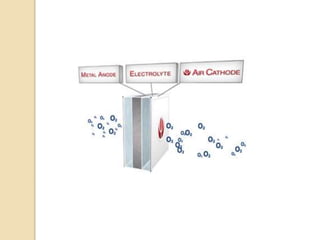
 Aluminum-Air batteries or Al-Air batteries
produce electricity from the reaction of
oxygen in the air with aluminium.
 A chemical reaction with b/w Al and salt water
is oxidising Al and creating electrons.
 Activated carbon provides a surface for air
from the atmosphere to reduce which
requires electrons.
Electrochemistry
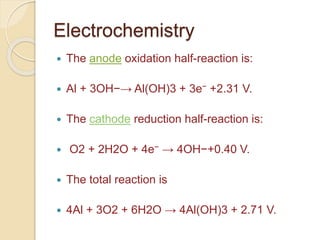
 The anode oxidation half-reaction is:
 Al + 3OH−→ Al(OH)3 + 3e− +2.31 V.
 The cathode reduction half-reaction is:
 O2 + 2H2O + 4e− → 4OH−+0.40 V.
 The total reaction is
 4Al + 3O2 + 6H2O → 4Al(OH)3 + 2.71 V.
Aluminium as a fuel
 The Al/air battery system can generate
enough energy and power for driving ranges
and acceleration similar to gasoline powered
cars.
 The total fuel efficiency during the cycle
process in Al/air electric vehicles (EVs) can
be 15% (present stage) or 20% (projected),
comparable to that of internal combustion
engine vehicles (ICEs) (13%).
 They have one of the highest energy
densities of all batteries.
Aluminium as a fuel
 Aluminium–air batteries are primary cells; i.e.,
non-rechargeable. Once the aluminium
anode is consumed by its reaction with
atmospheric oxygen, the battery will no
longer produce electricity.
 However, it is possible to mechanically
recharge the battery with new aluminium
anodes made from recycling the hydrated
aluminium oxide.
Aluminium as a fuel
 In March 2013, Phinergy created an electric
car using aluminium-air cells driven 330 km
using a special cathode and potassium
hydroxide.
 These batteries can be used, for example,
as reserve batteries in telephone
exchanges and as backup power sources.
Al–air batteries could be used to power
laptop computers and cell phones and are
being developed for such use.
Thank
You

Chem e-car

  • 1.
    Chem-e-car Aluminium air battery AmarChand Ashutosh Kushwaha Akul Jain Kunal -IIT Roorkee
  • 2.
    Why Al-Air Battery? Nowadays vehicles are creating about 60% pollution on this earth.  If the pollution has to be controlled than vehicles should be run by other methods that causes very less or negligible pollution.  There are various other methods. One of them is to create a new type of chemical reaction which helps the vehicle to move. Our project "chemecar" is based on it.  Our chemecar is based on a method which has a basic mechanism of converting chemical energy to electrical energy which is then converted to mechanical energy.
  • 3.
    Mechanism  Aluminum-Air batteriesor Al-Air batteries produce electricity from the reaction of oxygen in the air with aluminium.  A chemical reaction with b/w Al and salt water is oxidising Al and creating electrons.  Activated carbon provides a surface for air from the atmosphere to reduce which requires electrons.
  • 5.
    Electrochemistry  The anodeoxidation half-reaction is:  Al + 3OH−→ Al(OH)3 + 3e− +2.31 V.  The cathode reduction half-reaction is:  O2 + 2H2O + 4e− → 4OH−+0.40 V.  The total reaction is  4Al + 3O2 + 6H2O → 4Al(OH)3 + 2.71 V.
  • 6.
    Aluminium as afuel  The Al/air battery system can generate enough energy and power for driving ranges and acceleration similar to gasoline powered cars.  The total fuel efficiency during the cycle process in Al/air electric vehicles (EVs) can be 15% (present stage) or 20% (projected), comparable to that of internal combustion engine vehicles (ICEs) (13%).  They have one of the highest energy densities of all batteries.
  • 7.
    Aluminium as afuel  Aluminium–air batteries are primary cells; i.e., non-rechargeable. Once the aluminium anode is consumed by its reaction with atmospheric oxygen, the battery will no longer produce electricity.  However, it is possible to mechanically recharge the battery with new aluminium anodes made from recycling the hydrated aluminium oxide.
  • 8.
    Aluminium as afuel  In March 2013, Phinergy created an electric car using aluminium-air cells driven 330 km using a special cathode and potassium hydroxide.  These batteries can be used, for example, as reserve batteries in telephone exchanges and as backup power sources. Al–air batteries could be used to power laptop computers and cell phones and are being developed for such use.
  • 9.