LIQUID ORALS
Contents:
Liquid orals:
‱Introduction to liquid orals
‱Formulation and manufacturing consideration of
syrups and elixirs suspensions and emulsions
‱Filling and packaging
‱evaluation of liquid orals official in
pharmacopoeia
1
LIQUID ORAL PREPARATIONS
The liquid oral preparations are administered by oral
route. These preparations are of two types that is monophasic
and polyphasic liquid dosage form.
Ex. Solutions, Syrup, Elixir, Emulsion, Suspension.
Monophasic liquid dosage forms are true or
colloidal solution. It is clear, homogenous solution that is
prepared by dissolving a solid, liquid or gas in liquid.
Solvent :-
The component of solution present in large quantity is
called as solvent. Water is commonly used as solvent in most of
monophasic liquid dosage form.
Solute:-
The component of solution present in small quantity is
called as solute.
2
3
Advantages:
1.Liquid oral preparations has
faster absorption and rapid onset
of action.
2.They having pleasant taste and
odour.
3.They are useful in the people
suffering from difficulty in
swallowing.
4.They are commonly used in
children's and elderly patients.
5.The products like adsorbents
and antacids are more effective
in liquid dosage forms.
6.They can be easily measured
using measuring device
provided with package.
Disadvantages:
1. They are more bulky.
2. Transportation is not easy.
3. Less shelf life with compared to
solid dosage form.
4. The containers may break
easily.
5. There is chance of growth of
microorganisms.
6. Less economic.
7. More space is required for
storage.
8. Physically and chemically less
stable.
SOLUTIONS
The solution is a homogeneous liquid dosage form prepared
by dissolving active ingredient(s) in an aqueous or non-aqueous
solvent.
Classification of solutions:
They are classified two different methods.
1.According to composition and uses
2.According to vehicle
1. According to composition and uses:
A.Syrup: Aqueous solution containing sugar.
B.Elixir: Sweeten hydro-alcoholic solution.
C.Spirit: Solution of aromatic materials in alcohol.
D.Aromatic water: Solution of aromatic materials in water.
E.Tincture: Solution prepared by extraction of active component
from crude drug.
F.Injection: It is sterile & pyrogen free used for parenteral
administration.
4
5
2. According to vehicle:
A. Aqueous solutions: Solutions that contains water as
solvent, for example, sugar in water.
B. Non-aqueous solutions: Solutions that contains solvent
other than water, for example, ethanol, ethyl ether.
Advantages of Solutions:
1. Solutions will get fast absorbed and has rapid onset of
action.
2. They having pleasant taste and odour.
3. They are useful in the people suffering from difficulty in
swallowing.
4. They are commonly used in children's and elderly patients.
5. The drug is uniformly distributed throughout the solution.
6. They can be easily measured using measuring device
provided with package.
6
Disadvantages:
1. They are more bulky.
2. Transportation is not easy.
3. Less shelf life with compared to solid dosage for.
4. The containers may break easily.
5. There is chance of growth of microorganisms.
6. Less economic.
7. More space is required for storage.
8. Physically and chemically less stable.
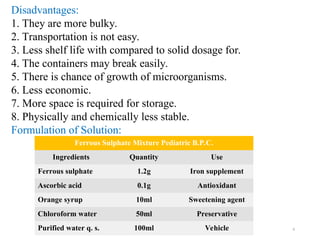
Formulation of Solution:
Ferrous Sulphate Mixture Pediatric B.P.C.
Ingredients Quantity Use
Ferrous sulphate 1.2g Iron supplement
Ascorbic acid 0.1g Antioxidant
Orange syrup 10ml Sweetening agent
Chloroform water 50ml Preservative
Purified water q. s. 100ml Vehicle
7
Method of Preparation:
This solution is prepared by dissolving ferrous
sulphate in 10 ml of water and then chloroform water,
ascorbic acid and orange syrup is added. The solution is
filtered and final volume is adjusted.
Use: To treat iron deficiency.
Storage:
Solutions for oral use are packed in well closed
plain or amber colour bottle and stored in cool and dry
place away from light.
Quality Control Tests For Solutions
Following are the different quality control tests
carried out for solutions.
1.General test
2.Identification tests
3.Assay
4.Pourability
5.Viscosity
6.Clarity
7.Relative density
8.pH
9.Surface tension
10. Microbial limit test
11.Stability
12.Container and closure compatibility
8
9
1.General test:
Solutions are evaluated for visual appearance, colour,
taste, odour, labelling and homogenicity.
2. Identification tests:
Solutions are tested for physicochemical tests for
identification.
3. Assay:
Solutions are tested quantitatively to determine content
of drug.
4. Pourability:
Solutions must be easily poured from the container. The
pourability of solution is determined by measuring the flow
time and flow rate.
5. Viscosity:
Viscosity of solutions is tested by using viscometers
like Ostwald's viscometer, Brookfield viscometer.
10
6. Clarity:
The solutions must be clear. The clarity of solution is
determined by using clarity test apparatus.
7. Relative density:
Density of solutions are determined by using
Pycnometer or density bottle.
8. pH:
pH of solutions is determined by using pH paper. For
more accuracy pH is determined by using pH meter.
9. Surface tension:
Surface tension of solution is determined by using
instrument such as stalagmometer.
11
10. Microbial limit test:
The microbial contamination of solutions is
determined by microbial testing.
11. Stability:
Solutions are tested for stability test for short and
long-term durations against different temperature, light and
humidity conditions.
12. Container and closure compatibility:
Compatibility regarding container and closure
material can be tested as per the guidelines given in the
official books.

LIQUID ORAL PREPARATION SOLUTION.ppt pha

  • 1.
    LIQUID ORALS Contents: Liquid orals: ‱Introductionto liquid orals ‱Formulation and manufacturing consideration of syrups and elixirs suspensions and emulsions ‱Filling and packaging ‱evaluation of liquid orals official in pharmacopoeia 1
  • 2.
    LIQUID ORAL PREPARATIONS Theliquid oral preparations are administered by oral route. These preparations are of two types that is monophasic and polyphasic liquid dosage form. Ex. Solutions, Syrup, Elixir, Emulsion, Suspension. Monophasic liquid dosage forms are true or colloidal solution. It is clear, homogenous solution that is prepared by dissolving a solid, liquid or gas in liquid. Solvent :- The component of solution present in large quantity is called as solvent. Water is commonly used as solvent in most of monophasic liquid dosage form. Solute:- The component of solution present in small quantity is called as solute. 2
  • 3.
    3 Advantages: 1.Liquid oral preparationshas faster absorption and rapid onset of action. 2.They having pleasant taste and odour. 3.They are useful in the people suffering from difficulty in swallowing. 4.They are commonly used in children's and elderly patients. 5.The products like adsorbents and antacids are more effective in liquid dosage forms. 6.They can be easily measured using measuring device provided with package. Disadvantages: 1. They are more bulky. 2. Transportation is not easy. 3. Less shelf life with compared to solid dosage form. 4. The containers may break easily. 5. There is chance of growth of microorganisms. 6. Less economic. 7. More space is required for storage. 8. Physically and chemically less stable.
  • 4.
    SOLUTIONS The solution isa homogeneous liquid dosage form prepared by dissolving active ingredient(s) in an aqueous or non-aqueous solvent. Classification of solutions: They are classified two different methods. 1.According to composition and uses 2.According to vehicle 1. According to composition and uses: A.Syrup: Aqueous solution containing sugar. B.Elixir: Sweeten hydro-alcoholic solution. C.Spirit: Solution of aromatic materials in alcohol. D.Aromatic water: Solution of aromatic materials in water. E.Tincture: Solution prepared by extraction of active component from crude drug. F.Injection: It is sterile & pyrogen free used for parenteral administration. 4
  • 5.
    5 2. According tovehicle: A. Aqueous solutions: Solutions that contains water as solvent, for example, sugar in water. B. Non-aqueous solutions: Solutions that contains solvent other than water, for example, ethanol, ethyl ether. Advantages of Solutions: 1. Solutions will get fast absorbed and has rapid onset of action. 2. They having pleasant taste and odour. 3. They are useful in the people suffering from difficulty in swallowing. 4. They are commonly used in children's and elderly patients. 5. The drug is uniformly distributed throughout the solution. 6. They can be easily measured using measuring device provided with package.
  • 6.
    6 Disadvantages: 1. They aremore bulky. 2. Transportation is not easy. 3. Less shelf life with compared to solid dosage for. 4. The containers may break easily. 5. There is chance of growth of microorganisms. 6. Less economic. 7. More space is required for storage. 8. Physically and chemically less stable. Formulation of Solution: Ferrous Sulphate Mixture Pediatric B.P.C. Ingredients Quantity Use Ferrous sulphate 1.2g Iron supplement Ascorbic acid 0.1g Antioxidant Orange syrup 10ml Sweetening agent Chloroform water 50ml Preservative Purified water q. s. 100ml Vehicle
  • 7.
    7 Method of Preparation: Thissolution is prepared by dissolving ferrous sulphate in 10 ml of water and then chloroform water, ascorbic acid and orange syrup is added. The solution is filtered and final volume is adjusted. Use: To treat iron deficiency. Storage: Solutions for oral use are packed in well closed plain or amber colour bottle and stored in cool and dry place away from light.
  • 8.
    Quality Control TestsFor Solutions Following are the different quality control tests carried out for solutions. 1.General test 2.Identification tests 3.Assay 4.Pourability 5.Viscosity 6.Clarity 7.Relative density 8.pH 9.Surface tension 10. Microbial limit test 11.Stability 12.Container and closure compatibility 8
  • 9.
    9 1.General test: Solutions areevaluated for visual appearance, colour, taste, odour, labelling and homogenicity. 2. Identification tests: Solutions are tested for physicochemical tests for identification. 3. Assay: Solutions are tested quantitatively to determine content of drug. 4. Pourability: Solutions must be easily poured from the container. The pourability of solution is determined by measuring the flow time and flow rate. 5. Viscosity: Viscosity of solutions is tested by using viscometers like Ostwald's viscometer, Brookfield viscometer.
  • 10.
    10 6. Clarity: The solutionsmust be clear. The clarity of solution is determined by using clarity test apparatus. 7. Relative density: Density of solutions are determined by using Pycnometer or density bottle. 8. pH: pH of solutions is determined by using pH paper. For more accuracy pH is determined by using pH meter. 9. Surface tension: Surface tension of solution is determined by using instrument such as stalagmometer.
  • 11.
    11 10. Microbial limittest: The microbial contamination of solutions is determined by microbial testing. 11. Stability: Solutions are tested for stability test for short and long-term durations against different temperature, light and humidity conditions. 12. Container and closure compatibility: Compatibility regarding container and closure material can be tested as per the guidelines given in the official books.