
PHARMACEUTICAL DOSAGE FORM
AND COSMETIC TECHNOLOGY
“Aerosol Containers | Definition |
Components | Manufacturing |
Evaluation”
By
Chetan A., IIIrd B.Pharm
K.K. College of Pharmacy
Chennai, TamilNadu
ChetanPrakash
LEARNING OBJECTIVE
 Introduction
 Components of Aerosol
 Types of Valves, Aerosol System, Aerosol Spray
 Manufacturing of Pharmaceuticsl Aerosol
 Evaluation of Aerosol
 Packaging, Labelling & Storage of Aerosol
 Reference
ChetanPrakash
INTRODUCTION
 The Aerosols container referred to as pressurized
package in which therapeutically active drug is dissolved
or suspended in a compressed or liquefied gas.
 It is a system that depends on power of compressed or
liquefied gas to expel the content from the container.
ChetanPrakash
DEFINITION OF AEROSOL
 Aerosols are a suspension of small solid particles or
droplets suspended in a gas or vapor. Examples:-haze,
dust, particulate air pollutants & smoke.
 An aerosols also called as pressurized pressure or
pressurized dosage forms.
 Pressure is developed to the aerosol system through the
use of one or more Liquefied or gaseous propellants .
ChetanPrakash
PHARMACEUTICAL AEROSOLS
 Pharmaceutical aerosols is defined as aerosols products
containing therapeutically active ingredients dissolved,
suspended or emulsified in a propellant or a mixture of
solvent and propellant and intended for topical
administration, for administration into ear, rectum, and
vagina or intended for administration orally or nasally as
fine solid particles or liquid mists through the pulmonary
airways, nasal passages or oral cavity.
ChetanPrakash
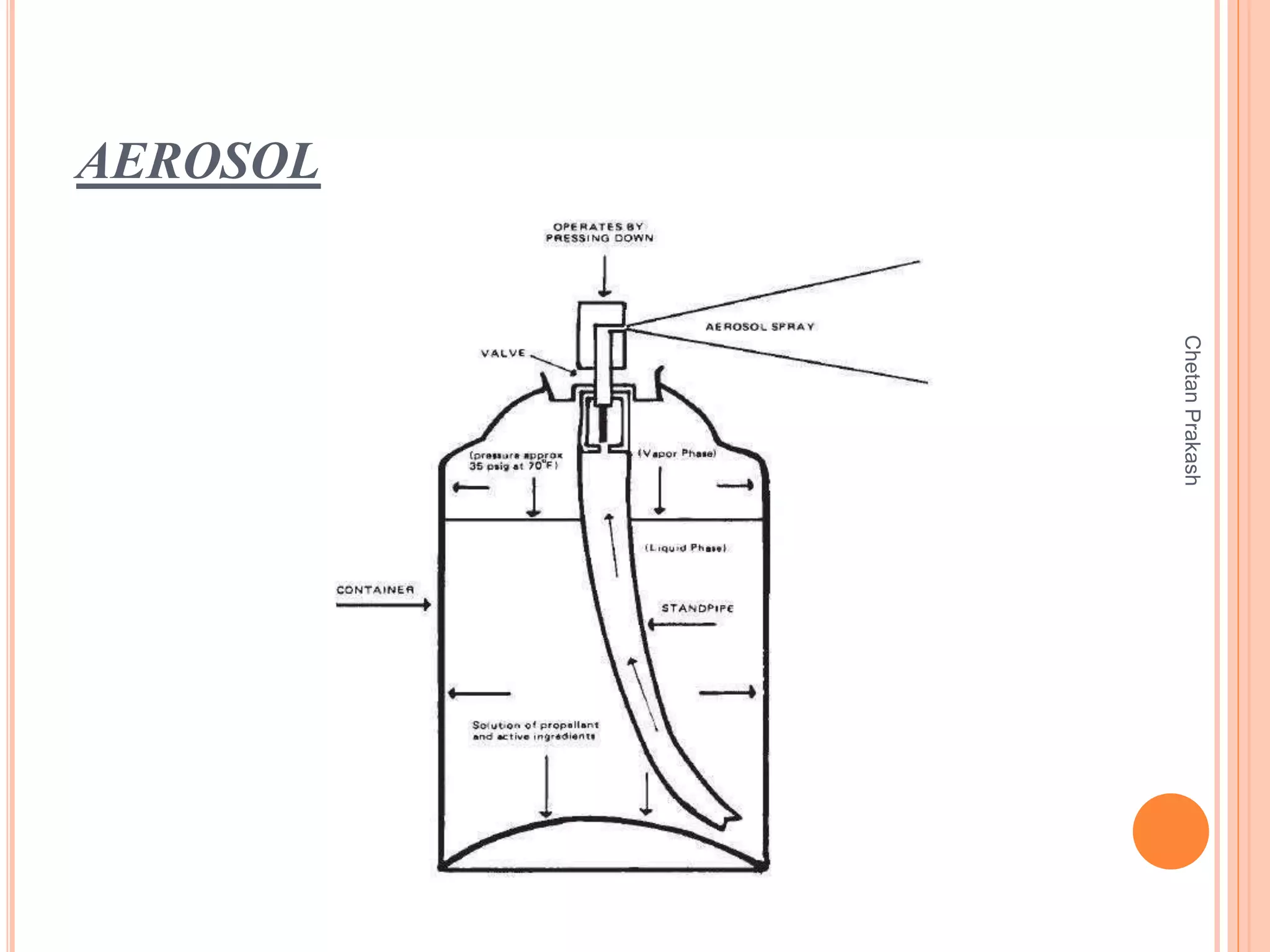
AEROSOL
ChetanPrakash
ADVANTAGES OF AEROSOLS
 Rapid onset of action.
 Aerosol form can avoid decomposition or inactivation of
drug by the pH or enzymatic action of stomach and also
can avoid first pass metabolism.
 A specific amount of dose or drug can be removed from
the container without contamination of removing
contents.
 Stability is enhanced for these substances adversely
affected by oxygen and or moisture.
ChetanPrakash
CONTINUATION…..
 The aerosol container protects the photosensitive
medicaments.
 When sterility is an important factor, it can be
maintained while a dose is being dispensed.
 Aerosols are portable and tamper-proof.
ChetanPrakash
DISADVANTAGES OF AEROSOLS
 Aerosols are cost effective.
 Disposal of empty aerosol containers are difficult.
 Aerosol packs must be kept away from temperature and
fire , because it may develop high pressure inside the
container and lead to explosion.
ChetanPrakash
COMPONENTS OF AEROSOLS
An aerosol system has following major components
 Propellant
 Container
 Valve and actuator
 Product concentrate
ChetanPrakash
•PROPELLANT
 The propellant generally is regarded as the heart of the
aerosol package.
 Propellant provide the driving force to expel product
form its container when the valve is opened
ChetanPrakash
TYPES OF PROPELLANTS
There are two types of propellants used in pharmaceutical
aerosols,
 Liquefied gas propellants
 Compressed gas propellants
ChetanPrakash
•LIQUEFIED GAS PROPELLANTS
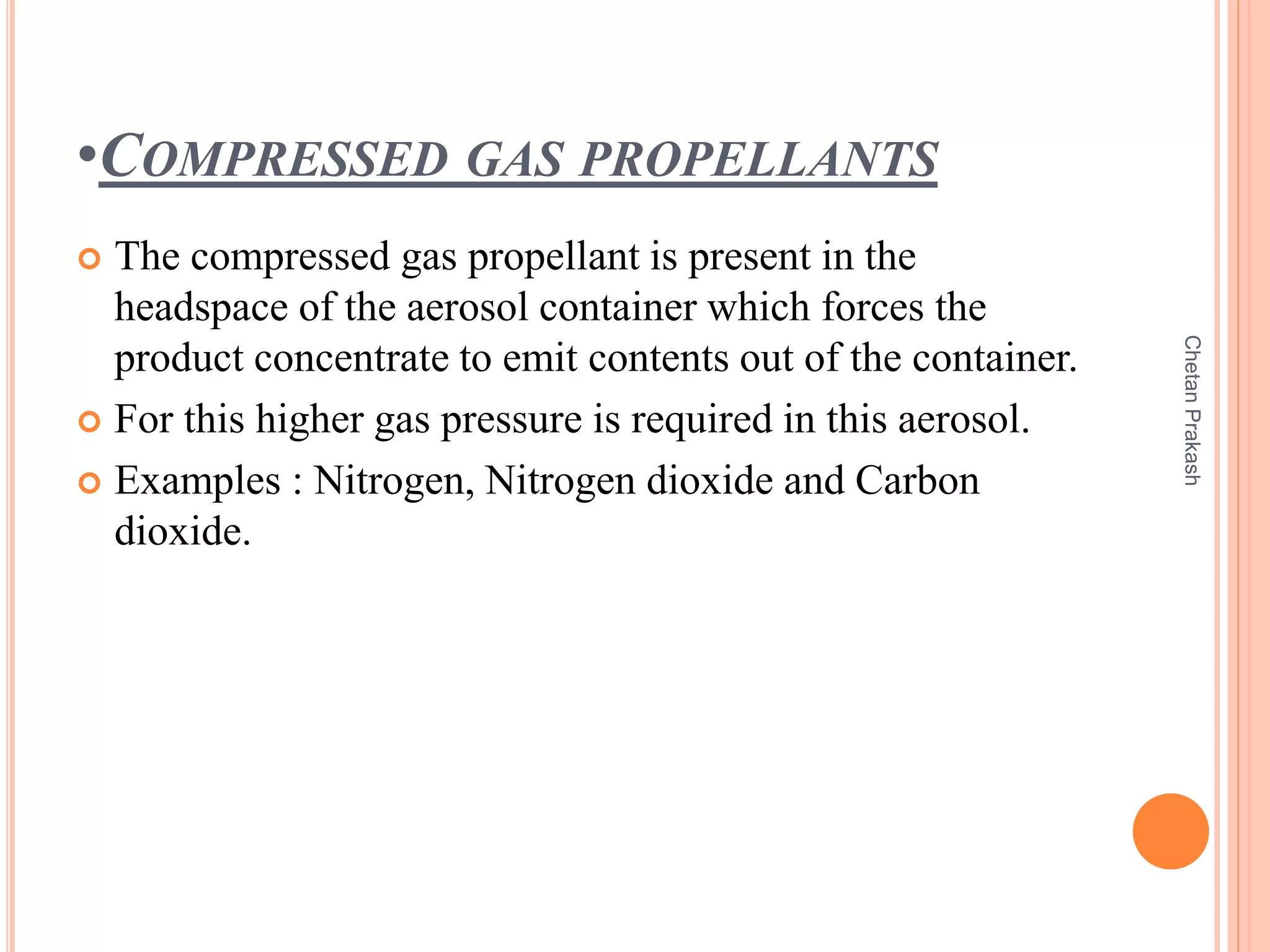
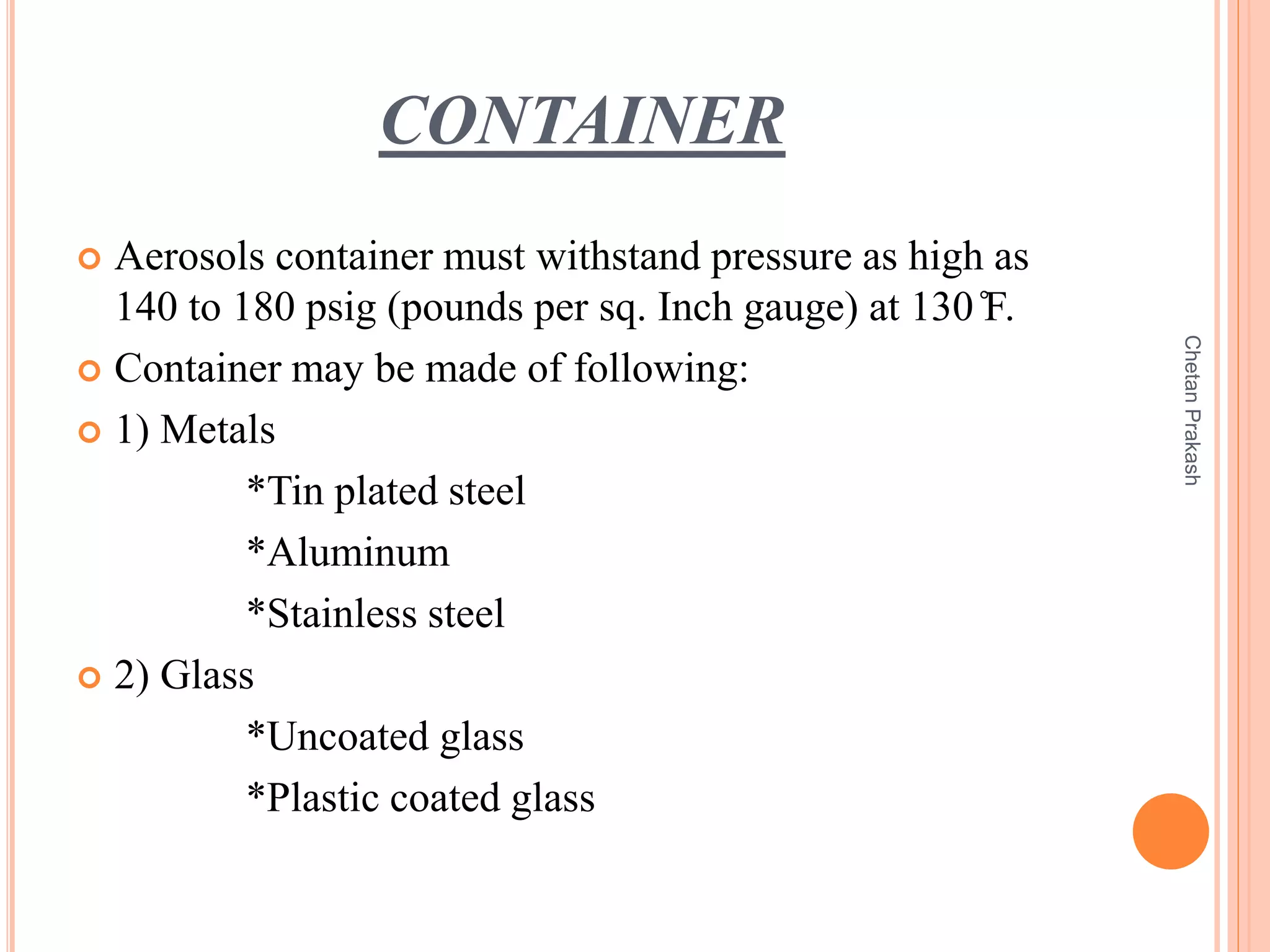
 The liquefied-gas propellants mixture is sealed in an
aerosols container with the product concentrate.
 It establish equilibrium between the propellant which
remains liquefied and a portion that vaporized and
occupies the upper portion of the container.
 Examples : Hydrocarbons (HCs), Chlorofluorocarbon
(CFCS), Hydrofluoroalkanes (HFA)
ChetanPrakash
•COMPRESSED GAS PROPELLANTS
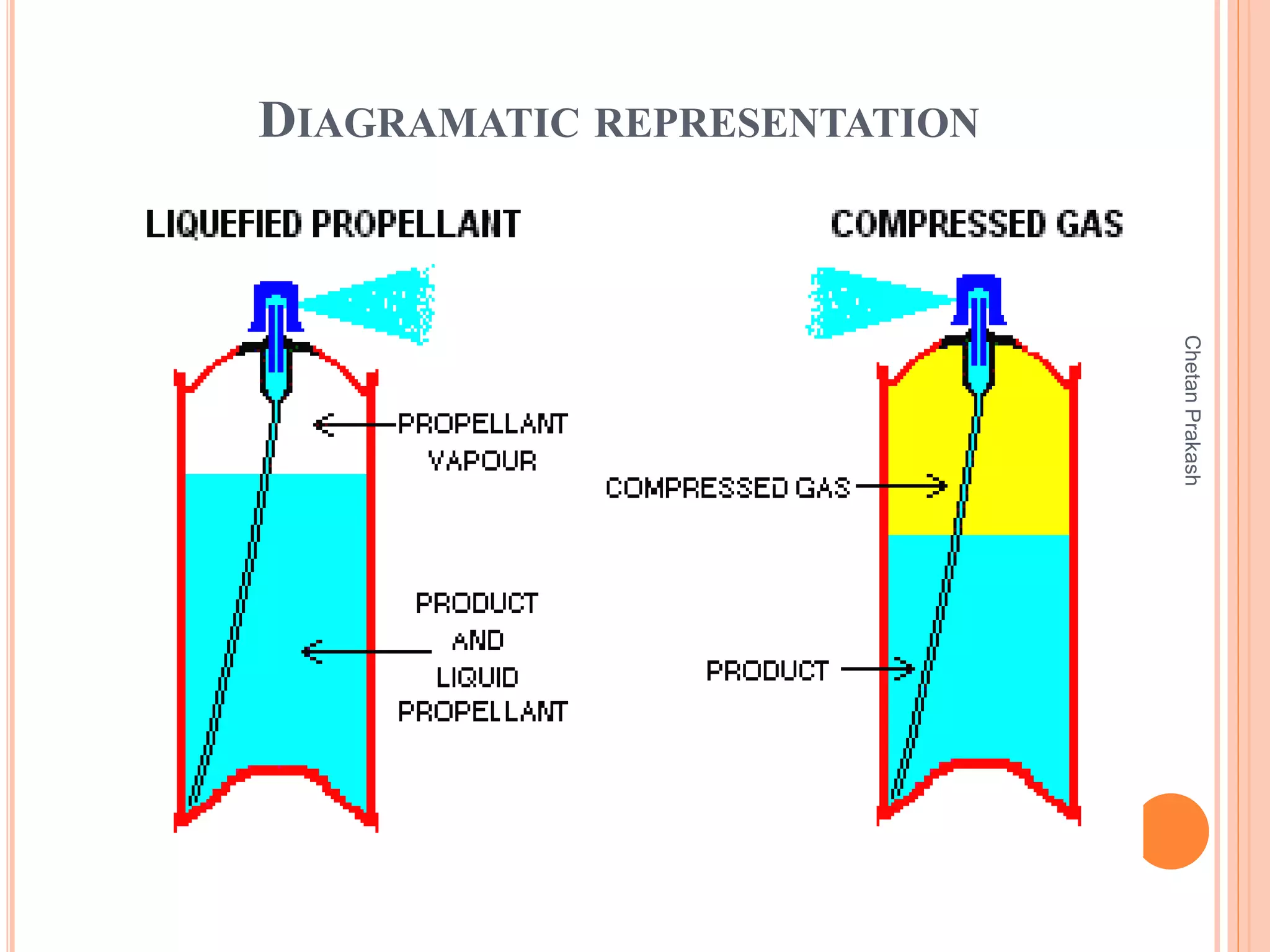
 The compressed gas propellant is present in the
headspace of the aerosol container which forces the
product concentrate to emit contents out of the container.
 For this higher gas pressure is required in this aerosol.
 Examples : Nitrogen, Nitrogen dioxide and Carbon
dioxide.
ChetanPrakash
DIAGRAMATIC REPRESENTATION
ChetanPrakash
CONTAINER
 Aerosols container must withstand pressure as high as
140 to 180 psig (pounds per sq. Inch gauge) at 130 ̊F.
 Container may be made of following:
 1) Metals
*Tin plated steel
*Aluminum
*Stainless steel
 2) Glass
*Uncoated glass
*Plastic coated glass
ChetanPrakash
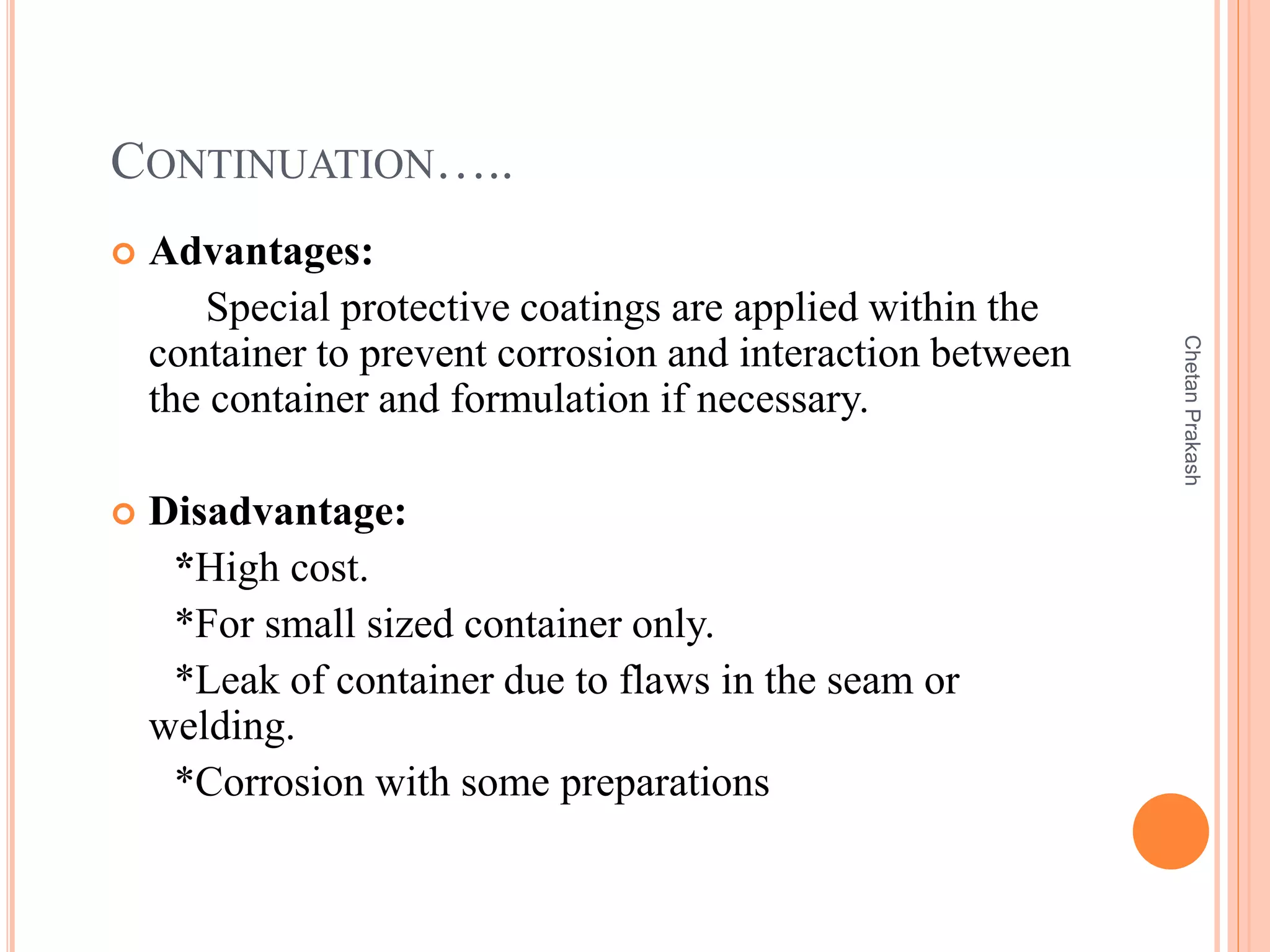
METALS
 1) Tin-plated steel
It is used for most aerosols as it is light,
inexpensive and durable.
It is steel that has been plated on both sides
with tin.
ChetanPrakash
CONTINUATION…..
 Advantages:
Special protective coatings are applied within the
container to prevent corrosion and interaction between
the container and formulation if necessary.
 Disadvantage:
*High cost.
*For small sized container only.
*Leak of container due to flaws in the seam or
welding.
*Corrosion with some preparations
ChetanPrakash
CONTINUATION…..
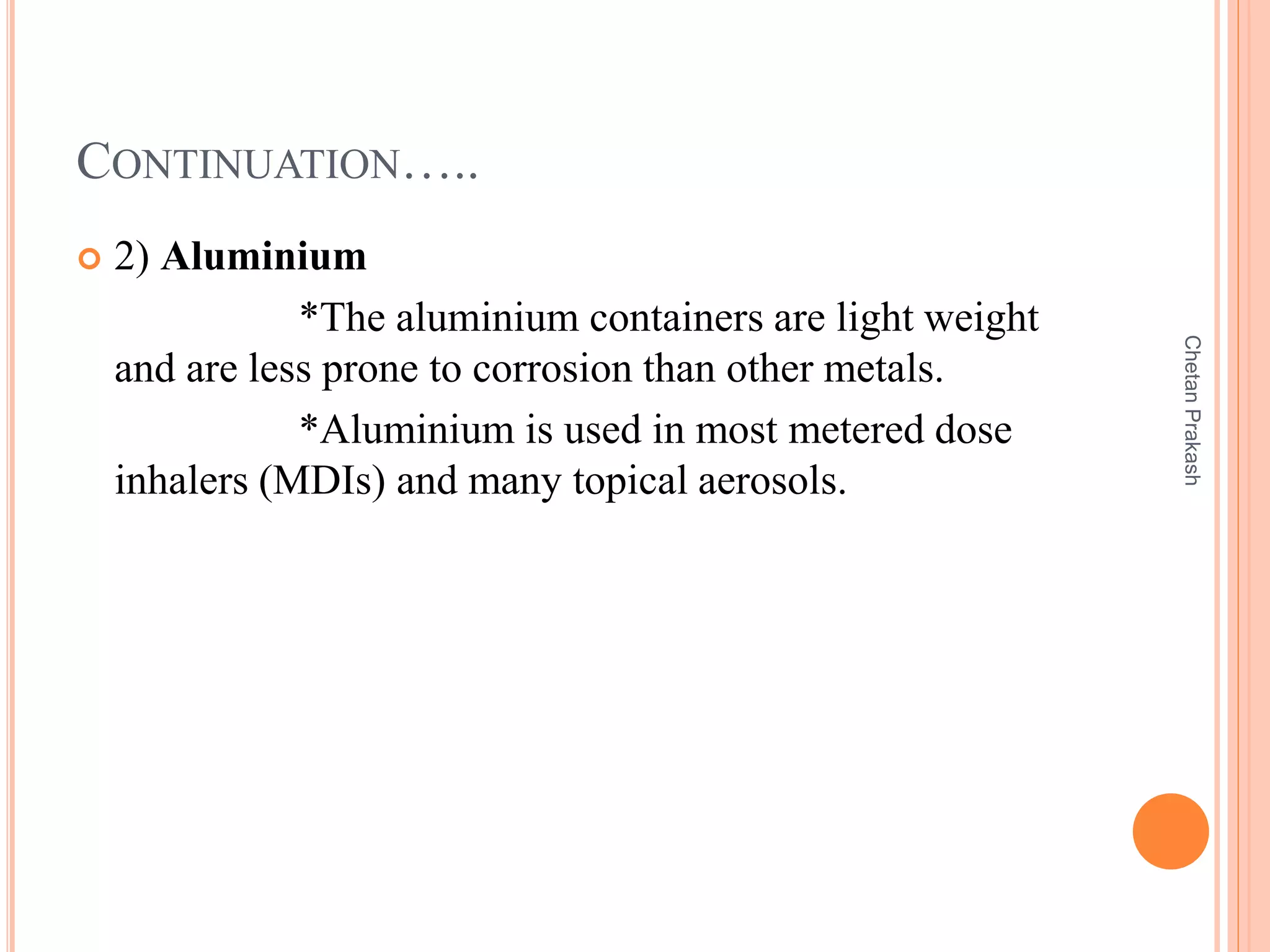
 2) Aluminium
*The aluminium containers are light weight
and are less prone to corrosion than other metals.
*Aluminium is used in most metered dose
inhalers (MDIs) and many topical aerosols.
ChetanPrakash
CONTINUATION…..
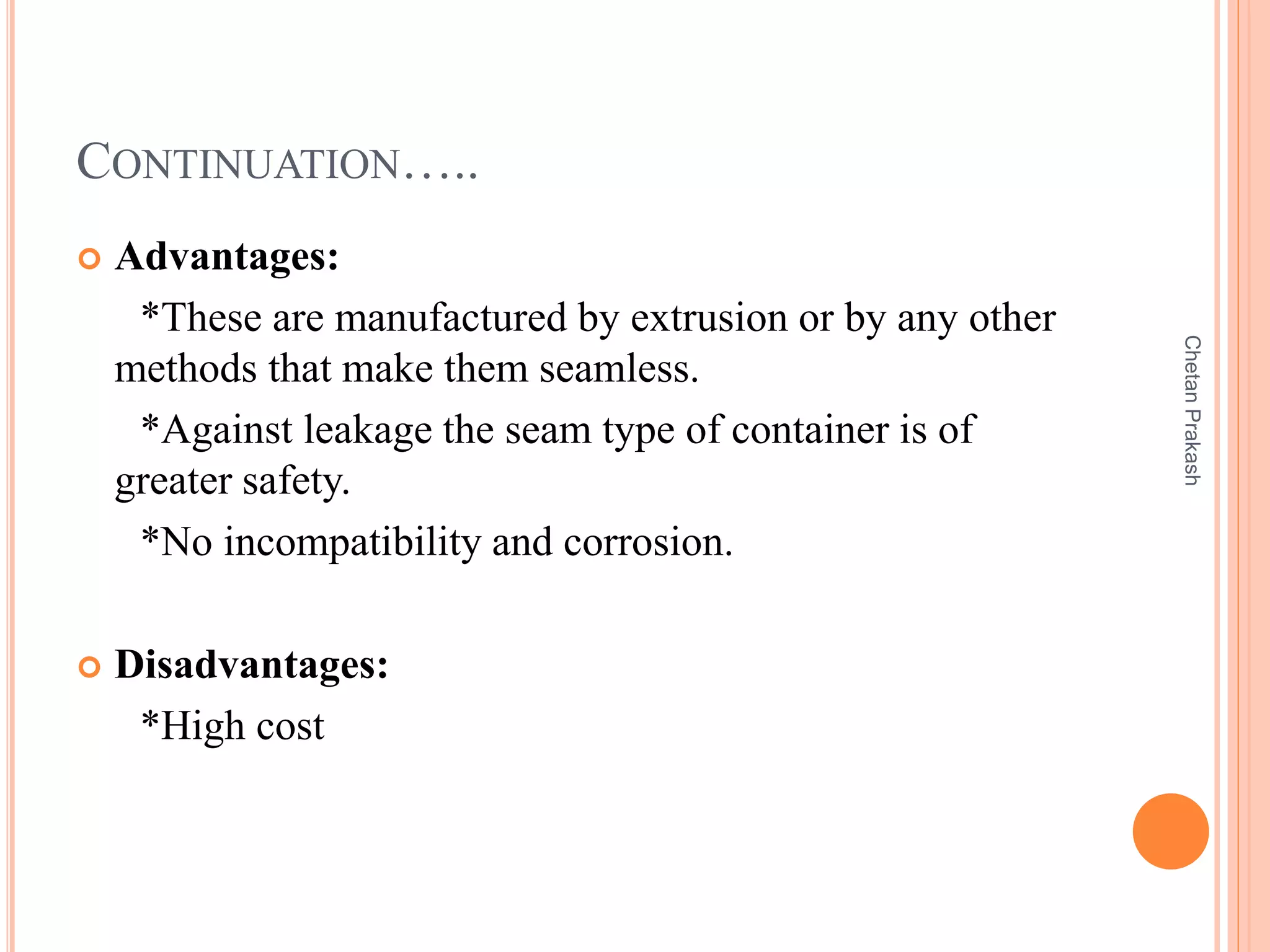
 Advantages:
*These are manufactured by extrusion or by any other
methods that make them seamless.
*Against leakage the seam type of container is of
greater safety.
*No incompatibility and corrosion.
 Disadvantages:
*High cost
ChetanPrakash
CONTINUATION…..
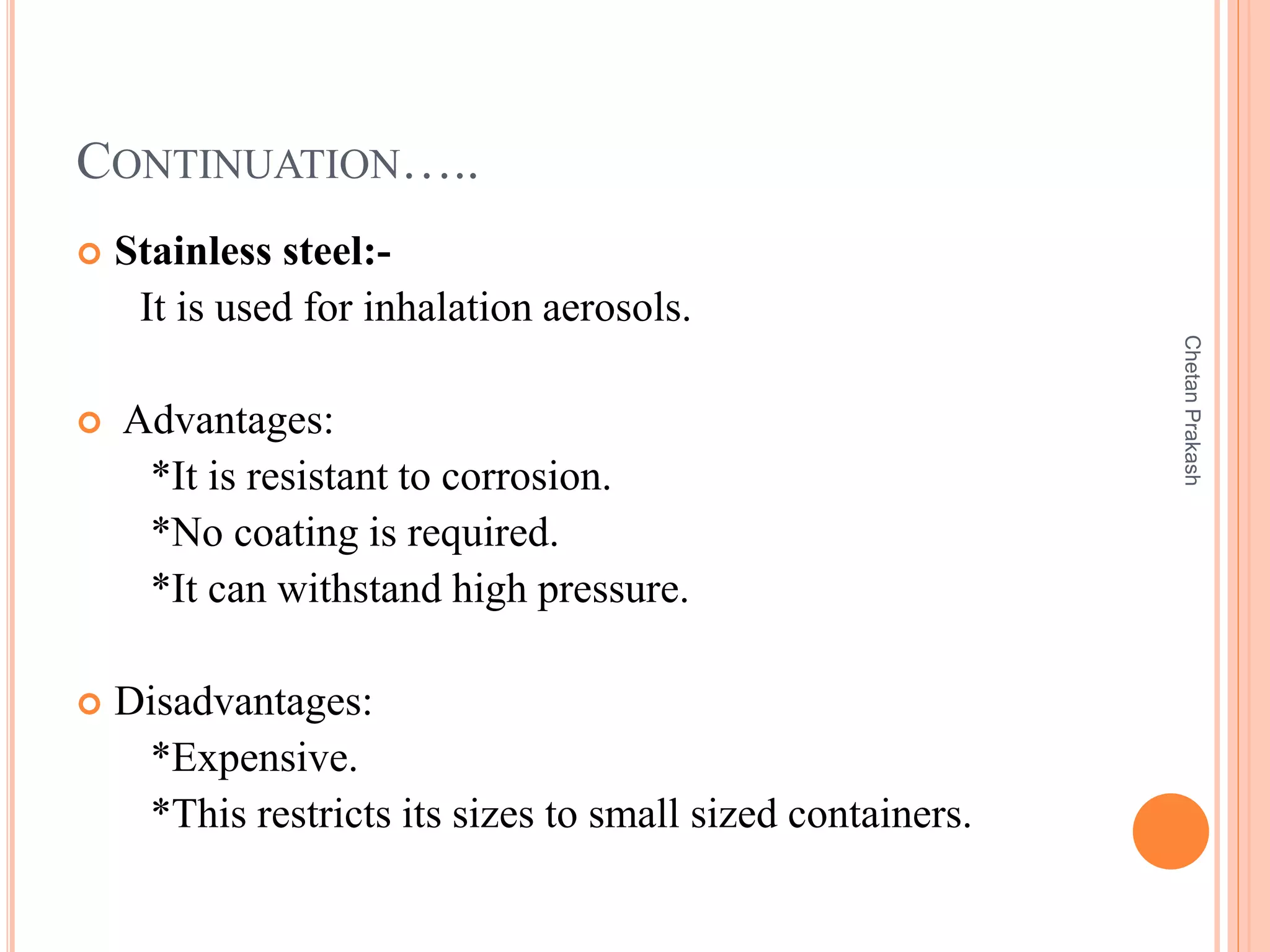
 Stainless steel:-
It is used for inhalation aerosols.
 Advantages:
*It is resistant to corrosion.
*No coating is required.
*It can withstand high pressure.
 Disadvantages:
*Expensive.
*This restricts its sizes to small sized containers.
ChetanPrakash
CONTINUATION…..
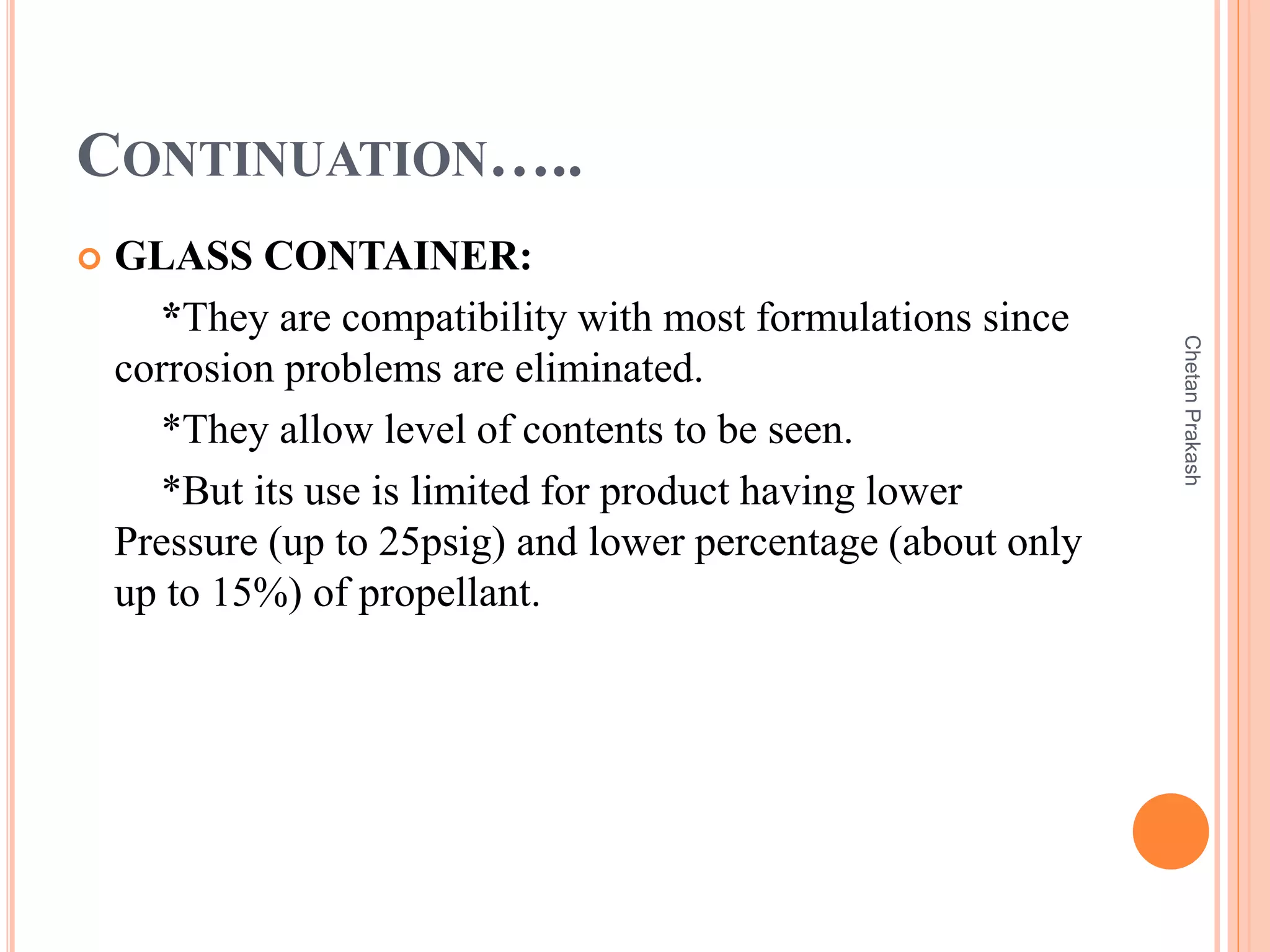
 GLASS CONTAINER:
*They are compatibility with most formulations since
corrosion problems are eliminated.
*They allow level of contents to be seen.
*But its use is limited for product having lower
Pressure (up to 25psig) and lower percentage (about only
up to 15%) of propellant.
ChetanPrakash
CONTINUATION…..
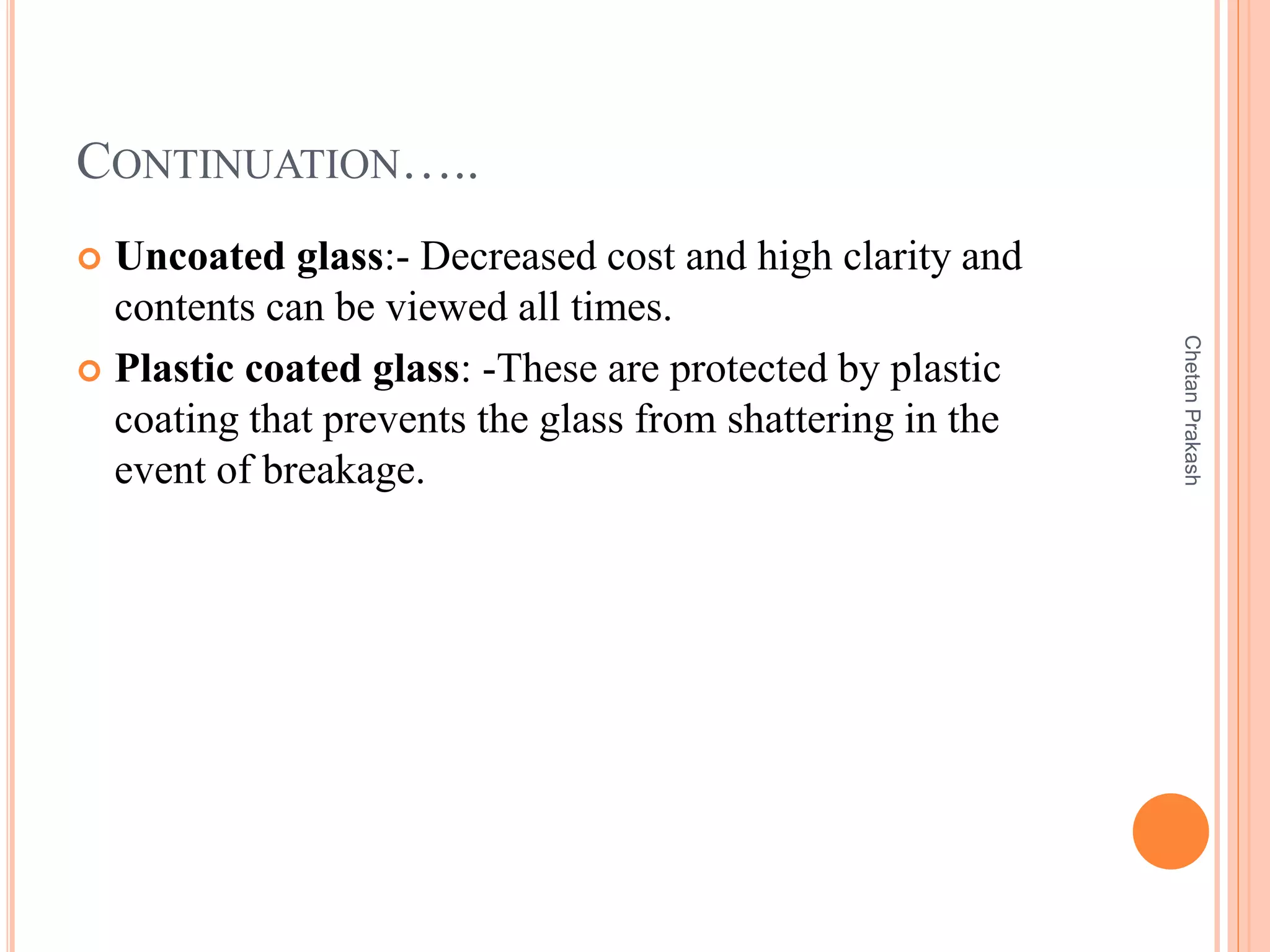
 Uncoated glass:- Decreased cost and high clarity and
contents can be viewed all times.
 Plastic coated glass: -These are protected by plastic
coating that prevents the glass from shattering in the
event of breakage.
ChetanPrakash
CONTINUATION…..
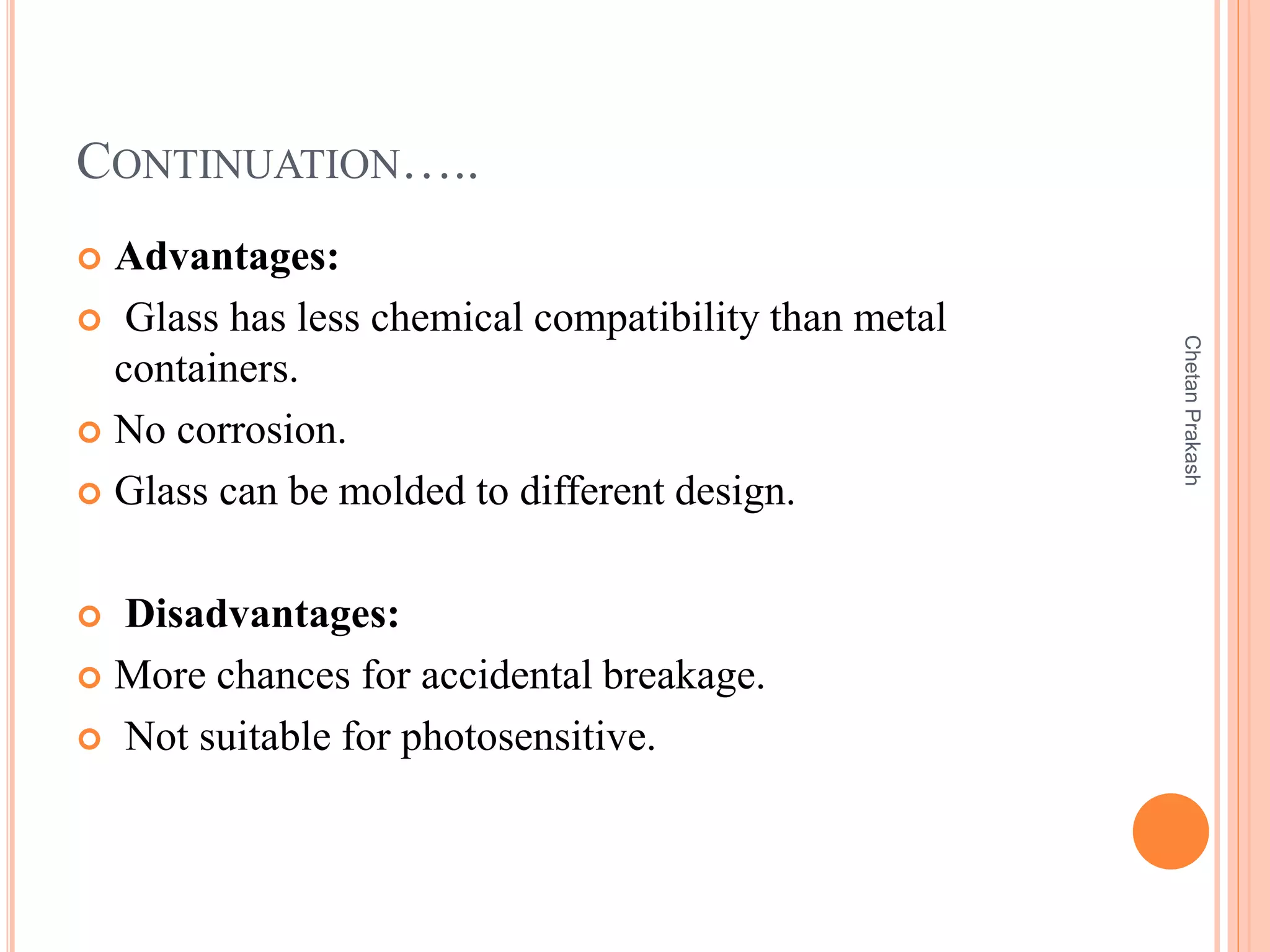
 Advantages:
 Glass has less chemical compatibility than metal
containers.
 No corrosion.
 Glass can be molded to different design.
 Disadvantages:
 More chances for accidental breakage.
 Not suitable for photosensitive.
ChetanPrakash
VALVES
 It is the vital component of an aerosol package.
 It helps to deliver the drug in desired form and
determines the performance of pressurized packages.
 Major functions of valves are,
 To regulate the flow of product from the container
 To provide a means of discharging desired amount when
needed and prevent loss at other times.
 To exert a major effect on the characteristics of
dispensed product.
ChetanPrakash
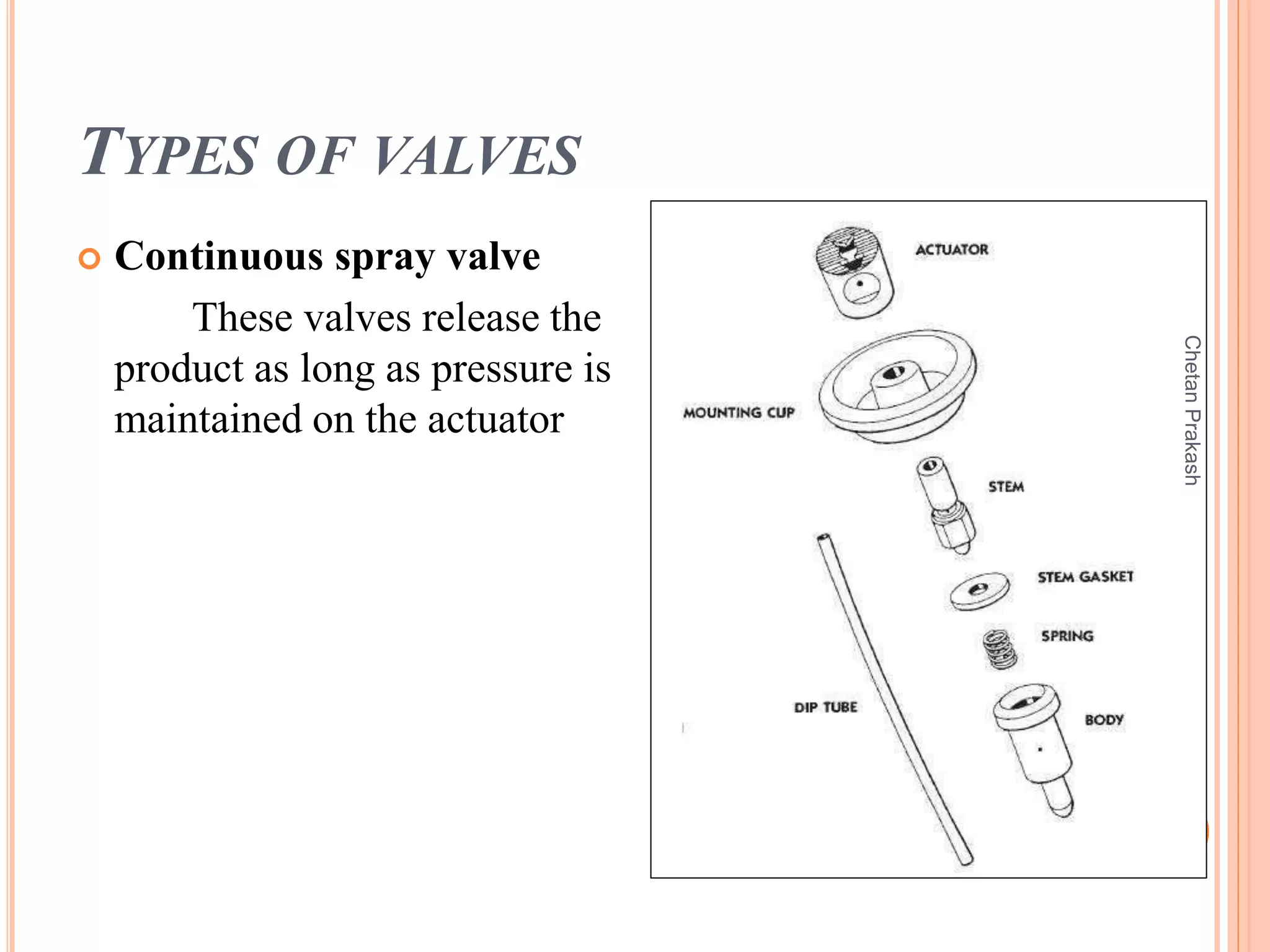
TYPES OF VALVES
 Continuous spray valve
These valves release the
product as long as pressure is
maintained on the actuator
ChetanPrakash
 Metering valves
*A finite volume (25-150µml for inhalation aerosols,
up to 5ml for topical aerosols) of product is released
when the actuator is pressed.
*No more products is released unless the actuator is
returned to its rest position and repressed.
*It is used for dispensing of potent medication
ChetanPrakash
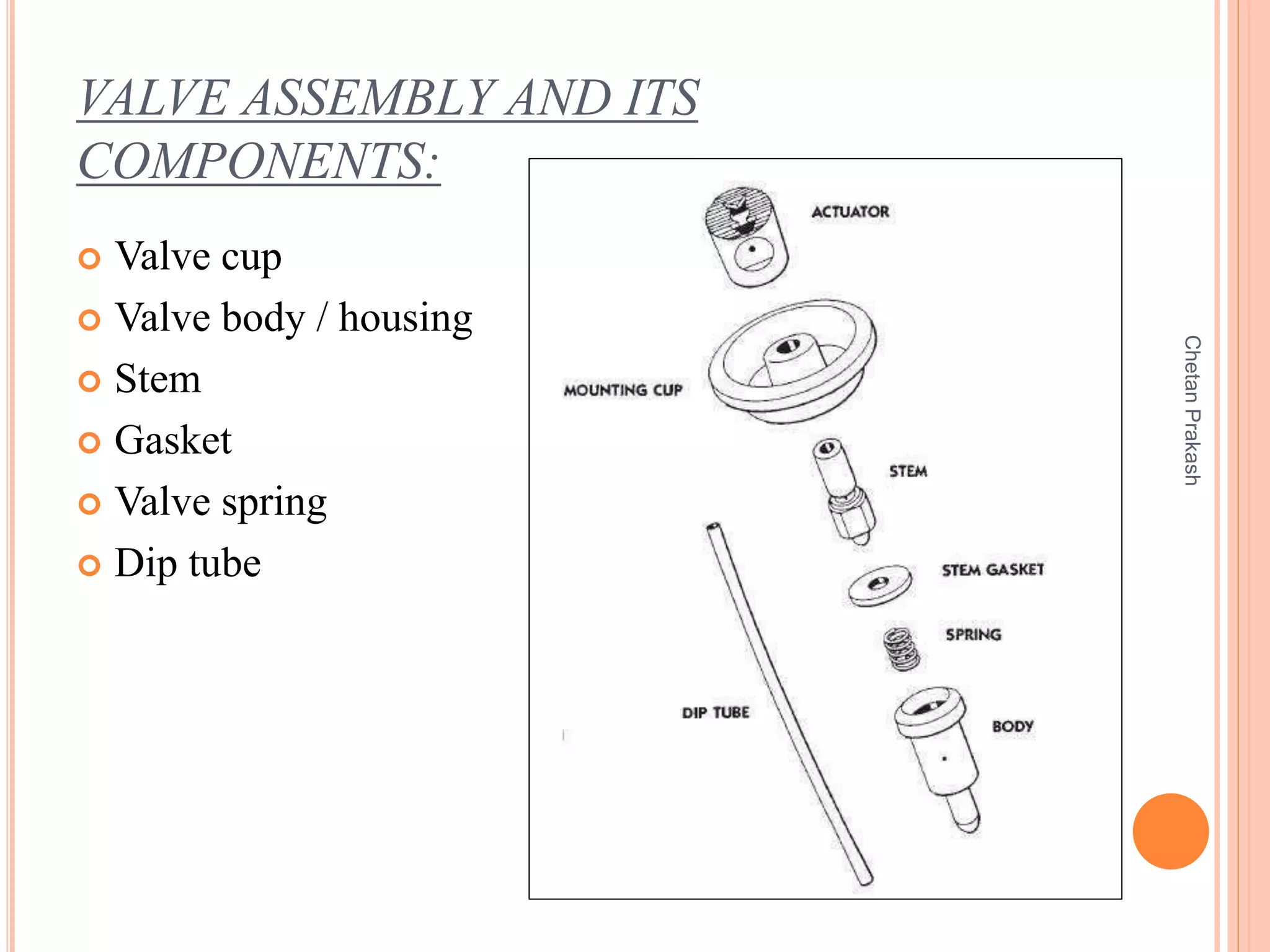
VALVE ASSEMBLY AND ITS
COMPONENTS:
 Valve cup
 Valve body / housing
 Stem
 Gasket
 Valve spring
 Dip tube
ChetanPrakash
ABOUT VALVE ASSEMBLY
 VALVE CUP (MOUNTING CUP/ FERRULE):-
The Mounting cup or Ferrule is generally
made up of aluminum which serves to place the valve
in its position and then attached to the aerosol
container.
 VALVE BODY / HOUSING:-
The Housing or Valve body located directly
below the Mounting cup or Ferrule is made up of
Nylon or Delrin work, which uses to connect dip tube,
stem and actuator of aerosol container.
ChetanPrakash
CONTINUATION……
 STEM: -The actuator is supported by the stem and the
formulation is delivered in the proper form to the
chamber of the actuator by the stem.
 GASKET: -The stem and valve are placed tightly in
their place by the gasket and the leakage of the
formulation is prevented by gasket.
ChetanPrakash
CONTINUATION…..
 VALVE SPRING: - The gasket of aerosol container is
held in its place by the spring and also helps to keep the
valve in closed position when the pressure is released
upon actuation of the formulation. Stainless steel can be
used with most aerosols.
 DIP TUBE: -The dip tube is made up of polyethylene or
polypropylene extends from the housing body or valve
body down into the product concentrate works to bring
the formulation from the container to the valve.
ChetanPrakash
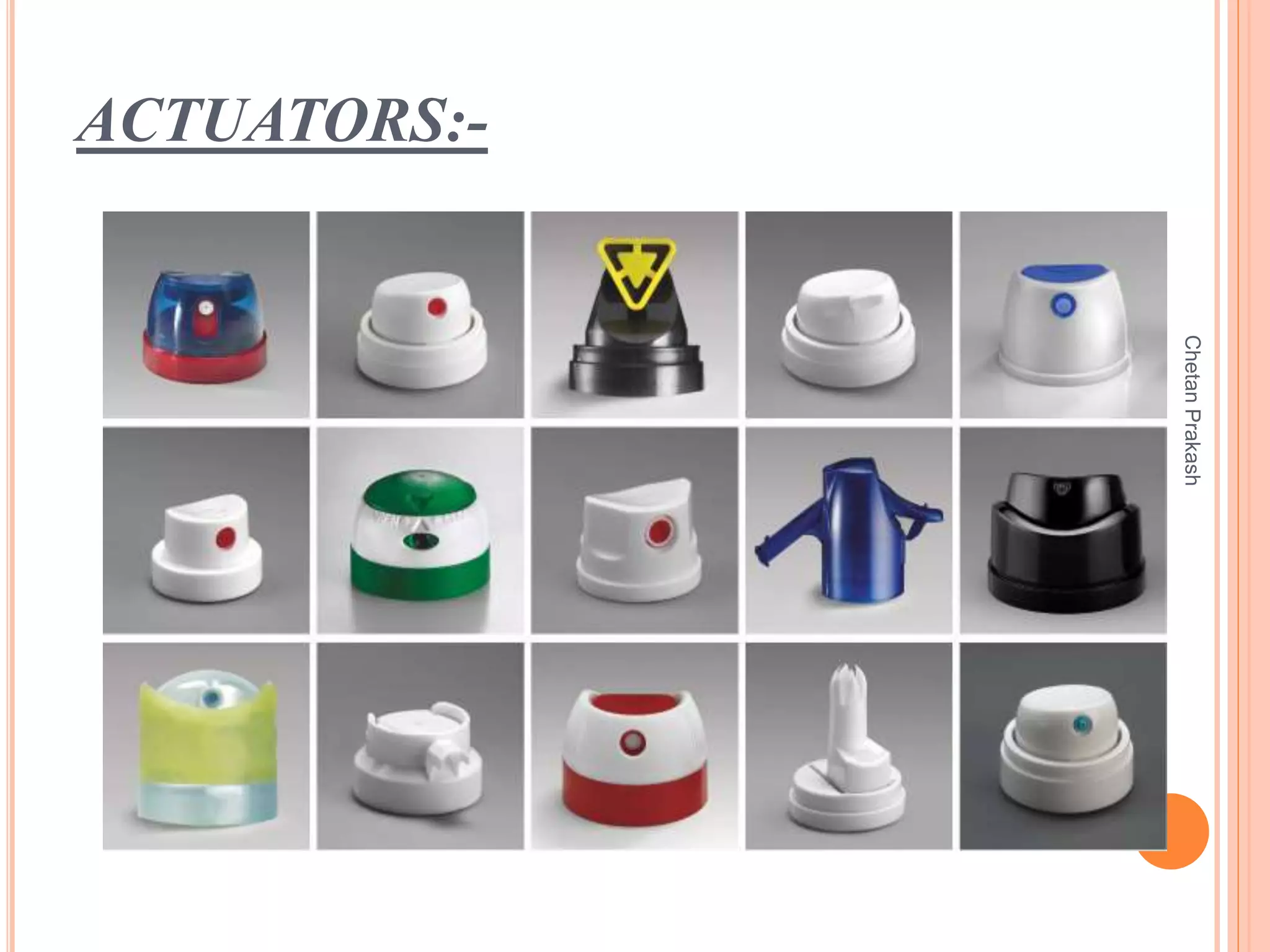
ACTUATOR:
 It ensures that aerosol product is delivered in the proper
and desired form.
 It allows easy opening and closing the valve.
 It is the fitting attached to an aerosol valve stem, which
when depressed or moved, open the valve,
ChetanPrakash
ACTUATORS:-
ChetanPrakash
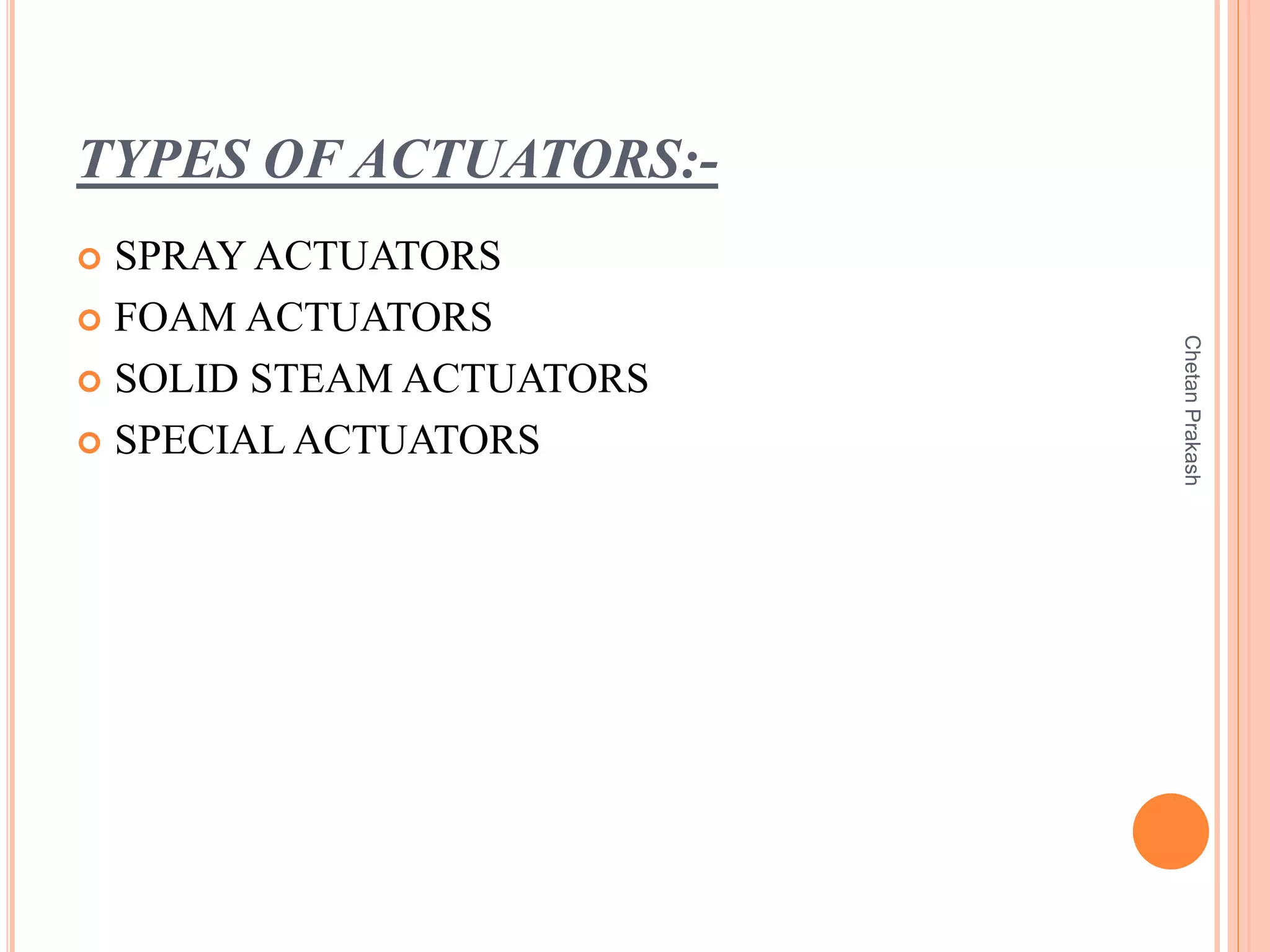
TYPES OF ACTUATORS:-
 SPRAY ACTUATORS
 FOAM ACTUATORS
 SOLID STEAM ACTUATORS
 SPECIAL ACTUATORS
ChetanPrakash
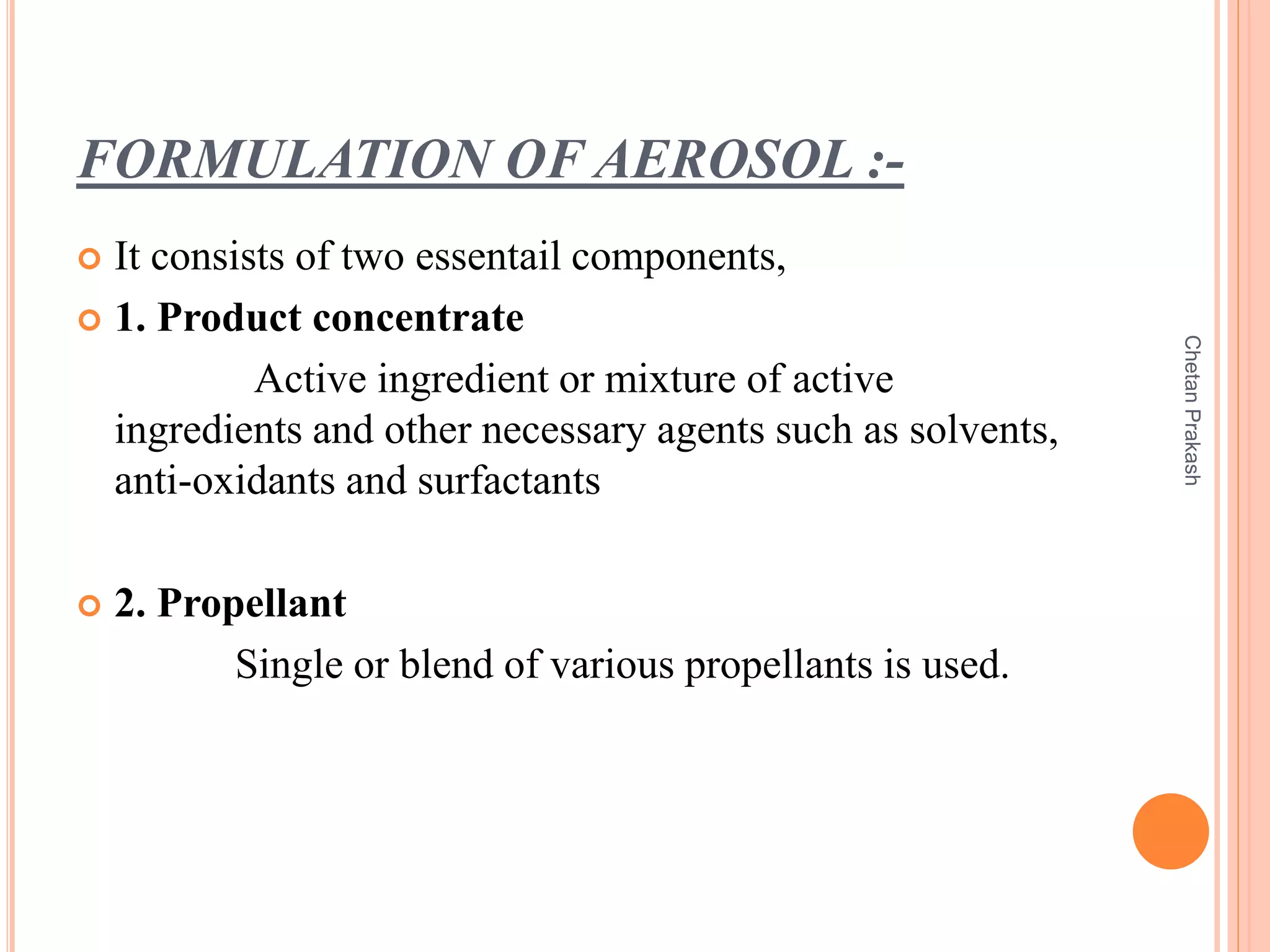
FORMULATION OF AEROSOL :-
 It consists of two essentail components,
 1. Product concentrate
Active ingredient or mixture of active
ingredients and other necessary agents such as solvents,
anti-oxidants and surfactants
 2. Propellant
Single or blend of various propellants is used.
ChetanPrakash
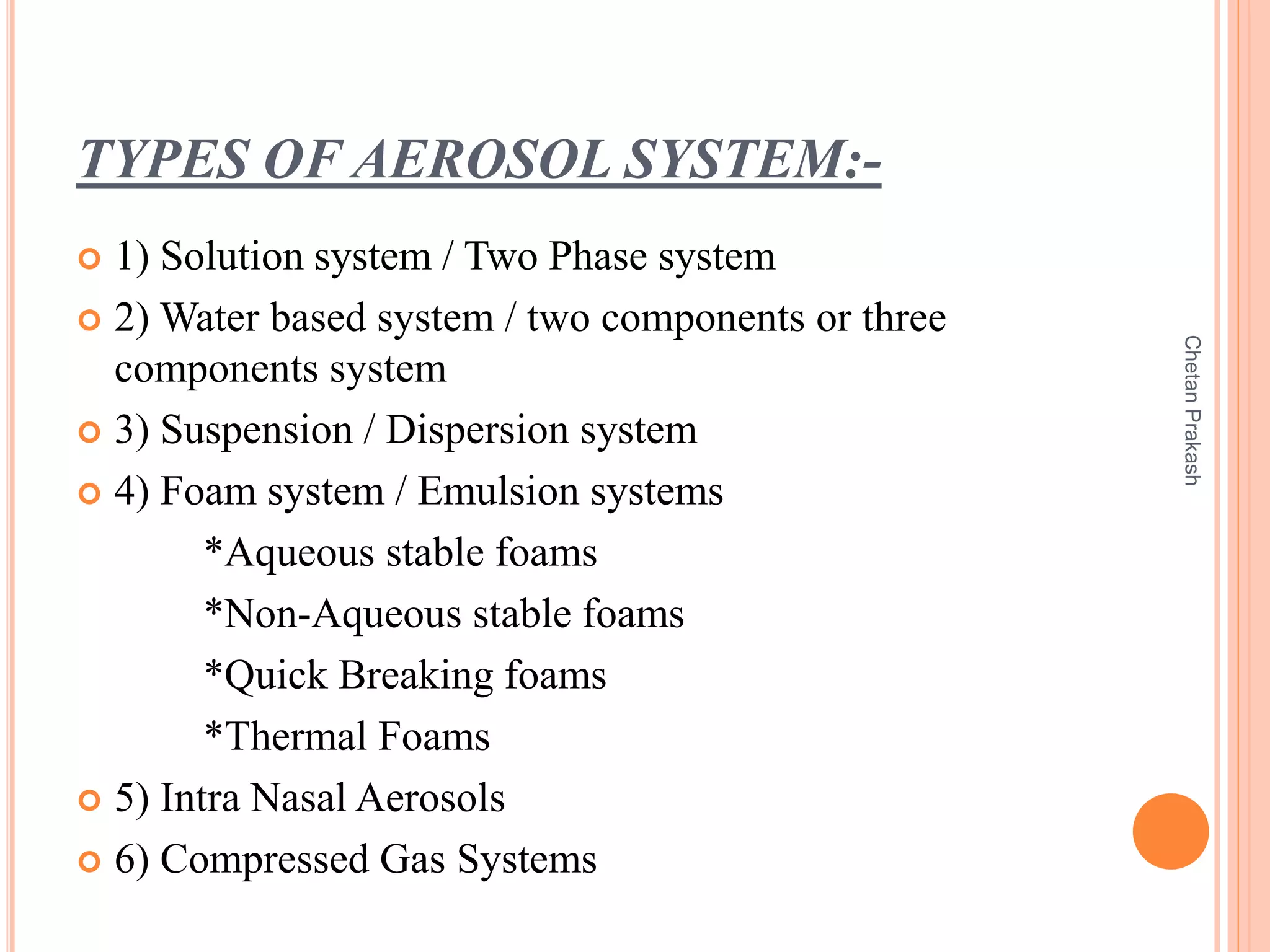
TYPES OF AEROSOL SYSTEM:-
 1) Solution system / Two Phase system
 2) Water based system / two components or three
components system
 3) Suspension / Dispersion system
 4) Foam system / Emulsion systems
*Aqueous stable foams
*Non-Aqueous stable foams
*Quick Breaking foams
*Thermal Foams
 5) Intra Nasal Aerosols
 6) Compressed Gas Systems
ChetanPrakash
 SOLUTION SYSTEM / TWO PHASE SYSTEM: -
*This system is also referred to as two- phase
system and consists of a vapor and liquid phase. When
the active ingredients are soluble in propellant, no other
solvent is required.
 WATER- BASED SYSTEM/ TWO COMPONENTS
AND THREE COMPONENTS SYSTEM:-
*Large amount of water can be used to
replace all or part of the non aqueous solvents used in
aerosols.
*This type of system employed when the
product is immiscible with the propellant.
ChetanPrakash
 SUSPENSION OR DISPERSION SYSTEMS:-
*The active ingredients are suspended or
dispersed throughout the propellant and solvent phase.
*This system is useful with antibiotics,
steroids and other poorly soluble compounds.
*To decrease the rates of settling of the
dispersed particles surfactants or suspending agent have
been used.
 FOAM SYSTEM/ EMULAION SYSTEM:-
*Emulsion or foam aerosols consist of Active
ingredient + Aqueous or Non aqueous vehicle +
Surfactant + and propellant
ChetanPrakash
CONTINUATION…..
 INTRA NASAL AEROSOLS:-
Drug delivery system is intended for the
deposition of medication into the nasal pathways for
effectiveness to produce local or systemic effect.
ChetanPrakash
TYPES OF AEROSOLS SPRAY:
 There are 3 types of Aerosol Sprays:
 1. Space sprays
 2. Surface coating spray
 3. Foam spray
ChetanPrakash
CONTINUATION…..
 1) SPACE SPRAY:
 Its products are delivered in a fine mist •
 It contains 85% propellant and it is pressurized at 30-
40psi and 70 °F. Eg.Room sprays
 2) SURFACE COATING SPRAY:
 Aerosols intended for carrying active ingredients to
surface are termed as surface sprays or surface coating
spray.
 It contains 30 –70% propellant operates between 22–55
psig at 70˚F. E.g. Topical Aerosol
ChetanPrakash
 3) FOAM SPRAY:
Foam aerosols (emulsion) usually operate
between 35 and 55 psig at21°c and contains only 6-10%
propellant
ChetanPrakash
MANUFACTURING OF
PHARMACEUTICAL AEROSOLS
 The manufactured aerosols can be filled in to the
containers can be done by following methods and
apparatus used.
 a) COLD FILLING APPARATUS
 b) PRESSURE FIILING APPARATUS
 c) COMPRESSED GAS FILLING APPARATUS
ChetanPrakash
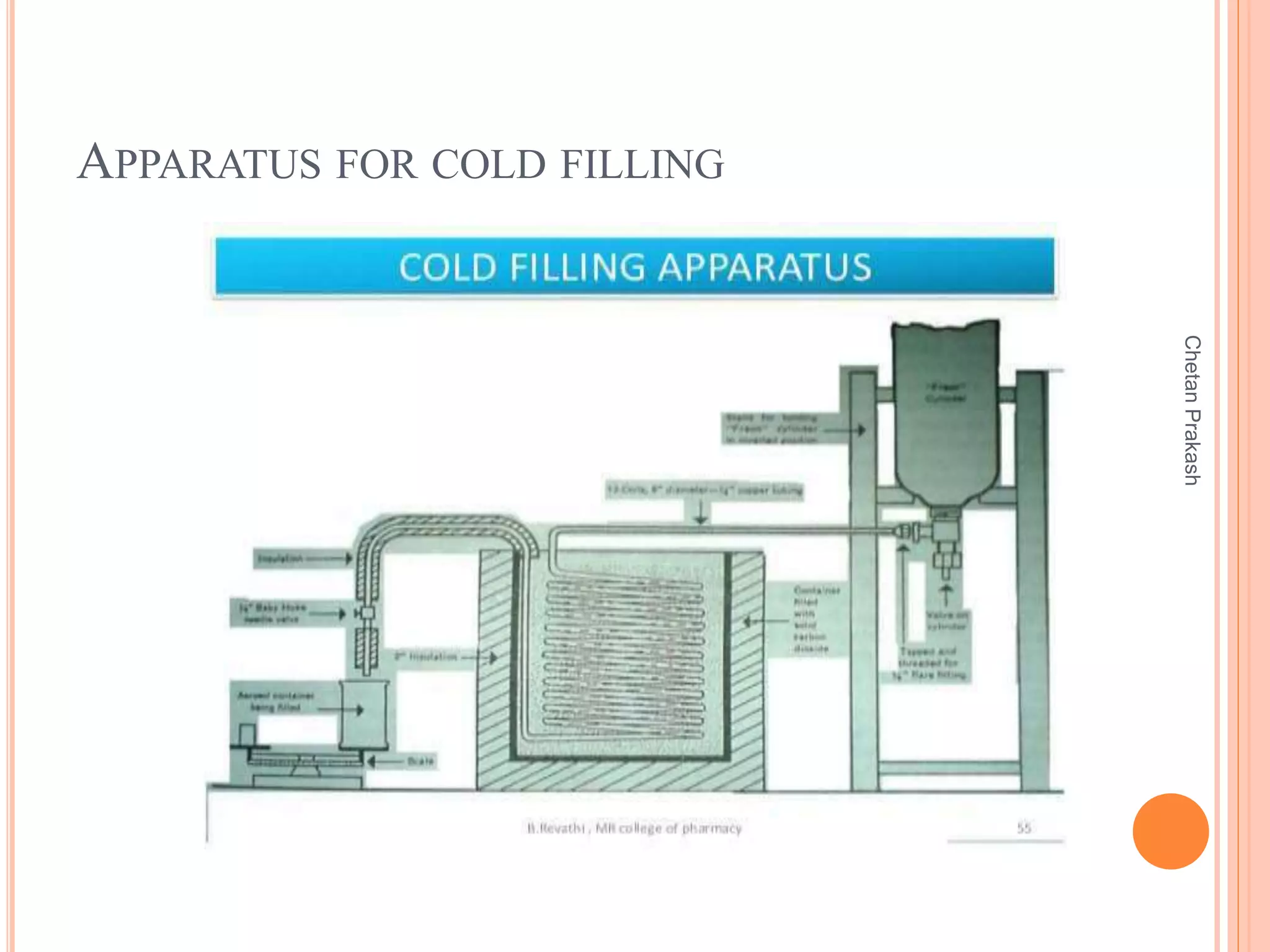
COLD FILLING APPARATUS
 Cold filling apparatus consists of an insulated box which
fitted with copper tubings and filled with dry ice or
acetone.
 The fitted copper tubings increase the surface area and
cause faster cooling.
 The hydrocarbon propellant is not to be stored in the
copper tubings as it might cause explosion.
ChetanPrakash
CONTINUATION…..
 Advantages:
Easy process.
 Disadvantages:
Aqueous products, emulsion and those products
adversely affected by cold temperature cannot be filled
by this method.
ChetanPrakash
APPARATUS FOR COLD FILLING
ChetanPrakash
PRESSURE FILLING APPARATUS
 Pressure filling apparatus consists of a metering burette
capable of measuring the amount of propellant to be
filled to the container.
 The mixture of propellant or propellants is added through
the inlet valve present to the bottom of the valve under
its own vapor pressure.
 A cylinder of nitrogen or compressed gas is attached to
the top of the valve and the pressure of nitrogen causes
the propellant to flow to the container through the
metering burette.
 The propellant flows to the container stops when the
pressure of the flowing propellant becomes equal to the
pressure of the container.
ChetanPrakash
CONTINUATION…..
 Advantages:
*Solutions, emulsions, suspensions can be filled by
this method as chilling does not occur. Contamination
due to moisture is less.
*High production speed can be achieved.
*Loss of propellant is less.
 Disadvantages:
*Certain types of metering valves can be handled only
by the cold filling process.
*Process is slower than cold filling method
ChetanPrakash
COMPRESSED GAS FILLING
APPARATUS:
 A compressed gas propellant is used. As the compressed
gas is under high pressure, so the pressure is reduced by
pressure reducing valve.
 A pressure of 150 pounds per square inch gauge is
required to fill the compressed gas propellant in the
aerosol container.
 The container is needed to be shaken during and after the
filling operation to enhance the solubility of the gas in
the product concentrate.
ChetanPrakash
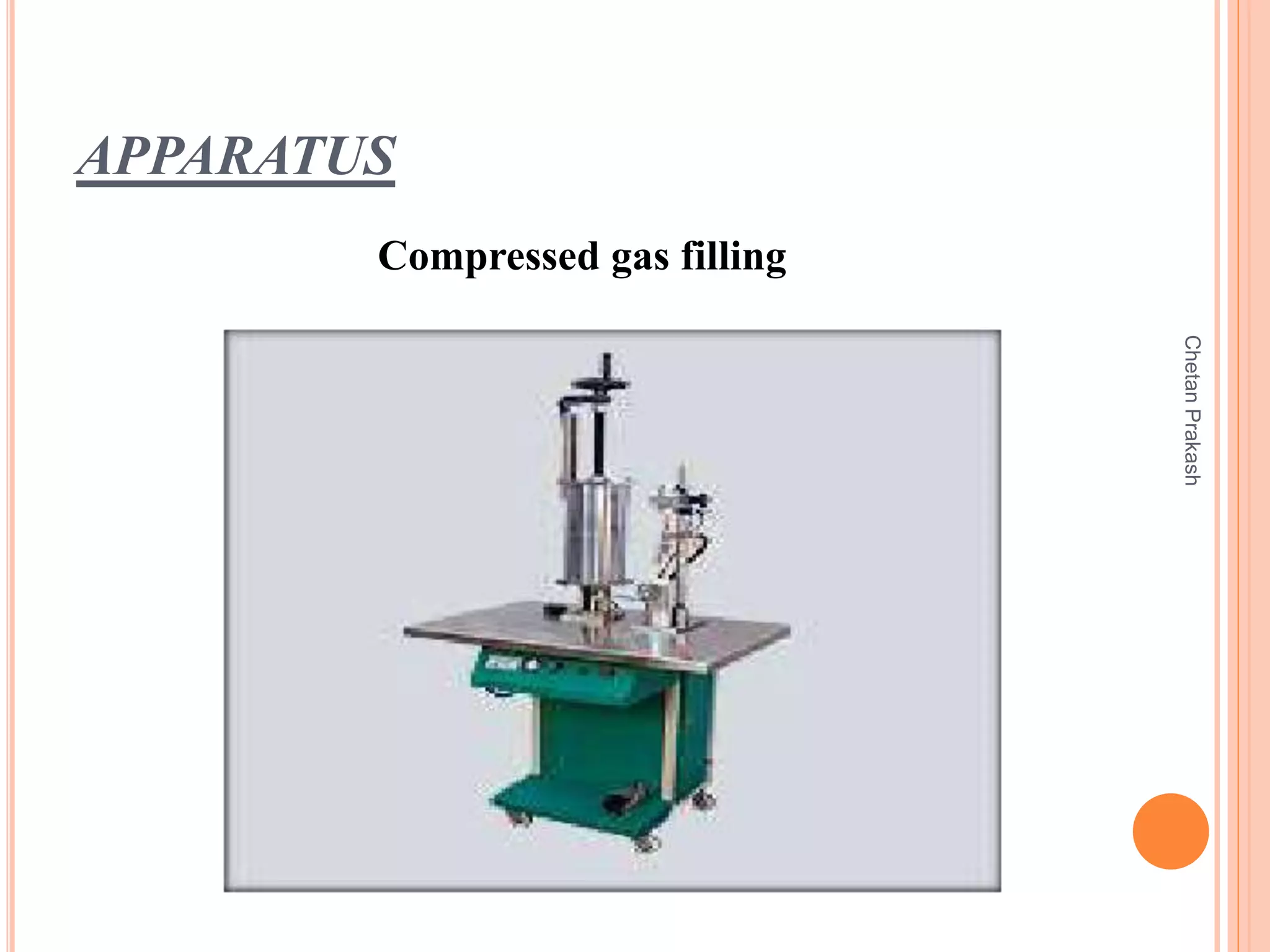
APPARATUS
Compressed gas filling
ChetanPrakash
EVALUATION OF AEROSOLS: -
 Pharmaceutical aerosols can be evaluated by a series of
physical, chemical and biological tests.
ChetanPrakash
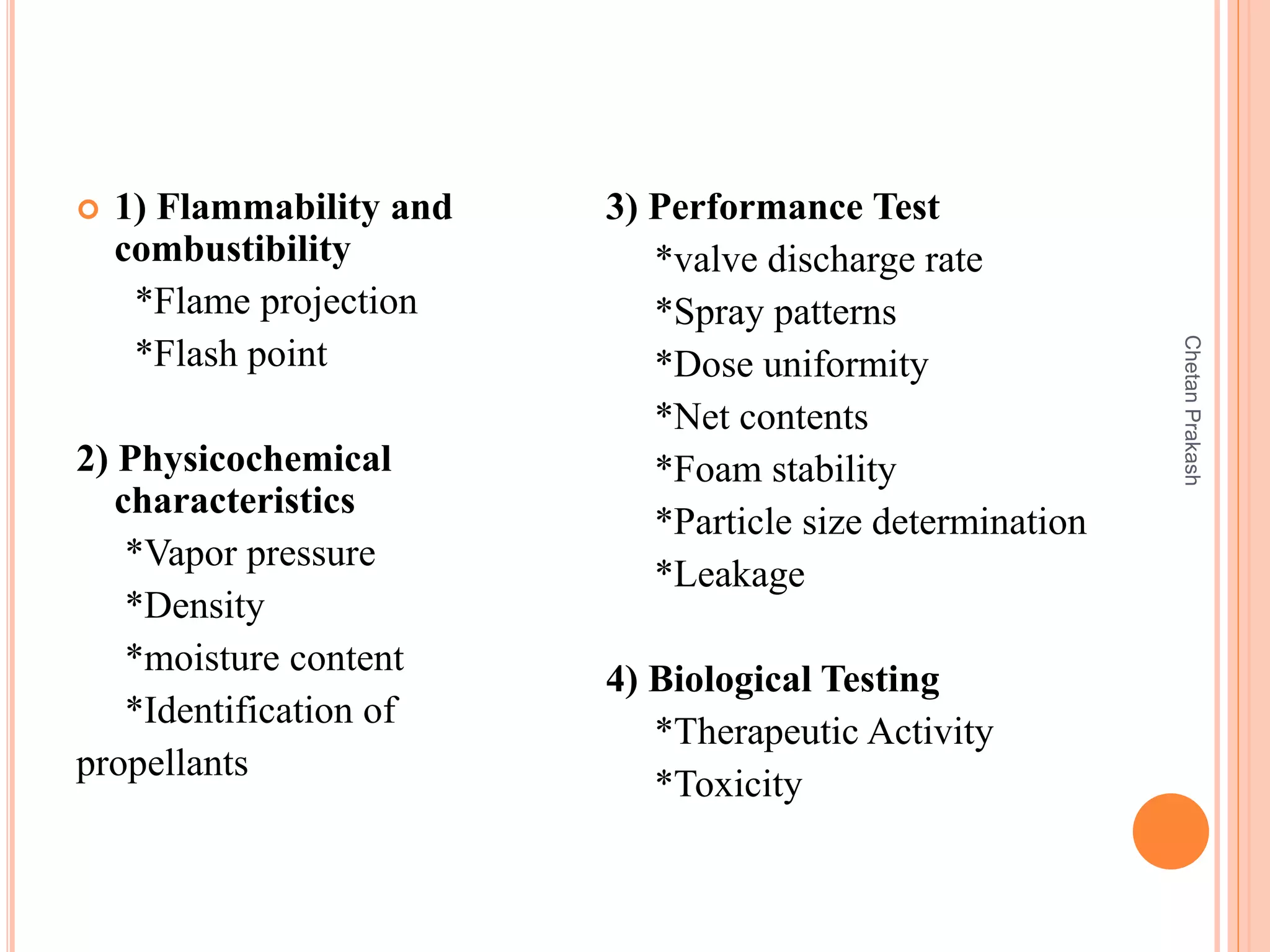
 1) Flammability and
combustibility
*Flame projection
*Flash point
2) Physicochemical
characteristics
*Vapor pressure
*Density
*moisture content
*Identification of
propellants
3) Performance Test
*valve discharge rate
*Spray patterns
*Dose uniformity
*Net contents
*Foam stability
*Particle size determination
*Leakage
4) Biological Testing
*Therapeutic Activity
*Toxicity
ChetanPrakash
FLAMMABILITY AND COMBUSTIBILITY
 FLAME PROJECTION:
 Flame test indicates the effect of an aerosol formulation
on the extension of an open flame.
 Aerosol product is sprayed for 4 sec into open flame.
 Depending on the nature and type of formulation, the
fame is extended to some length and exact length was
measured with ruler.
ChetanPrakash
CONTINUATION…..
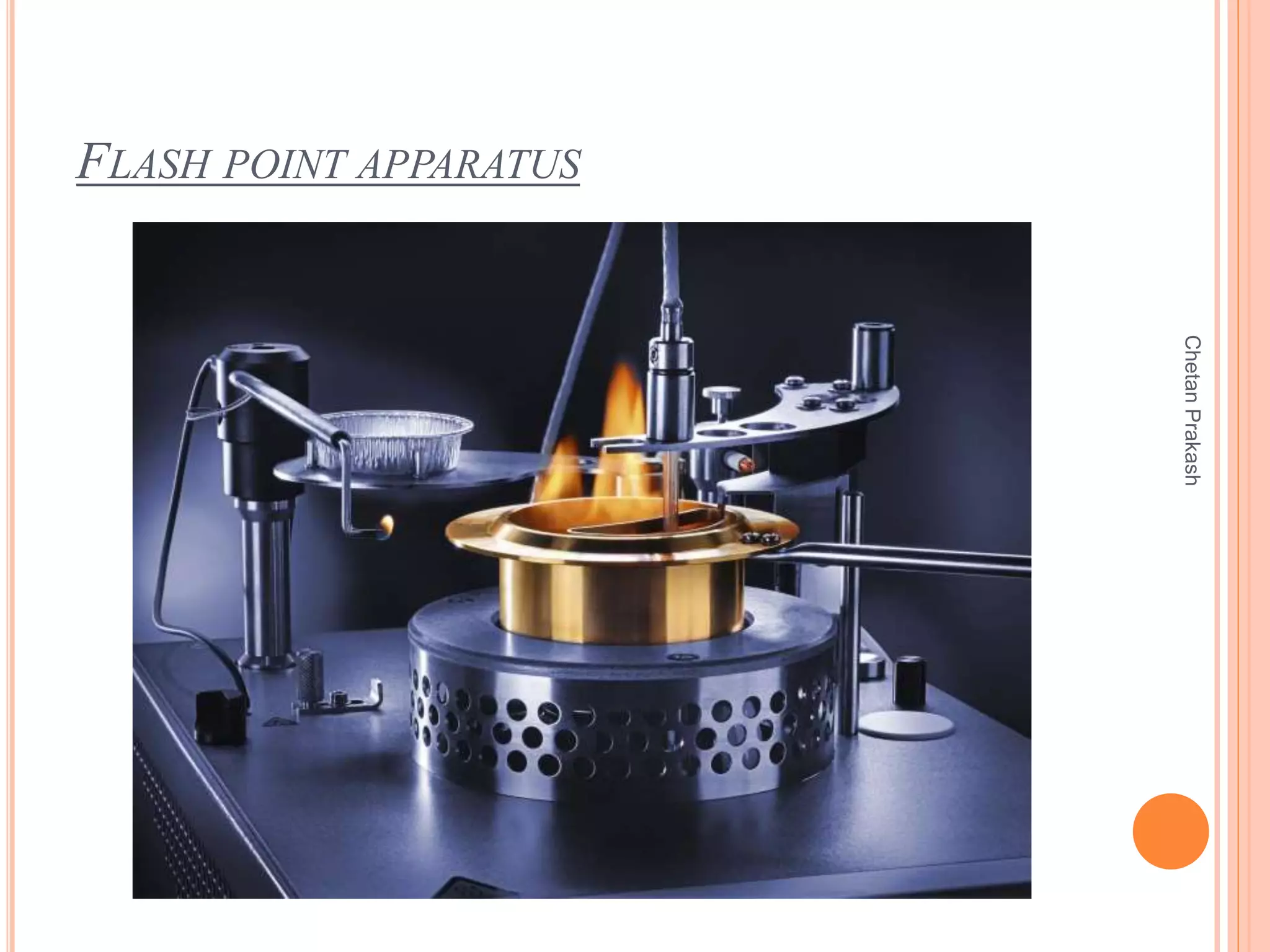
 FLASH POINT:
 It is mainly determined by the use of standard tag open
cap Apparatus.
 Aerosol product is chilled to a temperature of about -
25˚F and transferred to the test Apparatus.
 The test liquid is allowed to increase slowly in
temperature and the temperature at which the vapor
ignites is taken as the flash point.
ChetanPrakash
FLASH POINT APPARATUS
ChetanPrakash
PHYSICOCHEMICAL
CHARACTERSTICS:
 VAPOR PRESSURE:
 The pressure can be measured with a pressure gauge or
through the use of a water bath and test gauges.
 Excessive pressure variation from container to container
indicates the presence of air in the head space.
 A can puncturing device is available for accurately
measuring vapor pressure.
ChetanPrakash
CONTINUATION…..
 DENSITY:
 Hydrometer or pycnometer is mainly used to determine
the density of an aerosol system.
 A pressure tube is fitted with metal flanges and a hoke
valve, which for allows for the introduction of liquids
under pressure.
 The hydrometer is placed into the glass pressure tube.
 Sufficient sample is introduced the valve to cause the
hydrometer to rise halfway up the length of the tube and
the density can be read directly.
ChetanPrakash
CONTINUATION…..
 MOISTURE CONTENT:
 Presence of moisture can be determined by using
*Karl Fischer
*Gas Chromatography
ChetanPrakash
CONTINUATION…..
 IDENTIFICATION OF PROPELLANTS:
 Gas chromatography and IR Spectroscopy.
 These methods are used for the identification as well as
measurement for proportion of each component in blend.
ChetanPrakash
PERFORMANCE TEST
 VALVE DISCHARGE RATE:
 This is determined by taking an aerosol known weight
and discharging the contents for given time using
standard apparatus.
 By reweighing the container after time limit has expired,
the change in weight per time dispensed is the discharge
rate, which can then be expressed as grams per seconds.
ChetanPrakash
CONTINUATION…..
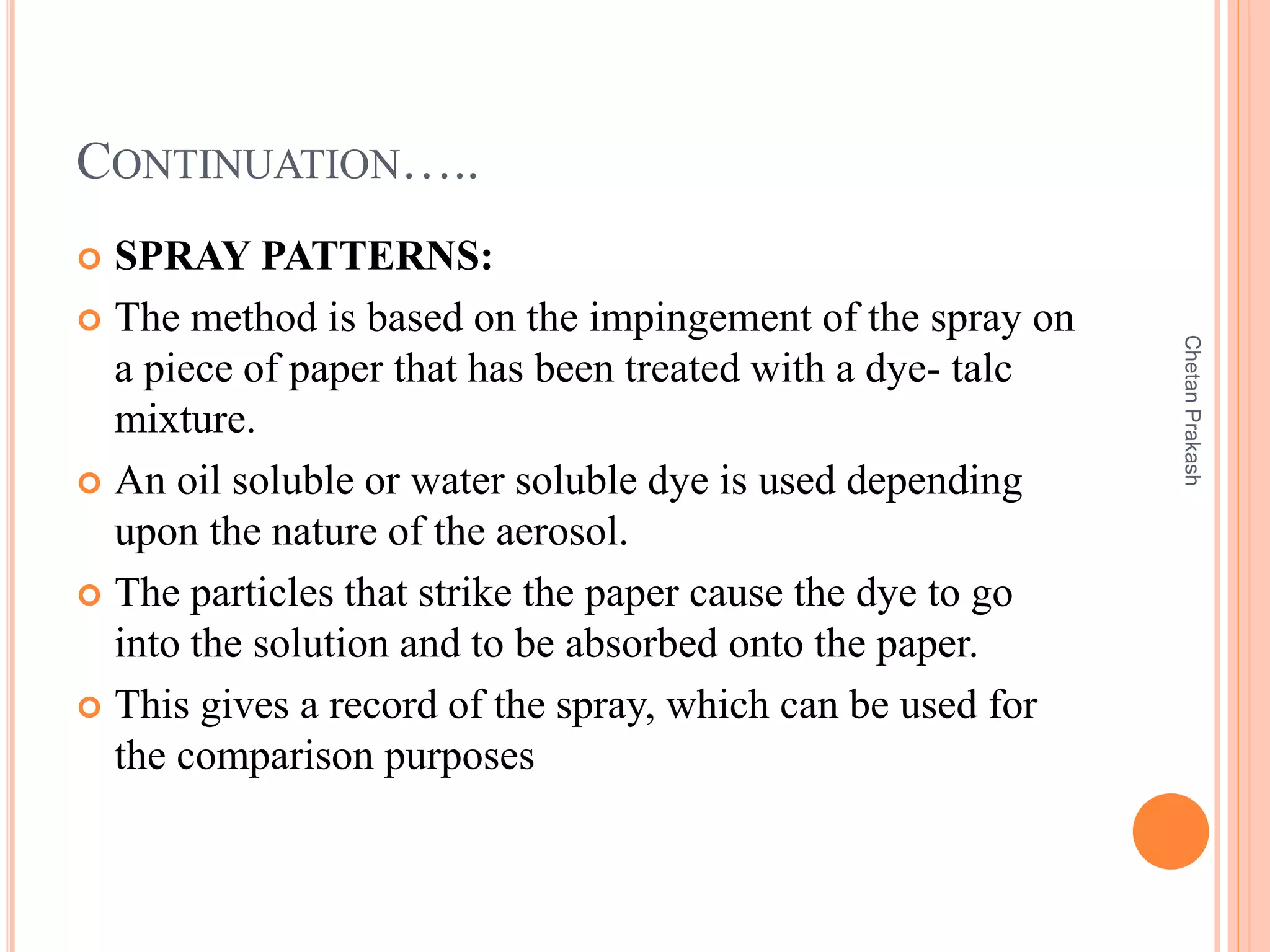
 SPRAY PATTERNS:
 The method is based on the impingement of the spray on
a piece of paper that has been treated with a dye- talc
mixture.
 An oil soluble or water soluble dye is used depending
upon the nature of the aerosol.
 The particles that strike the paper cause the dye to go
into the solution and to be absorbed onto the paper.
 This gives a record of the spray, which can be used for
the comparison purposes
ChetanPrakash
CONTINUATION…..
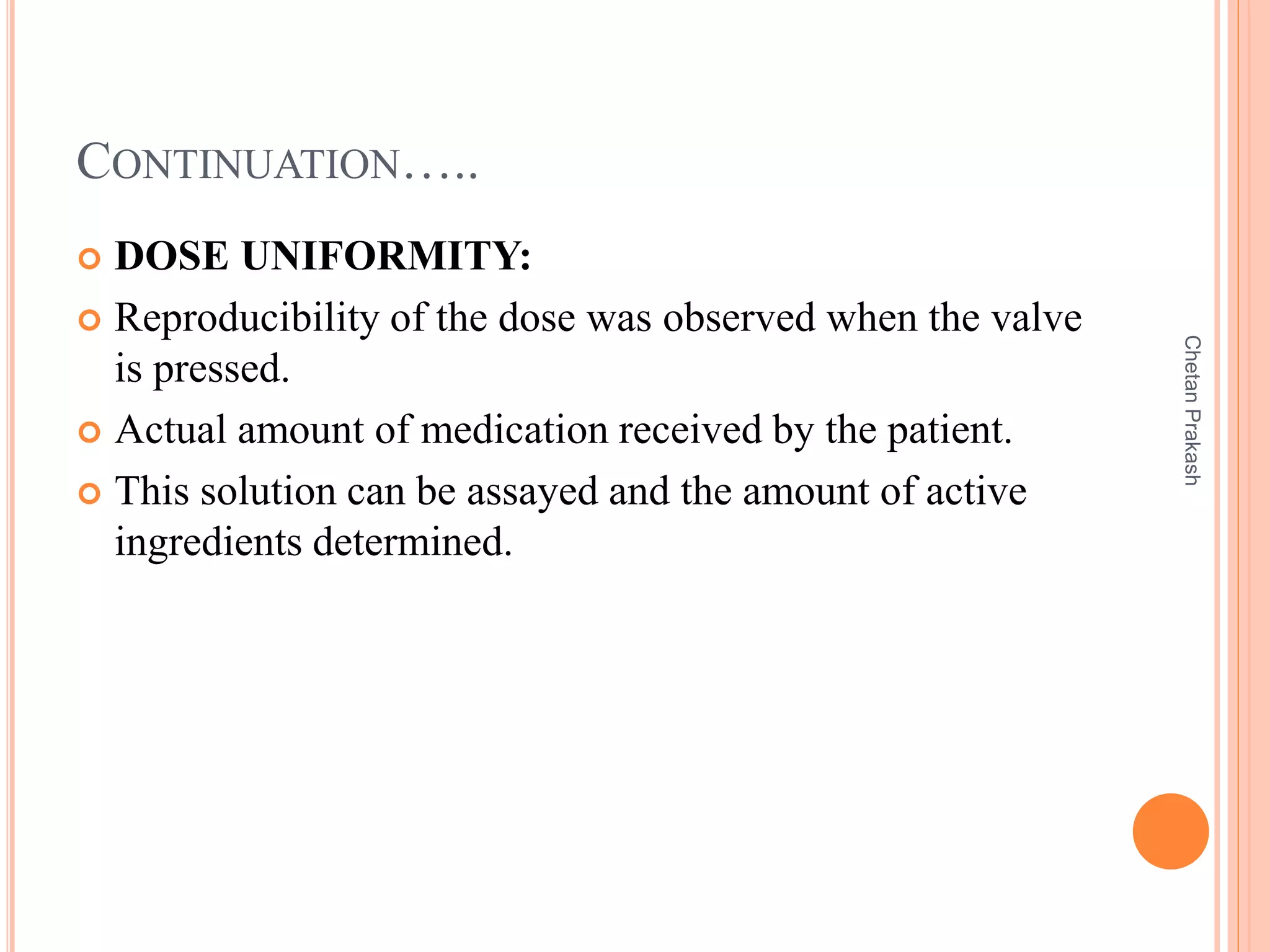
 DOSE UNIFORMITY:
 Reproducibility of the dose was observed when the valve
is pressed.
 Actual amount of medication received by the patient.
 This solution can be assayed and the amount of active
ingredients determined.
ChetanPrakash
CONTINUATION…..
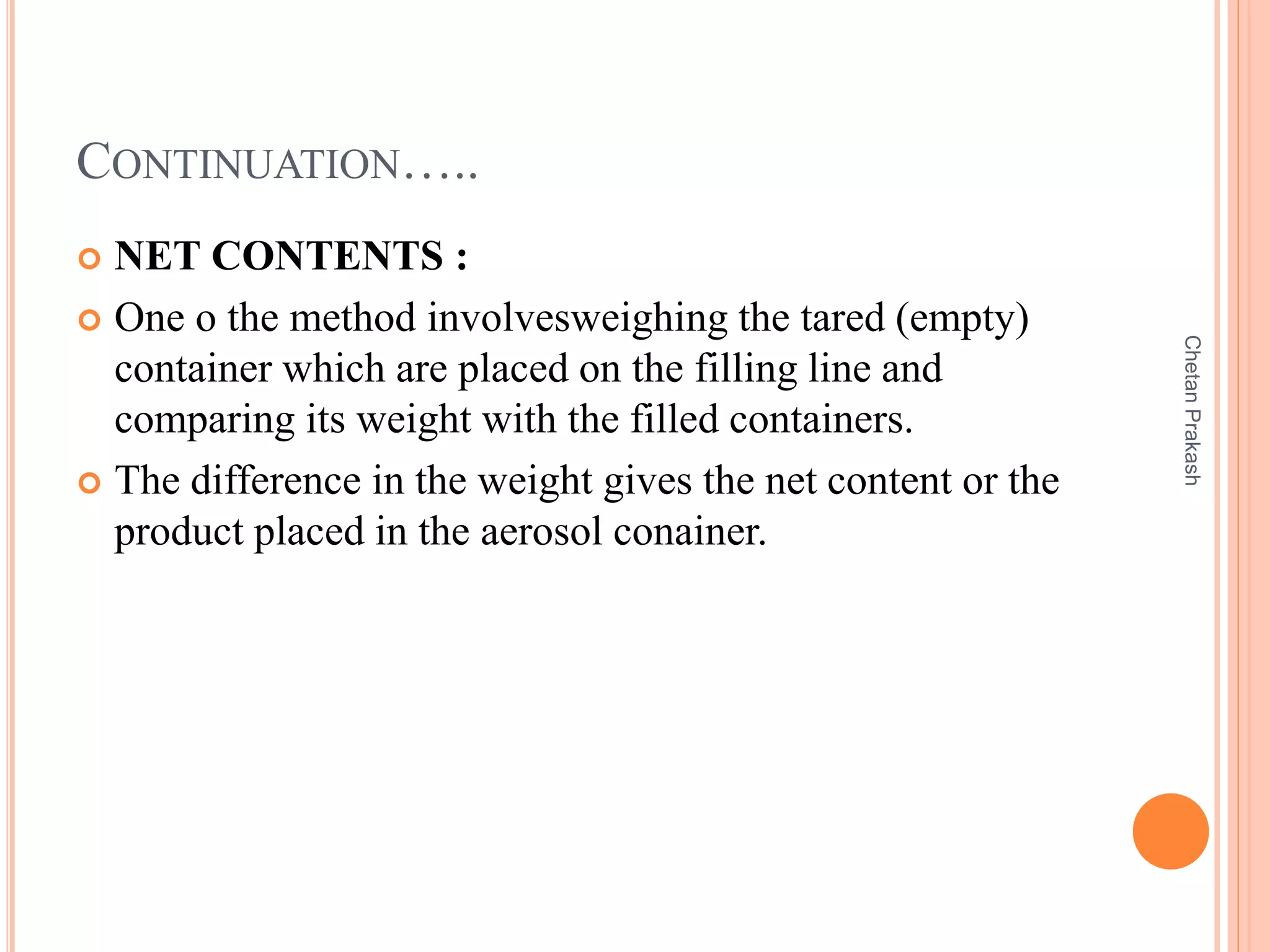
 NET CONTENTS :
 One o the method involvesweighing the tared (empty)
container which are placed on the filling line and
comparing its weight with the filled containers.
 The difference in the weight gives the net content or the
product placed in the aerosol conainer.
ChetanPrakash
CONTINUATION…..
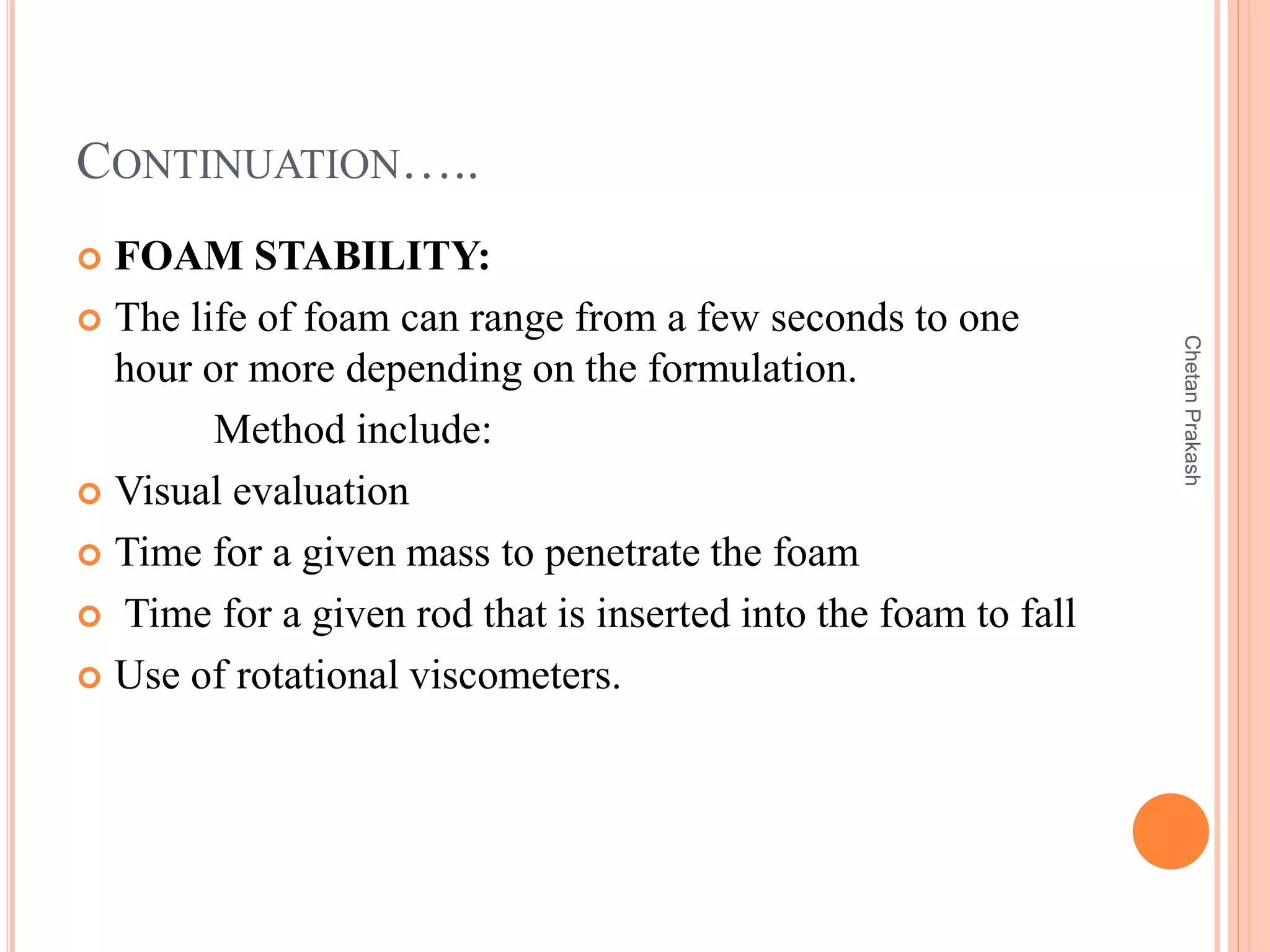
 FOAM STABILITY:
 The life of foam can range from a few seconds to one
hour or more depending on the formulation.
Method include:
 Visual evaluation
 Time for a given mass to penetrate the foam
 Time for a given rod that is inserted into the foam to fall
 Use of rotational viscometers.
ChetanPrakash
CONTINUATION…..
 PARTICLE SIZE DETERMINATION:
Two methods are used to determine the
particle size of the aerosols.
 1) Cascade impactor
 2) Light scattering decay
ChetanPrakash
CONTINUATION…..
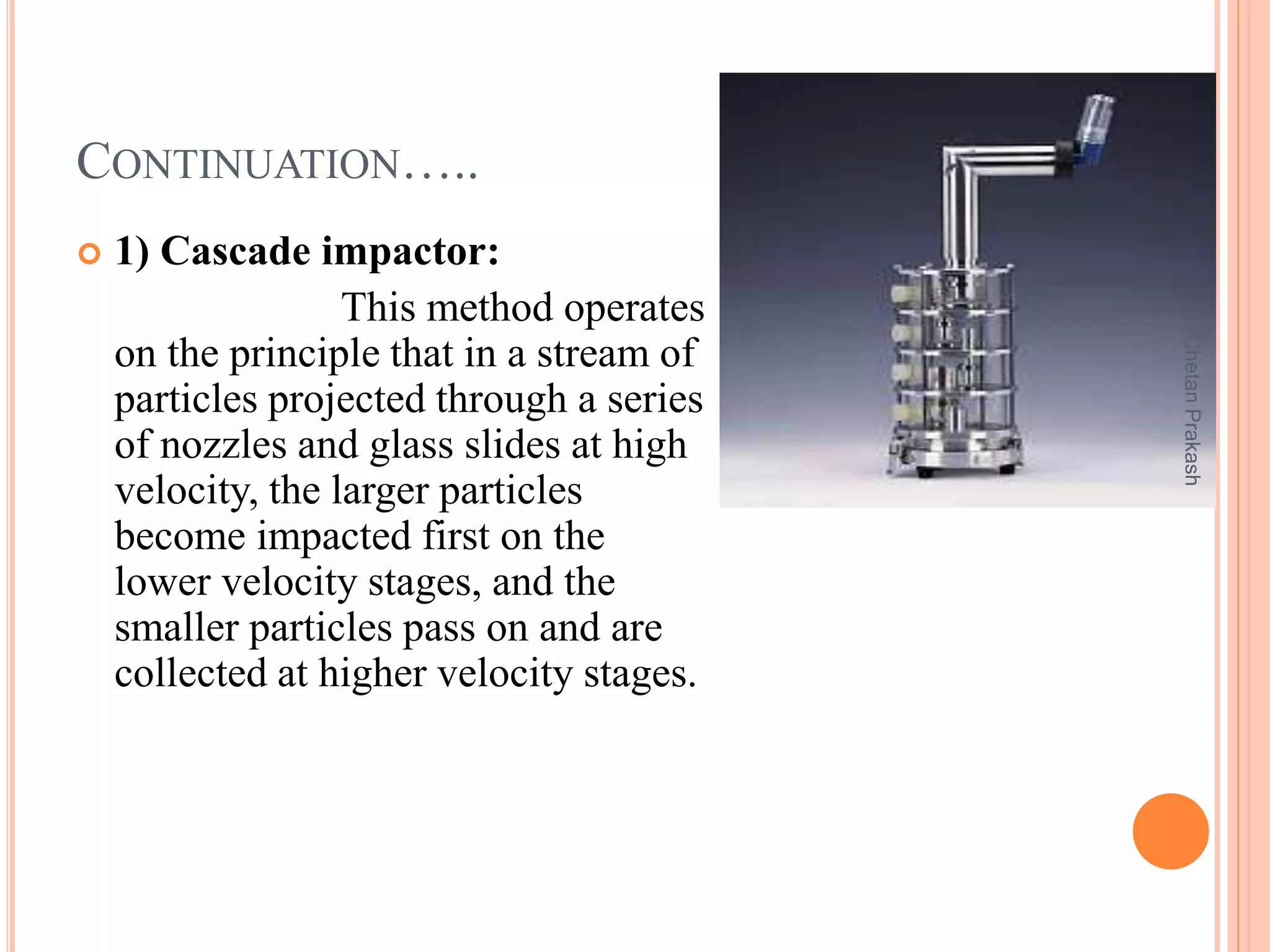
 1) Cascade impactor:
This method operates
on the principle that in a stream of
particles projected through a series
of nozzles and glass slides at high
velocity, the larger particles
become impacted first on the
lower velocity stages, and the
smaller particles pass on and are
collected at higher velocity stages.
ChetanPrakash
CONTINUATION…..
 2) Light scattering decay
When the aerosol settles due to sudden
changes, there is a change in the intensity of the light of
the tyndall beam. This change is measured in order to
determine the particles. It is noted,
*70% to 78% of the particles were less than 5
micron.
*88% to 93% were less than 7 micron.
*98% to 100% were less than 10 micron
ChetanPrakash
CONTINUATION…..
 LEAKAGE:
It is used to estimate the weight loss over a 1-
year period
ChetanPrakash
BIOLOGICAL TESTING:
 Therapeutic activity:
 For inhalation aerosols: It is depends on the particle size.
 For topical aerosols: It is applied to test areas and
adsorption of the therapeutic ingredients is determined.
ChetanPrakash
CONTINUATION…..
 Toxicity:
 This testing include both topical and inhalation effects.
 For inhalation aerosols: It can be done by exposing test
animals to vapors sprayed from an aerosol container.
 For topical aerosols: It may be irritating to the affected area
and may cause a chilling effect. The degree of chilling effect
depends on the type and amount of propellant present. When
the skin is sprayed with the aerosol for a given period of time,
the change in the skin temperature was observed. This change
in temperature is mainly determined by the use of thermostat
probes attached to recording thermometers.
ChetanPrakash
PACKAGING OF AEROSOLS:
 Most aerosol products have a protective cap or cover that
fits snugly over the valve and mounting cup. This
protects the valve against contamination with dust and
dirt. The cap, which is generally made of plastic or
metals, also serves a decorative function.
 Aerosols should be maintained with the protective caps
in place to prevent accidental activation of the valve
assembly or contamination by dust and other foreign
materials.
ChetanPrakash
LABELLING OF AEROSOLS:
 Medicinal aerosols that are to be dispensed only upon
prescription are labeled by the manufacturer with plastic
peel-away labels or easily removed paper labels.
 An aerosol required to be labeled ‘’Flammable’’.
 Safety labels must warn users not to puncture pressurized
container, not to use or store them near heat or an open
flame, and not to incinerate them.
ChetanPrakash
STORAGE OF AEROSOLS:
 Exposure to temperatures above 49˚c (120˚F) may burst
an aerosol container.
 When the containers are cold, less than the usual spray
may result. This may be particularly important to users
of metered- dose inhalation sprays.
 They are generally recommended for storage between
15˚c and 30˚c (59˚ F and 86˚F).
ChetanPrakash
REFERENCE
 Google Search
 Wikipedia.
 Slideshare.net
ChetanPrakash
QUOTE
~” See life as a music and enjoy every
twist and turn of it”
ChetanPrakash
THANK YOU
ChetanPrakash

Aerosol Containers | Definition | Components | Manufacturing | Evaluation

  • 1.
    PHARMACEUTICAL DOSAGE FORM ANDCOSMETIC TECHNOLOGY “Aerosol Containers | Definition | Components | Manufacturing | Evaluation” By Chetan A., IIIrd B.Pharm K.K. College of Pharmacy Chennai, TamilNadu ChetanPrakash
  • 2.
    LEARNING OBJECTIVE  Introduction Components of Aerosol  Types of Valves, Aerosol System, Aerosol Spray  Manufacturing of Pharmaceuticsl Aerosol  Evaluation of Aerosol  Packaging, Labelling & Storage of Aerosol  Reference ChetanPrakash
  • 3.
    INTRODUCTION  The Aerosolscontainer referred to as pressurized package in which therapeutically active drug is dissolved or suspended in a compressed or liquefied gas.  It is a system that depends on power of compressed or liquefied gas to expel the content from the container. ChetanPrakash
  • 4.
    DEFINITION OF AEROSOL Aerosols are a suspension of small solid particles or droplets suspended in a gas or vapor. Examples:-haze, dust, particulate air pollutants & smoke.  An aerosols also called as pressurized pressure or pressurized dosage forms.  Pressure is developed to the aerosol system through the use of one or more Liquefied or gaseous propellants . ChetanPrakash
  • 5.
    PHARMACEUTICAL AEROSOLS  Pharmaceuticalaerosols is defined as aerosols products containing therapeutically active ingredients dissolved, suspended or emulsified in a propellant or a mixture of solvent and propellant and intended for topical administration, for administration into ear, rectum, and vagina or intended for administration orally or nasally as fine solid particles or liquid mists through the pulmonary airways, nasal passages or oral cavity. ChetanPrakash
  • 6.
  • 7.
    ADVANTAGES OF AEROSOLS Rapid onset of action.  Aerosol form can avoid decomposition or inactivation of drug by the pH or enzymatic action of stomach and also can avoid first pass metabolism.  A specific amount of dose or drug can be removed from the container without contamination of removing contents.  Stability is enhanced for these substances adversely affected by oxygen and or moisture. ChetanPrakash
  • 8.
    CONTINUATION…..  The aerosolcontainer protects the photosensitive medicaments.  When sterility is an important factor, it can be maintained while a dose is being dispensed.  Aerosols are portable and tamper-proof. ChetanPrakash
  • 9.
    DISADVANTAGES OF AEROSOLS Aerosols are cost effective.  Disposal of empty aerosol containers are difficult.  Aerosol packs must be kept away from temperature and fire , because it may develop high pressure inside the container and lead to explosion. ChetanPrakash
  • 10.
    COMPONENTS OF AEROSOLS Anaerosol system has following major components  Propellant  Container  Valve and actuator  Product concentrate ChetanPrakash
  • 11.
    •PROPELLANT  The propellantgenerally is regarded as the heart of the aerosol package.  Propellant provide the driving force to expel product form its container when the valve is opened ChetanPrakash
  • 12.
    TYPES OF PROPELLANTS Thereare two types of propellants used in pharmaceutical aerosols,  Liquefied gas propellants  Compressed gas propellants ChetanPrakash
  • 13.
    •LIQUEFIED GAS PROPELLANTS The liquefied-gas propellants mixture is sealed in an aerosols container with the product concentrate.  It establish equilibrium between the propellant which remains liquefied and a portion that vaporized and occupies the upper portion of the container.  Examples : Hydrocarbons (HCs), Chlorofluorocarbon (CFCS), Hydrofluoroalkanes (HFA) ChetanPrakash
  • 14.
    •COMPRESSED GAS PROPELLANTS The compressed gas propellant is present in the headspace of the aerosol container which forces the product concentrate to emit contents out of the container.  For this higher gas pressure is required in this aerosol.  Examples : Nitrogen, Nitrogen dioxide and Carbon dioxide. ChetanPrakash
  • 15.
  • 16.
    CONTAINER  Aerosols containermust withstand pressure as high as 140 to 180 psig (pounds per sq. Inch gauge) at 130 ̊F.  Container may be made of following:  1) Metals *Tin plated steel *Aluminum *Stainless steel  2) Glass *Uncoated glass *Plastic coated glass ChetanPrakash
  • 17.
    METALS  1) Tin-platedsteel It is used for most aerosols as it is light, inexpensive and durable. It is steel that has been plated on both sides with tin. ChetanPrakash
  • 18.
    CONTINUATION…..  Advantages: Special protectivecoatings are applied within the container to prevent corrosion and interaction between the container and formulation if necessary.  Disadvantage: *High cost. *For small sized container only. *Leak of container due to flaws in the seam or welding. *Corrosion with some preparations ChetanPrakash
  • 19.
    CONTINUATION…..  2) Aluminium *Thealuminium containers are light weight and are less prone to corrosion than other metals. *Aluminium is used in most metered dose inhalers (MDIs) and many topical aerosols. ChetanPrakash
  • 20.
    CONTINUATION…..  Advantages: *These aremanufactured by extrusion or by any other methods that make them seamless. *Against leakage the seam type of container is of greater safety. *No incompatibility and corrosion.  Disadvantages: *High cost ChetanPrakash
  • 21.
    CONTINUATION…..  Stainless steel:- Itis used for inhalation aerosols.  Advantages: *It is resistant to corrosion. *No coating is required. *It can withstand high pressure.  Disadvantages: *Expensive. *This restricts its sizes to small sized containers. ChetanPrakash
  • 22.
    CONTINUATION…..  GLASS CONTAINER: *Theyare compatibility with most formulations since corrosion problems are eliminated. *They allow level of contents to be seen. *But its use is limited for product having lower Pressure (up to 25psig) and lower percentage (about only up to 15%) of propellant. ChetanPrakash
  • 23.
    CONTINUATION…..  Uncoated glass:-Decreased cost and high clarity and contents can be viewed all times.  Plastic coated glass: -These are protected by plastic coating that prevents the glass from shattering in the event of breakage. ChetanPrakash
  • 24.
    CONTINUATION…..  Advantages:  Glasshas less chemical compatibility than metal containers.  No corrosion.  Glass can be molded to different design.  Disadvantages:  More chances for accidental breakage.  Not suitable for photosensitive. ChetanPrakash
  • 25.
    VALVES  It isthe vital component of an aerosol package.  It helps to deliver the drug in desired form and determines the performance of pressurized packages.  Major functions of valves are,  To regulate the flow of product from the container  To provide a means of discharging desired amount when needed and prevent loss at other times.  To exert a major effect on the characteristics of dispensed product. ChetanPrakash
  • 26.
    TYPES OF VALVES Continuous spray valve These valves release the product as long as pressure is maintained on the actuator ChetanPrakash
  • 27.
     Metering valves *Afinite volume (25-150µml for inhalation aerosols, up to 5ml for topical aerosols) of product is released when the actuator is pressed. *No more products is released unless the actuator is returned to its rest position and repressed. *It is used for dispensing of potent medication ChetanPrakash
  • 28.
    VALVE ASSEMBLY ANDITS COMPONENTS:  Valve cup  Valve body / housing  Stem  Gasket  Valve spring  Dip tube ChetanPrakash
  • 29.
    ABOUT VALVE ASSEMBLY VALVE CUP (MOUNTING CUP/ FERRULE):- The Mounting cup or Ferrule is generally made up of aluminum which serves to place the valve in its position and then attached to the aerosol container.  VALVE BODY / HOUSING:- The Housing or Valve body located directly below the Mounting cup or Ferrule is made up of Nylon or Delrin work, which uses to connect dip tube, stem and actuator of aerosol container. ChetanPrakash
  • 30.
    CONTINUATION……  STEM: -Theactuator is supported by the stem and the formulation is delivered in the proper form to the chamber of the actuator by the stem.  GASKET: -The stem and valve are placed tightly in their place by the gasket and the leakage of the formulation is prevented by gasket. ChetanPrakash
  • 31.
    CONTINUATION…..  VALVE SPRING:- The gasket of aerosol container is held in its place by the spring and also helps to keep the valve in closed position when the pressure is released upon actuation of the formulation. Stainless steel can be used with most aerosols.  DIP TUBE: -The dip tube is made up of polyethylene or polypropylene extends from the housing body or valve body down into the product concentrate works to bring the formulation from the container to the valve. ChetanPrakash
  • 32.
    ACTUATOR:  It ensuresthat aerosol product is delivered in the proper and desired form.  It allows easy opening and closing the valve.  It is the fitting attached to an aerosol valve stem, which when depressed or moved, open the valve, ChetanPrakash
  • 33.
  • 34.
    TYPES OF ACTUATORS:- SPRAY ACTUATORS  FOAM ACTUATORS  SOLID STEAM ACTUATORS  SPECIAL ACTUATORS ChetanPrakash
  • 35.
    FORMULATION OF AEROSOL:-  It consists of two essentail components,  1. Product concentrate Active ingredient or mixture of active ingredients and other necessary agents such as solvents, anti-oxidants and surfactants  2. Propellant Single or blend of various propellants is used. ChetanPrakash
  • 36.
    TYPES OF AEROSOLSYSTEM:-  1) Solution system / Two Phase system  2) Water based system / two components or three components system  3) Suspension / Dispersion system  4) Foam system / Emulsion systems *Aqueous stable foams *Non-Aqueous stable foams *Quick Breaking foams *Thermal Foams  5) Intra Nasal Aerosols  6) Compressed Gas Systems ChetanPrakash
  • 37.
     SOLUTION SYSTEM/ TWO PHASE SYSTEM: - *This system is also referred to as two- phase system and consists of a vapor and liquid phase. When the active ingredients are soluble in propellant, no other solvent is required.  WATER- BASED SYSTEM/ TWO COMPONENTS AND THREE COMPONENTS SYSTEM:- *Large amount of water can be used to replace all or part of the non aqueous solvents used in aerosols. *This type of system employed when the product is immiscible with the propellant. ChetanPrakash
  • 38.
     SUSPENSION ORDISPERSION SYSTEMS:- *The active ingredients are suspended or dispersed throughout the propellant and solvent phase. *This system is useful with antibiotics, steroids and other poorly soluble compounds. *To decrease the rates of settling of the dispersed particles surfactants or suspending agent have been used.  FOAM SYSTEM/ EMULAION SYSTEM:- *Emulsion or foam aerosols consist of Active ingredient + Aqueous or Non aqueous vehicle + Surfactant + and propellant ChetanPrakash
  • 39.
    CONTINUATION…..  INTRA NASALAEROSOLS:- Drug delivery system is intended for the deposition of medication into the nasal pathways for effectiveness to produce local or systemic effect. ChetanPrakash
  • 40.
    TYPES OF AEROSOLSSPRAY:  There are 3 types of Aerosol Sprays:  1. Space sprays  2. Surface coating spray  3. Foam spray ChetanPrakash
  • 41.
    CONTINUATION…..  1) SPACESPRAY:  Its products are delivered in a fine mist •  It contains 85% propellant and it is pressurized at 30- 40psi and 70 °F. Eg.Room sprays  2) SURFACE COATING SPRAY:  Aerosols intended for carrying active ingredients to surface are termed as surface sprays or surface coating spray.  It contains 30 –70% propellant operates between 22–55 psig at 70˚F. E.g. Topical Aerosol ChetanPrakash
  • 42.
     3) FOAMSPRAY: Foam aerosols (emulsion) usually operate between 35 and 55 psig at21°c and contains only 6-10% propellant ChetanPrakash
  • 43.
    MANUFACTURING OF PHARMACEUTICAL AEROSOLS The manufactured aerosols can be filled in to the containers can be done by following methods and apparatus used.  a) COLD FILLING APPARATUS  b) PRESSURE FIILING APPARATUS  c) COMPRESSED GAS FILLING APPARATUS ChetanPrakash
  • 44.
    COLD FILLING APPARATUS Cold filling apparatus consists of an insulated box which fitted with copper tubings and filled with dry ice or acetone.  The fitted copper tubings increase the surface area and cause faster cooling.  The hydrocarbon propellant is not to be stored in the copper tubings as it might cause explosion. ChetanPrakash
  • 45.
    CONTINUATION…..  Advantages: Easy process. Disadvantages: Aqueous products, emulsion and those products adversely affected by cold temperature cannot be filled by this method. ChetanPrakash
  • 46.
    APPARATUS FOR COLDFILLING ChetanPrakash
  • 47.
    PRESSURE FILLING APPARATUS Pressure filling apparatus consists of a metering burette capable of measuring the amount of propellant to be filled to the container.  The mixture of propellant or propellants is added through the inlet valve present to the bottom of the valve under its own vapor pressure.  A cylinder of nitrogen or compressed gas is attached to the top of the valve and the pressure of nitrogen causes the propellant to flow to the container through the metering burette.  The propellant flows to the container stops when the pressure of the flowing propellant becomes equal to the pressure of the container. ChetanPrakash
  • 48.
    CONTINUATION…..  Advantages: *Solutions, emulsions,suspensions can be filled by this method as chilling does not occur. Contamination due to moisture is less. *High production speed can be achieved. *Loss of propellant is less.  Disadvantages: *Certain types of metering valves can be handled only by the cold filling process. *Process is slower than cold filling method ChetanPrakash
  • 49.
    COMPRESSED GAS FILLING APPARATUS: A compressed gas propellant is used. As the compressed gas is under high pressure, so the pressure is reduced by pressure reducing valve.  A pressure of 150 pounds per square inch gauge is required to fill the compressed gas propellant in the aerosol container.  The container is needed to be shaken during and after the filling operation to enhance the solubility of the gas in the product concentrate. ChetanPrakash
  • 50.
  • 51.
    EVALUATION OF AEROSOLS:-  Pharmaceutical aerosols can be evaluated by a series of physical, chemical and biological tests. ChetanPrakash
  • 52.
     1) Flammabilityand combustibility *Flame projection *Flash point 2) Physicochemical characteristics *Vapor pressure *Density *moisture content *Identification of propellants 3) Performance Test *valve discharge rate *Spray patterns *Dose uniformity *Net contents *Foam stability *Particle size determination *Leakage 4) Biological Testing *Therapeutic Activity *Toxicity ChetanPrakash
  • 53.
    FLAMMABILITY AND COMBUSTIBILITY FLAME PROJECTION:  Flame test indicates the effect of an aerosol formulation on the extension of an open flame.  Aerosol product is sprayed for 4 sec into open flame.  Depending on the nature and type of formulation, the fame is extended to some length and exact length was measured with ruler. ChetanPrakash
  • 54.
    CONTINUATION…..  FLASH POINT: It is mainly determined by the use of standard tag open cap Apparatus.  Aerosol product is chilled to a temperature of about - 25˚F and transferred to the test Apparatus.  The test liquid is allowed to increase slowly in temperature and the temperature at which the vapor ignites is taken as the flash point. ChetanPrakash
  • 55.
  • 56.
    PHYSICOCHEMICAL CHARACTERSTICS:  VAPOR PRESSURE: The pressure can be measured with a pressure gauge or through the use of a water bath and test gauges.  Excessive pressure variation from container to container indicates the presence of air in the head space.  A can puncturing device is available for accurately measuring vapor pressure. ChetanPrakash
  • 57.
    CONTINUATION…..  DENSITY:  Hydrometeror pycnometer is mainly used to determine the density of an aerosol system.  A pressure tube is fitted with metal flanges and a hoke valve, which for allows for the introduction of liquids under pressure.  The hydrometer is placed into the glass pressure tube.  Sufficient sample is introduced the valve to cause the hydrometer to rise halfway up the length of the tube and the density can be read directly. ChetanPrakash
  • 58.
    CONTINUATION…..  MOISTURE CONTENT: Presence of moisture can be determined by using *Karl Fischer *Gas Chromatography ChetanPrakash
  • 59.
    CONTINUATION…..  IDENTIFICATION OFPROPELLANTS:  Gas chromatography and IR Spectroscopy.  These methods are used for the identification as well as measurement for proportion of each component in blend. ChetanPrakash
  • 60.
    PERFORMANCE TEST  VALVEDISCHARGE RATE:  This is determined by taking an aerosol known weight and discharging the contents for given time using standard apparatus.  By reweighing the container after time limit has expired, the change in weight per time dispensed is the discharge rate, which can then be expressed as grams per seconds. ChetanPrakash
  • 61.
    CONTINUATION…..  SPRAY PATTERNS: The method is based on the impingement of the spray on a piece of paper that has been treated with a dye- talc mixture.  An oil soluble or water soluble dye is used depending upon the nature of the aerosol.  The particles that strike the paper cause the dye to go into the solution and to be absorbed onto the paper.  This gives a record of the spray, which can be used for the comparison purposes ChetanPrakash
  • 62.
    CONTINUATION…..  DOSE UNIFORMITY: Reproducibility of the dose was observed when the valve is pressed.  Actual amount of medication received by the patient.  This solution can be assayed and the amount of active ingredients determined. ChetanPrakash
  • 63.
    CONTINUATION…..  NET CONTENTS:  One o the method involvesweighing the tared (empty) container which are placed on the filling line and comparing its weight with the filled containers.  The difference in the weight gives the net content or the product placed in the aerosol conainer. ChetanPrakash
  • 64.
    CONTINUATION…..  FOAM STABILITY: The life of foam can range from a few seconds to one hour or more depending on the formulation. Method include:  Visual evaluation  Time for a given mass to penetrate the foam  Time for a given rod that is inserted into the foam to fall  Use of rotational viscometers. ChetanPrakash
  • 65.
    CONTINUATION…..  PARTICLE SIZEDETERMINATION: Two methods are used to determine the particle size of the aerosols.  1) Cascade impactor  2) Light scattering decay ChetanPrakash
  • 66.
    CONTINUATION…..  1) Cascadeimpactor: This method operates on the principle that in a stream of particles projected through a series of nozzles and glass slides at high velocity, the larger particles become impacted first on the lower velocity stages, and the smaller particles pass on and are collected at higher velocity stages. ChetanPrakash
  • 67.
    CONTINUATION…..  2) Lightscattering decay When the aerosol settles due to sudden changes, there is a change in the intensity of the light of the tyndall beam. This change is measured in order to determine the particles. It is noted, *70% to 78% of the particles were less than 5 micron. *88% to 93% were less than 7 micron. *98% to 100% were less than 10 micron ChetanPrakash
  • 68.
    CONTINUATION…..  LEAKAGE: It isused to estimate the weight loss over a 1- year period ChetanPrakash
  • 69.
    BIOLOGICAL TESTING:  Therapeuticactivity:  For inhalation aerosols: It is depends on the particle size.  For topical aerosols: It is applied to test areas and adsorption of the therapeutic ingredients is determined. ChetanPrakash
  • 70.
    CONTINUATION…..  Toxicity:  Thistesting include both topical and inhalation effects.  For inhalation aerosols: It can be done by exposing test animals to vapors sprayed from an aerosol container.  For topical aerosols: It may be irritating to the affected area and may cause a chilling effect. The degree of chilling effect depends on the type and amount of propellant present. When the skin is sprayed with the aerosol for a given period of time, the change in the skin temperature was observed. This change in temperature is mainly determined by the use of thermostat probes attached to recording thermometers. ChetanPrakash
  • 71.
    PACKAGING OF AEROSOLS: Most aerosol products have a protective cap or cover that fits snugly over the valve and mounting cup. This protects the valve against contamination with dust and dirt. The cap, which is generally made of plastic or metals, also serves a decorative function.  Aerosols should be maintained with the protective caps in place to prevent accidental activation of the valve assembly or contamination by dust and other foreign materials. ChetanPrakash
  • 72.
    LABELLING OF AEROSOLS: Medicinal aerosols that are to be dispensed only upon prescription are labeled by the manufacturer with plastic peel-away labels or easily removed paper labels.  An aerosol required to be labeled ‘’Flammable’’.  Safety labels must warn users not to puncture pressurized container, not to use or store them near heat or an open flame, and not to incinerate them. ChetanPrakash
  • 73.
    STORAGE OF AEROSOLS: Exposure to temperatures above 49˚c (120˚F) may burst an aerosol container.  When the containers are cold, less than the usual spray may result. This may be particularly important to users of metered- dose inhalation sprays.  They are generally recommended for storage between 15˚c and 30˚c (59˚ F and 86˚F). ChetanPrakash
  • 74.
    REFERENCE  Google Search Wikipedia.  Slideshare.net ChetanPrakash
  • 75.
    QUOTE ~” See lifeas a music and enjoy every twist and turn of it” ChetanPrakash
  • 76.