Prepared by
JAY
20/10/2021
CONTENTS
• Introduction
• Inventions of LCD
• What is LCD
• Working of LCD
• Types of LCD
• Applications of LCD
• Advantages and
Disadvantages
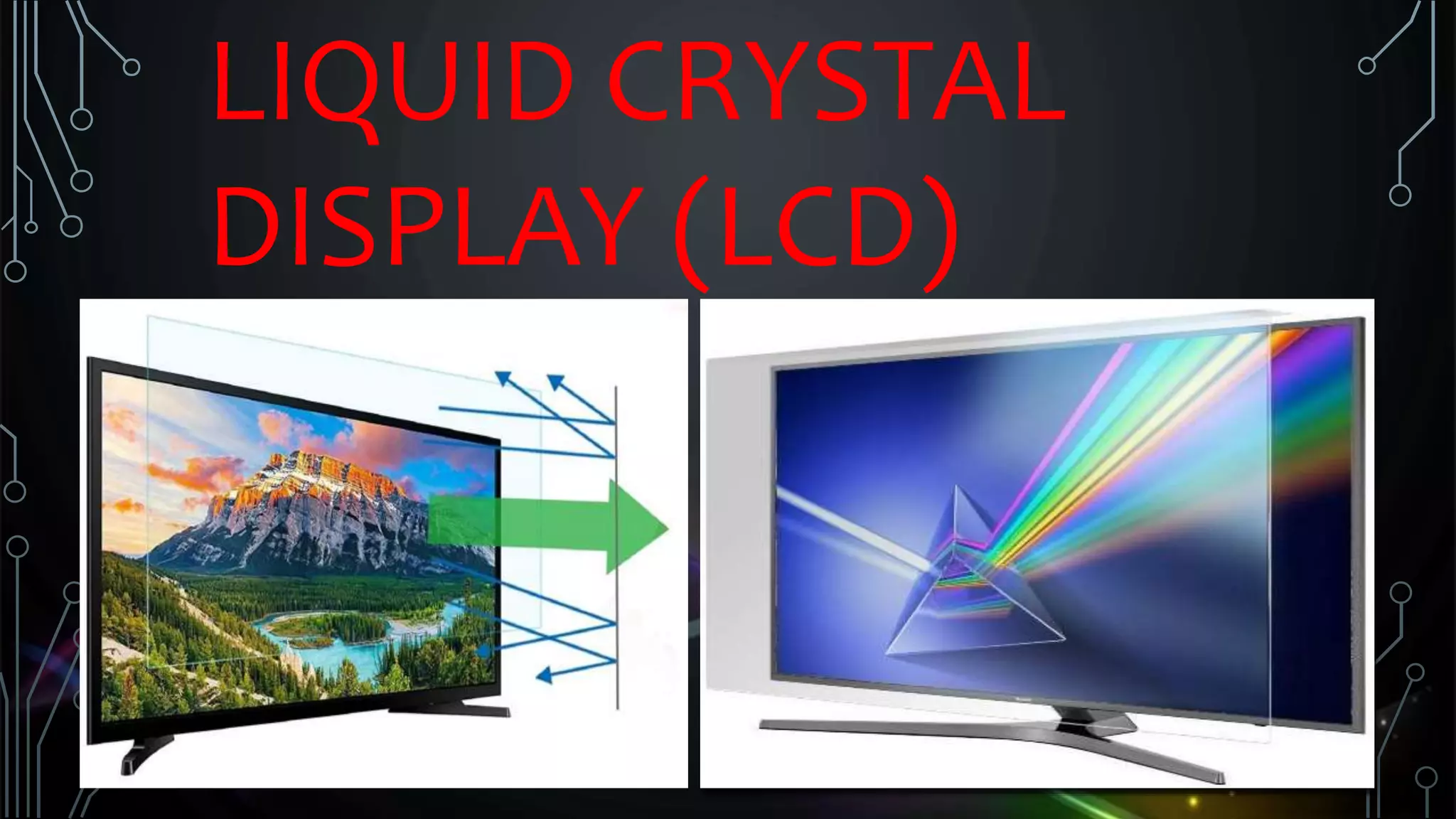
LIQUID CRYSTAL
DISPLAY (LCD)
INVENTIONS OF LCD DISPLAY
Discovery of Liquid Crystal Display
- In year 1888 by Freidrich Reinitzer
- Innovation
- 1963 by Richard Williams & George Heilmeier Suggest using
liquid crystal for making a display device.
- 1968 , The First operational LCD created by RCA using Dynamic
Scattering Method (DSM)
- In year 1971, First LCD using Twisted Nematics Produced
WHATIS LCD?
A Liquid Crystal Display (LCD) is a thin, flat panel used for
electronically displaying information such as text, images, and
moving pictures.
BASICS OF LCD
It is a combination of two states of matter, the
solid and the liquid state.
LCD uses liquid crystal to produce visible
image.
LCD are super thin display screen compared
to CRT display.
It includes several layers, where liquid crystal
layer is sandwiched between some layers
Light is projected from the lens, and based on
liquid crystal orientation, image is displayed
on the screen.
WORKING OF LCD
CCFL light
Source
2. LCD requires back light as they do not emit light.
3. When electrical signal is given to liquid crystal, its
orientation is getting change and based on orientation
polarized light will pass through it.
4. So blocking of light is been done based on electrical
signal applied to liquid crystal.
1. It works based on blocking of light. It does not
emit light.
Liqui
d
cryst
al
(Diff. colors) O/P
Crystal
STRUCTURE OF LCD
Fluorescent
Back Light
(CCFL)
Polarizing
Films
Negative
Coating
Liquid
Crystal
Positive
Coating
Polarizing
Films
Glass Cover
WHY LCD?
Smaller Size –LSD’s occupy approximately 60% less space than CRT displays an important
when office space is limited.
Lower power Consumption –LCD’s typically consume about half the power and emit much
less heat than CRT display.
No electromagnetic field –LCD’s do not emit electromagnetic field and are not susceptible
to them thus, they are suitable for use in areas where CRT’s cannot be used.
Longer Life – LCD’s have a longer useful life than CRT.
TYPES OF LCD
1. Twisted Nematic (TN) Twisted Nematic LCDs are the most commonly
manufactured and used types of monitors across a wide range of industries.
2. IPS Panel Technology
3. VA Panel
4. Advanced Fringe Field Switching.
5. OLED (Organic Light-Emitting Diode)
6. AMOLED (Active-Matrix Organic Light-Emitting Diode)
ADVANTAGES OF LCD
1. LCD Monitors are very thin in shape and
size.
2. They do not consume much electricity and
emits less heat.
3. They are preferred over CRT monitors
because of their size as they can be installed
in small locations.
4. They do not affect any magnetic fields.
5. Very low power compared to CRT or
Plasma.
Disadvantages of LCD
1. It needs an external source of light for
displaying the image.
2. Its operating temperature range is limited that
lies in between 0 to 60°C.
3. LCDs are less reliable display units.
4. The image visibility relies on light intensity.
5. They are slightly more expensive plasma flat
panels.
6. They are very expensive as compared to CRTs.
APPLICATION OF LCD
1. The liquid crystal displays (LCDs) are used in aircraft
cockpit displays.
2. It is used as a display screen in calculators.
3. For displaying images used in digital cameras.
4. The television is main applications of LCD.
5. Mostly the computer monitor is made up of LCDs.
6. The LCDs are commonly used in all the digital wrist watches
for displaying time.
7. The LCDs are used in mobile screens.
8. It is also used in video players.
REFERENCE
1.https://whatis.techtarget.com/definition/LCD-liquid-crystal-
display
2.https://www.semiconductorforu.com/application-lcd-liquid-
crystal-display/
3.https://www.elprocus.com/ever-wondered-lcd-works/
4.https://www.ecstuff4u.com/2018/12/advantages-and-
disadvantages-of-lcd.html
ANY
QUESTION
?
THANK
YOU

Jay 123

  • 1.
  • 2.
    CONTENTS • Introduction • Inventionsof LCD • What is LCD • Working of LCD • Types of LCD • Applications of LCD • Advantages and Disadvantages
  • 3.
  • 4.
    INVENTIONS OF LCDDISPLAY Discovery of Liquid Crystal Display - In year 1888 by Freidrich Reinitzer - Innovation - 1963 by Richard Williams & George Heilmeier Suggest using liquid crystal for making a display device. - 1968 , The First operational LCD created by RCA using Dynamic Scattering Method (DSM) - In year 1971, First LCD using Twisted Nematics Produced
  • 5.
    WHATIS LCD? A LiquidCrystal Display (LCD) is a thin, flat panel used for electronically displaying information such as text, images, and moving pictures.
  • 6.
    BASICS OF LCD Itis a combination of two states of matter, the solid and the liquid state. LCD uses liquid crystal to produce visible image. LCD are super thin display screen compared to CRT display. It includes several layers, where liquid crystal layer is sandwiched between some layers Light is projected from the lens, and based on liquid crystal orientation, image is displayed on the screen.
  • 7.
    WORKING OF LCD CCFLlight Source 2. LCD requires back light as they do not emit light. 3. When electrical signal is given to liquid crystal, its orientation is getting change and based on orientation polarized light will pass through it. 4. So blocking of light is been done based on electrical signal applied to liquid crystal. 1. It works based on blocking of light. It does not emit light. Liqui d cryst al (Diff. colors) O/P Crystal
  • 8.
    STRUCTURE OF LCD Fluorescent BackLight (CCFL) Polarizing Films Negative Coating Liquid Crystal Positive Coating Polarizing Films Glass Cover
  • 9.
    WHY LCD? Smaller Size–LSD’s occupy approximately 60% less space than CRT displays an important when office space is limited. Lower power Consumption –LCD’s typically consume about half the power and emit much less heat than CRT display. No electromagnetic field –LCD’s do not emit electromagnetic field and are not susceptible to them thus, they are suitable for use in areas where CRT’s cannot be used. Longer Life – LCD’s have a longer useful life than CRT.
  • 10.
    TYPES OF LCD 1.Twisted Nematic (TN) Twisted Nematic LCDs are the most commonly manufactured and used types of monitors across a wide range of industries. 2. IPS Panel Technology 3. VA Panel 4. Advanced Fringe Field Switching. 5. OLED (Organic Light-Emitting Diode) 6. AMOLED (Active-Matrix Organic Light-Emitting Diode)
  • 11.
    ADVANTAGES OF LCD 1.LCD Monitors are very thin in shape and size. 2. They do not consume much electricity and emits less heat. 3. They are preferred over CRT monitors because of their size as they can be installed in small locations. 4. They do not affect any magnetic fields. 5. Very low power compared to CRT or Plasma.
  • 12.
    Disadvantages of LCD 1.It needs an external source of light for displaying the image. 2. Its operating temperature range is limited that lies in between 0 to 60°C. 3. LCDs are less reliable display units. 4. The image visibility relies on light intensity. 5. They are slightly more expensive plasma flat panels. 6. They are very expensive as compared to CRTs.
  • 13.
    APPLICATION OF LCD 1.The liquid crystal displays (LCDs) are used in aircraft cockpit displays. 2. It is used as a display screen in calculators. 3. For displaying images used in digital cameras. 4. The television is main applications of LCD. 5. Mostly the computer monitor is made up of LCDs. 6. The LCDs are commonly used in all the digital wrist watches for displaying time. 7. The LCDs are used in mobile screens. 8. It is also used in video players.
  • 14.
  • 15.
  • 16.