 Most liquid-based additive manufacturing (AM)
systems build parts in a vat of photocurable
liquid resin, an organic resin that cures or
solidifies under the effect of exposure to light,
usually in the UV range.
 The light cures the resin near the surface,
forming a thin hardened layer.
 Once the complete layer of the part is formed, it
is lowered by an elevation control system to allow
the next layer of resin to be coated and similarly
formed over it.
 This continues until the entire part is completed.
 There are variations to this technique by the
various vendors and they are dependent on
 The type of light or laser
 Method of scanning or exposure
 Type of liquid resin
 Type of elevation
 Optical system
Another method is by jetting drops of liquid
photopolymer onto a build tray via a print
head, akin to inkjet printing and curing them
with UV light.
 Again, there are variations to the technique
depending on the types of resin, exposure,
elevation and so on.

3D Systems was founded in 1986 by inventor
Charles W. Hull and entrepreneur Raymond S.
Freed.
 Among all the commercial AM systems, the
Stereolithography Apparatus, or SLA as it is
commonly called, is the pioneer with its first
commercial system marketed in 1988.

The company has grown significantly through
increased sales and acquisitions, most notably of
EOS GmbH's stereolithography business in 1997
 By 2007, 3D Systems had grown into a global
company that delivered advanced rapid
prototyping solutions to every major market
around the world.
 It has a global portfolio of nearly 400 U.S. and
foreign patents, with additional patents filed or
pending in the United States and several other
major industrialised countries.
 3D Systems Inc.is headquartered in 333 Three D
Systems Circle Rock Hill, SC 29730 USA.
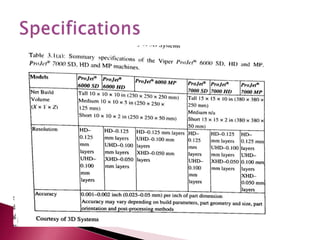
 3D Systems produces a wide range of AM
machines to cater to various part sizes and
throughput.
 There are several models available, including
those in the series of
 ProJet® 6000 SD, HD and MP,
 ProJet® 7000 SD. HD,
 ProX 850 and 950.
 For larger build envelopes, the ProX 800 and 950
are available.
 These machines are used to create casting
patterns, moulds, end-use parts and functional
prototypes.
 These products' surface smoothness, feature
resolution, edge definition and tolerances are
enhanced.
 The ProXⓇM 950 has single-part durability
allowing for product build up to 1.5 m wide in
one piece without any assembly required.
 These machines use one-component,
photocurable liquid resins as the material for
building.
 There are several grades of resins available and
usage is dependent on the machine's laser and
the mechanical requirements of the part.
 Specific details on the correct type of resins
to be used are available from the
manufacturer.
 The other main consumable used by these
machines is the cleaning solvent which is
required to clean the part of any residual
resin after the building of the part is
completed on the machine.
 3D Systems' stereolithography process creates three-
dimensional (3D) plastic objects directly from
computer-aided design (CAD) data.
 The process begins with the vat filled with the
photocurable liquid resin and the elevator table set
just below the surface of the liquid resin .
 The 3DManage loads a 3D CAD solid model file into
the system.
 3DPrint software takes the output files from the
3DManage“ software, and then provides control of
the build via the attached controller PC on the SLA
system.
 Supports are designed to stabilise the part during
building.
 The translator converts the CAD data into an STL file.
 The control unit slices the model and support into a series
of cross sections from 0.025 to 0.5 mm (0.001–0.020 in.)
thick.
 The computer-controlled optical scanning system then
directs and focuses the laser beam so that it solidifies a
two-dimensional (2D) cross section corresponding to the
slice on the surface of the photocurable liquid resin to a
depth greater than one-layer thickness.
 The elevator table then lowers enough to cover the solid
polymer with another layer of the liquid
resin.

 A levelling wiper or vacuum blade moves
across the surfaces to recoat the next layer
of resin on the surface.
 The laser then draws the next layer.
 This process continues building the part from
bottom up, until the system completes the
part.
 The part is then raised out of the vat and
cleaned of excess polymer.
 The SLA process is based fundamentally on
the following principles
 (1) Parts are built from a photocurable liquid
resin that cures when exposed to a laser
beam (basically, undergoing the
photopolymerisation process), which scans
across the surface of the resin.
 (2) The building is done layer by layer, each
layer being scanned by the optical scanning
system and controlled by an elevation
mechanism which lowers at the completion of
each layer.
 This first principle deals mostly with
photocurable liquid resins, which are
essentially photopolymers, and the photo
polymerisation process.
 The second principle deals mainly with CAD
data, the laser and the control of the optical
scanning system as well as the elevation
mechanism.
 There are many types of liquid photopolymers.
 They are solidified by exposure to electromagnetic
radiation, including wavelengths in the gamma
rays, X-rays, UV and visible range, or electron-
beam (EB).
 The majority of photopolymers are curable in the
UV range.
 UV curable photopolymers are formed from
photo initiators and reactive liquid monomers.
 Photoploymers contain fillers and other
chemical modifiers to meet specified
chemical and mechanical requirements.
 The process through which photopolymers
are cured is referred to as the
photopolymerisation process.
Polymerisation is the process of linking small
molecules (known as monomers) into chain-
like larger molecules (known as polymers).
Photo polymerisation is polymerisation
initiated by a photochemical process whereby
the starting point is usually the induction of
energy from an appropriate radiation source.
 Polymerisation of photopolymers is exothermic reaction.
 A catalyst is required for polymerisation to take place at a
reasonable rate.
 This catalyst is usually a free radical which may be
 generated photo chemically.
 The source of a photo chemically generated radical is a
photo initiator.
 photo initiators reacts with an actinic photon to produce the
radicals that catalyse the polymerisation process.
The free-radical photo polymerization process
Photo initiator molecules, Pi, which are mixed with the
monomers, M, are exposed to a UV source of actinic
photons, with energy of hν . The photo initiators absorb
some of the photons and are in an excited state.
Some of these are converted into reactive initiator
molecules, P•, after undergoing several complex chemical
energy transformation steps.
These molecules then react with a monomer molecule to
form a polymerization initiating molecule, PM•.
This is the chain initiation step.
Once activated, additional monomer molecules go on to
react in the chain propagation step, forming longer
molecules, PMMM• until a chain inhibition process
terminates the polymerization reaction.
 Almost all AM systems use layering
technology in creation of prototype parts.
 Basic principle is availability of computer
software to slice CAD model into layers and
reproduce it in an output device like laser
scanning system.
 The layer thickness is controlled by precision
elevation mechanism
 Important component of manufacturing parts.
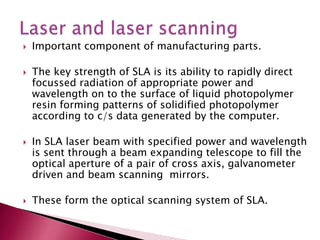
 The key strength of SLA is its ability to rapidly direct
focussed radiation of appropriate power and
wavelength on to the surface of liquid photopolymer
resin forming patterns of solidified photopolymer
according to c/s data generated by the computer.
 In SLA laser beam with specified power and wavelength
is sent through a beam expanding telescope to fill the
optical aperture of a pair of cross axis, galvanometer
driven and beam scanning mirrors.
 These form the optical scanning system of SLA.
 The beam comes to a focus on the surface of
a liquid photopolymer curing predetermined
depth of resin after controlled time of
exposure.
 Solidification of liquid resin depends on
energy per unit area deposited during motion
of the focussed spot on the surface of the
photopolymer.
The main advantages of using SLA are:
(1)Round the clock operation. The SLA can be used
continuously and unattended round the clock.
(2)Good user support. The computerized process serves as a
good user support.
(3) Build volumes. The different SLA machines have build
volumes ranging from small to large to suit the needs of
different users.
(4)Good accuracy. The SLA has good accuracy and can thus
be used or many application areas.
(5)Surface finish. The SLA can obtain one of the best surface
finishes amongst RP technologies.
(6) Wide range of materials. There is a wide range
of materials, from general-purpose materials to
specialty materials for specific
applications.
.
(1) Requires support structures. Structures that have
overhangs and undercuts must have supports that are
designed and fabricated together with the main structure.
(2) Requires post-processing. Post-processing includes removal of
supports and other unwanted materials, which is tedious, time
consuming and can damage the model.
(3) Requires post-curing. Post-curing may be needed to cure the
object completely and ensure the integrity of the structure
The SLA technology provide methods for reducing time to
market, lowering product development costs, gaining greater
control of their design process and improving product design.
(1)Models for conceptualization(an elaborated concept),
packaging and presentation.
(2) Prototypes for design, analysis, verify ,functional testing.
(3)Parts for prototype tooling and low volume production
tooling.
(4) Investment casting, sand casting and molding.
(5)Tools for fixture and tooling design, and production
tooling.
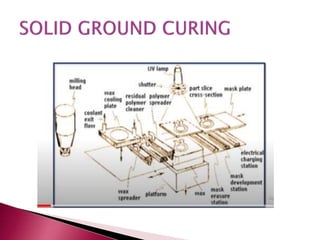
 The SGC process uses photosensitive resin
hardened in layers as with the Stereolithography
(SLA) process.

However, in contrast to SLA, the SGC process is
considered a high-throughput production
process.

The high throughput is achieved by hardening
each layer of photosensitive resin at once.
 Many parts can be created at once because of the
large work space and the fact that a milling step
maintains vertical accuracy.
 The multi-part capability also allows quite large
single parts (e.g. 500 x 500 x 350 mm /
 20 x 20 x 14 in) to be fabricated.
 Wax replaces liquid resin in non-part areas with
each layer so that model support is
ensured.
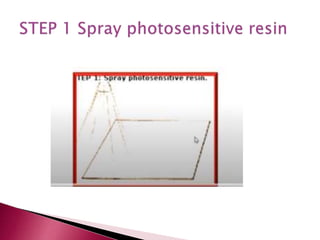
 First, a CAD model of the part is created and
it is sliced into layers using software.
 At the beginning of a layer creation step, the
flat work surface is sprayed with
photosensitive resin, as shown below:
 Photomask is used for production of
components.
 It is a master copy for patterning.
 Photomasks are used to transfer the patterns
on to the base plate.
 The photomask is positioned over the work
surface and a powerful UV lamp hardens the
exposed photosensitive resin.
 After the layer is cured, all uncured resin is
vacuumed for recycling, leaving the
hardened areas intact.
 The cured layer is passed beneath a strong
linear UV lamp to fully cure it and to solidify
any remnant particles, as illustrated below
 In the fifth step, wax replaces the cavities left
by vacuuming the liquid resin.

The wax is hardened by cooling to provide
continuous, solid support for the
model as it is fabricated.
 Extra supports are not needed.
 In the final step before the next layer, the
wax/resin surface is milled flat to an
accurate, reliable finish for the next layer:
 Once all layers are completed, the wax is
removed, and any finishing operations such
as sanding, etc. can be performed.
 No post-cure is necessary.
• High capital and operational cost
• Large heavy equipment
• Good dimensional accuaracy
• Much less warpage than SLA

Liquid based RP systems

  • 3.
     Most liquid-basedadditive manufacturing (AM) systems build parts in a vat of photocurable liquid resin, an organic resin that cures or solidifies under the effect of exposure to light, usually in the UV range.  The light cures the resin near the surface, forming a thin hardened layer.  Once the complete layer of the part is formed, it is lowered by an elevation control system to allow the next layer of resin to be coated and similarly formed over it.  This continues until the entire part is completed.
  • 4.
     There arevariations to this technique by the various vendors and they are dependent on  The type of light or laser  Method of scanning or exposure  Type of liquid resin  Type of elevation  Optical system
  • 5.
    Another method isby jetting drops of liquid photopolymer onto a build tray via a print head, akin to inkjet printing and curing them with UV light.  Again, there are variations to the technique depending on the types of resin, exposure, elevation and so on.
  • 6.
     3D Systems wasfounded in 1986 by inventor Charles W. Hull and entrepreneur Raymond S. Freed.  Among all the commercial AM systems, the Stereolithography Apparatus, or SLA as it is commonly called, is the pioneer with its first commercial system marketed in 1988.  The company has grown significantly through increased sales and acquisitions, most notably of EOS GmbH's stereolithography business in 1997
  • 7.
     By 2007,3D Systems had grown into a global company that delivered advanced rapid prototyping solutions to every major market around the world.  It has a global portfolio of nearly 400 U.S. and foreign patents, with additional patents filed or pending in the United States and several other major industrialised countries.  3D Systems Inc.is headquartered in 333 Three D Systems Circle Rock Hill, SC 29730 USA.
  • 8.
     3D Systemsproduces a wide range of AM machines to cater to various part sizes and throughput.  There are several models available, including those in the series of  ProJet® 6000 SD, HD and MP,  ProJet® 7000 SD. HD,  ProX 850 and 950.
  • 9.
     For largerbuild envelopes, the ProX 800 and 950 are available.  These machines are used to create casting patterns, moulds, end-use parts and functional prototypes.  These products' surface smoothness, feature resolution, edge definition and tolerances are enhanced.  The ProXⓇM 950 has single-part durability allowing for product build up to 1.5 m wide in one piece without any assembly required.
  • 11.
     These machinesuse one-component, photocurable liquid resins as the material for building.  There are several grades of resins available and usage is dependent on the machine's laser and the mechanical requirements of the part.
  • 12.
     Specific detailson the correct type of resins to be used are available from the manufacturer.  The other main consumable used by these machines is the cleaning solvent which is required to clean the part of any residual resin after the building of the part is completed on the machine.
  • 17.
     3D Systems'stereolithography process creates three- dimensional (3D) plastic objects directly from computer-aided design (CAD) data.  The process begins with the vat filled with the photocurable liquid resin and the elevator table set just below the surface of the liquid resin .  The 3DManage loads a 3D CAD solid model file into the system.  3DPrint software takes the output files from the 3DManage“ software, and then provides control of the build via the attached controller PC on the SLA system.  Supports are designed to stabilise the part during building.
  • 18.
     The translatorconverts the CAD data into an STL file.  The control unit slices the model and support into a series of cross sections from 0.025 to 0.5 mm (0.001–0.020 in.) thick.  The computer-controlled optical scanning system then directs and focuses the laser beam so that it solidifies a two-dimensional (2D) cross section corresponding to the slice on the surface of the photocurable liquid resin to a depth greater than one-layer thickness.  The elevator table then lowers enough to cover the solid polymer with another layer of the liquid resin. 
  • 19.
     A levellingwiper or vacuum blade moves across the surfaces to recoat the next layer of resin on the surface.  The laser then draws the next layer.  This process continues building the part from bottom up, until the system completes the part.  The part is then raised out of the vat and cleaned of excess polymer.
  • 20.
     The SLAprocess is based fundamentally on the following principles  (1) Parts are built from a photocurable liquid resin that cures when exposed to a laser beam (basically, undergoing the photopolymerisation process), which scans across the surface of the resin.
  • 21.
     (2) Thebuilding is done layer by layer, each layer being scanned by the optical scanning system and controlled by an elevation mechanism which lowers at the completion of each layer.
  • 22.
     This firstprinciple deals mostly with photocurable liquid resins, which are essentially photopolymers, and the photo polymerisation process.  The second principle deals mainly with CAD data, the laser and the control of the optical scanning system as well as the elevation mechanism.
  • 23.
     There aremany types of liquid photopolymers.  They are solidified by exposure to electromagnetic radiation, including wavelengths in the gamma rays, X-rays, UV and visible range, or electron- beam (EB).  The majority of photopolymers are curable in the UV range.  UV curable photopolymers are formed from photo initiators and reactive liquid monomers.
  • 24.
     Photoploymers containfillers and other chemical modifiers to meet specified chemical and mechanical requirements.  The process through which photopolymers are cured is referred to as the photopolymerisation process.
  • 25.
    Polymerisation is theprocess of linking small molecules (known as monomers) into chain- like larger molecules (known as polymers). Photo polymerisation is polymerisation initiated by a photochemical process whereby the starting point is usually the induction of energy from an appropriate radiation source.
  • 26.
     Polymerisation ofphotopolymers is exothermic reaction.  A catalyst is required for polymerisation to take place at a reasonable rate.  This catalyst is usually a free radical which may be  generated photo chemically.  The source of a photo chemically generated radical is a photo initiator.  photo initiators reacts with an actinic photon to produce the radicals that catalyse the polymerisation process.
  • 28.
    The free-radical photopolymerization process Photo initiator molecules, Pi, which are mixed with the monomers, M, are exposed to a UV source of actinic photons, with energy of hν . The photo initiators absorb some of the photons and are in an excited state. Some of these are converted into reactive initiator molecules, P•, after undergoing several complex chemical energy transformation steps. These molecules then react with a monomer molecule to form a polymerization initiating molecule, PM•. This is the chain initiation step. Once activated, additional monomer molecules go on to react in the chain propagation step, forming longer molecules, PMMM• until a chain inhibition process terminates the polymerization reaction.
  • 29.
     Almost allAM systems use layering technology in creation of prototype parts.  Basic principle is availability of computer software to slice CAD model into layers and reproduce it in an output device like laser scanning system.  The layer thickness is controlled by precision elevation mechanism
  • 30.
     Important componentof manufacturing parts.  The key strength of SLA is its ability to rapidly direct focussed radiation of appropriate power and wavelength on to the surface of liquid photopolymer resin forming patterns of solidified photopolymer according to c/s data generated by the computer.  In SLA laser beam with specified power and wavelength is sent through a beam expanding telescope to fill the optical aperture of a pair of cross axis, galvanometer driven and beam scanning mirrors.  These form the optical scanning system of SLA.
  • 31.
     The beamcomes to a focus on the surface of a liquid photopolymer curing predetermined depth of resin after controlled time of exposure.  Solidification of liquid resin depends on energy per unit area deposited during motion of the focussed spot on the surface of the photopolymer.
  • 32.
    The main advantagesof using SLA are: (1)Round the clock operation. The SLA can be used continuously and unattended round the clock. (2)Good user support. The computerized process serves as a good user support. (3) Build volumes. The different SLA machines have build volumes ranging from small to large to suit the needs of different users.
  • 33.
    (4)Good accuracy. TheSLA has good accuracy and can thus be used or many application areas. (5)Surface finish. The SLA can obtain one of the best surface finishes amongst RP technologies. (6) Wide range of materials. There is a wide range of materials, from general-purpose materials to specialty materials for specific applications. .
  • 34.
    (1) Requires supportstructures. Structures that have overhangs and undercuts must have supports that are designed and fabricated together with the main structure. (2) Requires post-processing. Post-processing includes removal of supports and other unwanted materials, which is tedious, time consuming and can damage the model. (3) Requires post-curing. Post-curing may be needed to cure the object completely and ensure the integrity of the structure
  • 35.
    The SLA technologyprovide methods for reducing time to market, lowering product development costs, gaining greater control of their design process and improving product design. (1)Models for conceptualization(an elaborated concept), packaging and presentation. (2) Prototypes for design, analysis, verify ,functional testing. (3)Parts for prototype tooling and low volume production tooling. (4) Investment casting, sand casting and molding. (5)Tools for fixture and tooling design, and production tooling.
  • 37.
     The SGCprocess uses photosensitive resin hardened in layers as with the Stereolithography (SLA) process.  However, in contrast to SLA, the SGC process is considered a high-throughput production process.  The high throughput is achieved by hardening each layer of photosensitive resin at once.
  • 38.
     Many partscan be created at once because of the large work space and the fact that a milling step maintains vertical accuracy.  The multi-part capability also allows quite large single parts (e.g. 500 x 500 x 350 mm /  20 x 20 x 14 in) to be fabricated.  Wax replaces liquid resin in non-part areas with each layer so that model support is ensured.
  • 40.
     First, aCAD model of the part is created and it is sliced into layers using software.  At the beginning of a layer creation step, the flat work surface is sprayed with photosensitive resin, as shown below:
  • 42.
     Photomask isused for production of components.  It is a master copy for patterning.  Photomasks are used to transfer the patterns on to the base plate.  The photomask is positioned over the work surface and a powerful UV lamp hardens the exposed photosensitive resin.
  • 45.
     After thelayer is cured, all uncured resin is vacuumed for recycling, leaving the hardened areas intact.  The cured layer is passed beneath a strong linear UV lamp to fully cure it and to solidify any remnant particles, as illustrated below
  • 47.
     In thefifth step, wax replaces the cavities left by vacuuming the liquid resin.  The wax is hardened by cooling to provide continuous, solid support for the model as it is fabricated.  Extra supports are not needed.
  • 49.
     In thefinal step before the next layer, the wax/resin surface is milled flat to an accurate, reliable finish for the next layer:
  • 51.
     Once alllayers are completed, the wax is removed, and any finishing operations such as sanding, etc. can be performed.  No post-cure is necessary.
  • 53.
    • High capitaland operational cost • Large heavy equipment • Good dimensional accuaracy • Much less warpage than SLA