Isolation, Identification and Analysis of Phytoconstituents
Terpenoids: Menthol, Citral, Artemisin
Glycosides: Glycyrrhetinic acid & Rutin
UNIT 3
B. Pharm 5th Semester
Pharmacognosy & Phytochemistry II
Pranita Sunar
Assistant Professor
MGCOP
Terpenes or terpenoids are a secondary metabolite compounds, majority of which are found in
plant species and few are obtained from other sources such as fungi, algae and sponges. These
are volatile substances which is also responsible for fragrance of some flowers and plants.
Terpenoids are the polymers of isoprene units (C5H8)n. Hence, they are also known as
Isoprenoids.
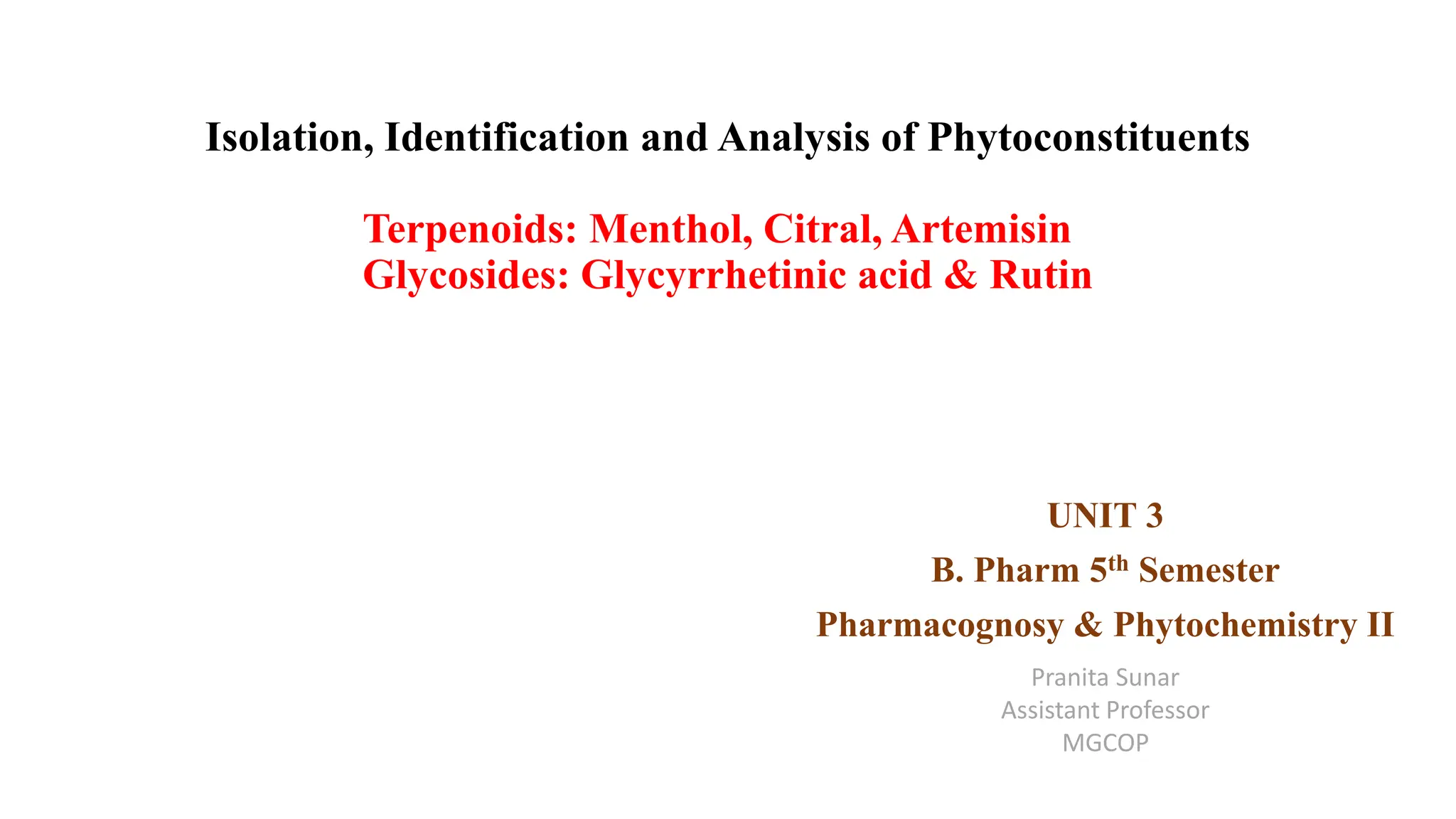
1. MENTHOL
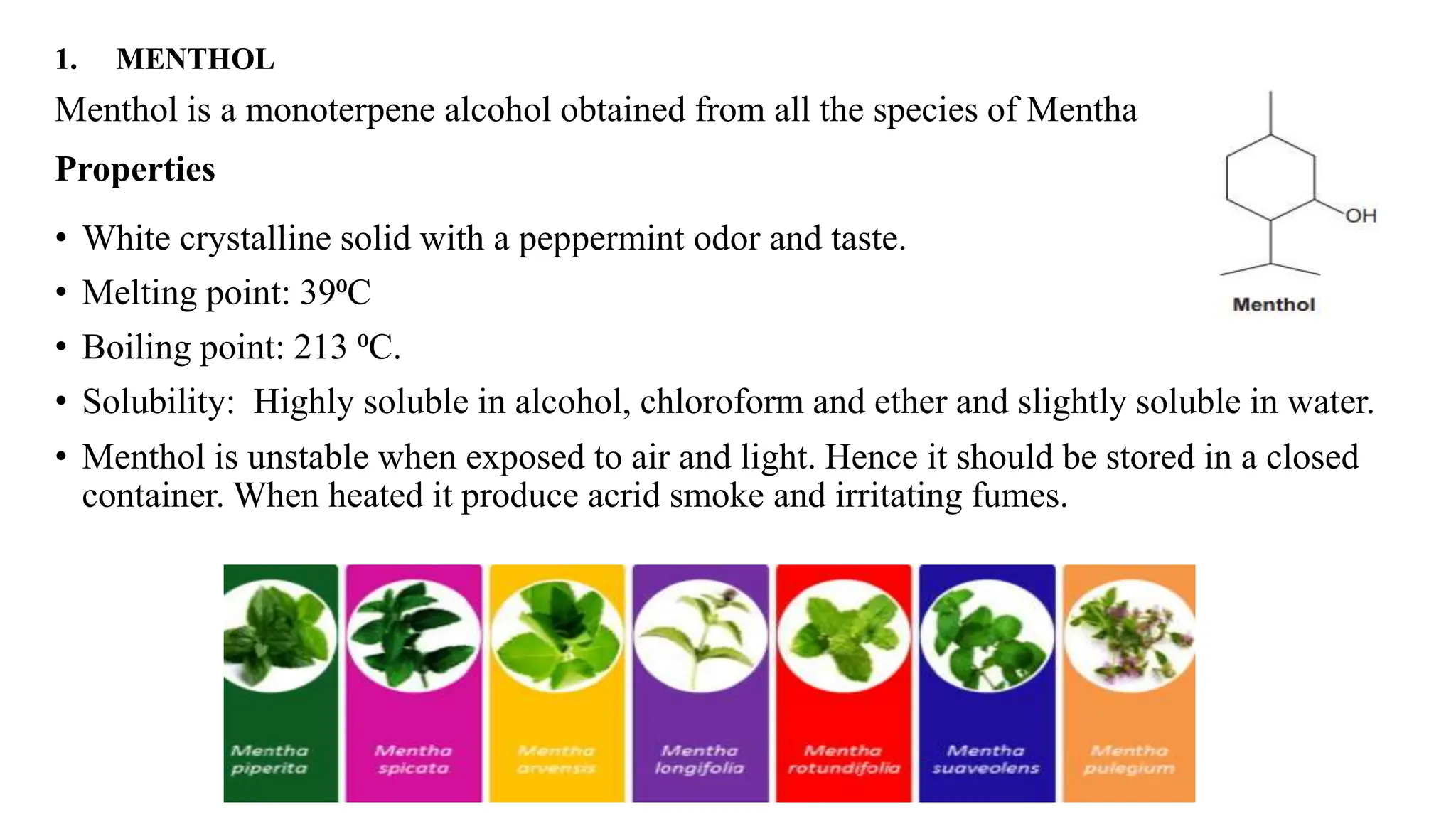
Menthol is a monoterpene alcohol obtained from all the species of Mentha
Properties
• White crystalline solid with a peppermint odor and taste.
• Melting point: 39⁰C
• Boiling point: 213 ⁰C.
• Solubility: Highly soluble in alcohol, chloroform and ether and slightly soluble in water.
• Menthol is unstable when exposed to air and light. Hence it should be stored in a closed
container. When heated it produce acrid smoke and irritating fumes.
Isolation of Menthol:
Mentha oil is obtained by hydro distillation of fresh parts of the Mentha
plant. For the isolation of menthol from peppermint oil, the oil is subjected
to cooling. The menthol crystal crystallizes out and is separated by
centrifugation.
Identification and analysis of Menthol
Chemical test:
Vanillin-Sulphuric Acid test: 10 mg menthol crystals are dissolved in 4
drops of concentrated sulphuric acid and added a few drops of vanillin
sulphuric acid reagent. It shows orange-yellow colour which changes to
violet upon the addition of a few ml of water.
Chromatographic method (TLC):
• Sampling: 1 mg menthol is dissolved in 1 ml of methanol.
• Mobile phase: Toluene: Ethyl acetate (9.3:0.7)
• Detecting agent: The dried plates are sprayed with a 1% vanillin-sulphuric acid reagent.
Heat the plate at 110°C for 10 minutes.
• Rf values: 0.48-0.62.
• Spectroscopic method
(a) IR Spectroscopic method: Determine the different functional groups. 3315 cm -1 (O-H), 2850-2957 cm-1
(C-H), 1025-1045 cm-1 (C-O).
(b) UV spectra: UV-Visible is spectra of menthol in alcohol. λmax of the menthol is 253 nm.
(c) Mass spectra: To determine molecular weight in molecules. Molecular weight of menthol is 156.27 g/mol
(d) 13C NMR spectra: To determine the numbers and types of C and H atom present in structure of molecules.
Pharmacological action:
Nasal decongestant, Counter-irritant effect on skin and mucous membranes, Local analgesic
or anaesthetic effect and Antimicrobial flavouring.
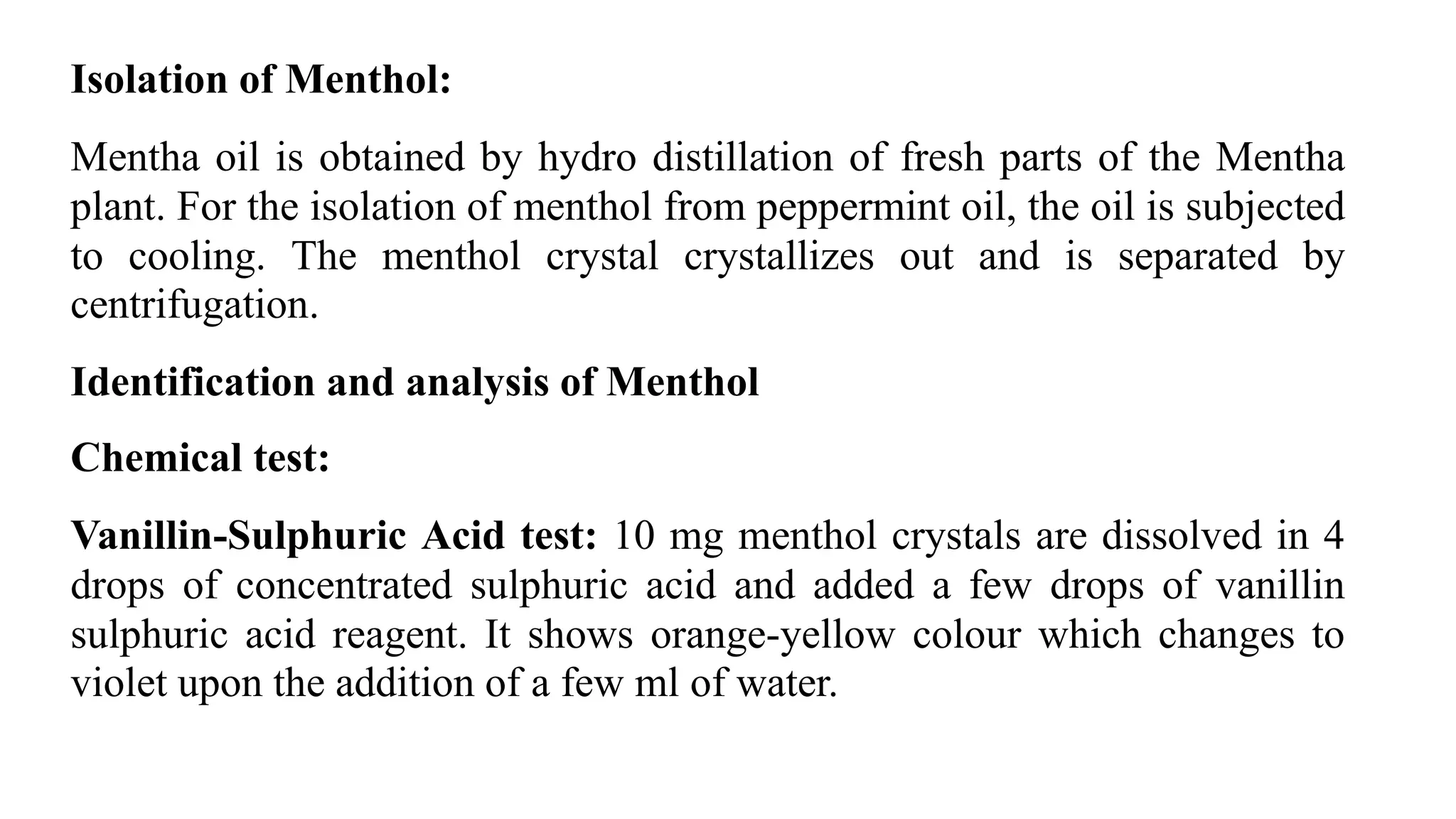
2. CITRAL
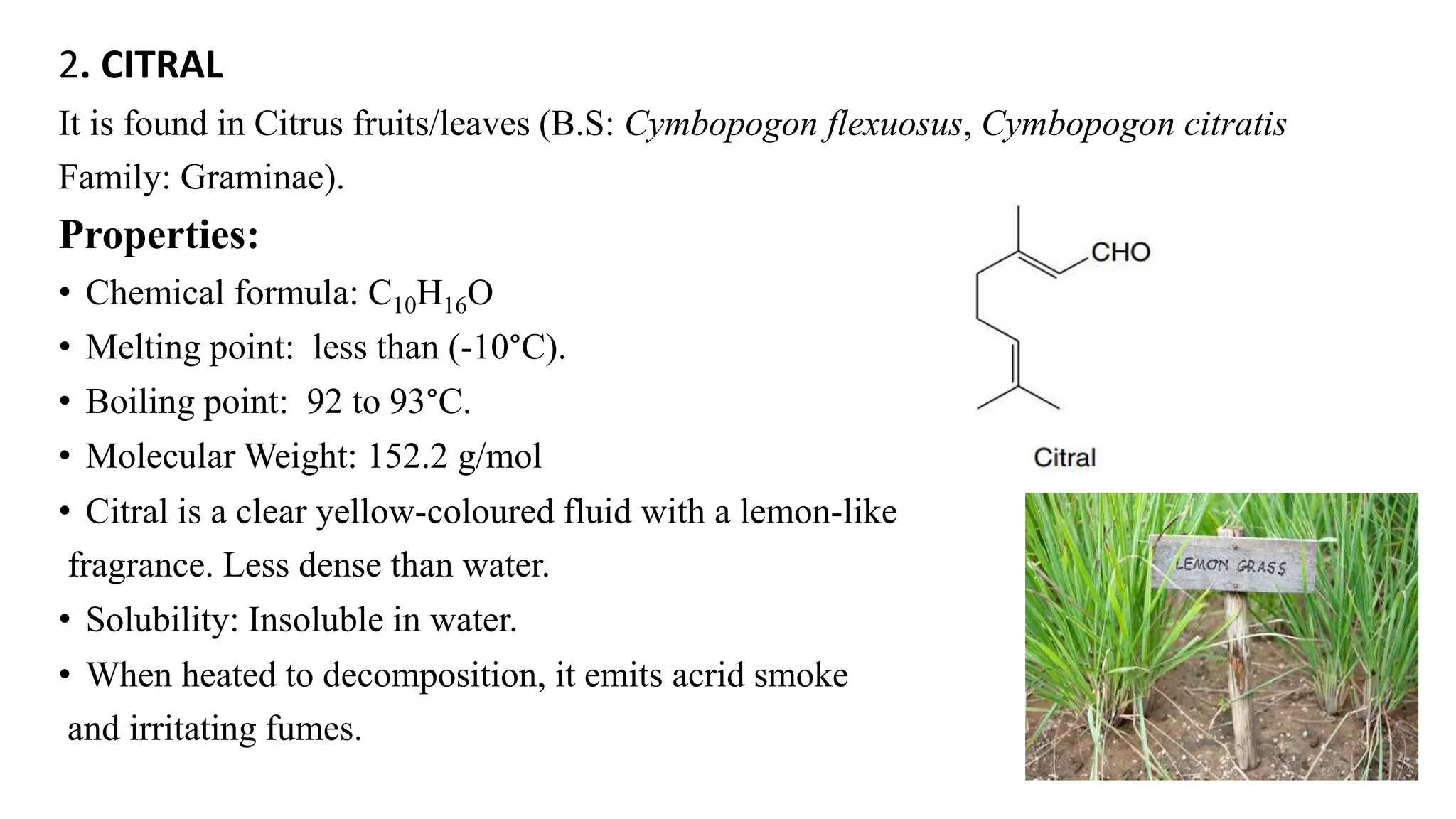
It is found in Citrus fruits/leaves (B.S: Cymbopogon flexuosus, Cymbopogon citratis
Family: Graminae).
Properties:
• Chemical formula: C10H16O
• Melting point: less than (-10°C).
• Boiling point: 92 to 93°C.
• Molecular Weight: 152.2 g/mol
• Citral is a clear yellow-coloured fluid with a lemon-like
fragrance. Less dense than water.
• Solubility: Insoluble in water.
• When heated to decomposition, it emits acrid smoke
and irritating fumes.
Isolation:
• The lemongrass oil is shaken with 5 % Sodium bisulphate solution for 25 to 30 minutes.
The resultant is first separated on the Buchner funnel and washed with solvent ether or
ethanol.
• The crude citral is regenerated with dilute sodium hydroxide solution. Pure citral is
obtained by distillation of crude citral under reduced pressure.
Identification and analysis of Citral
Chemical test:
Vanillin-sulphuric acid test: 1 ml Citral is dissolved in 4 drops of concentrated sulphuric
acid and added a few drops of vanillin sulphuric acid reagent. It shows orange-yellow
colour which changes to violet upon the addition of a few ml of water.
Chromatographic method (TLC):
• Sampling :1 ml citral
• Mobile phase: Toluene: Ethyl acetate (9.3:0.7)
• Detecting agent:
• Vanillin-sulphuric acid reagent + heating
• Anisaldehyde-sulphuric acid reagent + heating
• Rf values: 0.42
Pharmacological action: Insecticides and insect repellent, Antimicrobial, Antiseptic,
Flavouring agent, Stomachache.
3. Artemisinin
It is a sesquiterpene lactone found in a Chinese herb Artemisia annua belonging to family
Asteraceae which is best known for its antimalarial activity.
Properties
• Molecular formula: C15H22O5
• Molecular weight: 282.332 g/mol
• Form: colourless needles or white crystalline powder.
• Solubility: insoluble in water, very soluble in ethanol and methanol.
Isolation of Artemisinin
Identification test: 1 gm finely powdered drug is boiled with 10 ml alcohol and
filtered. Then add sodium hydroxide to the filtrate and heat again. The red colour
develops in liquid.
Chromatographic method (TLC):
• Sampling :1mg artemisinin dissolve in chloroform.
• Mobile phase: Petroleum ether: Ethyl acetate (1:2).
• Detecting agent: Vanillin-sulphuric acid reagent + heating
• Rf values: 0.67
Uses: Artemisinin shows antimalarial, Anti-bacterial, Anti-inflammatory & Anti-
HIV activity.
GLYCOSIDES
1. GLYCYRRHETINIC ACID
It is obtained from the roots & stolon of Glycyrrhiza glabra belonging to
family Leguminosae.
Properties:
• Mol formula: C30H46O4
• Molecular weight: 470.694 g/mol
• Melting point: 300°C.
• Form: White crystalline powder.
• Solubility: Soluble in chloroform, benzene, ether and insoluble in water.
Isolation of glycyrrhetinic acid
1. Coarsely powdered drug of Glycyrrhiza is extracted with chloroform. The
chloroform extract is filtered and the filtrate is discarded.
2. Then obtained marc is extracted with 0.5M sulphuric acid for 1 hour.
3. Filter and extract the filtrate with 3 portions of chloroform.
4. Separate the chloroform layer. Repeat this step again.
5. Combine the chloroform layers.
6. Then distil off the chloroform extract to yield the dry residue of
glycyrrhetinic acid.
Identification and analysis of Glycyrrhetinic acid
Chemical test:
Liebermann Burchard test:
2 ml test extract is mixed with 1 ml chloroform and 1 ml acetic anhydride. Then add one drop of
concentrated sulphuric acid. Blue-green to red-orange colour develops.
Chromatographic method
(TLC):
Sampling: 1 mg of glycyrrhetinic acid is dissolved in 1 ml methanol chloroform (1:1) solvent. Mobile
phase: Toluene-ethyl acetate-glacial acetic acid (12:8:0.5).
Detecting agent:
• Vanillin-sulphuric acid reagent + heating OR
• Anisaldehyde-sulphuric acid reagent + heating the plates for 10 minutes at 1100C gives purplish spot.
Rf values: 0.41
Uses: Expectorant, Demulcent, Anti-inflammatory & anti-ulcer.
2. RUTIN
Rutin is a citrus flavonoid glycoside, obtained from the various plant species such as Rhubarb (Rheum emodi,
Family: Polygonaceae), Tobacco (Nicotiana tabacum, Family: Solanaceae), Ruta (Ruta graveolens, Family:
Rutaceae), Tea (Thea sinensis, Family: Theaceae), Eucalyptus (Eucalyptus macrorhyncha, Fam- Myrtaceae).
Properties:
• Molecular formula: C27H30O16
• Melting point: 242°C
• Molecular weight: 610.517 g/mol
• Form: Light yellow or yellow-green needle crystal or crystalline powder.
• Taste: Slightly bitter.
Isolation of Rutin:
a. Coarsely powdered drug is first defatted with n-hexane.
b. Then extract the marc with alcohol (78%) for 60 minutes.
c. Filter the solution and evaporate the solvent.
d. The obtained dried residue is dissolved in a sufficient quantity of acetone (30%).
e. Filter the solution and evaporate the filtrate to one-fourth of its original weight.
f. Then add a sufficient quantity of borax solution (5%) until pH 7.5 with continuous shaking.
g. Then add enough quantity of solid sodium chloride with stirring.
h. Filter the solution and acidify it with phosphoric acid to lower the pH 5.5.
i. Stir the solution for 15 minutes and filter it.
j. Wash the residue with sodium chloride (20%) solution.
k. Again, filter the solution and evaporate the filtrate to 500°C to one-fourth of its original
volume.
l. Then add hydrochloric acid in hot conditions to lower the pH to 1.5. Cool the solution and
kept in the refrigerator overnight.
m. Rutin crystals will be separated out, collect, and dried.
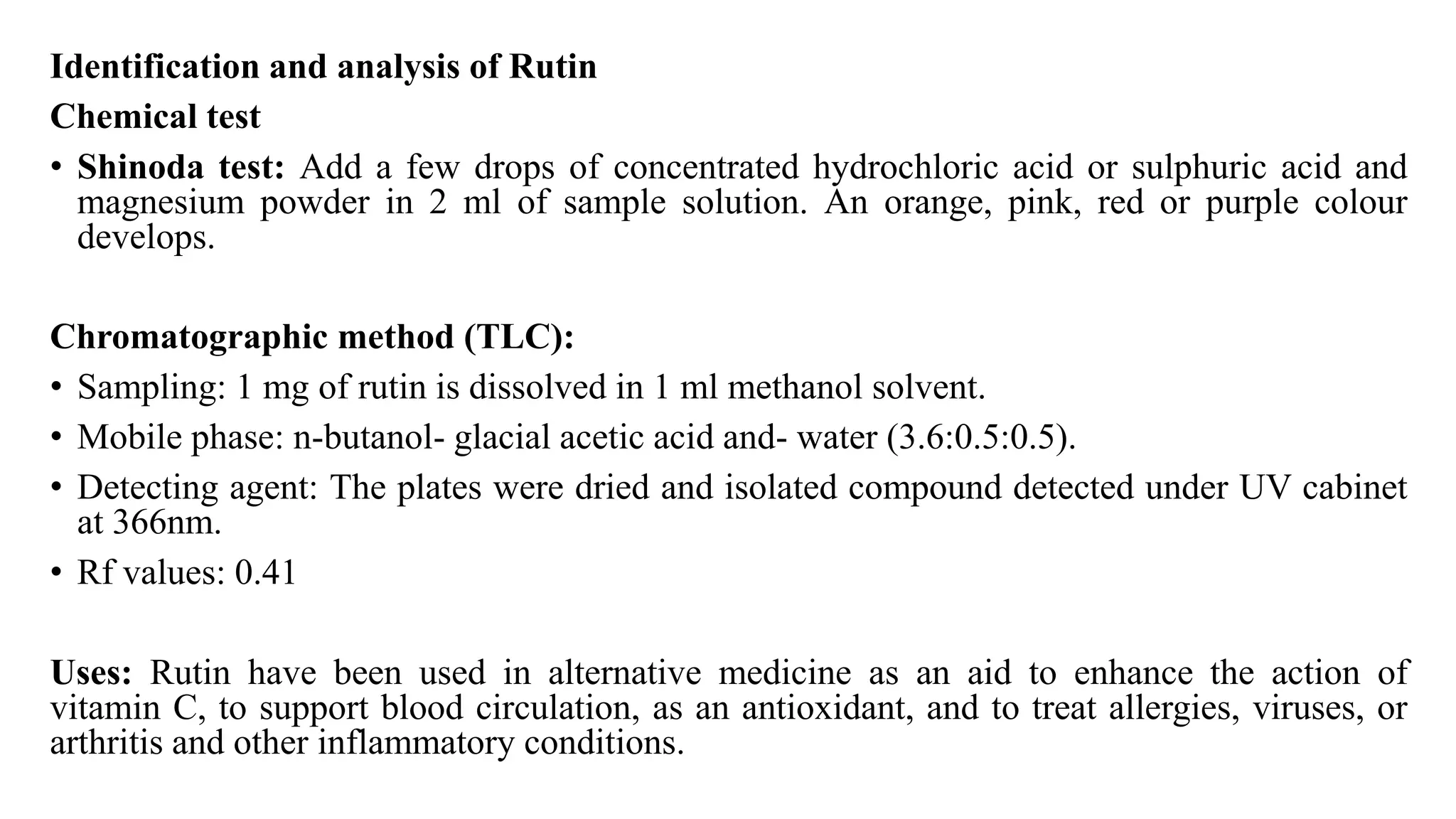
Identification and analysis of Rutin
Chemical test
• Shinoda test: Add a few drops of concentrated hydrochloric acid or sulphuric acid and
magnesium powder in 2 ml of sample solution. An orange, pink, red or purple colour
develops.
Chromatographic method (TLC):
• Sampling: 1 mg of rutin is dissolved in 1 ml methanol solvent.
• Mobile phase: n-butanol- glacial acetic acid and- water (3.6:0.5:0.5).
• Detecting agent: The plates were dried and isolated compound detected under UV cabinet
at 366nm.
• Rf values: 0.41
Uses: Rutin have been used in alternative medicine as an aid to enhance the action of
vitamin C, to support blood circulation, as an antioxidant, and to treat allergies, viruses, or
arthritis and other inflammatory conditions.
Pharmacognosy & Phytochemistry 2 unit 3.pptx

Pharmacognosy & Phytochemistry 2 unit 3.pptx

  • 1.
    Isolation, Identification andAnalysis of Phytoconstituents Terpenoids: Menthol, Citral, Artemisin Glycosides: Glycyrrhetinic acid & Rutin UNIT 3 B. Pharm 5th Semester Pharmacognosy & Phytochemistry II Pranita Sunar Assistant Professor MGCOP
  • 2.
    Terpenes or terpenoidsare a secondary metabolite compounds, majority of which are found in plant species and few are obtained from other sources such as fungi, algae and sponges. These are volatile substances which is also responsible for fragrance of some flowers and plants. Terpenoids are the polymers of isoprene units (C5H8)n. Hence, they are also known as Isoprenoids.
  • 3.
    1. MENTHOL Menthol isa monoterpene alcohol obtained from all the species of Mentha Properties • White crystalline solid with a peppermint odor and taste. • Melting point: 39⁰C • Boiling point: 213 ⁰C. • Solubility: Highly soluble in alcohol, chloroform and ether and slightly soluble in water. • Menthol is unstable when exposed to air and light. Hence it should be stored in a closed container. When heated it produce acrid smoke and irritating fumes.
  • 4.
    Isolation of Menthol: Menthaoil is obtained by hydro distillation of fresh parts of the Mentha plant. For the isolation of menthol from peppermint oil, the oil is subjected to cooling. The menthol crystal crystallizes out and is separated by centrifugation. Identification and analysis of Menthol Chemical test: Vanillin-Sulphuric Acid test: 10 mg menthol crystals are dissolved in 4 drops of concentrated sulphuric acid and added a few drops of vanillin sulphuric acid reagent. It shows orange-yellow colour which changes to violet upon the addition of a few ml of water.
  • 5.
    Chromatographic method (TLC): •Sampling: 1 mg menthol is dissolved in 1 ml of methanol. • Mobile phase: Toluene: Ethyl acetate (9.3:0.7) • Detecting agent: The dried plates are sprayed with a 1% vanillin-sulphuric acid reagent. Heat the plate at 110°C for 10 minutes. • Rf values: 0.48-0.62.
  • 6.
    • Spectroscopic method (a)IR Spectroscopic method: Determine the different functional groups. 3315 cm -1 (O-H), 2850-2957 cm-1 (C-H), 1025-1045 cm-1 (C-O). (b) UV spectra: UV-Visible is spectra of menthol in alcohol. λmax of the menthol is 253 nm. (c) Mass spectra: To determine molecular weight in molecules. Molecular weight of menthol is 156.27 g/mol (d) 13C NMR spectra: To determine the numbers and types of C and H atom present in structure of molecules. Pharmacological action: Nasal decongestant, Counter-irritant effect on skin and mucous membranes, Local analgesic or anaesthetic effect and Antimicrobial flavouring.
  • 7.
    2. CITRAL It isfound in Citrus fruits/leaves (B.S: Cymbopogon flexuosus, Cymbopogon citratis Family: Graminae). Properties: • Chemical formula: C10H16O • Melting point: less than (-10°C). • Boiling point: 92 to 93°C. • Molecular Weight: 152.2 g/mol • Citral is a clear yellow-coloured fluid with a lemon-like fragrance. Less dense than water. • Solubility: Insoluble in water. • When heated to decomposition, it emits acrid smoke and irritating fumes.
  • 8.
    Isolation: • The lemongrassoil is shaken with 5 % Sodium bisulphate solution for 25 to 30 minutes. The resultant is first separated on the Buchner funnel and washed with solvent ether or ethanol. • The crude citral is regenerated with dilute sodium hydroxide solution. Pure citral is obtained by distillation of crude citral under reduced pressure. Identification and analysis of Citral Chemical test: Vanillin-sulphuric acid test: 1 ml Citral is dissolved in 4 drops of concentrated sulphuric acid and added a few drops of vanillin sulphuric acid reagent. It shows orange-yellow colour which changes to violet upon the addition of a few ml of water.
  • 9.
    Chromatographic method (TLC): •Sampling :1 ml citral • Mobile phase: Toluene: Ethyl acetate (9.3:0.7) • Detecting agent: • Vanillin-sulphuric acid reagent + heating • Anisaldehyde-sulphuric acid reagent + heating • Rf values: 0.42 Pharmacological action: Insecticides and insect repellent, Antimicrobial, Antiseptic, Flavouring agent, Stomachache.
  • 10.
    3. Artemisinin It isa sesquiterpene lactone found in a Chinese herb Artemisia annua belonging to family Asteraceae which is best known for its antimalarial activity. Properties • Molecular formula: C15H22O5 • Molecular weight: 282.332 g/mol • Form: colourless needles or white crystalline powder. • Solubility: insoluble in water, very soluble in ethanol and methanol.
  • 11.
  • 12.
    Identification test: 1gm finely powdered drug is boiled with 10 ml alcohol and filtered. Then add sodium hydroxide to the filtrate and heat again. The red colour develops in liquid. Chromatographic method (TLC): • Sampling :1mg artemisinin dissolve in chloroform. • Mobile phase: Petroleum ether: Ethyl acetate (1:2). • Detecting agent: Vanillin-sulphuric acid reagent + heating • Rf values: 0.67 Uses: Artemisinin shows antimalarial, Anti-bacterial, Anti-inflammatory & Anti- HIV activity.
  • 13.
    GLYCOSIDES 1. GLYCYRRHETINIC ACID Itis obtained from the roots & stolon of Glycyrrhiza glabra belonging to family Leguminosae. Properties: • Mol formula: C30H46O4 • Molecular weight: 470.694 g/mol • Melting point: 300°C. • Form: White crystalline powder. • Solubility: Soluble in chloroform, benzene, ether and insoluble in water.
  • 14.
    Isolation of glycyrrhetinicacid 1. Coarsely powdered drug of Glycyrrhiza is extracted with chloroform. The chloroform extract is filtered and the filtrate is discarded. 2. Then obtained marc is extracted with 0.5M sulphuric acid for 1 hour. 3. Filter and extract the filtrate with 3 portions of chloroform. 4. Separate the chloroform layer. Repeat this step again. 5. Combine the chloroform layers. 6. Then distil off the chloroform extract to yield the dry residue of glycyrrhetinic acid.
  • 15.
    Identification and analysisof Glycyrrhetinic acid Chemical test: Liebermann Burchard test: 2 ml test extract is mixed with 1 ml chloroform and 1 ml acetic anhydride. Then add one drop of concentrated sulphuric acid. Blue-green to red-orange colour develops. Chromatographic method (TLC): Sampling: 1 mg of glycyrrhetinic acid is dissolved in 1 ml methanol chloroform (1:1) solvent. Mobile phase: Toluene-ethyl acetate-glacial acetic acid (12:8:0.5). Detecting agent: • Vanillin-sulphuric acid reagent + heating OR • Anisaldehyde-sulphuric acid reagent + heating the plates for 10 minutes at 1100C gives purplish spot. Rf values: 0.41 Uses: Expectorant, Demulcent, Anti-inflammatory & anti-ulcer.
  • 16.
    2. RUTIN Rutin isa citrus flavonoid glycoside, obtained from the various plant species such as Rhubarb (Rheum emodi, Family: Polygonaceae), Tobacco (Nicotiana tabacum, Family: Solanaceae), Ruta (Ruta graveolens, Family: Rutaceae), Tea (Thea sinensis, Family: Theaceae), Eucalyptus (Eucalyptus macrorhyncha, Fam- Myrtaceae). Properties: • Molecular formula: C27H30O16 • Melting point: 242°C • Molecular weight: 610.517 g/mol • Form: Light yellow or yellow-green needle crystal or crystalline powder. • Taste: Slightly bitter.
  • 17.
    Isolation of Rutin: a.Coarsely powdered drug is first defatted with n-hexane. b. Then extract the marc with alcohol (78%) for 60 minutes. c. Filter the solution and evaporate the solvent. d. The obtained dried residue is dissolved in a sufficient quantity of acetone (30%). e. Filter the solution and evaporate the filtrate to one-fourth of its original weight. f. Then add a sufficient quantity of borax solution (5%) until pH 7.5 with continuous shaking. g. Then add enough quantity of solid sodium chloride with stirring. h. Filter the solution and acidify it with phosphoric acid to lower the pH 5.5. i. Stir the solution for 15 minutes and filter it. j. Wash the residue with sodium chloride (20%) solution. k. Again, filter the solution and evaporate the filtrate to 500°C to one-fourth of its original volume. l. Then add hydrochloric acid in hot conditions to lower the pH to 1.5. Cool the solution and kept in the refrigerator overnight. m. Rutin crystals will be separated out, collect, and dried.
  • 18.
    Identification and analysisof Rutin Chemical test • Shinoda test: Add a few drops of concentrated hydrochloric acid or sulphuric acid and magnesium powder in 2 ml of sample solution. An orange, pink, red or purple colour develops. Chromatographic method (TLC): • Sampling: 1 mg of rutin is dissolved in 1 ml methanol solvent. • Mobile phase: n-butanol- glacial acetic acid and- water (3.6:0.5:0.5). • Detecting agent: The plates were dried and isolated compound detected under UV cabinet at 366nm. • Rf values: 0.41 Uses: Rutin have been used in alternative medicine as an aid to enhance the action of vitamin C, to support blood circulation, as an antioxidant, and to treat allergies, viruses, or arthritis and other inflammatory conditions.