Drugs containing lipids 09PPB110 DEPT. OF  BOTANY. ST. JOSEPH’S COLLEGE TRICHY - 2
What Is a Lipid? Lipids  are a broad group of naturally occurring molecules which includes fats, waxes, sterols, fat-soluble vitamins (such as vitamins A, D, E and K), monoglycerides, diglycerides, phospholipids, and others. The main biological functions of lipids include energy storage, as structural components of cell membranes, and as important signaling molecules..
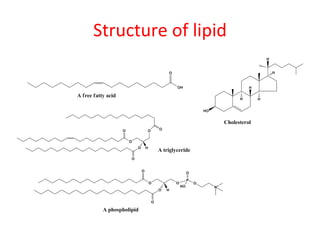
Structure of lipid
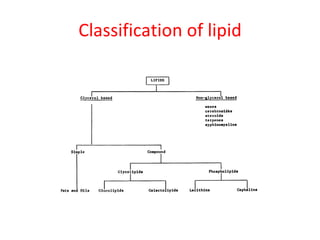
Classification of lipid
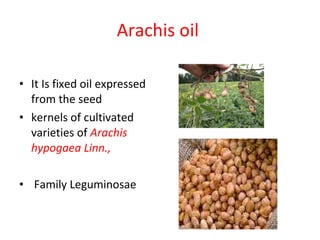
Arachis oil  It Is fixed oil expressed from the seed  kernels of cultivated  varieties of  Arachis  hypogaea Linn., Family Leguminosae
Method preparation Peanut kernels contain about 40-50% of fixed oil.  The graded and cleaned kernels are crushed d  and oil is separated by expression further quantity of oil is collected by hot expression method.  Both fractions are mixed together.  It is then allowed to stand for some time to separate stearin   and filtered.  The oil is then treated with fueller’s earth or carbon for bleaching and filtered thoroughly by using filter presses.
description Colour - Pale yellow colored liquid Odour  - Faint and characteristic Taste - Bland  Solubility  -It is slightly soluble in alcohol and soluble in solvent either, chloroform and light petroleum(40-60 c)
Chemical constituents Arachis iol consists of glycerides of fatty acids, chiefly oleic,linileic,stearic and other acids are lignoceric and palmitic acids.
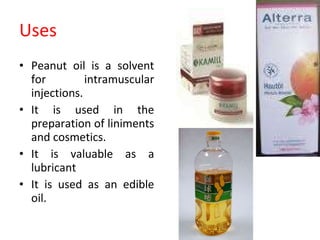
Uses Peanut oil is a solvent for intramuscular injections. It is used in the preparation of liniments and cosmetics. It is valuable as a lubricant It is used as an edible oil.
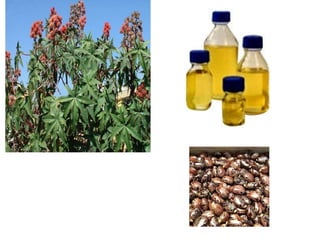
Castor oil  Biological source Castor oil is the fixed oil obtained by the cold expression of the seeds of  Ricinus communis , Family-  Euphorbiaceae. Composition of  seeds Castor oil  is a fixed oil of therapeutic importance and purgative in action it cannot be consumed freely. Apart from the oil seeds also contain some of the toxic substances (recin).  Castor seeds consist  of 75% kernel and 25% of hull.
 
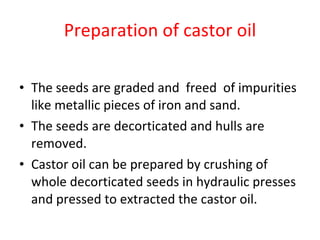
Preparation of castor oil The seeds are graded and  freed  of impurities like metallic pieces of iron and sand.  The seeds are decorticated and hulls are removed.  Castor oil can be prepared by crushing of whole decorticated seeds in hydraulic presses and pressed to extracted the castor oil.
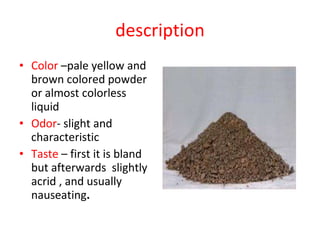
description Color  –pale yellow and brown colored powder or almost colorless liquid  Odor - slight and  characteristic Taste  – first it is bland but afterwards  slightly acrid , and usually nauseating .
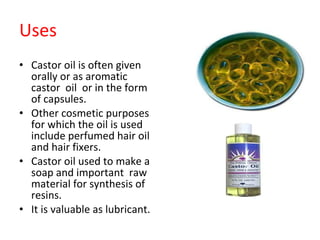
Uses   Castor oil is often given orally or as aromatic castor  oil  or in the form of capsules. Other cosmetic purposes for which the oil is used include perfumed hair oil and hair fixers. Castor oil used to make a soap and important  raw material for synthesis of resins. It is valuable as lubricant.
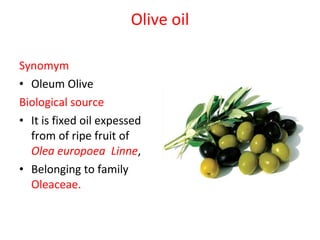
Olive oil Synomym Oleum Olive  Biological source It is fixed oil expessed from of ripe fruit of  Olea europoea  Linne ,  Belonging to family  Oleaceae.
Method of preparation  It is prepared by crushing and pressing the ripe fruits called Olives.  The entire olive consists of 20-30 percent oil. The  fruit pulp has  60-80 percent oil.  The hydraulic pressed are used to squeeze the oil out of fruit under low pressure.  The further pressing give low quality oil. The oil that comes from the last pressing is called olive residue and is generally used for cosmetics, medicines, etc.
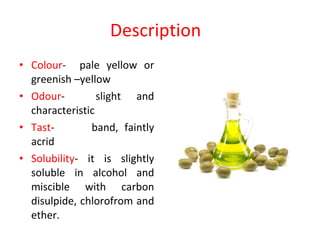
Description  Colour -  pale yellow or greenish –yellow Odour -  slight and characteristic Tast -  band, faintly acrid Solubility - it is slightly soluble in alcohol and miscible with carbon disulpide, chlorofrom and ether.
Chemical constituents  The olive oil contains the triglycerides mainly in the from of olein. Palmitin and linolein.
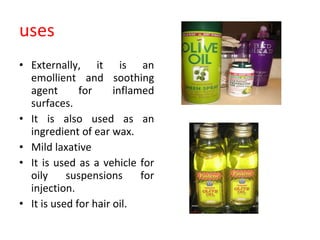
uses Externally, it is an emollient and soothing agent for inflamed surfaces.  It is also used as an ingredient of ear wax. Mild laxative It is used as a vehicle for oily suspensions for injection. It is used for hair oil.
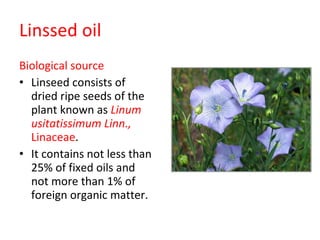
Linssed oil Biological source Linseed consists of dried ripe seeds of the plant known as  Linum usitatissimum Linn.,  Linaceae . It contains not less than 25% of fixed oils and not more than 1% of foreign organic matter.
Method of preparation Mature Seeds are served to make free of earthy matter and other materials. Commercially, linseed oil is produced by use of expellers. Before the seeds are subjected to the expellers, they are rolled into meal, then moistened and heated by means off steam jacketed troughs filled over the expellers.
An average yield of oil is 30 – 35% The expressed oil is tanked for along period, to settle the coloring matter and mucilage. The oil is then treated with alkali (NaOH, KOH Ca)immediately after filtration. Alkali treatment helps to remove free fatty acids. Bleaching of oil is done by either charcoal of fuller's earth at elevated temperature. The refined oil are chilled to separate wax.
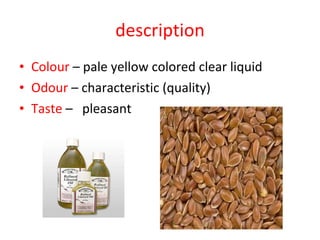
description Colour  – pale yellow colored clear liquid Odour  – characteristic (quality) Taste  –  pleasant
Chemical constituents It contains the glycerides of palmitic, stewaric, oleic, linoleic and linolenic acids. Linseed also contains a cyanogenetic (beta)glycoside linamartin and mucilage(5%). In addition of fixed oil (20 -40%)
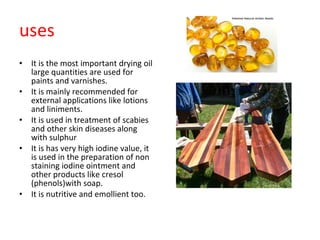
uses It is the most important drying oil large quantities are used for paints and varnishes. It is mainly recommended for external applications like lotions and liniments. It is used in treatment of scabies and other skin diseases along with sulphur It is has very high iodine value, it is used in the preparation of non staining iodine ointment and other products like cresol (phenols)with soap. It is nutritive and emollient too.
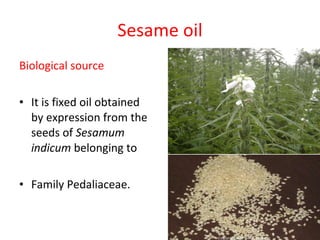
Sesame oil Biological source It is fixed oil obtained by expression from the seeds of  Sesamum indicum  belonging to  Family Pedaliaceae.
Method of preparation  Sesame seeds contain about 50% 0f fixed oil. Only white variety of seeds is used for pharmaceutical purposes. Seeds are very small in size. They are cleaned, washed, sundried and expressed to yield oil at room temperature. Subsequently, the temperature ands pressure are raised. The oil is purified by the refining method and used.
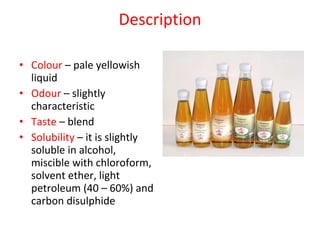
Description Colour  – pale yellowish liquid Odour  – slightly characteristic Taste  – blend Solubility  – it is slightly soluble in alcohol, miscible with chloroform, solvent ether, light petroleum (40 – 60%) and carbon disulphide
Chemical constituents Gingelly oil contains glycerides of high fatty acids mainly oleic, linoleic, palmitic, stearic and arachidic acids. It contain about 5% of olein, and a phenol known as sesamol which is responsible for solubility of oil. It also contain lignone derivatives (Sesamin and sesamolin)
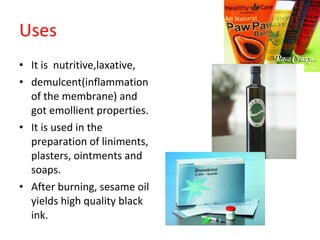
Uses It is  nutritive,laxative, demulcent(inflammation of the membrane) and got emollient properties. It is used in the preparation of liniments, plasters, ointments and soaps. After burning, sesame oil yields high quality black ink.
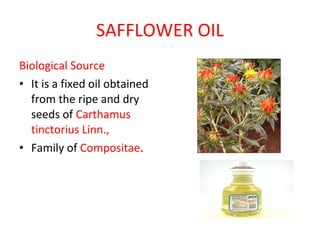
SAFFLOWER OIL Biological Source It is a fixed oil obtained from the ripe and dry seeds of  Carthamus tinctorius Linn.,  Family of  Compositae .
Method of preparation For expression of oil, the seeds from promising varieties in India are selected, cleaned and further processed. About 1000 seeds of safflower weigh 20 to 50g. The seeds normally contain 35 to 38% of fixed oil. The oil is prepared by expression in expellers or with the help of hydraulic presses. The oil is filtered and further purified. The seed meal or round seeds are subjected to cooking by means of open steam, which ensured maximum yield of oil. The filtered and decolorized oil is packed into suitable containers.
Description It is a clear, faint yellowish liquid with characteristic odor and taste.  The oil thickens and becomes rancid on exposure to air. Soluble in alcohol in alcohol and freely soluble in ether, chloroform, benzene and petroleum-ether.
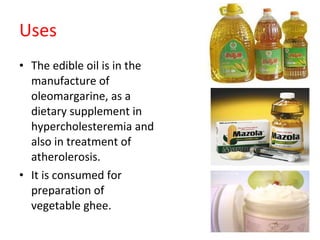
Uses The edible oil is in the manufacture of oleomargarine, as a dietary supplement in hypercholesteremia and also in treatment of atherolerosis. It is consumed for preparation of vegetable ghee.
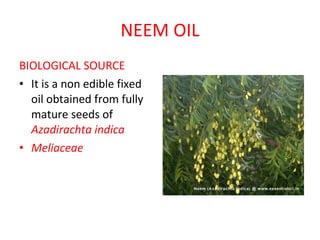
NEEM OIL BIOLOGICAL SOURCE It is a non edible fixed oil obtained from fully mature seeds of  Azadirachta indica Meliaceae
Description It is yellow coloured oil with specific odour and bitter taste.  It is soluble in ether and chloroform.
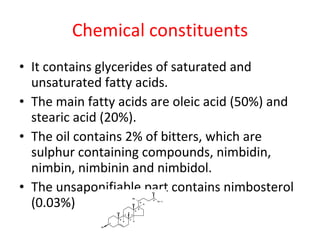
Chemical constituents It contains glycerides of saturated and unsaturated fatty acids. The main fatty acids are oleic acid (50%) and stearic acid (20%). The oil contains 2% of bitters, which are sulphur containing compounds, nimbidin, nimbin, nimbinin and nimbidol. The unsaponifiable part contains nimbosterol (0.03%)
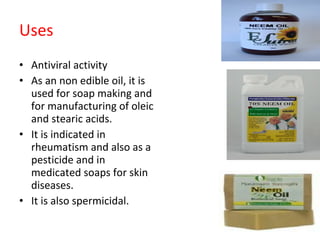
Uses Antiviral activity As an non edible oil, it is used for soap making and for manufacturing of oleic and stearic acids. It is indicated in rheumatism and also as a pesticide and in medicated soaps for skin diseases. It is also spermicidal.

Drugs containing lipids

  • 1.
    Drugs containing lipids09PPB110 DEPT. OF BOTANY. ST. JOSEPH’S COLLEGE TRICHY - 2
  • 2.
    What Is aLipid? Lipids are a broad group of naturally occurring molecules which includes fats, waxes, sterols, fat-soluble vitamins (such as vitamins A, D, E and K), monoglycerides, diglycerides, phospholipids, and others. The main biological functions of lipids include energy storage, as structural components of cell membranes, and as important signaling molecules..
  • 3.
  • 4.
  • 5.
    Arachis oil It Is fixed oil expressed from the seed kernels of cultivated varieties of Arachis hypogaea Linn., Family Leguminosae
  • 6.
    Method preparation Peanutkernels contain about 40-50% of fixed oil. The graded and cleaned kernels are crushed d and oil is separated by expression further quantity of oil is collected by hot expression method. Both fractions are mixed together. It is then allowed to stand for some time to separate stearin and filtered. The oil is then treated with fueller’s earth or carbon for bleaching and filtered thoroughly by using filter presses.
  • 7.
    description Colour -Pale yellow colored liquid Odour - Faint and characteristic Taste - Bland Solubility -It is slightly soluble in alcohol and soluble in solvent either, chloroform and light petroleum(40-60 c)
  • 8.
    Chemical constituents Arachisiol consists of glycerides of fatty acids, chiefly oleic,linileic,stearic and other acids are lignoceric and palmitic acids.
  • 9.
    Uses Peanut oilis a solvent for intramuscular injections. It is used in the preparation of liniments and cosmetics. It is valuable as a lubricant It is used as an edible oil.
  • 10.
    Castor oil Biological source Castor oil is the fixed oil obtained by the cold expression of the seeds of Ricinus communis , Family- Euphorbiaceae. Composition of seeds Castor oil is a fixed oil of therapeutic importance and purgative in action it cannot be consumed freely. Apart from the oil seeds also contain some of the toxic substances (recin). Castor seeds consist of 75% kernel and 25% of hull.
  • 11.
  • 12.
    Preparation of castoroil The seeds are graded and freed of impurities like metallic pieces of iron and sand. The seeds are decorticated and hulls are removed. Castor oil can be prepared by crushing of whole decorticated seeds in hydraulic presses and pressed to extracted the castor oil.
  • 13.
    description Color –pale yellow and brown colored powder or almost colorless liquid Odor - slight and characteristic Taste – first it is bland but afterwards slightly acrid , and usually nauseating .
  • 14.
    Uses Castor oil is often given orally or as aromatic castor oil or in the form of capsules. Other cosmetic purposes for which the oil is used include perfumed hair oil and hair fixers. Castor oil used to make a soap and important raw material for synthesis of resins. It is valuable as lubricant.
  • 15.
    Olive oil SynomymOleum Olive Biological source It is fixed oil expessed from of ripe fruit of Olea europoea Linne , Belonging to family Oleaceae.
  • 16.
    Method of preparation It is prepared by crushing and pressing the ripe fruits called Olives. The entire olive consists of 20-30 percent oil. The fruit pulp has 60-80 percent oil. The hydraulic pressed are used to squeeze the oil out of fruit under low pressure. The further pressing give low quality oil. The oil that comes from the last pressing is called olive residue and is generally used for cosmetics, medicines, etc.
  • 17.
    Description Colour- pale yellow or greenish –yellow Odour - slight and characteristic Tast - band, faintly acrid Solubility - it is slightly soluble in alcohol and miscible with carbon disulpide, chlorofrom and ether.
  • 18.
    Chemical constituents The olive oil contains the triglycerides mainly in the from of olein. Palmitin and linolein.
  • 19.
    uses Externally, itis an emollient and soothing agent for inflamed surfaces. It is also used as an ingredient of ear wax. Mild laxative It is used as a vehicle for oily suspensions for injection. It is used for hair oil.
  • 20.
    Linssed oil Biologicalsource Linseed consists of dried ripe seeds of the plant known as Linum usitatissimum Linn., Linaceae . It contains not less than 25% of fixed oils and not more than 1% of foreign organic matter.
  • 21.
    Method of preparationMature Seeds are served to make free of earthy matter and other materials. Commercially, linseed oil is produced by use of expellers. Before the seeds are subjected to the expellers, they are rolled into meal, then moistened and heated by means off steam jacketed troughs filled over the expellers.
  • 22.
    An average yieldof oil is 30 – 35% The expressed oil is tanked for along period, to settle the coloring matter and mucilage. The oil is then treated with alkali (NaOH, KOH Ca)immediately after filtration. Alkali treatment helps to remove free fatty acids. Bleaching of oil is done by either charcoal of fuller's earth at elevated temperature. The refined oil are chilled to separate wax.
  • 23.
    description Colour – pale yellow colored clear liquid Odour – characteristic (quality) Taste – pleasant
  • 24.
    Chemical constituents Itcontains the glycerides of palmitic, stewaric, oleic, linoleic and linolenic acids. Linseed also contains a cyanogenetic (beta)glycoside linamartin and mucilage(5%). In addition of fixed oil (20 -40%)
  • 25.
    uses It isthe most important drying oil large quantities are used for paints and varnishes. It is mainly recommended for external applications like lotions and liniments. It is used in treatment of scabies and other skin diseases along with sulphur It is has very high iodine value, it is used in the preparation of non staining iodine ointment and other products like cresol (phenols)with soap. It is nutritive and emollient too.
  • 26.
    Sesame oil Biologicalsource It is fixed oil obtained by expression from the seeds of Sesamum indicum belonging to Family Pedaliaceae.
  • 27.
    Method of preparation Sesame seeds contain about 50% 0f fixed oil. Only white variety of seeds is used for pharmaceutical purposes. Seeds are very small in size. They are cleaned, washed, sundried and expressed to yield oil at room temperature. Subsequently, the temperature ands pressure are raised. The oil is purified by the refining method and used.
  • 28.
    Description Colour – pale yellowish liquid Odour – slightly characteristic Taste – blend Solubility – it is slightly soluble in alcohol, miscible with chloroform, solvent ether, light petroleum (40 – 60%) and carbon disulphide
  • 29.
    Chemical constituents Gingellyoil contains glycerides of high fatty acids mainly oleic, linoleic, palmitic, stearic and arachidic acids. It contain about 5% of olein, and a phenol known as sesamol which is responsible for solubility of oil. It also contain lignone derivatives (Sesamin and sesamolin)
  • 30.
    Uses It is nutritive,laxative, demulcent(inflammation of the membrane) and got emollient properties. It is used in the preparation of liniments, plasters, ointments and soaps. After burning, sesame oil yields high quality black ink.
  • 31.
    SAFFLOWER OIL BiologicalSource It is a fixed oil obtained from the ripe and dry seeds of Carthamus tinctorius Linn., Family of Compositae .
  • 32.
    Method of preparationFor expression of oil, the seeds from promising varieties in India are selected, cleaned and further processed. About 1000 seeds of safflower weigh 20 to 50g. The seeds normally contain 35 to 38% of fixed oil. The oil is prepared by expression in expellers or with the help of hydraulic presses. The oil is filtered and further purified. The seed meal or round seeds are subjected to cooking by means of open steam, which ensured maximum yield of oil. The filtered and decolorized oil is packed into suitable containers.
  • 33.
    Description It isa clear, faint yellowish liquid with characteristic odor and taste. The oil thickens and becomes rancid on exposure to air. Soluble in alcohol in alcohol and freely soluble in ether, chloroform, benzene and petroleum-ether.
  • 34.
    Uses The edibleoil is in the manufacture of oleomargarine, as a dietary supplement in hypercholesteremia and also in treatment of atherolerosis. It is consumed for preparation of vegetable ghee.
  • 35.
    NEEM OIL BIOLOGICALSOURCE It is a non edible fixed oil obtained from fully mature seeds of Azadirachta indica Meliaceae
  • 36.
    Description It isyellow coloured oil with specific odour and bitter taste. It is soluble in ether and chloroform.
  • 37.
    Chemical constituents Itcontains glycerides of saturated and unsaturated fatty acids. The main fatty acids are oleic acid (50%) and stearic acid (20%). The oil contains 2% of bitters, which are sulphur containing compounds, nimbidin, nimbin, nimbinin and nimbidol. The unsaponifiable part contains nimbosterol (0.03%)
  • 38.
    Uses Antiviral activityAs an non edible oil, it is used for soap making and for manufacturing of oleic and stearic acids. It is indicated in rheumatism and also as a pesticide and in medicated soaps for skin diseases. It is also spermicidal.