PROTEIN
BY: MS KAJAL
2
PROTEIN
This name was suggested by Mulder in 1838 to the
complex organic nitrogenous substance found in animal
and plant tissue.
Protein is the basic material for every living cells . It is the
only nutrient that can make new cells and rebuild the worn
out cells.
3
DEFINITION
Protein are large complex organic compound made up of
carbon, hydrogen, oxygen and nitrogen.
The basic unit of protein are the amino acid. Each amino
acid contain an acidic group and an amino group.
4
AMINO ACIDS
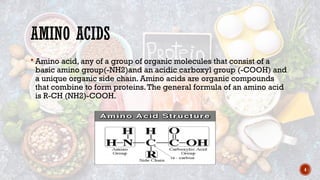
 Amino acid, any of a group of organic molecules that consist of a
basic amino group(-NH2)and an acidic carboxyl group (-COOH) and
a unique organic side chain. Amino acids are organic compounds
that combine to form proteins.The general formula of an amino acid
is R-CH (NH2)-COOH.
5
CLASSIFICATION OF PROTEIN
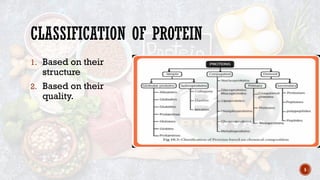
1. Based on their
structure
2. Based on their
quality.
6
BASED ON THEIR STRUCTURE
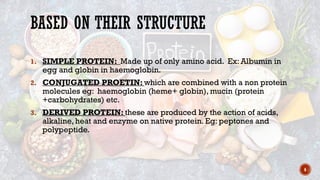
1. SIMPLE PROTEIN: Made up of only amino acid. Ex: Albumin in
egg and globin in haemoglobin.
2. CONJUGATED PROETIN: which are combined with a non protein
molecules eg: haemoglobin (heme+ globin), mucin (protein
+carbohydrates) etc.
3. DERIVED PROTEIN: these are produced by the action of acids,
alkaline, heat and enzyme on native protein. Eg: peptones and
polypeptide.
7
BASED ON THEIR QUALITY.
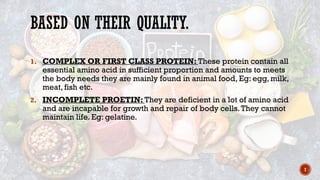
1. COMPLEX OR FIRST CLASS PROTEIN: These protein contain all
essential amino acid in sufficient proportion and amounts to meets
the body needs they are mainly found in animal food, Eg: egg, milk,
meat, fish etc.
2. INCOMPLETE PROETIN: They are deficient in a lot of amino acid
and are incapable for growth and repair of body cells.They cannot
maintain life. Eg: gelatine.
8
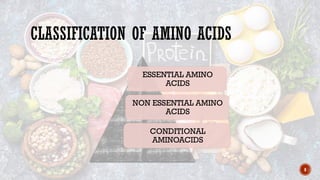
CLASSIFICATION OF AMINO ACIDS
ESSENTIAL AMINO
ACIDS
NON ESSENTIAL AMINO
ACIDS
CONDITIONAL
AMINOACIDS
9
ESSENTIAL AMINO ACIDS
 Essential amino acids (EAAs) make up a group of nine amino
acids that cannot be produced inside the body ( de novo) but
must be ingested as dietary protein.The building blocks of
proteins, amino acids are bound together to produce polymer
chain or folded proteins with a huge array of functions.
 histidine, isoleucine, leucine, lysine, methionine,
phenylalanine, threonine, tryptophan, and valine.
 They’re vital for functions throughout your body, including
protein synthesis, tissue repair, and nutrient absorption.
10
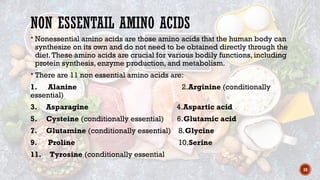
NON ESSENTAIL AMINO ACIDS
 Nonessential amino acids are those amino acids that the human body can
synthesize on its own and do not need to be obtained directly through the
diet.These amino acids are crucial for various bodily functions, including
protein synthesis, enzyme production, and metabolism.
 There are 11 non essential amino acids are:
1. Alanine 2.Arginine (conditionally
essential)
3. Asparagine 4.Aspartic acid
5. Cysteine (conditionally essential) 6.Glutamic acid
7. Glutamine (conditionally essential) 8.Glycine
9. Proline 10.Serine
11. Tyrosine (conditionally essential
11
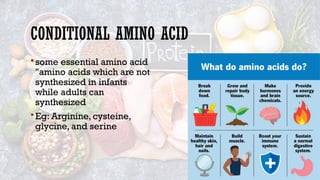
CONDITIONAL AMINO ACID
some essential amino acid
"amino acids which are not
synthesized in infants
while adults can
synthesized
Eg: Arginine, cysteine,
glycine, and serine
12
FUNCTION OF PROTEIN
Growth and development.
Maintenance of wear and tear.
Regulatory function.
Energy.
Synthesis of certain substance: hormone, enzyme and
antibodies.
Maintain healthy Pregnancy and lactation.
13
SOURCES OF PROTEINS
ANIMAL SOURCES:
milk, meat, cheese, fish
all are contain EAA.
VEGETABLE
SOURCES: pulses,
cereals, beans, nuts, oils,
seeds, soya.
14
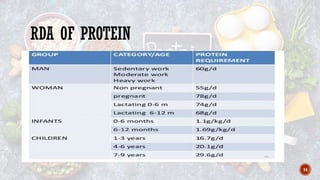
RDA OF PROTEIN
15
DIGESTION AND METABOLISM OF PROTEIN
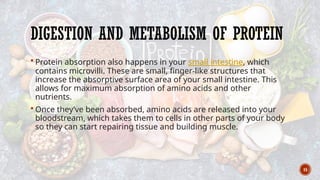
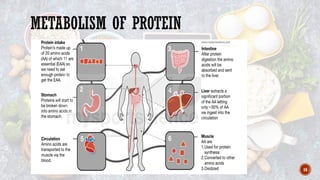
 Protein absorption also happens in your small intestine, which
contains microvilli. These are small, finger-like structures that
increase the absorptive surface area of your small intestine. This
allows for maximum absorption of amino acids and other
nutrients.
 Once they’ve been absorbed, amino acids are released into your
bloodstream, which takes them to cells in other parts of your body
so they can start repairing tissue and building muscle.
16
METABOLISM OF PROTEIN
THANK YOU