
Energy
By – Astha K. Patel
• https://www.youtube.com/watch?v=VEQaH4L
ruUo
Introduction
• Energy is ability too do work.
• We eat food to supply energy to the
body.
• A body requires energy not only when it
is at work but also when it is at rest.
• The energy to perform work is derived
from the metabolism of CHO, fats, &
protein.
Definition of energy
• It isdefined as the capacityfor doing work. It isthe heat
producedin the body,which isutilizedfor performing
the involuntary& voluntary activitiesin the body
Why body needs energy ?
Maintaining metabolic activity
Temperature
Supporting growth
Physical work
Maintaining constant body weight
Good health
• Energy is released by the metabolism of
food, which is utilized by the body to
maintain life.
• This continuous process involves many
biochemical reactions that include
digestion, absorption, synthesis, and
maintenance of tissues, conduction of
nerve impulses & regulation of body
temperature.
Types of energy
Osmotic energy
( maintenance of transport of nutrient)
Electrical energy
(Transmission of nerve impulses)
Chemical energy
( synthesis of new compounds)
Thermal energy
( Heat Regulation )
Units of energy
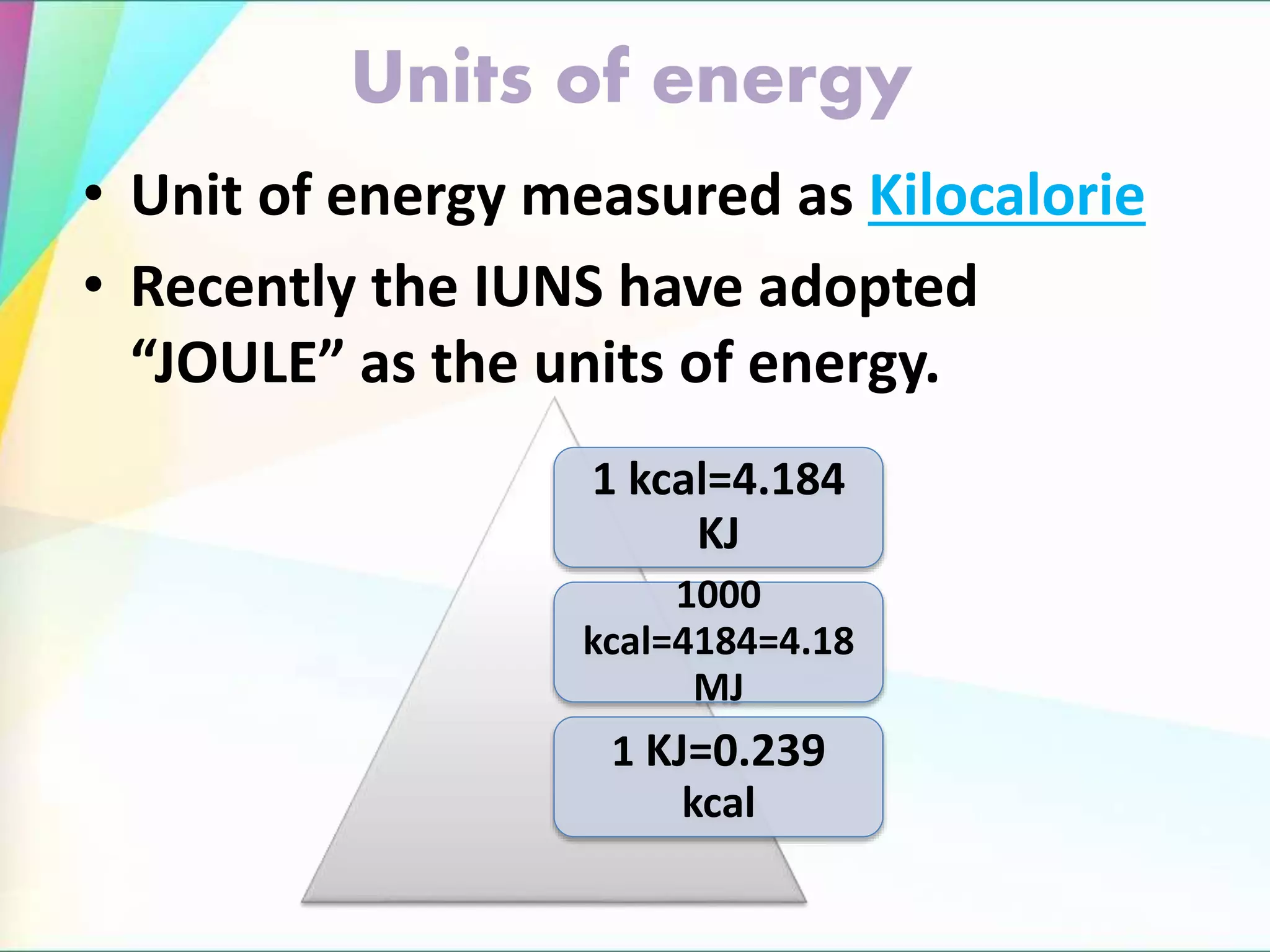
• Unit of energy measured as Kilocalorie
• Recently the IUNS have adopted
“JOULE” as the units of energy.
1 kcal=4.184
KJ
1000
kcal=4184=4.18
MJ
1 KJ=0.239
kcal
Energy value
CHO are the major source of energy in
our body
1 gm of CHO = 4 Kcal
Protein is used for synthesis of tissues.
1 gm of Protein = 4 Kcal
Fat is concentrated source of energy
1 gm of fat = 9 kcal
Energy supplied by food
CHO
•60-65% of total energy
Protein
•20-30% of total energy
Fats
•10-15% of total energy
Energy requirements
BMR
Thermogenic
effects of
food
Physical activity
Growth Pregnancy Lactation
BMR
• It is defined as minimum energy
required by a person at complete
physical & mental rest and in the post
absorptive state ( 10-12 hours after the
last meal).
Factors affecting BMR
Factors Effects on BMR
1. Body size & composition The more the lean body mass, higher
the BMR
2. Fever Fever raises the BMR. 7% increase in
BMR for each degree of rise in
temperature in Fahrenheit.
3. Stress Raise BMR
4. Smoking & Caffeine consumption Increase BMR
5. Hyperthyroidism BMR elevated up to 50-70%
6. Growth In Children BMR is higher
7. Pregnancy BMR is increase by 15-25% as there is
increase in the muscles mass of
uterus, mammary glands, fetal mass,
& placenta.
Factors Effects on BMR
8. Fasting & Starvation Lower the BMR
9. Hypothyroidism Lower the BMR by 30 %
10. Age BMR higher in infants & children
than adults & old age.
11. Gender Male having high BMR than
females
12. Weather condition BMR higher in cool climates
compared to warm climates
13. Exercise BMR is increase during exercise
14. Sleep Decrease BMR by 10%
15. Height Tall people have higher BMR
THERMOGENIC EFFECTS OF FOOD
• Food ingestion stimulates metabolism &
requires energy to meet the multiple
activities of digestion, absorption, &
transport of nutrients.
• This over all stimulating effect of food in
called as thermogenesis or thermic
effects of food.
PHYSICAL ACTIVITY
Gender Sedentary
(80-180 Kcal/hr)
Moderate
(170-240
Kcal/hr)
Heavy
(250-350
Kcal/hr)
Male 1. Teacher
2. Tailor
3. Executives
1. Fisherman
2. Potter
1. Stone cutter
2. Mine worker
3. Wood cutter
Female 1. Teacher
2. Executive
1. Servant maid
2. Weaver
3. Nurse
1. Stone cutter
GROWTH
• The energy cost of growth has two
components –
1. The energy needed to synthesized growing
tissue
2. The energy deposited in those tissue.
• The energy cost of growth is about 35% total
energy requirement during first three months
of age.
• 30% at 12 month of age.
• 27% at second year
• 25-26% until mid-adolescence.
• Negligible in late teens.
Pregnancy
• During pregnancy, extra energy is needed for
the growth of the fetus, placenta & various
maternal tissue, such as uterus, breast & fat
stores.
Lactation
• The energy cost of lactation has two
components –
1. The energy content of the milk secreted
2. The energy required producing that milk.
Energy requirements of various age
group
Gender Age Activity level
Sedentary Moderately
active
Active
Child 2-3 1000 1000-1400 1000-1400
Female 4-8 1200 1400-1600 1000-1800
9-13 1600 1600-2000 1800-2000
14-18 1800 2000 2400
19-30 2000 2000-2200 2400
31-50 1800 2000 2200
51+ 1600 1800 2000-2200
Gender Age Activity level
sedentary Moderately
active
Active
Male 4-8 1400 1400-1600 1600-2000
9-13 1800 1800-2000 2000-2600
14-18 2200 2400-2800 2800-3200
19-30 2400 2600-2800 3000
31-50 2200 2400-2600 2800-3000
51+ 2000 2200-2400 2400-2800
A useful tool is assessing a persons body
composition and health status is BMI.
BMI = Weight (KG)
Height (M2)
Obesity
• It is a deposition of excessive fat around
the body.
• In can be measured by BMI. ( Body Mass
Index)
Factors causing obesity
• 1. Genetic Factors – it influences a persons
chance of becoming obese by 50-70%.
• If both the parents are obese, the chance in
children is 80%.
• 2. Age & Sex - it can occur at any age and in
any sex.
• 3. Eating Habit- over eating may leads to
obesity
• 4. physical activity – obesity is common
after the age of 35 when physical
activity decrease.
• 5. endocrine factors – dysfunction of the
thyroid & pituitary may results in
obesity.
Treatment
• Dietary modification
• Physical exercise
• Behavior modification
• Self monitoring
• Self reward for eating control
• Cutting calories
• Feeling full on less
• Making healthier choices
• Restricting certain foods.
• Meal replacements
• Exercise. People who are overweight or obese
need to get at least 150 minutes a week of
moderate-intensity physical activity to prevent
further weight gain
• Keep moving. Even though regular aerobic
exercise is the most efficient way to burn
calories and shed excess weight, any extra
movement helps burn calories.
Preventing weight regain after
obesity treatment
• One of the best ways to prevent regaining the
weight you've lost is to get regular physical
activity. Aim for 60 minutes a day.
Energy.pptx

Energy.pptx

  • 1.
  • 2.
  • 3.
    Introduction • Energy isability too do work. • We eat food to supply energy to the body. • A body requires energy not only when it is at work but also when it is at rest. • The energy to perform work is derived from the metabolism of CHO, fats, & protein.
  • 4.
    Definition of energy •It isdefined as the capacityfor doing work. It isthe heat producedin the body,which isutilizedfor performing the involuntary& voluntary activitiesin the body
  • 5.
    Why body needsenergy ? Maintaining metabolic activity Temperature Supporting growth Physical work Maintaining constant body weight Good health
  • 6.
    • Energy isreleased by the metabolism of food, which is utilized by the body to maintain life. • This continuous process involves many biochemical reactions that include digestion, absorption, synthesis, and maintenance of tissues, conduction of nerve impulses & regulation of body temperature.
  • 7.
    Types of energy Osmoticenergy ( maintenance of transport of nutrient) Electrical energy (Transmission of nerve impulses) Chemical energy ( synthesis of new compounds) Thermal energy ( Heat Regulation )
  • 8.
    Units of energy •Unit of energy measured as Kilocalorie • Recently the IUNS have adopted “JOULE” as the units of energy. 1 kcal=4.184 KJ 1000 kcal=4184=4.18 MJ 1 KJ=0.239 kcal
  • 9.
    Energy value CHO arethe major source of energy in our body 1 gm of CHO = 4 Kcal Protein is used for synthesis of tissues. 1 gm of Protein = 4 Kcal Fat is concentrated source of energy 1 gm of fat = 9 kcal
  • 10.
    Energy supplied byfood CHO •60-65% of total energy Protein •20-30% of total energy Fats •10-15% of total energy
  • 11.
  • 12.
    BMR • It isdefined as minimum energy required by a person at complete physical & mental rest and in the post absorptive state ( 10-12 hours after the last meal).
  • 13.
    Factors affecting BMR FactorsEffects on BMR 1. Body size & composition The more the lean body mass, higher the BMR 2. Fever Fever raises the BMR. 7% increase in BMR for each degree of rise in temperature in Fahrenheit. 3. Stress Raise BMR 4. Smoking & Caffeine consumption Increase BMR 5. Hyperthyroidism BMR elevated up to 50-70% 6. Growth In Children BMR is higher 7. Pregnancy BMR is increase by 15-25% as there is increase in the muscles mass of uterus, mammary glands, fetal mass, & placenta.
  • 14.
    Factors Effects onBMR 8. Fasting & Starvation Lower the BMR 9. Hypothyroidism Lower the BMR by 30 % 10. Age BMR higher in infants & children than adults & old age. 11. Gender Male having high BMR than females 12. Weather condition BMR higher in cool climates compared to warm climates 13. Exercise BMR is increase during exercise 14. Sleep Decrease BMR by 10% 15. Height Tall people have higher BMR
  • 15.
    THERMOGENIC EFFECTS OFFOOD • Food ingestion stimulates metabolism & requires energy to meet the multiple activities of digestion, absorption, & transport of nutrients. • This over all stimulating effect of food in called as thermogenesis or thermic effects of food.
  • 16.
    PHYSICAL ACTIVITY Gender Sedentary (80-180Kcal/hr) Moderate (170-240 Kcal/hr) Heavy (250-350 Kcal/hr) Male 1. Teacher 2. Tailor 3. Executives 1. Fisherman 2. Potter 1. Stone cutter 2. Mine worker 3. Wood cutter Female 1. Teacher 2. Executive 1. Servant maid 2. Weaver 3. Nurse 1. Stone cutter
  • 17.
    GROWTH • The energycost of growth has two components – 1. The energy needed to synthesized growing tissue 2. The energy deposited in those tissue.
  • 18.
    • The energycost of growth is about 35% total energy requirement during first three months of age. • 30% at 12 month of age. • 27% at second year • 25-26% until mid-adolescence. • Negligible in late teens.
  • 19.
    Pregnancy • During pregnancy,extra energy is needed for the growth of the fetus, placenta & various maternal tissue, such as uterus, breast & fat stores.
  • 20.
    Lactation • The energycost of lactation has two components – 1. The energy content of the milk secreted 2. The energy required producing that milk.
  • 21.
    Energy requirements ofvarious age group Gender Age Activity level Sedentary Moderately active Active Child 2-3 1000 1000-1400 1000-1400 Female 4-8 1200 1400-1600 1000-1800 9-13 1600 1600-2000 1800-2000 14-18 1800 2000 2400 19-30 2000 2000-2200 2400 31-50 1800 2000 2200 51+ 1600 1800 2000-2200
  • 22.
    Gender Age Activitylevel sedentary Moderately active Active Male 4-8 1400 1400-1600 1600-2000 9-13 1800 1800-2000 2000-2600 14-18 2200 2400-2800 2800-3200 19-30 2400 2600-2800 3000 31-50 2200 2400-2600 2800-3000 51+ 2000 2200-2400 2400-2800
  • 23.
    A useful toolis assessing a persons body composition and health status is BMI. BMI = Weight (KG) Height (M2)
  • 26.
    Obesity • It isa deposition of excessive fat around the body. • In can be measured by BMI. ( Body Mass Index)
  • 28.
    Factors causing obesity •1. Genetic Factors – it influences a persons chance of becoming obese by 50-70%. • If both the parents are obese, the chance in children is 80%. • 2. Age & Sex - it can occur at any age and in any sex.
  • 29.
    • 3. EatingHabit- over eating may leads to obesity • 4. physical activity – obesity is common after the age of 35 when physical activity decrease. • 5. endocrine factors – dysfunction of the thyroid & pituitary may results in obesity.
  • 30.
    Treatment • Dietary modification •Physical exercise • Behavior modification • Self monitoring • Self reward for eating control
  • 32.
    • Cutting calories •Feeling full on less • Making healthier choices • Restricting certain foods. • Meal replacements
  • 33.
    • Exercise. Peoplewho are overweight or obese need to get at least 150 minutes a week of moderate-intensity physical activity to prevent further weight gain • Keep moving. Even though regular aerobic exercise is the most efficient way to burn calories and shed excess weight, any extra movement helps burn calories.
  • 34.
    Preventing weight regainafter obesity treatment • One of the best ways to prevent regaining the weight you've lost is to get regular physical activity. Aim for 60 minutes a day.