LIPID RAFTS IN PHYSIOLOGY
AND DISEASES
Presented by-
Moitrayee Majumder
M. PhilNeuroscience 1st year
i. What are lipid rafts?
ii. Functionality of Rafts
iii. Lipid rafts in neurological
diseases.
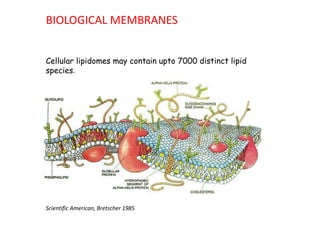
BIOLOGICAL MEMBRANES
Cellular lipidomes may contain upto 7000 distinct lipid
species.
Scientific American, Bretscher 1985
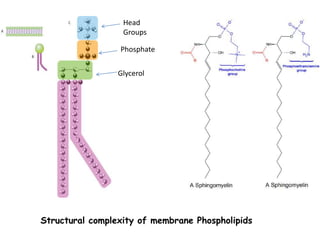
Structural complexity of membrane Phospholipids
Glycerol
Phosphate
Head
Groups
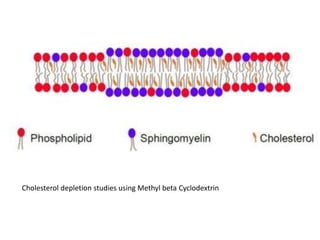
Cholesterol depletion studies using Methyl beta Cyclodextrin
Cellular Lipidomics
 Cellular architecture
 Lipid Signaling
 Regulating membrane proteins
 Membrane trafficking
 Creating sub-specific compartments in
membranes
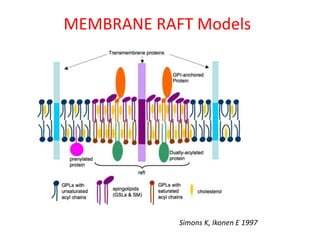
MEMBRANE RAFT Models
Simons K, Ikonen E 1997
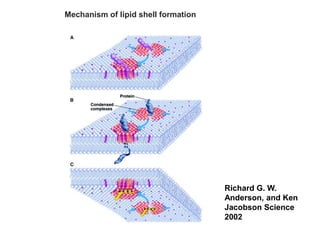
Mechanism of lipid shell formation
Richard G. W.
Anderson, and Ken
Jacobson Science
2002
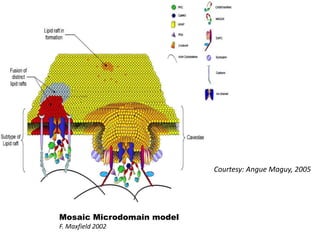
Courtesy: Angue Maguy, 2005
Mosaic Microdomain model
F. Maxfield 2002
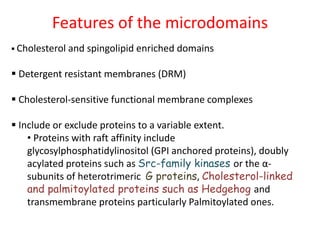
Features of the microdomains
 Cholesterol and spingolipid enriched domains
 Detergent resistant membranes (DRM)
 Cholesterol-sensitive functional membrane complexes
 Include or exclude proteins to a variable extent.
• Proteins with raft affinity include
glycosylphosphatidylinositol (GPI anchored proteins), doubly
acylated proteins such as Src-family kinases or the α-
subunits of heterotrimeric G proteins, Cholesterol-linked
and palmitoylated proteins such as Hedgehog and
transmembrane proteins particularly Palmitoylated ones.
Lipid Raft Hypothesis 1
Epithelial cells have distinct lipid and
proteins composition at their apical and
basolateral surfaces.
Glycerospingolipids and Spingomyelin
are concentrated at the apical surface.
Simons and Ikonen , 1997
Lipid Raft Hypothesis 1
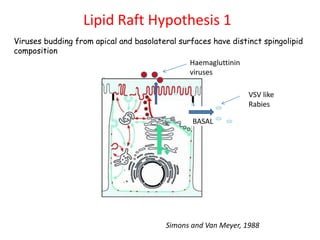
BASAL
Viruses budding from apical and basolateral surfaces have distinct spingolipid
composition
Haemagluttinin
viruses
VSV like
Rabies
Simons and Van Meyer, 1988
Lipid rafts are hypothesized to be involved in
diverse biological phenomena
 Nervous System
 Immune function
 Nutrient uptake
 Cell Cycle
 Virus budding and entry
 Pathogen biology
 Cell motility
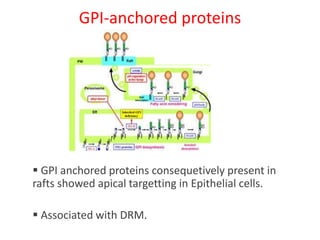
GPI-anchored proteins
 GPI anchored proteins consequetively present in
rafts showed apical targetting in Epithelial cells.
 Associated with DRM.
Signal Transduction by GPI-anchored proteins
 GPI-anchored proteins are cleaved by Phospholipase C, Phospholipase D,
Notum (in Wnt signaling) cleaves extracellularly. Cleavage of GPI anchors helps in
activation or inactivation of various signalling pathways for growth and
differentiation of cells.
 Antibody cross-linking of GPI-anchored proteins has been known to evoke
signalling responses, including rises in intracellular Ca2+ or tyrosine
phosphorylation.
 The variable surface glycoproteins from the sleeping sickness
protozoan Trypanosoma brucei are attached to the plasma membrane via a GPI
anchor.
( Taylor and Hooper)
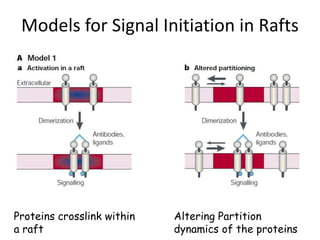
Models for Signal Initiation in Rafts
Proteins crosslink within
a raft
Altering Partition
dynamics of the proteins
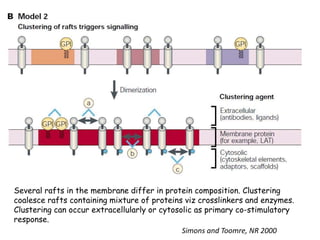
Several rafts in the membrane differ in protein composition. Clustering
coalesce rafts containing mixture of proteins viz crosslinkers and enzymes.
Clustering can occur extracellularly or cytosolic as primary co-stimulatory
response.
Simons and Toomre, NR 2000
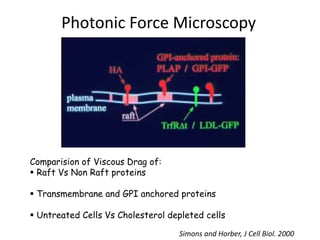
Photonic Force Microscopy
Comparision of Viscous Drag of:
 Raft Vs Non Raft proteins
 Transmembrane and GPI anchored proteins
 Untreated Cells Vs Cholesterol depleted cells
Simons and Horber, J Cell Biol. 2000
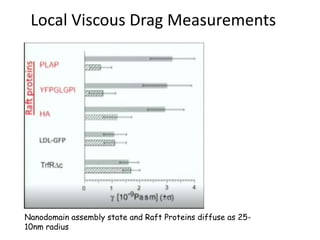
Local Viscous Drag Measurements
Nanodomain assembly state and Raft Proteins diffuse as 25-
10nm radius
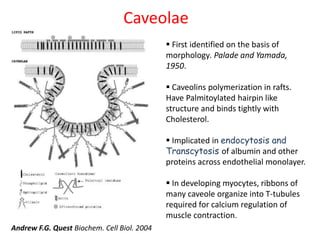
Caveolae
 First identified on the basis of
morphology. Palade and Yamada,
1950.
 Caveolins polymerization in rafts.
Have Palmitoylated hairpin like
structure and binds tightly with
Cholesterol.
 Implicated in endocytosis and
Transcytosis of albumin and other
proteins across endothelial monolayer.
 In developing myocytes, ribbons of
many caveole organize into T-tubules
required for calcium regulation of
muscle contraction.
Andrew F.G. Quest Biochem. Cell Biol. 2004
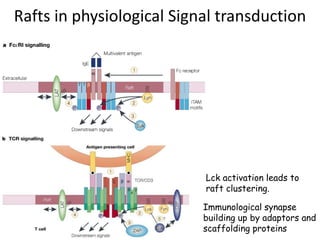
Rafts in physiological Signal transduction
Immunological synapse
building up by adaptors and
scaffolding proteins
Lck activation leads to
raft clustering.
Rafts in physiological Signal transduction Contd…
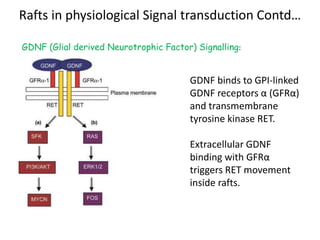
GDNF (Glial derived Neurotrophic Factor) Signalling:
GDNF binds to GPI-linked
GDNF receptors α (GFRα)
and transmembrane
tyrosine kinase RET.
Extracellular GDNF
binding with GFRα
triggers RET movement
inside rafts.
Rafts in physiological Signal transduction Contd…
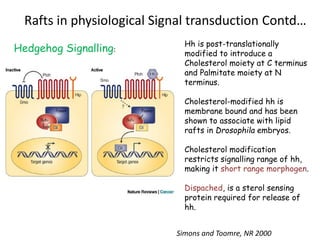
Hedgehog Signalling:
Hh is post-translationally
modified to introduce a
Cholesterol moiety at C terminus
and Palmitate moiety at N
terminus.
Cholesterol-modified hh is
membrane bound and has been
shown to associate with lipid
rafts in Drosophila embryos.
Cholesterol modification
restricts signalling range of hh,
making it short range morphogen.
Dispached, is a sterol sensing
protein required for release of
hh.
Simons and Toomre, NR 2000
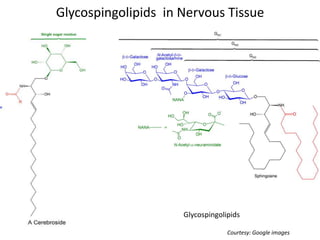
Glycospingolipids in Nervous Tissue
Glycospingolipids
Courtesy: Google images
Function of GSL in Nervous Tissue
 Their association with lipid rafts is uncertain.
 The oligosaccharide groups on gangliosides extend well
beyond the surfaces of the cell membranes, and act as
distinguishing surface markers that can serve as specific
determinants in cellular recognition and cell-to-cell
communication.
 These carbohydrate head groups also act as specific
receptors for certain pituitary hormones and certain bacterial
protein toxins such as cholera toxin.
Lehninger Principles of Biochemistry, 4th
edition
Lipid Raft associated Neurological
disorders
Raft lipid alteration in Alzheimer’s Disease
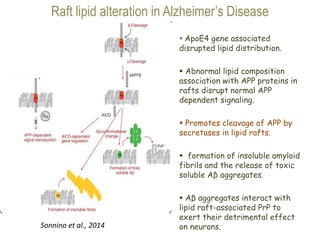
 ApoE4 gene associated
disrupted lipid distribution.
 Abnormal lipid composition
association with APP proteins in
rafts disrupt normal APP
dependent signaling.
 Promotes cleavage of APP by
secretases in lipid rafts.
 formation of insoluble amyloid
fibrils and the release of toxic
soluble Aβ aggregates.
 Aβ aggregates interact with
lipid raft-associated PrP to
exert their detrimental effect
on neurons.Sonnino et al., 2014
Abnormal synaptic traffiking in Huntington’s Disease
 Huntington’s disease (HD), characterized by neurodegeneration of the striatum
and less so of the cerebral cortex.
 Mutant htt associated with rafts accompanied by a significant increase in
raft-associated glycogen synthase kinase 3- which coincides with apoptotic stress.
(Valencia et al, J. Neurosci. 2009)
Gene array analyses indicated that mutant htt inhibited expression of several genes
encoding enzymes needed for cholesterol synthesis as well as expression of
genes involved in vesicle trafficking and synaptic vesicle formation. (S. Sipione, Hum.
Mol. Genet.2002)
 Decrease in Ganglioside content which is implicated in Ca++ transport and
signaling is decreased in HD . Desplats (2007)
Parkinson’s Disease
 Parkin and α-synuclein have also been shown to associate
with lipid raft.
 Parkin, found in lipid rafts on the synaptic plasma membrane
and on post-synaptic densities where it has been implicated in
N-methyl-D-aspartate trafficking.
 Targetting ganglioside GM1 induced α-helical structure of
synuclein and prevented formation of α-synuclin fibrils.
Z. Martinez, Biochemistry (2007)
Amyotrophic Lateral Sclerosis
 ALS is a neurodegenerative disease characterized by the
progressive loss of function of motor neurons in the brain and spinal
cord resulting in paralysis of voluntary muscles.
 Embryonic muscle cells from rat pups induced with ALS showed
overexpression of BDNF activating TrkB signaling at the level of
excitotoxicity. TrkB which is coupled with GPCR and Src-family
kinases are experimentally observed to be associated with rafts.
 Disruption of rafts with MβCD resulted in neuroprotection in
these cells and the non-raft TrkB signaling compensated for the
loss.
(J. Mojsilovic-Petrovic, J. Neurosci. 2006)
Thank you…

lipid rafts

  • 1.
    LIPID RAFTS INPHYSIOLOGY AND DISEASES Presented by- Moitrayee Majumder M. PhilNeuroscience 1st year
  • 2.
    i. What arelipid rafts? ii. Functionality of Rafts iii. Lipid rafts in neurological diseases.
  • 3.
    BIOLOGICAL MEMBRANES Cellular lipidomesmay contain upto 7000 distinct lipid species. Scientific American, Bretscher 1985
  • 4.
    Structural complexity ofmembrane Phospholipids Glycerol Phosphate Head Groups
  • 5.
    Cholesterol depletion studiesusing Methyl beta Cyclodextrin
  • 6.
    Cellular Lipidomics  Cellulararchitecture  Lipid Signaling  Regulating membrane proteins  Membrane trafficking  Creating sub-specific compartments in membranes
  • 7.
  • 8.
    Mechanism of lipidshell formation Richard G. W. Anderson, and Ken Jacobson Science 2002
  • 9.
    Courtesy: Angue Maguy,2005 Mosaic Microdomain model F. Maxfield 2002
  • 10.
    Features of themicrodomains  Cholesterol and spingolipid enriched domains  Detergent resistant membranes (DRM)  Cholesterol-sensitive functional membrane complexes  Include or exclude proteins to a variable extent. • Proteins with raft affinity include glycosylphosphatidylinositol (GPI anchored proteins), doubly acylated proteins such as Src-family kinases or the α- subunits of heterotrimeric G proteins, Cholesterol-linked and palmitoylated proteins such as Hedgehog and transmembrane proteins particularly Palmitoylated ones.
  • 11.
    Lipid Raft Hypothesis1 Epithelial cells have distinct lipid and proteins composition at their apical and basolateral surfaces. Glycerospingolipids and Spingomyelin are concentrated at the apical surface. Simons and Ikonen , 1997
  • 12.
    Lipid Raft Hypothesis1 BASAL Viruses budding from apical and basolateral surfaces have distinct spingolipid composition Haemagluttinin viruses VSV like Rabies Simons and Van Meyer, 1988
  • 13.
    Lipid rafts arehypothesized to be involved in diverse biological phenomena  Nervous System  Immune function  Nutrient uptake  Cell Cycle  Virus budding and entry  Pathogen biology  Cell motility
  • 14.
    GPI-anchored proteins  GPIanchored proteins consequetively present in rafts showed apical targetting in Epithelial cells.  Associated with DRM.
  • 15.
    Signal Transduction byGPI-anchored proteins  GPI-anchored proteins are cleaved by Phospholipase C, Phospholipase D, Notum (in Wnt signaling) cleaves extracellularly. Cleavage of GPI anchors helps in activation or inactivation of various signalling pathways for growth and differentiation of cells.  Antibody cross-linking of GPI-anchored proteins has been known to evoke signalling responses, including rises in intracellular Ca2+ or tyrosine phosphorylation.  The variable surface glycoproteins from the sleeping sickness protozoan Trypanosoma brucei are attached to the plasma membrane via a GPI anchor. ( Taylor and Hooper)
  • 16.
    Models for SignalInitiation in Rafts Proteins crosslink within a raft Altering Partition dynamics of the proteins
  • 17.
    Several rafts inthe membrane differ in protein composition. Clustering coalesce rafts containing mixture of proteins viz crosslinkers and enzymes. Clustering can occur extracellularly or cytosolic as primary co-stimulatory response. Simons and Toomre, NR 2000
  • 18.
    Photonic Force Microscopy Comparisionof Viscous Drag of:  Raft Vs Non Raft proteins  Transmembrane and GPI anchored proteins  Untreated Cells Vs Cholesterol depleted cells Simons and Horber, J Cell Biol. 2000
  • 19.
    Local Viscous DragMeasurements Nanodomain assembly state and Raft Proteins diffuse as 25- 10nm radius
  • 20.
    Caveolae  First identifiedon the basis of morphology. Palade and Yamada, 1950.  Caveolins polymerization in rafts. Have Palmitoylated hairpin like structure and binds tightly with Cholesterol.  Implicated in endocytosis and Transcytosis of albumin and other proteins across endothelial monolayer.  In developing myocytes, ribbons of many caveole organize into T-tubules required for calcium regulation of muscle contraction. Andrew F.G. Quest Biochem. Cell Biol. 2004
  • 21.
    Rafts in physiologicalSignal transduction Immunological synapse building up by adaptors and scaffolding proteins Lck activation leads to raft clustering.
  • 22.
    Rafts in physiologicalSignal transduction Contd… GDNF (Glial derived Neurotrophic Factor) Signalling: GDNF binds to GPI-linked GDNF receptors α (GFRα) and transmembrane tyrosine kinase RET. Extracellular GDNF binding with GFRα triggers RET movement inside rafts.
  • 23.
    Rafts in physiologicalSignal transduction Contd… Hedgehog Signalling: Hh is post-translationally modified to introduce a Cholesterol moiety at C terminus and Palmitate moiety at N terminus. Cholesterol-modified hh is membrane bound and has been shown to associate with lipid rafts in Drosophila embryos. Cholesterol modification restricts signalling range of hh, making it short range morphogen. Dispached, is a sterol sensing protein required for release of hh. Simons and Toomre, NR 2000
  • 24.
    Glycospingolipids in NervousTissue Glycospingolipids Courtesy: Google images
  • 25.
    Function of GSLin Nervous Tissue  Their association with lipid rafts is uncertain.  The oligosaccharide groups on gangliosides extend well beyond the surfaces of the cell membranes, and act as distinguishing surface markers that can serve as specific determinants in cellular recognition and cell-to-cell communication.  These carbohydrate head groups also act as specific receptors for certain pituitary hormones and certain bacterial protein toxins such as cholera toxin. Lehninger Principles of Biochemistry, 4th edition
  • 26.
    Lipid Raft associatedNeurological disorders
  • 27.
    Raft lipid alterationin Alzheimer’s Disease  ApoE4 gene associated disrupted lipid distribution.  Abnormal lipid composition association with APP proteins in rafts disrupt normal APP dependent signaling.  Promotes cleavage of APP by secretases in lipid rafts.  formation of insoluble amyloid fibrils and the release of toxic soluble Aβ aggregates.  Aβ aggregates interact with lipid raft-associated PrP to exert their detrimental effect on neurons.Sonnino et al., 2014
  • 28.
    Abnormal synaptic traffikingin Huntington’s Disease  Huntington’s disease (HD), characterized by neurodegeneration of the striatum and less so of the cerebral cortex.  Mutant htt associated with rafts accompanied by a significant increase in raft-associated glycogen synthase kinase 3- which coincides with apoptotic stress. (Valencia et al, J. Neurosci. 2009) Gene array analyses indicated that mutant htt inhibited expression of several genes encoding enzymes needed for cholesterol synthesis as well as expression of genes involved in vesicle trafficking and synaptic vesicle formation. (S. Sipione, Hum. Mol. Genet.2002)  Decrease in Ganglioside content which is implicated in Ca++ transport and signaling is decreased in HD . Desplats (2007)
  • 29.
    Parkinson’s Disease  Parkinand α-synuclein have also been shown to associate with lipid raft.  Parkin, found in lipid rafts on the synaptic plasma membrane and on post-synaptic densities where it has been implicated in N-methyl-D-aspartate trafficking.  Targetting ganglioside GM1 induced α-helical structure of synuclein and prevented formation of α-synuclin fibrils. Z. Martinez, Biochemistry (2007)
  • 30.
    Amyotrophic Lateral Sclerosis ALS is a neurodegenerative disease characterized by the progressive loss of function of motor neurons in the brain and spinal cord resulting in paralysis of voluntary muscles.  Embryonic muscle cells from rat pups induced with ALS showed overexpression of BDNF activating TrkB signaling at the level of excitotoxicity. TrkB which is coupled with GPCR and Src-family kinases are experimentally observed to be associated with rafts.  Disruption of rafts with MβCD resulted in neuroprotection in these cells and the non-raft TrkB signaling compensated for the loss. (J. Mojsilovic-Petrovic, J. Neurosci. 2006)
  • 31.

Editor's Notes

  • #9 Mechanism of lipid shell formation. Cholesterol (purple) and sphingolipids (orange) self-assemble to form cholesterol-rich complexes in the membrane. The orange head groups of the sphingolipids project above the phospholipid head groups owing to the longer fatty acyl chains on the sphingolipids. The model proposes that each protein interacts with at least two complexes (right and left blue arrows). (A) The mechanism of shell formation around GPI-anchored proteins (purple) can involve a combination of physical interactions with the condensed complexes, including hydrophobic mismatch, water exclusion from cholesterol, glycan-sphingolipid interactions, and protein-sphingolipid interactions. (B) Specific transmembrane proteins (blue) have the ability to dynamically associate with two or more condensed complexes, thereby becoming encased in a shell of cholesterol-sphingolipid (curved blue arrow). (C) On the inner membrane surface, the predominant condensed complex is composed of cholesterol and PS. Shell formation around polybasic proteins like MARCKS (yellow) occurs when they electrostatically interact with these negatively charged condensed complexes.
  • #11 Palmitoyl groups increases the hydrophobicity
  • #16 Wnt signaling was first identified for its role in carcinogenesis, then for its function in embryonic development. The embryonic processes it controls include body axis patterning,cell fate specification, cell proliferation and cell migration. These processes are necessary for proper formation of important tissues including bone, heart and muscle. Its role inembryonic development was discovered when genetic mutations in Wnt pathway proteins produced abnormal fruit fly embryos. Wnt signaling also controls tissue regeneration in adult bone marrow, skin and intestine.[3] Later research found that the genes responsible for these abnormalities also influenced breast cancer development in mice.
  • #19  Because viscous drag depends on the size of the diffusing object, Hörber and coworkers were interested whether raft and non-raft proteins show different behaviour, both under control conditions and upon depletion of cholesterol. Consistently, the raft markers yielded a drag reduction upon cholesterol depletion, whereas no effect was observed for the non-raft proteins. The differential behaviour was taken as indication that indeed some of the tracked molecules were part of raft structures. In this study, local viscous drags were found to be constant over time-scales of minutes, indicating that the associated rafts were rather long-lived. A radius of 26 nm was estimated, using the Saffman–Delbrück relation for protein diffusion PLAP- Placental alkaline Phosphate proteins
  • #20 When Cholesterol is depleted (dashed Bars) the viscous drag reduces as equivalent to NR proteins, which suggests LR proteins assembles in nm scales within clouds of sp
  • #21 Double label immunoelectron microscopy Neurons and lymphocytes do not require Caveoles as they signal through lipid rafts
  • #22 IgE binds to Fc segment of FceRI over Mast cells and Basophill cells. Beta and gamma chain of FceRI contain ITAMS – Immune receptor Tyrosine based activation motifs Lyn-Src like Tyrosine kinase phosphorylates ITAMs which in terms phosphorylates Syk and activates PLCgamma. PLC g releases calcium in the proximity of the membrane, triggering histamine release from nearby grannules.
  • #23 GDNF signalling in differentiation of Kidney cells and spermatogonia. Cholesterol depletion reduces GNDF signalling RET autophosphorylation trigger different pathway depending on whether its inside or outside raft in neural tissue. GFRα-GPI linked GNDF receptor-α RET-Transmembrane tyrosine kinase
  • #24 Patched-smoothened inactive complex.
  • #25 Galactose sugar residue of both the GSLs NANA-sialic acids – N acylneuraminic acids- Various subtypes in GM1, GM2, GM3 GM –monosialic ganglioside
  • #28 The normal role of apoE is to redistribute lipids among cells, Mice expressing human apoE4 were found to have alterations in their lipid raft protein (alkaline phosphaptase and flotillin-1) AICD- APP Intracellular C terminus domain
  • #29 Caused by expression of a CAG trinucleotide repeat in exon 1 of the HD gene that results in inclusion of an elongated sequence of glutamine residues (>35) in the amino-terminal portion of the huntingtin Protein, htt This is one of the evidence that ganglioside Induction of calcium influx through TRPC5 channels by cross-linking of GM1 ganglioside associated with alpha5beta1 integrin initiates neurite outgrowth. abnormal expression of genes in their striatum that encoded glycosyltransferases needed for ganglioside synthesis.
  • #30 Dopaminergic cells-substantia niagra Lewy body is composed of the protein alpha-synuclein associated with other proteins, such as ubiquitin, neurofilament protein