Human Physiology
Branch of medical science
Dealing with the functions & activities
Human and their parts
Including physical & chemical processes
Scientific study of
Normal function &Mechanism
Living systems
Human physiology
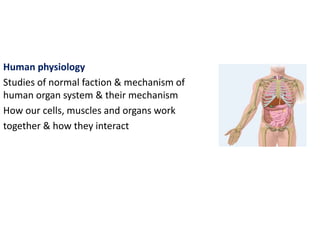
Studies of normal faction & mechanism of
human organ system & their mechanism
How our cells, muscles and organs work
together & how they interact
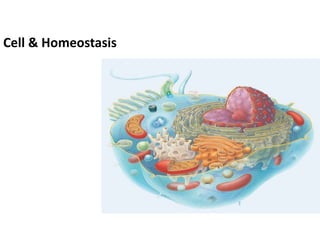
Cell & Homeostasis
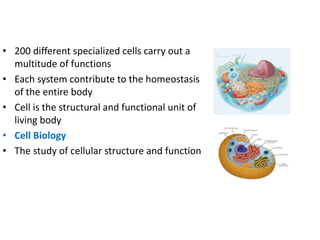
• 200 different specialized cells carry out a
multitude of functions
• Each system contribute to the homeostasis
of the entire body
• Cell is the structural and functional unit of
living body
• Cell Biology
• The study of cellular structure and function
Cell
• The basic structural, functional, and
biological unit
• Cells are the smallest unit of life that can
replicate independently
• Often called the "building blocks of life"
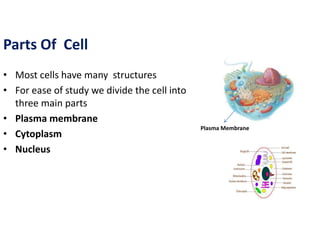
Parts Of Cell
• Most cells have many structures
• For ease of study we divide the cell into
three main parts
• Plasma membrane
• Cytoplasm
• Nucleus
Plasma Membrane
• Forms the flexible outer surface
• Surrounds and contains the
cytoplasm
• Separating internal from the
external environment
• It is a selective barrier
• Best described by fluid mosaic
model
Plasma membrane
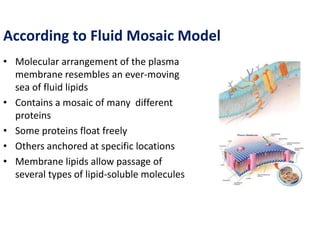
• Molecular arrangement of the plasma
membrane resembles an ever-moving
sea of fluid lipids
• Contains a mosaic of many different
proteins
• Some proteins float freely
• Others anchored at specific locations
• Membrane lipids allow passage of
several types of lipid-soluble molecules
According to Fluid Mosaic Model
• Barrier to the entry or exit of charged
or polar substances
• Some proteins allow movement of
polar molecules and ions
• Other proteins can act as signal
receptors or adhesion molecules
Plasma Membrane Structure
• Basic structural of plasma membrane
• Lipid
• Protein
• Three types of lipid molecules
• Phospholipids
• Cholesterol
• Glycolipids
• Phospholipids
• 75% lipids are phospholipids lipids
• Consist of two long, nonpolar hydrocarbon
chains
• Linked to a hydrophilic head group
• Heads of phospholipids are phosphorylated
• Consist of either:
• Glycerol
• Sphingosine
• Sphingomyelin and ceramide
Lipid of Plasma Membrane
Types of Phospholipid
• Phospholipids present in lipid layer
• Aminophospholipids
• Sphingomyelins
• Phosphatidylcholine
• Phosphatidyletholamine
• Phosphatidylglycerol
• Phosphatidylserine
• Phosphatidylinositol
• Various glycolipids (about 5%), lipids with
attached carbohydrate
• Identity marker
• Cell attachment
Glycolipids
Cholesterol
• Present between the phospholipid
molecules
• Phospholipids are soft and oily structures
• Cholesterol helps to ‘pack’ phospholipids
• Responsible for the structural integrity
• The bilayer arrangement occurs because
the lipids are amphipathic molecules
• In phospholipids the polar part is the
phosphate containing “head,” which is
hydrophilic
• The nonpolar parts are the two long
fatty acid “tails,”
• The hydrophilic heads of phospholipid
molecules facing outward
• The heads face a watery fluid on
either side
• Cytosol on inside and extracellular
fluid on outside
• The hydrophobic fatty acid tails facing
one another
Membrane Proteins
• Constitute approximately 50% of the
plasma membrane composition
• Integral proteins
• Firmly embedded in the membrane
• Dissolved in the lipid bilayer
• Span the entire thickness of membrane
• Extend into the lipid bilayer among the
fatty acid tails
• Mostly they are transmembrane proteins
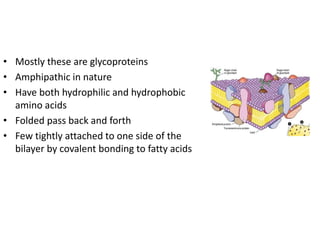
• Mostly these are glycoproteins
• Amphipathic in nature
• Have both hydrophilic and hydrophobic
amino acids
• Folded pass back and forth
• Few tightly attached to one side of the
bilayer by covalent bonding to fatty acids
• Function as
• Membrane receptors
• Enzymes
• Cell adhesion molecules
• Cell recognition proteins
• Function in message transduction
• Transport proteins
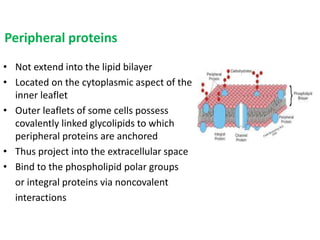
Peripheral proteins
• Not extend into the lipid bilayer
• Located on the cytoplasmic aspect of the
inner leaflet
• Outer leaflets of some cells possess
covalently linked glycolipids to which
peripheral proteins are anchored
• Thus project into the extracellular space
• Bind to the phospholipid polar groups
or integral proteins via noncovalent
interactions
• Associate loosely with polar heads of lipids
• Or with integral proteins
• Carbohydrate portions form sugary coat
• Glycocalyx is hydrophilic in nature
• Makes red blood cells slippery
• Molecular “signature”
• Enables cells to recognize one another
Function of Glycocalyx
• Aids in attachment of some cells
• Binds antigens and enzymes to the cell surface
• Facilitates cell-cell recognition and interaction
• Protects cells from injury
• Assists T-cells and antigen-presenting cells in
aligning
• In blood vessels it lines the endothelial surface
• Decrease frictional
Functions of Membrane Proteins
• Some integral proteins form ion channels
• Other act as carriers selectively moving a polar substance
• Carriers are also known as transporters
• Integral proteins called receptors serve as cellular recognition
sites
• Each type of receptor recognizes and binds a specific type of
molecule
• For instance, insulin receptors bind the hormone insulin
• A specific molecule that binds to a receptor is called a ligand of
that receptor
• Some integral proteins are enzymes that catalyze specific
• Some serve as linkers, which anchor proteins
• Membrane glycoproteins and glycolipids often serve as cell
identity markers
• The ABO blood type markers are one example of identity
markers
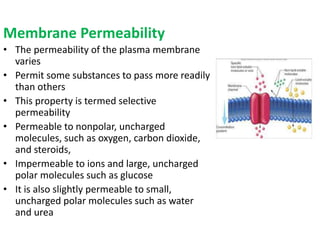
Membrane Permeability
• The permeability of the plasma membrane
varies
• Permit some substances to pass more readily
than others
• This property is termed selective
permeability
• Permeable to nonpolar, uncharged
molecules, such as oxygen, carbon dioxide,
and steroids,
• Impermeable to ions and large, uncharged
polar molecules such as glucose
• It is also slightly permeable to small,
uncharged polar molecules such as water
and urea

Cell & Homeostasis

  • 2.
    Human Physiology Branch ofmedical science Dealing with the functions & activities Human and their parts Including physical & chemical processes Scientific study of Normal function &Mechanism Living systems
  • 3.
    Human physiology Studies ofnormal faction & mechanism of human organ system & their mechanism How our cells, muscles and organs work together & how they interact
  • 4.
  • 5.
    • 200 differentspecialized cells carry out a multitude of functions • Each system contribute to the homeostasis of the entire body • Cell is the structural and functional unit of living body • Cell Biology • The study of cellular structure and function
  • 6.
    Cell • The basicstructural, functional, and biological unit • Cells are the smallest unit of life that can replicate independently • Often called the "building blocks of life"
  • 7.
    Parts Of Cell •Most cells have many structures • For ease of study we divide the cell into three main parts • Plasma membrane • Cytoplasm • Nucleus Plasma Membrane
  • 8.
    • Forms theflexible outer surface • Surrounds and contains the cytoplasm • Separating internal from the external environment • It is a selective barrier • Best described by fluid mosaic model Plasma membrane
  • 9.
    • Molecular arrangementof the plasma membrane resembles an ever-moving sea of fluid lipids • Contains a mosaic of many different proteins • Some proteins float freely • Others anchored at specific locations • Membrane lipids allow passage of several types of lipid-soluble molecules According to Fluid Mosaic Model
  • 10.
    • Barrier tothe entry or exit of charged or polar substances • Some proteins allow movement of polar molecules and ions • Other proteins can act as signal receptors or adhesion molecules
  • 11.
    Plasma Membrane Structure •Basic structural of plasma membrane • Lipid • Protein • Three types of lipid molecules • Phospholipids • Cholesterol • Glycolipids
  • 12.
    • Phospholipids • 75%lipids are phospholipids lipids • Consist of two long, nonpolar hydrocarbon chains • Linked to a hydrophilic head group • Heads of phospholipids are phosphorylated • Consist of either: • Glycerol • Sphingosine • Sphingomyelin and ceramide Lipid of Plasma Membrane
  • 13.
    Types of Phospholipid •Phospholipids present in lipid layer • Aminophospholipids • Sphingomyelins • Phosphatidylcholine • Phosphatidyletholamine • Phosphatidylglycerol • Phosphatidylserine • Phosphatidylinositol
  • 14.
    • Various glycolipids(about 5%), lipids with attached carbohydrate • Identity marker • Cell attachment Glycolipids
  • 15.
    Cholesterol • Present betweenthe phospholipid molecules • Phospholipids are soft and oily structures • Cholesterol helps to ‘pack’ phospholipids • Responsible for the structural integrity
  • 16.
    • The bilayerarrangement occurs because the lipids are amphipathic molecules • In phospholipids the polar part is the phosphate containing “head,” which is hydrophilic • The nonpolar parts are the two long fatty acid “tails,”
  • 17.
    • The hydrophilicheads of phospholipid molecules facing outward • The heads face a watery fluid on either side • Cytosol on inside and extracellular fluid on outside • The hydrophobic fatty acid tails facing one another
  • 18.
    Membrane Proteins • Constituteapproximately 50% of the plasma membrane composition • Integral proteins • Firmly embedded in the membrane • Dissolved in the lipid bilayer • Span the entire thickness of membrane • Extend into the lipid bilayer among the fatty acid tails • Mostly they are transmembrane proteins
  • 19.
    • Mostly theseare glycoproteins • Amphipathic in nature • Have both hydrophilic and hydrophobic amino acids • Folded pass back and forth • Few tightly attached to one side of the bilayer by covalent bonding to fatty acids
  • 20.
    • Function as •Membrane receptors • Enzymes • Cell adhesion molecules • Cell recognition proteins • Function in message transduction • Transport proteins
  • 21.
    Peripheral proteins • Notextend into the lipid bilayer • Located on the cytoplasmic aspect of the inner leaflet • Outer leaflets of some cells possess covalently linked glycolipids to which peripheral proteins are anchored • Thus project into the extracellular space • Bind to the phospholipid polar groups or integral proteins via noncovalent interactions
  • 22.
    • Associate looselywith polar heads of lipids • Or with integral proteins • Carbohydrate portions form sugary coat • Glycocalyx is hydrophilic in nature • Makes red blood cells slippery • Molecular “signature” • Enables cells to recognize one another
  • 23.
    Function of Glycocalyx •Aids in attachment of some cells • Binds antigens and enzymes to the cell surface • Facilitates cell-cell recognition and interaction • Protects cells from injury • Assists T-cells and antigen-presenting cells in aligning • In blood vessels it lines the endothelial surface • Decrease frictional
  • 24.
    Functions of MembraneProteins • Some integral proteins form ion channels • Other act as carriers selectively moving a polar substance • Carriers are also known as transporters • Integral proteins called receptors serve as cellular recognition sites • Each type of receptor recognizes and binds a specific type of molecule • For instance, insulin receptors bind the hormone insulin • A specific molecule that binds to a receptor is called a ligand of that receptor
  • 25.
    • Some integralproteins are enzymes that catalyze specific • Some serve as linkers, which anchor proteins • Membrane glycoproteins and glycolipids often serve as cell identity markers • The ABO blood type markers are one example of identity markers
  • 26.
    Membrane Permeability • Thepermeability of the plasma membrane varies • Permit some substances to pass more readily than others • This property is termed selective permeability • Permeable to nonpolar, uncharged molecules, such as oxygen, carbon dioxide, and steroids, • Impermeable to ions and large, uncharged polar molecules such as glucose • It is also slightly permeable to small, uncharged polar molecules such as water and urea