LINKAGE AND CROSSING OVER
Dr V.P.Saini
Dr V.P.Saini
Prof. & Dean
Prof. & Dean
College of Fisheries, Kishanganj
INTRODUCTION
INTRODUCTION
The number of genes in an organism far exceeds
the number of chromosome.
Gene tally for Daphnia pulex, around 31,000 genes, stack up
against other organisms? Humans have about 23,000 genes –
close in number to mice, roundworms, and a small flowering
plant called Arabidopsis thaliana. Fruit flies have about 14,000
genes, yeast has about 6,000, and E. coli bacteria about
3,200.Zebrafish has more than 5000 genes
A single chromosome bears several genes.
LINKED GENES
Genes present at the same locus have the tendency to be linked
together from one generation to the other and are not disturbed
by the meiotic recombination.
Linkage is defined as “the tendency of genes to remain
together during the process of inheritance”.
 When two loci were linked genetically on the same
chromosome they did not segregate.
 Extent of linkage - closer the genes, stronger the linkage and
vice versa.
Linkage of genes is in the linear fashion in the chromosomes.
LINKAGE
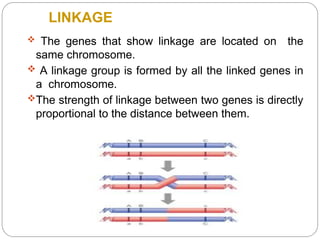
 The genes that show linkage are located on the
same chromosome.
 A linkage group is formed by all the linked genes in
a chromosome.
The strength of linkage between two genes is directly
proportional to the distance between them.
TYPES OF LINKAGE
i) Complete Linkage
 When two or more genes tend to remain
together on the same chromosome and
are inherited together for many generations,
the phenomenon is known as complete
linkage.
 Happen when chromosomes do not
undergo any breakage by accident during
gametogenesis.
ii) Incomplete Linkage
 When the linked genes tend to separate on
some occasions during the course of
inheritance, the phenomenon is known as
incomplete linkage.
 Occurs in the process of crossing over
during gametogenesis.
 The genes present on the homologous part
of sex chromosomes exhibit the
phenomenon of incomplete linkage.
AUTOSOMAL & SEX LINKAGE
Autosomal linkage- the linked genes are present on the
autosomes.
Sex linkage- the linked genes are present on the sex
chromosomes.
Linkage groups in fish-detected by Winge (1923).
E.g., the Xvi and Xel genes in the guppy are linked on the X
chromosome.
Although both genes may cross over to theY chromosome, it is assumed
that they are located only on the X chromosome.
CROSSING-OVER
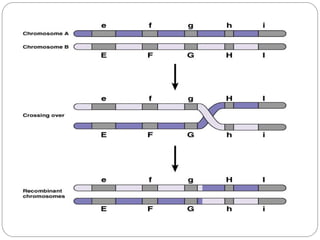
The physical exchange of parts of non-sister
chromatids of homologous chromosomes
following synapsis at meiosis is known as
crossing-over.
Results in the recombination of genes.
1,or 2, or more fragments may be interchanged
during crossing-over.
Frequency of crossing over of a given pair of genes is
not constant.
Crossing over frequencies are higher in the female sex
than in males.
Temperature, nutrition, sex, age, etc. influence crossing
over.
It is a part of meiotic mechanism during gametogenesis.
Brings about variation and leads to evolution through
natural selection.
1. SINGLE CROSSING-OVER
.
 Only one chromatid of each chromosome is
involved in single crossing over.
Single crossing over is of most frequent
occurrence.
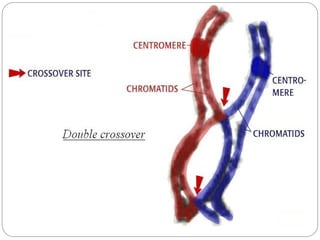
2. DOUBLE CROSSING-OVER
Both the chiasmata may be between the same
chromatids or between different chromatids.
Two, or three, or all the four chromatids of the
homologous pairs of chromosomes are involved in
the process of double crossing-over.
Double cross-over gametes are produced.
This is of less frequent occurrence.
3. MULTIPLE CROSSING-OVER
More than two chiasmata are formed.
Corresponding to the number of chiasmata
formed, it is called triple (3 chiasmata),
quadruple (4 chiasmata), and so on.
Multiple crossing-over does not occur frequently.
SIGNIFICANCE
 Provides a direct evidence of the linear
arrangement of genes in the chromosomes.
Chromosome maps can be constructed.
Gives rise to new combinations of genes, and
hence, variations in offspring.
CHROMOSOME MAPPING
Sturtevant, (1913) constructed first chromosome
map showing the position genes on the X
chromosome
Genetic maps of chromosomes are also known
as chromosome maps.
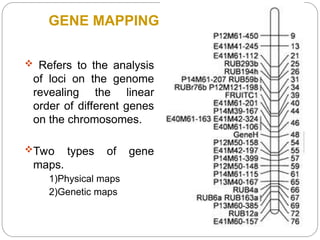
GENE MAPPING
 Refers to the analysis
of loci on the genome
revealing the linear
order of different genes
on the chromosomes.
Two types of gene
maps.
1)Physical maps
2)Genetic maps
PHYSICAL MAPS
 Based on the assignment of loci to chromosomes.
Accomplished by the methods
1) somatic cell hybrid panels,
2) in situ hybridization,
3) comparative mapping.
In physical maps the coordinates are the chromosome
regions or bands.
The distance between two loci are measured in kilobases.
GENETIC MAPS
Constructed by studying the meiotic recombination
between two or more loci through linkage analysis.
A new locus are assigned to a chromosome following the
inheritance of the new locus and of an already mapped
locus.
Do not provide an absolute location of loci but they
reveal the genetic distance of the loci as a function of the
frequency of crossing-overs occurring during
recombination.
Provides an ordered array or sequence tagged sites
along the chromosome.
GENETIC DISTANCE
Expressed in units of crossing over or centimorgan (cM).
One CM equals 1% crossing over and contains
approximately 1000 kb.
i.e, two loci which show 1% recombination are 1 CM apart on
a genetic map.
In a linkage a new locus is assigned based on an already
known locus.
It shows that a reference locus is a prerequisite for the
purpose.
One map unit is defined as the linkage distance
that yields 1% recombination.
When a large number of genes are mapped in
any given species, the genes are observed to
occur in linkage groups, with one linkage group
corresponding to each pair of chromosomes.
FISH – (Fluorescent In Situ Hybridization)
Highly effective, rapid technique for use in gene mapping.
Probes are labeled with fluorochrome dyes which
fluoresce in different colours when excited by UV–light.
Location of the probes are visualized under
Epifluoresence microscope.
CHROMOSOME PAINTING
It is one of the application of FISH techniques.
The direct visualization of specific chromosomes by
fluorescent detection by hybridized labeled whole
chromosome probes is called Chromosomes painting.
Used to improve the accuracy of cytogenetic studies,
closing the gap between cytogenetic and molecular
analysis.
Whole chromosomes specific probes are called ‘paints’.
Used in identification of species specific chromosomes
among somatic cell hybrids.
Used in detection of Chromosomal rearrangements or
abnormalities for which no locus–specific probes are
available.
THANK YOU

LINKAGE-AND-CROSSING-OVER genetics -8.ppt

  • 1.
    LINKAGE AND CROSSINGOVER Dr V.P.Saini Dr V.P.Saini Prof. & Dean Prof. & Dean College of Fisheries, Kishanganj College of Fisheries, Kishanganj
  • 2.
    INTRODUCTION INTRODUCTION The number ofgenes in an organism far exceeds the number of chromosome. Gene tally for Daphnia pulex, around 31,000 genes, stack up against other organisms? Humans have about 23,000 genes – close in number to mice, roundworms, and a small flowering plant called Arabidopsis thaliana. Fruit flies have about 14,000 genes, yeast has about 6,000, and E. coli bacteria about 3,200.Zebrafish has more than 5000 genes A single chromosome bears several genes.
  • 3.
    LINKED GENES Genes presentat the same locus have the tendency to be linked together from one generation to the other and are not disturbed by the meiotic recombination. Linkage is defined as “the tendency of genes to remain together during the process of inheritance”.  When two loci were linked genetically on the same chromosome they did not segregate.  Extent of linkage - closer the genes, stronger the linkage and vice versa. Linkage of genes is in the linear fashion in the chromosomes.
  • 4.
    LINKAGE  The genesthat show linkage are located on the same chromosome.  A linkage group is formed by all the linked genes in a chromosome. The strength of linkage between two genes is directly proportional to the distance between them.
  • 5.
    TYPES OF LINKAGE i)Complete Linkage  When two or more genes tend to remain together on the same chromosome and are inherited together for many generations, the phenomenon is known as complete linkage.  Happen when chromosomes do not undergo any breakage by accident during gametogenesis.
  • 6.
    ii) Incomplete Linkage When the linked genes tend to separate on some occasions during the course of inheritance, the phenomenon is known as incomplete linkage.  Occurs in the process of crossing over during gametogenesis.  The genes present on the homologous part of sex chromosomes exhibit the phenomenon of incomplete linkage.
  • 7.
    AUTOSOMAL & SEXLINKAGE Autosomal linkage- the linked genes are present on the autosomes. Sex linkage- the linked genes are present on the sex chromosomes. Linkage groups in fish-detected by Winge (1923). E.g., the Xvi and Xel genes in the guppy are linked on the X chromosome. Although both genes may cross over to theY chromosome, it is assumed that they are located only on the X chromosome.
  • 8.
    CROSSING-OVER The physical exchangeof parts of non-sister chromatids of homologous chromosomes following synapsis at meiosis is known as crossing-over. Results in the recombination of genes. 1,or 2, or more fragments may be interchanged during crossing-over.
  • 10.
    Frequency of crossingover of a given pair of genes is not constant. Crossing over frequencies are higher in the female sex than in males. Temperature, nutrition, sex, age, etc. influence crossing over. It is a part of meiotic mechanism during gametogenesis. Brings about variation and leads to evolution through natural selection.
  • 11.
    1. SINGLE CROSSING-OVER . Only one chromatid of each chromosome is involved in single crossing over. Single crossing over is of most frequent occurrence.
  • 12.
    2. DOUBLE CROSSING-OVER Boththe chiasmata may be between the same chromatids or between different chromatids. Two, or three, or all the four chromatids of the homologous pairs of chromosomes are involved in the process of double crossing-over. Double cross-over gametes are produced. This is of less frequent occurrence.
  • 14.
    3. MULTIPLE CROSSING-OVER Morethan two chiasmata are formed. Corresponding to the number of chiasmata formed, it is called triple (3 chiasmata), quadruple (4 chiasmata), and so on. Multiple crossing-over does not occur frequently.
  • 15.
    SIGNIFICANCE  Provides adirect evidence of the linear arrangement of genes in the chromosomes. Chromosome maps can be constructed. Gives rise to new combinations of genes, and hence, variations in offspring.
  • 16.
    CHROMOSOME MAPPING Sturtevant, (1913)constructed first chromosome map showing the position genes on the X chromosome Genetic maps of chromosomes are also known as chromosome maps.
  • 17.
    GENE MAPPING  Refersto the analysis of loci on the genome revealing the linear order of different genes on the chromosomes. Two types of gene maps. 1)Physical maps 2)Genetic maps
  • 18.
    PHYSICAL MAPS  Basedon the assignment of loci to chromosomes. Accomplished by the methods 1) somatic cell hybrid panels, 2) in situ hybridization, 3) comparative mapping. In physical maps the coordinates are the chromosome regions or bands. The distance between two loci are measured in kilobases.
  • 19.
    GENETIC MAPS Constructed bystudying the meiotic recombination between two or more loci through linkage analysis. A new locus are assigned to a chromosome following the inheritance of the new locus and of an already mapped locus. Do not provide an absolute location of loci but they reveal the genetic distance of the loci as a function of the frequency of crossing-overs occurring during recombination. Provides an ordered array or sequence tagged sites along the chromosome.
  • 20.
    GENETIC DISTANCE Expressed inunits of crossing over or centimorgan (cM). One CM equals 1% crossing over and contains approximately 1000 kb. i.e, two loci which show 1% recombination are 1 CM apart on a genetic map. In a linkage a new locus is assigned based on an already known locus. It shows that a reference locus is a prerequisite for the purpose.
  • 21.
    One map unitis defined as the linkage distance that yields 1% recombination. When a large number of genes are mapped in any given species, the genes are observed to occur in linkage groups, with one linkage group corresponding to each pair of chromosomes.
  • 22.
    FISH – (FluorescentIn Situ Hybridization) Highly effective, rapid technique for use in gene mapping. Probes are labeled with fluorochrome dyes which fluoresce in different colours when excited by UV–light. Location of the probes are visualized under Epifluoresence microscope.
  • 23.
    CHROMOSOME PAINTING It isone of the application of FISH techniques. The direct visualization of specific chromosomes by fluorescent detection by hybridized labeled whole chromosome probes is called Chromosomes painting. Used to improve the accuracy of cytogenetic studies, closing the gap between cytogenetic and molecular analysis.
  • 24.
    Whole chromosomes specificprobes are called ‘paints’. Used in identification of species specific chromosomes among somatic cell hybrids. Used in detection of Chromosomal rearrangements or abnormalities for which no locus–specific probes are available.
  • 25.