Semantics:
The Analysis of
Meaning
Group 7 :
• Ririn Destina (0611100106)
• Riyanti Oct. Nainggolan (06111001012)
• Melin Atika (06111001028)
• Ronika A. Manik (06111001034)
Meaning
• To understand language
– the meaning of words and of the morphemes
that compose them
– Words into phrases and sentences
– Context which determines the meaning
(Pragmatics)
The study of meaning of words,
phrases, and sentences.
• Lexical semantics (words and
meaning relationship among words)
•Phrasal/ sentential semantics
(syntactic units larger than a word)
What is Semantics?
How can we describe the meaning
of different words?
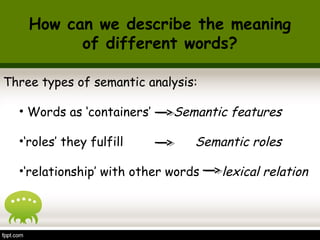
Three types of semantic analysis:
• Words as ‘containers’ Semantic features
•‘roles’ they fulfill Semantic roles
•‘relationship’ with other words lexical relation
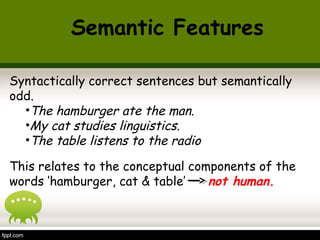
Syntactically correct sentences but semantically
odd.
•The hamburger ate the man.
•My cat studies linguistics.
•The table listens to the radio
This relates to the conceptual components of the
words ‘hamburger, cat & table’ not human.
Semantic Features
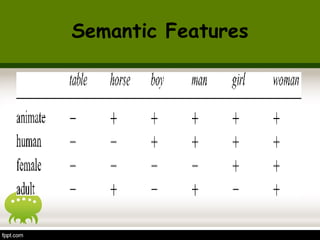
• Semantic properties: The components of
meaning of a word.
• Meaning as collection of
properties/features typically with two
possible values (+ / -)
• Example of componential analysis:
baby is [+ young], [+ human], [+animate]
Semantic Features
Semantic Features
Identify the features (1)
1.(a) widow, mother, sister, aunt, maid
(b) widower, father, brother, uncle
The (a) and (b) words are
The (a) words are
The (b) words are
2. (a) bachelor, paperboy, pope, chief
(b) bull, rooster, drake, ram
 The (a) and (b) words are
 The (a) words are
 The (b) words are
[+ human]
[+ female]
[+ male]
[+ male]
[+ human]
[+ animal]
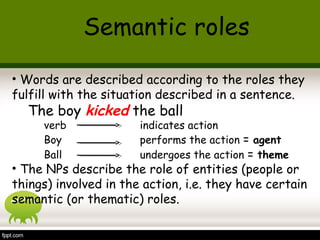
• Words are described according to the roles they
fulfill with the situation described in a sentence.
The boy kicked the ball
verb indicates action
Boy performs the action = agent
Ball undergoes the action = theme
• The NPs describe the role of entities (people or
things) involved in the action, i.e. they have certain
semantic (or thematic) roles.
Semantic roles
Agent = the entity that performs the action
Theme = the entity that undergoes the action
Experiencer = one who perceives something
Instrument = an entity used to perform an action
Location = the place where the action happens
Source = the place from which an action
originates.
Goal = the place where the action is directed
Semantic Roles
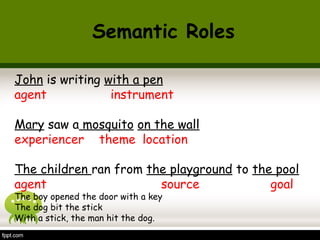
John is writing with a pen
agent instrument
Mary saw a mosquito on the wall
experiencer theme location
The children ran from the playground to the pool
agent source goal
The boy opened the door with a key
The dog bit the stick
With a stick, the man hit the dog.
Semantic Roles

Semantics

  • 1.
    Semantics: The Analysis of Meaning Group7 : • Ririn Destina (0611100106) • Riyanti Oct. Nainggolan (06111001012) • Melin Atika (06111001028) • Ronika A. Manik (06111001034)
  • 2.
    Meaning • To understandlanguage – the meaning of words and of the morphemes that compose them – Words into phrases and sentences – Context which determines the meaning (Pragmatics)
  • 3.
    The study ofmeaning of words, phrases, and sentences. • Lexical semantics (words and meaning relationship among words) •Phrasal/ sentential semantics (syntactic units larger than a word) What is Semantics?
  • 4.
    How can wedescribe the meaning of different words? Three types of semantic analysis: • Words as ‘containers’ Semantic features •‘roles’ they fulfill Semantic roles •‘relationship’ with other words lexical relation
  • 5.
    Syntactically correct sentencesbut semantically odd. •The hamburger ate the man. •My cat studies linguistics. •The table listens to the radio This relates to the conceptual components of the words ‘hamburger, cat & table’ not human. Semantic Features
  • 6.
    • Semantic properties:The components of meaning of a word. • Meaning as collection of properties/features typically with two possible values (+ / -) • Example of componential analysis: baby is [+ young], [+ human], [+animate] Semantic Features
  • 7.
  • 8.
    Identify the features(1) 1.(a) widow, mother, sister, aunt, maid (b) widower, father, brother, uncle The (a) and (b) words are The (a) words are The (b) words are 2. (a) bachelor, paperboy, pope, chief (b) bull, rooster, drake, ram  The (a) and (b) words are  The (a) words are  The (b) words are [+ human] [+ female] [+ male] [+ male] [+ human] [+ animal]
  • 9.
    • Words aredescribed according to the roles they fulfill with the situation described in a sentence. The boy kicked the ball verb indicates action Boy performs the action = agent Ball undergoes the action = theme • The NPs describe the role of entities (people or things) involved in the action, i.e. they have certain semantic (or thematic) roles. Semantic roles
  • 10.
    Agent = theentity that performs the action Theme = the entity that undergoes the action Experiencer = one who perceives something Instrument = an entity used to perform an action Location = the place where the action happens Source = the place from which an action originates. Goal = the place where the action is directed Semantic Roles
  • 11.
    John is writingwith a pen agent instrument Mary saw a mosquito on the wall experiencer theme location The children ran from the playground to the pool agent source goal The boy opened the door with a key The dog bit the stick With a stick, the man hit the dog. Semantic Roles