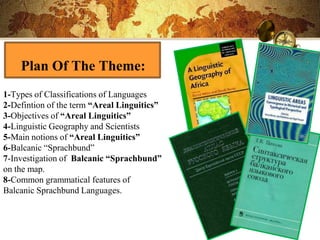
Plan Of The Theme:
1-Types of Classifications of Languages
2-Defintion of the term “Areal Linguitics”
3-Objectives of “Areal Linguitics”
4-Linguistic Geography and Scientists
5-Main notions of “Areal Linguitics”
6-Balcanic ―Sprachbund‖
7-Investigation of Balcanic “Sprachbund”
on the map.
8-Common grammatical features of
Balcanic Sprachbund Languages.
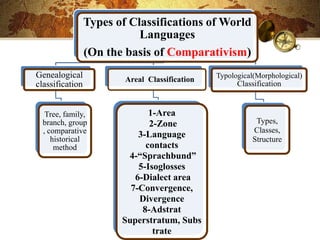
Types of Classifications of World
                            Languages
                 (On the basis of Comparativism)
Genealogical             Areal Classification   Typological(Morphological)
classification                                        Classification


   Tree, family,               1-Area
  branch, group                2-Zone                      Types,
  , comparative                                           Classes,
     historical
                            3-Language                    Structure
      method                  contacts
                         4-“Sprachbund”
                            5-Isoglosses
                           6-Dialect area
                          7-Convergence,
                            Divergence
                             8-Adstrat
                        Superstratum, Subs
                                trate
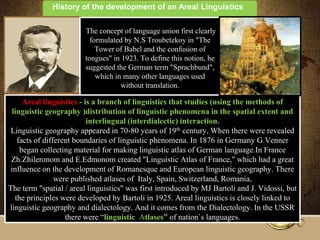
History of the development of an Areal Linguistics

                        The concept of language union first clearly
                          formulated by N.S Troubetzkoy in "The
                            Tower of Babel and the confusion of
                        tongues" in 1923. To define this notion, he
                        suggested the German term "Sprachbund",
                            which in many other languages ​used
                                    without translation.

     Areal linguistics - is a branch of linguistics that studies (using the methods of
 linguistic geography )distribution of linguistic phenomena in the spatial extent and
                          interlingual (interdialectic) interaction.
 Linguistic geography appeared in 70-80 years of 19th century, When there were revealed
   facts of different boundaries of linguistic phenomena. In 1876 in Germany G.Venner
    began collecting material for making linguistic atlas of German language.In France
 Zh.Zhileronom and E.Edmonom created "Linguistic Atlas of France," which had a great
 influence on the development of Romanesque and European linguistic geography. There
                were published atlases of Italy, Spain, Switzerland, Romania,
The term "spatial / areal linguistics" was first introduced by MJ Bartoli and J. Vidossi, but
  the principles were developed by Bartoli in 1925. Areal linguistics is closely linked to
linguistic geography and dialectology. And it comes from the Dialectology. In the USSR
                   there were ―linguistic Atlases” of nation`s languages.
Subject, Object, Aim and Methods of Areal Linguistics

I-Its main Aim - to determine the area of ​language (or dialect) within the boarders of its
    linguistic features.
II-The main research Methods are linguageographical method(displaying of linguistic
    phenomena on the map) or areal (isoglossive) method . The studies identify the regions
    (areas) the interaction of dialects, languages, and areal communities – ―sprachbunds‖
    sharing common structural features.
III-The Object of Areal linguistics is territorial distribution of languages ​and linguistic
    phenomena.
IV-The Subject of Modern Areal linguistics are general linguistic problems:
 Division of proto-language states at historically attested languages ​and dialect continuum;
 Giving areal characteristic features of the interacting languages ​and dialects of certain
    region;
 Finding regularities of language contacts;
 Development of areal typology principles, setting a theory of language interaction (theory of
    sprachbund);
 Defining the role of substrates in the area of contacts;
 The study of language interference in geographically contiguous languages;
 Development of ethno-linguistic and socio-linguistic typology for geographically
    contiguous languages.
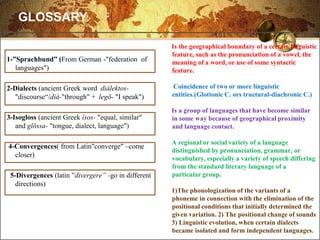
GLOSSARY

                                                     Is the geographical boundary of a certain linguistic
                                                     feature, such as the pronunciation of a vowel, the
1-”Sprachbund” (From German -"federation of          meaning of a word, or use of some syntactic
   languages")                                       feature.

2-Dialects (ancient Greek word diálektos-            Coincidence of two or more linguistic
  "discourse―/diá-"through" + legō- "I speak")       entities.(Glottonic C. ors tructural-diachronic C.)

                                                     Is a group of languages that have become similar
3-Isogloss (ancient Greek ísos- "equal, similar"     in some way because of geographical proximity
   and glōssa- "tongue, dialect, language")          and language contact.

                                                     A regional or social variety of a language
4-Convergences( from Latin"converge" –come
                                                     distinguished by pronunciation, grammar, or
  closer)                                            vocabulary, especially a variety of speech differing
                                                     from the standard literary language of a
 5-Divergences (latin ‖divergere” -go in different   particular group.
   directions)
                                                     1)The phonologization of the variants of a
                                                     phoneme in connection with the elimination of the
                                                     positional conditions that initially determined the
                                                     given variation. 2) The positional change of sounds
                                                     3) Linguistic evolution, when certain dialects
                                                     became isolated and form independent languages.
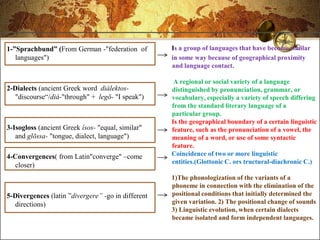
1-”Sprachbund” (From German -"federation of         Is a group of languages that have become similar
   languages")                                      in some way because of geographical proximity
                                                    and language contact.

                                                     A regional or social variety of a language
2-Dialects (ancient Greek word diálektos-           distinguished by pronunciation, grammar, or
  "discourse―/diá-"through" + legō- "I speak")      vocabulary, especially a variety of speech differing
                                                    from the standard literary language of a
                                                    particular group.
                                                    Is the geographical boundary of a certain linguistic
3-Isogloss (ancient Greek ísos- "equal, similar"    feature, such as the pronunciation of a vowel, the
   and glōssa- "tongue, dialect, language")         meaning of a word, or use of some syntactic
                                                    feature.
4-Convergences( from Latin"converge" –come          Coincidence of two or more linguistic
                                                    entities.(Glottonic C. ors tructural-diachronic C.)
  closer)
                                                    1)The phonologization of the variants of a
                                                    phoneme in connection with the elimination of the
5-Divergences (latin ‖divergere” -go in different   positional conditions that initially determined the
  directions)                                       given variation. 2) The positional change of sounds
                                                    3) Linguistic evolution, when certain dialects
                                                    became isolated and form independent languages.
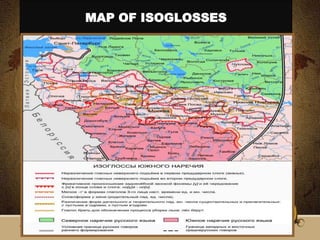
MAP OF ISOGLOSSES


14.02.2013
Terms
              Infl
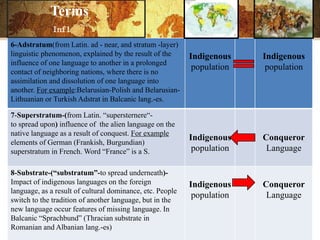
6-Adstratum(from Latin. ad - near, and stratum -layer)
linguistic phenomenon, explained by the result of the      Indigenous    Indigenous
influence of one language to another in a prolonged
                                                            population    population
contact of neighboring nations, where there is no
assimilation and dissolution of one language into
another. For example:Belarusian-Polish and Belarusian-
Lithuanian or Turkish Adstrat in Balcanic lang.-es.

7-Superstratum-(from Latin. ―supersternere―-
to spread upon) influence of the alien language on the
native language as a result of conquest. For example
                                                           Indigenous    Conqueror
elements of German (Frankish, Burgundian)
superstratum in French. Word ―France‖ is a S.               population    Language

8-Substrate-(“substratum”-to spread underneath)-
Impact of indigenous languages ​on the foreign             Indigenous    Conqueror
language, as a result of cultural dominance, etc. People
                                                            population    Language
switch to the tradition of another language, but in the
new language occur features of missing language. In
Balcanic ―Sprachbund‖ (Thracian substrate in
Romanian and Albanian lang.-es)
Balcanic “Sprachbund”
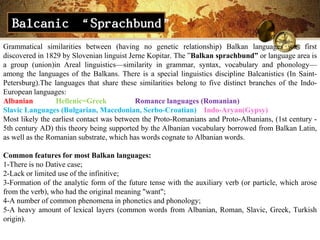
Grammatical similarities between (having no genetic relationship) Balkan languages ​was first
discovered in 1829 by Slovenian linguist Jerne Kopitar. The ‖Balkan sprachbund” or language area is
a group (union)in Areal linguistics—similarity in grammar, syntax, vocabulary and phonology—
among the languages of the Balkans. There is a special linguistics discipline Balcanistics (In Saint-
Petersburg).The languages that share these similarities belong to five distinct branches of the Indo-
European languages:
Albanian         Hellenic=Greek            Romance languages (Romanian)
Slavic Languages (Bulgarian, Macedonian, Serbo-Croatian) Indo-Aryan(Gypsy)
Most likely the earliest contact was between the Proto-Romanians and Proto-Albanians, (1st century -
5th century AD) this theory being supported by the Albanian vocabulary borrowed from Balkan Latin,
as well as the Romanian substrate, which has words cognate to Albanian words.

Common features for most Balkan languages​​:
1-There is no Dative case;
2-Lack or limited use of the infinitive;
3-Formation of the analytic form of the future tense with the auxiliary verb (or particle, which arose
from the verb), who had the original meaning "want";
4-A number of common phenomena in phonetics and phonology;
5-A heavy amount of lexical layers (common words from Albanian, Roman, Slavic, Greek, Turkish
origin).
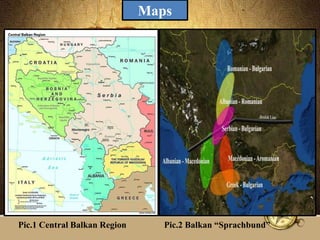
Maps

Balcanic sprachbund


Pic.1 Central Balkan Region      Pic.2 Balkan “Sprachbund”
This example translates in the Balkan languages the phrase "You should go!",
                     using the subjunctive constructions.

language           example           notes
Macedonian         Да (си) одиш!     "Оди" [odi] in the imperative is more
                                     common, and has the identical meaning.
Bulgarian          Да си ходиш!
Serbo-Croatian     Да идеш!          "Иди!" in the imperative is grammatically
                                     correct, and has the identical meaning.
Albanian           Të shkosh!        "Shko!" in the imperative is grammatically
                                     correct. "Të shkosh" is used in sentence only
                                     followed by a modal verbs, ex. in these cases:
                                     Ti duhet të shkosh (You should go), Ti mund
                                     të shkosh (You can go) etc.
Modern Greek       Να πας!
Romany (Gypsy)     Te dža!           Compare with similar Spanish "¡Que te
Romanian           Să te duci!       largues!"in Romanian, the "a se duce" (to go)
                                     requires a reflexive construction, literally
                                     "take yourself (to)"
Thank you for your attention!!!!
        Thank you for your
           attention!!!

Areal linguistics

  • 2.
    Plan Of TheTheme: 1-Types of Classifications of Languages 2-Defintion of the term “Areal Linguitics” 3-Objectives of “Areal Linguitics” 4-Linguistic Geography and Scientists 5-Main notions of “Areal Linguitics” 6-Balcanic ―Sprachbund‖ 7-Investigation of Balcanic “Sprachbund” on the map. 8-Common grammatical features of Balcanic Sprachbund Languages.
  • 3.
    Types of Classificationsof World Languages (On the basis of Comparativism) Genealogical Areal Classification Typological(Morphological) classification Classification Tree, family, 1-Area branch, group 2-Zone Types, , comparative Classes, historical 3-Language Structure method contacts 4-“Sprachbund” 5-Isoglosses 6-Dialect area 7-Convergence, Divergence 8-Adstrat Superstratum, Subs trate
  • 4.
    History of thedevelopment of an Areal Linguistics The concept of language union first clearly formulated by N.S Troubetzkoy in "The Tower of Babel and the confusion of tongues" in 1923. To define this notion, he suggested the German term "Sprachbund", which in many other languages ​used without translation. Areal linguistics - is a branch of linguistics that studies (using the methods of linguistic geography )distribution of linguistic phenomena in the spatial extent and interlingual (interdialectic) interaction. Linguistic geography appeared in 70-80 years of 19th century, When there were revealed facts of different boundaries of linguistic phenomena. In 1876 in Germany G.Venner began collecting material for making linguistic atlas of German language.In France Zh.Zhileronom and E.Edmonom created "Linguistic Atlas of France," which had a great influence on the development of Romanesque and European linguistic geography. There were published atlases of Italy, Spain, Switzerland, Romania, The term "spatial / areal linguistics" was first introduced by MJ Bartoli and J. Vidossi, but the principles were developed by Bartoli in 1925. Areal linguistics is closely linked to linguistic geography and dialectology. And it comes from the Dialectology. In the USSR there were ―linguistic Atlases” of nation`s languages.
  • 5.
    Subject, Object, Aimand Methods of Areal Linguistics I-Its main Aim - to determine the area of ​language (or dialect) within the boarders of its linguistic features. II-The main research Methods are linguageographical method(displaying of linguistic phenomena on the map) or areal (isoglossive) method . The studies identify the regions (areas) the interaction of dialects, languages, and areal communities – ―sprachbunds‖ sharing common structural features. III-The Object of Areal linguistics is territorial distribution of languages ​and linguistic phenomena. IV-The Subject of Modern Areal linguistics are general linguistic problems:  Division of proto-language states at historically attested languages ​and dialect continuum;  Giving areal characteristic features of the interacting languages ​and dialects of certain region;  Finding regularities of language contacts;  Development of areal typology principles, setting a theory of language interaction (theory of sprachbund);  Defining the role of substrates in the area of contacts;  The study of language interference in geographically contiguous languages;  Development of ethno-linguistic and socio-linguistic typology for geographically contiguous languages.
  • 6.
    GLOSSARY Is the geographical boundary of a certain linguistic feature, such as the pronunciation of a vowel, the 1-”Sprachbund” (From German -"federation of meaning of a word, or use of some syntactic languages") feature. 2-Dialects (ancient Greek word diálektos- Coincidence of two or more linguistic "discourse―/diá-"through" + legō- "I speak") entities.(Glottonic C. ors tructural-diachronic C.) Is a group of languages that have become similar 3-Isogloss (ancient Greek ísos- "equal, similar" in some way because of geographical proximity and glōssa- "tongue, dialect, language") and language contact. A regional or social variety of a language 4-Convergences( from Latin"converge" –come distinguished by pronunciation, grammar, or closer) vocabulary, especially a variety of speech differing from the standard literary language of a 5-Divergences (latin ‖divergere” -go in different particular group. directions) 1)The phonologization of the variants of a phoneme in connection with the elimination of the positional conditions that initially determined the given variation. 2) The positional change of sounds 3) Linguistic evolution, when certain dialects became isolated and form independent languages.
  • 7.
    1-”Sprachbund” (From German-"federation of Is a group of languages that have become similar languages") in some way because of geographical proximity and language contact. A regional or social variety of a language 2-Dialects (ancient Greek word diálektos- distinguished by pronunciation, grammar, or "discourse―/diá-"through" + legō- "I speak") vocabulary, especially a variety of speech differing from the standard literary language of a particular group. Is the geographical boundary of a certain linguistic 3-Isogloss (ancient Greek ísos- "equal, similar" feature, such as the pronunciation of a vowel, the and glōssa- "tongue, dialect, language") meaning of a word, or use of some syntactic feature. 4-Convergences( from Latin"converge" –come Coincidence of two or more linguistic entities.(Glottonic C. ors tructural-diachronic C.) closer) 1)The phonologization of the variants of a phoneme in connection with the elimination of the 5-Divergences (latin ‖divergere” -go in different positional conditions that initially determined the directions) given variation. 2) The positional change of sounds 3) Linguistic evolution, when certain dialects became isolated and form independent languages.
  • 8.
  • 9.
    Terms Infl 6-Adstratum(from Latin. ad - near, and stratum -layer) linguistic phenomenon, explained by the result of the Indigenous Indigenous influence of one language to another in a prolonged population population contact of neighboring nations, where there is no assimilation and dissolution of one language into another. For example:Belarusian-Polish and Belarusian- Lithuanian or Turkish Adstrat in Balcanic lang.-es. 7-Superstratum-(from Latin. ―supersternere―- to spread upon) influence of the alien language on the native language as a result of conquest. For example Indigenous Conqueror elements of German (Frankish, Burgundian) superstratum in French. Word ―France‖ is a S. population Language 8-Substrate-(“substratum”-to spread underneath)- Impact of indigenous languages ​on the foreign Indigenous Conqueror language, as a result of cultural dominance, etc. People population Language switch to the tradition of another language, but in the new language occur features of missing language. In Balcanic ―Sprachbund‖ (Thracian substrate in Romanian and Albanian lang.-es)
  • 10.
    Balcanic “Sprachbund” Grammatical similaritiesbetween (having no genetic relationship) Balkan languages ​was first discovered in 1829 by Slovenian linguist Jerne Kopitar. The ‖Balkan sprachbund” or language area is a group (union)in Areal linguistics—similarity in grammar, syntax, vocabulary and phonology— among the languages of the Balkans. There is a special linguistics discipline Balcanistics (In Saint- Petersburg).The languages that share these similarities belong to five distinct branches of the Indo- European languages: Albanian Hellenic=Greek Romance languages (Romanian) Slavic Languages (Bulgarian, Macedonian, Serbo-Croatian) Indo-Aryan(Gypsy) Most likely the earliest contact was between the Proto-Romanians and Proto-Albanians, (1st century - 5th century AD) this theory being supported by the Albanian vocabulary borrowed from Balkan Latin, as well as the Romanian substrate, which has words cognate to Albanian words. Common features for most Balkan languages​​: 1-There is no Dative case; 2-Lack or limited use of the infinitive; 3-Formation of the analytic form of the future tense with the auxiliary verb (or particle, which arose from the verb), who had the original meaning "want"; 4-A number of common phenomena in phonetics and phonology; 5-A heavy amount of lexical layers (common words from Albanian, Roman, Slavic, Greek, Turkish origin).
  • 11.
    Maps Balcanic sprachbund Pic.1 CentralBalkan Region Pic.2 Balkan “Sprachbund”
  • 12.
    This example translatesin the Balkan languages the phrase "You should go!", using the subjunctive constructions. language example notes Macedonian Да (си) одиш! "Оди" [odi] in the imperative is more common, and has the identical meaning. Bulgarian Да си ходиш! Serbo-Croatian Да идеш! "Иди!" in the imperative is grammatically correct, and has the identical meaning. Albanian Të shkosh! "Shko!" in the imperative is grammatically correct. "Të shkosh" is used in sentence only followed by a modal verbs, ex. in these cases: Ti duhet të shkosh (You should go), Ti mund të shkosh (You can go) etc. Modern Greek Να πας! Romany (Gypsy) Te dža! Compare with similar Spanish "¡Que te Romanian Să te duci! largues!"in Romanian, the "a se duce" (to go) requires a reflexive construction, literally "take yourself (to)"
  • 13.
    Thank you foryour attention!!!! Thank you for your attention!!!