INTRODUCTION
Mathematics is the queen of science. In our daily life, planning is
required on various occasions, especially when the resources are
limited. Any planning is meant for attaining certain objectives. The
best strategy is one that gives a maximum output from a
minimum input. The objective which is in the form of output may
be to get the maximum profit, minimum cost of production or
minimum inventory cost with a limited input of raw material,
manpower and machine capacity. Such problems are referred to
as the problems of constrained optimization. Linear programming
is a technique for determining an optimum schedule of
interdependent activities in view of the available resources.
Programming is just another word for 'planning' and refers to the
process of determining a particular plan of action from amongst
several alternatives.
Linear programming applies to optimization models in which
objective and constraint functions are strictly linear. The
technique is used in a wide range of applications, including
agriculture, industry, transportation, economics, health systems,
behavioral and social sciences and the military. It also boasts
efficient computational algorithms for problems with thousands
of constraints and variables. Indeed, because of its tremendous
computational efficiency, linear programming forms the backbone
of the solution algorithms for other operative research models,
including integer, stochastic and non-linear programming. The
graphical solution provides insight into the development of the
general algebraic simplex method. It also gives concrete ideas for
the development and interpretation of sensitivity analysis in linear
programming.
Linear programming is a major innovation since World War II in
the field of business decision making, particularly under
conditions of certainty. The word 'linear' means the relationships
handled are those represented by straight lines, i.e. the
relationships are of the form y = a + bx and the word
'programming' means taking decisions systematically. Thus, linear
programming is a decision making technique under given
constraints on the assumption that the relationships amongst the
variables representing different phenomena happen to be linear.
A linear programming problem consists of three parts. First, there
objective function which is to be either maximized or minimized.
Second, there is a set of linear constraints which contains thee
technical specifications of the problems in relation to the given
resources or requirements. Third, there is a set of non negativity
constraints - since negative production has no physical
counterpart.
AIM
1. To find and know more about the importance and uses of
'linear programming'.
2. To formulate a linear programming problem and solve in
simplex method and dual problem
DATA COLLECTION
Linear programming is a versatile mathematical technique in
operations research and a plan of action to solve a given problem
involving linearly related variables in order to achieve the laid
down objective in the form of minimizing or maximizing the
objective function under a given set of constraints.
CHARACTERISTICS
• Objectives can be expressed in a standard form viz.
maximize/minimize z = f(x) where z is called the objective
function.
• Constraints are capable of being expressed in the form of
equality or inequality viz. f(x) = or ≤ or ≥ k, where k = constant
and x ≥ 0.
• Resources to be optimized are capable of being quantified in
numerical terms.
• The variables are linearly related to each other.
• More than one solution exist, the objectives being to select the
optimum solution.
• The linear programming technique is based on simultaneous
solutions of linear equations.
USES
There are many uses of L.P. It is not possible to list them all here.
However L.P is very useful to find out the following:
• Optimum product mix to maximize the profit.
• Optimum schedule of orders to minimize the total cost.
• Optimum media-mix to get maximum advertisement effect.
• Optimum schedule of supplies from warehouses to minimize
transportation costs.
• Optimum line balancing to have minimum idling time.
• Optimum allocation of capital to obtain maximum R.O.I
• Optimum allocation of jobs between machines for maximum
utilization of machines.
• Optimum assignments of jobs between workers to have
maximum labor productivity.
• Optimum staffing in hotels, police stations and hospitals to
maximize efficiency.
• Optimum number of crew in buses and trains to have
minimum operating costs.
• Optimum facilities in telephone exchange to have minimum
break downs.
The above list is not an exhaustive one; only an illustration.
ADVANTAGES
• Provide the best allocation of available resources.
• meet overall objectives of the management.
• Assist management to take proper decisions.
• Provide clarity of thought and better appreciation of
problem.
• Improve objectivity of assessment of the situation.
• Put across our view points more successfully by logical
argument supported by scientific methods.
PRINCIPLES
Following principles are assumed in L.P.P
: There exist proportional relationships between
objectives and constraints.
: Total resources are equal to the sum of the resources
used in individual activities.
: Solution need not be a whole number viz decision
variable can be in fractional form.
: Coefficients of objective function and constraints are
known constants and do not change viz parameters remain
unaltered.
: Activities and constraints are finite in number.
: The ultimate objective is to obtain an optimum
solution viz 'maximization' or 'minimization'.
DEFINITION OF TERMS
: There are instances where number of
unknowns (p) are more than the number of linear equations (q)
available. In such cases we assign zero values to all surplus
unknowns. There will be (p-q) such unknowns. With these values
we solve 'q' equations and get values of 'q' unknowns. Such
solutions are called Basic Solutions.
: The variables whose value is obtained from
the basic solution is called basic variables.
: The variables whose value are assumed
as zero in basic solutions are called non-basic variables.
: A solution to a L.P.P is the set of values of the
variables which satisfies the set of constraints for the problem.
: A feasible solution to a L.P.P the set of
values of variables which satisfies the set of constraints as well as
the non-negative constraints of theproblem.
: A feasible solution to a L.P.P in which
the vectors associated with the non-zero variables are linearly
independent is called basic feasible solution
Linearly independent: variables x1 , x2 , x3......... are said to
be linearly independent if k 1 x1+k 2 x2+.........+k n x n=0, implying
k 1=0, k 2=0,........
: A feasible solution of a L.P.P is
said to be the optimum solution if it also optimizes the objective
function of the problem.
: Linear equations are solved through equality
form of equations. Normally, constraints are given in the "less
than or equal" (≤) form. In such cases, we add appropriate
variables to make it an "equality" (=) equation. These variables
added to the constraints to make it an equality equation in L.P.P is
called stack variables and is often denoted by the letter 'S'.
Eg: 2x1 + 3x2 ≤ 500
2x1 + 3x2 + S1 = 500, where S1 is the slack variable
: Sometime, constraints are given in the
"more than or equal" (≥) form. In such cases we subtract an
approximate variable to make it into "equality" (=) form. Hence
variables subtracted from the constraints to make it an equality
equation in L.P.P is called surplus variables and often denoted by
the letter 's'.
Eg: 3x1 + 4x2 ≥ 100
3x1 + 4x2 - S2 = 0, where S2 is the surplus variable.
: Artificial variables are fictitious variables.
These are introduced to help computation and solution of
equations in L.P.P. There are used when constraints are given in
(≥) "greater than equal" form. As discussed, surplus variables are
subtracted in such cases to convert inequality to equality form . In
certain cases, even after introducing surplus variables, the simplex
tableau may not contain an 'Identity matrix' or unit vector. Thus,
in a L.P.P artificial variables are introduced in order to get a unit
vector in the simplex tableau to get feasible solution. Normally,
artificial variables are represented by the letter 'A'.
: Problems where artificial variables are
introduced can be solved by two methods viz.
• Big-M-method and
• Two phase method.
Big-M-method is modified simplex method for solving L.P.P when
highpenalty cost (or profit) has been assigned to the artificial
variable in theobjective function. This method is applicable for
minimizing and maximizing problems.
: L.P.P where artificial variables are added
can be solved by two phase method. This is a modified simplex
method. Here the solution takes place in two phases as follows:
• Phase I - Basic Feasible solution: Here, simplex method is
applied to a specially constricted L.P.P called Auxiliary L.P.P
and obtain basic feasible solution.
• Phase II - Optimum Basic solution: From basic feasible
solution, obtain optimum feasible solution.
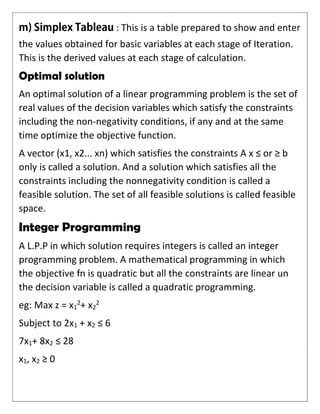
: This is a table prepared to show and enter
the values obtained for basic variables at each stage of Iteration.
This is the derived values at each stage of calculation.
Optimal solution
An optimal solution of a linear programming problem is the set of
real values of the decision variables which satisfy the constraints
including the non-negativity conditions, if any and at the same
time optimize the objective function.
A vector (x1, x2... xn) which satisfies the constraints A x ≤ or ≥ b
only is called a solution. And a solution which satisfies all the
constraints including the nonnegativity condition is called a
feasible solution. The set of all feasible solutions is called feasible
space.
Integer Programming
A L.P.P in which solution requires integers is called an integer
programming problem. A mathematical programming in which
the objective fn is quadratic but all the constraints are linear un
the decision variable is called a quadratic programming.
eg: Max z = x1
2
+ x2
2
Subject to 2x1 + x2 ≤ 6
7x1+ 8x2 ≤ 28
x1, x2 ≥ 0
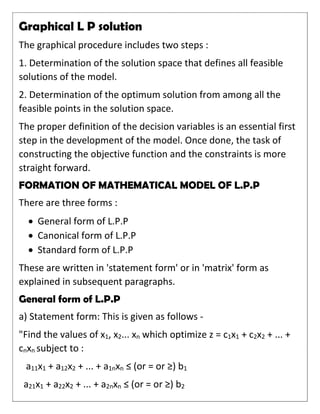
Graphical L P solution
The graphical procedure includes two steps :
1. Determination of the solution space that defines all feasible
solutions of the model.
2. Determination of the optimum solution from among all the
feasible points in the solution space.
The proper definition of the decision variables is an essential first
step in the development of the model. Once done, the task of
constructing the objective function and the constraints is more
straight forward.
FORMATION OF MATHEMATICAL MODEL OF L.P.P
There are three forms :
• General form of L.P.P
• Canonical form of L.P.P
• Standard form of L.P.P
These are written in 'statement form' or in 'matrix' form as
explained in subsequent paragraphs.
General form of L.P.P
a) Statement form: This is given as follows -
"Find the values of x1, x2... xn which optimize z = c1x1 + c2x2 + ... +
cnxn subject to :
a11x1 + a12x2 + ... + a1nxn ≤ (or = or ≥) b1
a21x1 + a22x2 + ... + a2nxn ≤ (or = or ≥) b2
am1x1 + am2x2 + ... + amnxn ≤ (or = or ≥) bm
x1, x2,... xn ≥ 0
where all the coefficients (cj, aij, bi) are constants and x j's are
variables.
(i = 1,2,... m)
(j = 1,2,... n ) "
b) Matrix form of general L.P.P. This is stated as follows -
"Find the values of x1, x2, ... xn to maximize: z = c1x1 + c2x2 + ...
+cnxn
Let z be a linear function on a Rn
defined by
i. z = c1x1 + c2x2 + ... cnxn
where cj are constants. Let aij be m*n matrix and let { b1, b2,
... bm } be set of constraints such that
ii. a11x1 + a12x2 + ... + a1nxn ≤ (or = or ≥) b1
a21x1 + a22x2 + ... + a2nx ≤ (or = or ≥) b2
am1x1 + am2x2 + ... + amnxn ≤ (or = or ≥) bm
And let
iii. xj ≥ 0 j = 1,2,... n
The problem of determining an n-tuple (x1, x2,... xn) which make z
a minimum or a maximum is called 'General linear programming
problem'. Canonical Form of L.P.P
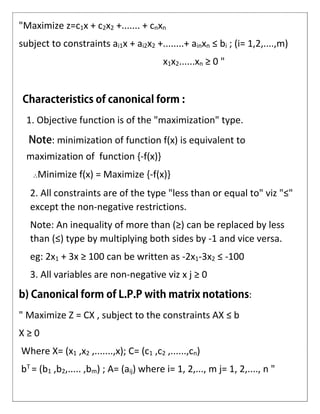
: This form is given as follows:
"Maximize z=c1x + c2x2 +....... + cnxn
subject to constraints ai1x + ai2x2 +........+ ainxn ≤ bi ; (i= 1,2,....,m)
x1x2......xn ≥ 0 "
1. Objective function is of the "maximization" type.
: minimization of function f(x) is equivalent to
maximization of function {-f(x)}
Minimize f(x) = Maximize {-f(x)}
2. All constraints are of the type "less than or equal to" viz "≤"
except the non-negative restrictions.
Note: An inequality of more than (≥) can be replaced by less
than (≤) type by multiplying both sides by -1 and vice versa.
eg: 2x1 + 3x ≥ 100 can be written as -2x1-3x2 ≤ -100
3. All variables are non-negative viz x j ≥ 0
:
" Maximize Z = CX , subject to the constraints AX ≤ b
X ≥ 0
Where X= (x1 ,x2 ,.......,x); C= (c1 ,c2 ,......,cn)
bT
= (b1 ,b2,..... ,bm) ; A= (aij) where i= 1, 2,..., m j= 1, 2,...., n "
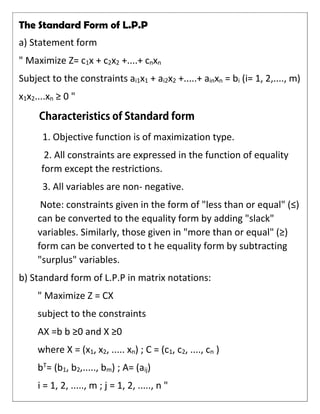
The Standard Form of L.P.P
a) Statement form
" Maximize Z= c1x + c2x2 +....+ cnxn
Subject to the constraints ai1x1 + ai2x2 +.....+ ainxn = bi (i= 1, 2,...., m)
x1x2....xn ≥ 0 "
1. Objective function is of maximization type.
2. All constraints are expressed in the function of equality
form except the restrictions.
3. All variables are non- negative.
Note: constraints given in the form of "less than or equal" (≤)
can be converted to the equality form by adding "slack"
variables. Similarly, those given in "more than or equal" (≥)
form can be converted to t he equality form by subtracting
"surplus" variables.
b) Standard form of L.P.P in matrix notations:
" Maximize Z = CX
subject to the constraints
AX =b b ≥0 and X ≥0
where X = (x1, x2, ..... xn) ; C = (c1, c2, ...., cn )
bT
= (b1, b2,....., bm) ; A= (aij)
i = 1, 2, ....., m ; j = 1, 2, ....., n "
Note: coefficients of slack and surplus variables in objective
function are always assumed to be zero.
The primary reason for using linear programming methodology is
to ensure that limited resources are utilized to the fullest extent
without any waste and that utilization is made in such a way that
the outcomes are expected to be the best possible.
Some of the examples of linear programming are:
a) A production manager planning to produce various products
with the given resources of raw materials, man-hours, and
machine-time for each product must determine how many
products and quantities of each product to produce so as to
maximize the total profit.
b) An investor has a limited capital to invest in a number of
securities such as stocks and bonds. He can use linear
programming approach to establish a portfolio of stocks and
bonds so as to maximize return at a given level of risk.
c) A marketing manager has at his disposal a budget for
advertisement in such media as newspapers, magazines, radio
and television. The manager would like to determine the extent of
media mix which would maximize the advertising effectiveness.
d) A Farm has inventories of a number of items stored in
warehouses located in different parts of the country that are
intended to serve various markets. With in the constraints of the
demand for the products and location of markets, the company
would like to determine which warehouse should ship which
product and how much of it to each market so that the total cost
of shipment is minimized.
e) Linear programming is also used in production smoothing. A
manufacturer has to determine the best production plan and
inventory policy for future demands which are subject to seasonal
and cyclical fluctuations. The objective here is to minimize the
total production and inventory cost.
f) A marketing manager wants to assign territories to be covered
by salespersons. The objective is to determine the shortest route
for each salesperson starting from his base, visiting clients in
various places and then returning to the original point of
departure. Linear programming can be used to determine the
shortest route.
g) In the area of personnel management, similar to the travelling
salesperson problem, the problem of assigning a given number of
personnel to different jobs can be solved by this technique. The
objective here is to minimize the total time taken to complete all
jobs.
h) Another problem in the area of personnel management is the
problem of determining the equitable salaries and sales-incentive
compensation. Linear programming has been used successfully in
such problems.
Linear programming class 12 investigatory project

Linear programming class 12 investigatory project

  • 1.
    INTRODUCTION Mathematics is thequeen of science. In our daily life, planning is required on various occasions, especially when the resources are limited. Any planning is meant for attaining certain objectives. The best strategy is one that gives a maximum output from a minimum input. The objective which is in the form of output may be to get the maximum profit, minimum cost of production or minimum inventory cost with a limited input of raw material, manpower and machine capacity. Such problems are referred to as the problems of constrained optimization. Linear programming is a technique for determining an optimum schedule of interdependent activities in view of the available resources. Programming is just another word for 'planning' and refers to the process of determining a particular plan of action from amongst several alternatives. Linear programming applies to optimization models in which objective and constraint functions are strictly linear. The technique is used in a wide range of applications, including agriculture, industry, transportation, economics, health systems, behavioral and social sciences and the military. It also boasts efficient computational algorithms for problems with thousands of constraints and variables. Indeed, because of its tremendous computational efficiency, linear programming forms the backbone of the solution algorithms for other operative research models, including integer, stochastic and non-linear programming. The graphical solution provides insight into the development of the
  • 2.
    general algebraic simplexmethod. It also gives concrete ideas for the development and interpretation of sensitivity analysis in linear programming. Linear programming is a major innovation since World War II in the field of business decision making, particularly under conditions of certainty. The word 'linear' means the relationships handled are those represented by straight lines, i.e. the relationships are of the form y = a + bx and the word 'programming' means taking decisions systematically. Thus, linear programming is a decision making technique under given constraints on the assumption that the relationships amongst the variables representing different phenomena happen to be linear. A linear programming problem consists of three parts. First, there objective function which is to be either maximized or minimized. Second, there is a set of linear constraints which contains thee technical specifications of the problems in relation to the given resources or requirements. Third, there is a set of non negativity constraints - since negative production has no physical counterpart. AIM 1. To find and know more about the importance and uses of 'linear programming'. 2. To formulate a linear programming problem and solve in simplex method and dual problem
  • 3.
    DATA COLLECTION Linear programmingis a versatile mathematical technique in operations research and a plan of action to solve a given problem involving linearly related variables in order to achieve the laid down objective in the form of minimizing or maximizing the objective function under a given set of constraints. CHARACTERISTICS • Objectives can be expressed in a standard form viz. maximize/minimize z = f(x) where z is called the objective function. • Constraints are capable of being expressed in the form of equality or inequality viz. f(x) = or ≤ or ≥ k, where k = constant and x ≥ 0. • Resources to be optimized are capable of being quantified in numerical terms. • The variables are linearly related to each other. • More than one solution exist, the objectives being to select the optimum solution. • The linear programming technique is based on simultaneous solutions of linear equations. USES There are many uses of L.P. It is not possible to list them all here. However L.P is very useful to find out the following:
  • 4.
    • Optimum productmix to maximize the profit. • Optimum schedule of orders to minimize the total cost. • Optimum media-mix to get maximum advertisement effect. • Optimum schedule of supplies from warehouses to minimize transportation costs. • Optimum line balancing to have minimum idling time. • Optimum allocation of capital to obtain maximum R.O.I • Optimum allocation of jobs between machines for maximum utilization of machines. • Optimum assignments of jobs between workers to have maximum labor productivity. • Optimum staffing in hotels, police stations and hospitals to maximize efficiency. • Optimum number of crew in buses and trains to have minimum operating costs. • Optimum facilities in telephone exchange to have minimum break downs. The above list is not an exhaustive one; only an illustration. ADVANTAGES • Provide the best allocation of available resources. • meet overall objectives of the management. • Assist management to take proper decisions. • Provide clarity of thought and better appreciation of problem. • Improve objectivity of assessment of the situation.
  • 5.
    • Put acrossour view points more successfully by logical argument supported by scientific methods. PRINCIPLES Following principles are assumed in L.P.P : There exist proportional relationships between objectives and constraints. : Total resources are equal to the sum of the resources used in individual activities. : Solution need not be a whole number viz decision variable can be in fractional form. : Coefficients of objective function and constraints are known constants and do not change viz parameters remain unaltered. : Activities and constraints are finite in number. : The ultimate objective is to obtain an optimum solution viz 'maximization' or 'minimization'.
  • 6.
    DEFINITION OF TERMS :There are instances where number of unknowns (p) are more than the number of linear equations (q) available. In such cases we assign zero values to all surplus unknowns. There will be (p-q) such unknowns. With these values we solve 'q' equations and get values of 'q' unknowns. Such solutions are called Basic Solutions. : The variables whose value is obtained from the basic solution is called basic variables. : The variables whose value are assumed as zero in basic solutions are called non-basic variables. : A solution to a L.P.P is the set of values of the variables which satisfies the set of constraints for the problem. : A feasible solution to a L.P.P the set of values of variables which satisfies the set of constraints as well as the non-negative constraints of theproblem. : A feasible solution to a L.P.P in which the vectors associated with the non-zero variables are linearly independent is called basic feasible solution Linearly independent: variables x1 , x2 , x3......... are said to be linearly independent if k 1 x1+k 2 x2+.........+k n x n=0, implying k 1=0, k 2=0,........
  • 7.
    : A feasiblesolution of a L.P.P is said to be the optimum solution if it also optimizes the objective function of the problem. : Linear equations are solved through equality form of equations. Normally, constraints are given in the "less than or equal" (≤) form. In such cases, we add appropriate variables to make it an "equality" (=) equation. These variables added to the constraints to make it an equality equation in L.P.P is called stack variables and is often denoted by the letter 'S'. Eg: 2x1 + 3x2 ≤ 500 2x1 + 3x2 + S1 = 500, where S1 is the slack variable : Sometime, constraints are given in the "more than or equal" (≥) form. In such cases we subtract an approximate variable to make it into "equality" (=) form. Hence variables subtracted from the constraints to make it an equality equation in L.P.P is called surplus variables and often denoted by the letter 's'. Eg: 3x1 + 4x2 ≥ 100 3x1 + 4x2 - S2 = 0, where S2 is the surplus variable. : Artificial variables are fictitious variables. These are introduced to help computation and solution of equations in L.P.P. There are used when constraints are given in (≥) "greater than equal" form. As discussed, surplus variables are
  • 8.
    subtracted in suchcases to convert inequality to equality form . In certain cases, even after introducing surplus variables, the simplex tableau may not contain an 'Identity matrix' or unit vector. Thus, in a L.P.P artificial variables are introduced in order to get a unit vector in the simplex tableau to get feasible solution. Normally, artificial variables are represented by the letter 'A'. : Problems where artificial variables are introduced can be solved by two methods viz. • Big-M-method and • Two phase method. Big-M-method is modified simplex method for solving L.P.P when highpenalty cost (or profit) has been assigned to the artificial variable in theobjective function. This method is applicable for minimizing and maximizing problems. : L.P.P where artificial variables are added can be solved by two phase method. This is a modified simplex method. Here the solution takes place in two phases as follows: • Phase I - Basic Feasible solution: Here, simplex method is applied to a specially constricted L.P.P called Auxiliary L.P.P and obtain basic feasible solution. • Phase II - Optimum Basic solution: From basic feasible solution, obtain optimum feasible solution.
  • 9.
    : This isa table prepared to show and enter the values obtained for basic variables at each stage of Iteration. This is the derived values at each stage of calculation. Optimal solution An optimal solution of a linear programming problem is the set of real values of the decision variables which satisfy the constraints including the non-negativity conditions, if any and at the same time optimize the objective function. A vector (x1, x2... xn) which satisfies the constraints A x ≤ or ≥ b only is called a solution. And a solution which satisfies all the constraints including the nonnegativity condition is called a feasible solution. The set of all feasible solutions is called feasible space. Integer Programming A L.P.P in which solution requires integers is called an integer programming problem. A mathematical programming in which the objective fn is quadratic but all the constraints are linear un the decision variable is called a quadratic programming. eg: Max z = x1 2 + x2 2 Subject to 2x1 + x2 ≤ 6 7x1+ 8x2 ≤ 28 x1, x2 ≥ 0
  • 10.
    Graphical L Psolution The graphical procedure includes two steps : 1. Determination of the solution space that defines all feasible solutions of the model. 2. Determination of the optimum solution from among all the feasible points in the solution space. The proper definition of the decision variables is an essential first step in the development of the model. Once done, the task of constructing the objective function and the constraints is more straight forward. FORMATION OF MATHEMATICAL MODEL OF L.P.P There are three forms : • General form of L.P.P • Canonical form of L.P.P • Standard form of L.P.P These are written in 'statement form' or in 'matrix' form as explained in subsequent paragraphs. General form of L.P.P a) Statement form: This is given as follows - "Find the values of x1, x2... xn which optimize z = c1x1 + c2x2 + ... + cnxn subject to : a11x1 + a12x2 + ... + a1nxn ≤ (or = or ≥) b1 a21x1 + a22x2 + ... + a2nxn ≤ (or = or ≥) b2
  • 11.
    am1x1 + am2x2+ ... + amnxn ≤ (or = or ≥) bm x1, x2,... xn ≥ 0 where all the coefficients (cj, aij, bi) are constants and x j's are variables. (i = 1,2,... m) (j = 1,2,... n ) " b) Matrix form of general L.P.P. This is stated as follows - "Find the values of x1, x2, ... xn to maximize: z = c1x1 + c2x2 + ... +cnxn Let z be a linear function on a Rn defined by i. z = c1x1 + c2x2 + ... cnxn where cj are constants. Let aij be m*n matrix and let { b1, b2, ... bm } be set of constraints such that ii. a11x1 + a12x2 + ... + a1nxn ≤ (or = or ≥) b1 a21x1 + a22x2 + ... + a2nx ≤ (or = or ≥) b2 am1x1 + am2x2 + ... + amnxn ≤ (or = or ≥) bm And let iii. xj ≥ 0 j = 1,2,... n The problem of determining an n-tuple (x1, x2,... xn) which make z a minimum or a maximum is called 'General linear programming problem'. Canonical Form of L.P.P : This form is given as follows:
  • 12.
    "Maximize z=c1x +c2x2 +....... + cnxn subject to constraints ai1x + ai2x2 +........+ ainxn ≤ bi ; (i= 1,2,....,m) x1x2......xn ≥ 0 " 1. Objective function is of the "maximization" type. : minimization of function f(x) is equivalent to maximization of function {-f(x)} Minimize f(x) = Maximize {-f(x)} 2. All constraints are of the type "less than or equal to" viz "≤" except the non-negative restrictions. Note: An inequality of more than (≥) can be replaced by less than (≤) type by multiplying both sides by -1 and vice versa. eg: 2x1 + 3x ≥ 100 can be written as -2x1-3x2 ≤ -100 3. All variables are non-negative viz x j ≥ 0 : " Maximize Z = CX , subject to the constraints AX ≤ b X ≥ 0 Where X= (x1 ,x2 ,.......,x); C= (c1 ,c2 ,......,cn) bT = (b1 ,b2,..... ,bm) ; A= (aij) where i= 1, 2,..., m j= 1, 2,...., n "
  • 13.
    The Standard Formof L.P.P a) Statement form " Maximize Z= c1x + c2x2 +....+ cnxn Subject to the constraints ai1x1 + ai2x2 +.....+ ainxn = bi (i= 1, 2,...., m) x1x2....xn ≥ 0 " 1. Objective function is of maximization type. 2. All constraints are expressed in the function of equality form except the restrictions. 3. All variables are non- negative. Note: constraints given in the form of "less than or equal" (≤) can be converted to the equality form by adding "slack" variables. Similarly, those given in "more than or equal" (≥) form can be converted to t he equality form by subtracting "surplus" variables. b) Standard form of L.P.P in matrix notations: " Maximize Z = CX subject to the constraints AX =b b ≥0 and X ≥0 where X = (x1, x2, ..... xn) ; C = (c1, c2, ...., cn ) bT = (b1, b2,....., bm) ; A= (aij) i = 1, 2, ....., m ; j = 1, 2, ....., n "
  • 14.
    Note: coefficients ofslack and surplus variables in objective function are always assumed to be zero. The primary reason for using linear programming methodology is to ensure that limited resources are utilized to the fullest extent without any waste and that utilization is made in such a way that the outcomes are expected to be the best possible. Some of the examples of linear programming are: a) A production manager planning to produce various products with the given resources of raw materials, man-hours, and machine-time for each product must determine how many products and quantities of each product to produce so as to maximize the total profit. b) An investor has a limited capital to invest in a number of securities such as stocks and bonds. He can use linear programming approach to establish a portfolio of stocks and bonds so as to maximize return at a given level of risk. c) A marketing manager has at his disposal a budget for advertisement in such media as newspapers, magazines, radio and television. The manager would like to determine the extent of media mix which would maximize the advertising effectiveness. d) A Farm has inventories of a number of items stored in warehouses located in different parts of the country that are intended to serve various markets. With in the constraints of the
  • 15.
    demand for theproducts and location of markets, the company would like to determine which warehouse should ship which product and how much of it to each market so that the total cost of shipment is minimized. e) Linear programming is also used in production smoothing. A manufacturer has to determine the best production plan and inventory policy for future demands which are subject to seasonal and cyclical fluctuations. The objective here is to minimize the total production and inventory cost. f) A marketing manager wants to assign territories to be covered by salespersons. The objective is to determine the shortest route for each salesperson starting from his base, visiting clients in various places and then returning to the original point of departure. Linear programming can be used to determine the shortest route. g) In the area of personnel management, similar to the travelling salesperson problem, the problem of assigning a given number of personnel to different jobs can be solved by this technique. The objective here is to minimize the total time taken to complete all jobs. h) Another problem in the area of personnel management is the problem of determining the equitable salaries and sales-incentive compensation. Linear programming has been used successfully in such problems.