Operation Research Project Work
 Topic: Planning the Product Mix at
      Panchtantra Corporation
Introduction
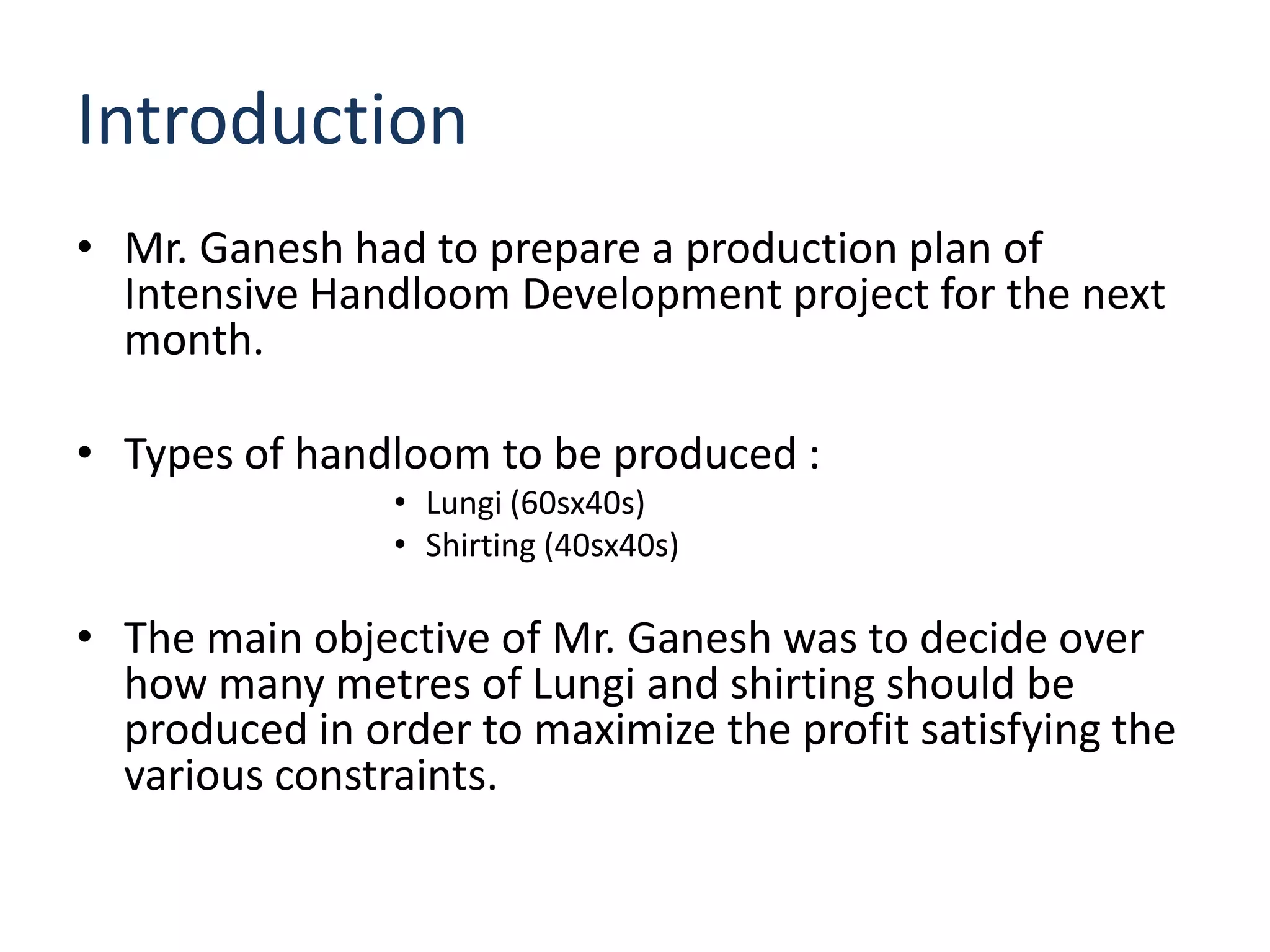
• Mr. Ganesh had to prepare a production plan of
  Intensive Handloom Development project for the next
  month.

• Types of handloom to be produced :
                • Lungi (60sx40s)
                • Shirting (40sx40s)

• The main objective of Mr. Ganesh was to decide over
  how many metres of Lungi and shirting should be
  produced in order to maximize the profit satisfying the
  various constraints.
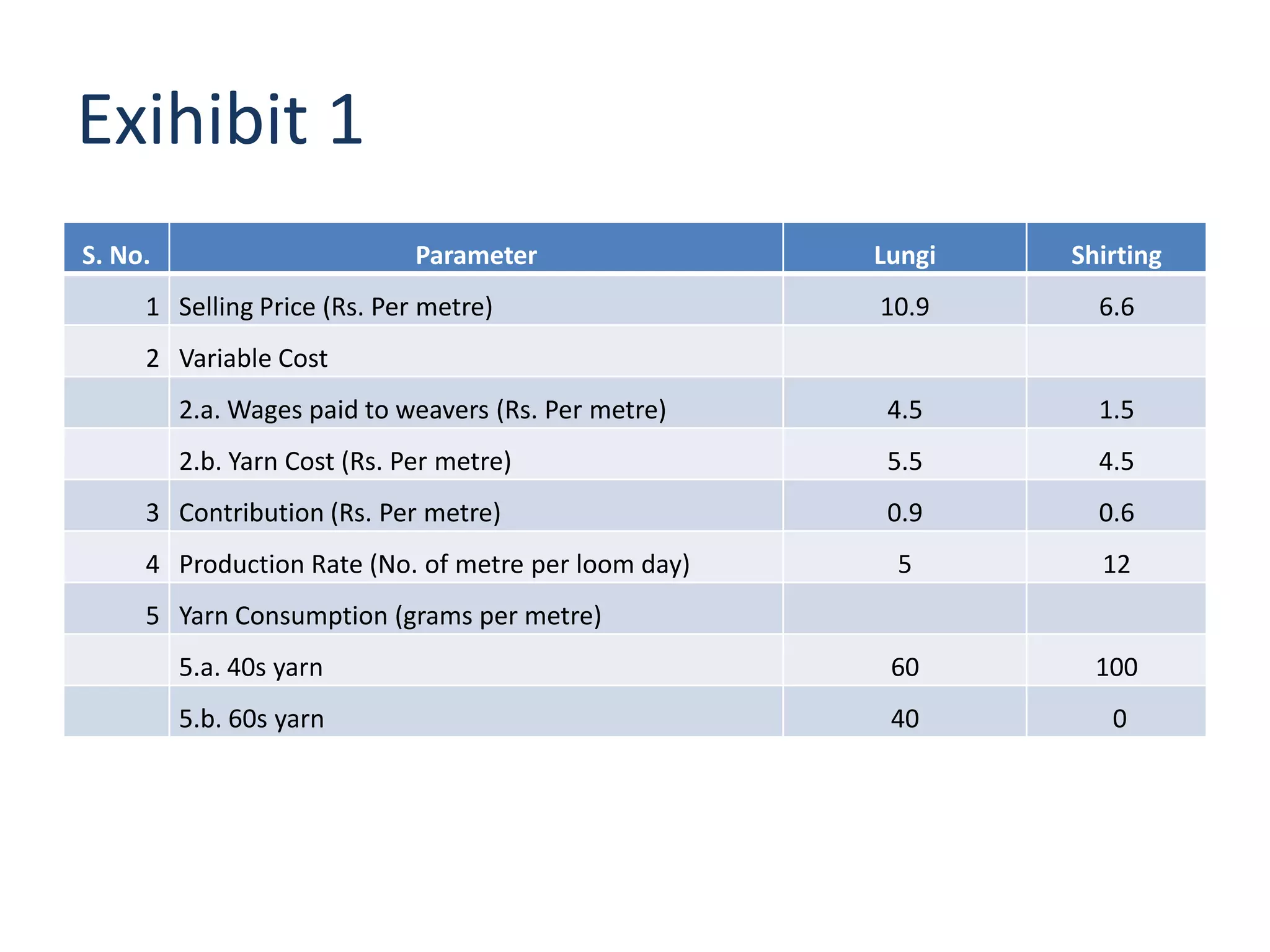
Exihibit 1
S. No.                        Parameter               Lungi   Shirting
     1 Selling Price (Rs. Per metre)                  10.9      6.6
     2 Variable Cost
         2.a. Wages paid to weavers (Rs. Per metre)    4.5      1.5
         2.b. Yarn Cost (Rs. Per metre)                5.5      4.5
     3 Contribution (Rs. Per metre)                    0.9      0.6
     4 Production Rate (No. of metre per loom day)     5        12
     5 Yarn Consumption (grams per metre)
         5.a. 40s yarn                                 60       100
         5.b. 60s yarn                                 40        0
Decision Variables
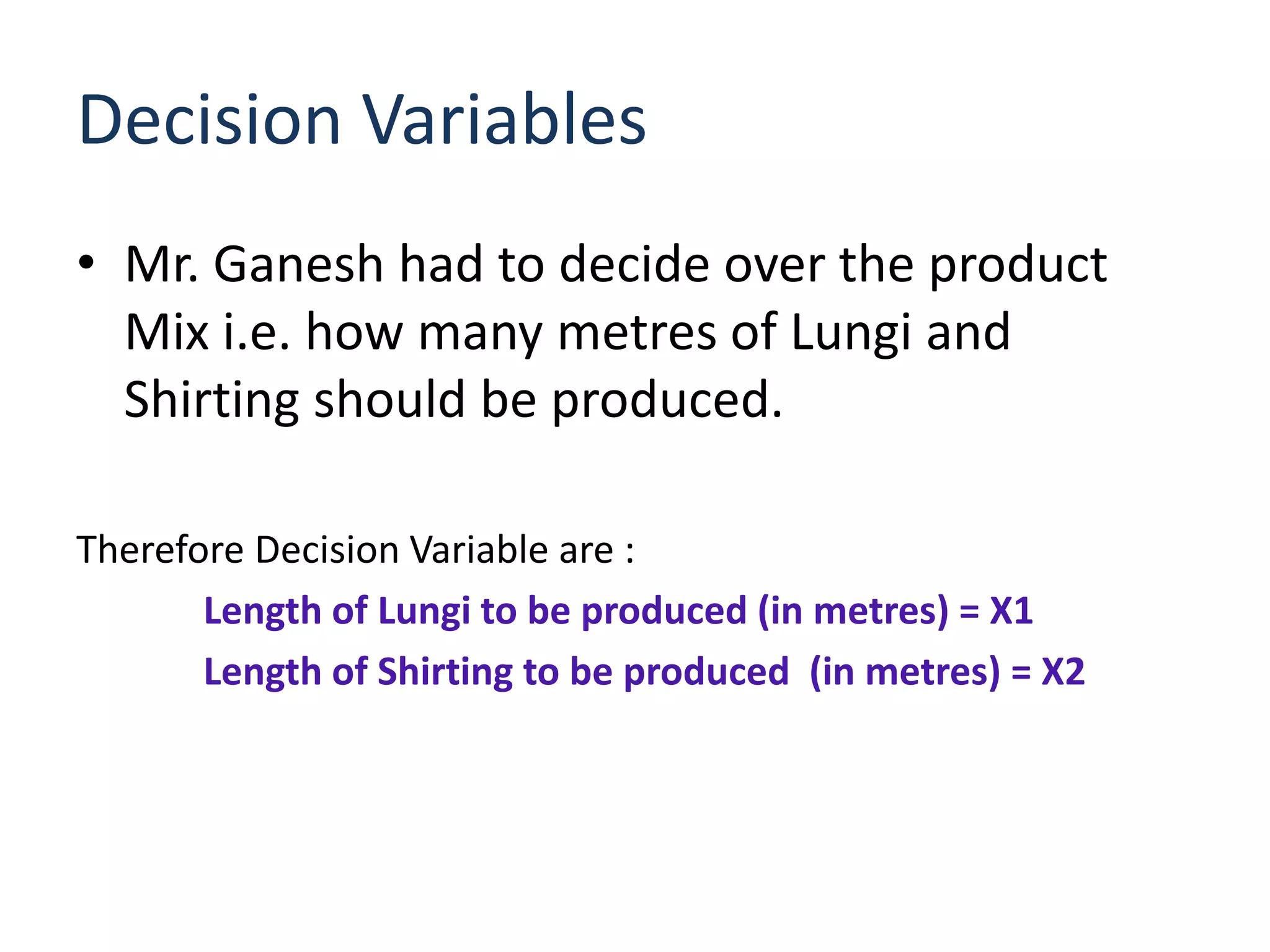
• Mr. Ganesh had to decide over the product
  Mix i.e. how many metres of Lungi and
  Shirting should be produced.

Therefore Decision Variable are :
       Length of Lungi to be produced (in metres) = X1
       Length of Shirting to be produced (in metres) = X2
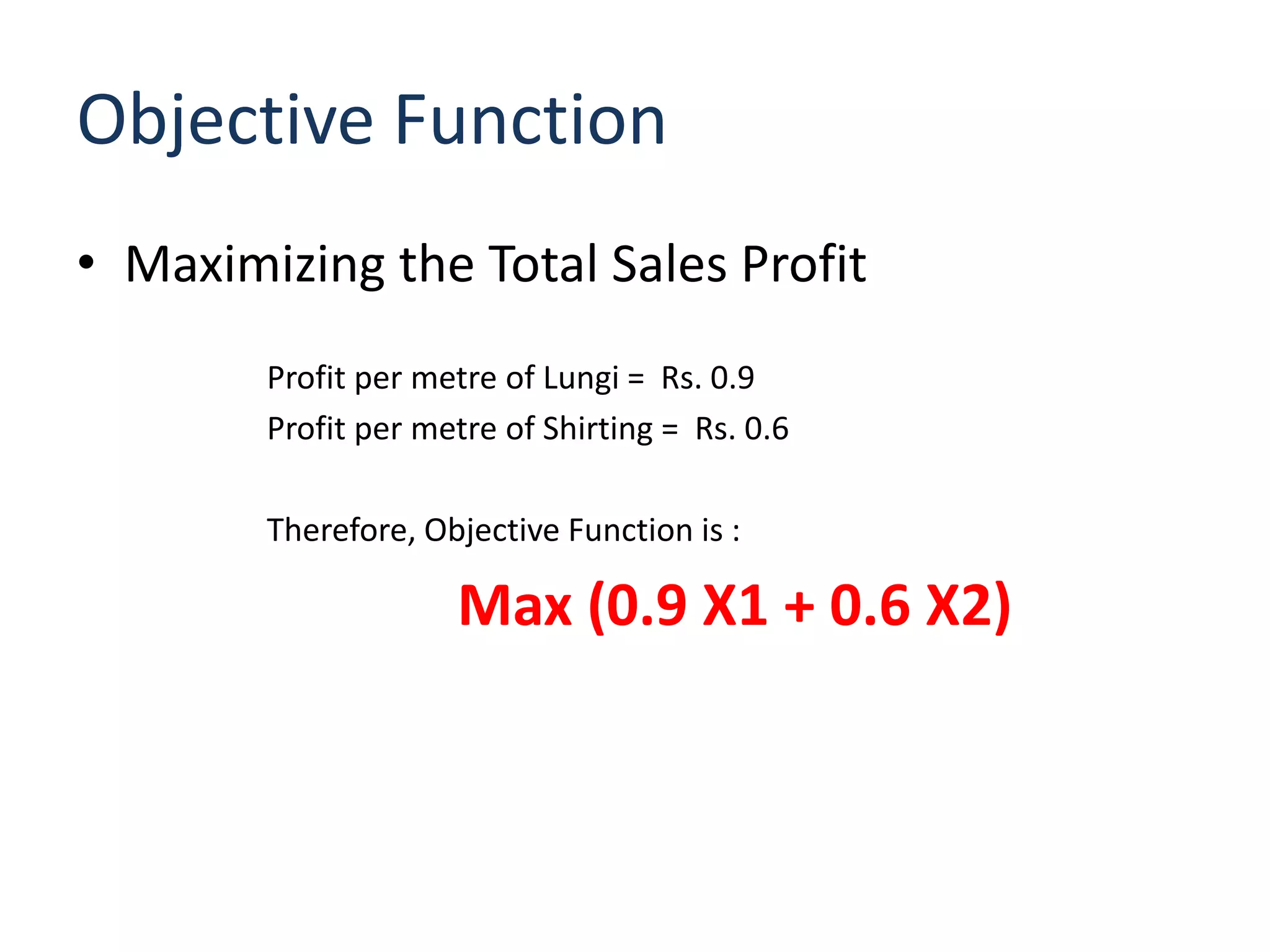
Objective Function
• Maximizing the Total Sales Profit
        Profit per metre of Lungi = Rs. 0.9
        Profit per metre of Shirting = Rs. 0.6

        Therefore, Objective Function is :

                     Max (0.9 X1 + 0.6 X2)
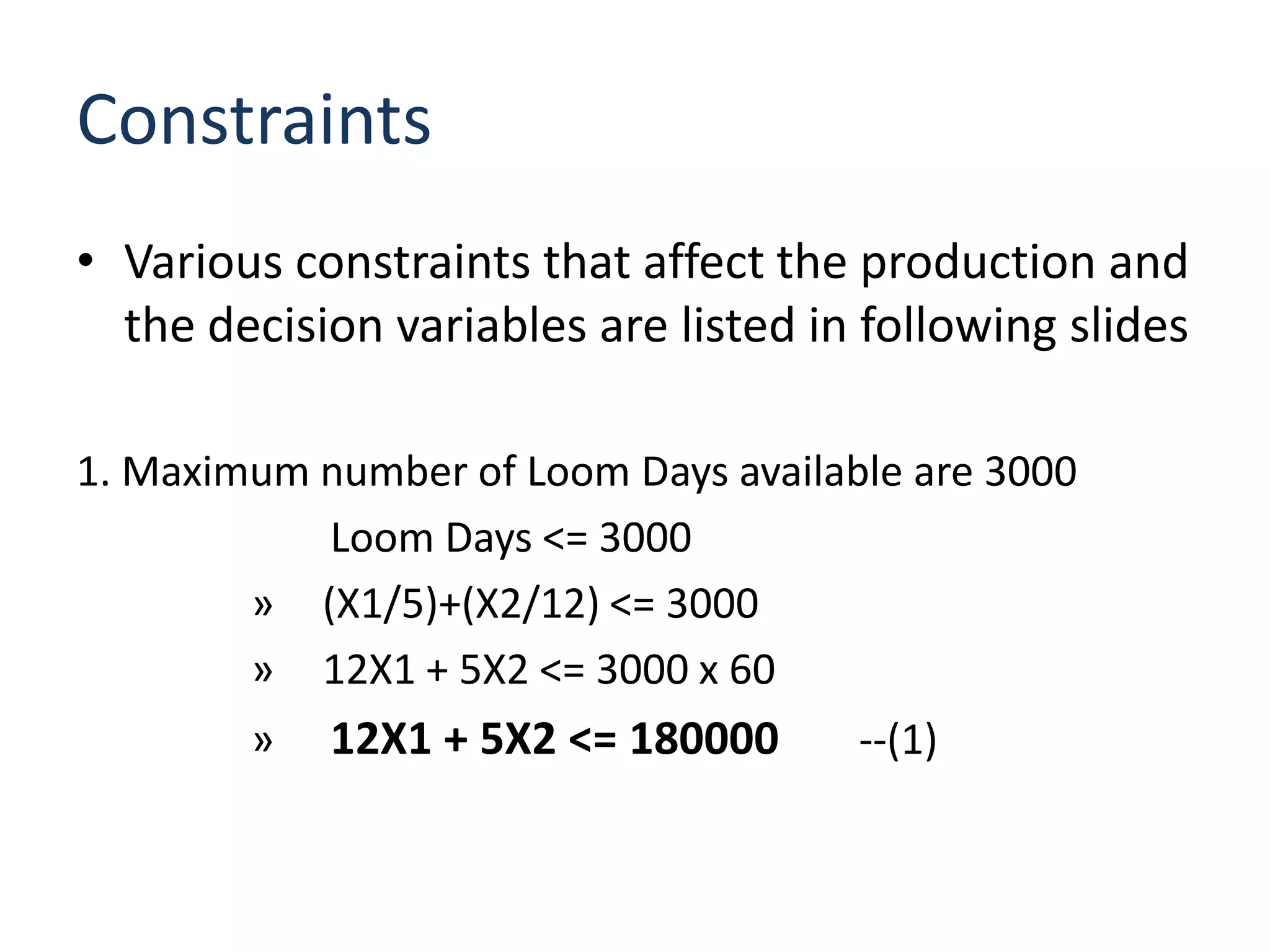
Constraints
• Various constraints that affect the production and
  the decision variables are listed in following slides

1. Maximum number of Loom Days available are 3000
           Loom Days <= 3000
        » (X1/5)+(X2/12) <= 3000
        » 12X1 + 5X2 <= 3000 x 60
        »   12X1 + 5X2 <= 180000      --(1)
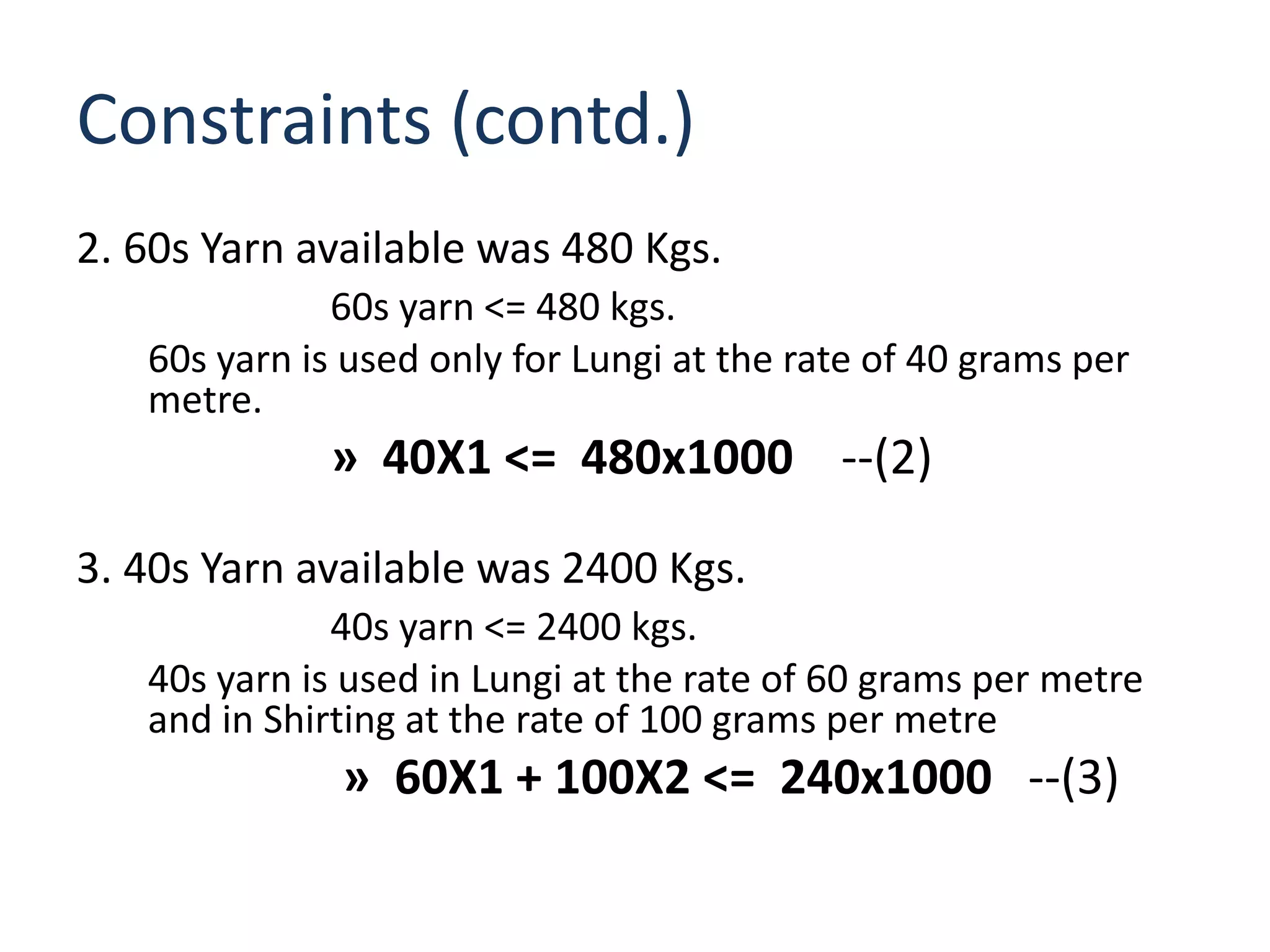
Constraints (contd.)
2. 60s Yarn available was 480 Kgs.
              60s yarn <= 480 kgs.
   60s yarn is used only for Lungi at the rate of 40 grams per
   metre.
             » 40X1 <= 480x1000 --(2)

3. 40s Yarn available was 2400 Kgs.
              40s yarn <= 2400 kgs.
   40s yarn is used in Lungi at the rate of 60 grams per metre
   and in Shirting at the rate of 100 grams per metre
              » 60X1 + 100X2 <= 240x1000 --(3)
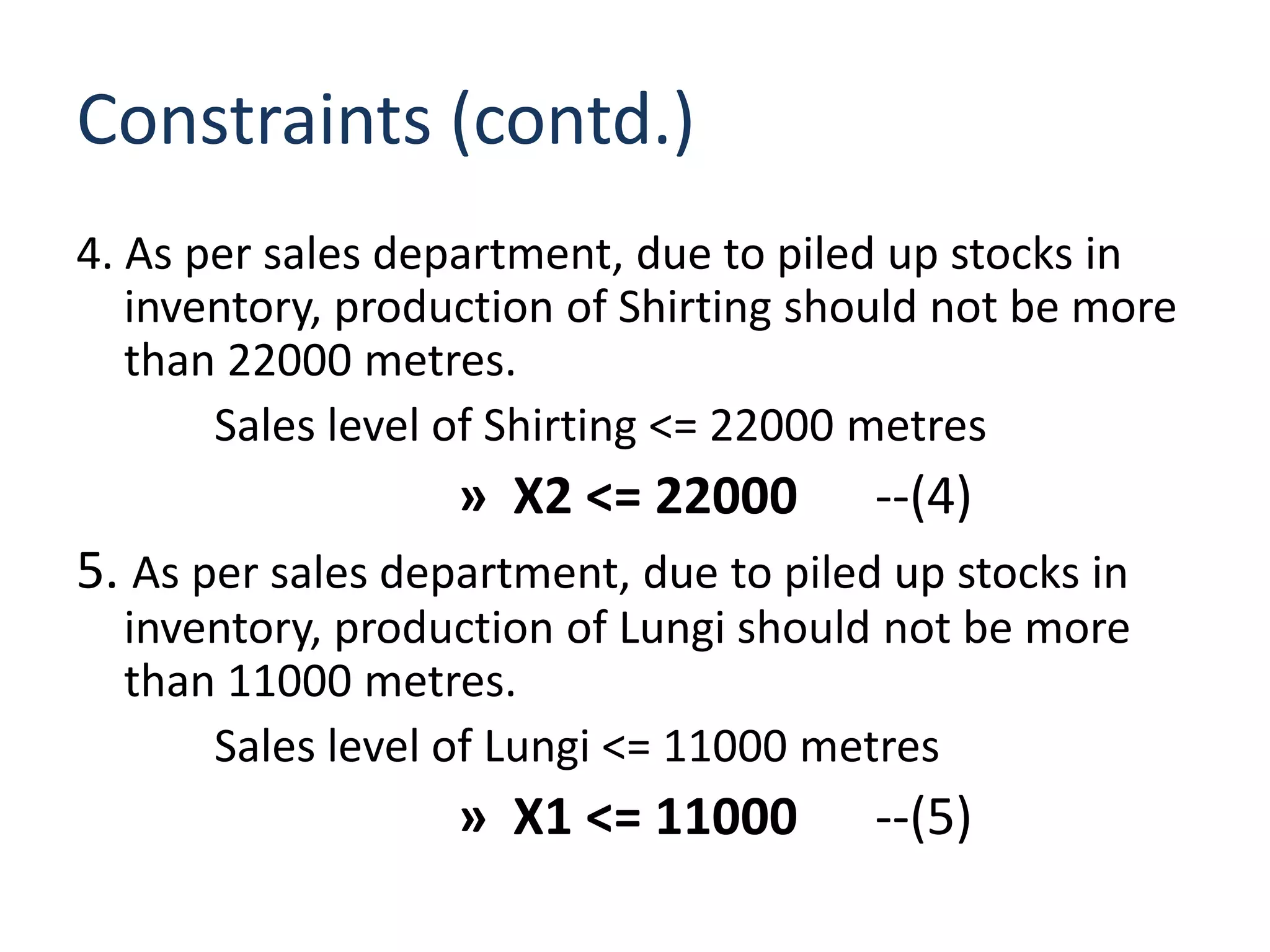
Constraints (contd.)
4. As per sales department, due to piled up stocks in
   inventory, production of Shirting should not be more
   than 22000 metres.
       Sales level of Shirting <= 22000 metres
                   » X2 <= 22000        --(4)
5. As per sales department, due to piled up stocks in
  inventory, production of Lungi should not be more
  than 11000 metres.
      Sales level of Lungi <= 11000 metres
                   » X1 <= 11000        --(5)
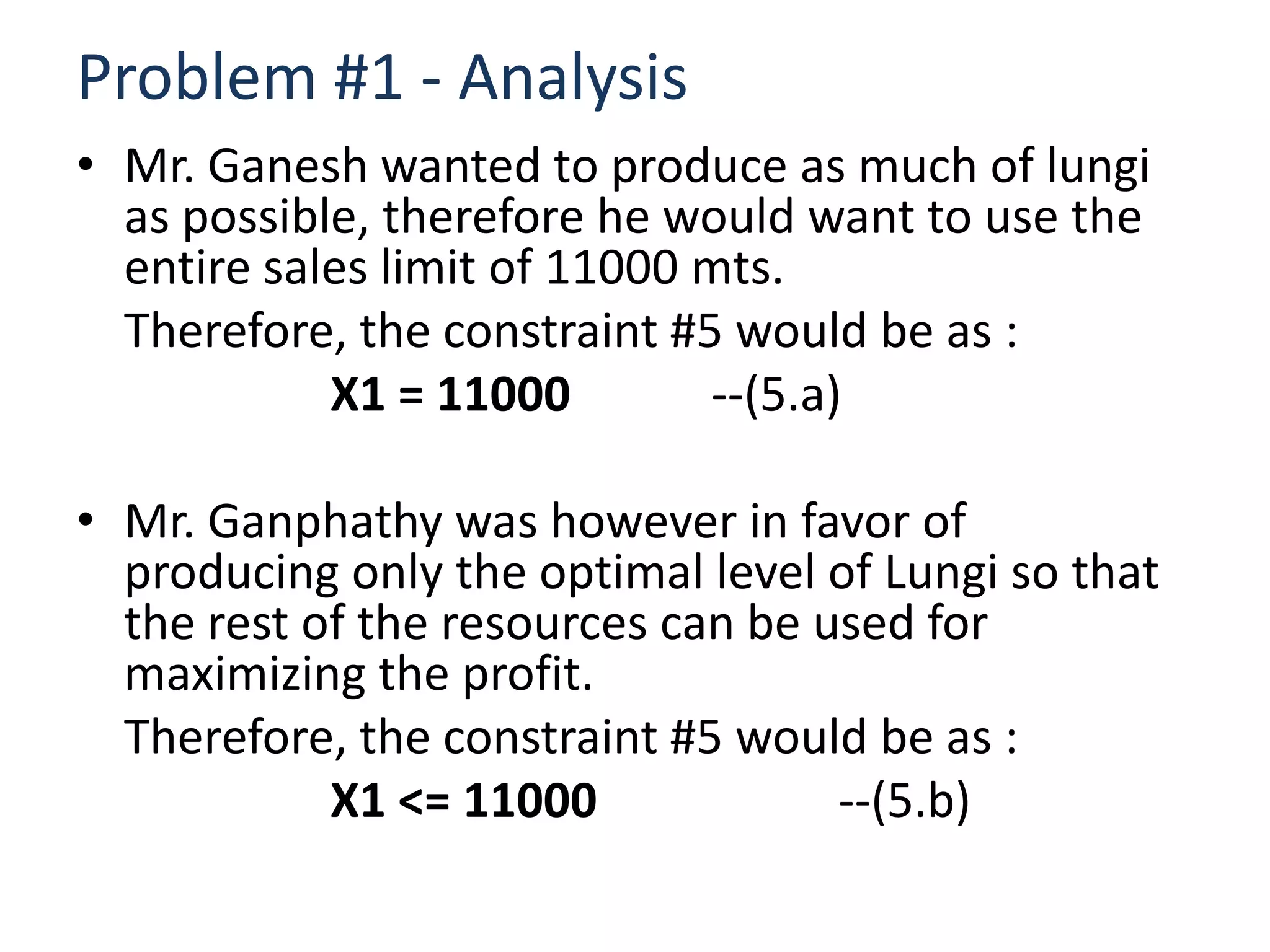
Problem #1 - Analysis
• Mr. Ganesh wanted to produce as much of lungi
  as possible, therefore he would want to use the
  entire sales limit of 11000 mts.
  Therefore, the constraint #5 would be as :
            X1 = 11000        --(5.a)

• Mr. Ganphathy was however in favor of
  producing only the optimal level of Lungi so that
  the rest of the resources can be used for
  maximizing the profit.
  Therefore, the constraint #5 would be as :
            X1 <= 11000             --(5.b)
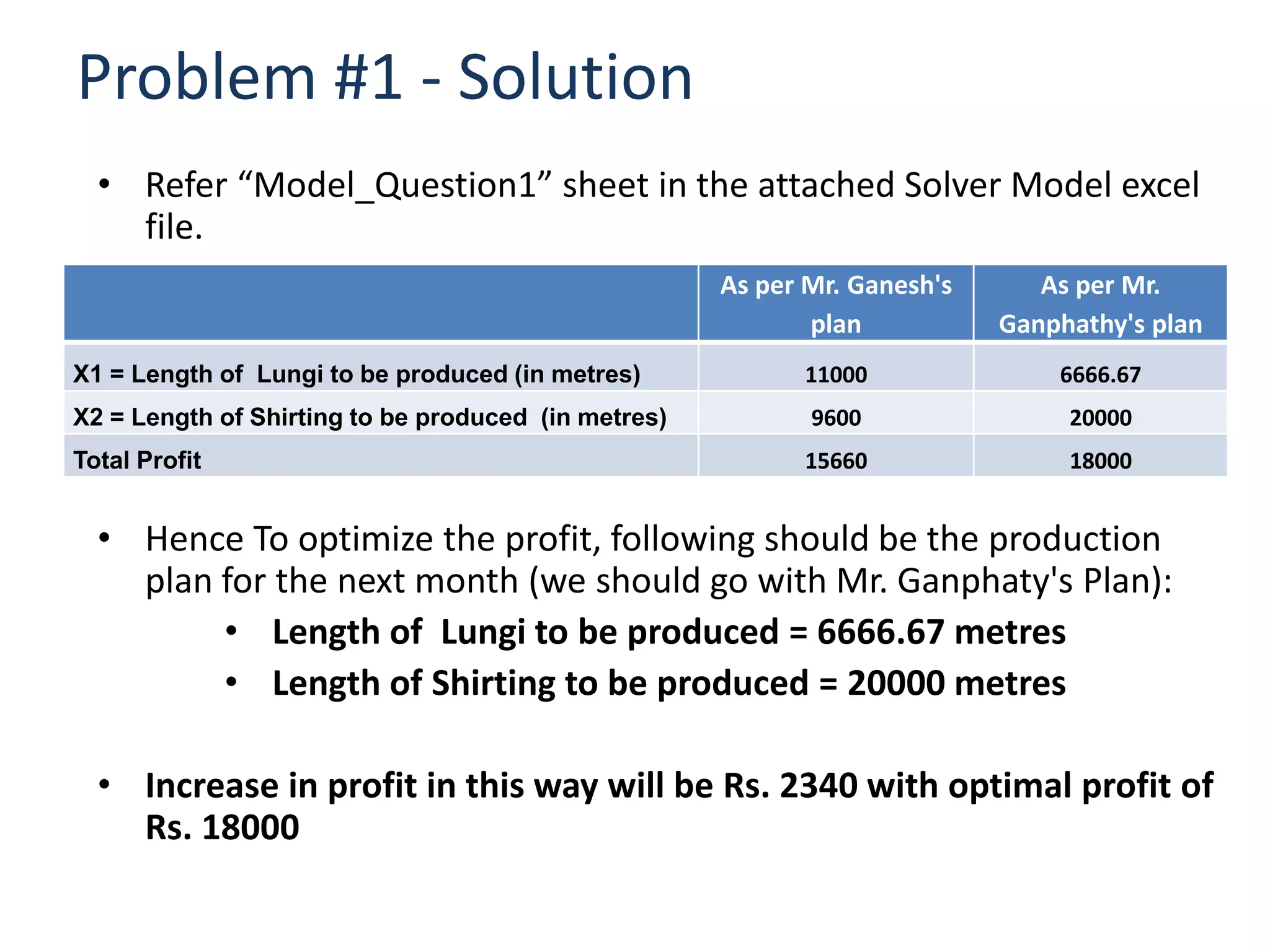
Problem #1 - Solution
  • Refer “Model_Question1” sheet in the attached Solver Model excel
    file.
                                                     As per Mr. Ganesh's      As per Mr.
                                                            plan           Ganphathy's plan
X1 = Length of Lungi to be produced (in metres)            11000               6666.67
X2 = Length of Shirting to be produced (in metres)          9600                20000
Total Profit                                               15660                18000


  • Hence To optimize the profit, following should be the production
    plan for the next month (we should go with Mr. Ganphaty's Plan):
         • Length of Lungi to be produced = 6666.67 metres
         • Length of Shirting to be produced = 20000 metres

  • Increase in profit in this way will be Rs. 2340 with optimal profit of
    Rs. 18000
Problem #2 – Additional Constraint
• Additional constraint added to ensure that on an
  average, the production paid as wages to the weavers at
  least Rs. 20.5 per loom day.
• Total wages for the production could be given by
              4.5X1 + 1.5X2
• Total number of loom days used could be given by
              (X1/5) + (X2/12)
• Therefore
                 4.5X1 + 1.5X2 >= 20.5 x [(X1/5) + (X2/12)]
              » (4.5-20.5/5)X1 + (1.5 - 20.5/12)X2 >= 0
             » 0.4X1 – 0.2083X2 >= 0             -- (6)
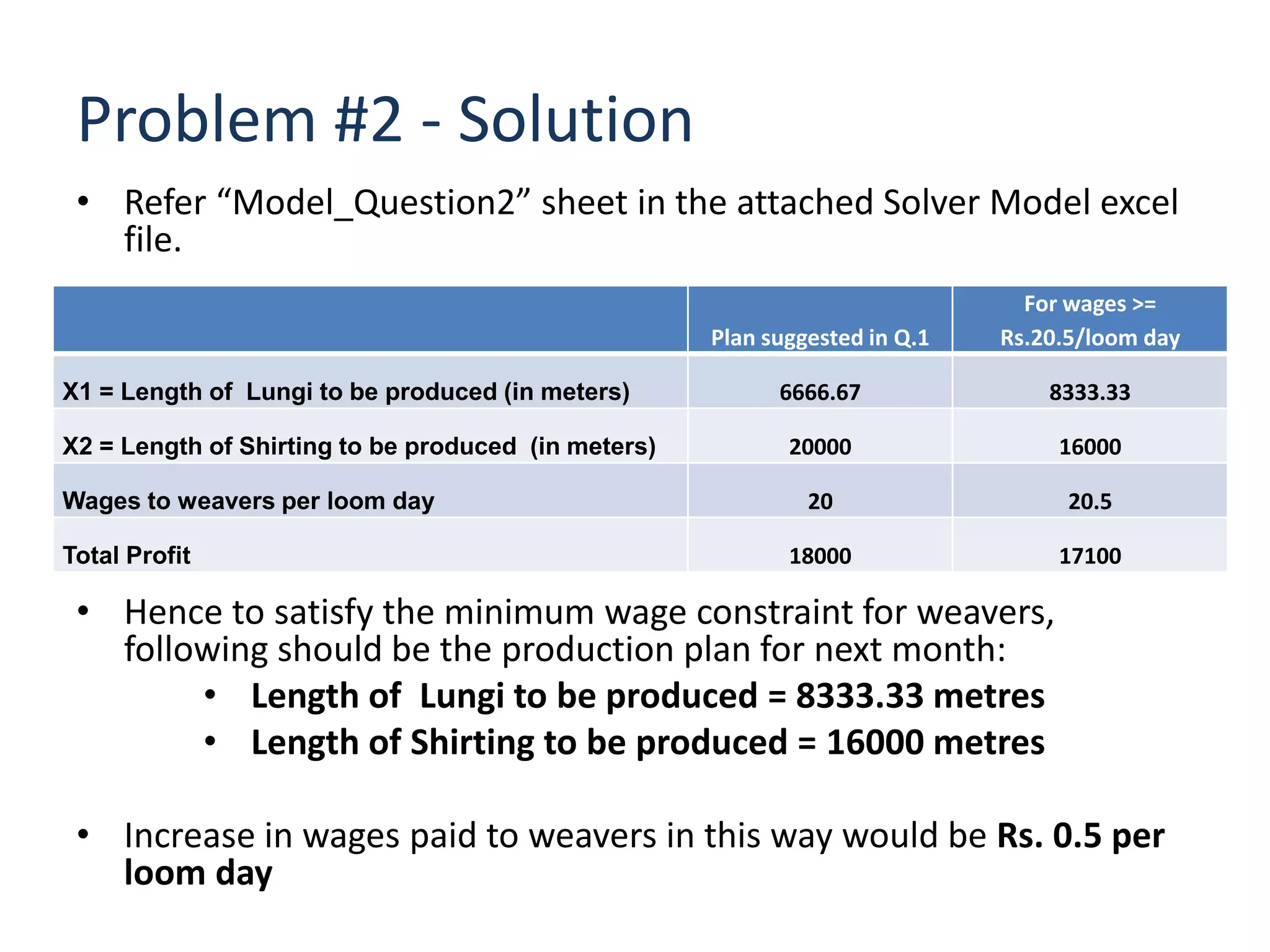
Problem #2 - Solution
 • Refer “Model_Question2” sheet in the attached Solver Model excel
   file.
                                                                               For wages >=
                                                     Plan suggested in Q.1   Rs.20.5/loom day

X1 = Length of Lungi to be produced (in meters)            6666.67               8333.33

X2 = Length of Shirting to be produced (in meters)          20000                 16000

Wages to weavers per loom day                                 20                   20.5

Total Profit                                                18000                 17100

 • Hence to satisfy the minimum wage constraint for weavers,
   following should be the production plan for next month:
        • Length of Lungi to be produced = 8333.33 metres
        • Length of Shirting to be produced = 16000 metres

 • Increase in wages paid to weavers in this way would be Rs. 0.5 per
   loom day
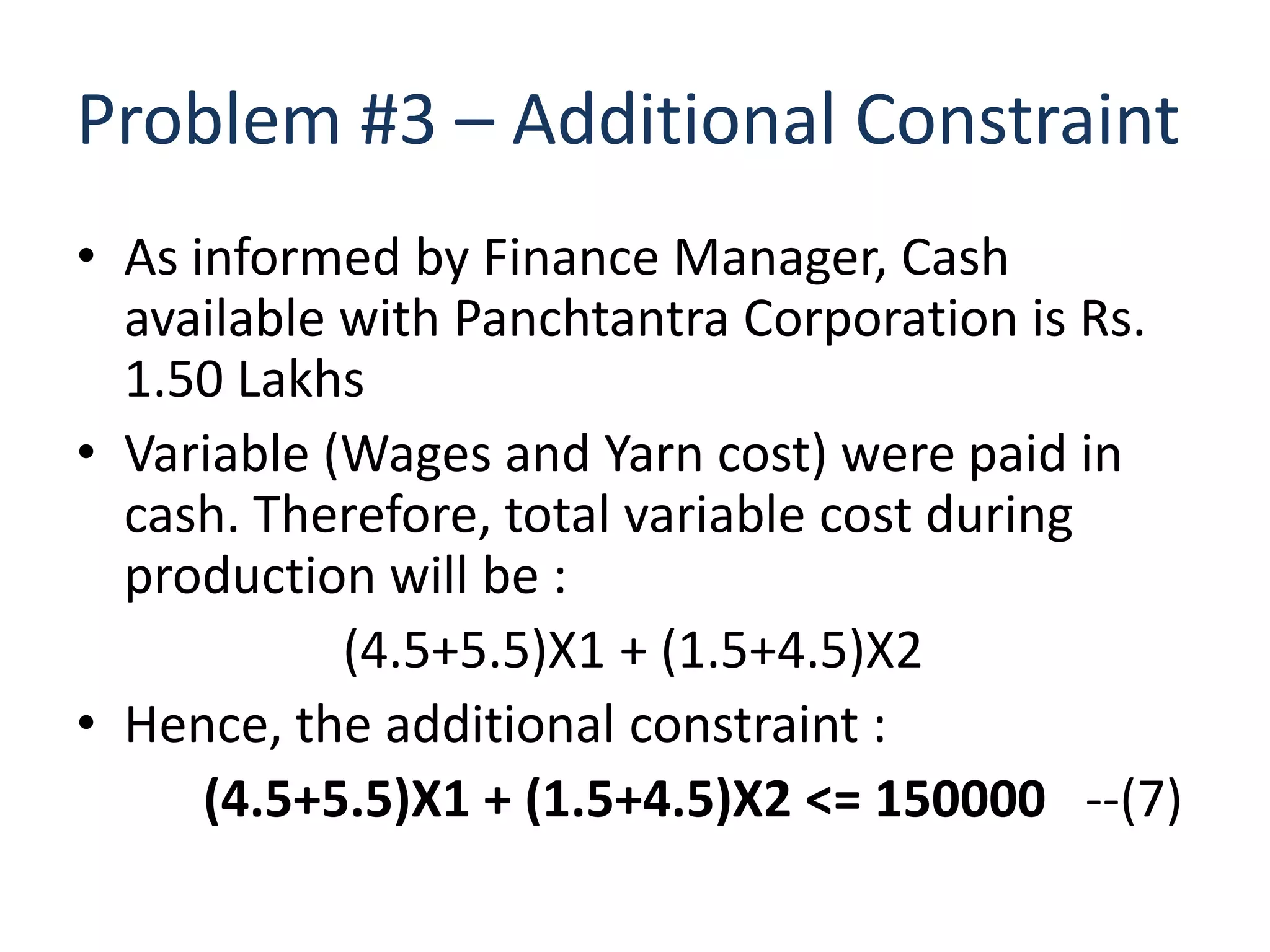
Problem #3 – Additional Constraint
• As informed by Finance Manager, Cash
  available with Panchtantra Corporation is Rs.
  1.50 Lakhs
• Variable (Wages and Yarn cost) were paid in
  cash. Therefore, total variable cost during
  production will be :
            (4.5+5.5)X1 + (1.5+4.5)X2
• Hence, the additional constraint :
      (4.5+5.5)X1 + (1.5+4.5)X2 <= 150000 --(7)
Problem #3 – Solution
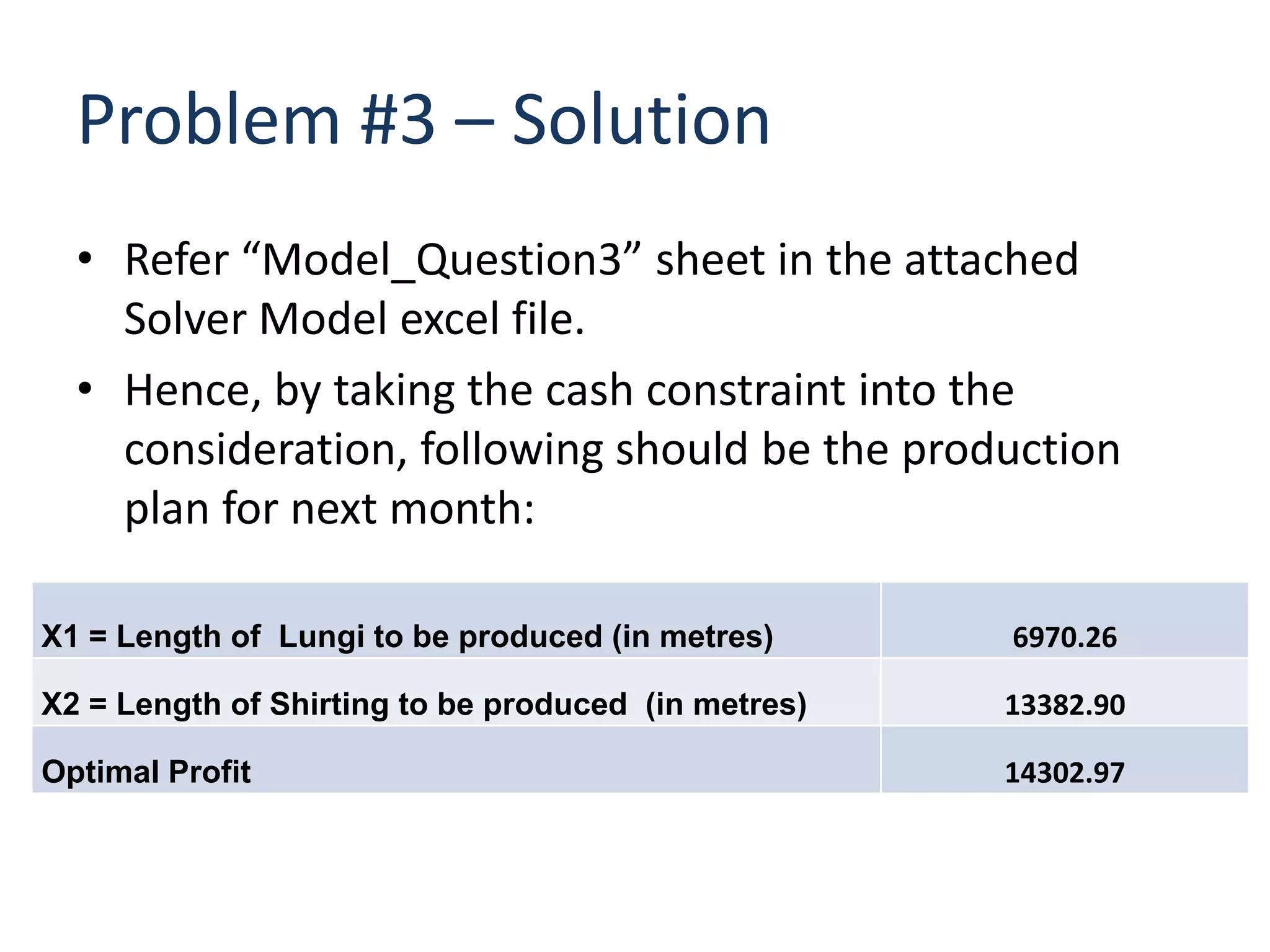
  • Refer “Model_Question3” sheet in the attached
    Solver Model excel file.
  • Hence, by taking the cash constraint into the
    consideration, following should be the production
    plan for next month:

X1 = Length of Lungi to be produced (in metres)      6970.26

X2 = Length of Shirting to be produced (in metres)   13382.90

Optimal Profit                                       14302.97
Solver Answer Report
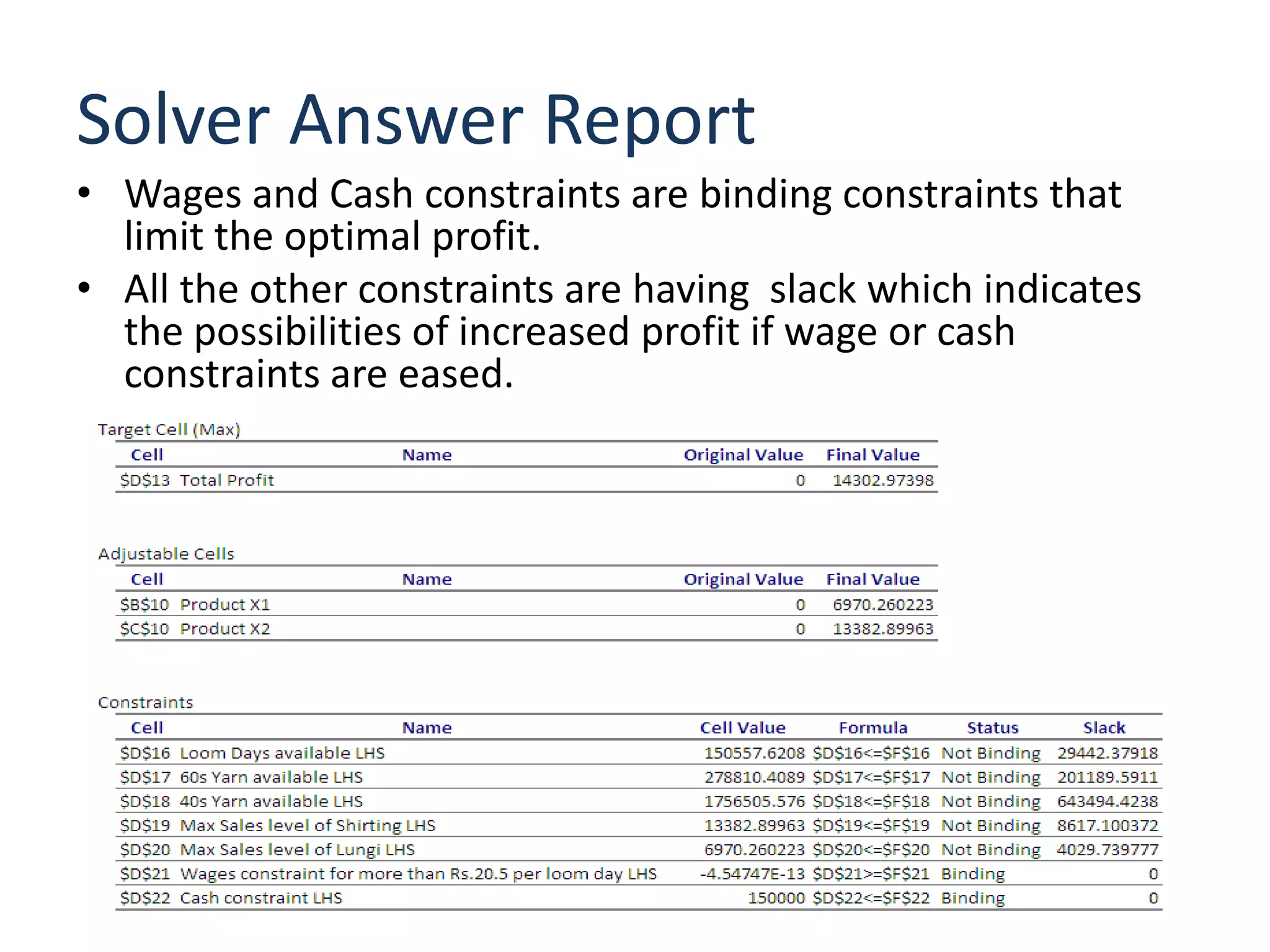
• Wages and Cash constraints are binding constraints that
  limit the optimal profit.
• All the other constraints are having slack which indicates
  the possibilities of increased profit if wage or cash
  constraints are eased.
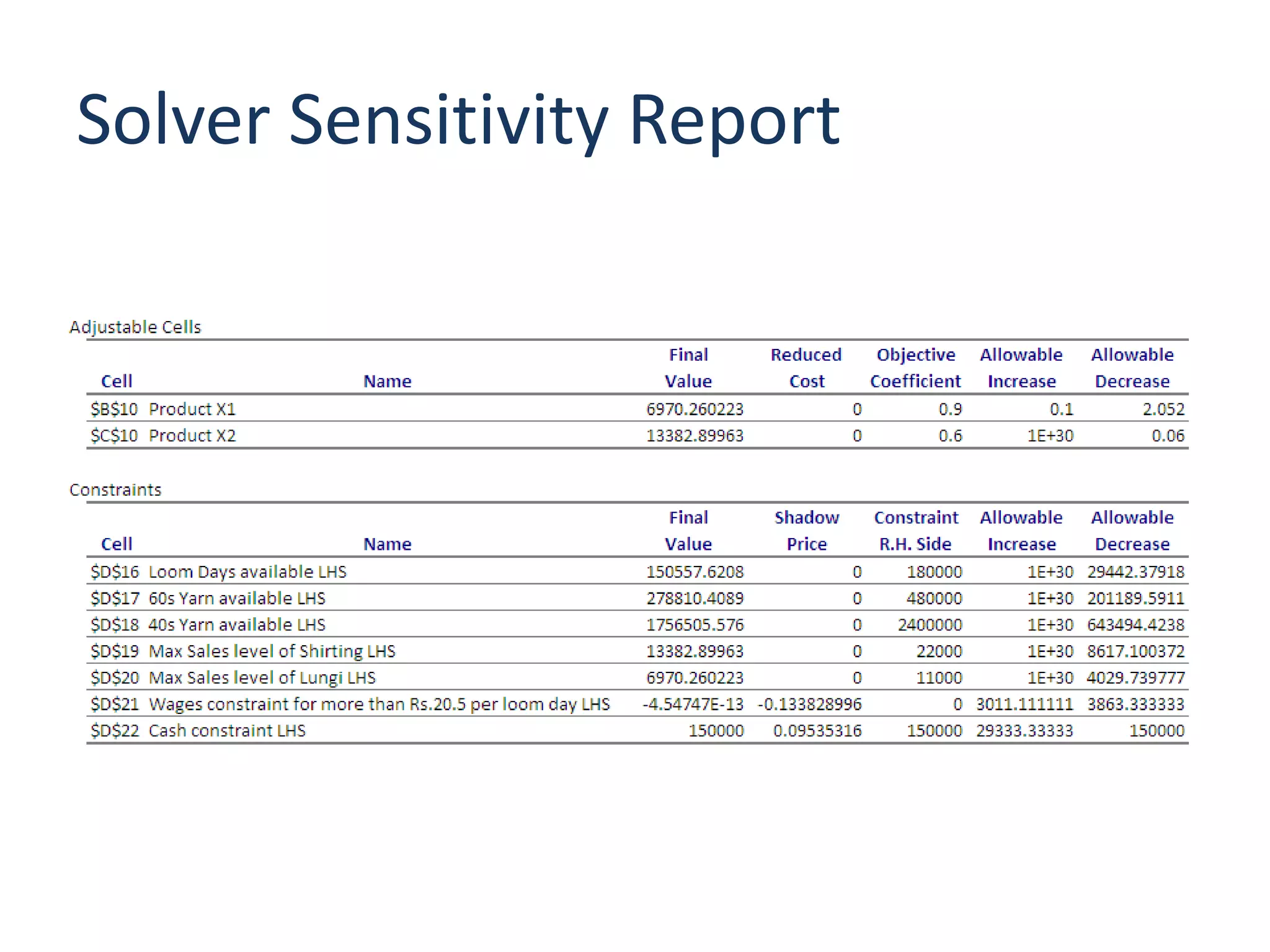
Solver Sensitivity Report
End of slides

Operation research project work

  • 1.
    Operation Research ProjectWork Topic: Planning the Product Mix at Panchtantra Corporation
  • 2.
    Introduction • Mr. Ganeshhad to prepare a production plan of Intensive Handloom Development project for the next month. • Types of handloom to be produced : • Lungi (60sx40s) • Shirting (40sx40s) • The main objective of Mr. Ganesh was to decide over how many metres of Lungi and shirting should be produced in order to maximize the profit satisfying the various constraints.
  • 3.
    Exihibit 1 S. No. Parameter Lungi Shirting 1 Selling Price (Rs. Per metre) 10.9 6.6 2 Variable Cost 2.a. Wages paid to weavers (Rs. Per metre) 4.5 1.5 2.b. Yarn Cost (Rs. Per metre) 5.5 4.5 3 Contribution (Rs. Per metre) 0.9 0.6 4 Production Rate (No. of metre per loom day) 5 12 5 Yarn Consumption (grams per metre) 5.a. 40s yarn 60 100 5.b. 60s yarn 40 0
  • 4.
    Decision Variables • Mr.Ganesh had to decide over the product Mix i.e. how many metres of Lungi and Shirting should be produced. Therefore Decision Variable are : Length of Lungi to be produced (in metres) = X1 Length of Shirting to be produced (in metres) = X2
  • 5.
    Objective Function • Maximizingthe Total Sales Profit Profit per metre of Lungi = Rs. 0.9 Profit per metre of Shirting = Rs. 0.6 Therefore, Objective Function is : Max (0.9 X1 + 0.6 X2)
  • 6.
    Constraints • Various constraintsthat affect the production and the decision variables are listed in following slides 1. Maximum number of Loom Days available are 3000 Loom Days <= 3000 » (X1/5)+(X2/12) <= 3000 » 12X1 + 5X2 <= 3000 x 60 » 12X1 + 5X2 <= 180000 --(1)
  • 7.
    Constraints (contd.) 2. 60sYarn available was 480 Kgs. 60s yarn <= 480 kgs. 60s yarn is used only for Lungi at the rate of 40 grams per metre. » 40X1 <= 480x1000 --(2) 3. 40s Yarn available was 2400 Kgs. 40s yarn <= 2400 kgs. 40s yarn is used in Lungi at the rate of 60 grams per metre and in Shirting at the rate of 100 grams per metre » 60X1 + 100X2 <= 240x1000 --(3)
  • 8.
    Constraints (contd.) 4. Asper sales department, due to piled up stocks in inventory, production of Shirting should not be more than 22000 metres. Sales level of Shirting <= 22000 metres » X2 <= 22000 --(4) 5. As per sales department, due to piled up stocks in inventory, production of Lungi should not be more than 11000 metres. Sales level of Lungi <= 11000 metres » X1 <= 11000 --(5)
  • 9.
    Problem #1 -Analysis • Mr. Ganesh wanted to produce as much of lungi as possible, therefore he would want to use the entire sales limit of 11000 mts. Therefore, the constraint #5 would be as : X1 = 11000 --(5.a) • Mr. Ganphathy was however in favor of producing only the optimal level of Lungi so that the rest of the resources can be used for maximizing the profit. Therefore, the constraint #5 would be as : X1 <= 11000 --(5.b)
  • 10.
    Problem #1 -Solution • Refer “Model_Question1” sheet in the attached Solver Model excel file. As per Mr. Ganesh's As per Mr. plan Ganphathy's plan X1 = Length of Lungi to be produced (in metres) 11000 6666.67 X2 = Length of Shirting to be produced (in metres) 9600 20000 Total Profit 15660 18000 • Hence To optimize the profit, following should be the production plan for the next month (we should go with Mr. Ganphaty's Plan): • Length of Lungi to be produced = 6666.67 metres • Length of Shirting to be produced = 20000 metres • Increase in profit in this way will be Rs. 2340 with optimal profit of Rs. 18000
  • 11.
    Problem #2 –Additional Constraint • Additional constraint added to ensure that on an average, the production paid as wages to the weavers at least Rs. 20.5 per loom day. • Total wages for the production could be given by 4.5X1 + 1.5X2 • Total number of loom days used could be given by (X1/5) + (X2/12) • Therefore 4.5X1 + 1.5X2 >= 20.5 x [(X1/5) + (X2/12)] » (4.5-20.5/5)X1 + (1.5 - 20.5/12)X2 >= 0 » 0.4X1 – 0.2083X2 >= 0 -- (6)
  • 12.
    Problem #2 -Solution • Refer “Model_Question2” sheet in the attached Solver Model excel file. For wages >= Plan suggested in Q.1 Rs.20.5/loom day X1 = Length of Lungi to be produced (in meters) 6666.67 8333.33 X2 = Length of Shirting to be produced (in meters) 20000 16000 Wages to weavers per loom day 20 20.5 Total Profit 18000 17100 • Hence to satisfy the minimum wage constraint for weavers, following should be the production plan for next month: • Length of Lungi to be produced = 8333.33 metres • Length of Shirting to be produced = 16000 metres • Increase in wages paid to weavers in this way would be Rs. 0.5 per loom day
  • 13.
    Problem #3 –Additional Constraint • As informed by Finance Manager, Cash available with Panchtantra Corporation is Rs. 1.50 Lakhs • Variable (Wages and Yarn cost) were paid in cash. Therefore, total variable cost during production will be : (4.5+5.5)X1 + (1.5+4.5)X2 • Hence, the additional constraint : (4.5+5.5)X1 + (1.5+4.5)X2 <= 150000 --(7)
  • 14.
    Problem #3 –Solution • Refer “Model_Question3” sheet in the attached Solver Model excel file. • Hence, by taking the cash constraint into the consideration, following should be the production plan for next month: X1 = Length of Lungi to be produced (in metres) 6970.26 X2 = Length of Shirting to be produced (in metres) 13382.90 Optimal Profit 14302.97
  • 15.
    Solver Answer Report •Wages and Cash constraints are binding constraints that limit the optimal profit. • All the other constraints are having slack which indicates the possibilities of increased profit if wage or cash constraints are eased.
  • 16.
  • 17.