Research Scholar L.N.I.P.E
Tahir Ramzan Bhat
Scalar
 Scalars are quantities that are fully
described by a magnitude (or numerical
value) alone. मात्रा है जो पूरी तरह से के वल
पररमाण को वर्णित करता हैं
 Vectors are quantities that are fully
described by both a magnitude and a
direction. वेक्टर मात्रा है जो पूरी तरह से
पररमाण और दिशा िोनों को वर्णित करता हैं
Distance and displacement
Motion is change in position with respect to
some frame of reference. (final position
minus initial position). The simplest linear
motion variable is a scalar called Distance
(l).
(l) Is the length an object travelled
irrespective of direction (mtr, feet etc) दिशा
की परवाह ककए बिना एक वस्तु की यात्रा की
लंिाई या िुरी
displacement
 displacement is a vector quantity.
 shows distance and direction of objects.
 Shortest distance from the reference point.
 Displacements are calculated as final
position minus initial position in that
particular direction
Speed and Velocity
 Speed is how fast an object is moving
without regard to direction.
 Speed is a scalar quantity like distance.
 Speed (s) is defined as the rate of
change of distance (s = l/t), so typical units
are m/s, ft/s, km/hr, or miles/hr.
Speed
Speed is one way to describe motion. It describes how fast an
object is moving using distance and time. Average speed is
the total distance traveled over the total time and
instantaneous speed is the speed at a particular moment
For example, 30 miles per hour means object travels distance
of 30 miles in an elapsed time of one hour. Write as,
(SPEED) =
(Distance traveled)
(Time elapsed)
30 miles per hour = 30
miles
hour
Practice:
What is the average speed of a cheetah that
sprints 100 meters in 4 seconds? How about if
it sprints 50 meters in 2 seconds?
A car has an average speed of 100 kilometers per
hour. How far does it travel in 30 minutes?
Velocity
• Constant speed means steady speed. Something
with constant speed doesn’t speed up or slow down.
• Constant velocity means both constant speed and
constant direction.
• Constant direction is a straight line, so constant
velocity means motion in a straight line at constant
speed.
• Constant speed and constant velocity are not the same.
• A body may move at constant speed along a curved path
but it does not move with constant velocity, because its
direction is changing every instant.
Practice
The speedometer of a car moving east
reads 100 km/h. It passes another car
moving west at 100 km/h. Do they have
same speed? Velocity?
During a certain period of time, the
speedometer of a car reads a constant
60 km/h. Does this indicate a constant
speed? Constant velocity?
Velocity
 Velocity is the vector corresponding to
speed.
 V is the speed of an object, in a particular
direction.
 Velocity is the rate of change of
displacement (V = d/t), so its units are
the same as speed, and are usually
qualified by a directional adjective (i.e.,
horizontal, vertical, ).
Velocity
 The phrase “rate of change” is very
important because velocity defines how
quickly position is changing in the specified
direction (displacement).
Acceleration
Define acceleration as how fast velocity changes
Acceleration is a rate of a rate (units will have 2 time values)
(ACCELERATION) =
(Change in Velocity)
(Time interval)
Note: An object accelerates anytime its velocity changes.
Examples include:
Object speeds up.
Object slows down
Object changes direction (curved path)
Best example of acceleration is objects in free fall
Equations
 s = d/t
 v = d/t
 a = Δv/Δt
 g = 9.8 m/s/s
Gravity
 Many types of forces act on objects.
• Gravity is an attractive force between all
objects that have mass.
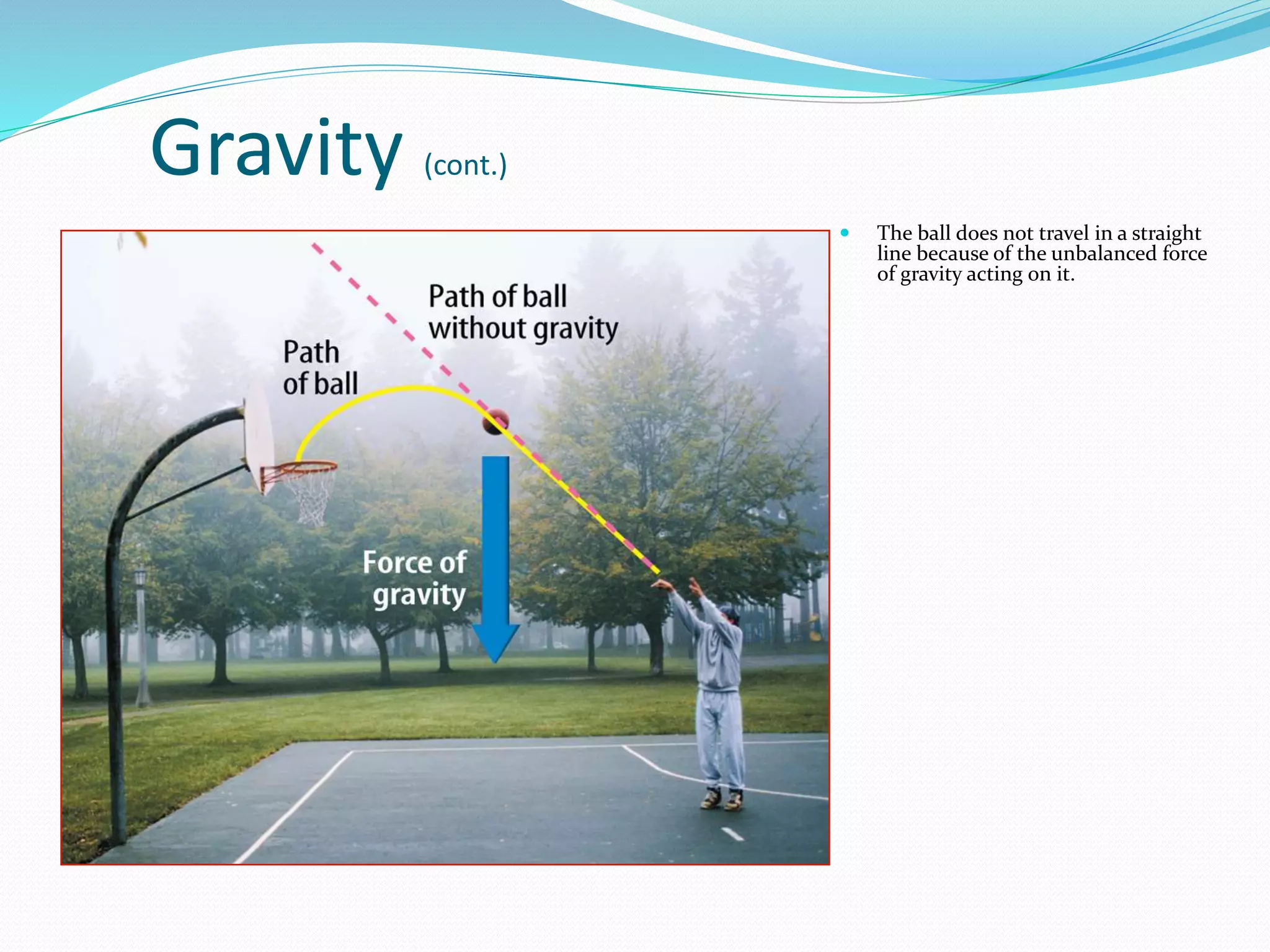
Gravity (cont.)
 The ball does not travel in a straight
line because of the unbalanced force
of gravity acting on it.
The Law of Universal Gravitation
 The Law of Universal Gravitation states that all objects
with mass are attracted to each other.
• The magnitude of attraction depends on
the mass of each object and the distance
between them.
The Law of Universal Gravitation (cont.)
 The gravitational force becomes stronger as either or both
objects increase in mass or move closer together.
• The gravitational force becomes weaker as
either or both objects decrease in mass or
move farther apart.
Inertia
Inertia: Mass:
 Resistance to being
accelerated
 Quantity of matter an object
is made of.
 measure of the inertia of the
object
 scalar quantity
 not the same as weight
Mass
 Quantity of matter an object is made of.
 measure of the inertia of the object
 scalar quantity
 not the same as weight
 Mass and Inertia
large mass=lots of inertia
small mass=not lots of inertia
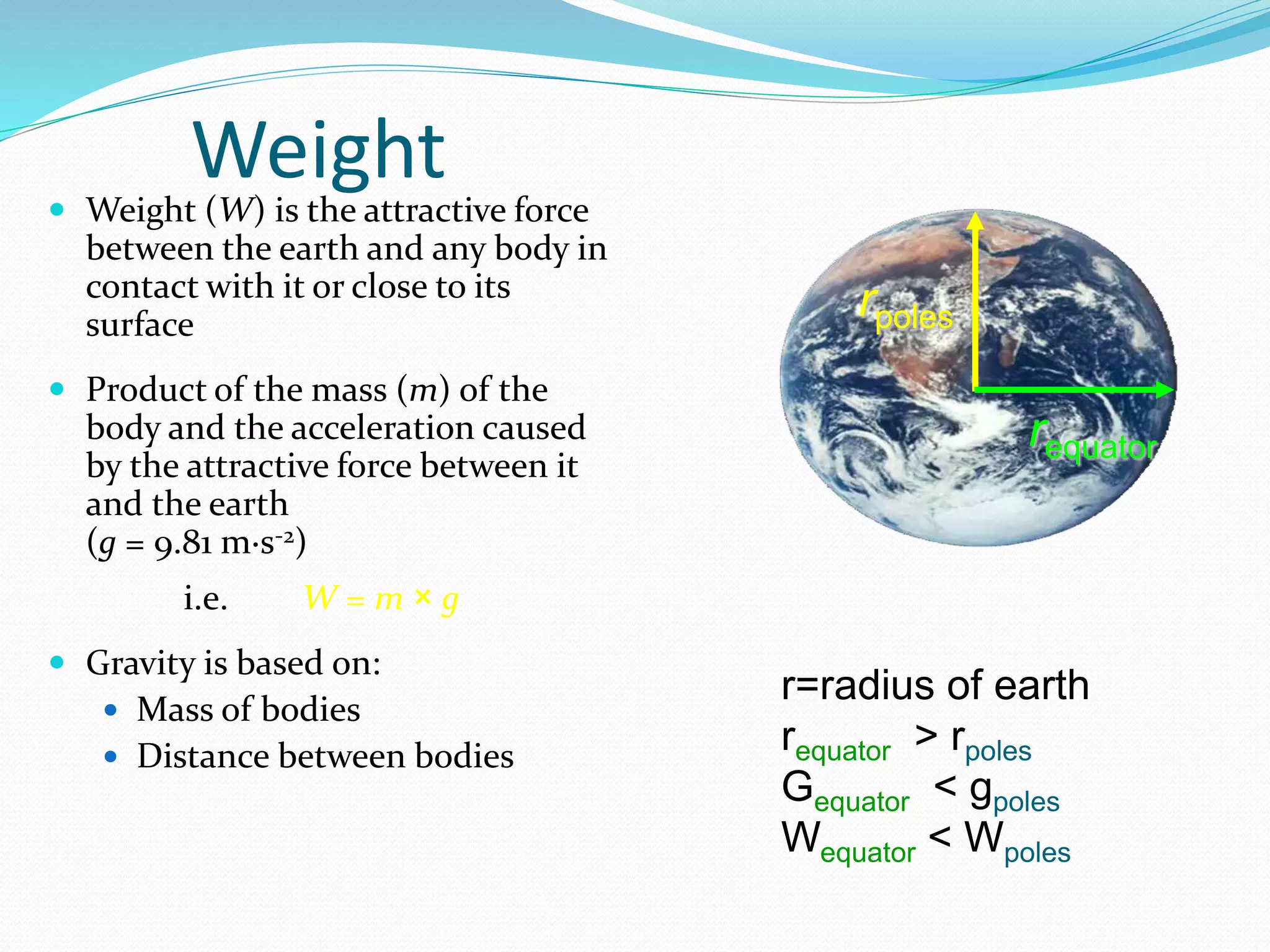
rpoles
Weight Weight (W) is the attractive force
between the earth and any body in
contact with it or close to its
surface
 Product of the mass (m) of the
body and the acceleration caused
by the attractive force between it
and the earth
(g = 9.81 m·s-2)
i.e. W = m × g
 Gravity is based on:
 Mass of bodies
 Distance between bodies
requator
r=radius of earth
requator > rpoles
Gequator < gpoles
Wequator < Wpoles
Force
 A push or pull that one object exerts on another object.
 Examples: Earth (pulls us downward), chairs, pencils.
 Example: pulling a drawer open; you exert force on the
drawer.
• An object’s motion changes in response to a
force.
• A force has a size and a direction—both are
important in determining an object’s motion.
• The force you exert on the book when you
push is called a contact force.
• A contact force is a force that is exerted when
two objects are touching each other.
Long-Range Forces
• A force can be exerted if two objects are not
in contact.
• If you bring a magnet close to a paper clip,
the paper clip moves toward the magnet, so
a force must be acting on the paper clip.
Long-Range Forces
• A dropped ball will fall downward, even
though nothing appears to be touching it.
• The forces acting on the paper clip and the ball
are long-range forces.
• In SI units the unit of force is the Newton,
which is abbreviated N and named for Isaac
Newton.
• One Newton is about the amount of force needed
to lift a half cup of water.
 Momentum:-
Is a commonly used term in sports. A
team that has the momentum is on the move and is
going to take some effort to stop. A team that has a lot
of momentum is really on the move and is going to be
hard to stop. Momentum is a physics term; it refers to
the quantity of motion that an object has. A sports
team that is on the move has the momentum. If an
object is in motion (on the move) then it has
momentum
 Momentum can be defined as "mass in motion.“
 All objects have mass; so if an object is moving, then it
has momentum - it has its mass in motion. The
amount of momentum that an object has is dependent
upon two variables: how much stuff is moving and
how fast the stuff is moving. Momentum depends
upon the variables mass and velocity. In terms of an
equation, the momentum of an object is equal to the
mass of the object times the velocity of the object.
 Momentum = mass • velocity
 p = m • v
 where m is the mass and
v is the velocity.
The equation illustrates that
momentum is directly proportional to an object's mass
and directly proportional to the object's velocity.
 The standard metric unit of momentum is the kg•m/s.
It is going to take more force to move a large
mass. Ten pounds is twice as much as five pounds. It
will take twice as much force to move 10 pounds as it
will to move five pounds. When enough force is
applied to move either 10 pounds or five pounds and
they were both given the same speed of movement
(velocity), the 10-pound weight would have twice as
much momentum. Remember that momentum is not
just velocity. While momentum is movement, it is
made up of both velocity and mass.
For example, it would take more effort (force) on your
part to catch the 10-pound weight (twice as much
effort) as it would for the five-pound weight if both
traveling at the same speed (velocity).
Types of momentum
 Linear
 Angular
 Linear momentum:-
Momentum is the quantity of motion
of a body in linear motion. It is equal to the product of
the body’s mass and velocity.
That is :
momentum = Mass X velocity
M = m X v
where : m is the mass [Kg]
v is the velocity[m/s]
M is the momentum[Kg m/s]
 Angular Momentum:-
The quantity of angular motion
possessed by a body is called it’s Angular momentum.
just as linear momentum varies with
a varying body mass and varying velocity.
Angular momentum =
moment of inertia X Angular velocity
H = j X ω
where :
j is the moment[Kg.m²]
ω is the angular velocity[°/s or rad/s]
H is the angular momentum
[Kg.m².°/s or Kg.m².rad/s]
Impulse Defined
Impulse is defined as the product force acting on an
object and the time during which the force acts. The
symbol for impulse is J. So, by definition:
J = F t
Example: A 50 N force is applied to a 100 kg boulder
for 3 s. The impulse of this force is J = (50 N) (3 s)
= 150 N·s.
Note that we didn’t need to know the mass of the
object in the above example.
Impulse Units
J = Ft shows why the SI unit for impulse is the Newton ·second.
There is no special name for this unit, but it is equivalent to a kg·m/s.
proof: 1 N·s = 1 (kg·m/s2) (s) = 1 kg·m/s
Fnet = ma shows this is
equivalent to a newton.
Therefore, impulse and momentum have the same units, which leads
to a useful theorem.
PRESSURE
 Pressure is defined as the distribution of force
over a given area. The greater the area over which the
force is distributed the smaller the pressure.
Snowshoes are an excellent example of how the
amount of area is increased to spread out the force
and thus decrease the pressure , making it possible to
walk on the snow.
36
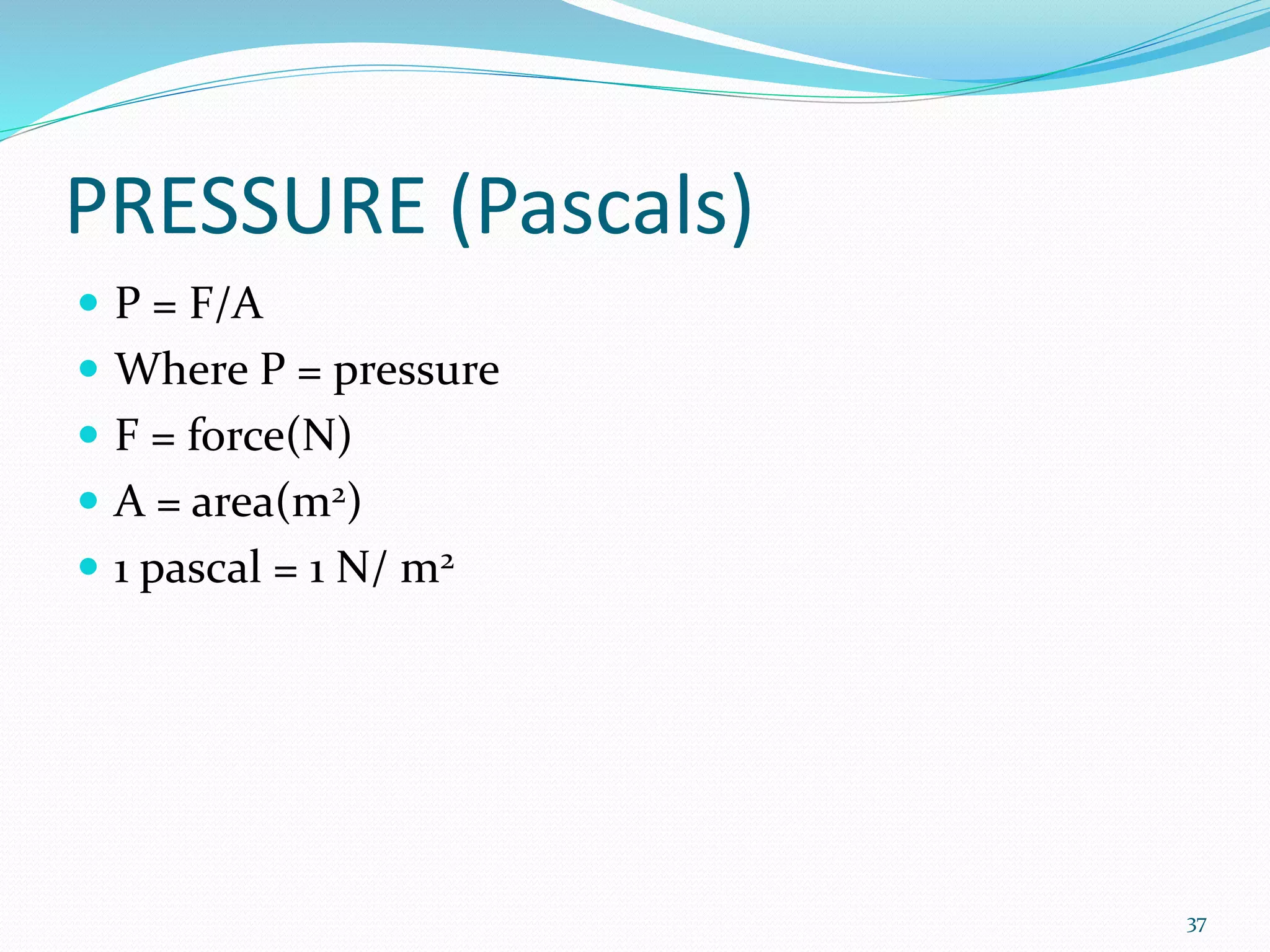
PRESSURE (Pascals)
 P = F/A
 Where P = pressure
 F = force(N)
 A = area(m2)
 1 pascal = 1 N/ m2
37
PROBLEM
 If a person who weighs 400N is standing on one foot
which has a contact area of 100cm2. What is the
pressure exerted?
 F = 400N
 A = 100cm2
 P=F/A = 400/100 = 4N/cm2
38

linear motion in biomechanics

  • 1.
  • 2.
    Scalar  Scalars arequantities that are fully described by a magnitude (or numerical value) alone. मात्रा है जो पूरी तरह से के वल पररमाण को वर्णित करता हैं  Vectors are quantities that are fully described by both a magnitude and a direction. वेक्टर मात्रा है जो पूरी तरह से पररमाण और दिशा िोनों को वर्णित करता हैं
  • 3.
    Distance and displacement Motionis change in position with respect to some frame of reference. (final position minus initial position). The simplest linear motion variable is a scalar called Distance (l). (l) Is the length an object travelled irrespective of direction (mtr, feet etc) दिशा की परवाह ककए बिना एक वस्तु की यात्रा की लंिाई या िुरी
  • 4.
    displacement  displacement isa vector quantity.  shows distance and direction of objects.  Shortest distance from the reference point.  Displacements are calculated as final position minus initial position in that particular direction
  • 5.
    Speed and Velocity Speed is how fast an object is moving without regard to direction.  Speed is a scalar quantity like distance.  Speed (s) is defined as the rate of change of distance (s = l/t), so typical units are m/s, ft/s, km/hr, or miles/hr.
  • 6.
    Speed Speed is oneway to describe motion. It describes how fast an object is moving using distance and time. Average speed is the total distance traveled over the total time and instantaneous speed is the speed at a particular moment For example, 30 miles per hour means object travels distance of 30 miles in an elapsed time of one hour. Write as, (SPEED) = (Distance traveled) (Time elapsed) 30 miles per hour = 30 miles hour
  • 7.
    Practice: What is theaverage speed of a cheetah that sprints 100 meters in 4 seconds? How about if it sprints 50 meters in 2 seconds? A car has an average speed of 100 kilometers per hour. How far does it travel in 30 minutes?
  • 8.
    Velocity • Constant speedmeans steady speed. Something with constant speed doesn’t speed up or slow down. • Constant velocity means both constant speed and constant direction. • Constant direction is a straight line, so constant velocity means motion in a straight line at constant speed. • Constant speed and constant velocity are not the same. • A body may move at constant speed along a curved path but it does not move with constant velocity, because its direction is changing every instant.
  • 9.
    Practice The speedometer ofa car moving east reads 100 km/h. It passes another car moving west at 100 km/h. Do they have same speed? Velocity? During a certain period of time, the speedometer of a car reads a constant 60 km/h. Does this indicate a constant speed? Constant velocity?
  • 10.
    Velocity  Velocity isthe vector corresponding to speed.  V is the speed of an object, in a particular direction.  Velocity is the rate of change of displacement (V = d/t), so its units are the same as speed, and are usually qualified by a directional adjective (i.e., horizontal, vertical, ).
  • 11.
    Velocity  The phrase“rate of change” is very important because velocity defines how quickly position is changing in the specified direction (displacement).
  • 12.
    Acceleration Define acceleration ashow fast velocity changes Acceleration is a rate of a rate (units will have 2 time values) (ACCELERATION) = (Change in Velocity) (Time interval) Note: An object accelerates anytime its velocity changes. Examples include: Object speeds up. Object slows down Object changes direction (curved path) Best example of acceleration is objects in free fall
  • 13.
    Equations  s =d/t  v = d/t  a = Δv/Δt  g = 9.8 m/s/s
  • 14.
    Gravity  Many typesof forces act on objects. • Gravity is an attractive force between all objects that have mass.
  • 15.
    Gravity (cont.)  Theball does not travel in a straight line because of the unbalanced force of gravity acting on it.
  • 16.
    The Law ofUniversal Gravitation  The Law of Universal Gravitation states that all objects with mass are attracted to each other. • The magnitude of attraction depends on the mass of each object and the distance between them.
  • 17.
    The Law ofUniversal Gravitation (cont.)  The gravitational force becomes stronger as either or both objects increase in mass or move closer together. • The gravitational force becomes weaker as either or both objects decrease in mass or move farther apart.
  • 18.
    Inertia Inertia: Mass:  Resistanceto being accelerated  Quantity of matter an object is made of.  measure of the inertia of the object  scalar quantity  not the same as weight
  • 19.
    Mass  Quantity ofmatter an object is made of.  measure of the inertia of the object  scalar quantity  not the same as weight  Mass and Inertia large mass=lots of inertia small mass=not lots of inertia
  • 20.
    rpoles Weight Weight (W)is the attractive force between the earth and any body in contact with it or close to its surface  Product of the mass (m) of the body and the acceleration caused by the attractive force between it and the earth (g = 9.81 m·s-2) i.e. W = m × g  Gravity is based on:  Mass of bodies  Distance between bodies requator r=radius of earth requator > rpoles Gequator < gpoles Wequator < Wpoles
  • 21.
    Force  A pushor pull that one object exerts on another object.  Examples: Earth (pulls us downward), chairs, pencils.  Example: pulling a drawer open; you exert force on the drawer.
  • 22.
    • An object’smotion changes in response to a force. • A force has a size and a direction—both are important in determining an object’s motion. • The force you exert on the book when you push is called a contact force. • A contact force is a force that is exerted when two objects are touching each other.
  • 23.
    Long-Range Forces • Aforce can be exerted if two objects are not in contact. • If you bring a magnet close to a paper clip, the paper clip moves toward the magnet, so a force must be acting on the paper clip.
  • 24.
    Long-Range Forces • Adropped ball will fall downward, even though nothing appears to be touching it. • The forces acting on the paper clip and the ball are long-range forces. • In SI units the unit of force is the Newton, which is abbreviated N and named for Isaac Newton. • One Newton is about the amount of force needed to lift a half cup of water.
  • 25.
     Momentum:- Is acommonly used term in sports. A team that has the momentum is on the move and is going to take some effort to stop. A team that has a lot of momentum is really on the move and is going to be hard to stop. Momentum is a physics term; it refers to the quantity of motion that an object has. A sports team that is on the move has the momentum. If an object is in motion (on the move) then it has momentum
  • 26.
     Momentum canbe defined as "mass in motion.“  All objects have mass; so if an object is moving, then it has momentum - it has its mass in motion. The amount of momentum that an object has is dependent upon two variables: how much stuff is moving and how fast the stuff is moving. Momentum depends upon the variables mass and velocity. In terms of an equation, the momentum of an object is equal to the mass of the object times the velocity of the object.  Momentum = mass • velocity
  • 27.
     p =m • v  where m is the mass and v is the velocity. The equation illustrates that momentum is directly proportional to an object's mass and directly proportional to the object's velocity.  The standard metric unit of momentum is the kg•m/s.
  • 28.
    It is goingto take more force to move a large mass. Ten pounds is twice as much as five pounds. It will take twice as much force to move 10 pounds as it will to move five pounds. When enough force is applied to move either 10 pounds or five pounds and they were both given the same speed of movement (velocity), the 10-pound weight would have twice as much momentum. Remember that momentum is not just velocity. While momentum is movement, it is made up of both velocity and mass.
  • 29.
    For example, itwould take more effort (force) on your part to catch the 10-pound weight (twice as much effort) as it would for the five-pound weight if both traveling at the same speed (velocity).
  • 30.
    Types of momentum Linear  Angular  Linear momentum:- Momentum is the quantity of motion of a body in linear motion. It is equal to the product of the body’s mass and velocity.
  • 31.
    That is : momentum= Mass X velocity M = m X v where : m is the mass [Kg] v is the velocity[m/s] M is the momentum[Kg m/s]
  • 32.
     Angular Momentum:- Thequantity of angular motion possessed by a body is called it’s Angular momentum. just as linear momentum varies with a varying body mass and varying velocity.
  • 33.
    Angular momentum = momentof inertia X Angular velocity H = j X ω where : j is the moment[Kg.m²] ω is the angular velocity[°/s or rad/s] H is the angular momentum [Kg.m².°/s or Kg.m².rad/s]
  • 34.
    Impulse Defined Impulse isdefined as the product force acting on an object and the time during which the force acts. The symbol for impulse is J. So, by definition: J = F t Example: A 50 N force is applied to a 100 kg boulder for 3 s. The impulse of this force is J = (50 N) (3 s) = 150 N·s. Note that we didn’t need to know the mass of the object in the above example.
  • 35.
    Impulse Units J =Ft shows why the SI unit for impulse is the Newton ·second. There is no special name for this unit, but it is equivalent to a kg·m/s. proof: 1 N·s = 1 (kg·m/s2) (s) = 1 kg·m/s Fnet = ma shows this is equivalent to a newton. Therefore, impulse and momentum have the same units, which leads to a useful theorem.
  • 36.
    PRESSURE  Pressure isdefined as the distribution of force over a given area. The greater the area over which the force is distributed the smaller the pressure. Snowshoes are an excellent example of how the amount of area is increased to spread out the force and thus decrease the pressure , making it possible to walk on the snow. 36
  • 37.
    PRESSURE (Pascals)  P= F/A  Where P = pressure  F = force(N)  A = area(m2)  1 pascal = 1 N/ m2 37
  • 38.
    PROBLEM  If aperson who weighs 400N is standing on one foot which has a contact area of 100cm2. What is the pressure exerted?  F = 400N  A = 100cm2  P=F/A = 400/100 = 4N/cm2 38