What is Speed?
•Speed of an object is the magnitude of its
velocity (the rate of change of its position); it
is thus a scalar quantity.
• The average speed of an object in an interval
of time is the distance travelled by the object
divided by the duration of the interval.
• In equation form, this is
where v is speed, d is distance, and t is time
3.
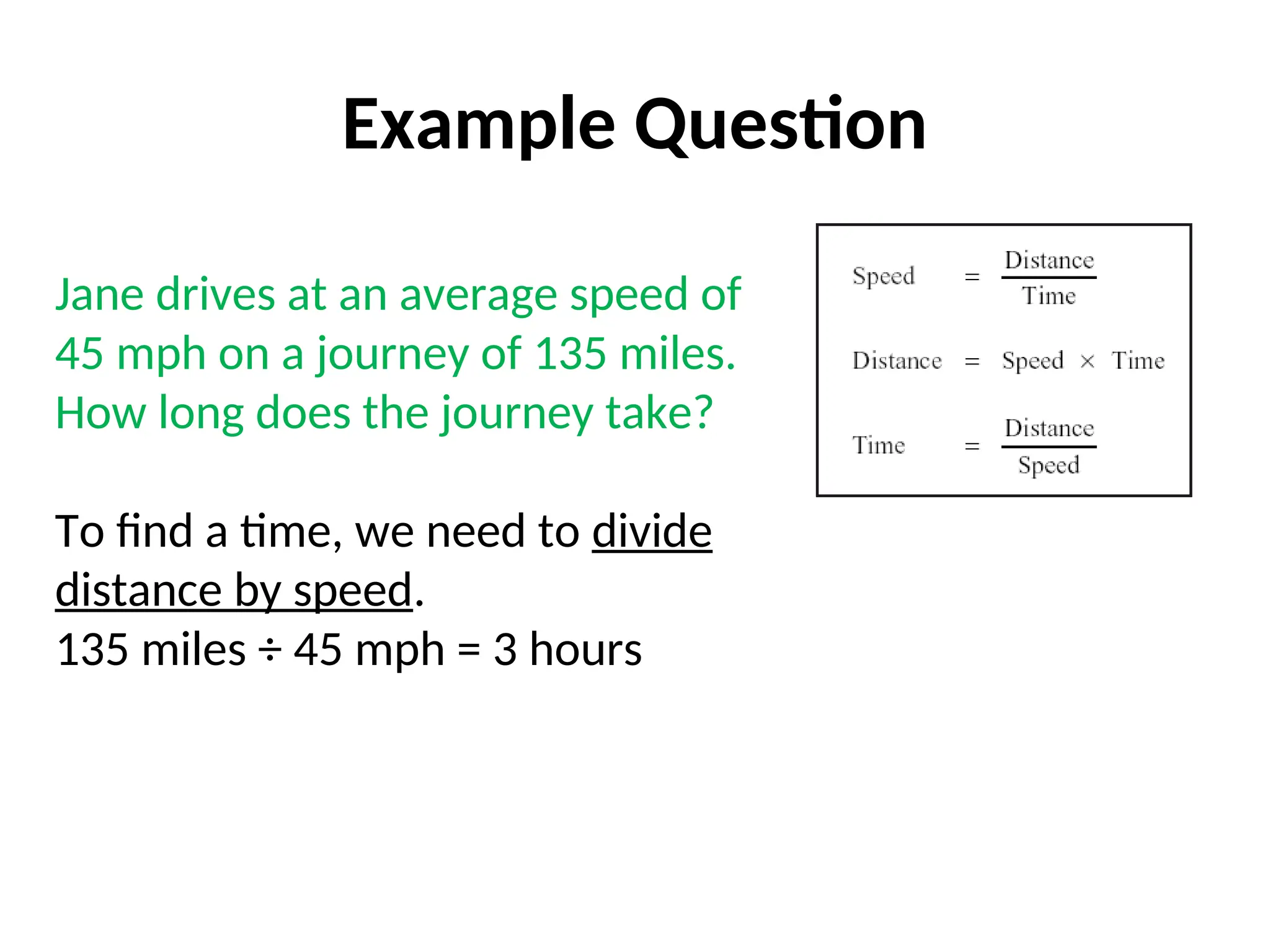
Example Question
Jane drivesat an average speed of
45 mph on a journey of 135 miles.
How long does the journey take?
To find a time, we need to divide
distance by speed.
135 miles ÷ 45 mph = 3 hours
4.
Velocity
• The averagespeed of an object is defined as the distance
traveled divided by the time elapsed.
• Velocity is a vector quantity, and average velocity can be
defined as the displacement divided by the time.
• For the special case of straight line motion in the x
direction, the average velocity takes the form:
• The units for velocity can be implied from the definition to
be meters/second or in general any distance unit over any
time unit.
5.
Acceleration
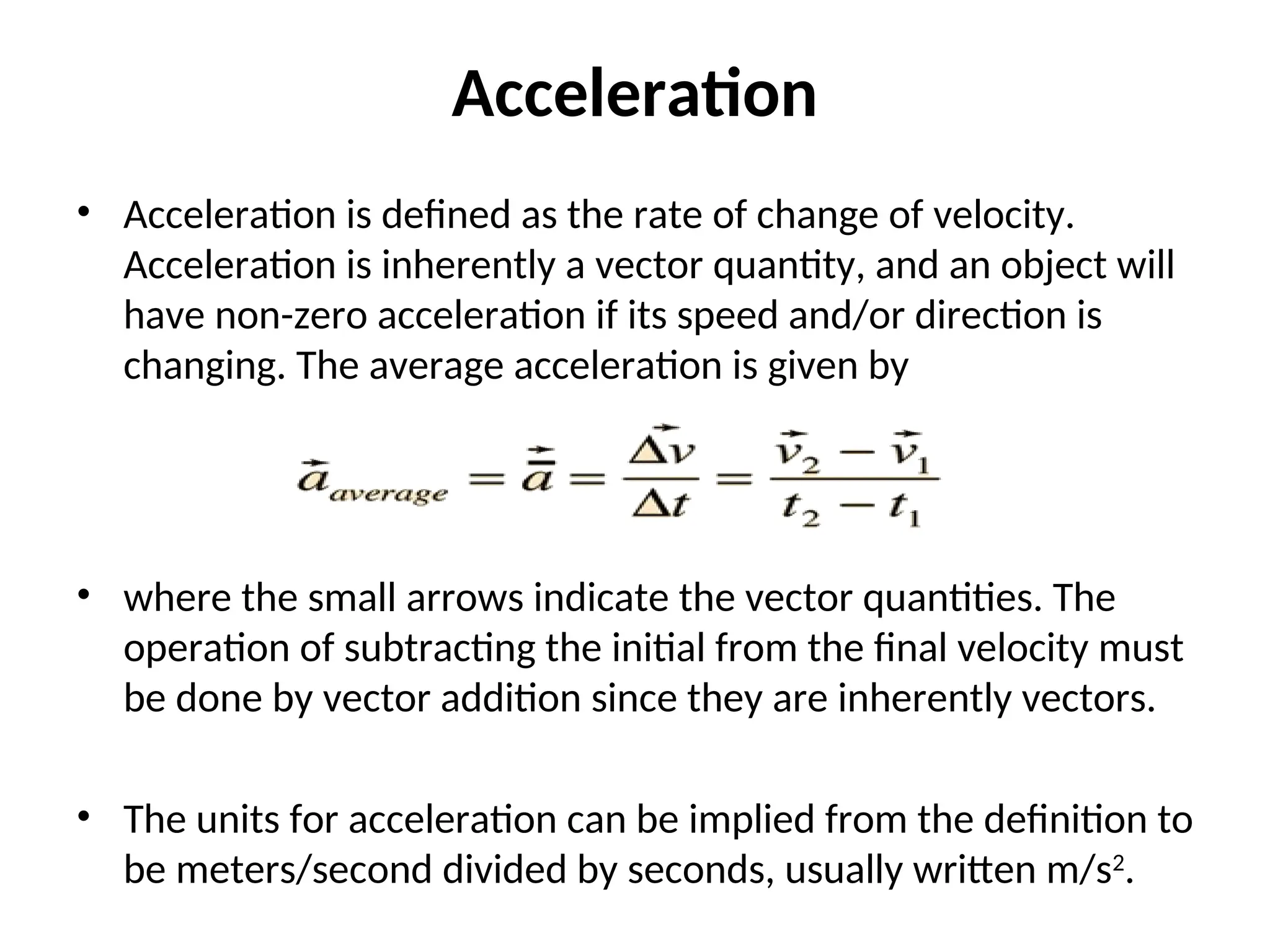
• Acceleration isdefined as the rate of change of velocity.
Acceleration is inherently a vector quantity, and an object will
have non-zero acceleration if its speed and/or direction is
changing. The average acceleration is given by
• where the small arrows indicate the vector quantities. The
operation of subtracting the initial from the final velocity must
be done by vector addition since they are inherently vectors.
• The units for acceleration can be implied from the definition to
be meters/second divided by seconds, usually written m/s2
.
6.
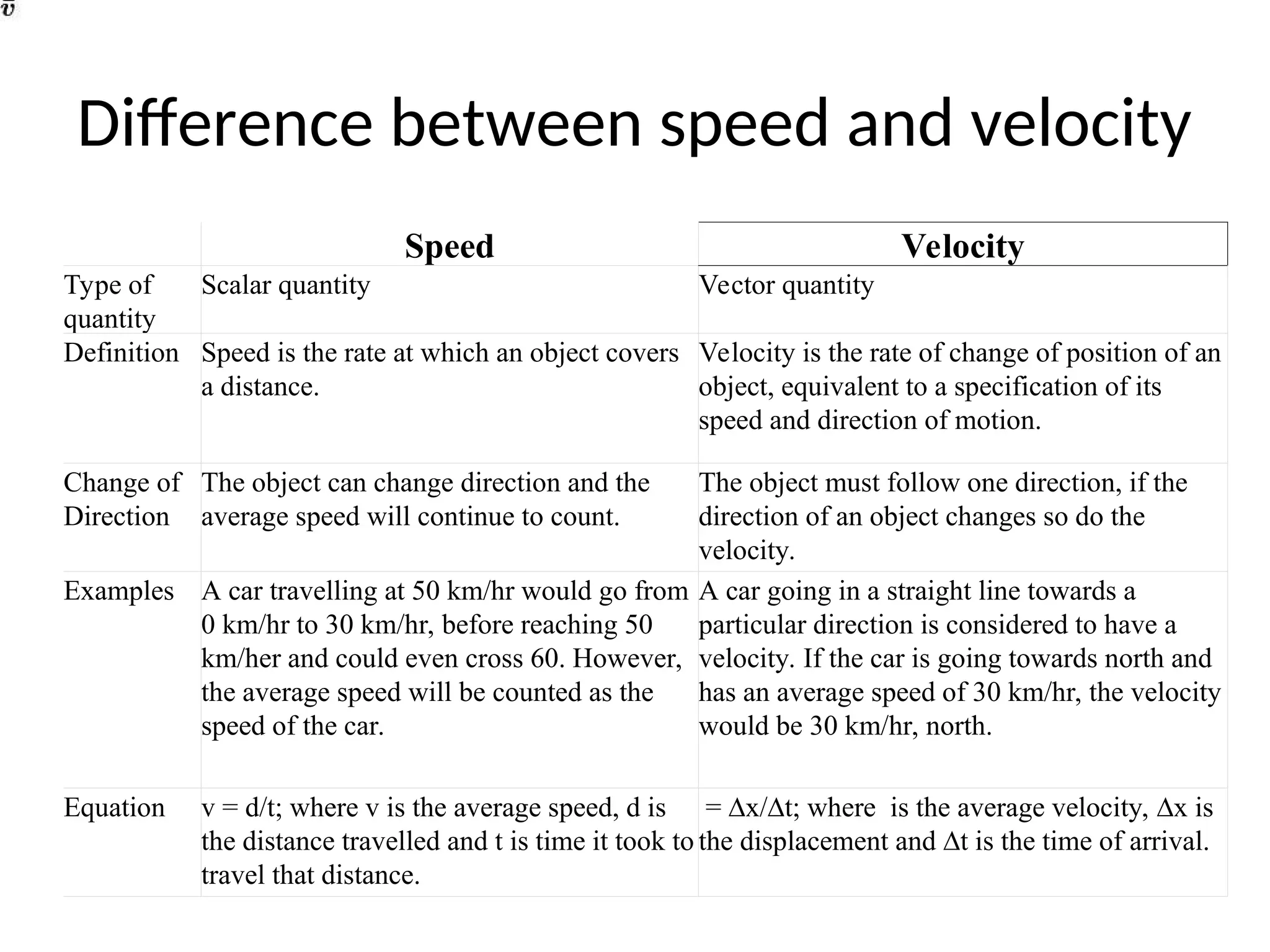
Difference between speedand velocity
Speed Velocity
Type of
quantity
Scalar quantity Vector quantity
Definition Speed is the rate at which an object covers
a distance.
Velocity is the rate of change of position of an
object, equivalent to a specification of its
speed and direction of motion.
Change of
Direction
The object can change direction and the
average speed will continue to count.
The object must follow one direction, if the
direction of an object changes so do the
velocity.
Examples A car travelling at 50 km/hr would go from
0 km/hr to 30 km/hr, before reaching 50
km/her and could even cross 60. However,
the average speed will be counted as the
speed of the car.
A car going in a straight line towards a
particular direction is considered to have a
velocity. If the car is going towards north and
has an average speed of 30 km/hr, the velocity
would be 30 km/hr, north.
Equation v = d/t; where v is the average speed, d is
the distance travelled and t is time it took to
travel that distance.
= ∆x/∆t; where is the average velocity, ∆x is
the displacement and ∆t is the time of arrival.
7.
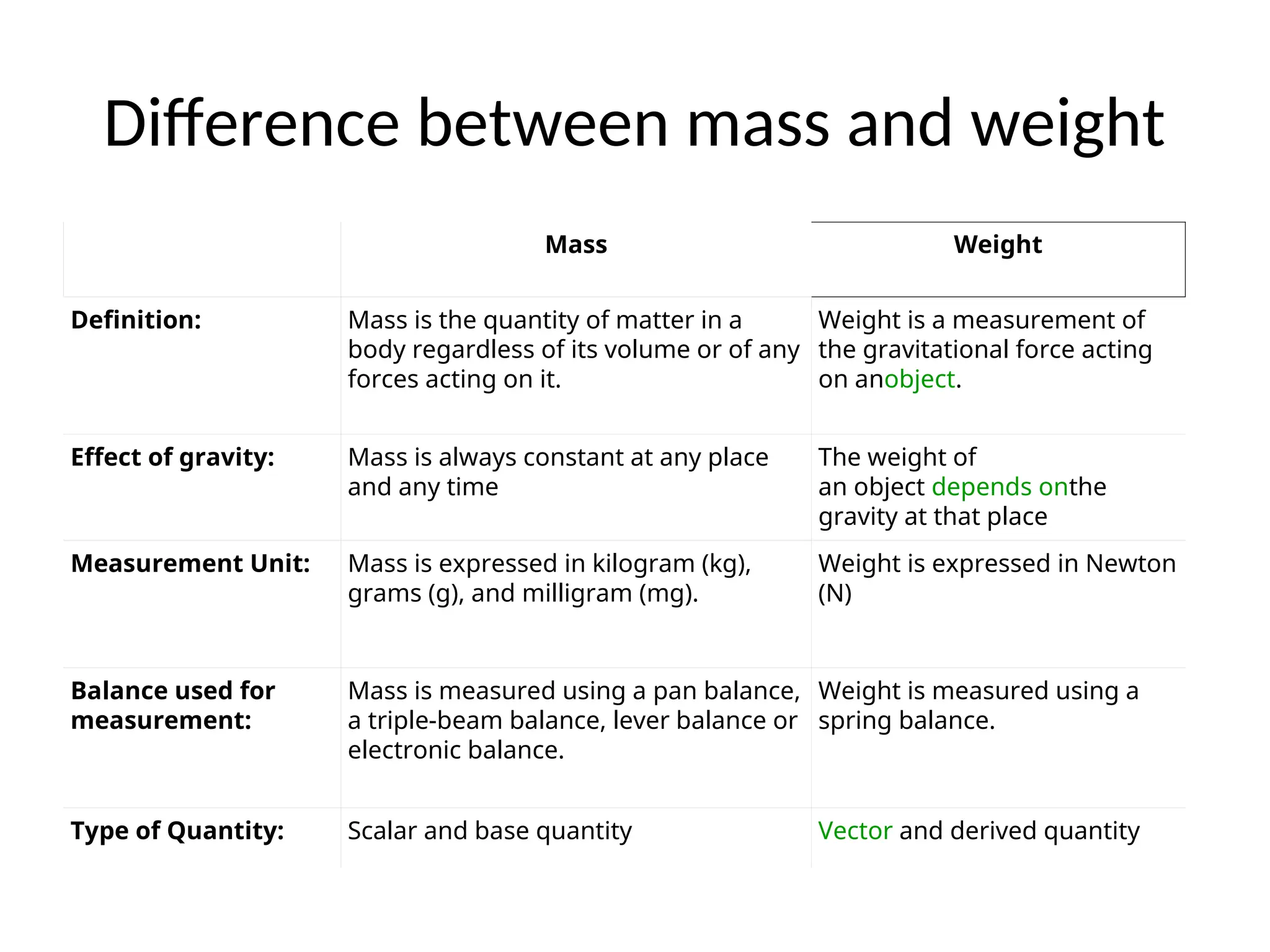
Difference between massand weight
Mass Weight
Definition: Mass is the quantity of matter in a
body regardless of its volume or of any
forces acting on it.
Weight is a measurement of
the gravitational force acting
on anobject.
Effect of gravity: Mass is always constant at any place
and any time
The weight of
an object depends onthe
gravity at that place
Measurement Unit: Mass is expressed in kilogram (kg),
grams (g), and milligram (mg).
Weight is expressed in Newton
(N)
Balance used for
measurement:
Mass is measured using a pan balance,
a triple-beam balance, lever balance or
electronic balance.
Weight is measured using a
spring balance.
Type of Quantity: Scalar and base quantity Vector and derived quantity
8.
What is Force?
•A force is a push or pull acting upon an object
as a result of its interaction with another
object. There are a variety of types of forces.
9.
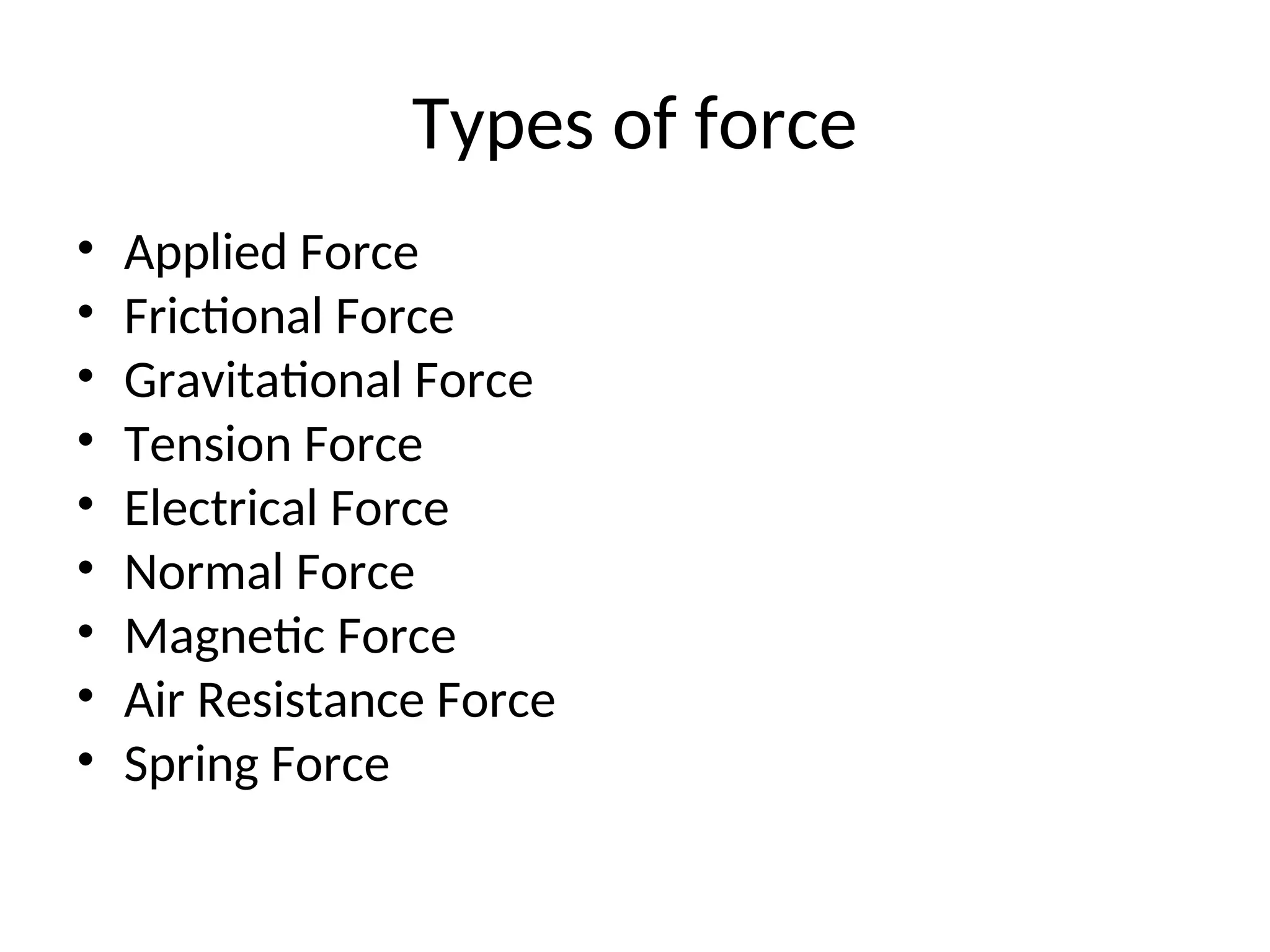
Types of force
•Applied Force
• Frictional Force
• Gravitational Force
• Tension Force
• Electrical Force
• Normal Force
• Magnetic Force
• Air Resistance Force
• Spring Force
10.
1. Applied force:
• An applied force is a force that is applied to an
object by a person or another object.
• If a person is pushing a desk across the room,
then there is an applied force acting upon the
object.
• The applied force is the force exerted on the
desk by the person.
11.
2. Gravity Force
•The force of gravity is the force with which the earth,
moon, or other massively large object attracts another
object towards itself.
• By definition, this is the weight of the object. All
objects upon earth experience a force of gravity that is
directed "downward" towards the center of the earth.
• The force of gravity on earth is always equal to the
weight of the object as found by the equation:
• F(grav) = m * g
where g = 9.8 N/kg (on Earth)and m = mass (in kg)
12.
3. Normal force
•The normal force is the support force exerted
upon an object that is in contact with another
stable object.
• For example, if a book is resting upon a
surface, then the surface is exerting an
upward force upon the book in order to
support the weight of the book.
13.
4.Friction force
• Thefriction force is the force exerted by a surface
as an object moves across it or makes an effort to
move across it.
• There are at least two types of friction force -
sliding and static friction.
• Thought it is not always the case, the friction
force often opposes the motion of an object.
• For example, if a book slides across the surface of
a desk, then the desk exerts a friction force in the
opposite direction of its motion.
14.
5. Air resistanceForce
• The air resistance is a special type of frictional
force that acts upon objects as they travel
through the air.
• The force of air resistance is often observed to
oppose the motion of an object.
• It is most noticeable for objects that travel at
high speeds or for objects with large surface
areas.
15.
6. Tension force
•The tension force is the force that is
transmitted through a string, rope, cable or
wire when it is pulled tight by forces acting
from opposite ends.
• The tension force is directed along the length
of the wire and pulls equally on the objects on
the opposite ends of the wire.
16.
7. Spring force
•The spring force is the force exerted by a
compressed or stretched spring upon any object
that is attached to it.
• An object that compresses or stretches a spring is
always acted upon by a force that restores the
object to its rest or equilibrium position.
• For most springs (specifically, for those that are
said to obey "Hooke's Law"), the magnitude of
the force is directly proportional to the amount
of stretch or compression of the spring.