Newton’s Laws And forces, vectors, gravity, momentum, impulse and moments
Newton’s First Law Objects at rest remain at rest Objects in motion remain in motion UNTIL YOU APPLY A FORCE
Newton’s Second Law F = ma What forces are important in sports?
Newton’s Third Law For every action there is an equal and opposite reaction. But do they act on the same body?
Vector Force is a vector - ? It has a magnitude and a direction. This allows forces to be cancelled out. Force brings about acceleration Which law relates to that? Newton’s 2 nd  Law F=ma
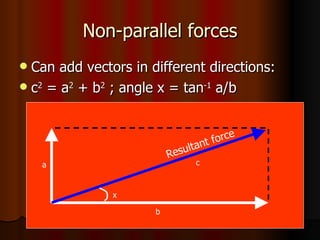
Non-parallel forces Can add vectors in different directions: c 2  = a 2  + b 2  ; angle x = tan -1  a/b x Resultant force a b c
Vectors Remember: the resultant force is not a new force It is the sum of the 2 components Use either the resultant or component in any calculation, not both!
Newton What is a Newton? Unit  1N = force that accelerates 1kg mass by 1ms -2
weight What’s the weight of 1 litre of water? 1kg is the mass The weight = mass x g g is the gravitational field strength g = 10 N kg -1 or 9.81 N kg -1  (more accurately) Weight of 1 litre of water is 10N or 9.81N
Quiz What is my acceleration due to weight? 9.81 ms -2 What is your acceleration due to weight? 9.81 ms -2 What about the marker? 9.81 ms -2 Acceleration due to weight is always g
Mass Amount of matter Measure of inertia Inertia is the resistance to acceleration Mass attracts gravity Gravitational force is directly proportional to mass Note: Gravitational force is inversely proportional to distance 2  between 2 points
Quiz As one moves away from the centre of the earth, his/her weight decreases. At 3000m, g = 9.8009 N kg -1   What if we throw shot put at 3000m? What if we run marathon at 3000m? At 3000m, oxygen pressure is reduced by more than 10% Always consider other factors!
Impulse Momentum = mass x velocity Since F = ma and a =  ∆ v / t , F = m  ∆ v / t Therefore F t = m  ∆v, or Impulse = change of momentum The larger the impulse, the greater is the change in velocity. Application?
Impulse Hence, to increase velocity, we either increase F or t (time of contact). Remember,  F = m  ∆ v / t To reduce impact, encourage soft landing Use cushioning, bend joints, etc
Conservation of energy Energy is always conserved Regardless of whether you can observe Mechanical energy is not always conserved Mechanical energy is only conserved in a closed system Initial (total kinetic + potential energy) = final (total kinetic + potential energy)
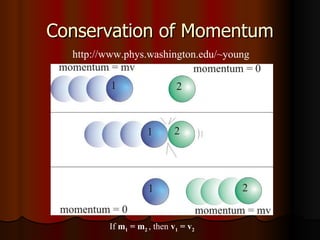
Conservation of momentum Momentum is conserved when there is no external forces E.g. snooker, assuming no friction Application? Momentum can be transferred in a collision Application?
Conservation of Momentum If  m 1  = m 2   , then  v 1  = v 2 http://www.phys.washington.edu/~young
Moments Turning effect of a force Moment = force x perpendicular distance Also called torque

Physics: Mechanics

  • 1.
    Newton’s Laws Andforces, vectors, gravity, momentum, impulse and moments
  • 2.
    Newton’s First LawObjects at rest remain at rest Objects in motion remain in motion UNTIL YOU APPLY A FORCE
  • 3.
    Newton’s Second LawF = ma What forces are important in sports?
  • 4.
    Newton’s Third LawFor every action there is an equal and opposite reaction. But do they act on the same body?
  • 5.
    Vector Force isa vector - ? It has a magnitude and a direction. This allows forces to be cancelled out. Force brings about acceleration Which law relates to that? Newton’s 2 nd Law F=ma
  • 6.
    Non-parallel forces Canadd vectors in different directions: c 2 = a 2 + b 2 ; angle x = tan -1 a/b x Resultant force a b c
  • 7.
    Vectors Remember: theresultant force is not a new force It is the sum of the 2 components Use either the resultant or component in any calculation, not both!
  • 8.
    Newton What isa Newton? Unit 1N = force that accelerates 1kg mass by 1ms -2
  • 9.
    weight What’s theweight of 1 litre of water? 1kg is the mass The weight = mass x g g is the gravitational field strength g = 10 N kg -1 or 9.81 N kg -1 (more accurately) Weight of 1 litre of water is 10N or 9.81N
  • 10.
    Quiz What ismy acceleration due to weight? 9.81 ms -2 What is your acceleration due to weight? 9.81 ms -2 What about the marker? 9.81 ms -2 Acceleration due to weight is always g
  • 11.
    Mass Amount ofmatter Measure of inertia Inertia is the resistance to acceleration Mass attracts gravity Gravitational force is directly proportional to mass Note: Gravitational force is inversely proportional to distance 2 between 2 points
  • 12.
    Quiz As onemoves away from the centre of the earth, his/her weight decreases. At 3000m, g = 9.8009 N kg -1 What if we throw shot put at 3000m? What if we run marathon at 3000m? At 3000m, oxygen pressure is reduced by more than 10% Always consider other factors!
  • 13.
    Impulse Momentum =mass x velocity Since F = ma and a = ∆ v / t , F = m ∆ v / t Therefore F t = m ∆v, or Impulse = change of momentum The larger the impulse, the greater is the change in velocity. Application?
  • 14.
    Impulse Hence, toincrease velocity, we either increase F or t (time of contact). Remember, F = m ∆ v / t To reduce impact, encourage soft landing Use cushioning, bend joints, etc
  • 15.
    Conservation of energyEnergy is always conserved Regardless of whether you can observe Mechanical energy is not always conserved Mechanical energy is only conserved in a closed system Initial (total kinetic + potential energy) = final (total kinetic + potential energy)
  • 16.
    Conservation of momentumMomentum is conserved when there is no external forces E.g. snooker, assuming no friction Application? Momentum can be transferred in a collision Application?
  • 17.
    Conservation of MomentumIf m 1 = m 2 , then v 1 = v 2 http://www.phys.washington.edu/~young
  • 18.
    Moments Turning effectof a force Moment = force x perpendicular distance Also called torque