PREPARED BY: DR.KRUPA SONI (MPT)
A S S I S T A N T P R O F E S S O R
N O O T A N C O L L E G E O F P H Y S I O T H E R A P Y
S A N K A L C H A N D P A T E L U N I V E R S I T Y
Prepared by: Dr.Krupa Soni (MPT)
1
IMPETUS
Introduction
 The word impact is derived from the Latin
word impingere, “to press together.”
 Impact is further defined as force of contact,
violent collision, striking together.
 Impetus (mechanics), a concept very similar to
momentum.
 The product of the mass and velocity of an object.
 p =mv
Prepared by:Dr.Krupa Soni (MPT)
2
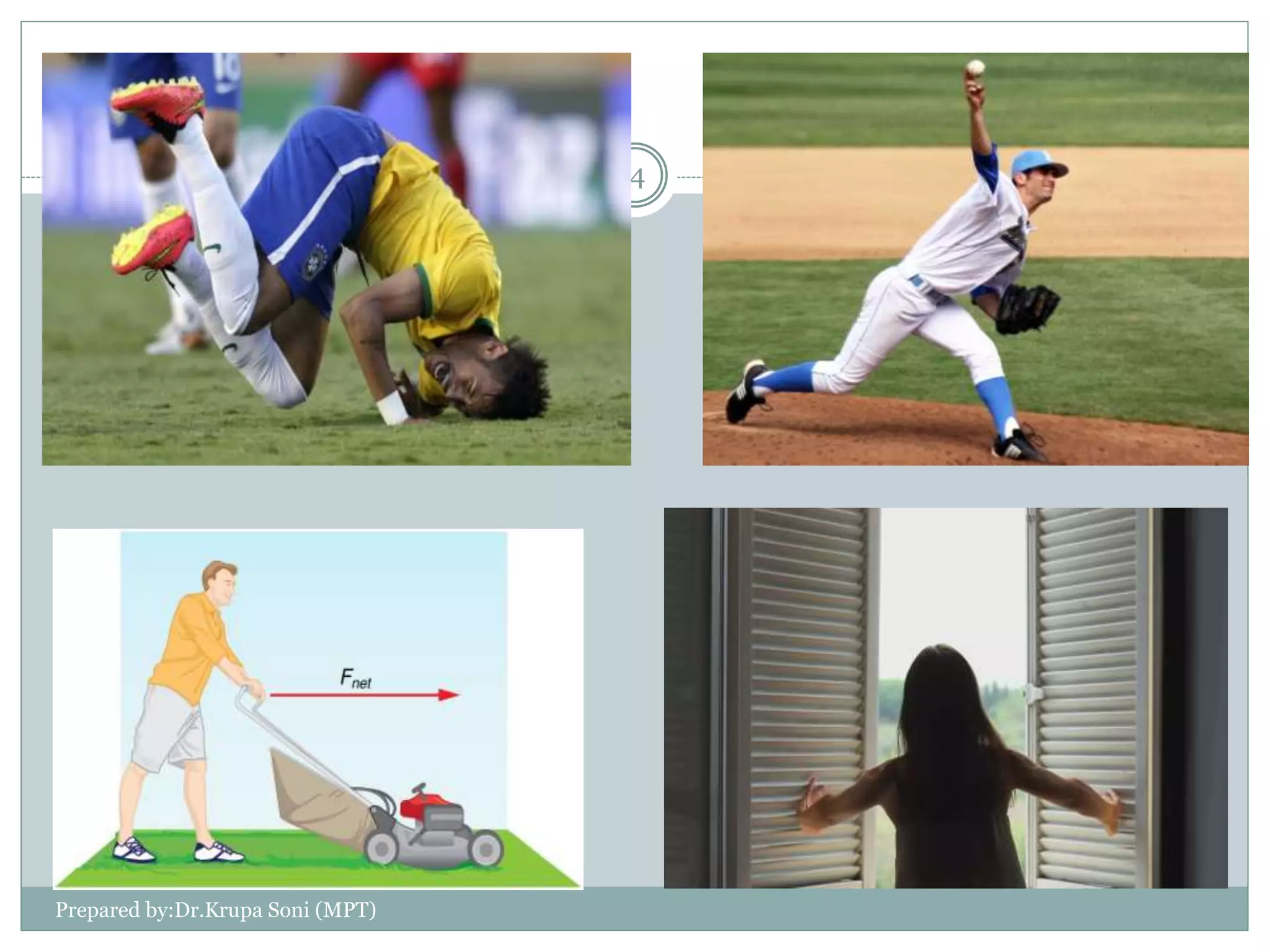
 Impact may be from one's own body, as in landing
from a jump or fall, or imparted by external objects,
as in catching.
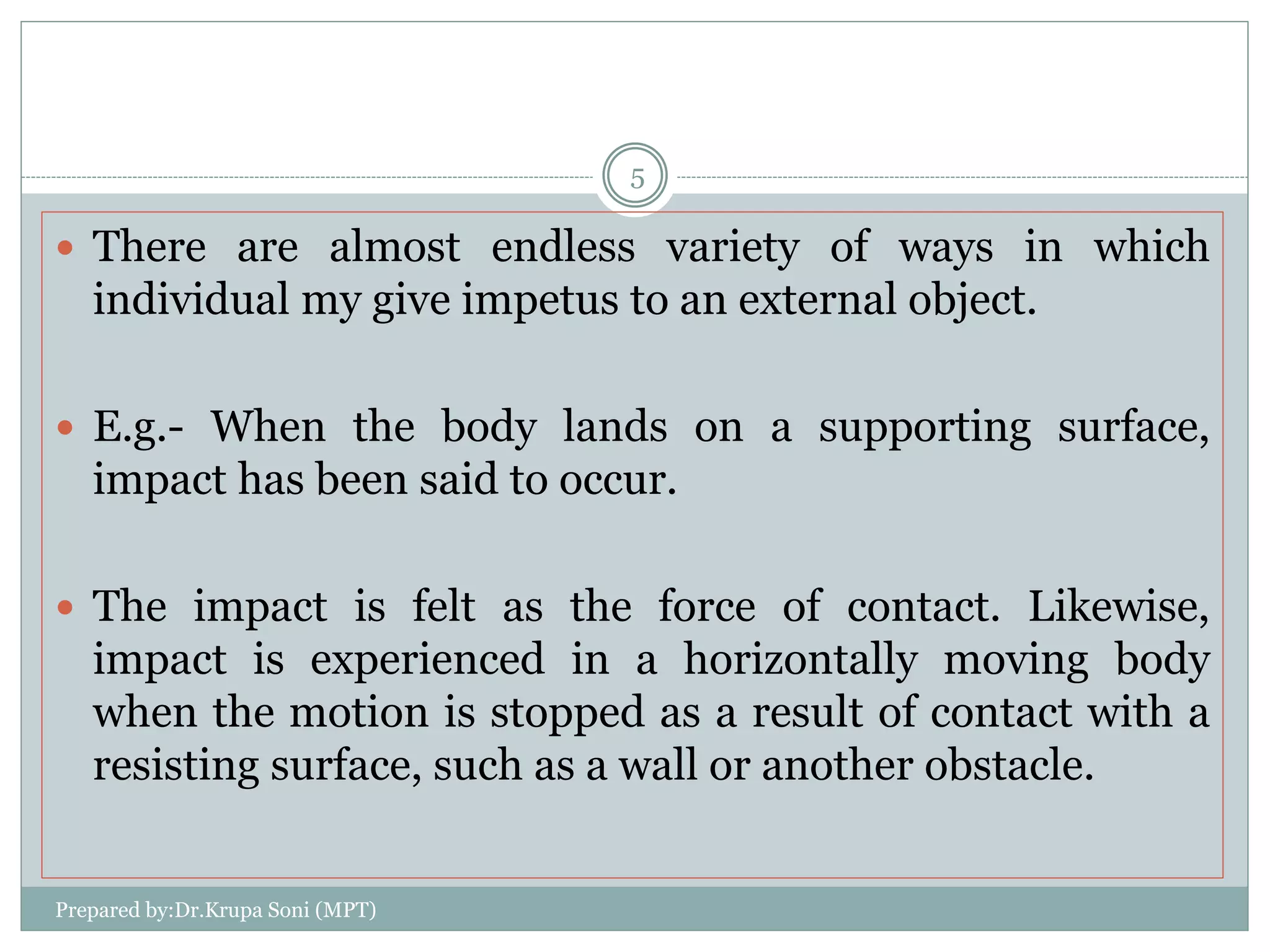
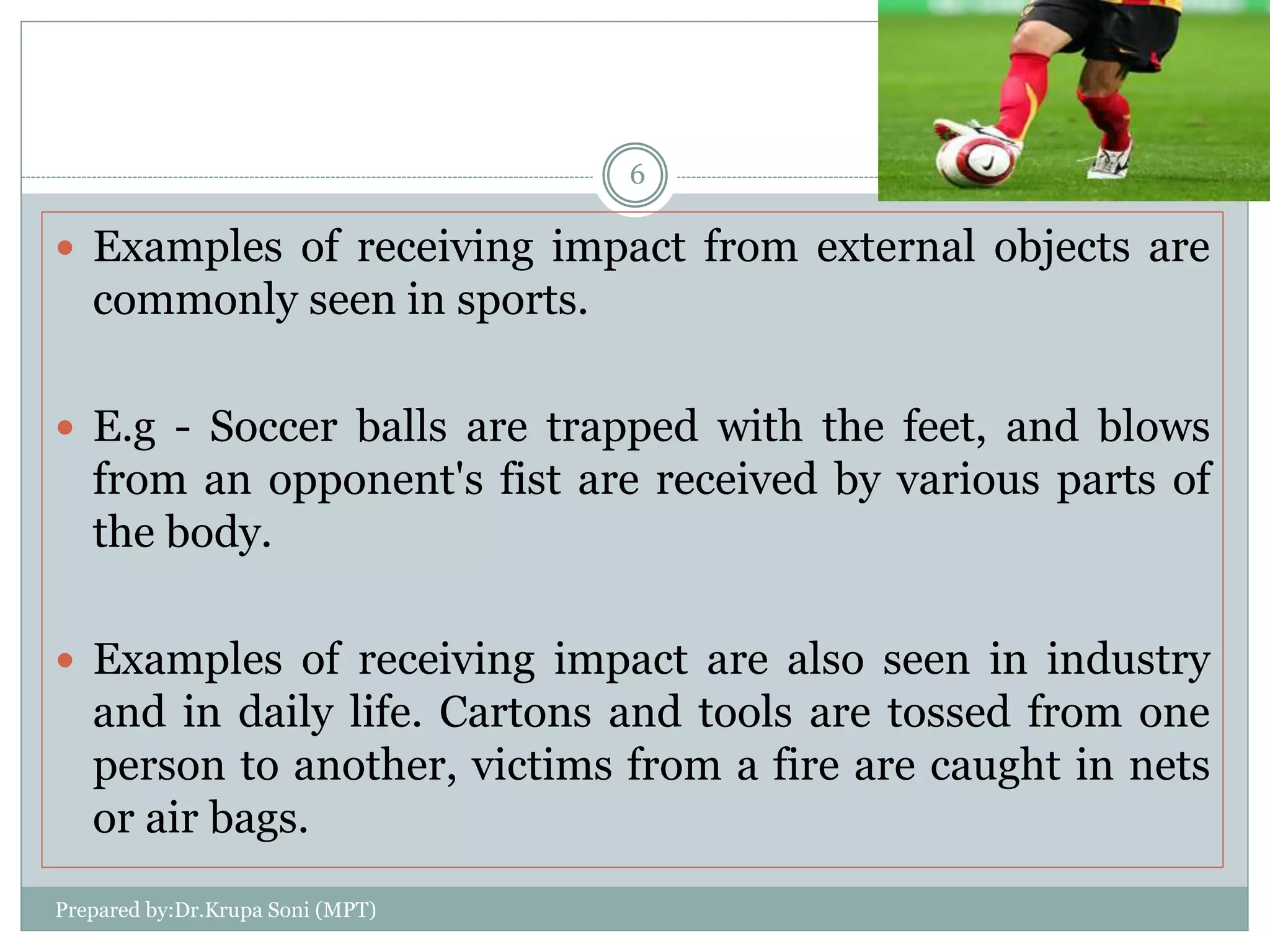
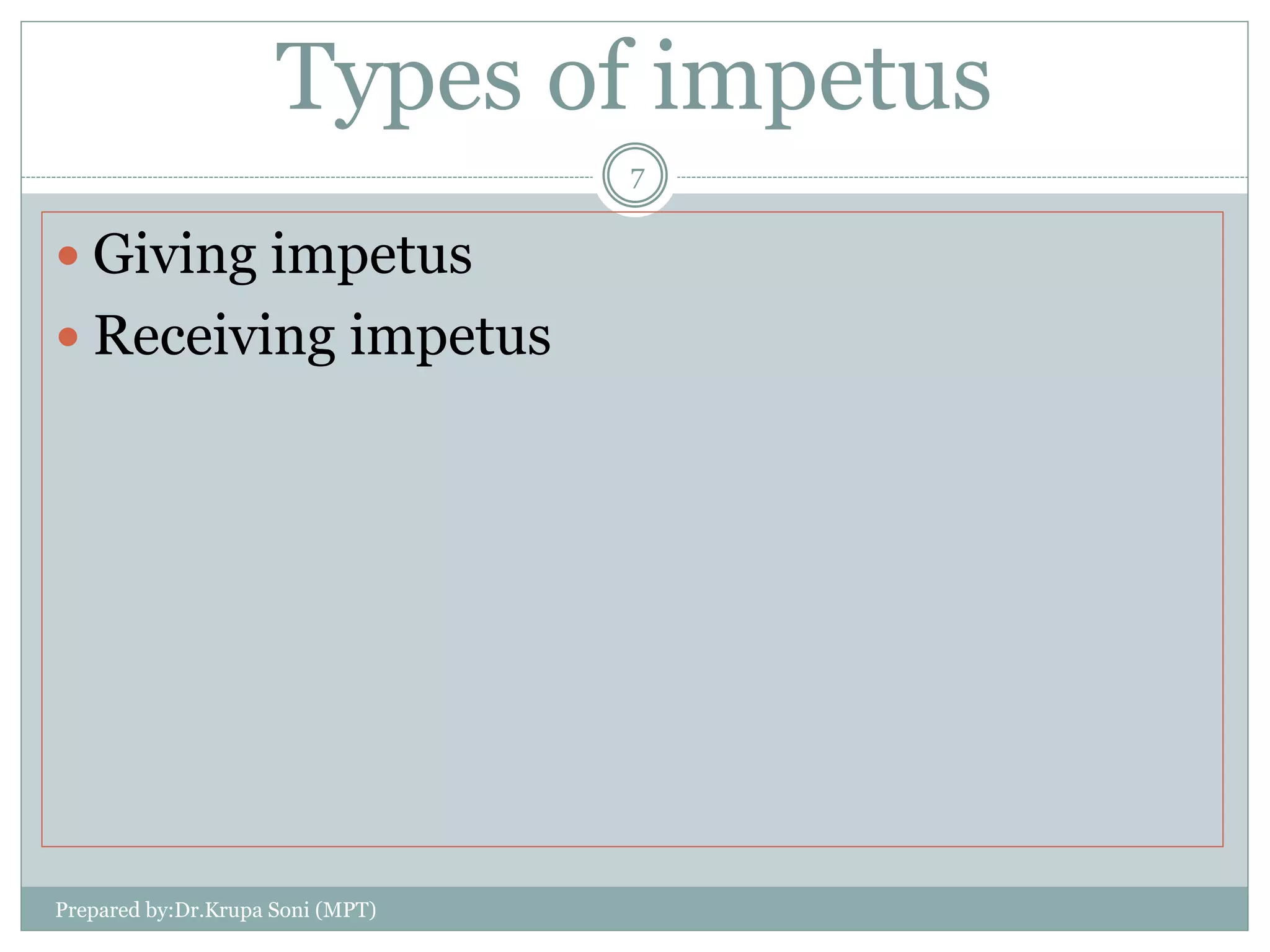
 Baseball pitcher throws a baseball, a man pushes a
lawn mover over the lawn, a school teacher opens the
window, each involves the giving of impetus to an
external object either directly by some part of body
or by means of an implement held in the hands.
Prepared by:Dr.Krupa Soni (MPT)
3
Prepared by:Dr.Krupa Soni (MPT)
4
 There are almost endless variety of ways in which
individual my give impetus to an external object.
 E.g.- When the body lands on a supporting surface,
impact has been said to occur.
 The impact is felt as the force of contact. Likewise,
impact is experienced in a horizontally moving body
when the motion is stopped as a result of contact with a
resisting surface, such as a wall or another obstacle.
Prepared by:Dr.Krupa Soni (MPT)
5
 Examples of receiving impact from external objects are
commonly seen in sports.
 E.g - Soccer balls are trapped with the feet, and blows
from an opponent's fist are received by various parts of
the body.
 Examples of receiving impact are also seen in industry
and in daily life. Cartons and tools are tossed from one
person to another, victims from a fire are caught in nets
or air bags.
Prepared by:Dr.Krupa Soni (MPT)
6
Types of impetus
 Giving impetus
 Receiving impetus
Prepared by:Dr.Krupa Soni (MPT)
7
GIVING IMPECTUS TO EXTERNAL OBJECTS
 Classification of movements for giving impetus
 Baseball player throwing ball
 Opening a window
 Lifting suitcase and placing overhead rake
 Service of tennis ball
Prepared by:Dr.Krupa Soni (MPT)
8
Prepared by:Dr.Krupa Soni (MPT) 9
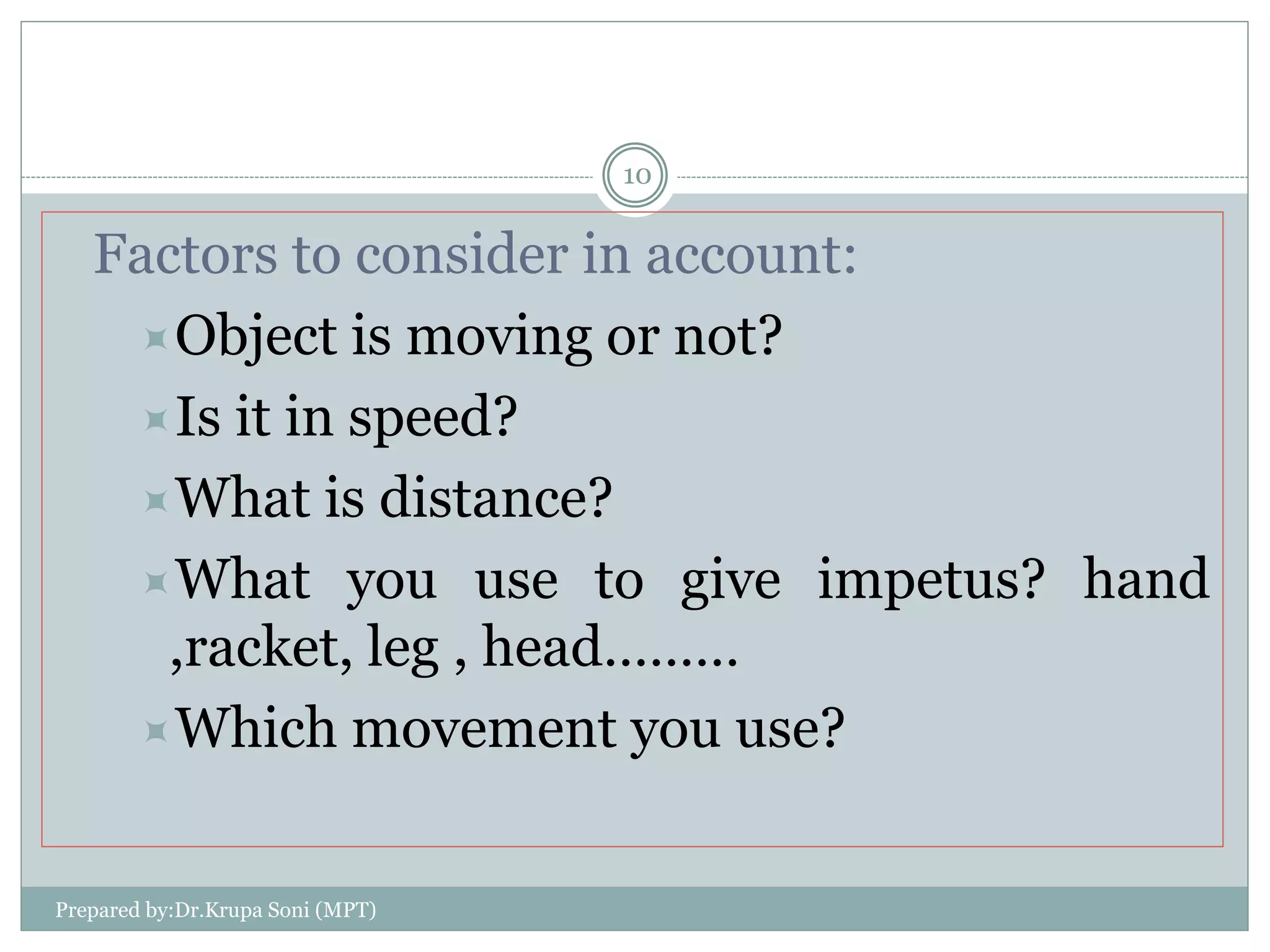
Factors to consider in account:
Object is moving or not?
Is it in speed?
What is distance?
What you use to give impetus? hand
,racket, leg , head………
Which movement you use?
Prepared by:Dr.Krupa Soni (MPT)
10
CATEGORIES
1)Throwing with hand or implement
2)Striking, kicking, hitting
3)Pushing, pulling ,lifting
Prepared by:Dr.Krupa Soni (MPT)
11
Throwing with hand
 It is characterized by the development of kinetic
energy in movable object usually held in hands,
followed by release of the object at the moment of
max velocity.
Prepared by:Dr.Krupa Soni (MPT)
12
Striking, hitting, kicking
 It is characterized by a momentary contact made
with an object by a moving part of body or by an
implement held or attached to moving segment of
body.
 The object may be stationary or moving.
 E.g striking with racket(tennis)
Prepared by:Dr.Krupa Soni (MPT)
13
Prepared by:Dr.Krupa Soni (MPT) 14
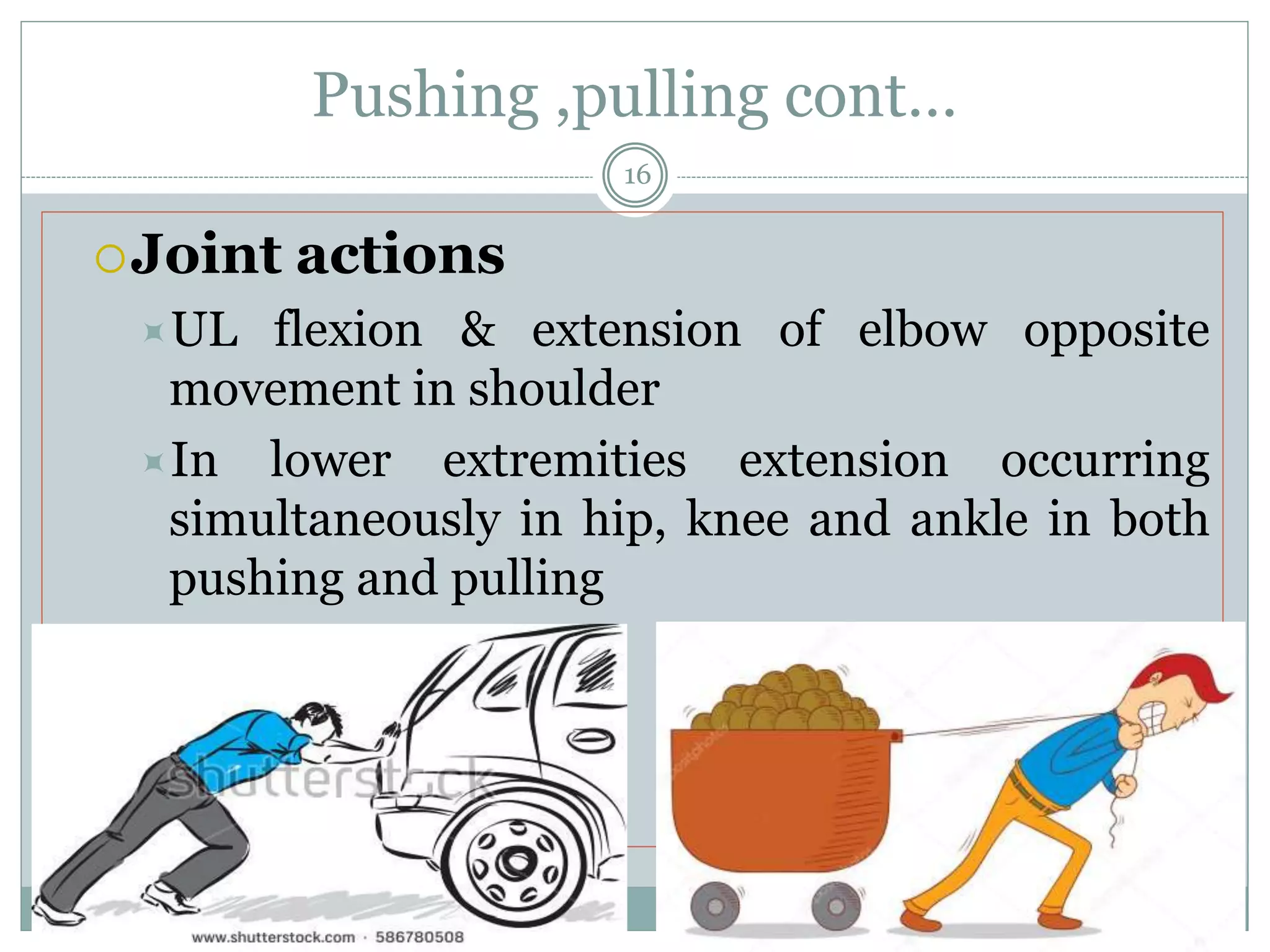
Pushing ,pulling
 The movement are Characterized by
 Continuous application of force
 Usually by hand or hands
 Legs may also included.
 A push, pull or lift may be applied either
directly or indirectly to the object.
Prepared by:Dr.Krupa Soni (MPT)
15
Pushing ,pulling cont…
Joint actions
UL flexion & extension of elbow opposite
movement in shoulder
In lower extremities extension occurring
simultaneously in hip, knee and ankle in both
pushing and pulling
Prepared by:Dr.Krupa Soni (MPT)
16
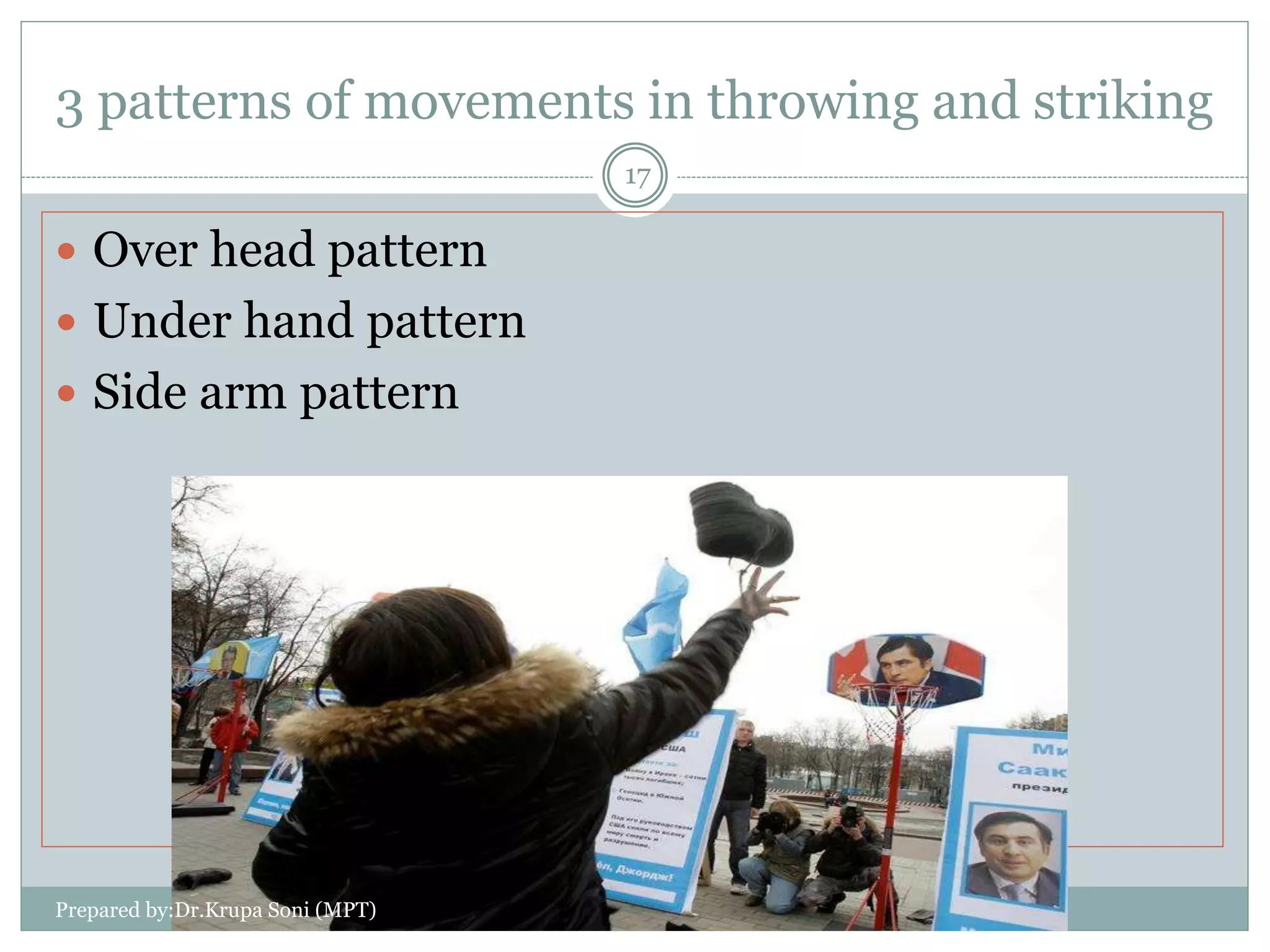
3 patterns of movements in throwing and striking
 Over head pattern
 Under hand pattern
 Side arm pattern
Prepared by:Dr.Krupa Soni (MPT)
17
Prepared by:Dr.Krupa Soni (MPT) 18
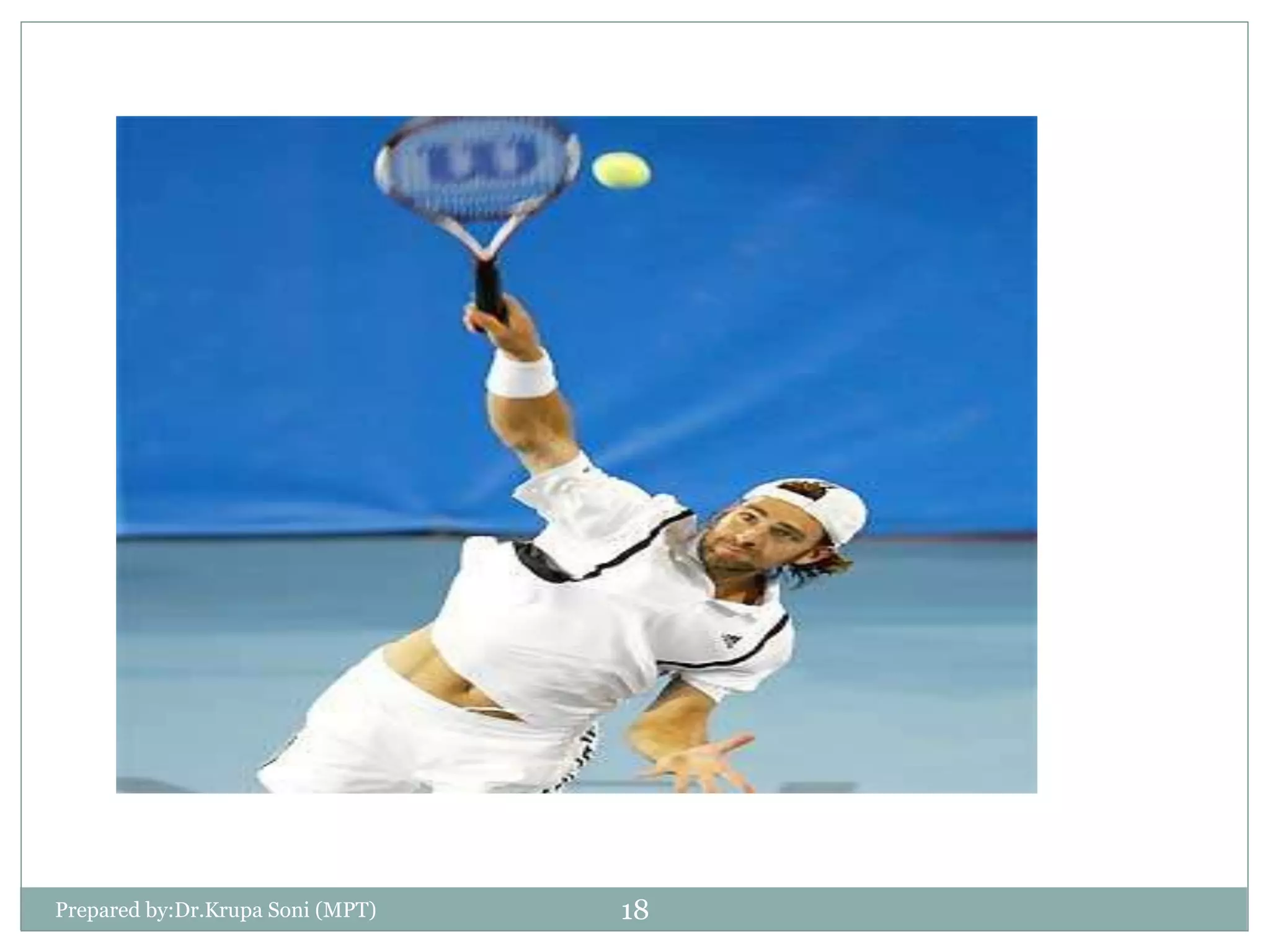
Overhead pattern
Prepared by:Dr.Krupa Soni (MPT)
19
 The kind of throw or
strike is characterized
by
 Rotation of shoulder
 In preparatory phase
abducted arm rotates
laterally
 In force phase arm rotate
medially
 Elbow extension, wrist
flexion and spinal rotation
 Rotation of pelvis and hip
of opposite limb
 Medial rotation of thigh
Underhand pattern
Prepared by:Dr.Krupa Soni (MPT)
20
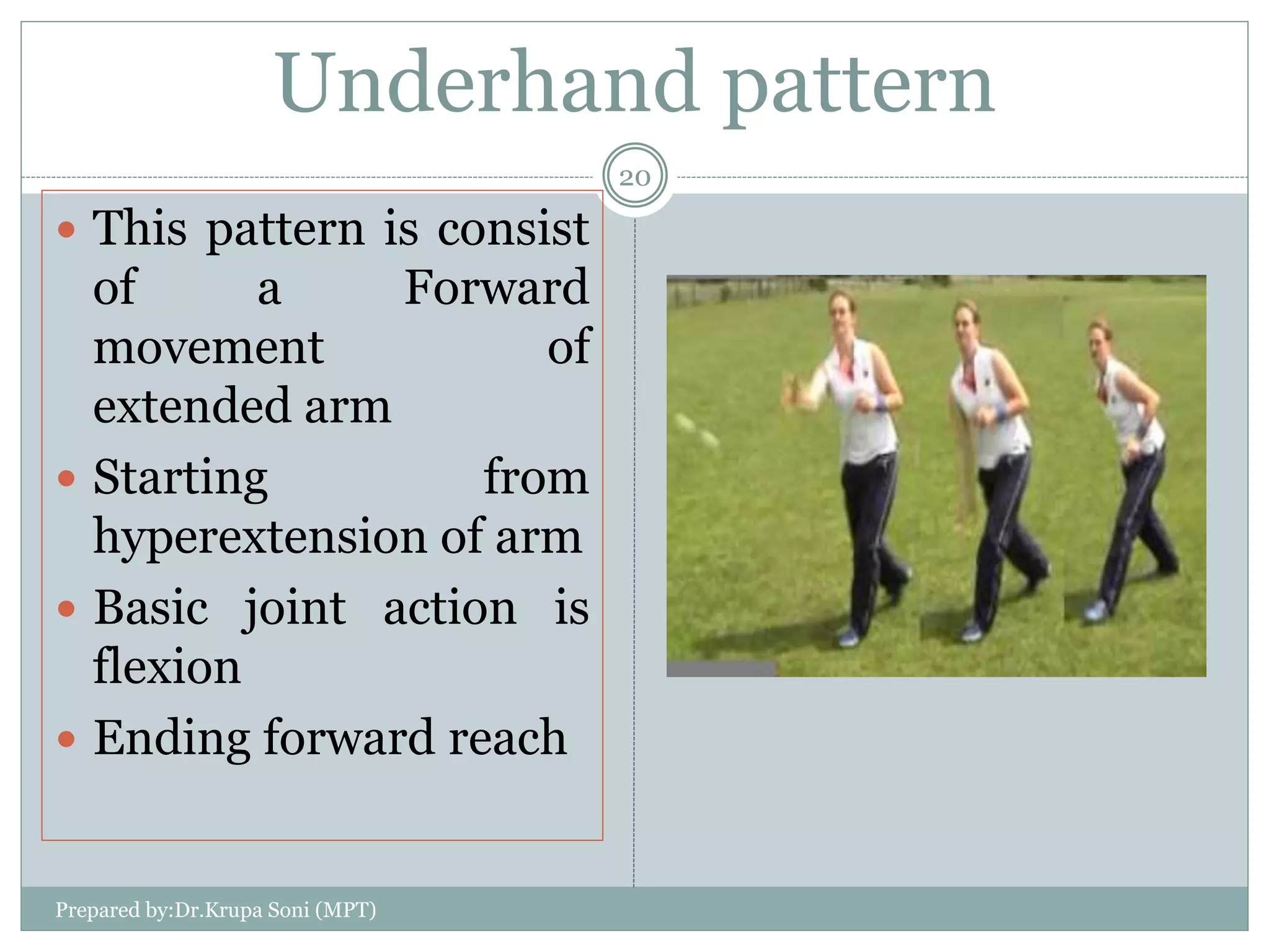
 This pattern is consist
of a Forward
movement of
extended arm
 Starting from
hyperextension of arm
 Basic joint action is
flexion
 Ending forward reach
Side arm pattern
Prepared by:Dr.Krupa Soni (MPT)
21
 In this pattern , the
basic movement of
upper extremity,
 Stating moderate
abduction
 Horizontal flexion with
elevation to shoulder
level
 Elbow in extension or
from slight flexion
 Force is provided by the
upper extremity
Upper extremity and trunk patterns for giving
impetus to external objects in sport activities
Prepared by:Dr.Krupa Soni (MPT)
22
 Throwing and striking
activities
 Overhead pattern
 Badminton
 Football pass
 Tennis
 Volleyball overhead serve
Prepared by:Dr.Krupa Soni (MPT)
23
 Underhand pattern
 Badminton
 Bowling
 Volleyball
 POLO
Prepared by:Dr.Krupa Soni (MPT)
24
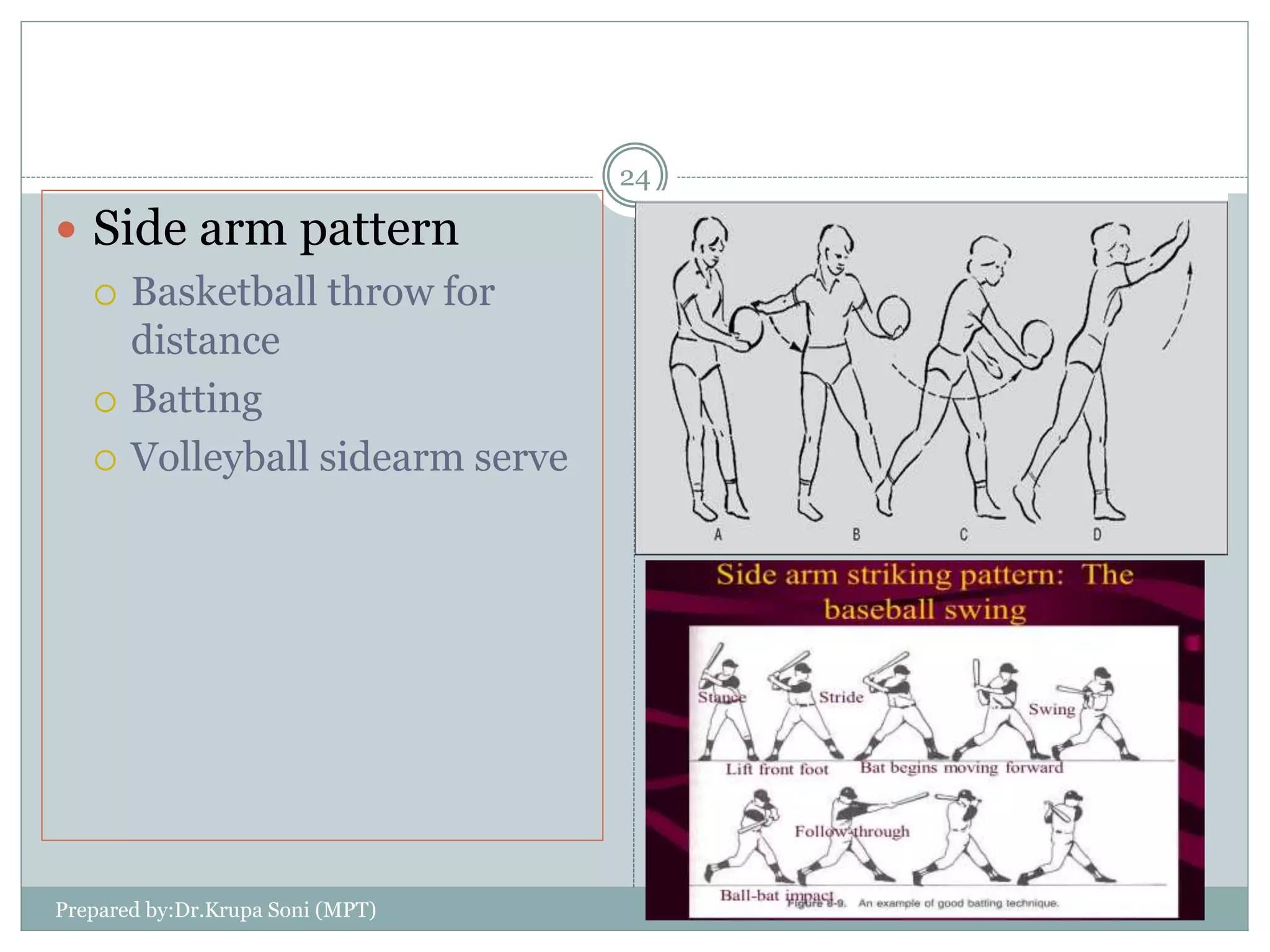
 Side arm pattern
 Basketball throw for
distance
 Batting
 Volleyball sidearm serve
Prepared by:Dr.Krupa Soni (MPT)
25
 Modified sidearm
pattern
 Golf
 Hockey
Prepared by:Dr.Krupa Soni (MPT)
26
 Pushing , pulling or
lifting activities
 Archery
 Weight lifting
 Rowing
Prepared by:Dr.Krupa Soni (MPT)
27
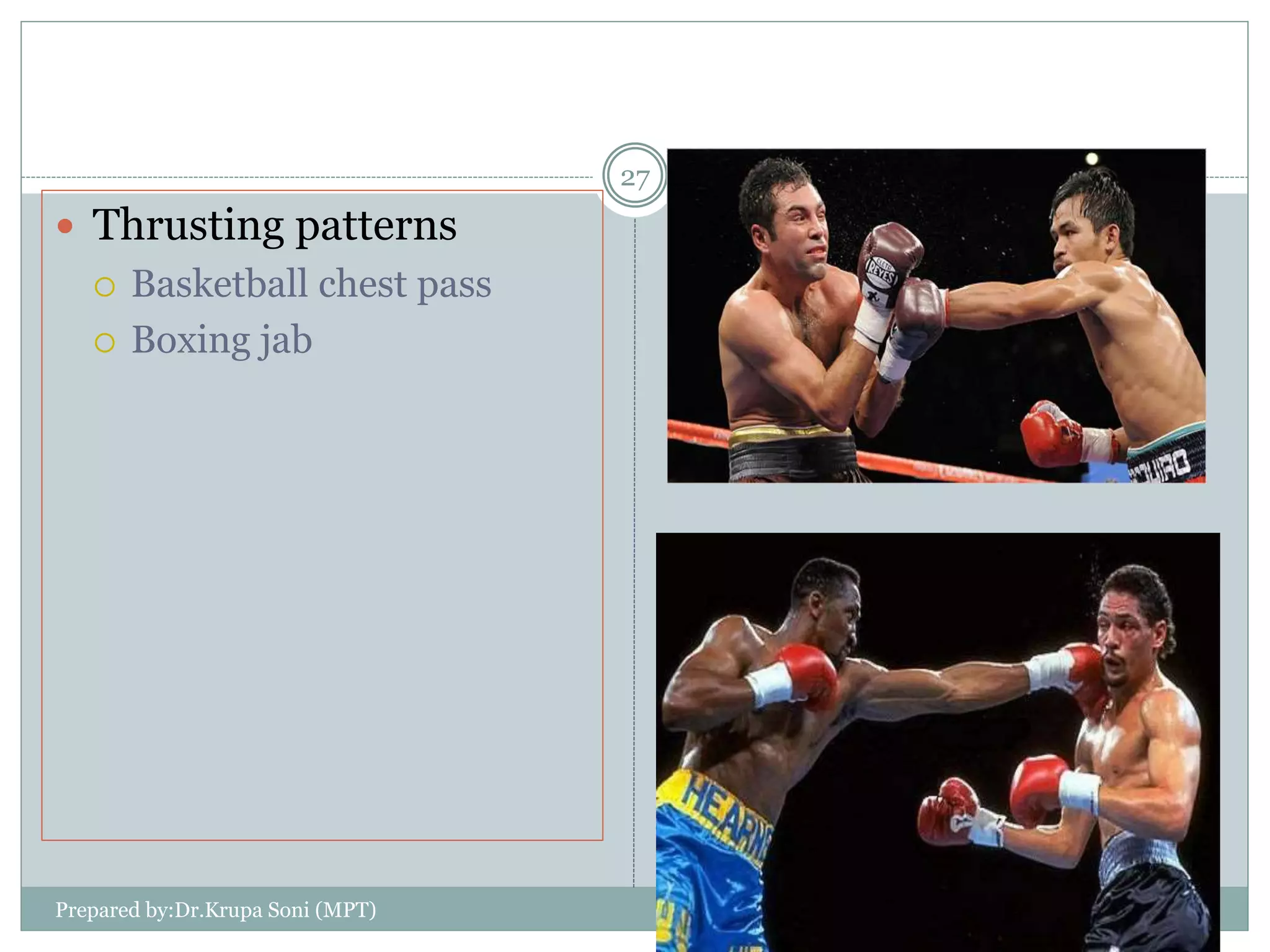
 Thrusting patterns
 Basketball chest pass
 Boxing jab
Giving impetus by parts of body other than upper
extremities
 In majority impetus is given by hands
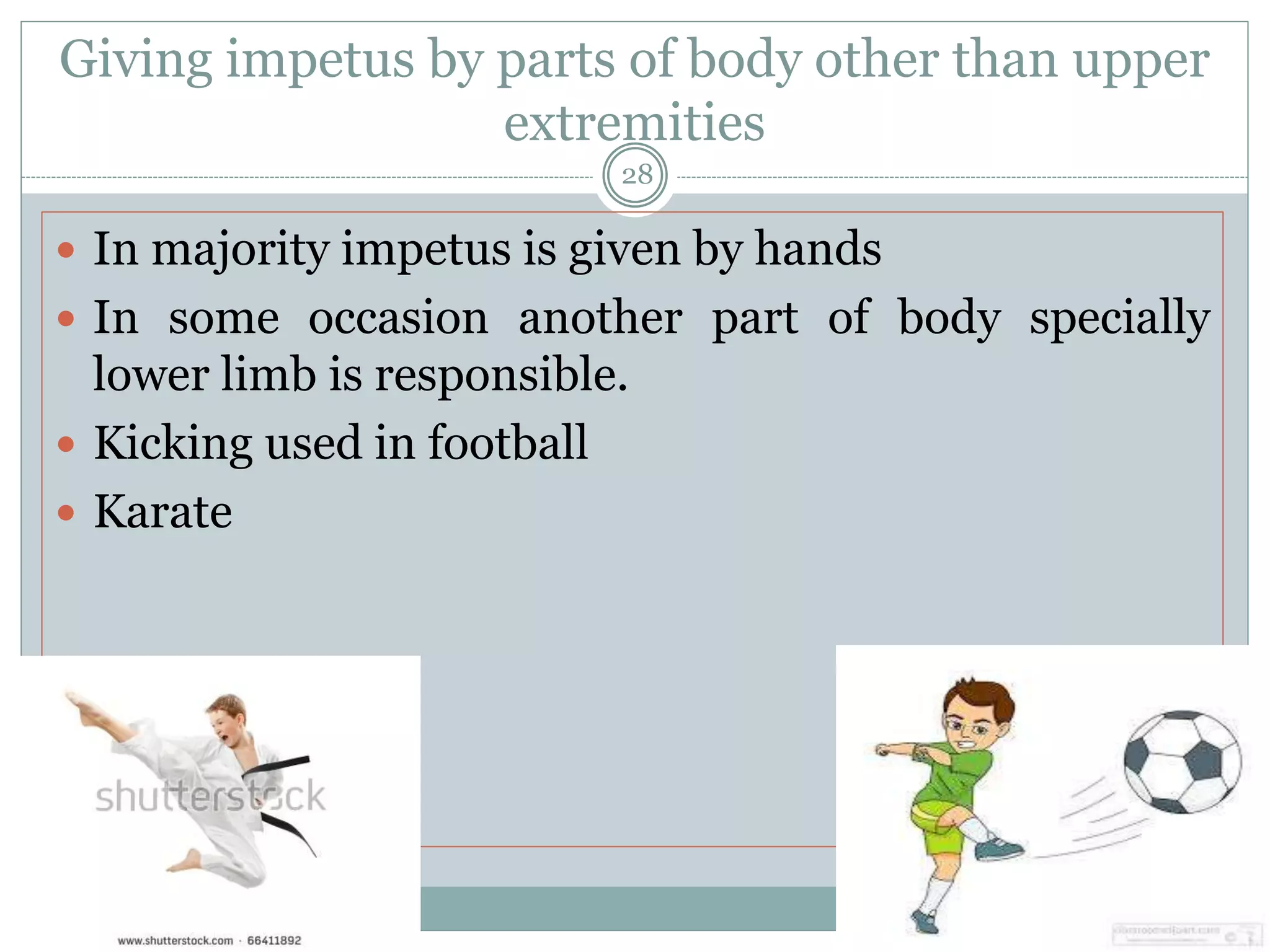
 In some occasion another part of body specially
lower limb is responsible.
 Kicking used in football
 Karate
Prepared by:Dr.Krupa Soni (MPT)
28
 Force or effort describes in terms of
1. Magnitude
2. Its direction and
3. Point of application
Prepared by:Dr.Krupa Soni (MPT)
29
Prepared by:Dr.Krupa Soni (MPT)
30
Principles and applications
of giving impetus
Relating to magnitude of force
Principle-I
 The object will move only if the force is of
sufficient magnitude to overcome object’s inertia
Prepared by:Dr.Krupa Soni (MPT)
31
Relating to the direction of force
Principle-II
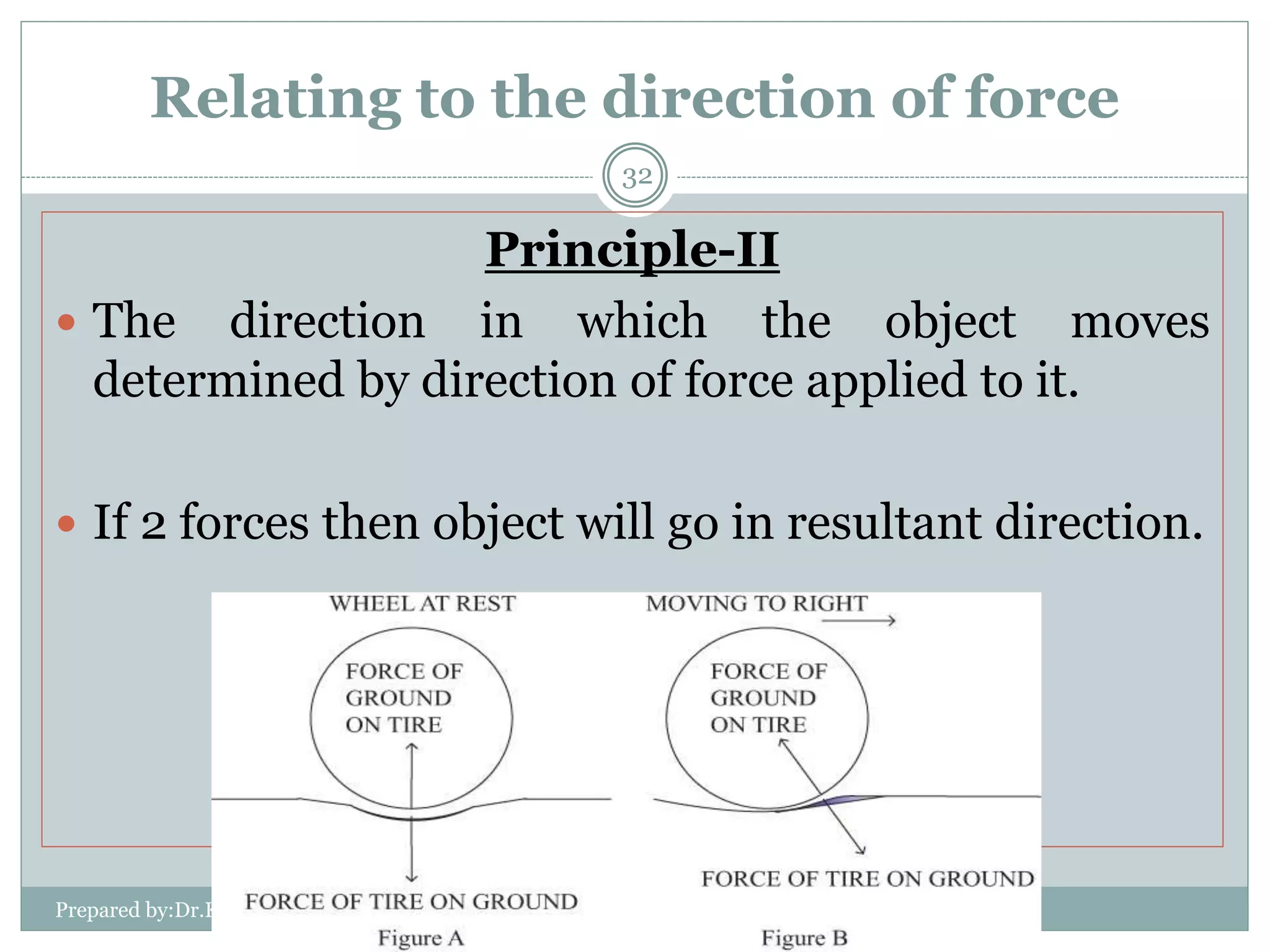
 The direction in which the object moves
determined by direction of force applied to it.
 If 2 forces then object will go in resultant direction.
Prepared by:Dr.Krupa Soni (MPT)
32
Principle-III
 If an object is free to move only along a
predetermined pathway any component serves to
increase friction.
Prepared by:Dr.Krupa Soni (MPT)
33
Relating to the point at which the force is
applied
Principle-IV
 Force applied in line with an object’s centre of
gravity will result in linear motion of object.
Prepared by:Dr.Krupa Soni (MPT)
34
Principle-V
 If a freely movable object is not in line with if the
force applied it will result in rotatory motion
Prepared by:Dr.Krupa Soni (MPT)
35
Principle-VI
 If free motion of an object is interrupted by
friction or by presence of an obstacle, rotatory
motion may result.
Prepared by:Dr.Krupa Soni (MPT)
36
Relating to the interaction b/w the body
and supporting surface
Principle-VII
 Force exerted by body will be transferred to an
external object in proportion to effectiveness of
counterforce of feet(or other parts of body) or
other surface
 This effectiveness depend upon counter pressure
and the friction presented by supporting surface
Prepared by:Dr.Krupa Soni (MPT)
37
Relating to speed ,distance and direction
of ball
Principle-VIII
 The greater the velocity of approaching ball ,the
greater the velocity of ball in opposite direction
after struck.
Prepared by:Dr.Krupa Soni (MPT)
38
Principle-IX
 The greater the velocity of striking implement at
moment of contact, greater the velocity of struck
ball.
Prepared by:Dr.Krupa Soni (MPT)
39
Principle-X
 The greater the mass of ball , the greater its velocity
after being struck.
 A hard base ball will travel faster than soft ball.
Prepared by:Dr.Krupa Soni (MPT)
40
Principle-XI
 The grater the mass of striking implement ,the
greater the striking force and greater the speed of
struck ball.
 Baseball the player select heavy bat
Prepared by:Dr.Krupa Soni (MPT)
41
Principle-XII
 The higher the coefficient of elasticity of ball and
striking implement ,the greater the speed of struck
ball.
Prepared by:Dr.Krupa Soni (MPT)
42
Principle-XIII
 The greater the speed of departure ,the greater the
distance of its flight.
Prepared by:Dr.Krupa Soni (MPT)
43
Principle-XIV
 The direction taken by struck ball is decided by
1. The direction of striking implement at moment of
contact
2. Relation of striking force to COG
3. Degree of firmness of grip and wrist at moment of
impact
4. Law of rebound
Prepared by:Dr.Krupa Soni (MPT)
44
Applications
Prepared by:Dr.Krupa Soni (MPT)
45
Throwing:
 The efficiency of imparting force to a ball is judged in
terms of speed, distance & direction of the ball after
release.
 If the distance is a major objective of the throw, the
angle of projection & the effect of gravitational force
must be taken into consideration.
Prepared by:Dr.Krupa Soni (MPT)
46
Striking, Hitting, Kicking
 As in case of throwing , the effectiveness of Striking, Hitting,
Kicking is judged in terms of the speed , distance & direction
of the struck ball.
 There are six major factors which apply to the speed of the
struck ball:
1. The speed of the oncoming ball
2. The mass of the ball
3. The speed of striking implement at the moment of contact
4. The mass of the striking implement
5. The coefficient of restitution (elasticity) of the ball
6. The coefficient of restitution (elasticity) of the striking
implement
Prepared by:Dr.Krupa Soni (MPT)
47
Pushing , Pulling & lifting
 There are relatively few sports that involve the
pushing or pulling of external objects.
 Weight lifting is the prime example of a sports
activities involve lifting.
 Archery is the example of pulling with one hand
while pushing with other hand.
Receiving Impetus
Prepared by:Dr.Krupa Soni (MPT)
48
 Impetus from vertical motion is experienced by
anyone who falls through space.
 When the body lands on a supporting surface, its
impetus is said to have been received.
 Likewise ,the impetus of a horizontally moving body
is received when its motion have been stopped as the
result of contact with a resisting surface , such as a
wall or other obstacle.
Prepared by:Dr.Krupa Soni (MPT)
49
 Examples of receiving the impetus of external
objects are commonly seen in sports.
 E.g- Victims from a fire are caught in net.
Prepared by:Dr.Krupa Soni (MPT)
50
Principles of receiving impetus
Principles related to avoiding injury
Prepared by:Dr.Krupa Soni (MPT)
51
Principle-I
 The more gradually the kinetic energy of a moving
body is lost , the less likely is the loss to cause injury.
Prepared by:Dr.Krupa Soni (MPT)
52
Principle-II
 The larger the area of the body which receives the
force of impact, the less will be the force per unit of
surface are.
Principles related to maintaining & regaining
Equilibrium
Prepared by:Dr.Krupa Soni (MPT)
53
Principle-III
 Other thing being equal ,the larger the base of
support & the better centered the center of gravity
above this base, the greater will be the body’s
equilibrium.
Principles related to accuracy & control in
receiving external objects
Prepared by:Dr.Krupa Soni (MPT)
54
Principle-IV
• The more gradually the velocity of an external
object is reduced ,the less likely to rebound when
its impetus is received.
Prepared by:Dr.Krupa Soni (MPT)
55
Principle-V
 “Keep the eye on the ball” whether the object
whose impetus is about to received is a ball ,a
carton or a fist , keeping the eye on it will enable
one to judge its speed & direction and to respond
accordingly.
Prepared by:Dr.Krupa Soni (MPT)
56
Principle-VI
 Catching an external object with accuracy &
control is depend largely upon the position of the
catcher relative to the direction of the approaching
object.
Classification of activities for receiving impetus
Prepared by:Dr.Krupa Soni (MPT)
57
 Another Human body
 Boxing
 Wrestling
 Of own body, landing from a jump or fall
 Baseball
 Tramoplining
 Football
 Of ball or similar object
 Baseball
 basketball
Reference
Prepared by:Dr.Krupa Soni (MPT)
58
1. Katherine Fuller Wells “Kinesiology: Scientific Basis
of Human Motion”
Prepared by:Dr.Krupa Soni (MPT)
59
THANK YOU

Impetus

  • 1.
    PREPARED BY: DR.KRUPASONI (MPT) A S S I S T A N T P R O F E S S O R N O O T A N C O L L E G E O F P H Y S I O T H E R A P Y S A N K A L C H A N D P A T E L U N I V E R S I T Y Prepared by: Dr.Krupa Soni (MPT) 1 IMPETUS
  • 2.
    Introduction  The wordimpact is derived from the Latin word impingere, “to press together.”  Impact is further defined as force of contact, violent collision, striking together.  Impetus (mechanics), a concept very similar to momentum.  The product of the mass and velocity of an object.  p =mv Prepared by:Dr.Krupa Soni (MPT) 2
  • 3.
     Impact maybe from one's own body, as in landing from a jump or fall, or imparted by external objects, as in catching.  Baseball pitcher throws a baseball, a man pushes a lawn mover over the lawn, a school teacher opens the window, each involves the giving of impetus to an external object either directly by some part of body or by means of an implement held in the hands. Prepared by:Dr.Krupa Soni (MPT) 3
  • 4.
  • 5.
     There arealmost endless variety of ways in which individual my give impetus to an external object.  E.g.- When the body lands on a supporting surface, impact has been said to occur.  The impact is felt as the force of contact. Likewise, impact is experienced in a horizontally moving body when the motion is stopped as a result of contact with a resisting surface, such as a wall or another obstacle. Prepared by:Dr.Krupa Soni (MPT) 5
  • 6.
     Examples ofreceiving impact from external objects are commonly seen in sports.  E.g - Soccer balls are trapped with the feet, and blows from an opponent's fist are received by various parts of the body.  Examples of receiving impact are also seen in industry and in daily life. Cartons and tools are tossed from one person to another, victims from a fire are caught in nets or air bags. Prepared by:Dr.Krupa Soni (MPT) 6
  • 7.
    Types of impetus Giving impetus  Receiving impetus Prepared by:Dr.Krupa Soni (MPT) 7
  • 8.
    GIVING IMPECTUS TOEXTERNAL OBJECTS  Classification of movements for giving impetus  Baseball player throwing ball  Opening a window  Lifting suitcase and placing overhead rake  Service of tennis ball Prepared by:Dr.Krupa Soni (MPT) 8
  • 9.
  • 10.
    Factors to considerin account: Object is moving or not? Is it in speed? What is distance? What you use to give impetus? hand ,racket, leg , head……… Which movement you use? Prepared by:Dr.Krupa Soni (MPT) 10
  • 11.
    CATEGORIES 1)Throwing with handor implement 2)Striking, kicking, hitting 3)Pushing, pulling ,lifting Prepared by:Dr.Krupa Soni (MPT) 11
  • 12.
    Throwing with hand It is characterized by the development of kinetic energy in movable object usually held in hands, followed by release of the object at the moment of max velocity. Prepared by:Dr.Krupa Soni (MPT) 12
  • 13.
    Striking, hitting, kicking It is characterized by a momentary contact made with an object by a moving part of body or by an implement held or attached to moving segment of body.  The object may be stationary or moving.  E.g striking with racket(tennis) Prepared by:Dr.Krupa Soni (MPT) 13
  • 14.
  • 15.
    Pushing ,pulling  Themovement are Characterized by  Continuous application of force  Usually by hand or hands  Legs may also included.  A push, pull or lift may be applied either directly or indirectly to the object. Prepared by:Dr.Krupa Soni (MPT) 15
  • 16.
    Pushing ,pulling cont… Jointactions UL flexion & extension of elbow opposite movement in shoulder In lower extremities extension occurring simultaneously in hip, knee and ankle in both pushing and pulling Prepared by:Dr.Krupa Soni (MPT) 16
  • 17.
    3 patterns ofmovements in throwing and striking  Over head pattern  Under hand pattern  Side arm pattern Prepared by:Dr.Krupa Soni (MPT) 17
  • 18.
  • 19.
    Overhead pattern Prepared by:Dr.KrupaSoni (MPT) 19  The kind of throw or strike is characterized by  Rotation of shoulder  In preparatory phase abducted arm rotates laterally  In force phase arm rotate medially  Elbow extension, wrist flexion and spinal rotation  Rotation of pelvis and hip of opposite limb  Medial rotation of thigh
  • 20.
    Underhand pattern Prepared by:Dr.KrupaSoni (MPT) 20  This pattern is consist of a Forward movement of extended arm  Starting from hyperextension of arm  Basic joint action is flexion  Ending forward reach
  • 21.
    Side arm pattern Preparedby:Dr.Krupa Soni (MPT) 21  In this pattern , the basic movement of upper extremity,  Stating moderate abduction  Horizontal flexion with elevation to shoulder level  Elbow in extension or from slight flexion  Force is provided by the upper extremity
  • 22.
    Upper extremity andtrunk patterns for giving impetus to external objects in sport activities Prepared by:Dr.Krupa Soni (MPT) 22  Throwing and striking activities  Overhead pattern  Badminton  Football pass  Tennis  Volleyball overhead serve
  • 23.
    Prepared by:Dr.Krupa Soni(MPT) 23  Underhand pattern  Badminton  Bowling  Volleyball  POLO
  • 24.
    Prepared by:Dr.Krupa Soni(MPT) 24  Side arm pattern  Basketball throw for distance  Batting  Volleyball sidearm serve
  • 25.
    Prepared by:Dr.Krupa Soni(MPT) 25  Modified sidearm pattern  Golf  Hockey
  • 26.
    Prepared by:Dr.Krupa Soni(MPT) 26  Pushing , pulling or lifting activities  Archery  Weight lifting  Rowing
  • 27.
    Prepared by:Dr.Krupa Soni(MPT) 27  Thrusting patterns  Basketball chest pass  Boxing jab
  • 28.
    Giving impetus byparts of body other than upper extremities  In majority impetus is given by hands  In some occasion another part of body specially lower limb is responsible.  Kicking used in football  Karate Prepared by:Dr.Krupa Soni (MPT) 28
  • 29.
     Force oreffort describes in terms of 1. Magnitude 2. Its direction and 3. Point of application Prepared by:Dr.Krupa Soni (MPT) 29
  • 30.
    Prepared by:Dr.Krupa Soni(MPT) 30 Principles and applications of giving impetus
  • 31.
    Relating to magnitudeof force Principle-I  The object will move only if the force is of sufficient magnitude to overcome object’s inertia Prepared by:Dr.Krupa Soni (MPT) 31
  • 32.
    Relating to thedirection of force Principle-II  The direction in which the object moves determined by direction of force applied to it.  If 2 forces then object will go in resultant direction. Prepared by:Dr.Krupa Soni (MPT) 32
  • 33.
    Principle-III  If anobject is free to move only along a predetermined pathway any component serves to increase friction. Prepared by:Dr.Krupa Soni (MPT) 33
  • 34.
    Relating to thepoint at which the force is applied Principle-IV  Force applied in line with an object’s centre of gravity will result in linear motion of object. Prepared by:Dr.Krupa Soni (MPT) 34
  • 35.
    Principle-V  If afreely movable object is not in line with if the force applied it will result in rotatory motion Prepared by:Dr.Krupa Soni (MPT) 35
  • 36.
    Principle-VI  If freemotion of an object is interrupted by friction or by presence of an obstacle, rotatory motion may result. Prepared by:Dr.Krupa Soni (MPT) 36
  • 37.
    Relating to theinteraction b/w the body and supporting surface Principle-VII  Force exerted by body will be transferred to an external object in proportion to effectiveness of counterforce of feet(or other parts of body) or other surface  This effectiveness depend upon counter pressure and the friction presented by supporting surface Prepared by:Dr.Krupa Soni (MPT) 37
  • 38.
    Relating to speed,distance and direction of ball Principle-VIII  The greater the velocity of approaching ball ,the greater the velocity of ball in opposite direction after struck. Prepared by:Dr.Krupa Soni (MPT) 38
  • 39.
    Principle-IX  The greaterthe velocity of striking implement at moment of contact, greater the velocity of struck ball. Prepared by:Dr.Krupa Soni (MPT) 39
  • 40.
    Principle-X  The greaterthe mass of ball , the greater its velocity after being struck.  A hard base ball will travel faster than soft ball. Prepared by:Dr.Krupa Soni (MPT) 40
  • 41.
    Principle-XI  The graterthe mass of striking implement ,the greater the striking force and greater the speed of struck ball.  Baseball the player select heavy bat Prepared by:Dr.Krupa Soni (MPT) 41
  • 42.
    Principle-XII  The higherthe coefficient of elasticity of ball and striking implement ,the greater the speed of struck ball. Prepared by:Dr.Krupa Soni (MPT) 42
  • 43.
    Principle-XIII  The greaterthe speed of departure ,the greater the distance of its flight. Prepared by:Dr.Krupa Soni (MPT) 43
  • 44.
    Principle-XIV  The directiontaken by struck ball is decided by 1. The direction of striking implement at moment of contact 2. Relation of striking force to COG 3. Degree of firmness of grip and wrist at moment of impact 4. Law of rebound Prepared by:Dr.Krupa Soni (MPT) 44
  • 45.
    Applications Prepared by:Dr.Krupa Soni(MPT) 45 Throwing:  The efficiency of imparting force to a ball is judged in terms of speed, distance & direction of the ball after release.  If the distance is a major objective of the throw, the angle of projection & the effect of gravitational force must be taken into consideration.
  • 46.
    Prepared by:Dr.Krupa Soni(MPT) 46 Striking, Hitting, Kicking  As in case of throwing , the effectiveness of Striking, Hitting, Kicking is judged in terms of the speed , distance & direction of the struck ball.  There are six major factors which apply to the speed of the struck ball: 1. The speed of the oncoming ball 2. The mass of the ball 3. The speed of striking implement at the moment of contact 4. The mass of the striking implement 5. The coefficient of restitution (elasticity) of the ball 6. The coefficient of restitution (elasticity) of the striking implement
  • 47.
    Prepared by:Dr.Krupa Soni(MPT) 47 Pushing , Pulling & lifting  There are relatively few sports that involve the pushing or pulling of external objects.  Weight lifting is the prime example of a sports activities involve lifting.  Archery is the example of pulling with one hand while pushing with other hand.
  • 48.
    Receiving Impetus Prepared by:Dr.KrupaSoni (MPT) 48  Impetus from vertical motion is experienced by anyone who falls through space.  When the body lands on a supporting surface, its impetus is said to have been received.  Likewise ,the impetus of a horizontally moving body is received when its motion have been stopped as the result of contact with a resisting surface , such as a wall or other obstacle.
  • 49.
    Prepared by:Dr.Krupa Soni(MPT) 49  Examples of receiving the impetus of external objects are commonly seen in sports.  E.g- Victims from a fire are caught in net.
  • 50.
    Prepared by:Dr.Krupa Soni(MPT) 50 Principles of receiving impetus
  • 51.
    Principles related toavoiding injury Prepared by:Dr.Krupa Soni (MPT) 51 Principle-I  The more gradually the kinetic energy of a moving body is lost , the less likely is the loss to cause injury.
  • 52.
    Prepared by:Dr.Krupa Soni(MPT) 52 Principle-II  The larger the area of the body which receives the force of impact, the less will be the force per unit of surface are.
  • 53.
    Principles related tomaintaining & regaining Equilibrium Prepared by:Dr.Krupa Soni (MPT) 53 Principle-III  Other thing being equal ,the larger the base of support & the better centered the center of gravity above this base, the greater will be the body’s equilibrium.
  • 54.
    Principles related toaccuracy & control in receiving external objects Prepared by:Dr.Krupa Soni (MPT) 54 Principle-IV • The more gradually the velocity of an external object is reduced ,the less likely to rebound when its impetus is received.
  • 55.
    Prepared by:Dr.Krupa Soni(MPT) 55 Principle-V  “Keep the eye on the ball” whether the object whose impetus is about to received is a ball ,a carton or a fist , keeping the eye on it will enable one to judge its speed & direction and to respond accordingly.
  • 56.
    Prepared by:Dr.Krupa Soni(MPT) 56 Principle-VI  Catching an external object with accuracy & control is depend largely upon the position of the catcher relative to the direction of the approaching object.
  • 57.
    Classification of activitiesfor receiving impetus Prepared by:Dr.Krupa Soni (MPT) 57  Another Human body  Boxing  Wrestling  Of own body, landing from a jump or fall  Baseball  Tramoplining  Football  Of ball or similar object  Baseball  basketball
  • 58.
    Reference Prepared by:Dr.Krupa Soni(MPT) 58 1. Katherine Fuller Wells “Kinesiology: Scientific Basis of Human Motion”
  • 59.
    Prepared by:Dr.Krupa Soni(MPT) 59 THANK YOU