CLINICAL RADIATION GENERATORS
1
KILOVOLTAGE UNITS
• Up to about 1950
• X-rays generated at voltages up to 300 kVps
• Still some use in the present era, esp. treatment of
superficial skin lesions
• Kilovoltage Therapy
– Grenz-Ray Therapy
– Contact Therapy
– Superficial Therapy
– Orthovoltage Therapy or Deep Therapy
– Supervoltage Therapy
2
3
GRENZ-RAY THERAPY
– Energy : < 20 kV
– Very low depth of penetration
– No longer used in RT
4
CONTACT THERAPY
– Energy: 40 – 50 kV
– Short SSD (< 2 cm)
– Produces a very rapidly decreasing depth dose
– Max irradiated tissue : skin surface
– Application: Tumor not deeper than 1 – 2 mm
– Endocavitary x ray machines have been used in the
treatment of superficial rectal cancers.
5
SUPERFICIAL THERAPY
– Energy: 50 – 150 kV
– HVLs: 1.0 – 8.0 mm Al
– Applicator or cone attached to the diaphragm
– SSD: 15 – 20 cm
– Tube current: 5 – 8 mA
– Application: tumors confined to about 5-mm depth
6
ORTHOVOLTAGE THERAPY
OR DEEP THERAPY
– Energy: 150 – 500 kV
– Tube current: 10 – 20 mA
– Cones or movable diaphragm (continuous
adjustable field size)
7
– SSD: 50 cm
– Application: tumor located < 2 –3 cm in depth
– Limitation of the treatment:
• skin dose
• Depth dose distribution
• Increase absorbed dose in bone
• Increase scattering
8
9
SUPERVOLTAGE THERAPY
– Energy: 500 – 1000 kV
– Technical problem
• Insulating the high-voltage transformer.
• Conventional transformer systems were not
suitable for producing potential > 300 kVp
– The problem solved by invention of resonant
transformer
10
– Used to generate x-rays from 300 to 2000 kV
11
At resonant frequency
1. Oscillating potential attains very high amplitude
2. Peak voltage across the x-ray tube becomes very large
RESONANT TRANSFORMER
UNITS
MEGAVOLTAGE THERAPY
• X-ray beams of energy > 1 MV
• Accelerators or γray(>1 Mev) produced by radionuclides
• Examples of clinical megavoltage machines
– Van de Graaff generator
– Linear accelerator
– Betatron
– Microtron
– Teletherapy γray units (e.g. cobalt-60)
12
VAN DE GRAAFF
GENERATOR
• Electrostatic accelerator-
accelerate charged particles
• Energy of x-rays: 2 MV (typical), up
to 10 MV
• Limitation:
– size
– high-voltage insulation
• No longer produced commercially
– Technically better machine (e.g.
Co-60 units & linear
accelerators)
13
LINEAR ACCELERATOR
• Use high frequency electromagnetic waves to accelerate
charged particles (e.g. electrons) to high energies
through a linear tube.
– High energy electron beam – treating superficial
tumors
– X rays- treating deep seated tumors
They use travelling or stationary electromagnetic
waves to accelerate electrons with frequency in the
microwave region.
14
• Types of EM wave
1. Traveling EM wave
• Required a terminating (“dummy”) load to absorb the
residual power at the end of the structure
• Prevent backward reflection wave
2. Standing EM wave
• Combination of forward and reverse traveling waves
• More efficiency
• More expensive
– Requires installation of a circulator (or insulator)
between the power source
– the structure prevent reflections from reaching the
power source
15
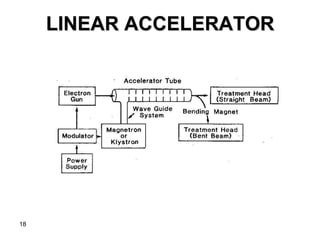
LINEAR ACCELERATOR
• POWER SUPPLY- Provides direct current to the
modulator
• MODULATOR- Pulse forming network which are
delivered to magnetron or klystron and simultaneously to
electron gun.
• MAGNETRON/KLYSTRON- Produce microwaves
• ACCELRATOR TUBE- Electrons interact with
electromagnetic field produced by microwaves and gain
energy
16
• LOW ENERGY LINACS- Electrons proceed
straight and strike target to produce x ray beam
• HIGH ENERGY LINACS- Electrons are bent
through a suitable angle with the help of beam
transport system consisting of bending magnets
and focussing coils.
17
LINEAR ACCELERATOR
18
19
THE MAGNETRON
• A device that produces microwaves
• Functions as a high-power oscillator
• Generating microwave pulses of several microseconds
with repetition rate of several hundred pulses per second
• Frequency of microwave within each pulse is about 3000
MHz
• Peak power output:
– 2 MW (for low-energy linacs, 6MV or less)
– 5 MW (for higher-energy linacs, mostly use klystrons)
20
21
The cathode is heated by an inner filament
Electrons are generated by
thermionic emission
Static B-field perpendicular to the plane of cavities
Electron move in complex spirals toward the resonant cavities
Radiating energy in form of microwave
Pulse E-field between cathode & anode
Electron accelerated toward the anode
THE KLYSTRON
• Not a generator of microwaves
• Microwave amplifier
– Needs to be driven by a low-power microwave
oscillator
22
23
The Klystron
Electrons produced by the cathode
Electrons are accelerated by –ve pulse
into buncher cavity
Lower level microwave set up an
alternating E field across the buncher
cavity
Velocity of e- is altered by the action
of E-field (velocity modulation)
1. Some e- are speed up
2. Other are slowed down
Passed in the drift tube
(field-free space)
Electrons arrive catcher cavity
1. Generate a retarding E-field
2. Electrons suffer
deceleration
3. KE of electrons converted
into high-power
microwaves
THE LINAC X-RAY BEAM
• Production of x-rays
– Electrons are incident on a target of a high-Z material
(e.g. tungsten)
– Target – need water cooled & thick enough to absorb
most of the incident electrons
– Bremsstrahlung interactions
• Electrons energy is converted into a spectrum of x-rays
energies
• Max energy of x-rays = energy of incident energy of electrons
• Average photon energy = 1/3 of max energy of x-rays
24
ELECTRON BEAM
• 3 mm diameter pencil beam of electrons
• In electron mode, beam strikes scattering foil
instead of target to spread the beam
• The thickness is such that most of the electrons
are scattered instead of producing
brehmsstrahlung.
• A small fraction still gets converted to x rays
• A secondary z foil of variable thickness to flatten
the electron beam
25
TREATMENT HEAD
26
26
Consists of a thick shell of
high density shielding material such
as lead, tungsten or lead-
tungsten alloy
FLATTENING FILTER
• Linacs produce electrons in megavoltage range,
hence x ray intensity is peaked in forward
direction.
• Flatting filter- makes intensity uniform across the
field
• Usually made of lead
27
28
BEAM COLLIMATION AND
MONITORING
• In x rays, beam is first collimated by fixed
primary collimator
• The flattened beam is then incident on the dose
monitoring chambers.
– Consists of several ion chambers
– Or single chamber with multiple plates
– Monitor dose rate, integrated dose and field
symmetry
– Normally shielded so that response isnt
influenced by temperature and pressure of
outside air
• Beam is further collimated by continuously
movable x ray collimator
– 2 pairs of blocks of lead and tungsten(jaws)
– Rectangular opening from 0 x 0 to 40 x 40cm
– Modern collimators have multileaf
29
• Field size definition is provided by light localizing
system in the treatment head.
• Electrons scatter readily in air, hence beam
collimation is achieved close to the skin surface
• Dose rate is affected with increase in field size
• Problem is solved by opening the x ray
collimator to maximum size and attaching an
auxillary collimator for electrons in form of
trimmers extended down to the skin surface
30
31
BETATRON
• Electron in a changing magnetic field
experiences acceleration in a circular orbit
32
Energy of x-rays:
6 – 40 MV
Disadvantage:
low dose rate
Small field size
MICROTRON
• Electron accelerator which combines the principles of
both linear accelerator and the cyclotron.
• Electrons are accelerated by the oscillating field of one
or more microwave cavities.
33
Advantage:
Easy energy selection, small beam energy spread
and small size
CYCLOTRON
• Charged particle accelerator
• Mainly used for nuclear physics research
• As a source of high-energy protons for proton beam
therapy
• Have been adopted for generating neutron beams
recently
34
CYCLOTRON
35
Structures
• Short metallic cylinder divided into two section (Ds)
• Highly evacuated
• Placed between the poles of a direct current magnet
• Alternating potential is applied between two Ds
CYCLOTRON
36
Positive charged particles (e.g. protons or deuterons) are
injected at the center of the two Ds
Under Mag-field, the particles travel in a circular orbit
Accelerated by E-field while passing from one D to the other
Received an increment of energy
Radius of its orbit increases
MACHINES USING
RADIONUCLIDES
• Radionuclides have been used as source of γrays for
teletherapy
• Radium-226, Cesium-137, Cobalt-60
• 60Co has proved to be most suitable for external beam
R/T
• Higher possible specific activity
• Greater radiation output
• Higher average photon energy
37
COBALT-60 UNIT
• Source
– From 59Co(n, γ) nuclear reactor
– Stable 59Co → radioactive 60Co
– In form of solid cylinder, discs, or pallets
• Treatment beam
60Co →60Ni + 0β(0.32 MeV) + γ(1.17 & 1.33 MeV)
• Heterogeneity of the beam
– Secondary interactions
– βabsorbed by capsule → bremsstrahlung x-rays
(0.1MeV)
– scattering from the surrounding capsule, the source
housing and the collimation system (electron
contamination)
38
SOURCE HOUSING
• Called sourcehead
• Steel shell filled with lead for shielding purposes
• A device for bringing source in front of opening
• A heavy metal alloy sleeve is provided to form
additional primary shield when source is in the
off position.
39
• Methods to move source from off to on postion
– Source mounted on a rotating wheel
– Source mounted on a heavy metal drawer
– Mercury is allowed to flow in the space
immediately below the source
– Source is fixed in aperture and beam is turned
off with shutter consisting heavy metal jaws
40
41
Cobalt-60 teletherapy machine
Theratron-780, AECL (now MDS Nordion), Ottawa, Canada
PENUMBRA
• The region, at the edge of a radiation beam, over which
the dose rate changes rapidly as function of distance
from the beam axis
1. Transmission penumbra
2. Geometric penumbra
42
• Transmission penumbra
– If the inner surface of the blocks is made
parallel to the central axis of the beam
– The radiation will pass through the edge of
the collimating blocks  Transmission
Penumbra
– The extent of this penumbra will be more
pronounced for larger collimator opening
43
44
Minimizing
the effect
45
From considering similar
triangles ABC and DEC
DE = CE = CD = MN = OF + FN – OM
AB CA CB OM OM
AB = s (source diameter)
OF = SSD
DE = Pd ( penumbra)
Pd = s (SSD + d – SDD)
SDD
Parameters determine the width of
penumbra
• Geometric penumbra
• Radiation source: not a point source
– e.g. 60 Co teletherapy → cylinder of diameter
ranging from 1.0 to 2.0 cm
46
• Geometric penumbra (con’t)
– Solutions
• Extendable penumbra trimmer
– Heavy metal bars to attenuate the beam in the penumbra
region
• Secondary blocks
– Placed closed to the patient for redifining the field
– Should not be placed < 15 – 20 cm, excessive electron
contaminants
– Definition of physical penumbra in dosimetry
• Lateral distance between two specified isodose
curves at a specified depth
– At a depth in the patient, dose variation at the field border
– Geometric, transmission penumbras + scattered
radiation produced in the patient
HEAVY PARTICLE BEAMS
• Advantage
– Dose localization
– Therapeutic gain (greater effect on tumor than on
normal tissue)
• Including
– neutrons, protons, deuterons, αparticles, negative
pions, and heavy ions
• Still experimental
• Few institutions because of the enormous cost
47
NEUTRONS
• Sources of high energy neutron beams
– D-T generator, cyclotrons, or linear accelerators
• D-T generators
2H + 3H → 4He + 1n + 17.6 MeV
1 1 2 0
– Monoenergetic (14 MeV)
– Isotropic (same yield in all directions)
– Major problem
• Lack of sufficient dose rate at the treatment distance
• 15 cGy/min at 1 m
– Advantage
• Its size is small enough to allow isocentric mounting on
gantry
48
• Cyclotron
– Stripping reaction
2
H + 9
Be → 10
Be + 1
n
1 4 5 0
– Mostly in forward
direction
– Spectrum of energies
(average neutron
energy is 40% - 50%
of deuteron energy)
49
Fig 4.15. Neutron spectra produced by
deuterons on beryllium target
PROTONS AND HEAVY IONS
• Energy of therapeutic proton beams
– 150 – 250 MeV
• Sources: produced by cyclotron or linear accelerator
• Major advantage
– Characteristic distribution of dose with depth. Dose
deposited is approximately constant with depth until
the end where dose peaks out to a high value with a
rapid fall off to zero.
50
51
Bragg peak
NEGATIVE PIONS
• Pi meson (pion, π)
– Protons and neutrons are held together by a mutual
exchange of pi mesons
– Mass : 237x of electron
– Charge : π+, π-, π0
– Decay: π+ → μ+ + ν (mean life: 2.54 x 10⁻¹⁸)
π- → μ- + ν (mean life: 2.54 x 10⁻¹⁸)
π0 → hν1 + hν2(mean life: 2.54 x 10⁻¹⁸)
μ— mesons; ν — neutrinos
52
53
– Sources:
• nuclear reaction
• Cyclotron or linear accelerator with protons (400 – 800 MeV)
and beryllium as target material
– Energy range of pion interest in R/T — 100 MeV
– Range in water about — 24 cm
– Problems
• Low dose rates
• Beam contamination
• High cost
THANK YOU
54

Clinical radiation generators

  • 1.
  • 2.
    KILOVOLTAGE UNITS • Upto about 1950 • X-rays generated at voltages up to 300 kVps • Still some use in the present era, esp. treatment of superficial skin lesions • Kilovoltage Therapy – Grenz-Ray Therapy – Contact Therapy – Superficial Therapy – Orthovoltage Therapy or Deep Therapy – Supervoltage Therapy 2
  • 3.
  • 4.
    GRENZ-RAY THERAPY – Energy: < 20 kV – Very low depth of penetration – No longer used in RT 4
  • 5.
    CONTACT THERAPY – Energy:40 – 50 kV – Short SSD (< 2 cm) – Produces a very rapidly decreasing depth dose – Max irradiated tissue : skin surface – Application: Tumor not deeper than 1 – 2 mm – Endocavitary x ray machines have been used in the treatment of superficial rectal cancers. 5
  • 6.
    SUPERFICIAL THERAPY – Energy:50 – 150 kV – HVLs: 1.0 – 8.0 mm Al – Applicator or cone attached to the diaphragm – SSD: 15 – 20 cm – Tube current: 5 – 8 mA – Application: tumors confined to about 5-mm depth 6
  • 7.
    ORTHOVOLTAGE THERAPY OR DEEPTHERAPY – Energy: 150 – 500 kV – Tube current: 10 – 20 mA – Cones or movable diaphragm (continuous adjustable field size) 7
  • 8.
    – SSD: 50cm – Application: tumor located < 2 –3 cm in depth – Limitation of the treatment: • skin dose • Depth dose distribution • Increase absorbed dose in bone • Increase scattering 8
  • 9.
  • 10.
    SUPERVOLTAGE THERAPY – Energy:500 – 1000 kV – Technical problem • Insulating the high-voltage transformer. • Conventional transformer systems were not suitable for producing potential > 300 kVp – The problem solved by invention of resonant transformer 10
  • 11.
    – Used togenerate x-rays from 300 to 2000 kV 11 At resonant frequency 1. Oscillating potential attains very high amplitude 2. Peak voltage across the x-ray tube becomes very large RESONANT TRANSFORMER UNITS
  • 12.
    MEGAVOLTAGE THERAPY • X-raybeams of energy > 1 MV • Accelerators or γray(>1 Mev) produced by radionuclides • Examples of clinical megavoltage machines – Van de Graaff generator – Linear accelerator – Betatron – Microtron – Teletherapy γray units (e.g. cobalt-60) 12
  • 13.
    VAN DE GRAAFF GENERATOR •Electrostatic accelerator- accelerate charged particles • Energy of x-rays: 2 MV (typical), up to 10 MV • Limitation: – size – high-voltage insulation • No longer produced commercially – Technically better machine (e.g. Co-60 units & linear accelerators) 13
  • 14.
    LINEAR ACCELERATOR • Usehigh frequency electromagnetic waves to accelerate charged particles (e.g. electrons) to high energies through a linear tube. – High energy electron beam – treating superficial tumors – X rays- treating deep seated tumors They use travelling or stationary electromagnetic waves to accelerate electrons with frequency in the microwave region. 14
  • 15.
    • Types ofEM wave 1. Traveling EM wave • Required a terminating (“dummy”) load to absorb the residual power at the end of the structure • Prevent backward reflection wave 2. Standing EM wave • Combination of forward and reverse traveling waves • More efficiency • More expensive – Requires installation of a circulator (or insulator) between the power source – the structure prevent reflections from reaching the power source 15 LINEAR ACCELERATOR
  • 16.
    • POWER SUPPLY-Provides direct current to the modulator • MODULATOR- Pulse forming network which are delivered to magnetron or klystron and simultaneously to electron gun. • MAGNETRON/KLYSTRON- Produce microwaves • ACCELRATOR TUBE- Electrons interact with electromagnetic field produced by microwaves and gain energy 16
  • 17.
    • LOW ENERGYLINACS- Electrons proceed straight and strike target to produce x ray beam • HIGH ENERGY LINACS- Electrons are bent through a suitable angle with the help of beam transport system consisting of bending magnets and focussing coils. 17
  • 18.
  • 19.
  • 20.
    THE MAGNETRON • Adevice that produces microwaves • Functions as a high-power oscillator • Generating microwave pulses of several microseconds with repetition rate of several hundred pulses per second • Frequency of microwave within each pulse is about 3000 MHz • Peak power output: – 2 MW (for low-energy linacs, 6MV or less) – 5 MW (for higher-energy linacs, mostly use klystrons) 20
  • 21.
    21 The cathode isheated by an inner filament Electrons are generated by thermionic emission Static B-field perpendicular to the plane of cavities Electron move in complex spirals toward the resonant cavities Radiating energy in form of microwave Pulse E-field between cathode & anode Electron accelerated toward the anode
  • 22.
    THE KLYSTRON • Nota generator of microwaves • Microwave amplifier – Needs to be driven by a low-power microwave oscillator 22
  • 23.
    23 The Klystron Electrons producedby the cathode Electrons are accelerated by –ve pulse into buncher cavity Lower level microwave set up an alternating E field across the buncher cavity Velocity of e- is altered by the action of E-field (velocity modulation) 1. Some e- are speed up 2. Other are slowed down Passed in the drift tube (field-free space) Electrons arrive catcher cavity 1. Generate a retarding E-field 2. Electrons suffer deceleration 3. KE of electrons converted into high-power microwaves
  • 24.
    THE LINAC X-RAYBEAM • Production of x-rays – Electrons are incident on a target of a high-Z material (e.g. tungsten) – Target – need water cooled & thick enough to absorb most of the incident electrons – Bremsstrahlung interactions • Electrons energy is converted into a spectrum of x-rays energies • Max energy of x-rays = energy of incident energy of electrons • Average photon energy = 1/3 of max energy of x-rays 24
  • 25.
    ELECTRON BEAM • 3mm diameter pencil beam of electrons • In electron mode, beam strikes scattering foil instead of target to spread the beam • The thickness is such that most of the electrons are scattered instead of producing brehmsstrahlung. • A small fraction still gets converted to x rays • A secondary z foil of variable thickness to flatten the electron beam 25
  • 26.
    TREATMENT HEAD 26 26 Consists ofa thick shell of high density shielding material such as lead, tungsten or lead- tungsten alloy
  • 27.
    FLATTENING FILTER • Linacsproduce electrons in megavoltage range, hence x ray intensity is peaked in forward direction. • Flatting filter- makes intensity uniform across the field • Usually made of lead 27
  • 28.
    28 BEAM COLLIMATION AND MONITORING •In x rays, beam is first collimated by fixed primary collimator • The flattened beam is then incident on the dose monitoring chambers. – Consists of several ion chambers – Or single chamber with multiple plates – Monitor dose rate, integrated dose and field symmetry – Normally shielded so that response isnt influenced by temperature and pressure of outside air
  • 29.
    • Beam isfurther collimated by continuously movable x ray collimator – 2 pairs of blocks of lead and tungsten(jaws) – Rectangular opening from 0 x 0 to 40 x 40cm – Modern collimators have multileaf 29
  • 30.
    • Field sizedefinition is provided by light localizing system in the treatment head. • Electrons scatter readily in air, hence beam collimation is achieved close to the skin surface • Dose rate is affected with increase in field size • Problem is solved by opening the x ray collimator to maximum size and attaching an auxillary collimator for electrons in form of trimmers extended down to the skin surface 30
  • 31.
  • 32.
    BETATRON • Electron ina changing magnetic field experiences acceleration in a circular orbit 32 Energy of x-rays: 6 – 40 MV Disadvantage: low dose rate Small field size
  • 33.
    MICROTRON • Electron acceleratorwhich combines the principles of both linear accelerator and the cyclotron. • Electrons are accelerated by the oscillating field of one or more microwave cavities. 33 Advantage: Easy energy selection, small beam energy spread and small size
  • 34.
    CYCLOTRON • Charged particleaccelerator • Mainly used for nuclear physics research • As a source of high-energy protons for proton beam therapy • Have been adopted for generating neutron beams recently 34
  • 35.
    CYCLOTRON 35 Structures • Short metalliccylinder divided into two section (Ds) • Highly evacuated • Placed between the poles of a direct current magnet • Alternating potential is applied between two Ds
  • 36.
    CYCLOTRON 36 Positive charged particles(e.g. protons or deuterons) are injected at the center of the two Ds Under Mag-field, the particles travel in a circular orbit Accelerated by E-field while passing from one D to the other Received an increment of energy Radius of its orbit increases
  • 37.
    MACHINES USING RADIONUCLIDES • Radionuclideshave been used as source of γrays for teletherapy • Radium-226, Cesium-137, Cobalt-60 • 60Co has proved to be most suitable for external beam R/T • Higher possible specific activity • Greater radiation output • Higher average photon energy 37
  • 38.
    COBALT-60 UNIT • Source –From 59Co(n, γ) nuclear reactor – Stable 59Co → radioactive 60Co – In form of solid cylinder, discs, or pallets • Treatment beam 60Co →60Ni + 0β(0.32 MeV) + γ(1.17 & 1.33 MeV) • Heterogeneity of the beam – Secondary interactions – βabsorbed by capsule → bremsstrahlung x-rays (0.1MeV) – scattering from the surrounding capsule, the source housing and the collimation system (electron contamination) 38
  • 39.
    SOURCE HOUSING • Calledsourcehead • Steel shell filled with lead for shielding purposes • A device for bringing source in front of opening • A heavy metal alloy sleeve is provided to form additional primary shield when source is in the off position. 39
  • 40.
    • Methods tomove source from off to on postion – Source mounted on a rotating wheel – Source mounted on a heavy metal drawer – Mercury is allowed to flow in the space immediately below the source – Source is fixed in aperture and beam is turned off with shutter consisting heavy metal jaws 40
  • 41.
    41 Cobalt-60 teletherapy machine Theratron-780,AECL (now MDS Nordion), Ottawa, Canada
  • 42.
    PENUMBRA • The region,at the edge of a radiation beam, over which the dose rate changes rapidly as function of distance from the beam axis 1. Transmission penumbra 2. Geometric penumbra 42
  • 43.
    • Transmission penumbra –If the inner surface of the blocks is made parallel to the central axis of the beam – The radiation will pass through the edge of the collimating blocks  Transmission Penumbra – The extent of this penumbra will be more pronounced for larger collimator opening 43
  • 44.
  • 45.
    45 From considering similar trianglesABC and DEC DE = CE = CD = MN = OF + FN – OM AB CA CB OM OM AB = s (source diameter) OF = SSD DE = Pd ( penumbra) Pd = s (SSD + d – SDD) SDD Parameters determine the width of penumbra • Geometric penumbra • Radiation source: not a point source – e.g. 60 Co teletherapy → cylinder of diameter ranging from 1.0 to 2.0 cm
  • 46.
    46 • Geometric penumbra(con’t) – Solutions • Extendable penumbra trimmer – Heavy metal bars to attenuate the beam in the penumbra region • Secondary blocks – Placed closed to the patient for redifining the field – Should not be placed < 15 – 20 cm, excessive electron contaminants – Definition of physical penumbra in dosimetry • Lateral distance between two specified isodose curves at a specified depth – At a depth in the patient, dose variation at the field border – Geometric, transmission penumbras + scattered radiation produced in the patient
  • 47.
    HEAVY PARTICLE BEAMS •Advantage – Dose localization – Therapeutic gain (greater effect on tumor than on normal tissue) • Including – neutrons, protons, deuterons, αparticles, negative pions, and heavy ions • Still experimental • Few institutions because of the enormous cost 47
  • 48.
    NEUTRONS • Sources ofhigh energy neutron beams – D-T generator, cyclotrons, or linear accelerators • D-T generators 2H + 3H → 4He + 1n + 17.6 MeV 1 1 2 0 – Monoenergetic (14 MeV) – Isotropic (same yield in all directions) – Major problem • Lack of sufficient dose rate at the treatment distance • 15 cGy/min at 1 m – Advantage • Its size is small enough to allow isocentric mounting on gantry 48
  • 49.
    • Cyclotron – Strippingreaction 2 H + 9 Be → 10 Be + 1 n 1 4 5 0 – Mostly in forward direction – Spectrum of energies (average neutron energy is 40% - 50% of deuteron energy) 49 Fig 4.15. Neutron spectra produced by deuterons on beryllium target
  • 50.
    PROTONS AND HEAVYIONS • Energy of therapeutic proton beams – 150 – 250 MeV • Sources: produced by cyclotron or linear accelerator • Major advantage – Characteristic distribution of dose with depth. Dose deposited is approximately constant with depth until the end where dose peaks out to a high value with a rapid fall off to zero. 50
  • 51.
  • 52.
    NEGATIVE PIONS • Pimeson (pion, π) – Protons and neutrons are held together by a mutual exchange of pi mesons – Mass : 237x of electron – Charge : π+, π-, π0 – Decay: π+ → μ+ + ν (mean life: 2.54 x 10⁻¹⁸) π- → μ- + ν (mean life: 2.54 x 10⁻¹⁸) π0 → hν1 + hν2(mean life: 2.54 x 10⁻¹⁸) μ— mesons; ν — neutrinos 52
  • 53.
    53 – Sources: • nuclearreaction • Cyclotron or linear accelerator with protons (400 – 800 MeV) and beryllium as target material – Energy range of pion interest in R/T — 100 MeV – Range in water about — 24 cm – Problems • Low dose rates • Beam contamination • High cost
  • 54.