Individual project
Course code : EEE 5212
Name : Yik Wei Kian
ID : I11008341
Presentation will covered the topic of:
 Explain what is illumination.
 Explain the principle of producing artificial light.
 Law of illumination.
 lighting schemes
 Explain what is floodlighting .
 Working principle of types of lamps(watch videos).
 Comparison of different light source
What is illumination?
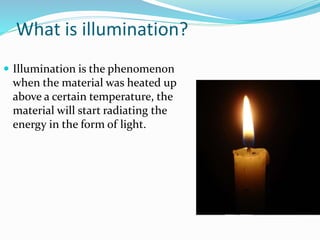
 Illumination is the phenomenon
when the material was heated up
above a certain temperature, the
material will start radiating the
energy in the form of light.
The principle of producing
artificial light
 Increase the temperature of body or gas above average
room temperature (23 Celsius).
 begins to radiate energy in the surrounding medium
in the form of electromagnetic waves of various
wavelengths
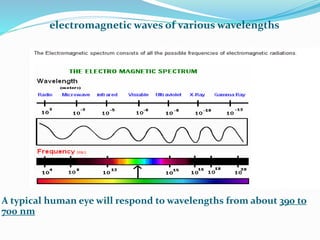
A typical human eye will respond to wavelengths from about 390 to
700 nm
electromagnetic waves of various wavelengths
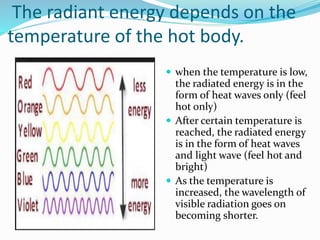
The radiant energy depends on the
temperature of the hot body.
 when the temperature is low,
the radiated energy is in the
form of heat waves only (feel
hot only)
 After certain temperature is
reached, the radiated energy
is in the form of heat waves
and light wave (feel hot and
bright)
 As the temperature is
increased, the wavelength of
visible radiation goes on
becoming shorter.
 The light wave travel with the velocity approximately
to 3x10 ^8m/sec.
 Red radiation wavelength = 390 nm
 Violet radiation wavelength = 700 nm
 For expressing wavelength of light, another unit called
Angstrom Unit
1 A.U. = 10-8 cm= 10-10 cm
 Hence red = 3900 x 10-10 cm
 Violet = 700 x 10-10 cm
There are two laws of Illuminations :
a. Law of intensity
b. Law of Inverse Squares
c. Lambert’s Cosine Law
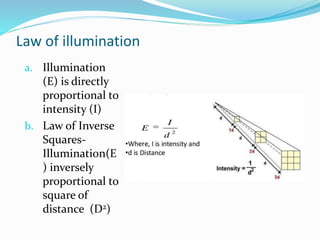
Law of illumination
a. Illumination
(E) is directly
proportional to
intensity (I)
b. Law of Inverse
Squares-
Illumination(E
) inversely
proportional to
square of
distance (D2)
Law of
illumination
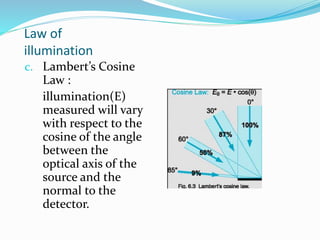
c. Lambert’s Cosine
Law :
illumination(E)
measured will vary
with respect to the
cosine of the angle
between the
optical axis of the
source and the
normal to the
detector.
lighting schemes
 Direct lightning
 Indirect lighting
 Semi- direct lighting
 Semi – indirect lighting
 General diffusing system
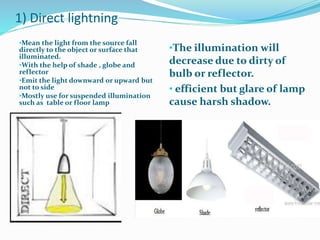
1) Direct lightning
•Mean the light from the source fall
directly to the object or surface that
illuminated.
•With the help of shade , globe and
reflector
•Emit the light downward or upward but
not to side
•Mostly use for suspended illumination
such as table or floor lamp
•The illumination will
decrease due to dirty of
bulb or reflector.
• efficient but glare of lamp
cause harsh shadow.
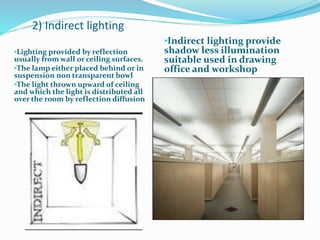
2) Indirect lighting
•Lighting provided by reflection
usually from wall or ceiling surfaces.
•The lamp either placed behind or in
suspension non transparent bowl
•The light thrown upward of ceiling
and which the light is distributed all
over the room by reflection diffusion
•Indirect lighting provide
shadow less illumination
suitable used in drawing
office and workshop
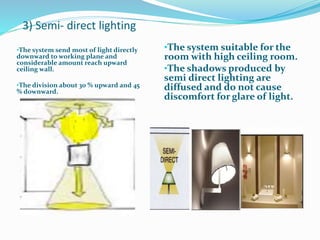
3) Semi- direct lighting
•The system send most of light directly
downward to working plane and
considerable amount reach upward
ceiling wall.
•The division about 30 % upward and 45
% downward.
•The system suitable for the
room with high ceiling room.
•The shadows produced by
semi direct lighting are
diffused and do not cause
discomfort for glare of light.
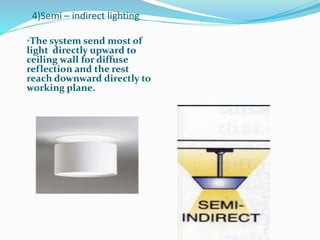
4)Semi – indirect lighting
•The system send most of
light directly upward to
ceiling wall for diffuse
reflection and the rest
reach downward directly to
working plane.
5) General diffusing system
•When the light is completely
enclosed or concealed with the
help of globe and ceiling panel.
•The light is diffused since pass
through the glass or plastic.
•The light distribution are
equally
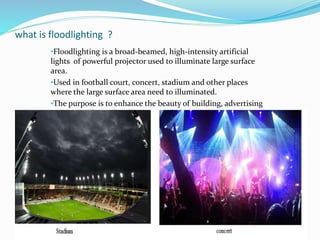
what is floodlighting ?
•Floodlighting is a broad-beamed, high-intensity artificial
lights of powerful projector used to illuminate large surface
area.
•Used in football court, concert, stadium and other places
where the large surface area need to illuminated.
•The purpose is to enhance the beauty of building, advertising
purpose, industrial and commercial purpose
•Incandescence lamp (3 minutes)
Discharge lamp :
•Fluorescent lamps (1.22 minutes)
•Sodium Vapour lamp (2 minutes)
•mercury vapour lamp(3 minutes)
Comparison of different light
source
1. Incandescent lamp :
- take short time to start, light up
instantaneously and off momentarily if cut off
supply.
- light color is near to naturally.
- low installation cost but high operating cost.
- Able to used in DC or AC supply
- switching frequency does not effect the life
span of lamp.
2. Discharge lamp (Fluorescent lamps)
 Need a little time to start (take I sec or more).
 When supply is restored lamp go off and
restart(blinking).
 The color of fluorescent is produced by various
phosphor coatings.
 Initial installation cost is high but operating cost is
low.
 Frequency switching will effect lifespan of lamp.
3. Sodium Vapour lamp
 Take long time to start about 5 to 6 minutes.
 The lamp turn off and cannot restart until recovery the
supply voltage fall to its normal value.
 The color of light is yellowish and produce color
distortion.
 Initial installation cost is high, operating cost lesser
than filament lamp but higher than fluorescent lamp.
 Usually use at open space such as high way, road side.
4. mercury vapour lamp
 Take long time to start about 5 -6 minutes.
 The lamp turn off and cannot restart until recovery
the supply voltage fall to its normal value.
 Initial installation cost is high , but operating cost
lesser than fluorescent lamp.
 Stroboscopic effect(flashes of light) occur in the light .
 Usually use at open space such as high way, car park.
References:
1. Laws Of Illumination Help for Electrical Energy – Trans tutors . 2015. Laws
Of Illumination Help for Electrical Energy – Trans tutors . [ONLINE]
Available at: http://www.transtutors.com/homework-help/electrical-
engineering/electrical-energy-utilization/laws-of-illumination.aspx.
[Accessed 26 October 2015].
2. Types Of Lighting Schemes Help for Electrical Energy - Transtutors . 2015.
Types Of Lighting Schemes Help for Electrical Energy - Transtutors .
[ONLINE] Available at: http://www.transtutors.com/homework-
help/electrical-engineering/electrical-energy-utilization/types-of-
lighting-schemes.aspx. [Accessed 26 October 2015].
3. Floodlights | Lighting | Screwfix.com. 2015. Floodlights | Lighting |
Screwfix.com. [ONLINE] Available at:
http://www.screwfix.com/c/electrical-
lighting/floodlights/cat840908. [Accessed 26 October 2015].
4. Incandescent Lamps . 2015. Incandescent Lamps . [ONLINE] Available
at:
http://homepages.inf.ed.ac.uk/rbf/CVonline/LOCAL_COPIES/RUSK/I
ncLamps.html. [Accessed 26 October 2015].
5. How Fluorescent Lamps Work - HowStuffWorks. 2015. How
Fluorescent Lamps Work - HowStuffWorks. [ONLINE] Available at:
http://home.howstuffworks.com/fluorescent-lamp.htm. [Accessed 26
October 2015].
6. High-pressure sodium vapor lamps for open and enclosed luminaires |
OSRAM. 2015. High-pressure sodium vapor lamps for open and
enclosed luminaires | OSRAM. [ONLINE] Available at:
http://www.osram.com/osram_com/products/lamps/high-intensity-
discharge-lamps/high-pressure-sodium-vapor-lamps-for-open-and-
enclosed-luminaires/index.jsp. [Accessed 26 October 2015].
7. The Mercury Vapor Lamp - How it works & history. 2015. The Mercury
Vapor Lamp - How it works & history. [ONLINE] Available at:
http://www.edisontechcenter.org/MercuryVaporLamps.html.
[Accessed 26 October 2015].
Thank you

Illumination project

  • 1.
    Individual project Course code: EEE 5212 Name : Yik Wei Kian ID : I11008341
  • 2.
    Presentation will coveredthe topic of:  Explain what is illumination.  Explain the principle of producing artificial light.  Law of illumination.  lighting schemes  Explain what is floodlighting .  Working principle of types of lamps(watch videos).  Comparison of different light source
  • 3.
    What is illumination? Illumination is the phenomenon when the material was heated up above a certain temperature, the material will start radiating the energy in the form of light.
  • 4.
    The principle ofproducing artificial light  Increase the temperature of body or gas above average room temperature (23 Celsius).  begins to radiate energy in the surrounding medium in the form of electromagnetic waves of various wavelengths
  • 5.
    A typical humaneye will respond to wavelengths from about 390 to 700 nm electromagnetic waves of various wavelengths
  • 6.
    The radiant energydepends on the temperature of the hot body.  when the temperature is low, the radiated energy is in the form of heat waves only (feel hot only)  After certain temperature is reached, the radiated energy is in the form of heat waves and light wave (feel hot and bright)  As the temperature is increased, the wavelength of visible radiation goes on becoming shorter.
  • 7.
     The lightwave travel with the velocity approximately to 3x10 ^8m/sec.  Red radiation wavelength = 390 nm  Violet radiation wavelength = 700 nm  For expressing wavelength of light, another unit called Angstrom Unit 1 A.U. = 10-8 cm= 10-10 cm  Hence red = 3900 x 10-10 cm  Violet = 700 x 10-10 cm
  • 8.
    There are twolaws of Illuminations : a. Law of intensity b. Law of Inverse Squares c. Lambert’s Cosine Law
  • 9.
    Law of illumination a.Illumination (E) is directly proportional to intensity (I) b. Law of Inverse Squares- Illumination(E ) inversely proportional to square of distance (D2)
  • 10.
    Law of illumination c. Lambert’sCosine Law : illumination(E) measured will vary with respect to the cosine of the angle between the optical axis of the source and the normal to the detector.
  • 11.
    lighting schemes  Directlightning  Indirect lighting  Semi- direct lighting  Semi – indirect lighting  General diffusing system
  • 12.
    1) Direct lightning •Meanthe light from the source fall directly to the object or surface that illuminated. •With the help of shade , globe and reflector •Emit the light downward or upward but not to side •Mostly use for suspended illumination such as table or floor lamp •The illumination will decrease due to dirty of bulb or reflector. • efficient but glare of lamp cause harsh shadow.
  • 13.
    2) Indirect lighting •Lightingprovided by reflection usually from wall or ceiling surfaces. •The lamp either placed behind or in suspension non transparent bowl •The light thrown upward of ceiling and which the light is distributed all over the room by reflection diffusion •Indirect lighting provide shadow less illumination suitable used in drawing office and workshop
  • 14.
    3) Semi- directlighting •The system send most of light directly downward to working plane and considerable amount reach upward ceiling wall. •The division about 30 % upward and 45 % downward. •The system suitable for the room with high ceiling room. •The shadows produced by semi direct lighting are diffused and do not cause discomfort for glare of light.
  • 15.
    4)Semi – indirectlighting •The system send most of light directly upward to ceiling wall for diffuse reflection and the rest reach downward directly to working plane.
  • 16.
    5) General diffusingsystem •When the light is completely enclosed or concealed with the help of globe and ceiling panel. •The light is diffused since pass through the glass or plastic. •The light distribution are equally
  • 17.
    what is floodlighting? •Floodlighting is a broad-beamed, high-intensity artificial lights of powerful projector used to illuminate large surface area. •Used in football court, concert, stadium and other places where the large surface area need to illuminated. •The purpose is to enhance the beauty of building, advertising purpose, industrial and commercial purpose
  • 18.
    •Incandescence lamp (3minutes) Discharge lamp : •Fluorescent lamps (1.22 minutes) •Sodium Vapour lamp (2 minutes) •mercury vapour lamp(3 minutes)
  • 19.
    Comparison of differentlight source 1. Incandescent lamp : - take short time to start, light up instantaneously and off momentarily if cut off supply. - light color is near to naturally. - low installation cost but high operating cost. - Able to used in DC or AC supply - switching frequency does not effect the life span of lamp.
  • 20.
    2. Discharge lamp(Fluorescent lamps)  Need a little time to start (take I sec or more).  When supply is restored lamp go off and restart(blinking).  The color of fluorescent is produced by various phosphor coatings.  Initial installation cost is high but operating cost is low.  Frequency switching will effect lifespan of lamp.
  • 21.
    3. Sodium Vapourlamp  Take long time to start about 5 to 6 minutes.  The lamp turn off and cannot restart until recovery the supply voltage fall to its normal value.  The color of light is yellowish and produce color distortion.  Initial installation cost is high, operating cost lesser than filament lamp but higher than fluorescent lamp.  Usually use at open space such as high way, road side.
  • 22.
    4. mercury vapourlamp  Take long time to start about 5 -6 minutes.  The lamp turn off and cannot restart until recovery the supply voltage fall to its normal value.  Initial installation cost is high , but operating cost lesser than fluorescent lamp.  Stroboscopic effect(flashes of light) occur in the light .  Usually use at open space such as high way, car park.
  • 23.
    References: 1. Laws OfIllumination Help for Electrical Energy – Trans tutors . 2015. Laws Of Illumination Help for Electrical Energy – Trans tutors . [ONLINE] Available at: http://www.transtutors.com/homework-help/electrical- engineering/electrical-energy-utilization/laws-of-illumination.aspx. [Accessed 26 October 2015]. 2. Types Of Lighting Schemes Help for Electrical Energy - Transtutors . 2015. Types Of Lighting Schemes Help for Electrical Energy - Transtutors . [ONLINE] Available at: http://www.transtutors.com/homework- help/electrical-engineering/electrical-energy-utilization/types-of- lighting-schemes.aspx. [Accessed 26 October 2015]. 3. Floodlights | Lighting | Screwfix.com. 2015. Floodlights | Lighting | Screwfix.com. [ONLINE] Available at: http://www.screwfix.com/c/electrical- lighting/floodlights/cat840908. [Accessed 26 October 2015].
  • 24.
    4. Incandescent Lamps. 2015. Incandescent Lamps . [ONLINE] Available at: http://homepages.inf.ed.ac.uk/rbf/CVonline/LOCAL_COPIES/RUSK/I ncLamps.html. [Accessed 26 October 2015]. 5. How Fluorescent Lamps Work - HowStuffWorks. 2015. How Fluorescent Lamps Work - HowStuffWorks. [ONLINE] Available at: http://home.howstuffworks.com/fluorescent-lamp.htm. [Accessed 26 October 2015]. 6. High-pressure sodium vapor lamps for open and enclosed luminaires | OSRAM. 2015. High-pressure sodium vapor lamps for open and enclosed luminaires | OSRAM. [ONLINE] Available at: http://www.osram.com/osram_com/products/lamps/high-intensity- discharge-lamps/high-pressure-sodium-vapor-lamps-for-open-and- enclosed-luminaires/index.jsp. [Accessed 26 October 2015]. 7. The Mercury Vapor Lamp - How it works & history. 2015. The Mercury Vapor Lamp - How it works & history. [ONLINE] Available at: http://www.edisontechcenter.org/MercuryVaporLamps.html. [Accessed 26 October 2015].
  • 25.

Editor's Notes

  • #3 In my presentation, I will …………..after that, and, also
  • #5 When temperature of a body increase a certain temperature
  • #6 Human only detect light at wavelengths in the visual spectrum between ……power of
  • #7 If the wavelength become shorter and , the following visible color detected by your eye will be ……..the shorter the wavelength required more energy
  • #8 Approximate to 3 time 10 power of 8… If want to convert wavelength of light to Angstrom Unit
  • #9 The law of illumination contain three laws .
  • #10 Illumination directly proportional to luminous intensity
  • #11 According to Lambert law, illumination at any point on a surface is directly proportional to the cosine of angle, the angle is between normal to the surface and incident flux.
  • #13 Light from source fall on surface of to be illuminated directly downward. The lighting system is efficient, but too bright and cause hard shadows
  • #14 Light fall on surface indirectly, the light thrown upward, reflected by ceiling and diffuse over the room. The system provide less shadow and suitable use in drawing room
  • #15 30% of light tend to upward and 45% tend to downward .
  • #16 Partly upward and partly downward.
  • #17 light of source is uniformly distributed upwards and downwards