Light: Spectroscopy
and Atoms
Prepared by: Jessa M. Arnado
Let’s Define...
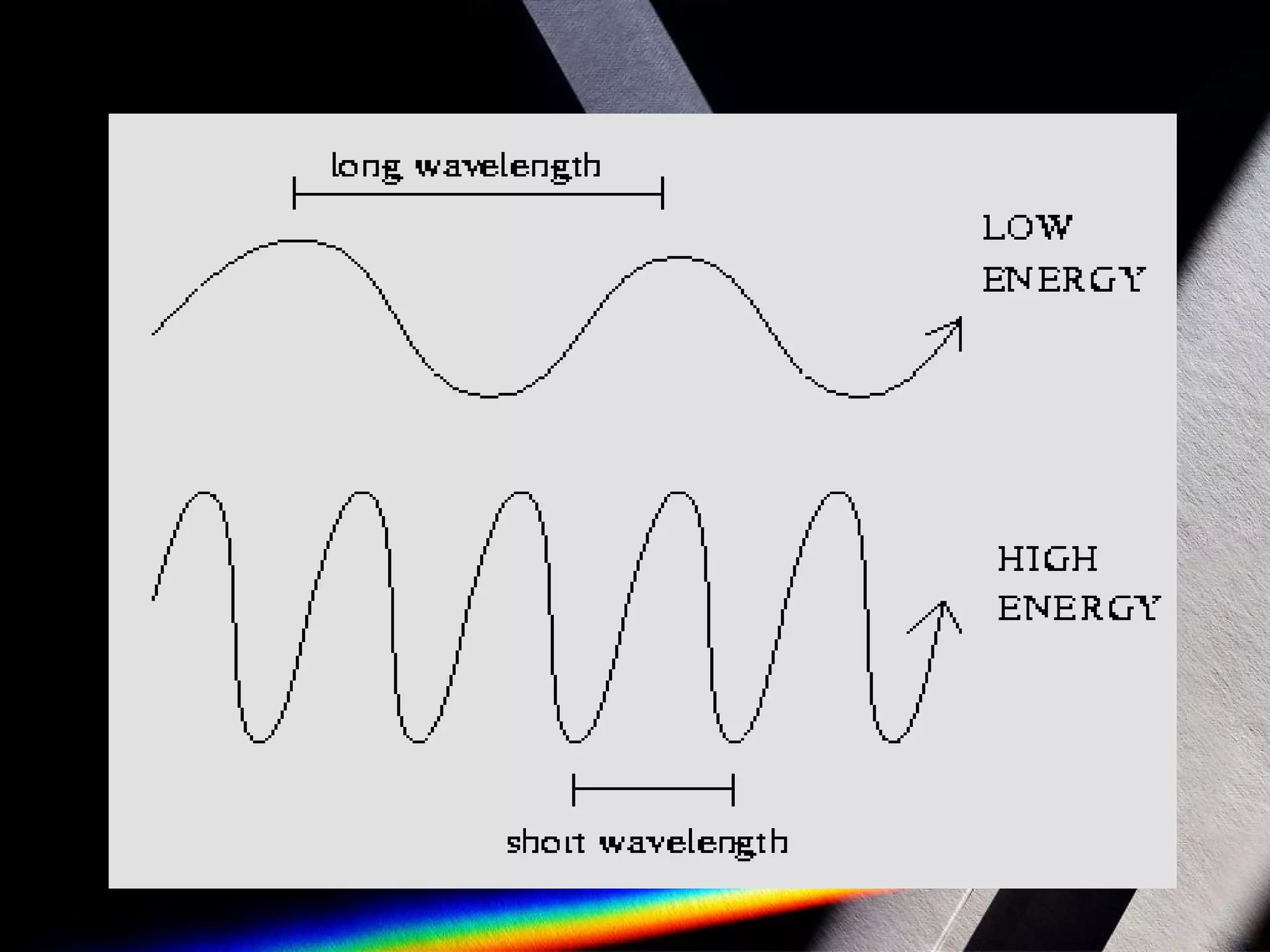
• Spectroscopy- The study of light in different wavelength. It
pertains to the dispersion of an object's light into its
component colors (i.e. energies). By performing this
dissection and analysis of an object's light, astronomers can
infer the physical properties of that object (such as
temperature, mass, luminosity and composition).
•Dispersion- The separation of visible light into a spectrum, may be
accomplished by means of a prism or a diffraction grating.
•Emission lines- Series of bright lines .
•Spectroscope- The instrument used for studying line spectra .
•Spectrophotometer- An electronic device use to obtain accurate
measurements of the radiation.
•Spectrum- Is a range of frequencies or wavelengths.
•Ground state- Atoms will settle to the lowest energy level.
Three Types of Spectra:
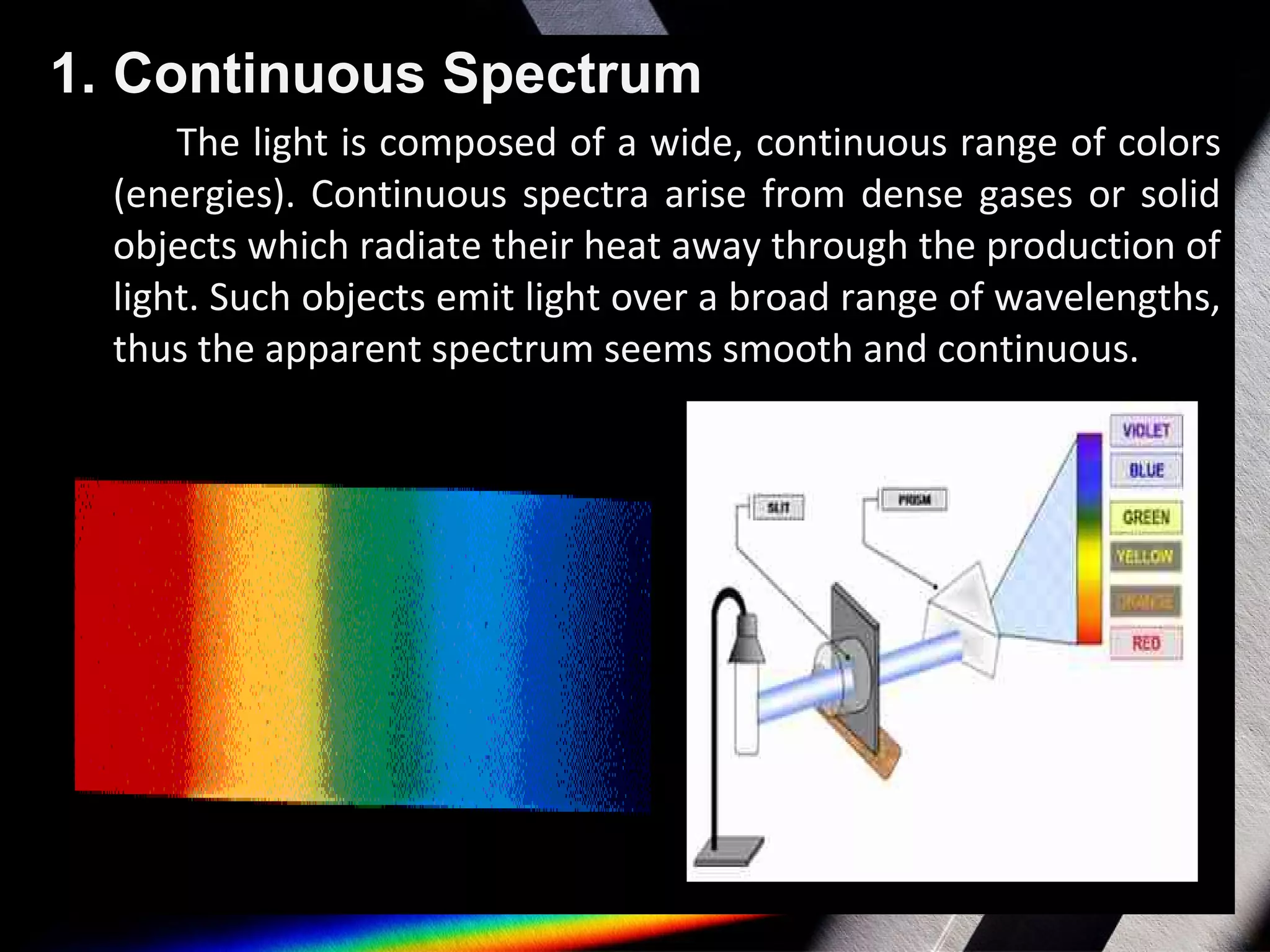
1. Continuous Spectrum
The light is composed of a wide, continuous range of colors
(energies). Continuous spectra arise from dense gases or solid
objects which radiate their heat away through the production of
light. Such objects emit light over a broad range of wavelengths,
thus the apparent spectrum seems smooth and continuous.
2. Absorption Line Spectrum
A dark-line, or absorption, spectrum is the reverse of a
bright-line spectrum; it is produced when white light containing
all frequencies passes through a gas not hot enough to be
incandescent. It consists of a series of dark lines superimposed
on a continuous spectrum, each line corresponding to a
frequency where a bright line would appear if the gas were
incandescent.
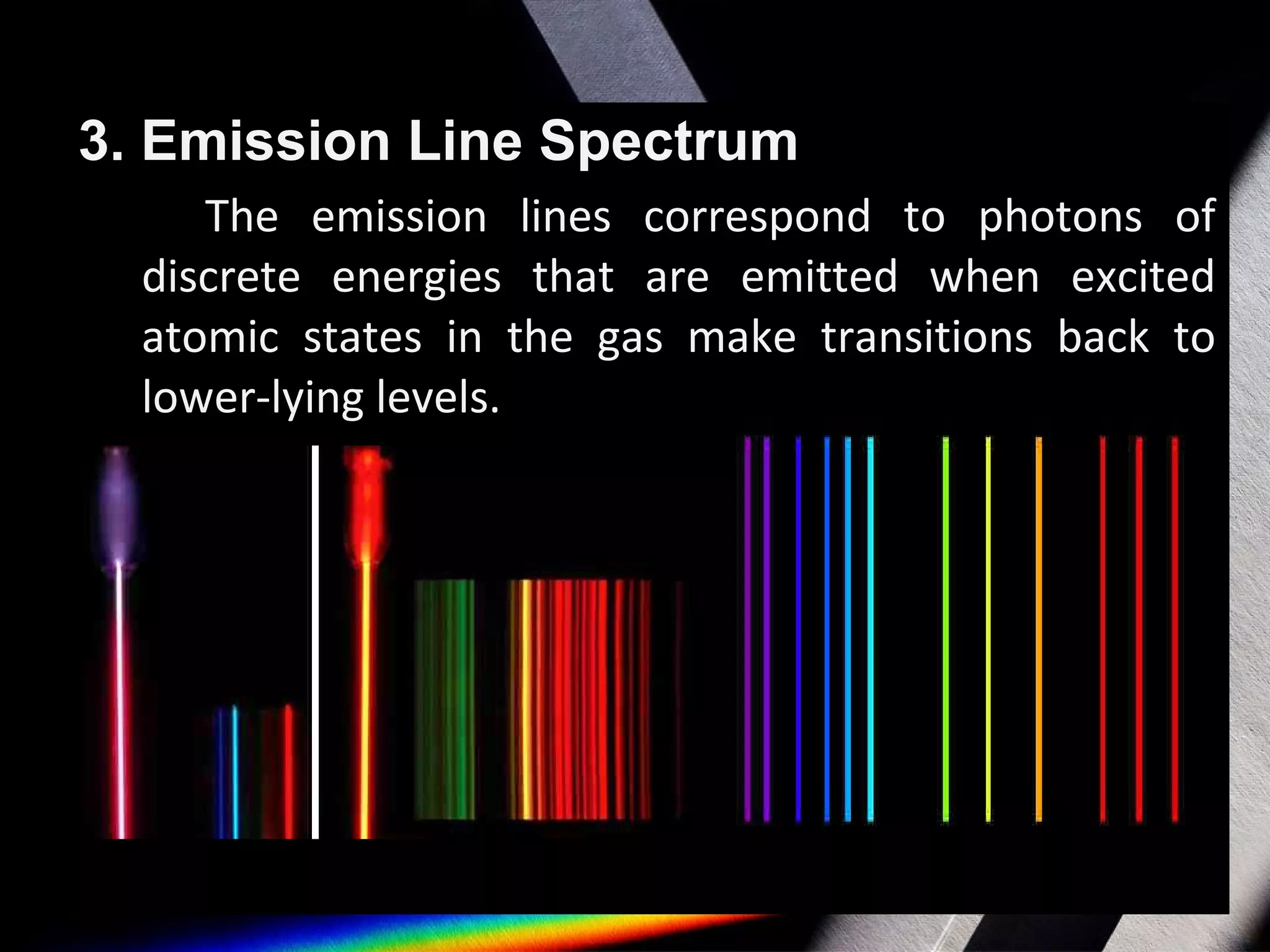
3. Emission Line Spectrum
The emission lines correspond to photons of
discrete energies that are emitted when excited
atomic states in the gas make transitions back to
lower-lying levels.
Origin of Continuous, Emission, and Absorption Spectra:
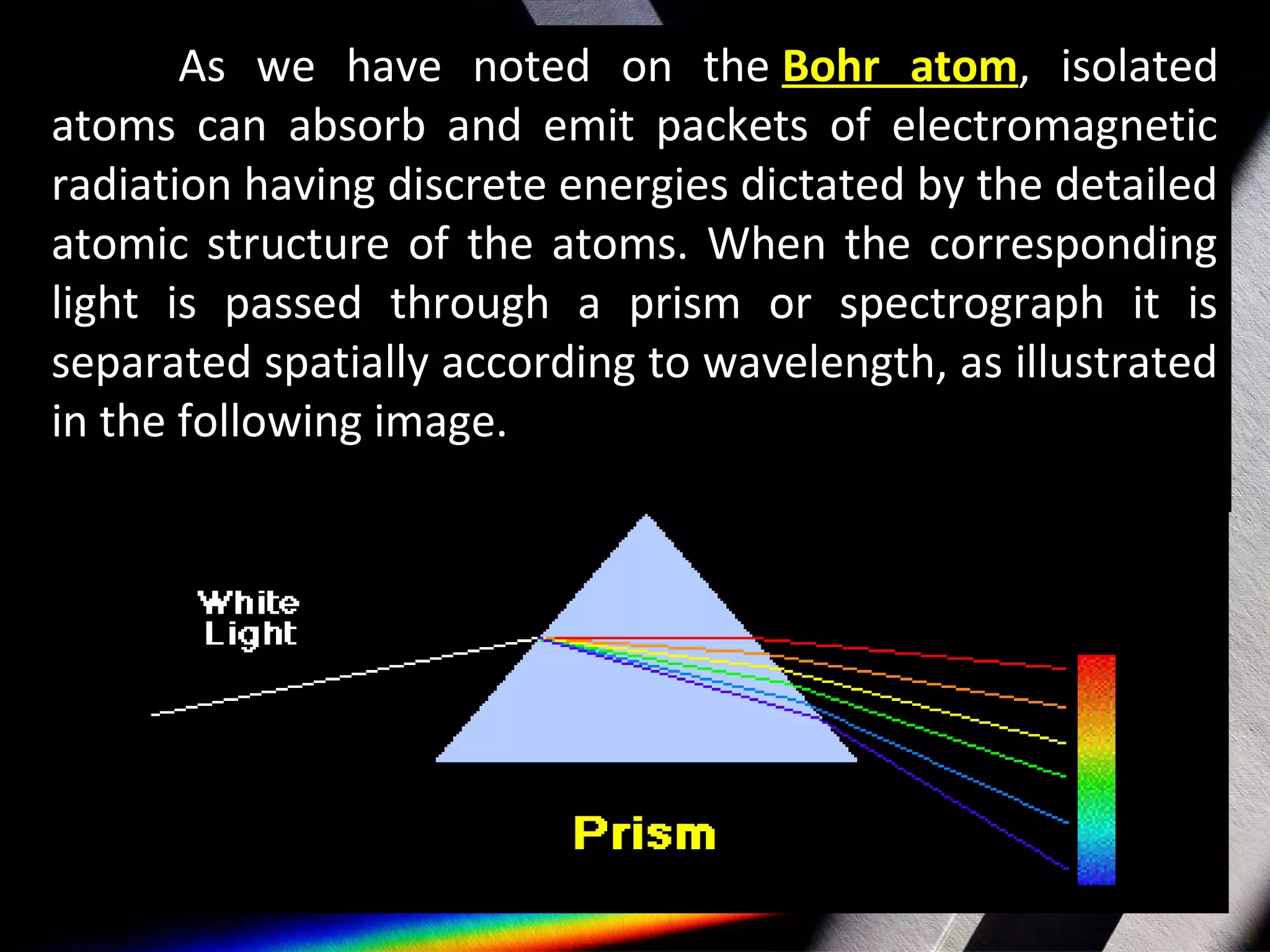
As we have noted on the Bohr atom, isolated
atoms can absorb and emit packets of electromagnetic
radiation having discrete energies dictated by the detailed
atomic structure of the atoms. When the corresponding
light is passed through a prism or spectrograph it is
separated spatially according to wavelength, as illustrated
in the following image.
Video Demonstration:
Applications of Atomic Spectral Analysis:
Atomic spectroscopy has many useful applications.
Since the emission spectrum is different for every element,
it acts as an atomic fingerprint by which elements can be
identified. Some elements were discovered by the analysis
of their atomic spectrum. Helium, for example, was
discovered while scientists were analyzing the absorption
spectrum of the sun. Emission spectra is especially useful
to astronomers who use emission and absorption spectra
to determine the make up of far away stars and other
celestial bodies.

Light: Spectroscopy and Atom

  • 1.
  • 2.
    Let’s Define... • Spectroscopy-The study of light in different wavelength. It pertains to the dispersion of an object's light into its component colors (i.e. energies). By performing this dissection and analysis of an object's light, astronomers can infer the physical properties of that object (such as temperature, mass, luminosity and composition). •Dispersion- The separation of visible light into a spectrum, may be accomplished by means of a prism or a diffraction grating. •Emission lines- Series of bright lines . •Spectroscope- The instrument used for studying line spectra . •Spectrophotometer- An electronic device use to obtain accurate measurements of the radiation. •Spectrum- Is a range of frequencies or wavelengths. •Ground state- Atoms will settle to the lowest energy level.
  • 5.
  • 6.
    1. Continuous Spectrum Thelight is composed of a wide, continuous range of colors (energies). Continuous spectra arise from dense gases or solid objects which radiate their heat away through the production of light. Such objects emit light over a broad range of wavelengths, thus the apparent spectrum seems smooth and continuous.
  • 7.
    2. Absorption LineSpectrum A dark-line, or absorption, spectrum is the reverse of a bright-line spectrum; it is produced when white light containing all frequencies passes through a gas not hot enough to be incandescent. It consists of a series of dark lines superimposed on a continuous spectrum, each line corresponding to a frequency where a bright line would appear if the gas were incandescent.
  • 8.
    3. Emission LineSpectrum The emission lines correspond to photons of discrete energies that are emitted when excited atomic states in the gas make transitions back to lower-lying levels.
  • 9.
    Origin of Continuous,Emission, and Absorption Spectra:
  • 10.
    As we havenoted on the Bohr atom, isolated atoms can absorb and emit packets of electromagnetic radiation having discrete energies dictated by the detailed atomic structure of the atoms. When the corresponding light is passed through a prism or spectrograph it is separated spatially according to wavelength, as illustrated in the following image.
  • 11.
  • 12.
    Applications of AtomicSpectral Analysis: Atomic spectroscopy has many useful applications. Since the emission spectrum is different for every element, it acts as an atomic fingerprint by which elements can be identified. Some elements were discovered by the analysis of their atomic spectrum. Helium, for example, was discovered while scientists were analyzing the absorption spectrum of the sun. Emission spectra is especially useful to astronomers who use emission and absorption spectra to determine the make up of far away stars and other celestial bodies.