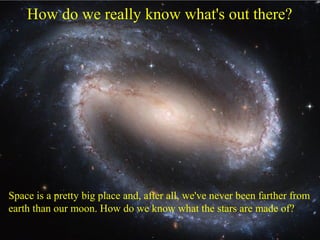
How do we really know what's out there?
Space is a pretty big place and, after all, we've never been farther from
earth than our moon. How do we know what the stars are made of?
This is the electromagnetic spectrum. It consists of waves which vary in
length from very long (radio waves) to incredibly short (gamma rays). A
special part of the spectrum consists of waves that we can see. This is
called the visible spectrum. We see different wavelengths as different
colors ranging from red (long wavelengths) to blue/violet (short wave-
lengths).
White light consists of all visible wavelengths together. When white
light passes through a prism, a triangular piece of glass or plastic, the
different wavelengths are separated and can be seen individually.
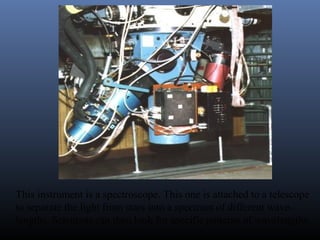
This instrument is a spectroscope. This one is attached to a telescope
to separate the light from stars into a spectrum of different wave-
lengths. Scientists can then look for specific patterns of wavelengths.
BASIC WORKING PRINCIPLE OF
SPECTROSCOPE
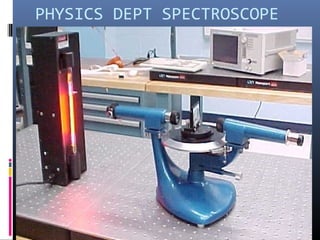
PHYSICS DEPT SPECTROSCOPE
Simple model of the atom
Electron absorbs some energy which
causes it to “jump” to a higher energy
level. This is called excitation.
E1
E2
Energy
Nucleus
De-excitation
E2
E1
Energy
The electron, preferring to be in the
lower energy, immediately drops back
down to the lower energy level.
In order to conserve energy, a
photon (discrete bundle of
energy) is emitted.E2
E1
Photon Energy
Photon Energy = E2 – E1
Because of the behavior of matter and energy at
the atomic scale, which is governed by Quantum
Mechanics, the energy of the photon is equal to
the difference in the energies of the two energy
levels and is also proportional to its frequency.
That is: Ephoton = hf where
•h = Planck’s constant.
•f = frequency of the photon.
Depending on the element, only certain
excitations and de-excitations (or transitions) are
allowed for the electrons.
•The cumulative result is that an atom of
a particular element will only have light
emissions of certain frequencies.
•The combination of all the allowed
transitions produces an emission
spectrum for that particular element.
•No two elements have the same
emission spectrum, so the emission
spectrum can be used to identify the
element in question.
Emission Spectrum
•Emission spectra are emitted
by atoms in a gaseous state
where the atoms are so far apart
that interactions between them
are negligible.
i.e. (each atom behaves as an
isolated system.)
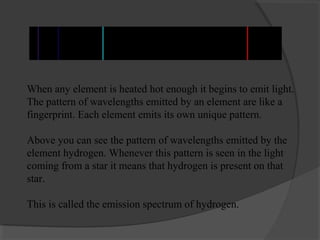
When any element is heated hot enough it begins to emit light.
The pattern of wavelengths emitted by an element are like a
fingerprint. Each element emits its own unique pattern.
Above you can see the pattern of wavelengths emitted by the
element hydrogen. Whenever this pattern is seen in the light
coming from a star it means that hydrogen is present on that
star.
This is called the emission spectrum of hydrogen.
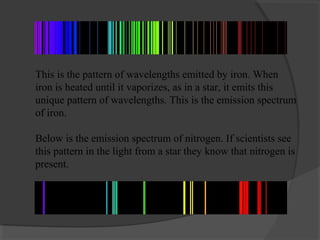
This is the pattern of wavelengths emitted by iron. When
iron is heated until it vaporizes, as in a star, it emits this
unique pattern of wavelengths. This is the emission spectrum
of iron.
Below is the emission spectrum of nitrogen. If scientists see
this pattern in the light from a star they know that nitrogen is
present.
Emission Spectrum of Various Elements
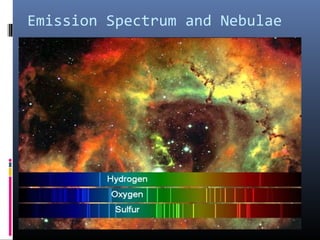
Emission Spectrum and Nebulae
Incandescence
 Hot Matter in condensed states
(solid or liquid or dense gas)
nearly always emits radiation with
a continuous spectrum.
•This is called Incandescence.
Continuous Spectrum
•When the atoms are in a condensed state,
the electrons can make transitions not only
within the energy levels of their own atom,
but also between the levels of neighboring
atoms.
•This results in a much larger number of
possible transitions with corresponding
frequencies of radiant energy, producing
a continuous spectrum.
Continuous Spectrum
(Chaisson/McMillan) Astronomy
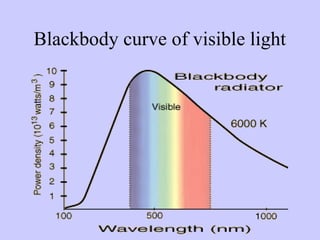
The continuous spectrum emitted by an ideal
surface that is completely nonreflecting is
called blackbody radiation.
•Example: A Star.
•The predominant frequency of radiation
(the peak frequency) is proportional to the
temperature of the emitter:
•f ∼ Temperature
Blackbody curve of visible light
Absorption Spectrum
 Absorption of certain lines when viewed through
a spectroscope, we see a absorption spectrum.
If a gas is placed between the source
and the spectroscope, we see an
absorption spectrum - the inverse of
emission spectrum.
Continous Spectrum
Portion of the Emission Spectrum
Absorption Spectrum
Hot Gas
Cold Gas
Spectrum of Hydrogen, Emission lines
Bohr’s formula:
An approximate
classification
of Spectral
colors.
Violet (380-435nm)
Blue(435-500 nm)
Cyan (500-520 nm)
Green (520-565 nm)
Yellow (565- 590 nm)
Orange (590-625 nm)
Red (625-740 nm)
The normal wavelength of H- alpha line is
656.3 nm. The light is observed to be
shifted to 670 nm, when coming from
galaxy. What is the recessional speed of
galaxy?
V= 6300 km/s.
Remember, the greater the amount of shift,
the faster the star is moving!
Helium
Helium slightly red shifted. Moving away.
Helium more red shifted. Moving away even faster!
ALL of the light from stars and galaxies that reaches the earth
is red shifted. What does that mean?
It means that everything is moving away from us!
How can everything be moving away from us?
The only explanation for that is .............................................
THE UNIVERSE IS EXPANDING!
And if the universe is expanding then long ago it must have
been much smaller. The expansion began about 14.7 billion
years ago with the.................
BIG BANG!
THANK YOU

Spectroscopy and doppler shift

  • 3.
    How do wereally know what's out there? Space is a pretty big place and, after all, we've never been farther from earth than our moon. How do we know what the stars are made of?
  • 4.
    This is theelectromagnetic spectrum. It consists of waves which vary in length from very long (radio waves) to incredibly short (gamma rays). A special part of the spectrum consists of waves that we can see. This is called the visible spectrum. We see different wavelengths as different colors ranging from red (long wavelengths) to blue/violet (short wave- lengths).
  • 5.
    White light consistsof all visible wavelengths together. When white light passes through a prism, a triangular piece of glass or plastic, the different wavelengths are separated and can be seen individually.
  • 6.
    This instrument isa spectroscope. This one is attached to a telescope to separate the light from stars into a spectrum of different wave- lengths. Scientists can then look for specific patterns of wavelengths.
  • 7.
    BASIC WORKING PRINCIPLEOF SPECTROSCOPE
  • 8.
  • 9.
    Simple model ofthe atom Electron absorbs some energy which causes it to “jump” to a higher energy level. This is called excitation. E1 E2 Energy Nucleus
  • 10.
    De-excitation E2 E1 Energy The electron, preferringto be in the lower energy, immediately drops back down to the lower energy level.
  • 11.
    In order toconserve energy, a photon (discrete bundle of energy) is emitted.E2 E1 Photon Energy Photon Energy = E2 – E1 Because of the behavior of matter and energy at the atomic scale, which is governed by Quantum Mechanics, the energy of the photon is equal to the difference in the energies of the two energy levels and is also proportional to its frequency.
  • 12.
    That is: Ephoton= hf where •h = Planck’s constant. •f = frequency of the photon. Depending on the element, only certain excitations and de-excitations (or transitions) are allowed for the electrons. •The cumulative result is that an atom of a particular element will only have light emissions of certain frequencies.
  • 13.
    •The combination ofall the allowed transitions produces an emission spectrum for that particular element. •No two elements have the same emission spectrum, so the emission spectrum can be used to identify the element in question.
  • 14.
    Emission Spectrum •Emission spectraare emitted by atoms in a gaseous state where the atoms are so far apart that interactions between them are negligible. i.e. (each atom behaves as an isolated system.)
  • 15.
    When any elementis heated hot enough it begins to emit light. The pattern of wavelengths emitted by an element are like a fingerprint. Each element emits its own unique pattern. Above you can see the pattern of wavelengths emitted by the element hydrogen. Whenever this pattern is seen in the light coming from a star it means that hydrogen is present on that star. This is called the emission spectrum of hydrogen.
  • 16.
    This is thepattern of wavelengths emitted by iron. When iron is heated until it vaporizes, as in a star, it emits this unique pattern of wavelengths. This is the emission spectrum of iron. Below is the emission spectrum of nitrogen. If scientists see this pattern in the light from a star they know that nitrogen is present.
  • 17.
    Emission Spectrum ofVarious Elements
  • 18.
  • 19.
    Incandescence  Hot Matterin condensed states (solid or liquid or dense gas) nearly always emits radiation with a continuous spectrum. •This is called Incandescence.
  • 20.
    Continuous Spectrum •When theatoms are in a condensed state, the electrons can make transitions not only within the energy levels of their own atom, but also between the levels of neighboring atoms. •This results in a much larger number of possible transitions with corresponding frequencies of radiant energy, producing a continuous spectrum.
  • 21.
  • 22.
    The continuous spectrumemitted by an ideal surface that is completely nonreflecting is called blackbody radiation. •Example: A Star. •The predominant frequency of radiation (the peak frequency) is proportional to the temperature of the emitter: •f ∼ Temperature
  • 23.
    Blackbody curve ofvisible light
  • 24.
    Absorption Spectrum  Absorptionof certain lines when viewed through a spectroscope, we see a absorption spectrum.
  • 25.
    If a gasis placed between the source and the spectroscope, we see an absorption spectrum - the inverse of emission spectrum.
  • 26.
    Continous Spectrum Portion ofthe Emission Spectrum Absorption Spectrum Hot Gas Cold Gas
  • 27.
    Spectrum of Hydrogen,Emission lines Bohr’s formula:
  • 29.
    An approximate classification of Spectral colors. Violet(380-435nm) Blue(435-500 nm) Cyan (500-520 nm) Green (520-565 nm) Yellow (565- 590 nm) Orange (590-625 nm) Red (625-740 nm)
  • 33.
    The normal wavelengthof H- alpha line is 656.3 nm. The light is observed to be shifted to 670 nm, when coming from galaxy. What is the recessional speed of galaxy? V= 6300 km/s.
  • 35.
    Remember, the greaterthe amount of shift, the faster the star is moving! Helium Helium slightly red shifted. Moving away. Helium more red shifted. Moving away even faster!
  • 37.
    ALL of thelight from stars and galaxies that reaches the earth is red shifted. What does that mean? It means that everything is moving away from us! How can everything be moving away from us? The only explanation for that is ............................................. THE UNIVERSE IS EXPANDING! And if the universe is expanding then long ago it must have been much smaller. The expansion began about 14.7 billion years ago with the................. BIG BANG!
  • 38.