Prepared by:
Kenneth Jay A. Robillos
Henry M. Lagrita
Integrated Circuit
INTEGRATED CIRCUIT
-also referred as a monolithic integrated circuit
is an assembly of different electronic components like
connected together on one small semiconductor wafer
(usually silicon).
-also called as a chip or a microchip.
-“A circuit in which all or some of the circuit
elements are inseparably associated and electrically
interconnected so that it is considered to be indivisible
for the purposes of construction and commerce”
History of Integrated Circuits
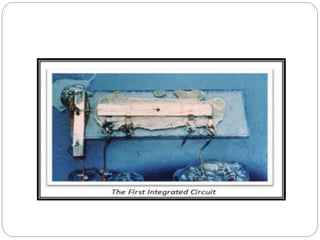
In 1958 Jack Kilby an engineer of Texas
instruments demonstrated successfully the first working
integrated circuit device. The first costumer to this new
invention was the US Air Force. In the year 2000 Jack
Kilby won the Nobel Prize in Physics for miniaturized
electronic circuits.
Jack St. Clair Kilby (November
8, 1923 – June 20, 2005)
- was an American electrical
engineer who took part (along
with Robert Noyce) in the
realization of the first integrated
circuit while working at Texas
Instruments (TI) in 1958. He was
awarded the Nobel Prize in
physics on December 10, 2000.
Evolution of INTEGRATED CIRCUIT
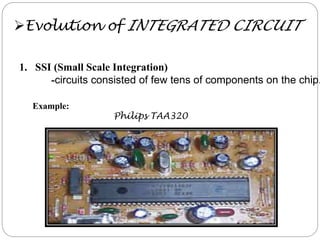
1. SSI (Small Scale Integration)
-circuits consisted of few tens of components on the chip.
Example:
Philips TAA320
2. MSI (Medium Small Integration)
-devices came into existence which had 100’s of
transistors on the chip. MSI devices were less expensive
and allowed more complex systems in very less space
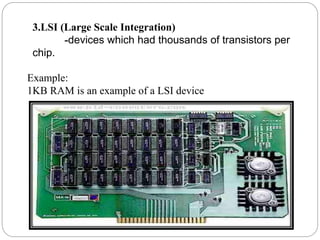
3.LSI (Large Scale Integration)
-devices which had thousands of transistors per
chip.
Example:
1KB RAM is an example of a LSI device
4. VLSI (Very Large Scale Integration)
-is the process of creating an integrated circuit (IC) by
combining thousands of transistors into a single chip. VLSI began
in the 1970s when
complex semiconductor and communication technologies were
being developed. The microprocessor is a VLSI device. Before the
introduction of VLSI technology most ICs had a limited set of
functions they could perform. An electronic circuit might consist of
a CPU, ROM, RAM and other glue logic. VLSI lets IC designers
add all of these into one chip
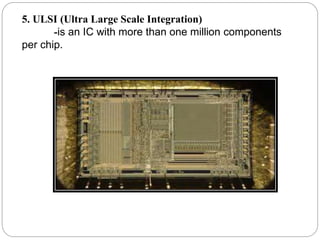
5. ULSI (Ultra Large Scale Integration)
-is an IC with more than one million components
per chip.
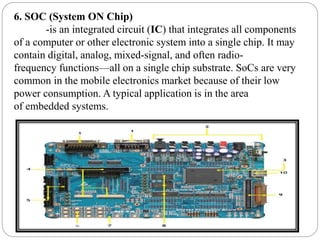
6. SOC (System ON Chip)
-is an integrated circuit (IC) that integrates all components
of a computer or other electronic system into a single chip. It may
contain digital, analog, mixed-signal, and often radio-
frequency functions—all on a single chip substrate. SoCs are very
common in the mobile electronics market because of their low
power consumption. A typical application is in the area
of embedded systems.
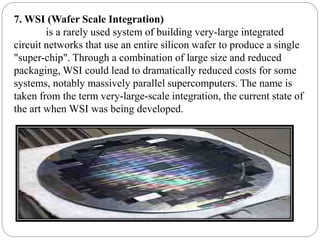
7. WSI (Wafer Scale Integration)
is a rarely used system of building very-large integrated
circuit networks that use an entire silicon wafer to produce a single
"super-chip". Through a combination of large size and reduced
packaging, WSI could lead to dramatically reduced costs for some
systems, notably massively parallel supercomputers. The name is
taken from the term very-large-scale integration, the current state of
the art when WSI was being developed.
8.3D-IC (Three dimensional Integrated Circuits)
-is an integrated circuit manufactured by
stacking silicon wafers and/or dies and interconnecting them
vertically using through-silicon vias (TSVs) so that they behave as
a single device to achieve performance improvements at reduced
power and smaller footprint than conventional two dimensional
processes. 3D IC is just one of a host of 3D integration schemes
that exploit the z-direction to achieve electrical performance
benefits.
Types of Integrated Circuits
A. Digital Integrated Circuits
Digital IC’s are the one’s which work only on
two defined levels 1’s and 0’s. They work on binary
mathematics. They can contain millions of logic gates,
flip-flops etc integrated on a single chip.
Microprocessors and microcontrollers are
examples of digital IC’s
B. Analog Integrated Circuits
They work by processing continuous signals. They perform
functions such as filtering, amplification, modulation, demodulation
etc.
Sensors, OP-AMP’s are analog IC’s
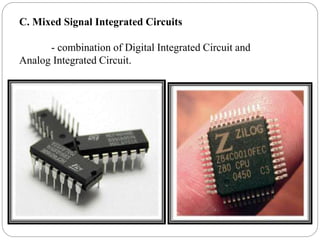
C. Mixed Signal Integrated Circuits
- combination of Digital Integrated Circuit and
Analog Integrated Circuit.
D. Microprocessor Integrated Circuits
-composed of millions of transistors that have been
configured as thousands of individual digital circuits, each of which
performs some specific logic function.
E. Memory Integrated Circuits
- memory is composed of dense arrays of parallel circuits that
use their voltage states to store information. Memory also stores
the temporary sequence of instructions, or program, for the
microprocessor
F. Application-specific Integrated Circuits
-An application-specific IC (ASIC) can be either a digital or
an analog circuit. As their name implies, ASICs are not
reconfigurable; they perform only one specific function. For
example, a speed controller IC for a remote control car is hard-wired
to do one job and could never become a microprocessor. An ASIC
does not contain any ability to follow alternate instructions.
G. Radio-frequency Integrated Circuits
-Radio-frequency ICs (RFICs) are rapidly gaining importance
in cellular telephones and pagers. RFICs are analog circuits that
usually run in the frequency range of 900 MHz to 2.4 GHz (900
million hertz to 2.4 billion hertz). They are usually thought of as
ASICs even though some may be configurable for several similar
applications.
H. Microwave monolithic Integrated Circuits
-A special type of RFIC is known as a microwave monolithic
IC (MMIC). These circuits run in the 2.4- to 20-GHz range, or
microwave frequencies, and are used in radar systems, in satellite
communications, and as power amplifiers for cellular telephones.
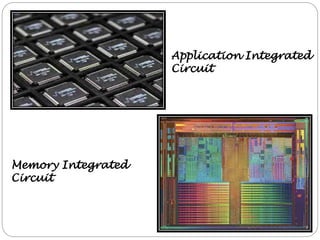
Application Integrated
Circuit
Memory Integrated
Circuit
Radio-Frequency
Integrated Circuit
Microwave
Monolithic
Integrated Circuit
Advantages of Integrated Circuits
1. Since the soldering joints are not used in integrated circuits, this
means that they are more reliable than discrete circuits. This is due
to the reduction in number of interconnections between
components.
2. Due to fabrication of the various components on the integrated
circuits, the components became much smaller. This makes
integrated circuits much lighter than discrete circuits. The
integrated circuits thus consume much less space than discrete
circuits.
3. Integrated circuits are encapsulated with a silicon oxide layer
during manufacture. This layer is tough and resistant and thus gives
the integrated an ability to operate at extremes of temperatures and
other extreme environmental conditions.
4. Integrated circuits are constrained to minimize the number of
external connection. This has greatly simplified the layout of these
circuits and makes them easier to use.
5. Integrated circuits have been notice to use less power for
operations.
Disadvantages of Integrated Circuits
1. If one component in an integrated fails, that means the whole
circuit has to be replaced.
2. Integrated circuits have limited capacitances. This calls for
external components if the capacitance needs an extension.
3. It is impossible to fabricate transformers or any other kind of
inductor onto the integrated circuits and again calling for a
discrete circuit.
4. Power that integrated circuits can produce is limited and calls for
extension.
5. Integrated circuits are not flexible. Their components cannot be
modified and neither can the parameters of operation.
Importance of IC in Industry
First, the fact that they contain multiple components that are
designed and tested to perform a specific task means that the
electronic designer can use them as building blocks within a
circuit instead of designing many separate components.
Second, and the more significant advantage is that they can
reduce the size of components to allow a far higher
component density. Processor and memory chips contain
millions of components in a package that is only an inch or
two across. The same circuit in discrete components would
fill a room. We benefit by seeing tiny products such as cell
phones or laptop computers that simply wouldn't exist
without integrated circuits.
Integrated circuits also benefit us by using less power than
discrete components and by operating at higher frequencies.

Integrated circuit

  • 1.
    Prepared by: Kenneth JayA. Robillos Henry M. Lagrita Integrated Circuit
  • 2.
    INTEGRATED CIRCUIT -also referredas a monolithic integrated circuit is an assembly of different electronic components like connected together on one small semiconductor wafer (usually silicon). -also called as a chip or a microchip. -“A circuit in which all or some of the circuit elements are inseparably associated and electrically interconnected so that it is considered to be indivisible for the purposes of construction and commerce”
  • 3.
    History of IntegratedCircuits In 1958 Jack Kilby an engineer of Texas instruments demonstrated successfully the first working integrated circuit device. The first costumer to this new invention was the US Air Force. In the year 2000 Jack Kilby won the Nobel Prize in Physics for miniaturized electronic circuits.
  • 4.
    Jack St. ClairKilby (November 8, 1923 – June 20, 2005) - was an American electrical engineer who took part (along with Robert Noyce) in the realization of the first integrated circuit while working at Texas Instruments (TI) in 1958. He was awarded the Nobel Prize in physics on December 10, 2000.
  • 6.
    Evolution of INTEGRATEDCIRCUIT 1. SSI (Small Scale Integration) -circuits consisted of few tens of components on the chip. Example: Philips TAA320
  • 7.
    2. MSI (MediumSmall Integration) -devices came into existence which had 100’s of transistors on the chip. MSI devices were less expensive and allowed more complex systems in very less space
  • 8.
    3.LSI (Large ScaleIntegration) -devices which had thousands of transistors per chip. Example: 1KB RAM is an example of a LSI device
  • 9.
    4. VLSI (VeryLarge Scale Integration) -is the process of creating an integrated circuit (IC) by combining thousands of transistors into a single chip. VLSI began in the 1970s when complex semiconductor and communication technologies were being developed. The microprocessor is a VLSI device. Before the introduction of VLSI technology most ICs had a limited set of functions they could perform. An electronic circuit might consist of a CPU, ROM, RAM and other glue logic. VLSI lets IC designers add all of these into one chip
  • 11.
    5. ULSI (UltraLarge Scale Integration) -is an IC with more than one million components per chip.
  • 12.
    6. SOC (SystemON Chip) -is an integrated circuit (IC) that integrates all components of a computer or other electronic system into a single chip. It may contain digital, analog, mixed-signal, and often radio- frequency functions—all on a single chip substrate. SoCs are very common in the mobile electronics market because of their low power consumption. A typical application is in the area of embedded systems.
  • 13.
    7. WSI (WaferScale Integration) is a rarely used system of building very-large integrated circuit networks that use an entire silicon wafer to produce a single "super-chip". Through a combination of large size and reduced packaging, WSI could lead to dramatically reduced costs for some systems, notably massively parallel supercomputers. The name is taken from the term very-large-scale integration, the current state of the art when WSI was being developed.
  • 14.
    8.3D-IC (Three dimensionalIntegrated Circuits) -is an integrated circuit manufactured by stacking silicon wafers and/or dies and interconnecting them vertically using through-silicon vias (TSVs) so that they behave as a single device to achieve performance improvements at reduced power and smaller footprint than conventional two dimensional processes. 3D IC is just one of a host of 3D integration schemes that exploit the z-direction to achieve electrical performance benefits.
  • 15.
    Types of IntegratedCircuits A. Digital Integrated Circuits Digital IC’s are the one’s which work only on two defined levels 1’s and 0’s. They work on binary mathematics. They can contain millions of logic gates, flip-flops etc integrated on a single chip. Microprocessors and microcontrollers are examples of digital IC’s
  • 17.
    B. Analog IntegratedCircuits They work by processing continuous signals. They perform functions such as filtering, amplification, modulation, demodulation etc. Sensors, OP-AMP’s are analog IC’s
  • 18.
    C. Mixed SignalIntegrated Circuits - combination of Digital Integrated Circuit and Analog Integrated Circuit.
  • 19.
    D. Microprocessor IntegratedCircuits -composed of millions of transistors that have been configured as thousands of individual digital circuits, each of which performs some specific logic function. E. Memory Integrated Circuits - memory is composed of dense arrays of parallel circuits that use their voltage states to store information. Memory also stores the temporary sequence of instructions, or program, for the microprocessor
  • 20.
    F. Application-specific IntegratedCircuits -An application-specific IC (ASIC) can be either a digital or an analog circuit. As their name implies, ASICs are not reconfigurable; they perform only one specific function. For example, a speed controller IC for a remote control car is hard-wired to do one job and could never become a microprocessor. An ASIC does not contain any ability to follow alternate instructions. G. Radio-frequency Integrated Circuits -Radio-frequency ICs (RFICs) are rapidly gaining importance in cellular telephones and pagers. RFICs are analog circuits that usually run in the frequency range of 900 MHz to 2.4 GHz (900 million hertz to 2.4 billion hertz). They are usually thought of as ASICs even though some may be configurable for several similar applications.
  • 21.
    H. Microwave monolithicIntegrated Circuits -A special type of RFIC is known as a microwave monolithic IC (MMIC). These circuits run in the 2.4- to 20-GHz range, or microwave frequencies, and are used in radar systems, in satellite communications, and as power amplifiers for cellular telephones.
  • 22.
  • 23.
  • 24.
    Advantages of IntegratedCircuits 1. Since the soldering joints are not used in integrated circuits, this means that they are more reliable than discrete circuits. This is due to the reduction in number of interconnections between components. 2. Due to fabrication of the various components on the integrated circuits, the components became much smaller. This makes integrated circuits much lighter than discrete circuits. The integrated circuits thus consume much less space than discrete circuits.
  • 25.
    3. Integrated circuitsare encapsulated with a silicon oxide layer during manufacture. This layer is tough and resistant and thus gives the integrated an ability to operate at extremes of temperatures and other extreme environmental conditions. 4. Integrated circuits are constrained to minimize the number of external connection. This has greatly simplified the layout of these circuits and makes them easier to use. 5. Integrated circuits have been notice to use less power for operations.
  • 26.
    Disadvantages of IntegratedCircuits 1. If one component in an integrated fails, that means the whole circuit has to be replaced. 2. Integrated circuits have limited capacitances. This calls for external components if the capacitance needs an extension. 3. It is impossible to fabricate transformers or any other kind of inductor onto the integrated circuits and again calling for a discrete circuit. 4. Power that integrated circuits can produce is limited and calls for extension. 5. Integrated circuits are not flexible. Their components cannot be modified and neither can the parameters of operation.
  • 27.
    Importance of ICin Industry First, the fact that they contain multiple components that are designed and tested to perform a specific task means that the electronic designer can use them as building blocks within a circuit instead of designing many separate components. Second, and the more significant advantage is that they can reduce the size of components to allow a far higher component density. Processor and memory chips contain millions of components in a package that is only an inch or two across. The same circuit in discrete components would fill a room. We benefit by seeing tiny products such as cell phones or laptop computers that simply wouldn't exist without integrated circuits. Integrated circuits also benefit us by using less power than discrete components and by operating at higher frequencies.