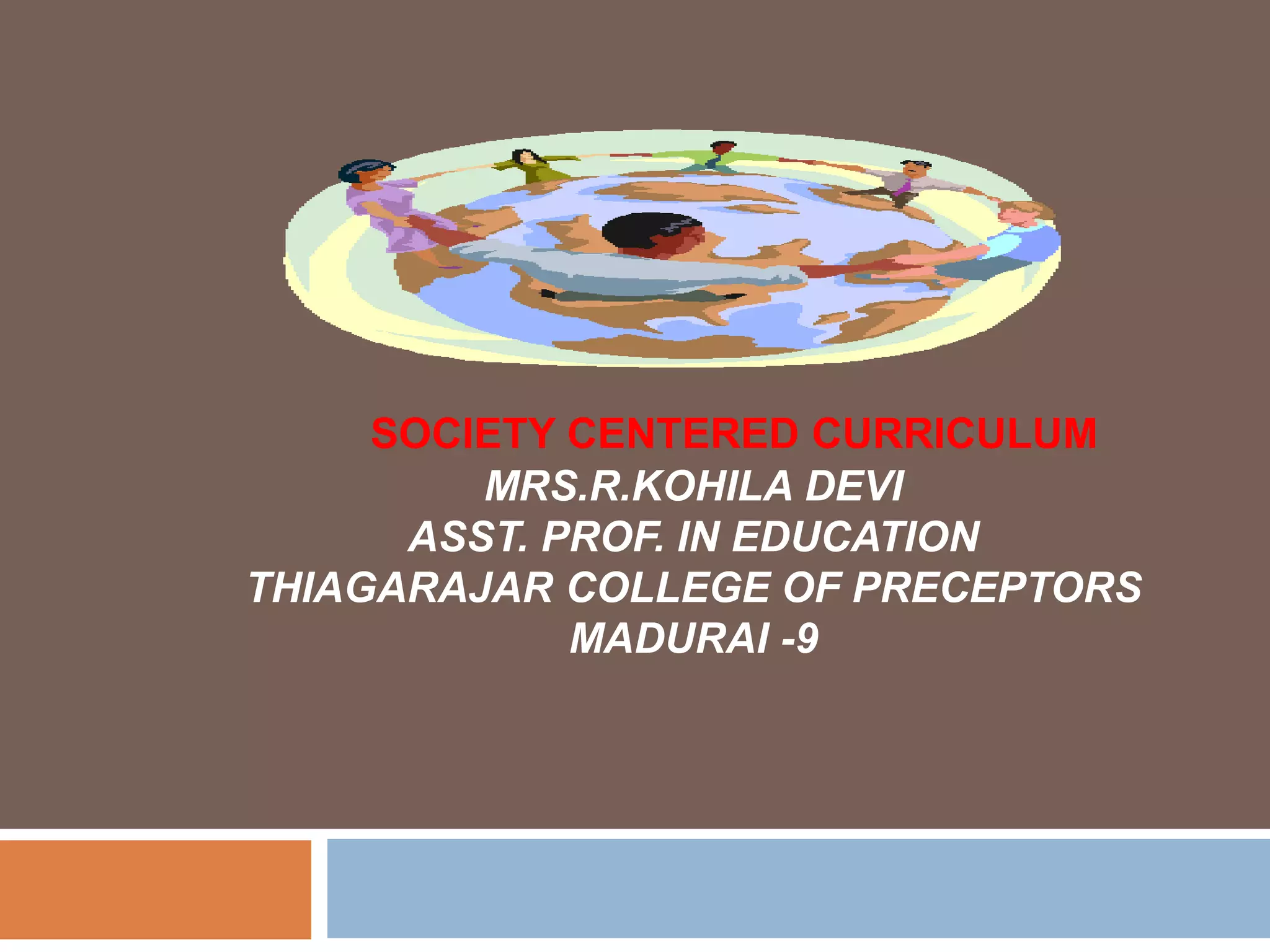
SOCIETY CENTERED CURRICULUM
MRS.R.KOHILA DEVI
ASST. PROF. IN EDUCATION
THIAGARAJAR COLLEGE OF PRECEPTORS
MADURAI -9
SOCIETY CENTERED
CURRICULUM
 The primary focus of this curriculum is to focus education on
socially relevant and significant factors.
 The focus is also on problems that engage the real world.
 Learning is presented through a project-approach rather than
working on independent projects for every student.
 Group and group action is an important aspect of this
curriculum.
 Interest is on making the world a better place by exploring the
local community's problems.
 Ultimately, it's a curriculum that gives a little bit back to the
community.
 The goal of the curriculum • The curriculum is
based on societal issues • and the goal of the
curriculum is to explore and solve those
issues. • “Young people are at a formative,
idealistic stage of their life, and they need to
learn that they can and should make a
difference in the world”
 Activist model • This is very much an activist
model, where students are encouraged to be
leading activists in their community where life
problems, community affairs, and real-world
problems exist.
 Emphasis •The main focus of the SCC is the
group and group action.
 The SCC curriculum is a problem- solving
curriculum, and these problems are to be solved
through the participation and efforts of the whole
group.
 Students work to find the social relevance of their
efforts and how they can improve their citizenship
by the projects they take on.
Role of teacher
 In the SCC teachers have a very important role.
 to help students achieve their goals. serve as facilitator: organizing
group efforts
 helps children develop their social skills
 In creating a climate for collaboration and team building.
 responsible for turning their class into a problem-solving unit.
 responsible for making connections with community members
 Student’s role in the Society-Centered Curriculum
 Students are responsible for being aware of the world around them
 issues that impact their life. • Cooperation • Team work • Active
participation • To make the community a better place
 Learning environment • Democratic • Community as laboratory
 Assessments in the Society-Centered Curriculum • focus around the
students’ efforts and outcomes • on their ability to apply their
knowledge and skills
 Types of SCC assessment include:
written work, observations, presentations, informal discussions
and questions, project designs, and final products.
 Teachers are not the only ones involved in the assessment
process, students and peers are also actively involved.
 Students are given the chance to create their own rubric
which the teacher can use to assess their learning.
Benefits
 Increases students awareness of social issues and current
events
 Fosters positive social interactions Fosters the social skills
 Emphasis on leaving the world a better place through group
problem solving
 Engages students in hands on learning experiences

LIFE CENTERED AND SOCIETY CENTERED CURRICULUM

  • 1.
    SOCIETY CENTERED CURRICULUM MRS.R.KOHILADEVI ASST. PROF. IN EDUCATION THIAGARAJAR COLLEGE OF PRECEPTORS MADURAI -9
  • 2.
    SOCIETY CENTERED CURRICULUM  Theprimary focus of this curriculum is to focus education on socially relevant and significant factors.  The focus is also on problems that engage the real world.  Learning is presented through a project-approach rather than working on independent projects for every student.  Group and group action is an important aspect of this curriculum.  Interest is on making the world a better place by exploring the local community's problems.  Ultimately, it's a curriculum that gives a little bit back to the community.
  • 3.
     The goalof the curriculum • The curriculum is based on societal issues • and the goal of the curriculum is to explore and solve those issues. • “Young people are at a formative, idealistic stage of their life, and they need to learn that they can and should make a difference in the world”
  • 4.
     Activist model• This is very much an activist model, where students are encouraged to be leading activists in their community where life problems, community affairs, and real-world problems exist.  Emphasis •The main focus of the SCC is the group and group action.  The SCC curriculum is a problem- solving curriculum, and these problems are to be solved through the participation and efforts of the whole group.  Students work to find the social relevance of their efforts and how they can improve their citizenship by the projects they take on.
  • 5.
    Role of teacher In the SCC teachers have a very important role.  to help students achieve their goals. serve as facilitator: organizing group efforts  helps children develop their social skills  In creating a climate for collaboration and team building.  responsible for turning their class into a problem-solving unit.  responsible for making connections with community members  Student’s role in the Society-Centered Curriculum  Students are responsible for being aware of the world around them  issues that impact their life. • Cooperation • Team work • Active participation • To make the community a better place  Learning environment • Democratic • Community as laboratory  Assessments in the Society-Centered Curriculum • focus around the students’ efforts and outcomes • on their ability to apply their knowledge and skills
  • 6.
     Types ofSCC assessment include: written work, observations, presentations, informal discussions and questions, project designs, and final products.  Teachers are not the only ones involved in the assessment process, students and peers are also actively involved.  Students are given the chance to create their own rubric which the teacher can use to assess their learning. Benefits  Increases students awareness of social issues and current events  Fosters positive social interactions Fosters the social skills  Emphasis on leaving the world a better place through group problem solving  Engages students in hands on learning experiences