School as a social hub
INTRODUCTION
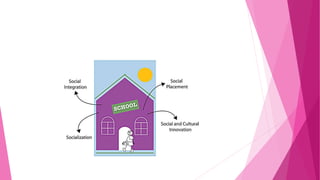
 The term social system refers to the actual association and educational process when it is examined as a discernible unit
from sectors of society.
 Education prepare them for future by developing the skill to live in society.
 According to clark the education system helps to bear on society economy , political organization, social stratification,
culture and social integration.
 Education is a social sub system that brings positive changes.
 School provides a learning place for students to learn a lot from teachers.
 Father of social subsystem is Chester Barnard.
 Education can act as a tool not only for development of society but also for people more capable before.
 The most important function of education is socialization, If children need to learn the norms, values, and skills they need
to function in society, then education is a primary vehicle for such learning.
 The establishment of peer relationships is another latent function of schooling.
 Most of us met many of our friends while we were in school at whatever grade level, and some of those friendships
endure the rest of our lives.
EDUCATION SYSTEM OF INDIAN
SOCIETY
 Development of science technology.
 After independence education is mostly focused on technology and
innovation.
 spending the education budget, most of it is spent on teachers’ salaries,
student scholarships, and science experiments.
 Economy has increased exponentially since independence.
 Education system of india is based on inculcating national, cultural and
liberate people from false ignorance.
CHARACTERISTICS OF EDUCATION
SUB SYSTEM
 Following are the characteristics of education as a sub-system
 Education is a strong way to create a healthy society.
 The education system takes the people to create a disciplined society where.
 All the needs related to education can be fulfilled only in the educational
institutions created in society.
 Education develops respect towards values, culture, and other effective
things.
 Educated people can take society in the desired direction.
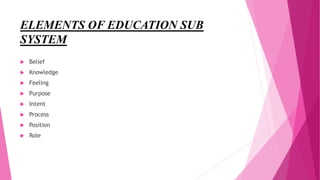
ELEMENTS OF EDUCATION SUB
SYSTEM
 Belief
 Knowledge
 Feeling
 Purpose
 Intent
 Process
 Position
 Role
ROLE OF SCHOOL IN INDIVIDUAL
GROWTH
 Positive interaction.
 Character building.
 Social development.
 Explore new things.
 Widening horizons.
 Build confidence and vocal.
conclusion
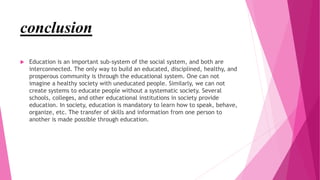
 Education is an important sub-system of the social system, and both are
interconnected. The only way to build an educated, disciplined, healthy, and
prosperous community is through the educational system. One can not
imagine a healthy society with uneducated people. Similarly, we can not
create systems to educate people without a systematic society. Several
schools, colleges, and other educational institutions in society provide
education. In society, education is mandatory to learn how to speak, behave,
organize, etc. The transfer of skills and information from one person to
another is made possible through education.
PSYCHO SOCIAL AND PHILOSOPHICAL BASES OF
EDUCATION
COMMUNITY SCHOOLS AND
COLLEGES
Group 2
9
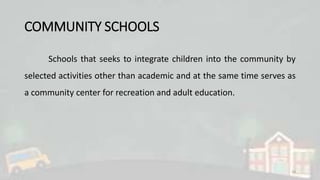
COMMUNITY SCHOOLS
Schools that seeks to integrate children into the community by
selected activities other than academic and at the same time serves as
a community center for recreation and adult education.
10
COMMUNITY SCHOOLS - OBJECTIVES
1. To provide stimulating environment to develop an inquisitive mind.
2. To increase the development opportunities of children
3. To enhance student learning by joining theory with experience and
thought with action.
11
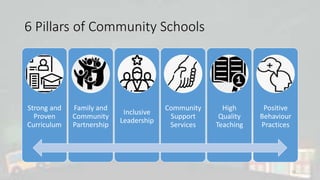
6 Pillars of Community Schools
Strong and
Proven
Curriculum
Family and
Community
Partnership
Inclusive
Leadership
Community
Support
Services
High
Quality
Teaching
Positive
Behaviour
Practices
12
COMMUNITY COLLEGES
Educational Institutions that provide a range of courses to students in order to help
their skill enhancement.
Community college is usually a 2 year college that offers general education to the
students such as math, history before transferring to a four year university or going
for a job.
Types of courses offered
• Certificate
• Diploma
• Advance diploma/ Associate degree
13
COMMUNITY COLLEGES - OBJECTIVES
1. Provide academic programming and skills training to prepare
students for jobs or to transfer to four-year colleges and universities.
2. Imparts in-depth knowledge and understanding so as to advance the
students to new frontiers of knowledge.
3. Provide proper career guidance to those students who are passing
out from the corporation colleges every year.
14
Reasons for studying community college
• Affordable: These colleges provide good quality education at an affordable cost
which doesn’t create a burden on the students as well as their parents.
• Flexibility: Community college can be great for those who are not actually sure
what they want to do as an academic institution provide the flexibility of learning
and coping with everything at your own pace without any pressure. It also gives
you the opportunity to discover new things about yourself and find out what is
best for you.
• Relevance: Everyone demands trained professionals in order to carry out work.
These types of colleges play a big role in developing technical and vocational skills
for international students. For eg- green technology is an emerging field and it
will require its workers to be trained in different and new ways.
15
Role of a teacher in community schools and
colleges
• Teacher initiates joyful and comfortable learning culture for
developing different life skills i.e. self awareness, problem solving,
decision making, creative thinking critical thinking and other essential
life skills.
• Teachers offer students guidance to show interest in their goals.
• Teachers helps to shape the community and can direct students in
positive directions that they may not have pursued otherwise.
16
THANK YOU
17
TRP
Education for Social
Justice , Democracy and
Citizenship
Stay
Positive
What is social Justice ?
Social justice means providing equal social, political, economic opportunities and
rights. There should not be any kind of discrimination based on caste, religion, language,
etc. Social justice promotes fairness and equity across many aspects of society.
Educationfor Social Justice
Education for social justice refers to an educational approach that aims to
promote social equity and justice by providing individuals with the knowledge, skills, and
attitudes necessary to understand and address social inequalities and injustices.
Education for Social Justice
At its core, education for social justice seeks to create a more just and equitable society
by empowering individuals to recognize and challenge systems of oppression,
discrimination, and privilege.
This involves teaching students about the historical and contemporary factors that
contribute to social inequality, including race, class, gender, sexuality, and other forms of
identity.
Some of the key principles of education for social justice include:
1. Critical thinking:
Encouraging students to critically analyze and question the social structures and
power dynamics that contribute to inequality.
2. Equity and inclusivity:
Promoting inclusive and equitable learning environments that recognize and
value the diversity of students' backgrounds, experiences, and perspectives.
What is Democracy?
Democracy is a system of government that values individual rights and freedoms,
and that is designed to ensure that power is held by the people, rather than by a single
ruler or governing body.
Education for Democracy
Education for democracy refers to an educational approach that aims to prepare
individuals to become active and engaged citizens who are capable of participating in and
contributing to democratic societies.
Education for Democracy
Education for democracy seeks to promote democratic values and practices, such as
freedom, equality, justice, and participation.
This involves teaching students about the principles of democracy, as well as the
skills and attitudes necessary to engage in democratic processes, such as voting,
participating in public debates, and advocating for social and political change.
Some of the key principles of education for democracy include:
1. Civic education: Providing students with the knowledge and skills necessary to
participate in democratic processes, including how to identify and analyze political
issues, how to engage in political action, and how to evaluate the effectiveness of
different political strategies.
2. Critical thinking:
Encouraging students to engage in critical analysis of social and political issues, and
to develop the ability to assess information, evaluate arguments, and make informed
decisions.
3. Inclusivity and diversity:
Promoting inclusive and diverse learning environments that recognize and value
the diversity of students' backgrounds, experiences, and perspectives, and that provide
opportunities for all students to participate in democratic processes.
Overall, education for democracy is crucial for building and sustaining democratic
societies, and for ensuring that individuals are able to participate fully in the democratic
processes that shape their lives.
What is Citizenship?
Citizenship is a legal status of belonging to a country. A citizen has certain rights and
responsibilities under the law. Being a citizen of a particular country, an individual is
entitled to a dignified life, and can take active part in the administration of the country.
Educationfor Citizenship
• Education for citizenship refers to the process of equipping individuals with the
knowledge, skills, and attitudes necessary to participate actively in their communities
and society as responsible, informed, and engaged citizens.
Education for Citizenship
• Education for citizenship aims to foster an understanding of democratic values,
human rights, and social responsibility, as well as critical thinking, communication,
and collaboration skills.
• It prepares individuals to become active participants in the democratic process,
engage in civil discourse, and respect diverse perspectives.
• Education for citizenship can take place in various settings, including schools,
community organizations, and online platforms. It can include classroom instruction,
experiential learning opportunities, and service projects.
• Education for citizenship is essential for building strong and inclusive communities,
promoting social justice and equity, and ensuring that individuals have the skills and
knowledge necessary to engage effectively in the democratic process.
Thank you

School as a social sub system.pdf

  • 1.
    School as asocial hub
  • 2.
    INTRODUCTION  The termsocial system refers to the actual association and educational process when it is examined as a discernible unit from sectors of society.  Education prepare them for future by developing the skill to live in society.  According to clark the education system helps to bear on society economy , political organization, social stratification, culture and social integration.  Education is a social sub system that brings positive changes.  School provides a learning place for students to learn a lot from teachers.  Father of social subsystem is Chester Barnard.  Education can act as a tool not only for development of society but also for people more capable before.  The most important function of education is socialization, If children need to learn the norms, values, and skills they need to function in society, then education is a primary vehicle for such learning.  The establishment of peer relationships is another latent function of schooling.  Most of us met many of our friends while we were in school at whatever grade level, and some of those friendships endure the rest of our lives.
  • 4.
    EDUCATION SYSTEM OFINDIAN SOCIETY  Development of science technology.  After independence education is mostly focused on technology and innovation.  spending the education budget, most of it is spent on teachers’ salaries, student scholarships, and science experiments.  Economy has increased exponentially since independence.  Education system of india is based on inculcating national, cultural and liberate people from false ignorance.
  • 5.
    CHARACTERISTICS OF EDUCATION SUBSYSTEM  Following are the characteristics of education as a sub-system  Education is a strong way to create a healthy society.  The education system takes the people to create a disciplined society where.  All the needs related to education can be fulfilled only in the educational institutions created in society.  Education develops respect towards values, culture, and other effective things.  Educated people can take society in the desired direction.
  • 6.
    ELEMENTS OF EDUCATIONSUB SYSTEM  Belief  Knowledge  Feeling  Purpose  Intent  Process  Position  Role
  • 7.
    ROLE OF SCHOOLIN INDIVIDUAL GROWTH  Positive interaction.  Character building.  Social development.  Explore new things.  Widening horizons.  Build confidence and vocal.
  • 8.
    conclusion  Education isan important sub-system of the social system, and both are interconnected. The only way to build an educated, disciplined, healthy, and prosperous community is through the educational system. One can not imagine a healthy society with uneducated people. Similarly, we can not create systems to educate people without a systematic society. Several schools, colleges, and other educational institutions in society provide education. In society, education is mandatory to learn how to speak, behave, organize, etc. The transfer of skills and information from one person to another is made possible through education.
  • 9.
    PSYCHO SOCIAL ANDPHILOSOPHICAL BASES OF EDUCATION COMMUNITY SCHOOLS AND COLLEGES Group 2 9
  • 10.
    COMMUNITY SCHOOLS Schools thatseeks to integrate children into the community by selected activities other than academic and at the same time serves as a community center for recreation and adult education. 10
  • 11.
    COMMUNITY SCHOOLS -OBJECTIVES 1. To provide stimulating environment to develop an inquisitive mind. 2. To increase the development opportunities of children 3. To enhance student learning by joining theory with experience and thought with action. 11
  • 12.
    6 Pillars ofCommunity Schools Strong and Proven Curriculum Family and Community Partnership Inclusive Leadership Community Support Services High Quality Teaching Positive Behaviour Practices 12
  • 13.
    COMMUNITY COLLEGES Educational Institutionsthat provide a range of courses to students in order to help their skill enhancement. Community college is usually a 2 year college that offers general education to the students such as math, history before transferring to a four year university or going for a job. Types of courses offered • Certificate • Diploma • Advance diploma/ Associate degree 13
  • 14.
    COMMUNITY COLLEGES -OBJECTIVES 1. Provide academic programming and skills training to prepare students for jobs or to transfer to four-year colleges and universities. 2. Imparts in-depth knowledge and understanding so as to advance the students to new frontiers of knowledge. 3. Provide proper career guidance to those students who are passing out from the corporation colleges every year. 14
  • 15.
    Reasons for studyingcommunity college • Affordable: These colleges provide good quality education at an affordable cost which doesn’t create a burden on the students as well as their parents. • Flexibility: Community college can be great for those who are not actually sure what they want to do as an academic institution provide the flexibility of learning and coping with everything at your own pace without any pressure. It also gives you the opportunity to discover new things about yourself and find out what is best for you. • Relevance: Everyone demands trained professionals in order to carry out work. These types of colleges play a big role in developing technical and vocational skills for international students. For eg- green technology is an emerging field and it will require its workers to be trained in different and new ways. 15
  • 16.
    Role of ateacher in community schools and colleges • Teacher initiates joyful and comfortable learning culture for developing different life skills i.e. self awareness, problem solving, decision making, creative thinking critical thinking and other essential life skills. • Teachers offer students guidance to show interest in their goals. • Teachers helps to shape the community and can direct students in positive directions that they may not have pursued otherwise. 16
  • 17.
  • 18.
    Education for Social Justice, Democracy and Citizenship Stay Positive
  • 19.
    What is socialJustice ? Social justice means providing equal social, political, economic opportunities and rights. There should not be any kind of discrimination based on caste, religion, language, etc. Social justice promotes fairness and equity across many aspects of society. Educationfor Social Justice Education for social justice refers to an educational approach that aims to promote social equity and justice by providing individuals with the knowledge, skills, and attitudes necessary to understand and address social inequalities and injustices. Education for Social Justice
  • 20.
    At its core,education for social justice seeks to create a more just and equitable society by empowering individuals to recognize and challenge systems of oppression, discrimination, and privilege. This involves teaching students about the historical and contemporary factors that contribute to social inequality, including race, class, gender, sexuality, and other forms of identity. Some of the key principles of education for social justice include: 1. Critical thinking: Encouraging students to critically analyze and question the social structures and power dynamics that contribute to inequality. 2. Equity and inclusivity: Promoting inclusive and equitable learning environments that recognize and value the diversity of students' backgrounds, experiences, and perspectives.
  • 21.
    What is Democracy? Democracyis a system of government that values individual rights and freedoms, and that is designed to ensure that power is held by the people, rather than by a single ruler or governing body. Education for Democracy Education for democracy refers to an educational approach that aims to prepare individuals to become active and engaged citizens who are capable of participating in and contributing to democratic societies. Education for Democracy
  • 22.
    Education for democracyseeks to promote democratic values and practices, such as freedom, equality, justice, and participation. This involves teaching students about the principles of democracy, as well as the skills and attitudes necessary to engage in democratic processes, such as voting, participating in public debates, and advocating for social and political change. Some of the key principles of education for democracy include: 1. Civic education: Providing students with the knowledge and skills necessary to participate in democratic processes, including how to identify and analyze political issues, how to engage in political action, and how to evaluate the effectiveness of different political strategies.
  • 23.
    2. Critical thinking: Encouragingstudents to engage in critical analysis of social and political issues, and to develop the ability to assess information, evaluate arguments, and make informed decisions. 3. Inclusivity and diversity: Promoting inclusive and diverse learning environments that recognize and value the diversity of students' backgrounds, experiences, and perspectives, and that provide opportunities for all students to participate in democratic processes. Overall, education for democracy is crucial for building and sustaining democratic societies, and for ensuring that individuals are able to participate fully in the democratic processes that shape their lives.
  • 24.
    What is Citizenship? Citizenshipis a legal status of belonging to a country. A citizen has certain rights and responsibilities under the law. Being a citizen of a particular country, an individual is entitled to a dignified life, and can take active part in the administration of the country. Educationfor Citizenship • Education for citizenship refers to the process of equipping individuals with the knowledge, skills, and attitudes necessary to participate actively in their communities and society as responsible, informed, and engaged citizens. Education for Citizenship
  • 25.
    • Education forcitizenship aims to foster an understanding of democratic values, human rights, and social responsibility, as well as critical thinking, communication, and collaboration skills. • It prepares individuals to become active participants in the democratic process, engage in civil discourse, and respect diverse perspectives. • Education for citizenship can take place in various settings, including schools, community organizations, and online platforms. It can include classroom instruction, experiential learning opportunities, and service projects. • Education for citizenship is essential for building strong and inclusive communities, promoting social justice and equity, and ensuring that individuals have the skills and knowledge necessary to engage effectively in the democratic process.
  • 26.