OPENSTACK COMPUTE 101
Libvirt/KVM Driver Update
Stephen Gordon (@xsgordon)
Sr. Technical Product Manager
Agenda
● Architecture Refresher
● Kilo Features
● Liberty Predictions/Speculation
OPENSTACK COMPUTE 101OPENSTACK COMPUTE 101
ARCHITECTURE REFRESHER
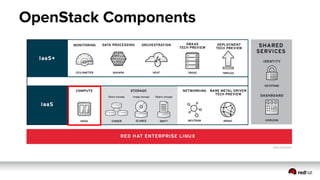
OpenStack Components
OpenStack Compute
● Execution and management of compute workloads
● Relatively technology agnostic (VMs, BM, Containers)
● Pluggable virtualization/container backends:
○ Libvirt (KVM, LXC, Parallels CT, Parallels VM, QEMU, Xen), Ironic,
Hyper-V, VMware vCenter, XenServer, etc.
○ http://docs.openstack.org/developer/nova/support-matrix.html
Components
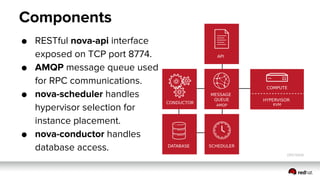
● RESTful nova-api interface
exposed on TCP port 8774.
● AMQP message queue used
for RPC communications.
● nova-scheduler handles
hypervisor selection for
instance placement.
● nova-conductor handles
database access.
Components (cont.)
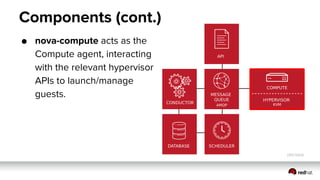
● nova-compute acts as the
Compute agent, interacting
with the relevant hypervisor
APIs to launch/manage
guests.
Libvirt/KVM
● Driver used for 85% of production OpenStack deployments. [1]
● Free and Open Source Software end-to-end stack:
○ Libvirt - Abstraction layer providing an API for hypervisor and virtual
machine lifecycle management. Supports many hypervisors and
architectures.
○ Qemu - Machine emulator able to use dynamic translation, or with
hypervisor assistance (e.g. KVM) virtualization.
○ KVM - Kernel-based-virtual machine is a kernel module providing full
virtualization for the Linux kernel .
● Why Libvirt instead of speaking straight to QEMU?
[1] http://superuser.openstack.org/articles/openstack-users-share-how-their-deployments-stack-up
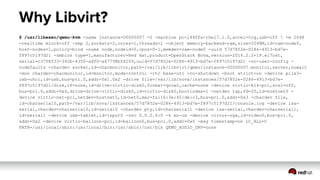
Why Libvirt?
$ /usr/libexec/qemu-kvm -name instance-00000007 -S -machine pc-i440fx-rhel7.1.0,accel=tcg,usb=off  -m 2048
-realtime mlock=off -smp 2,sockets=2,cores=1,threads=1 -object memory-backend-ram,size=2048M,id=ram-node0,
host-nodes=1,policy=bind -numa node,nodeid=0,cpus=0-1,memdev=ram-node0 -uuid 57d7852e-0286-4913-bd7e-
f897c5197d21 -smbios type=1,manufacturer=Red Hat,product=OpenStack Nova,version=2014.2.2-19.el7ost,
serial=c3758f33-342b-4350-adf0-a67798b56209,uuid=57d7852e-0286-4913-bd7e-f897c5197d21 -no-user-config -
nodefaults -chardev socket,id=charmonitor,path=/var/lib/libvirt/qemu/instance-00000007.monitor,server,nowait
-mon chardev=charmonitor,id=monitor,mode=control -rtc base=utc -no-shutdown -boot strict=on -device piix3-
usb-uhci,id=usb,bus=pci.0,addr=0x1.0x2 -drive file=/var/lib/nova/instances/57d7852e-0286-4913-bd7e-
f897c5197d21/disk,if=none,id=drive-virtio-disk0,format=qcow2,cache=none -device virtio-blk-pci,scsi=off,
bus=pci.0,addr=0x4,drive=drive-virtio-disk0,id=virtio-disk0,bootindex=1 -netdev tap,fd=25,id=hostnet0 -
device virtio-net-pci,netdev=hostnet0,id=net0,mac=fa:16:3e:45:de:c3,bus=pci.0,addr=0x3 -chardev file,
id=charserial0,path=/var/lib/nova/instances/57d7852e-0286-4913-bd7e-f897c5197d21/console.log -device isa-
serial,chardev=charserial0,id=serial0 -chardev pty,id=charserial1 -device isa-serial,chardev=charserial1,
id=serial1 -device usb-tablet,id=input0 -vnc 0.0.0.0:0 -k en-us -device cirrus-vga,id=video0,bus=pci.0,
addr=0x2 -device virtio-balloon-pci,id=balloon0,bus=pci.0,addr=0x5 -msg timestamp=on LC_ALL=C
PATH=/usr/local/sbin:/usr/local/bin:/usr/sbin:/usr/bin QEMU_AUDIO_DRV=none
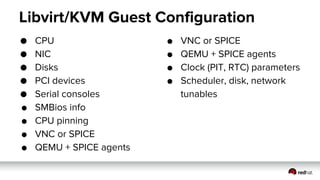
Libvirt/KVM Guest Configuration
● CPU
● NIC
● Disks
● PCI devices
● Serial consoles
● SMBios info
● CPU pinning
● VNC or SPICE
● QEMU + SPICE agents
● VNC or SPICE
● QEMU + SPICE agents
● Clock (PIT, RTC) parameters
● Scheduler, disk, network
tunables
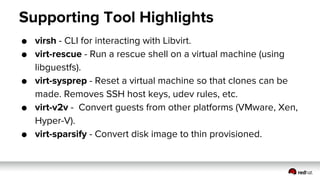
Supporting Tool Highlights
● virsh - CLI for interacting with Libvirt.
● virt-rescue - Run a rescue shell on a virtual machine (using
libguestfs).
● virt-sysprep - Reset a virtual machine so that clones can be
made. Removes SSH host keys, udev rules, etc.
● virt-v2v - Convert guests from other platforms (VMware, Xen,
Hyper-V).
● virt-sparsify - Convert disk image to thin provisioned.
Libvirt/KVM
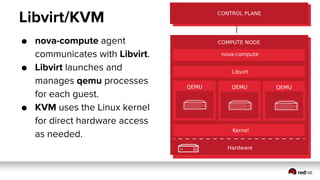
● nova-compute agent
communicates with Libvirt.
● Libvirt launches and
manages qemu processes
for each guest.
● KVM uses the Linux kernel
for direct hardware access
as needed.
Guest Enhancements
● VirtIO drivers provide paravirtualized device to virtual
machines, improving speed over emulation.
○ Built into modern enterprise Linux guest operating systems.
○ Available for Windows.
● QEMU guest agent optionally runs inside guests and
facilitates external interaction by users and/or management
platforms including OpenStack.
● Anti-VENOM provided using sVirt (SELinux and AppArmour
security drivers supported).
Virtual Interface Drivers
● Responsible for plugging/unplugging guest interfaces.
● Different interface types = different Libvirt XML definitions.
● Simplified LibvirtGenericVIFDriver implementation supports a
wide range of VIF types.
● Not easily pluggable by out-of-tree implementations.
○ Live in nova/virt/libvirt/vif.py
○ More on this later...
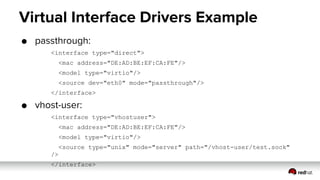
Virtual Interface Drivers Example
● passthrough:
<interface type="direct">
<mac address="DE:AD:BE:EF:CA:FE"/>
<model type="virtio"/>
<source dev="eth0" mode="passthrough"/>
</interface>
● vhost-user:
<interface type="vhostuser">
<mac address="DE:AD:BE:EF:CA:FE"/>
<model type="virtio"/>
<source type="unix" mode="server" path="/vhost-user/test.sock"
/>
</interface>
Volume Drivers
● Conceptually similar to VIF drivers, albeit no “generic” driver.
● volume_drivers=iscsi=nova.virt.libvirt.volume.
LibvirtISCSIVolumeDriver,iser=nova.virt.libvirt.volume.
LibvirtISERVolumeDriver,local=nova.virt.libvirt.volume.
LibvirtVolumeDriver...etc.
OPENSTACK COMPUTE 101OPENSTACK COMPUTE 101
KILO FEATURES
Performance Features
● CPU Pinning
● Huge Pages
● NUMA-aware scheduling (cont.)
○ Memory binding
○ I/O device locality awareness
CPU Pinning
● Extends NUMATopologyFilter added in Juno:
○ Adds concept of a “dedicated resource” guest.
○ Implicitly pins vCPUs and emulator threads to pCPU cores for increased
performance, trading off the ability to overcommit.
● Combine with existing techniques for isolating cores for
maximum benefit.
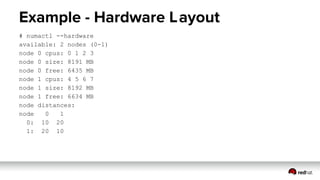
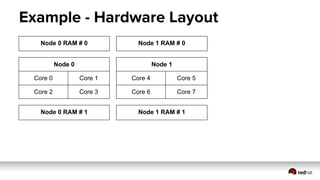
Example - Hardware Layout
# numactl --hardware
available: 2 nodes (0-1)
node 0 cpus: 0 1 2 3
node 0 size: 8191 MB
node 0 free: 6435 MB
node 1 cpus: 4 5 6 7
node 1 size: 8192 MB
node 1 free: 6634 MB
node distances:
node 0 1
0: 10 20
1: 20 10
Example - Hardware Layout
Node 0
Core 0 Core 1
Core 2 Core 3
Node 1
Core 4 Core 5
Core 6 Core 7
Node 0 RAM # 0
Node 0 RAM # 1 Node 1 RAM # 1
Node 1 RAM # 0
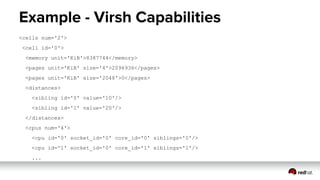
Example - Virsh Capabilities
<cells num='2'>
<cell id='0'>
<memory unit='KiB'>8387744</memory>
<pages unit='KiB' size='4'>2096936</pages>
<pages unit='KiB' size='2048'>0</pages>
<distances>
<sibling id='0' value='10'/>
<sibling id='1' value='20'/>
</distances>
<cpus num='4'>
<cpu id='0' socket_id='0' core_id='0' siblings='0'/>
<cpu id='1' socket_id='0' core_id='1' siblings='1'/>
...
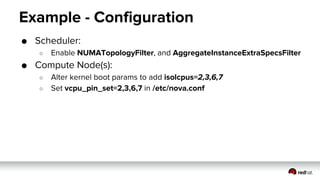
Example - Configuration
● Scheduler:
○ Enable NUMATopologyFilter, and AggregateInstanceExtraSpecsFilter
● Compute Node(s):
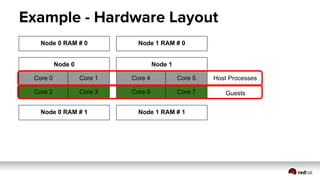
○ Alter kernel boot params to add isolcpus=2,3,6,7
○ Set vcpu_pin_set=2,3,6,7 in /etc/nova.conf
Example - Hardware Layout
Node 0
Core 0 Core 1
Core 2 Core 3
Node 1
Core 4 Core 5
Core 6 Core 7
Node 0 RAM # 0
Node 0 RAM # 1 Node 1 RAM # 1
Node 1 RAM # 0
Host Processes
Guests
Example - Configuration
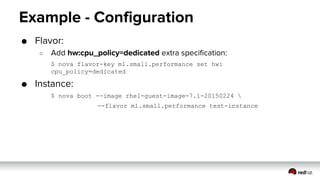
● Flavor:
○ Add hw:cpu_policy=dedicated extra specification:
$ nova flavor-key m1.small.performance set hw:
cpu_policy=dedicated
● Instance:
$ nova boot --image rhel-guest-image-7.1-20150224 
--flavor m1.small.performance test-instance
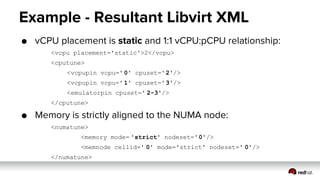
Example - Resultant Libvirt XML
● vCPU placement is static and 1:1 vCPU:pCPU relationship:
<vcpu placement='static'>2</vcpu>
<cputune>
<vcpupin vcpu=' 0' cpuset='2'/>
<vcpupin vcpu=' 1' cpuset='3'/>
<emulatorpin cpuset=' 2-3'/>
</cputune>
● Memory is strictly aligned to the NUMA node:
<numatune>
<memory mode= 'strict' nodeset='0'/>
<memnode cellid=' 0' mode='strict' nodeset=' 0'/>
</numatune>
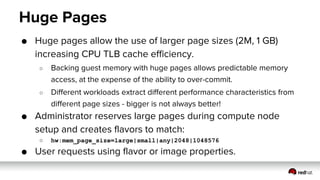
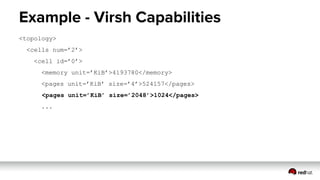
Huge Pages
● Huge pages allow the use of larger page sizes (2M, 1 GB)
increasing CPU TLB cache efficiency.
○ Backing guest memory with huge pages allows predictable memory
access, at the expense of the ability to over-commit.
○ Different workloads extract different performance characteristics from
different page sizes - bigger is not always better!
● Administrator reserves large pages during compute node
setup and creates flavors to match:
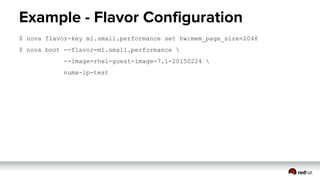
○ hw:mem_page_size=large|small|any|2048|1048576
● User requests using flavor or image properties.
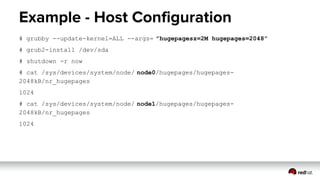
Example - Host Configuration
# grubby --update-kernel=ALL --args= ”hugepagesz=2M hugepages=2048”
# grub2-install /dev/sda
# shutdown -r now
# cat /sys/devices/system/node/ node0/hugepages/hugepages-
2048kB/nr_hugepages
1024
# cat /sys/devices/system/node/ node1/hugepages/hugepages-
2048kB/nr_hugepages
1024
Example - Virsh Capabilities
<topology>
<cells num=’2’>
<cell id=’0’>
<memory unit=’KiB’>4193780</memory>
<pages unit=’KiB’ size=’4’>524157</pages>
<pages unit=’KiB’ size=’2048’>1024</pages>
...
Example - Flavor Configuration
$ nova flavor-key m1.small.performance set hw:mem_page_size=2048
$ nova boot --flavor=m1.small.performance 
--image=rhel-guest-image-7.1-20150224 
numa-lp-test
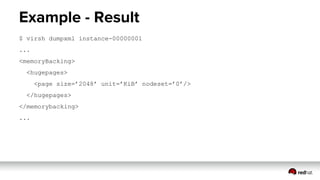
Example - Result
$ virsh dumpxml instance-00000001
...
<memoryBacking>
<hugepages>
<page size=’2048’ unit=’KiB’ nodeset=’0’/>
</hugepages>
</memorybacking>
...
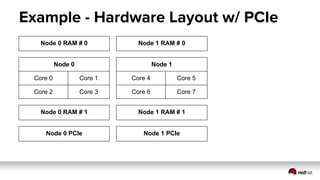
Example - Hardware Layout w/ PCIe
Node 0
Core 0 Core 1
Core 2 Core 3
Node 1
Core 4 Core 5
Core 6 Core 7
Node 0 RAM # 0
Node 0 RAM # 1 Node 1 RAM # 1
Node 1 RAM # 0
Node 0 PCIe Node 1 PCIe
I/O-based NUMA Scheduling
● Extends PciDevice model to include NUMA node the device
is associated with.
● Extends NUMATopologyFilter to make use of this information
when scheduling.
Quiesce Guest Filesystem
● Libvirt > 1.2.5 supports a fsFreeze/fsThaw API.
● Freezes/thaws guest filesystem(s) using QEMU guest agent.
● Ensures consistent snapshots.
● To enable:
○ hw_qemu_guest_agent image property must be set to yes.
○ hw_require_fsfreeze image property must be set to yes.
○ QEMU guest agent must be installed inside guest.
Hyper-V Enlightenment
● Windows guests support several additional paravirt features
when running on Hyper-V (similar to virtio, kvmclock, etc. on
KVM).
● Helps avoid BSOD in guests on heavily loaded hosts,
enhances performance.
● QEMU/KVM is able to support several of these natively.
● Expands behavior of os_type=“windows” image property.
vhost-user support
● VIF driver for new type of network interface implemented in
QEMU/Libvirt.
● Intended to provide a more efficient path between a guest
and userspace vswitches.
Liberty Predictions
Liberty Predictions/Speculation
● Libvirt hardware policy from libosinfo (approved)
● Post-plug VIF scripts (under review)
● Further work around SR-IOV incl.:
○ Interface attach/detach (under review)
○ Live migration when using macvtap (under review)
● Ability to select guest CPU model and/or features (under
review)
● VM HA (under review)
● VirtIO network performance enhancements (under review)
● Hot resize (under review)
Thank You
OPENSTACK COMPUTE 101OPENSTACK COMPUTE 101
Questions?
@xsgordon
sgordon@redhat.com

Libvirt/KVM Driver Update (Kilo)

  • 1.
    OPENSTACK COMPUTE 101 Libvirt/KVMDriver Update Stephen Gordon (@xsgordon) Sr. Technical Product Manager
  • 2.
    Agenda ● Architecture Refresher ●Kilo Features ● Liberty Predictions/Speculation
  • 3.
    OPENSTACK COMPUTE 101OPENSTACKCOMPUTE 101 ARCHITECTURE REFRESHER
  • 4.
  • 5.
    OpenStack Compute ● Executionand management of compute workloads ● Relatively technology agnostic (VMs, BM, Containers) ● Pluggable virtualization/container backends: ○ Libvirt (KVM, LXC, Parallels CT, Parallels VM, QEMU, Xen), Ironic, Hyper-V, VMware vCenter, XenServer, etc. ○ http://docs.openstack.org/developer/nova/support-matrix.html
  • 6.
    Components ● RESTful nova-apiinterface exposed on TCP port 8774. ● AMQP message queue used for RPC communications. ● nova-scheduler handles hypervisor selection for instance placement. ● nova-conductor handles database access.
  • 7.
    Components (cont.) ● nova-computeacts as the Compute agent, interacting with the relevant hypervisor APIs to launch/manage guests.
  • 8.
    Libvirt/KVM ● Driver usedfor 85% of production OpenStack deployments. [1] ● Free and Open Source Software end-to-end stack: ○ Libvirt - Abstraction layer providing an API for hypervisor and virtual machine lifecycle management. Supports many hypervisors and architectures. ○ Qemu - Machine emulator able to use dynamic translation, or with hypervisor assistance (e.g. KVM) virtualization. ○ KVM - Kernel-based-virtual machine is a kernel module providing full virtualization for the Linux kernel . ● Why Libvirt instead of speaking straight to QEMU? [1] http://superuser.openstack.org/articles/openstack-users-share-how-their-deployments-stack-up
  • 9.
    Why Libvirt? $ /usr/libexec/qemu-kvm-name instance-00000007 -S -machine pc-i440fx-rhel7.1.0,accel=tcg,usb=off -m 2048 -realtime mlock=off -smp 2,sockets=2,cores=1,threads=1 -object memory-backend-ram,size=2048M,id=ram-node0, host-nodes=1,policy=bind -numa node,nodeid=0,cpus=0-1,memdev=ram-node0 -uuid 57d7852e-0286-4913-bd7e- f897c5197d21 -smbios type=1,manufacturer=Red Hat,product=OpenStack Nova,version=2014.2.2-19.el7ost, serial=c3758f33-342b-4350-adf0-a67798b56209,uuid=57d7852e-0286-4913-bd7e-f897c5197d21 -no-user-config - nodefaults -chardev socket,id=charmonitor,path=/var/lib/libvirt/qemu/instance-00000007.monitor,server,nowait -mon chardev=charmonitor,id=monitor,mode=control -rtc base=utc -no-shutdown -boot strict=on -device piix3- usb-uhci,id=usb,bus=pci.0,addr=0x1.0x2 -drive file=/var/lib/nova/instances/57d7852e-0286-4913-bd7e- f897c5197d21/disk,if=none,id=drive-virtio-disk0,format=qcow2,cache=none -device virtio-blk-pci,scsi=off, bus=pci.0,addr=0x4,drive=drive-virtio-disk0,id=virtio-disk0,bootindex=1 -netdev tap,fd=25,id=hostnet0 - device virtio-net-pci,netdev=hostnet0,id=net0,mac=fa:16:3e:45:de:c3,bus=pci.0,addr=0x3 -chardev file, id=charserial0,path=/var/lib/nova/instances/57d7852e-0286-4913-bd7e-f897c5197d21/console.log -device isa- serial,chardev=charserial0,id=serial0 -chardev pty,id=charserial1 -device isa-serial,chardev=charserial1, id=serial1 -device usb-tablet,id=input0 -vnc 0.0.0.0:0 -k en-us -device cirrus-vga,id=video0,bus=pci.0, addr=0x2 -device virtio-balloon-pci,id=balloon0,bus=pci.0,addr=0x5 -msg timestamp=on LC_ALL=C PATH=/usr/local/sbin:/usr/local/bin:/usr/sbin:/usr/bin QEMU_AUDIO_DRV=none
  • 10.
    Libvirt/KVM Guest Configuration ●CPU ● NIC ● Disks ● PCI devices ● Serial consoles ● SMBios info ● CPU pinning ● VNC or SPICE ● QEMU + SPICE agents ● VNC or SPICE ● QEMU + SPICE agents ● Clock (PIT, RTC) parameters ● Scheduler, disk, network tunables
  • 11.
    Supporting Tool Highlights ●virsh - CLI for interacting with Libvirt. ● virt-rescue - Run a rescue shell on a virtual machine (using libguestfs). ● virt-sysprep - Reset a virtual machine so that clones can be made. Removes SSH host keys, udev rules, etc. ● virt-v2v - Convert guests from other platforms (VMware, Xen, Hyper-V). ● virt-sparsify - Convert disk image to thin provisioned.
  • 12.
    Libvirt/KVM ● nova-compute agent communicateswith Libvirt. ● Libvirt launches and manages qemu processes for each guest. ● KVM uses the Linux kernel for direct hardware access as needed.
  • 13.
    Guest Enhancements ● VirtIOdrivers provide paravirtualized device to virtual machines, improving speed over emulation. ○ Built into modern enterprise Linux guest operating systems. ○ Available for Windows. ● QEMU guest agent optionally runs inside guests and facilitates external interaction by users and/or management platforms including OpenStack. ● Anti-VENOM provided using sVirt (SELinux and AppArmour security drivers supported).
  • 14.
    Virtual Interface Drivers ●Responsible for plugging/unplugging guest interfaces. ● Different interface types = different Libvirt XML definitions. ● Simplified LibvirtGenericVIFDriver implementation supports a wide range of VIF types. ● Not easily pluggable by out-of-tree implementations. ○ Live in nova/virt/libvirt/vif.py ○ More on this later...
  • 15.
    Virtual Interface DriversExample ● passthrough: <interface type="direct"> <mac address="DE:AD:BE:EF:CA:FE"/> <model type="virtio"/> <source dev="eth0" mode="passthrough"/> </interface> ● vhost-user: <interface type="vhostuser"> <mac address="DE:AD:BE:EF:CA:FE"/> <model type="virtio"/> <source type="unix" mode="server" path="/vhost-user/test.sock" /> </interface>
  • 16.
    Volume Drivers ● Conceptuallysimilar to VIF drivers, albeit no “generic” driver. ● volume_drivers=iscsi=nova.virt.libvirt.volume. LibvirtISCSIVolumeDriver,iser=nova.virt.libvirt.volume. LibvirtISERVolumeDriver,local=nova.virt.libvirt.volume. LibvirtVolumeDriver...etc.
  • 17.
    OPENSTACK COMPUTE 101OPENSTACKCOMPUTE 101 KILO FEATURES
  • 18.
    Performance Features ● CPUPinning ● Huge Pages ● NUMA-aware scheduling (cont.) ○ Memory binding ○ I/O device locality awareness
  • 19.
    CPU Pinning ● ExtendsNUMATopologyFilter added in Juno: ○ Adds concept of a “dedicated resource” guest. ○ Implicitly pins vCPUs and emulator threads to pCPU cores for increased performance, trading off the ability to overcommit. ● Combine with existing techniques for isolating cores for maximum benefit.
  • 20.
    Example - HardwareLayout # numactl --hardware available: 2 nodes (0-1) node 0 cpus: 0 1 2 3 node 0 size: 8191 MB node 0 free: 6435 MB node 1 cpus: 4 5 6 7 node 1 size: 8192 MB node 1 free: 6634 MB node distances: node 0 1 0: 10 20 1: 20 10
  • 21.
    Example - HardwareLayout Node 0 Core 0 Core 1 Core 2 Core 3 Node 1 Core 4 Core 5 Core 6 Core 7 Node 0 RAM # 0 Node 0 RAM # 1 Node 1 RAM # 1 Node 1 RAM # 0
  • 22.
    Example - VirshCapabilities <cells num='2'> <cell id='0'> <memory unit='KiB'>8387744</memory> <pages unit='KiB' size='4'>2096936</pages> <pages unit='KiB' size='2048'>0</pages> <distances> <sibling id='0' value='10'/> <sibling id='1' value='20'/> </distances> <cpus num='4'> <cpu id='0' socket_id='0' core_id='0' siblings='0'/> <cpu id='1' socket_id='0' core_id='1' siblings='1'/> ...
  • 23.
    Example - Configuration ●Scheduler: ○ Enable NUMATopologyFilter, and AggregateInstanceExtraSpecsFilter ● Compute Node(s): ○ Alter kernel boot params to add isolcpus=2,3,6,7 ○ Set vcpu_pin_set=2,3,6,7 in /etc/nova.conf
  • 24.
    Example - HardwareLayout Node 0 Core 0 Core 1 Core 2 Core 3 Node 1 Core 4 Core 5 Core 6 Core 7 Node 0 RAM # 0 Node 0 RAM # 1 Node 1 RAM # 1 Node 1 RAM # 0 Host Processes Guests
  • 25.
    Example - Configuration ●Flavor: ○ Add hw:cpu_policy=dedicated extra specification: $ nova flavor-key m1.small.performance set hw: cpu_policy=dedicated ● Instance: $ nova boot --image rhel-guest-image-7.1-20150224 --flavor m1.small.performance test-instance
  • 26.
    Example - ResultantLibvirt XML ● vCPU placement is static and 1:1 vCPU:pCPU relationship: <vcpu placement='static'>2</vcpu> <cputune> <vcpupin vcpu=' 0' cpuset='2'/> <vcpupin vcpu=' 1' cpuset='3'/> <emulatorpin cpuset=' 2-3'/> </cputune> ● Memory is strictly aligned to the NUMA node: <numatune> <memory mode= 'strict' nodeset='0'/> <memnode cellid=' 0' mode='strict' nodeset=' 0'/> </numatune>
  • 27.
    Huge Pages ● Hugepages allow the use of larger page sizes (2M, 1 GB) increasing CPU TLB cache efficiency. ○ Backing guest memory with huge pages allows predictable memory access, at the expense of the ability to over-commit. ○ Different workloads extract different performance characteristics from different page sizes - bigger is not always better! ● Administrator reserves large pages during compute node setup and creates flavors to match: ○ hw:mem_page_size=large|small|any|2048|1048576 ● User requests using flavor or image properties.
  • 28.
    Example - HostConfiguration # grubby --update-kernel=ALL --args= ”hugepagesz=2M hugepages=2048” # grub2-install /dev/sda # shutdown -r now # cat /sys/devices/system/node/ node0/hugepages/hugepages- 2048kB/nr_hugepages 1024 # cat /sys/devices/system/node/ node1/hugepages/hugepages- 2048kB/nr_hugepages 1024
  • 29.
    Example - VirshCapabilities <topology> <cells num=’2’> <cell id=’0’> <memory unit=’KiB’>4193780</memory> <pages unit=’KiB’ size=’4’>524157</pages> <pages unit=’KiB’ size=’2048’>1024</pages> ...
  • 30.
    Example - FlavorConfiguration $ nova flavor-key m1.small.performance set hw:mem_page_size=2048 $ nova boot --flavor=m1.small.performance --image=rhel-guest-image-7.1-20150224 numa-lp-test
  • 31.
    Example - Result $virsh dumpxml instance-00000001 ... <memoryBacking> <hugepages> <page size=’2048’ unit=’KiB’ nodeset=’0’/> </hugepages> </memorybacking> ...
  • 32.
    Example - HardwareLayout w/ PCIe Node 0 Core 0 Core 1 Core 2 Core 3 Node 1 Core 4 Core 5 Core 6 Core 7 Node 0 RAM # 0 Node 0 RAM # 1 Node 1 RAM # 1 Node 1 RAM # 0 Node 0 PCIe Node 1 PCIe
  • 33.
    I/O-based NUMA Scheduling ●Extends PciDevice model to include NUMA node the device is associated with. ● Extends NUMATopologyFilter to make use of this information when scheduling.
  • 34.
    Quiesce Guest Filesystem ●Libvirt > 1.2.5 supports a fsFreeze/fsThaw API. ● Freezes/thaws guest filesystem(s) using QEMU guest agent. ● Ensures consistent snapshots. ● To enable: ○ hw_qemu_guest_agent image property must be set to yes. ○ hw_require_fsfreeze image property must be set to yes. ○ QEMU guest agent must be installed inside guest.
  • 35.
    Hyper-V Enlightenment ● Windowsguests support several additional paravirt features when running on Hyper-V (similar to virtio, kvmclock, etc. on KVM). ● Helps avoid BSOD in guests on heavily loaded hosts, enhances performance. ● QEMU/KVM is able to support several of these natively. ● Expands behavior of os_type=“windows” image property.
  • 36.
    vhost-user support ● VIFdriver for new type of network interface implemented in QEMU/Libvirt. ● Intended to provide a more efficient path between a guest and userspace vswitches.
  • 37.
  • 38.
    Liberty Predictions/Speculation ● Libvirthardware policy from libosinfo (approved) ● Post-plug VIF scripts (under review) ● Further work around SR-IOV incl.: ○ Interface attach/detach (under review) ○ Live migration when using macvtap (under review) ● Ability to select guest CPU model and/or features (under review) ● VM HA (under review) ● VirtIO network performance enhancements (under review) ● Hot resize (under review)
  • 39.
  • 40.
    OPENSTACK COMPUTE 101OPENSTACKCOMPUTE 101 Questions? @xsgordon sgordon@redhat.com