Raul Leite
SR Solution Architect / Red Hat
@sp4wnr0ot
https://sp4wnr0ot.blogspot.com.br
Known Basic of NFV Features
#vbrownbag
2
agenda
● NFV architecture/concepts
● NFV bottlenecks
● sr-iov
● pci passthrough
● hugepages
● cpu pinning / numa
● dpdk
3 INSERT DES
IGNATOR, I
● NFV architecture
4
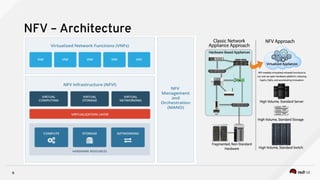
NFV - Network Functions Virtualization
5
NFV – basic concepts
● independent common hardware
● automatic network operation
● flexible application development/deploy/high reliability
● provide the same service quality and safety as Telecom network
6
NFV – Architecture
7
8
NFV bottlenecks
● packet loss
● hypervisor overhead
● low routing/traffic throughput
● CPU
● vm/instances resources allocation and scheduling
9
NFV – workload example
● Some NFV applications may have been developed to make specific use of certain
CPU instructions.
Example :
● A VPN appliance that requires a high-performance cryptography library Intel®
Advanced Encryption Standard New Instructions (Intel® AES-NI).
10 INSERT DES
IGNATOR, I
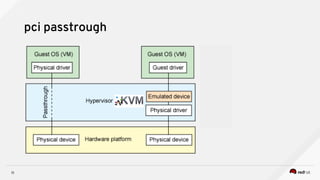
pci passtrough
11
pci passtrough
12
pci passtrough
● Allocation of the PCIe NIC entirely dedicated to the VMs
● No sharing of the NIC
● If your hardware does not have an I/O MMU (known as "Intel VT-d" on Intel-based
machines and "AMD I/O Virtualization Technology" on AMD-based machines), you
will not be able to assign devices in (hypervisor) KVM.
13
pci passtrough
# grep -i nic_PF /etc/nova/nova.conf
pci_alias={ "vendor_id": "8086", "product_id": "1528", "name":
"nic_PF"}
# openstack flavor create --ram 4096 --disk 100 --vcpus 2
m1.small.pci_passthrough
# openstack flavor set --property "pci_passthrough:alias"="nic_PF:1"
m1.small.pci_passthrough
# grep -i nic_PF /etc/nova/nova.conf
pci_alias={ "vendor_id": "8086", "product_id": "1528", "name":
"nic_PF"}
# openstack flavor create --ram 4096 --disk 100 --vcpus 2
m1.small.pci_passthrough
# openstack flavor set --property "pci_passthrough:alias"="nic_PF:1"
m1.small.pci_passthrough
14 INSERT DES
IGNATOR, I
sr-iov
15
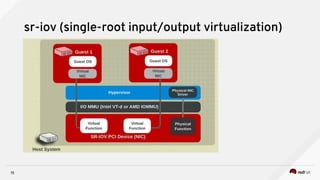
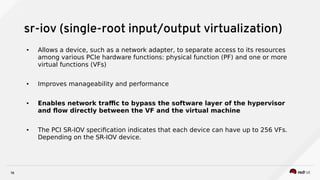
sr-iov (single-root input/output virtualization)
16
sr-iov (single-root input/output virtualization)
● Allows a device, such as a network adapter, to separate access to its resources
among various PCIe hardware functions: physical function (PF) and one or more
virtual functions (VFs)
● Improves manageability and performance
● Enables network traffic to bypass the software layer of the hypervisor
and flow directly between the VF and the virtual machine
● The PCI SR-IOV specification indicates that each device can have up to 256 VFs.
Depending on the SR-IOV device.
17
sr-iov
# lspci -nn | grep -i 82576
05:00.0 Ethernet controller [0200]: Intel Corporation 82576 Gigabit
Network Connection [8086:10c9] (rev 01)
05:10.0 Ethernet controller [0200]: Intel Corporation 82576 Virtual
Function [8086:10ca] (rev 01)
# neutron net-create nfv_sriov --shared --provider:network_type vlan
--provider:physical_network physnet_sriov
--provider:segmentation_id=2150
# neutron subnet-create --name nfv_subnet_sriov --disable-dhcp
--allocation-pool start=10.0.5.2,end=10.0.5.100 nfv_sriov 10.0.5.0/24
# neutron port-create nfv_sriov --name sriov-port --binding:vnic-type
direct
# lspci -nn | grep -i 82576
05:00.0 Ethernet controller [0200]: Intel Corporation 82576 Gigabit
Network Connection [8086:10c9] (rev 01)
05:10.0 Ethernet controller [0200]: Intel Corporation 82576 Virtual
Function [8086:10ca] (rev 01)
# neutron net-create nfv_sriov --shared --provider:network_type vlan
--provider:physical_network physnet_sriov
--provider:segmentation_id=2150
# neutron subnet-create --name nfv_subnet_sriov --disable-dhcp
--allocation-pool start=10.0.5.2,end=10.0.5.100 nfv_sriov 10.0.5.0/24
# neutron port-create nfv_sriov --name sriov-port --binding:vnic-type
direct
18 INSERT DES
IGNATOR, I
hugepages
19
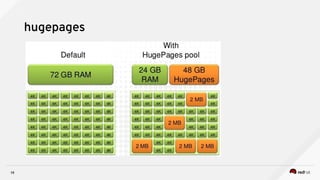
hugepages
20
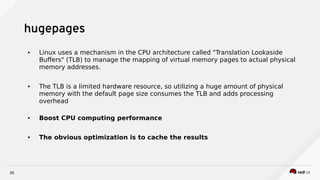
hugepages
● Linux uses a mechanism in the CPU architecture called "Translation Lookaside
Buffers" (TLB) to manage the mapping of virtual memory pages to actual physical
memory addresses.
● The TLB is a limited hardware resource, so utilizing a huge amount of physical
memory with the default page size consumes the TLB and adds processing
overhead
● Boost CPU computing performance
● The obvious optimization is to cache the results
21
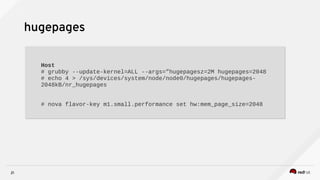
hugepages
Host
# grubby --update-kernel=ALL --args=”hugepagesz=2M hugepages=2048
# echo 4 > /sys/devices/system/node/node0/hugepages/hugepages-
2048kB/nr_hugepages
# nova flavor-key m1.small.performance set hw:mem_page_size=2048
Host
# grubby --update-kernel=ALL --args=”hugepagesz=2M hugepages=2048
# echo 4 > /sys/devices/system/node/node0/hugepages/hugepages-
2048kB/nr_hugepages
# nova flavor-key m1.small.performance set hw:mem_page_size=2048
22 INSERT DES
IGNATOR, I
numa / cpu pinning
23
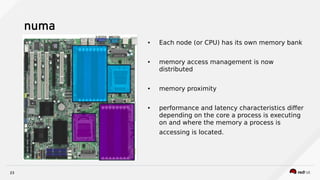
numa
● Each node (or CPU) has its own memory bank
● memory access management is now
distributed
● memory proximity
● performance and latency characteristics differ
depending on the core a process is executing
on and where the memory a process is
accessing is located.
24
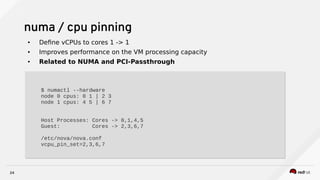
numa / cpu pinning
● Define vCPUs to cores 1 -> 1
● Improves performance on the VM processing capacity
● Related to NUMA and PCI-Passthrough
$ numactl --hardware
node 0 cpus: 0 1 | 2 3
node 1 cpus: 4 5 | 6 7
Host Processes: Cores -> 0,1,4,5
Guest: Cores -> 2,3,6,7
/etc/nova/nova.conf
vcpu_pin_set=2,3,6,7
$ numactl --hardware
node 0 cpus: 0 1 | 2 3
node 1 cpus: 4 5 | 6 7
Host Processes: Cores -> 0,1,4,5
Guest: Cores -> 2,3,6,7
/etc/nova/nova.conf
vcpu_pin_set=2,3,6,7
25
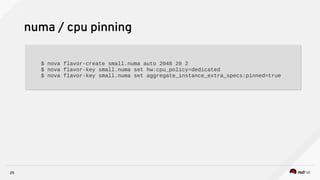
numa / cpu pinning
$ nova flavor-create small.numa auto 2048 20 2
$ nova flavor-key small.numa set hw:cpu_policy=dedicated
$ nova flavor-key small.numa set aggregate_instance_extra_specs:pinned=true
$ nova flavor-create small.numa auto 2048 20 2
$ nova flavor-key small.numa set hw:cpu_policy=dedicated
$ nova flavor-key small.numa set aggregate_instance_extra_specs:pinned=true
26
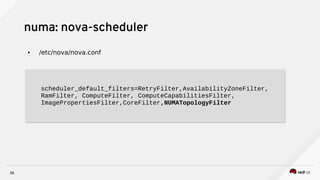
numa: nova-scheduler
● /etc/nova/nova.conf
scheduler_default_filters=RetryFilter,AvailabilityZoneFilter,
RamFilter, ComputeFilter, ComputeCapabilitiesFilter,
ImagePropertiesFilter,CoreFilter,NUMATopologyFilter
scheduler_default_filters=RetryFilter,AvailabilityZoneFilter,
RamFilter, ComputeFilter, ComputeCapabilitiesFilter,
ImagePropertiesFilter,CoreFilter,NUMATopologyFilter
27 INSERT DES
IGNATOR, I
dpdk
28
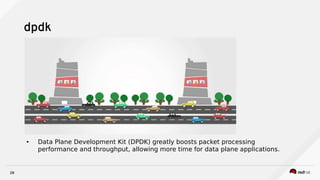
dpdk
● Data Plane Development Kit (DPDK) greatly boosts packet processing
performance and throughput, allowing more time for data plane applications.
29
THANK YOU!

Known basic of NFV Features

  • 1.
    Raul Leite SR SolutionArchitect / Red Hat @sp4wnr0ot https://sp4wnr0ot.blogspot.com.br Known Basic of NFV Features #vbrownbag
  • 2.
    2 agenda ● NFV architecture/concepts ●NFV bottlenecks ● sr-iov ● pci passthrough ● hugepages ● cpu pinning / numa ● dpdk
  • 3.
    3 INSERT DES IGNATOR,I ● NFV architecture
  • 4.
    4 NFV - NetworkFunctions Virtualization
  • 5.
    5 NFV – basicconcepts ● independent common hardware ● automatic network operation ● flexible application development/deploy/high reliability ● provide the same service quality and safety as Telecom network
  • 6.
  • 7.
  • 8.
    8 NFV bottlenecks ● packetloss ● hypervisor overhead ● low routing/traffic throughput ● CPU ● vm/instances resources allocation and scheduling
  • 9.
    9 NFV – workloadexample ● Some NFV applications may have been developed to make specific use of certain CPU instructions. Example : ● A VPN appliance that requires a high-performance cryptography library Intel® Advanced Encryption Standard New Instructions (Intel® AES-NI).
  • 10.
    10 INSERT DES IGNATOR,I pci passtrough
  • 11.
  • 12.
    12 pci passtrough ● Allocationof the PCIe NIC entirely dedicated to the VMs ● No sharing of the NIC ● If your hardware does not have an I/O MMU (known as "Intel VT-d" on Intel-based machines and "AMD I/O Virtualization Technology" on AMD-based machines), you will not be able to assign devices in (hypervisor) KVM.
  • 13.
    13 pci passtrough # grep-i nic_PF /etc/nova/nova.conf pci_alias={ "vendor_id": "8086", "product_id": "1528", "name": "nic_PF"} # openstack flavor create --ram 4096 --disk 100 --vcpus 2 m1.small.pci_passthrough # openstack flavor set --property "pci_passthrough:alias"="nic_PF:1" m1.small.pci_passthrough # grep -i nic_PF /etc/nova/nova.conf pci_alias={ "vendor_id": "8086", "product_id": "1528", "name": "nic_PF"} # openstack flavor create --ram 4096 --disk 100 --vcpus 2 m1.small.pci_passthrough # openstack flavor set --property "pci_passthrough:alias"="nic_PF:1" m1.small.pci_passthrough
  • 14.
  • 15.
  • 16.
    16 sr-iov (single-root input/outputvirtualization) ● Allows a device, such as a network adapter, to separate access to its resources among various PCIe hardware functions: physical function (PF) and one or more virtual functions (VFs) ● Improves manageability and performance ● Enables network traffic to bypass the software layer of the hypervisor and flow directly between the VF and the virtual machine ● The PCI SR-IOV specification indicates that each device can have up to 256 VFs. Depending on the SR-IOV device.
  • 17.
    17 sr-iov # lspci -nn| grep -i 82576 05:00.0 Ethernet controller [0200]: Intel Corporation 82576 Gigabit Network Connection [8086:10c9] (rev 01) 05:10.0 Ethernet controller [0200]: Intel Corporation 82576 Virtual Function [8086:10ca] (rev 01) # neutron net-create nfv_sriov --shared --provider:network_type vlan --provider:physical_network physnet_sriov --provider:segmentation_id=2150 # neutron subnet-create --name nfv_subnet_sriov --disable-dhcp --allocation-pool start=10.0.5.2,end=10.0.5.100 nfv_sriov 10.0.5.0/24 # neutron port-create nfv_sriov --name sriov-port --binding:vnic-type direct # lspci -nn | grep -i 82576 05:00.0 Ethernet controller [0200]: Intel Corporation 82576 Gigabit Network Connection [8086:10c9] (rev 01) 05:10.0 Ethernet controller [0200]: Intel Corporation 82576 Virtual Function [8086:10ca] (rev 01) # neutron net-create nfv_sriov --shared --provider:network_type vlan --provider:physical_network physnet_sriov --provider:segmentation_id=2150 # neutron subnet-create --name nfv_subnet_sriov --disable-dhcp --allocation-pool start=10.0.5.2,end=10.0.5.100 nfv_sriov 10.0.5.0/24 # neutron port-create nfv_sriov --name sriov-port --binding:vnic-type direct
  • 18.
  • 19.
  • 20.
    20 hugepages ● Linux usesa mechanism in the CPU architecture called "Translation Lookaside Buffers" (TLB) to manage the mapping of virtual memory pages to actual physical memory addresses. ● The TLB is a limited hardware resource, so utilizing a huge amount of physical memory with the default page size consumes the TLB and adds processing overhead ● Boost CPU computing performance ● The obvious optimization is to cache the results
  • 21.
    21 hugepages Host # grubby --update-kernel=ALL--args=”hugepagesz=2M hugepages=2048 # echo 4 > /sys/devices/system/node/node0/hugepages/hugepages- 2048kB/nr_hugepages # nova flavor-key m1.small.performance set hw:mem_page_size=2048 Host # grubby --update-kernel=ALL --args=”hugepagesz=2M hugepages=2048 # echo 4 > /sys/devices/system/node/node0/hugepages/hugepages- 2048kB/nr_hugepages # nova flavor-key m1.small.performance set hw:mem_page_size=2048
  • 22.
    22 INSERT DES IGNATOR,I numa / cpu pinning
  • 23.
    23 numa ● Each node(or CPU) has its own memory bank ● memory access management is now distributed ● memory proximity ● performance and latency characteristics differ depending on the core a process is executing on and where the memory a process is accessing is located.
  • 24.
    24 numa / cpupinning ● Define vCPUs to cores 1 -> 1 ● Improves performance on the VM processing capacity ● Related to NUMA and PCI-Passthrough $ numactl --hardware node 0 cpus: 0 1 | 2 3 node 1 cpus: 4 5 | 6 7 Host Processes: Cores -> 0,1,4,5 Guest: Cores -> 2,3,6,7 /etc/nova/nova.conf vcpu_pin_set=2,3,6,7 $ numactl --hardware node 0 cpus: 0 1 | 2 3 node 1 cpus: 4 5 | 6 7 Host Processes: Cores -> 0,1,4,5 Guest: Cores -> 2,3,6,7 /etc/nova/nova.conf vcpu_pin_set=2,3,6,7
  • 25.
    25 numa / cpupinning $ nova flavor-create small.numa auto 2048 20 2 $ nova flavor-key small.numa set hw:cpu_policy=dedicated $ nova flavor-key small.numa set aggregate_instance_extra_specs:pinned=true $ nova flavor-create small.numa auto 2048 20 2 $ nova flavor-key small.numa set hw:cpu_policy=dedicated $ nova flavor-key small.numa set aggregate_instance_extra_specs:pinned=true
  • 26.
    26 numa: nova-scheduler ● /etc/nova/nova.conf scheduler_default_filters=RetryFilter,AvailabilityZoneFilter, RamFilter,ComputeFilter, ComputeCapabilitiesFilter, ImagePropertiesFilter,CoreFilter,NUMATopologyFilter scheduler_default_filters=RetryFilter,AvailabilityZoneFilter, RamFilter, ComputeFilter, ComputeCapabilitiesFilter, ImagePropertiesFilter,CoreFilter,NUMATopologyFilter
  • 27.
  • 28.
    28 dpdk ● Data PlaneDevelopment Kit (DPDK) greatly boosts packet processing performance and throughput, allowing more time for data plane applications.
  • 29.