OpenStack Block Storage
OpenStack Storage and Cinder an Interactive
Discussion!!!
Aaron Delp, Director of Solutions
OpenStack Architect, @aarondelp
Quick Poll:
● How many of you are end-users of OpenStack?
● How many of you are OpenStack Operators?
● How many of you contribute to OpenStack?
● How many of you work for Vendor Organizations that contribute to OpenStack?
● How many are “all of the above”?
● How many just heard there was free Pizza?
What do you mean when you say Storage?
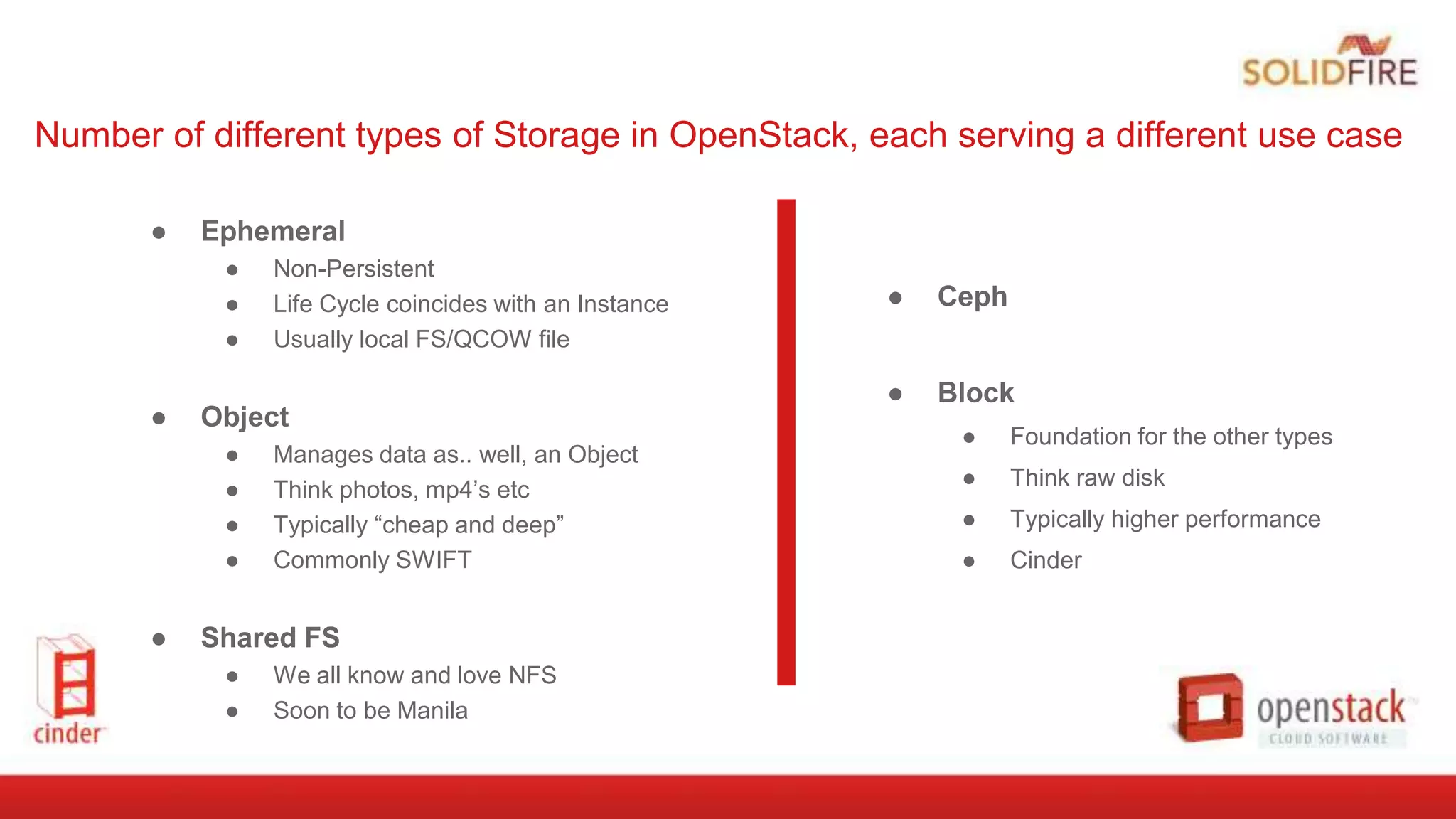
● Ephemeral
● Non-Persistent
● Life Cycle coincides with an Instance
● Usually local FS/QCOW file
● Object
● Manages data as.. well, an Object
● Think photos, mp4’s etc
● Typically “cheap and deep”
● Commonly SWIFT
● Shared FS
● We all know and love NFS
● Soon to be Manila
Number of different types of Storage in OpenStack, each serving a different use case
● Ceph
● Block
● Foundation for the other types
● Think raw disk
● Typically higher performance
● Cinder
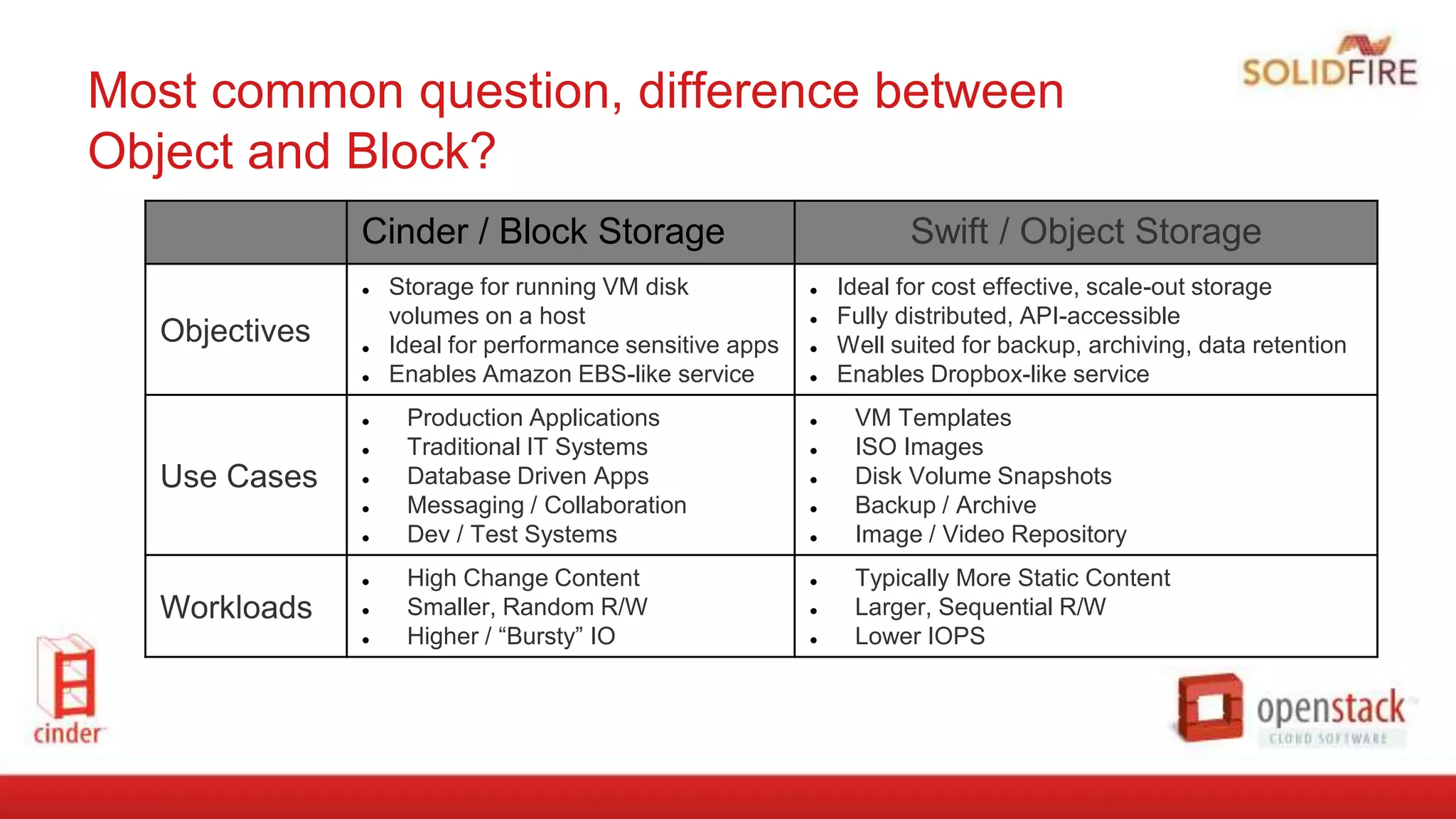
Most common question, difference between
Object and Block?
Cinder / Block Storage Swift / Object Storage
Objectives
● Storage for running VM disk
volumes on a host
● Ideal for performance sensitive apps
● Enables Amazon EBS-like service
● Ideal for cost effective, scale-out storage
● Fully distributed, API-accessible
● Well suited for backup, archiving, data retention
● Enables Dropbox-like service
Use Cases
● Production Applications
● Traditional IT Systems
● Database Driven Apps
● Messaging / Collaboration
● Dev / Test Systems
● VM Templates
● ISO Images
● Disk Volume Snapshots
● Backup / Archive
● Image / Video Repository
Workloads
● High Change Content
● Smaller, Random R/W
● Higher / “Bursty” IO
● Typically More Static Content
● Larger, Sequential R/W
● Lower IOPS
Let’s talk Cinder!
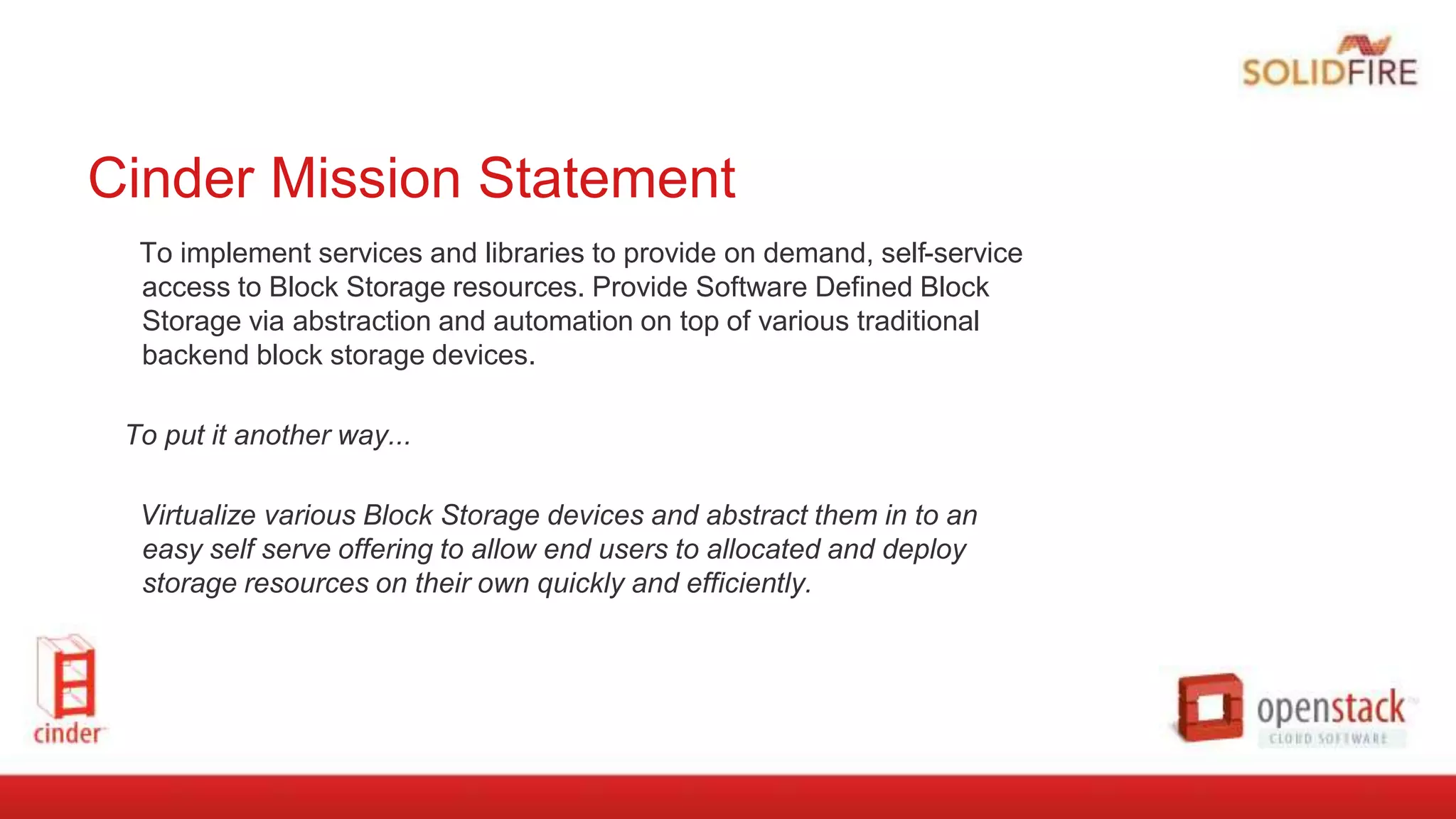
Cinder Mission Statement
To implement services and libraries to provide on demand, self-service
access to Block Storage resources. Provide Software Defined Block
Storage via abstraction and automation on top of various traditional
backend block storage devices.
To put it another way...
Virtualize various Block Storage devices and abstract them in to an
easy self serve offering to allow end users to allocated and deploy
storage resources on their own quickly and efficiently.
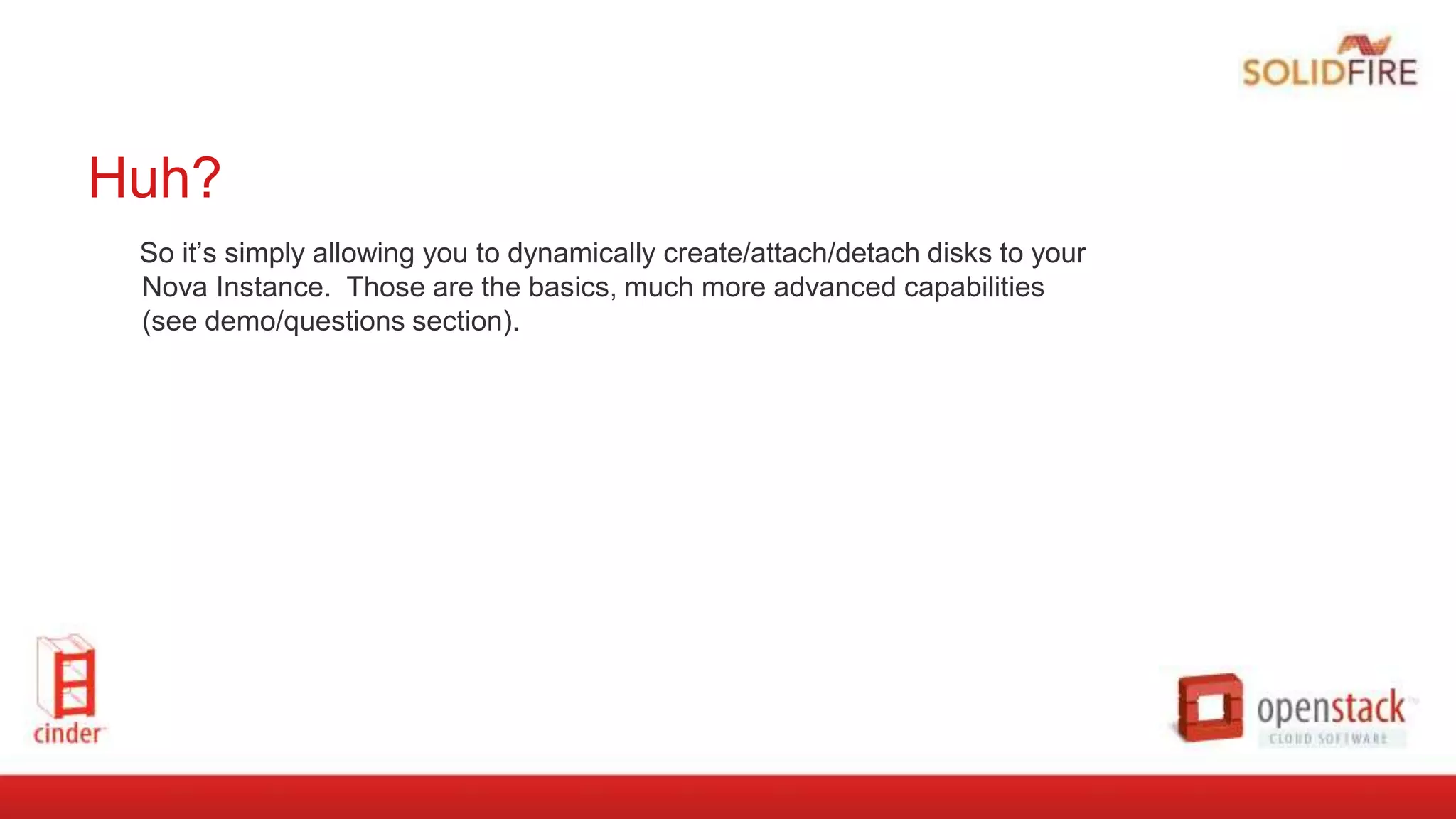
Huh?
So it’s simply allowing you to dynamically create/attach/detach disks to your
Nova Instance. Those are the basics, much more advanced capabilities
(see demo/questions section).
How it works
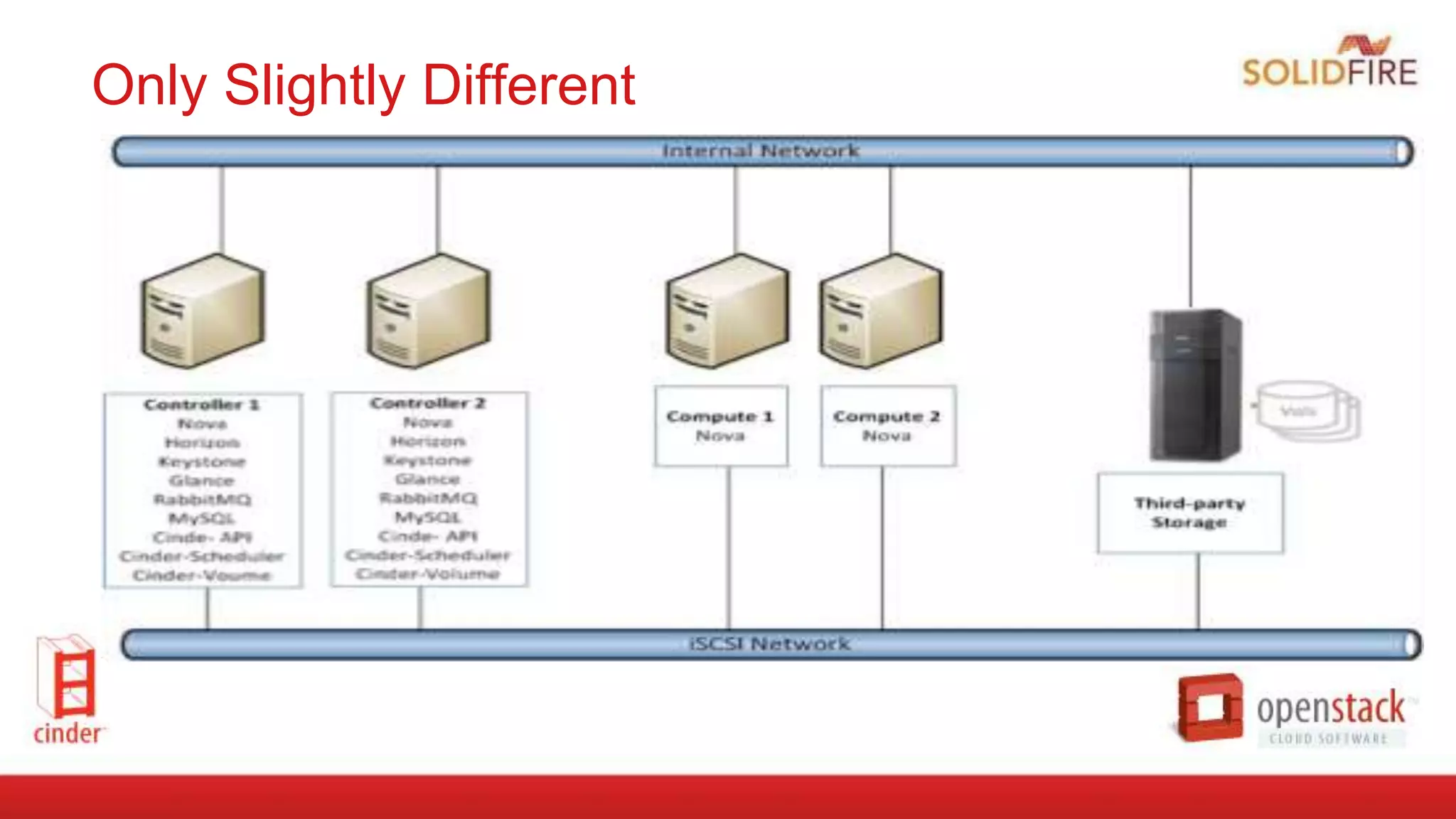
● Plugin architecture, use your own vendors
backend(s) or use the default
●Backend devices invisible to end-user
● Consistent API regardless of backend
● Filter Scheduler let’s you get get fancy
● expose differentiating features via custom
volume-types and extra-specs
Reference Implementation Included
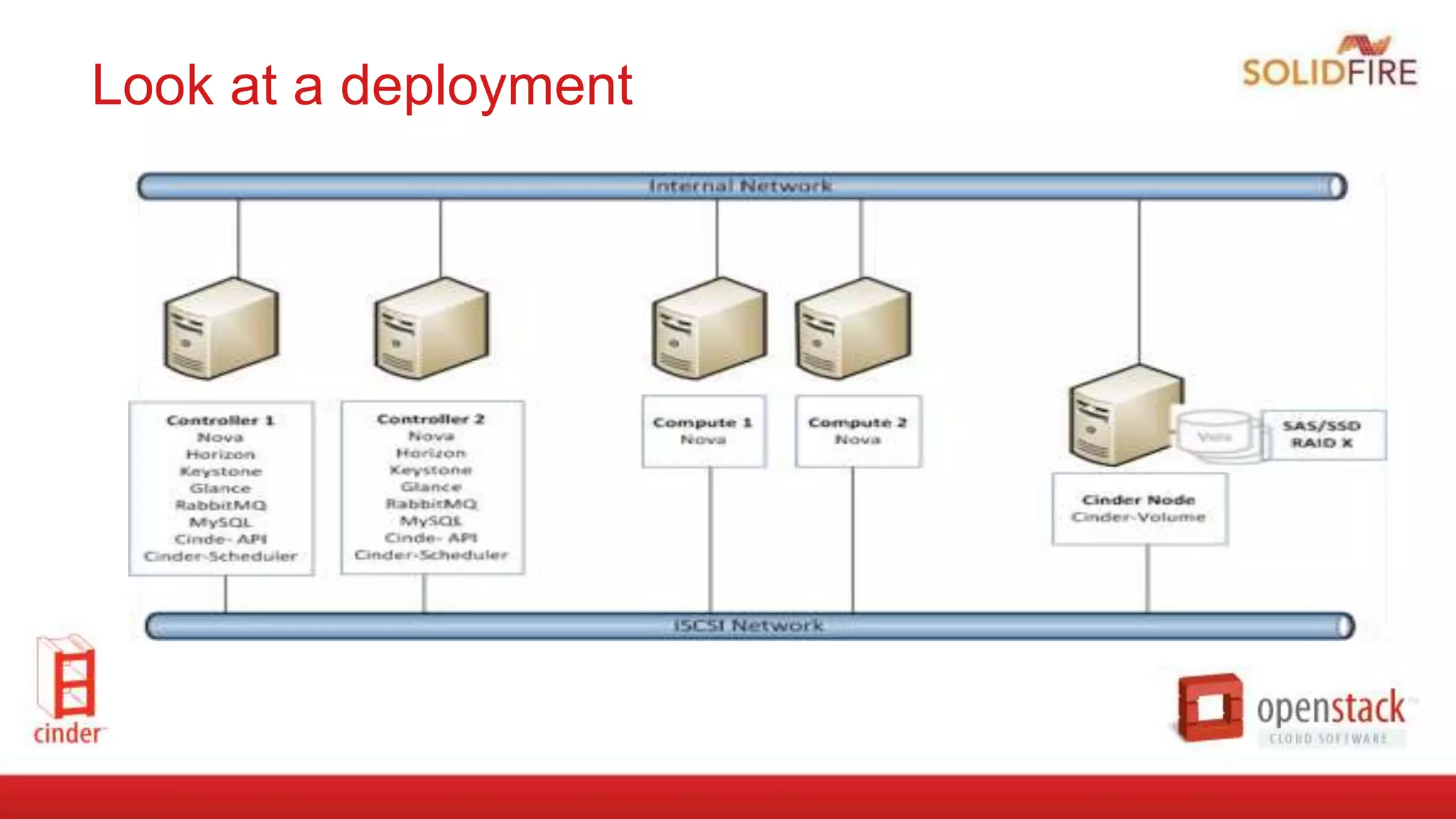
● Includes code to provide a base implementation using LVM
● Just add disks
● Great for POC and getting started
● Sometimes good enough
● Might be lacking for your performance, H/A and Scaling needs (it all depends)
● Can Scale by adding Nodes
● Cinder-Volume Node utilizes it’s local disks (allocate by creating an LVM VG)
● Cinder Volumes are LVM Logical Volumes, with an iSCSI target created for each
➔ Typical max size recommendations per VG/Cinder-Volume backend ~ 5 TB
➔ No Redundancy (yet)
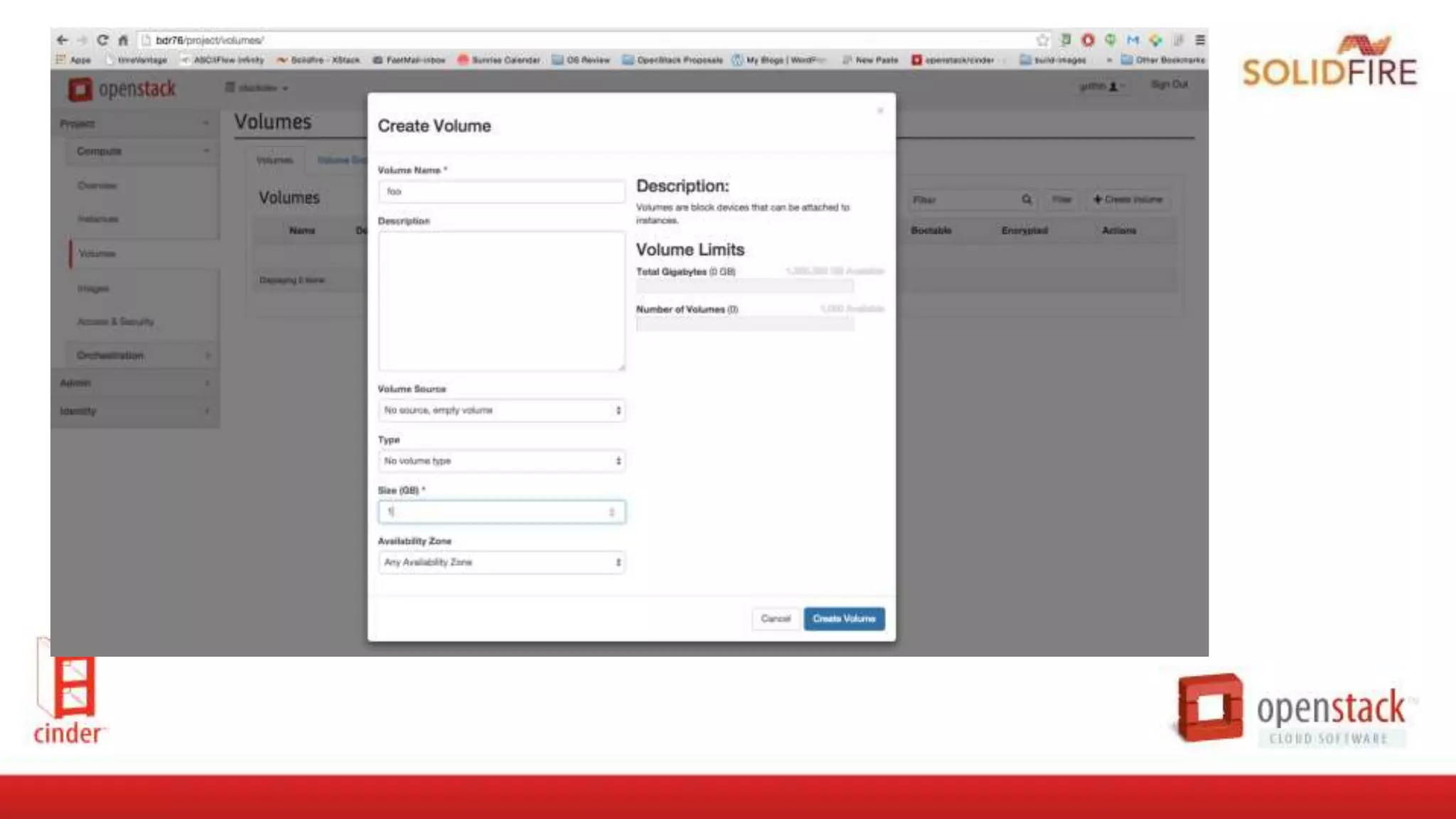
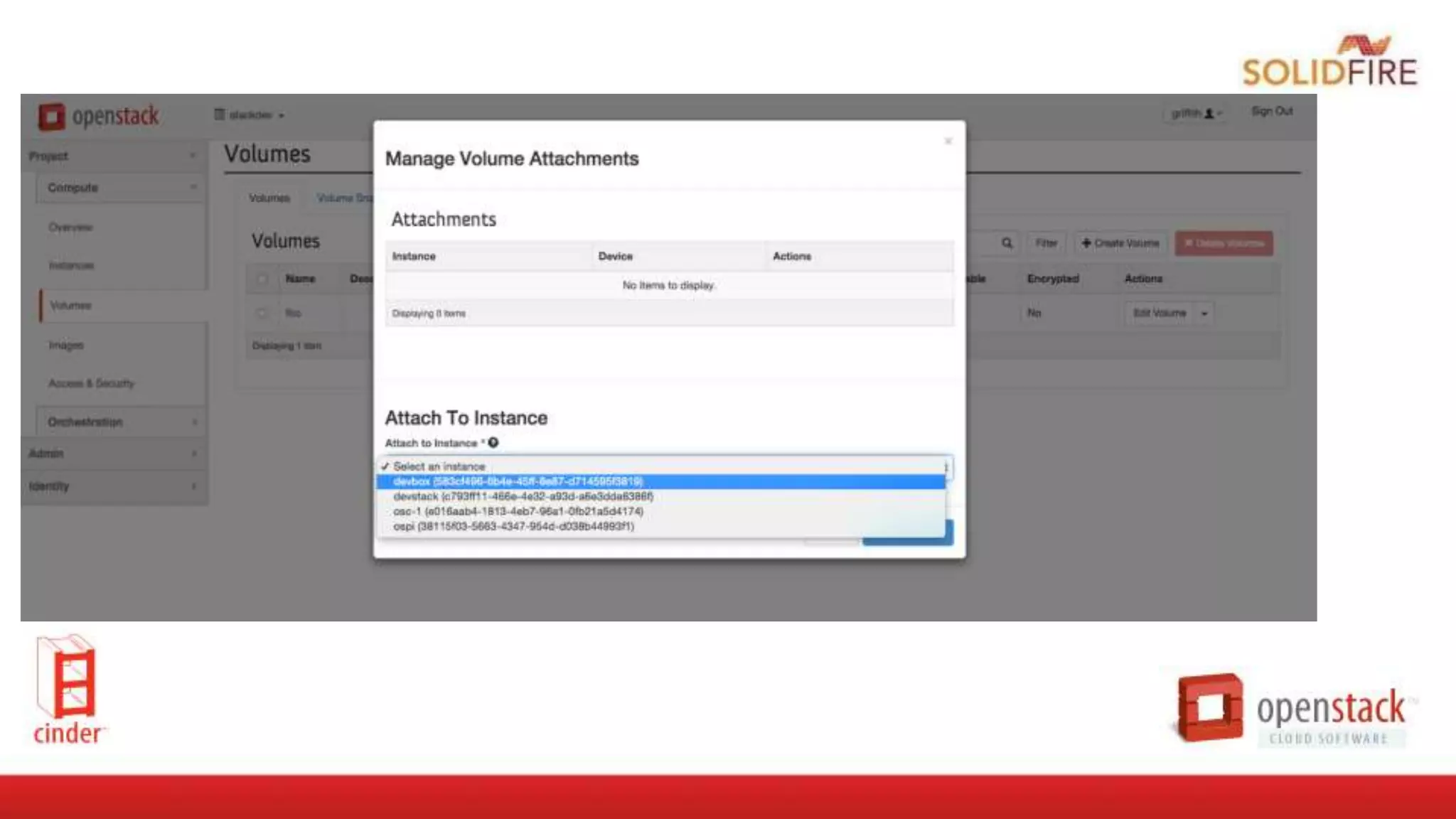
Look at a deployment
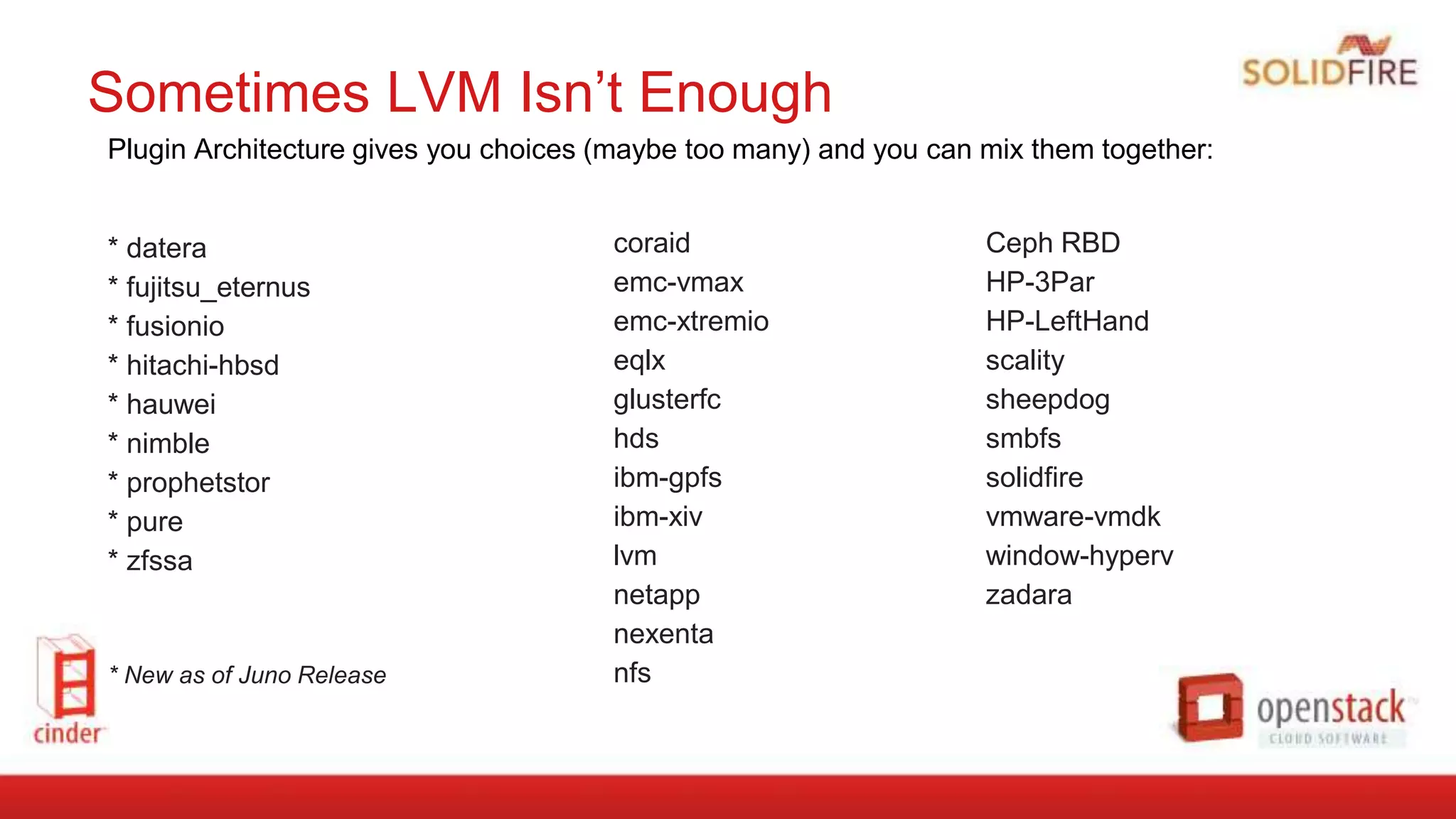
Sometimes LVM Isn’t Enough
* datera
* fujitsu_eternus
* fusionio
* hitachi-hbsd
* hauwei
* nimble
* prophetstor
* pure
* zfssa
* New as of Juno Release
coraid
emc-vmax
emc-xtremio
eqlx
glusterfc
hds
ibm-gpfs
ibm-xiv
lvm
netapp
nexenta
nfs
Ceph RBD
HP-3Par
HP-LeftHand
scality
sheepdog
smbfs
solidfire
vmware-vmdk
window-hyperv
zadara
Plugin Architecture gives you choices (maybe too many) and you can mix them together:
Only Slightly Different
Conf file entries
#Append to /etc/cinder.conf
enabled_backends=lvm,solidfire
[lvm]
volume_group=cinder_volumes
volume_driver=cinder.volume.drivers.lvm.LVMISCSIDriver
volume_backend_name=LVM_iSCSI
[solidfire]
volume_driver=cinder.volume.drivers.solidfire.SolidFire
san_ip=192.168.138.180
san_login=admin
san_password=solidfire
volume_backend_name=SolidFire
Speaking of Juno!!!
● Just wrapped up the fifth release of Cinder!!!!
● Major emphasis on testing and compatibility
● Running Third Party CI on Vendors gear in their own labs against each Cinder commit
● Manage/Unmanage (or Import/Export) of Volumes widely available
★ Introduced support for Pools for those devices that still have that concept
★ Introduced support for Replication
★ Introduced support for Consistency Groups
★ Continued improvements to Cinder-Backup making way towards incrementals
Preview for Kilo
★ It’s all about QUALITY
★ Technical debt
★ De-emphasizing new features (ie finish the ones we have and make them rock solid)
★ Redundancy for base LVM implementation
★ Rolling Upgrades!!
Thoughts for those building OpenStack Clouds
Making choices
can be the
HARDEST part!
● Each has their own merits
● Some excel at specific use cases
● Maybe you already own the gear
● TCO, TCO, TCO
Ask yourself:
➔ Does it scale?
➔ Is the architecture a good fit?
➔ Is it tested, will it really work in OpenStack?
➔ Support?
➔ What about performance and noisy neighbors?
➔ Third party CI testing?
➔ Active in the OpenStack Community?
➔ DIY, Services, both/neither (SolidFire AI, Fuel, JuJu,
Nebula….)
A few words from our sponsor...
SolidFire’s Scale-Out Block Storage System
Designed from the start for OpenStack and other cloud platforms
● Multi-Tenant architecture
● Designed for “Cloud-Scale” Deployments
● Linear non-disruptive platform growth
● Automation top priority in API design
● Built to deploy in an OpenStack environment
● Not an afterthought
● Extreme fault tolerance
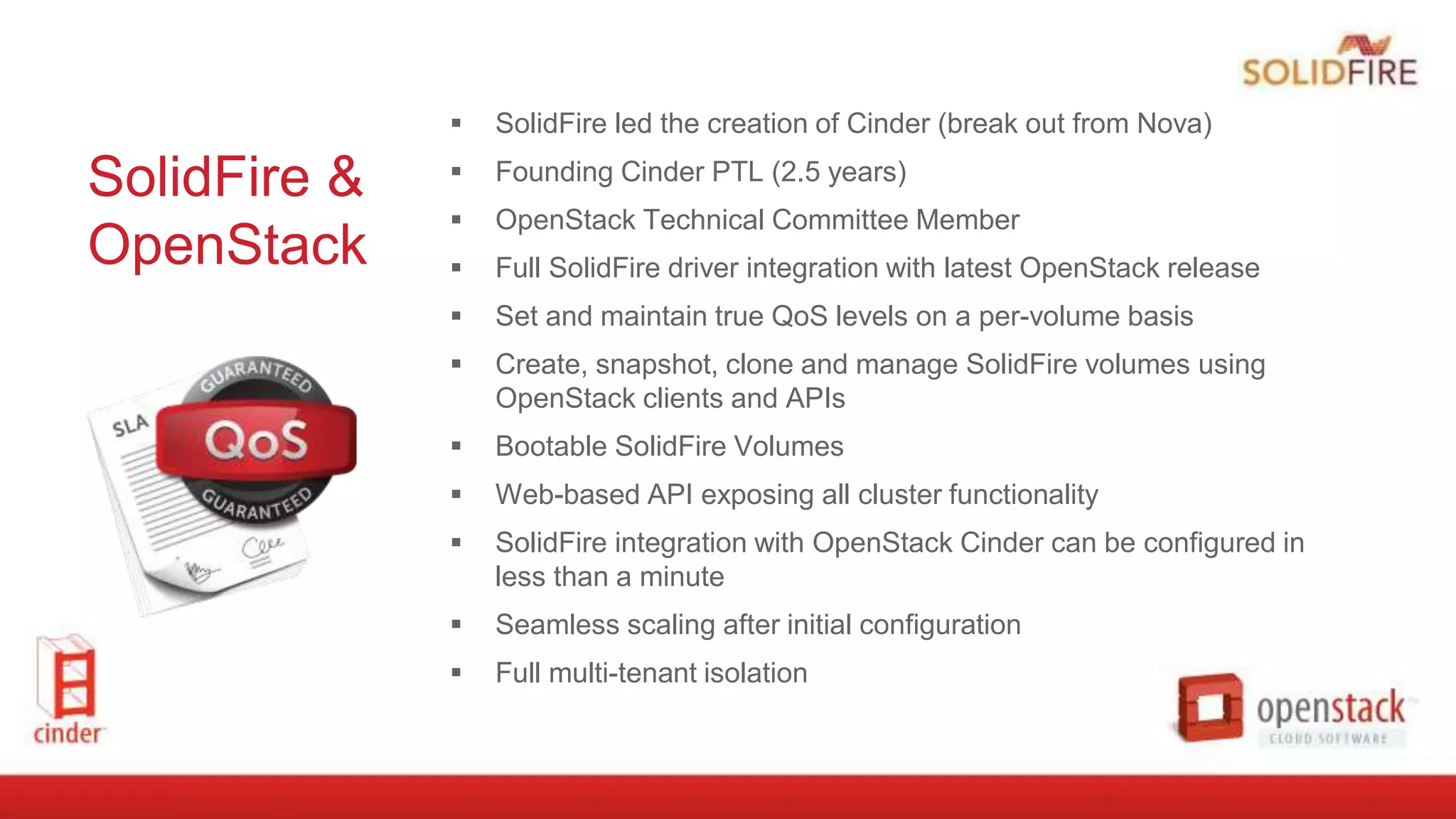
SolidFire &
OpenStack
 SolidFire led the creation of Cinder (break out from Nova)
 Founding Cinder PTL (2.5 years)
 OpenStack Technical Committee Member
 Full SolidFire driver integration with latest OpenStack release
 Set and maintain true QoS levels on a per-volume basis
 Create, snapshot, clone and manage SolidFire volumes using
OpenStack clients and APIs
 Bootable SolidFire Volumes
 Web-based API exposing all cluster functionality
 SolidFire integration with OpenStack Cinder can be configured in
less than a minute
 Seamless scaling after initial configuration
 Full multi-tenant isolation
Related
Resources
● OpenStack Solution Page
● OpenStack Solution Brief
● SolidFire/Cinder Reference Architecture
● OpenStack Configuration Guide
● SolidFire/Rackspace Private Cloud
Implementation Guide
● Video: Configuring OpenStack Block Storage
w/SolidFire
● Blogs
● OpenStack Summit Recap: Mindshare
Achieved, Market Share Must Follow
● Separating from the Pack
● Why OpenStack Matters
Demos/Questions?
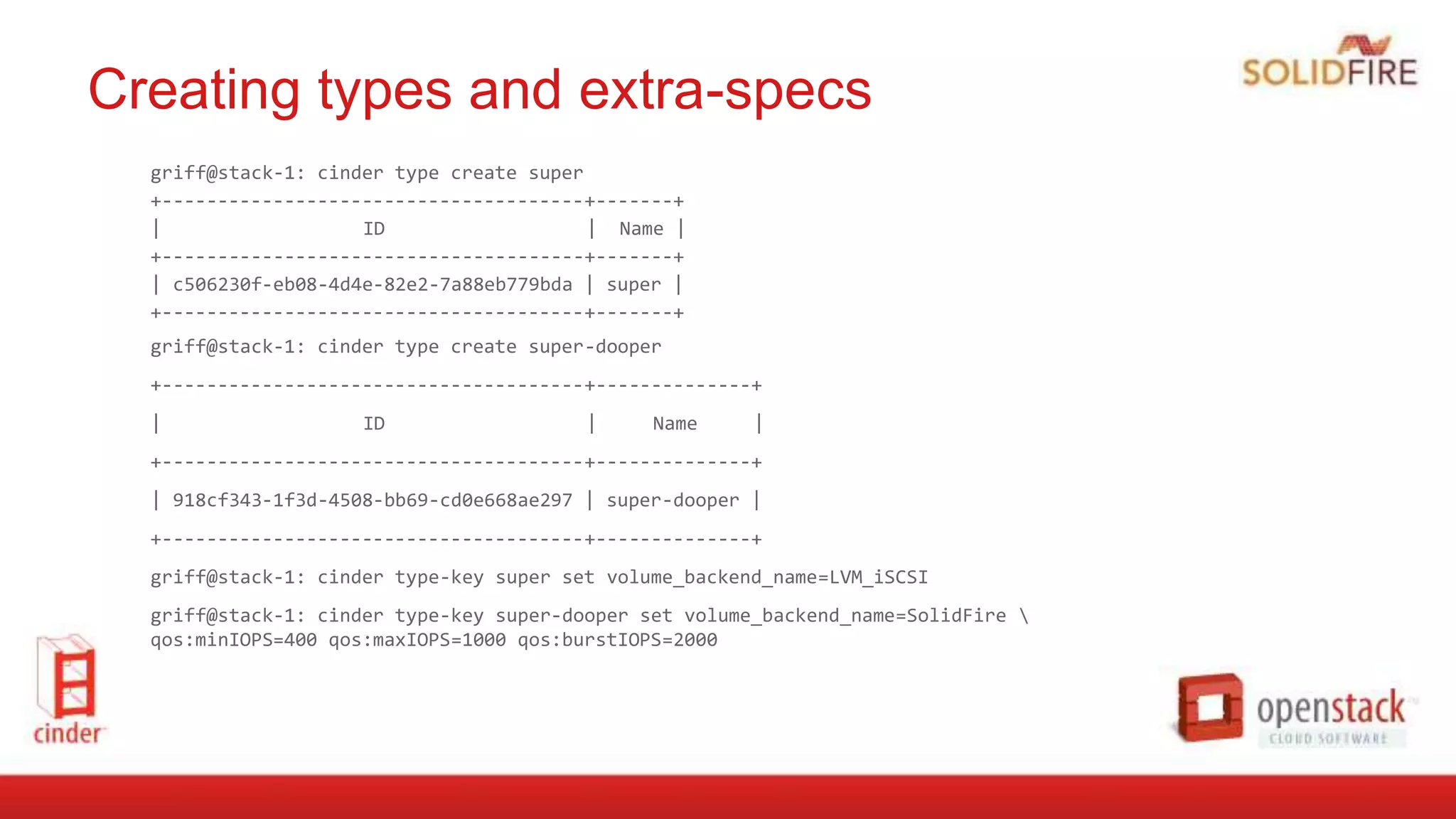
Creating types and extra-specs
griff@stack-1: cinder type create super
+--------------------------------------+-------+
| ID | Name |
+--------------------------------------+-------+
| c506230f-eb08-4d4e-82e2-7a88eb779bda | super |
+--------------------------------------+-------+
griff@stack-1: cinder type create super-dooper
+--------------------------------------+--------------+
| ID | Name |
+--------------------------------------+--------------+
| 918cf343-1f3d-4508-bb69-cd0e668ae297 | super-dooper |
+--------------------------------------+--------------+
griff@stack-1: cinder type-key super set volume_backend_name=LVM_iSCSI
griff@stack-1: cinder type-key super-dooper set volume_backend_name=SolidFire 
qos:minIOPS=400 qos:maxIOPS=1000 qos:burstIOPS=2000
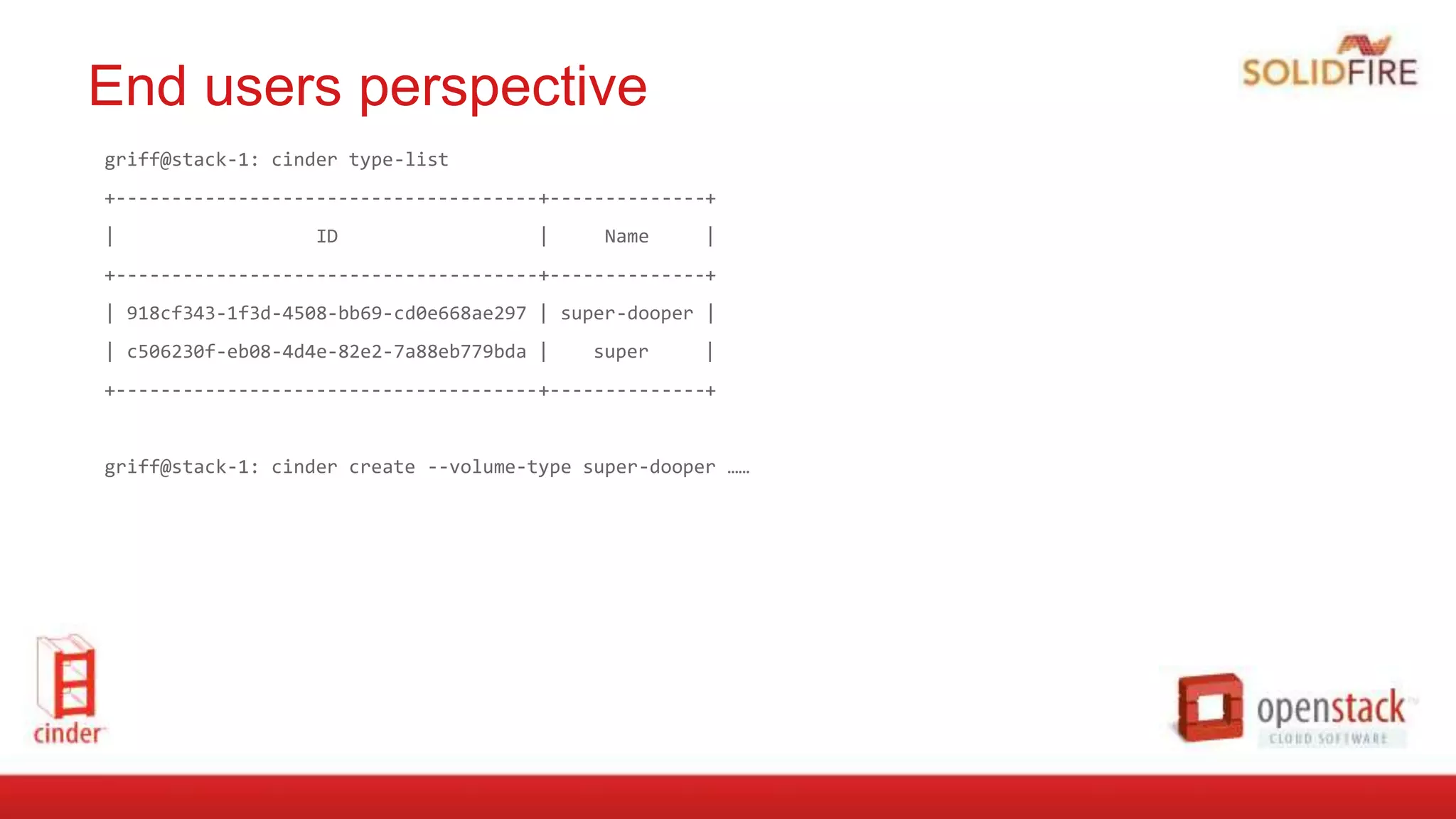
End users perspective
griff@stack-1: cinder type-list
+--------------------------------------+--------------+
| ID | Name |
+--------------------------------------+--------------+
| 918cf343-1f3d-4508-bb69-cd0e668ae297 | super-dooper |
| c506230f-eb08-4d4e-82e2-7a88eb779bda | super |
+--------------------------------------+--------------+
griff@stack-1: cinder create --volume-type super-dooper ……
How to get
involved?
● It’s Easy, Start Here
● https://wiki.openstack.org/wiki/How_To_Contrib
ute
● Any questions?
● Aaron.delp@solidfire.com
● @aarondelp
1620 Pearl Street,
Boulder, Colorado 80302
Phone: 720.523.3278
Email: info@solidfire.com
www.solidfire.com

OpenStack Cinder Best Practices - Meet Up

  • 1.
    OpenStack Block Storage OpenStackStorage and Cinder an Interactive Discussion!!! Aaron Delp, Director of Solutions OpenStack Architect, @aarondelp
  • 2.
    Quick Poll: ● Howmany of you are end-users of OpenStack? ● How many of you are OpenStack Operators? ● How many of you contribute to OpenStack? ● How many of you work for Vendor Organizations that contribute to OpenStack? ● How many are “all of the above”? ● How many just heard there was free Pizza?
  • 3.
    What do youmean when you say Storage?
  • 4.
    ● Ephemeral ● Non-Persistent ●Life Cycle coincides with an Instance ● Usually local FS/QCOW file ● Object ● Manages data as.. well, an Object ● Think photos, mp4’s etc ● Typically “cheap and deep” ● Commonly SWIFT ● Shared FS ● We all know and love NFS ● Soon to be Manila Number of different types of Storage in OpenStack, each serving a different use case ● Ceph ● Block ● Foundation for the other types ● Think raw disk ● Typically higher performance ● Cinder
  • 5.
    Most common question,difference between Object and Block? Cinder / Block Storage Swift / Object Storage Objectives ● Storage for running VM disk volumes on a host ● Ideal for performance sensitive apps ● Enables Amazon EBS-like service ● Ideal for cost effective, scale-out storage ● Fully distributed, API-accessible ● Well suited for backup, archiving, data retention ● Enables Dropbox-like service Use Cases ● Production Applications ● Traditional IT Systems ● Database Driven Apps ● Messaging / Collaboration ● Dev / Test Systems ● VM Templates ● ISO Images ● Disk Volume Snapshots ● Backup / Archive ● Image / Video Repository Workloads ● High Change Content ● Smaller, Random R/W ● Higher / “Bursty” IO ● Typically More Static Content ● Larger, Sequential R/W ● Lower IOPS
  • 6.
  • 7.
    Cinder Mission Statement Toimplement services and libraries to provide on demand, self-service access to Block Storage resources. Provide Software Defined Block Storage via abstraction and automation on top of various traditional backend block storage devices. To put it another way... Virtualize various Block Storage devices and abstract them in to an easy self serve offering to allow end users to allocated and deploy storage resources on their own quickly and efficiently.
  • 8.
    Huh? So it’s simplyallowing you to dynamically create/attach/detach disks to your Nova Instance. Those are the basics, much more advanced capabilities (see demo/questions section).
  • 11.
    How it works ●Plugin architecture, use your own vendors backend(s) or use the default ●Backend devices invisible to end-user ● Consistent API regardless of backend ● Filter Scheduler let’s you get get fancy ● expose differentiating features via custom volume-types and extra-specs
  • 12.
    Reference Implementation Included ●Includes code to provide a base implementation using LVM ● Just add disks ● Great for POC and getting started ● Sometimes good enough ● Might be lacking for your performance, H/A and Scaling needs (it all depends) ● Can Scale by adding Nodes ● Cinder-Volume Node utilizes it’s local disks (allocate by creating an LVM VG) ● Cinder Volumes are LVM Logical Volumes, with an iSCSI target created for each ➔ Typical max size recommendations per VG/Cinder-Volume backend ~ 5 TB ➔ No Redundancy (yet)
  • 13.
    Look at adeployment
  • 14.
    Sometimes LVM Isn’tEnough * datera * fujitsu_eternus * fusionio * hitachi-hbsd * hauwei * nimble * prophetstor * pure * zfssa * New as of Juno Release coraid emc-vmax emc-xtremio eqlx glusterfc hds ibm-gpfs ibm-xiv lvm netapp nexenta nfs Ceph RBD HP-3Par HP-LeftHand scality sheepdog smbfs solidfire vmware-vmdk window-hyperv zadara Plugin Architecture gives you choices (maybe too many) and you can mix them together:
  • 15.
  • 16.
    Conf file entries #Appendto /etc/cinder.conf enabled_backends=lvm,solidfire [lvm] volume_group=cinder_volumes volume_driver=cinder.volume.drivers.lvm.LVMISCSIDriver volume_backend_name=LVM_iSCSI [solidfire] volume_driver=cinder.volume.drivers.solidfire.SolidFire san_ip=192.168.138.180 san_login=admin san_password=solidfire volume_backend_name=SolidFire
  • 17.
    Speaking of Juno!!! ●Just wrapped up the fifth release of Cinder!!!! ● Major emphasis on testing and compatibility ● Running Third Party CI on Vendors gear in their own labs against each Cinder commit ● Manage/Unmanage (or Import/Export) of Volumes widely available ★ Introduced support for Pools for those devices that still have that concept ★ Introduced support for Replication ★ Introduced support for Consistency Groups ★ Continued improvements to Cinder-Backup making way towards incrementals
  • 18.
    Preview for Kilo ★It’s all about QUALITY ★ Technical debt ★ De-emphasizing new features (ie finish the ones we have and make them rock solid) ★ Redundancy for base LVM implementation ★ Rolling Upgrades!!
  • 19.
    Thoughts for thosebuilding OpenStack Clouds
  • 20.
    Making choices can bethe HARDEST part! ● Each has their own merits ● Some excel at specific use cases ● Maybe you already own the gear ● TCO, TCO, TCO Ask yourself: ➔ Does it scale? ➔ Is the architecture a good fit? ➔ Is it tested, will it really work in OpenStack? ➔ Support? ➔ What about performance and noisy neighbors? ➔ Third party CI testing? ➔ Active in the OpenStack Community? ➔ DIY, Services, both/neither (SolidFire AI, Fuel, JuJu, Nebula….)
  • 21.
    A few wordsfrom our sponsor...
  • 22.
    SolidFire’s Scale-Out BlockStorage System Designed from the start for OpenStack and other cloud platforms ● Multi-Tenant architecture ● Designed for “Cloud-Scale” Deployments ● Linear non-disruptive platform growth ● Automation top priority in API design ● Built to deploy in an OpenStack environment ● Not an afterthought ● Extreme fault tolerance
  • 23.
    SolidFire & OpenStack  SolidFireled the creation of Cinder (break out from Nova)  Founding Cinder PTL (2.5 years)  OpenStack Technical Committee Member  Full SolidFire driver integration with latest OpenStack release  Set and maintain true QoS levels on a per-volume basis  Create, snapshot, clone and manage SolidFire volumes using OpenStack clients and APIs  Bootable SolidFire Volumes  Web-based API exposing all cluster functionality  SolidFire integration with OpenStack Cinder can be configured in less than a minute  Seamless scaling after initial configuration  Full multi-tenant isolation
  • 24.
    Related Resources ● OpenStack SolutionPage ● OpenStack Solution Brief ● SolidFire/Cinder Reference Architecture ● OpenStack Configuration Guide ● SolidFire/Rackspace Private Cloud Implementation Guide ● Video: Configuring OpenStack Block Storage w/SolidFire ● Blogs ● OpenStack Summit Recap: Mindshare Achieved, Market Share Must Follow ● Separating from the Pack ● Why OpenStack Matters
  • 25.
  • 26.
    Creating types andextra-specs griff@stack-1: cinder type create super +--------------------------------------+-------+ | ID | Name | +--------------------------------------+-------+ | c506230f-eb08-4d4e-82e2-7a88eb779bda | super | +--------------------------------------+-------+ griff@stack-1: cinder type create super-dooper +--------------------------------------+--------------+ | ID | Name | +--------------------------------------+--------------+ | 918cf343-1f3d-4508-bb69-cd0e668ae297 | super-dooper | +--------------------------------------+--------------+ griff@stack-1: cinder type-key super set volume_backend_name=LVM_iSCSI griff@stack-1: cinder type-key super-dooper set volume_backend_name=SolidFire qos:minIOPS=400 qos:maxIOPS=1000 qos:burstIOPS=2000
  • 27.
    End users perspective griff@stack-1:cinder type-list +--------------------------------------+--------------+ | ID | Name | +--------------------------------------+--------------+ | 918cf343-1f3d-4508-bb69-cd0e668ae297 | super-dooper | | c506230f-eb08-4d4e-82e2-7a88eb779bda | super | +--------------------------------------+--------------+ griff@stack-1: cinder create --volume-type super-dooper ……
  • 28.
    How to get involved? ●It’s Easy, Start Here ● https://wiki.openstack.org/wiki/How_To_Contrib ute ● Any questions? ● Aaron.delp@solidfire.com ● @aarondelp
  • 29.
    1620 Pearl Street, Boulder,Colorado 80302 Phone: 720.523.3278 Email: info@solidfire.com www.solidfire.com