“ Plain” democracy v. Liberal   Democracy
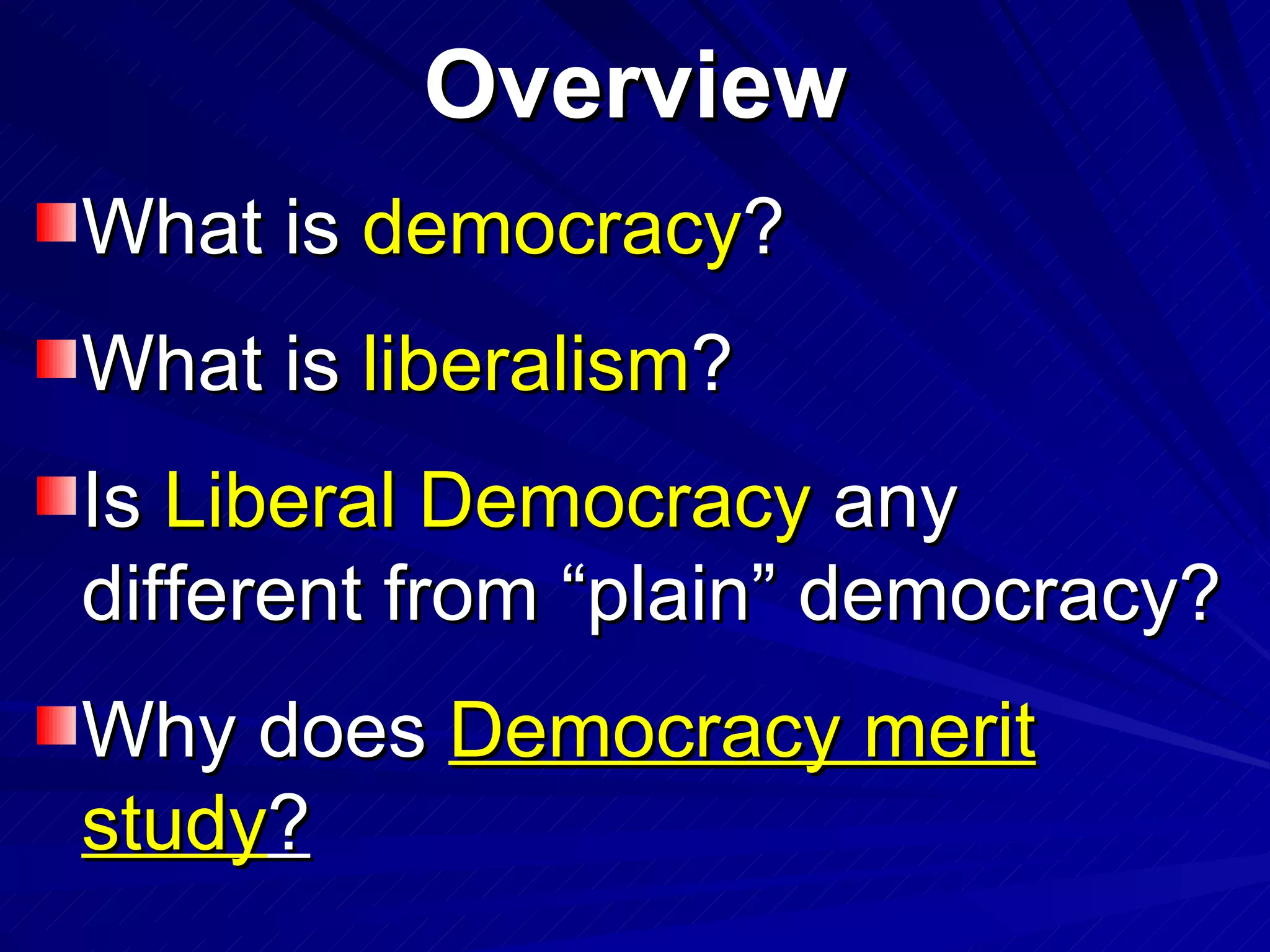
Overview What is  democracy ? What is  liberalism ? Is  Liberal Democracy  any different from “plain” democracy? Why does  Democracy merit study ?
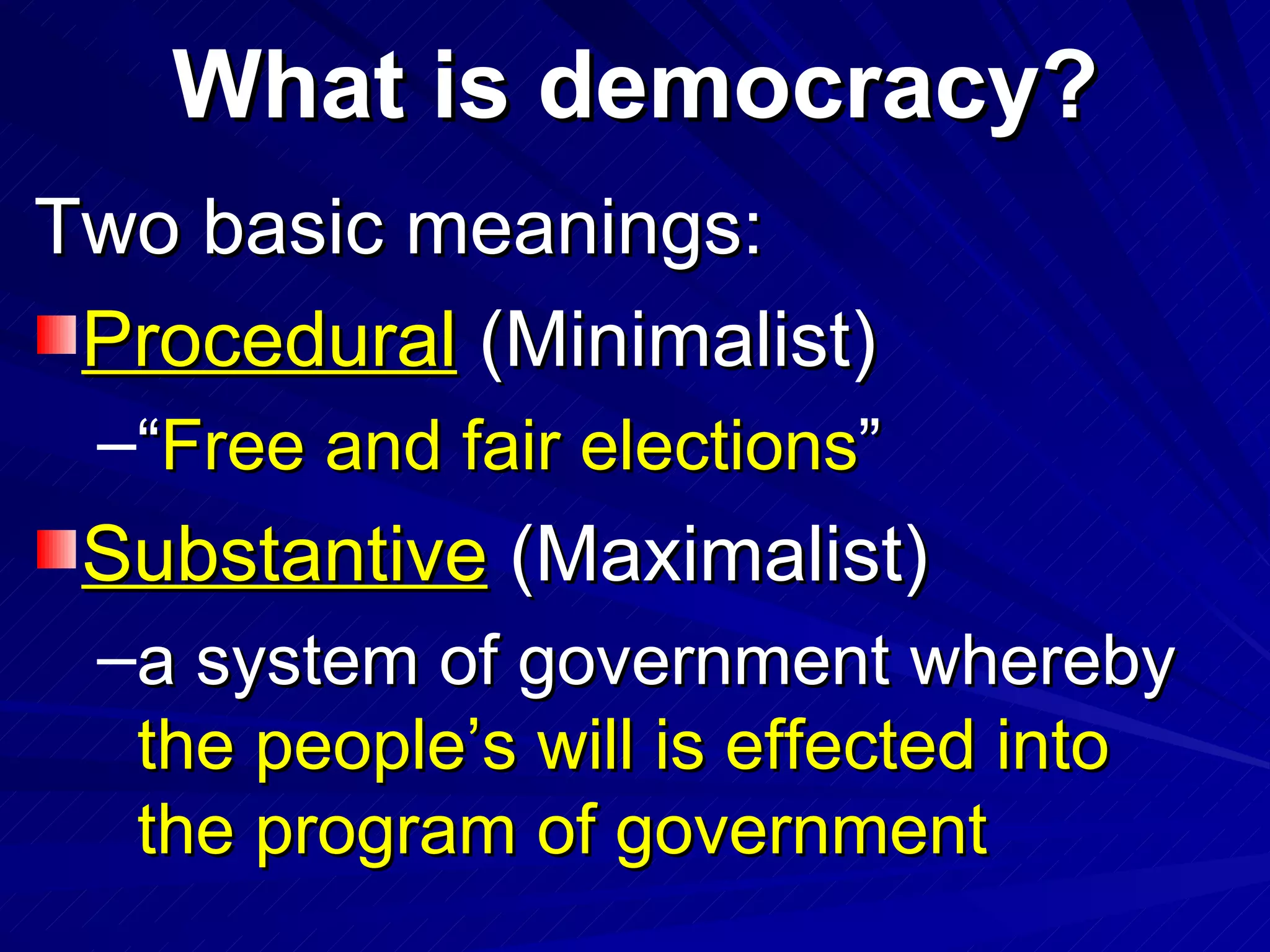
What is democracy? Two basic meanings: Procedural  (Minimalist) “ Free and fair elections ” Substantive  (Maximalist) a system of government whereby  the people’s will is effected into the program of government
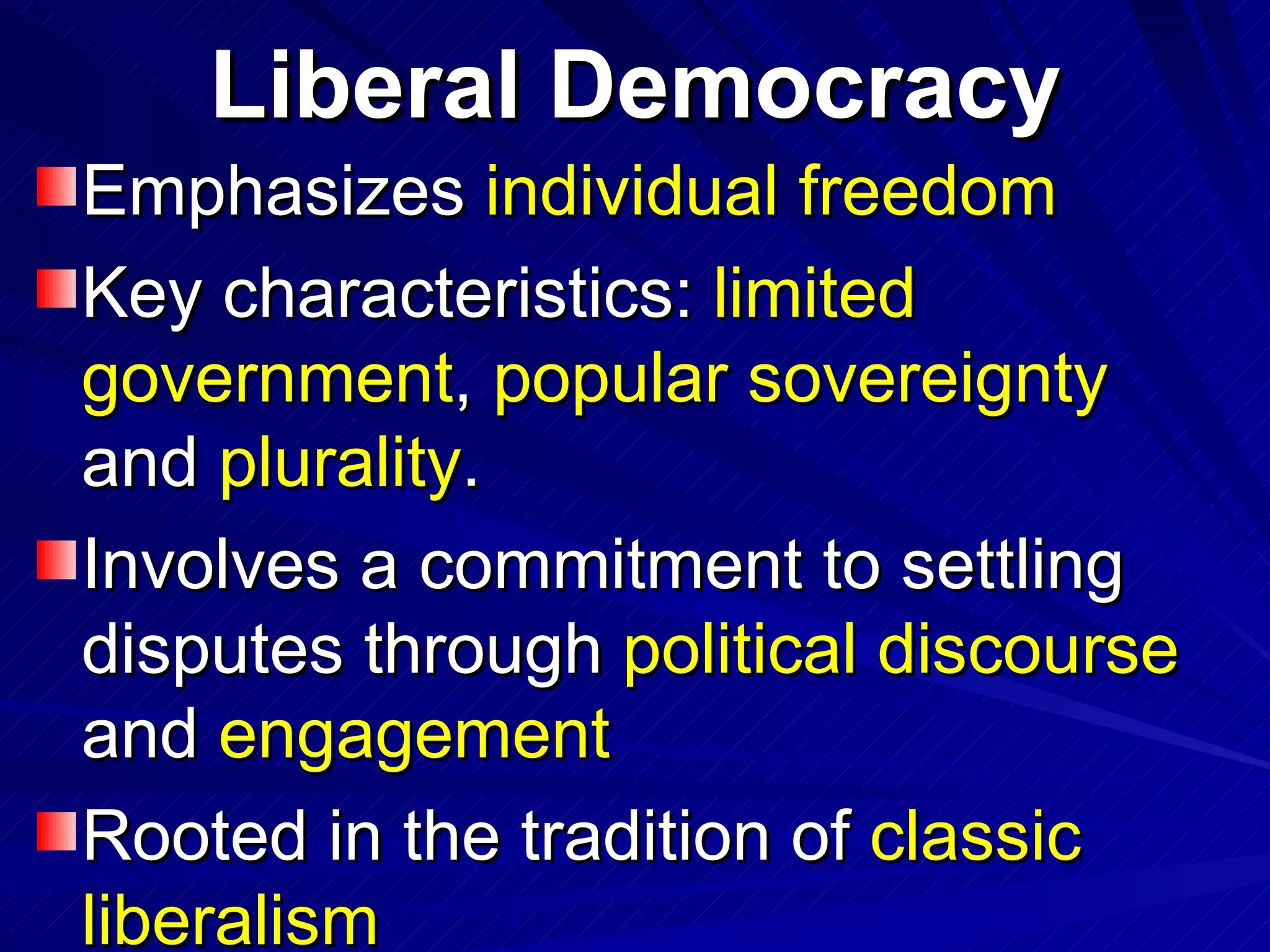
Liberal Democracy Emphasizes  individual freedom Key characteristics:  limited government ,  popular sovereignty  and  plurality . Involves a commitment to settling disputes through  political discourse  and  engagement Rooted in the tradition of  classic liberalism
Democracy’s Importance The  political freedoms  inherent to Democracy are  consistent with human freedom  in general Democracy allows people to  express and support claims to political attention   It enables people to  learn from each other and form society’s values and priorities
Further Reading… Abueva, Jose.  Philippine Democratization and the Consolidation of Democracy Since the 1986 EDSA Revolution: An Overview of the Main Issues, Trends and Prospects  in Felipe Miranda (ed).  Democratization: Philippine Perspectives . Quezon City: Anvil Publishers, 1990. Beetham, David.  ‘Key Principles and Indices for a Democratic Audit’ , in David Beetham (ed),  Defining and Measuring Democracy . London: Thousand Oaks, 1994.
Further Further Reading… Sen, Amartya.  Democracy as a Universal Value  in  Journal of Democracy .  Vol. 10, No. 3, 1999. Von Mises, Ludwig.  Liberalism in the Classical Tradition .  San Francisco, California: Cobden Press, 1985. Stanford Encyclopedia of Philosophy ( http: //plato . stanford . edu/ )

Liberal Democracy

  • 1.
    “ Plain” democracyv. Liberal Democracy
  • 2.
    Overview What is democracy ? What is liberalism ? Is Liberal Democracy any different from “plain” democracy? Why does Democracy merit study ?
  • 3.
    What is democracy?Two basic meanings: Procedural (Minimalist) “ Free and fair elections ” Substantive (Maximalist) a system of government whereby the people’s will is effected into the program of government
  • 4.
    Liberal Democracy Emphasizes individual freedom Key characteristics: limited government , popular sovereignty and plurality . Involves a commitment to settling disputes through political discourse and engagement Rooted in the tradition of classic liberalism
  • 5.
    Democracy’s Importance The political freedoms inherent to Democracy are consistent with human freedom in general Democracy allows people to express and support claims to political attention It enables people to learn from each other and form society’s values and priorities
  • 6.
    Further Reading… Abueva,Jose. Philippine Democratization and the Consolidation of Democracy Since the 1986 EDSA Revolution: An Overview of the Main Issues, Trends and Prospects in Felipe Miranda (ed). Democratization: Philippine Perspectives . Quezon City: Anvil Publishers, 1990. Beetham, David. ‘Key Principles and Indices for a Democratic Audit’ , in David Beetham (ed), Defining and Measuring Democracy . London: Thousand Oaks, 1994.
  • 7.
    Further Further Reading…Sen, Amartya. Democracy as a Universal Value in Journal of Democracy . Vol. 10, No. 3, 1999. Von Mises, Ludwig. Liberalism in the Classical Tradition . San Francisco, California: Cobden Press, 1985. Stanford Encyclopedia of Philosophy ( http: //plato . stanford . edu/ )

Editor's Notes

  • #2 Learning Objectives: 1.) To understand the key elements of a democracy 2.) To identify the key characteristics of Liberal Democracy that precisely make it liberal 3.) To distinguish between democracy (lowercase “d”) and Liberal Democracy (uppercase “D”) 4.) To explain the changing connotation of liberalism over the years 5.) To explain why Democracy merits study 6.) To enumerate important themes/topics related to democracy that will be covered in this course of political thought