Introduction to
Comparative Politics
CLASS LECTURE for
POLITICAL SCIENCE (HONOURS) /
PART – II
SILIGURI COLLEGE Prof. AMITAVA KANJILAL;
Head of the Department;
POLITICAL SCIENCE
SILIGURI COLLEGE
amitavakanjilal@ymail.com
9832031786 / 9126300912
What is Comparative Politics ?
What does Comparative Politics
do in practice?
1) DescriptionDescription
2) ExplanationExplanation
3) PredictionPrediction
““the intent of Comparative Politics is thatthe intent of Comparative Politics is that
of a rigorous scientific and empirical fieldof a rigorous scientific and empirical field
of study : description, explanation, andof study : description, explanation, and
prediction”prediction” (Daniele Caramani; 2008).(Daniele Caramani; 2008).
What is Comparative Politics ?
What are the
Levels of Comparison?
-National political systems
-Sub-national regional political systems
-Supra-national units
-Single elements or components of the political system
What is Comparative Politics ?
What is compared?
-Political systems
-Regimes
-Institutions
-Actors
-Processes
-Policies
What is Comparative Politics ?
Traditional Comparative Politics versus
“Behavioural Revolution”
What triggered this Revolution?
The emergence of new casesThe emergence of new cases ::
Breakdown of democracies and rise of newBreakdown of democracies and rise of new
types of regimestypes of regimes
Stable democracies which were not of theStable democracies which were not of the
Anglo-Saxon typeAnglo-Saxon type
What is Comparative Politics ?
Consequences of the Behavioural Revolution
for
Comparative Politics :
Increase in the variety of Political Systems
Study of Non-formal institutions
New methodology
New “Language”
Approaches in Comparative Politics
The five "I"s = the five main Approaches
in Comparative Politics
(1)Institutions(1)Institutions
(2)(2)InterestsInterests
(3)(3)IdeasIdeas
(4)(4)IndividualsIndividuals
(5)(5)International environmentInternational environment
Approaches in Comparative Politics
But weaknesses of five "I"s
 The lacking of a sixth “I”
Interaction
 Too static approach
Focus of Comparative Politics
What is the
focus of
Comparative Politics?Comparative Politics?
Focus of Comparative Politics
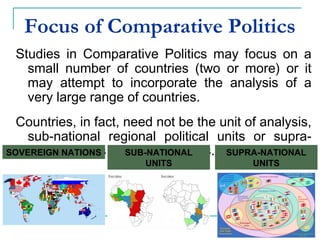
Studies in Comparative Politics may focus on a
small number of countries (two or more) or it
may attempt to incorporate the analysis of a
very large range of countries.
Countries, in fact, need not be the unit of analysis,
sub-national regional political units or supra-
national units may be the focus.SOVEREIGN NATIONS SUB-NATIONAL
UNITS
SUPRA-NATIONAL
UNITS
Origin and Evolution of
Comparative Politics
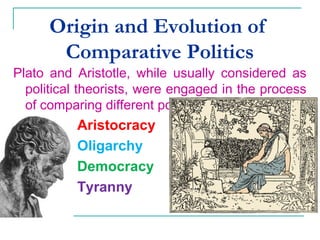
Plato and Aristotle, while usually considered as
political theorists, were engaged in the process
of comparing different political regimes :
Aristocracy
Oligarchy
Democracy
Tyranny
Origin and Evolution of
Comparative Politics
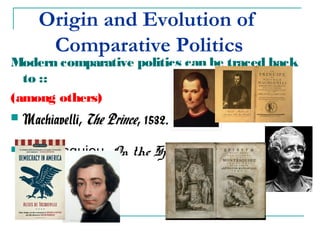
Modern comparative politics can be traced back
to ::
(among others)
 Machiavelli, The Prince, 1532.
 Montesquieu, On the Spirit of the Laws, 1748
Origin and Evolution of
Comparative Politics
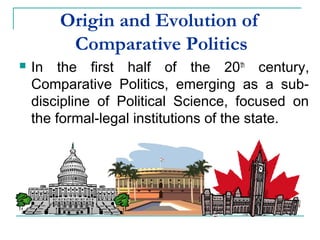
 In the first half of the 20th
century,
Comparative Politics, emerging as a sub-
discipline of Political Science, focused on
the formal-legal institutions of the state.
Origin and Evolution of
Comparative Politics
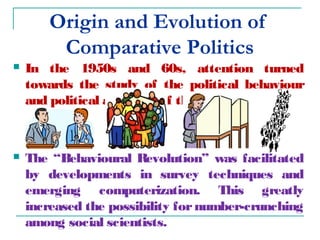
 In the 1950s and 60s, attention turned
towards the study of the political behaviour
and political attitudes of the public.
 The “Behavioural Revolution” was facilitated
by developments in survey techniques and
emerging computerization. This greatly
increased the possibility fornumber-crunching
among social scientists.
Origin and Evolution of
Comparative Politics
 The Empirical Approach in Political Science still has its
proponents today, but by the late 1960s it was under attack
from a variety of directions and for a variety of reasons.
The Politics of
Political Science Methodology
York University, 1969:
“Fifty student radicals converged on a
meeting of the Canadian Political Science
Association…to denounce what they called
the methodology of political science.”
Protesters “walked into the Vanier College
dining hall carrying balloons, flowers and
signs denouncing [David] Easton’s systems
analysis theory.”
See: http://imprint.uwaterloo.ca/pdfarchive/1969-70_v10,n06_Chevron.pdf
A Return to Institutions
 By the 1980s, various scholars were
attempting to ‘bring the state back in’ to the
centre of their analysis.
 This form of institutionalism often portrays
state actors as having a degree of autonomy
and different state structures as influencing
political outcomes.

Introduction to Comparative Politics

  • 1.
    Introduction to Comparative Politics CLASSLECTURE for POLITICAL SCIENCE (HONOURS) / PART – II SILIGURI COLLEGE Prof. AMITAVA KANJILAL; Head of the Department; POLITICAL SCIENCE SILIGURI COLLEGE amitavakanjilal@ymail.com 9832031786 / 9126300912
  • 2.
    What is ComparativePolitics ? What does Comparative Politics do in practice? 1) DescriptionDescription 2) ExplanationExplanation 3) PredictionPrediction ““the intent of Comparative Politics is thatthe intent of Comparative Politics is that of a rigorous scientific and empirical fieldof a rigorous scientific and empirical field of study : description, explanation, andof study : description, explanation, and prediction”prediction” (Daniele Caramani; 2008).(Daniele Caramani; 2008).
  • 3.
    What is ComparativePolitics ? What are the Levels of Comparison? -National political systems -Sub-national regional political systems -Supra-national units -Single elements or components of the political system
  • 4.
    What is ComparativePolitics ? What is compared? -Political systems -Regimes -Institutions -Actors -Processes -Policies
  • 5.
    What is ComparativePolitics ? Traditional Comparative Politics versus “Behavioural Revolution” What triggered this Revolution? The emergence of new casesThe emergence of new cases :: Breakdown of democracies and rise of newBreakdown of democracies and rise of new types of regimestypes of regimes Stable democracies which were not of theStable democracies which were not of the Anglo-Saxon typeAnglo-Saxon type
  • 6.
    What is ComparativePolitics ? Consequences of the Behavioural Revolution for Comparative Politics : Increase in the variety of Political Systems Study of Non-formal institutions New methodology New “Language”
  • 7.
    Approaches in ComparativePolitics The five "I"s = the five main Approaches in Comparative Politics (1)Institutions(1)Institutions (2)(2)InterestsInterests (3)(3)IdeasIdeas (4)(4)IndividualsIndividuals (5)(5)International environmentInternational environment
  • 8.
    Approaches in ComparativePolitics But weaknesses of five "I"s  The lacking of a sixth “I” Interaction  Too static approach
  • 9.
    Focus of ComparativePolitics What is the focus of Comparative Politics?Comparative Politics?
  • 10.
    Focus of ComparativePolitics Studies in Comparative Politics may focus on a small number of countries (two or more) or it may attempt to incorporate the analysis of a very large range of countries. Countries, in fact, need not be the unit of analysis, sub-national regional political units or supra- national units may be the focus.SOVEREIGN NATIONS SUB-NATIONAL UNITS SUPRA-NATIONAL UNITS
  • 11.
    Origin and Evolutionof Comparative Politics Plato and Aristotle, while usually considered as political theorists, were engaged in the process of comparing different political regimes : Aristocracy Oligarchy Democracy Tyranny
  • 12.
    Origin and Evolutionof Comparative Politics Modern comparative politics can be traced back to :: (among others)  Machiavelli, The Prince, 1532.  Montesquieu, On the Spirit of the Laws, 1748
  • 13.
    Origin and Evolutionof Comparative Politics  In the first half of the 20th century, Comparative Politics, emerging as a sub- discipline of Political Science, focused on the formal-legal institutions of the state.
  • 14.
    Origin and Evolutionof Comparative Politics  In the 1950s and 60s, attention turned towards the study of the political behaviour and political attitudes of the public.  The “Behavioural Revolution” was facilitated by developments in survey techniques and emerging computerization. This greatly increased the possibility fornumber-crunching among social scientists.
  • 15.
    Origin and Evolutionof Comparative Politics  The Empirical Approach in Political Science still has its proponents today, but by the late 1960s it was under attack from a variety of directions and for a variety of reasons.
  • 16.
    The Politics of PoliticalScience Methodology York University, 1969: “Fifty student radicals converged on a meeting of the Canadian Political Science Association…to denounce what they called the methodology of political science.” Protesters “walked into the Vanier College dining hall carrying balloons, flowers and signs denouncing [David] Easton’s systems analysis theory.” See: http://imprint.uwaterloo.ca/pdfarchive/1969-70_v10,n06_Chevron.pdf
  • 17.
    A Return toInstitutions  By the 1980s, various scholars were attempting to ‘bring the state back in’ to the centre of their analysis.  This form of institutionalism often portrays state actors as having a degree of autonomy and different state structures as influencing political outcomes.